Aurora · IL · COST GUIDE
Metal Roofing Costs in Aurora, IL (2026)
For budgeting, standing-seam steel roofing is estimated at $10–$17.50 per sq ft of roof surface, and exposed-fastener steel at $6.50–$11 per sq ft. These installed planning ranges include one-layer removal/disposal over sound decking; compare the specified system and conditional extras.
Standing Seam Steel Roof (Installed)
Budget estimate$10–$17.50per sq ft of roof surface (installed)
Planning range · Compare the roof area, material and included work in your quote.
Exposed-Fastener Steel Roof (Installed)
Budget estimate$6.50–$11per sq ft of roof surface (installed)
Planning range · Compare the roof area, material and included work in your quote.
Published examples apply to their stated scope. Budget ranges are estimates.
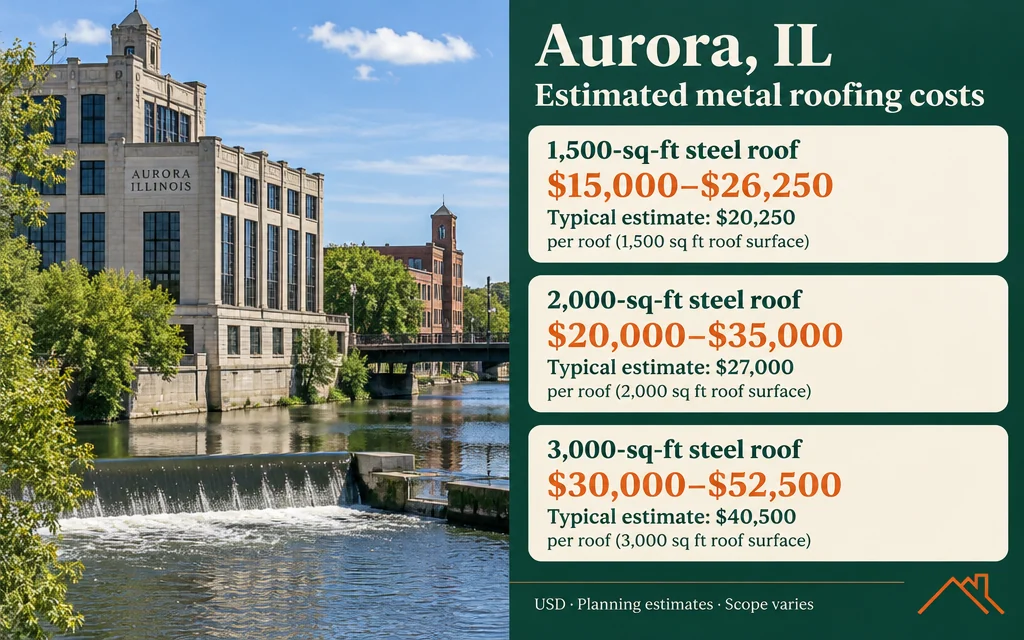
Calculated installed planning scenario for measured roof surface, including one-layer removal/disposal; conditional extras excluded.
Calculated installed planning scenario for measured roof surface, including one-layer removal/disposal; conditional extras excluded.
Calculated installed planning scenario for measured roof surface, including one-layer removal/disposal; conditional extras excluded.
Metal Roofing Investment in Aurora
A metal roof is a substantial exterior upgrade for an Aurora home. For a standard residential installation using concealed-fastener standing seam steel, budget $10–$17.50 per square foot of roof surface, with mid-complexity projects landing near $13.50.
On a hypothetical 2,000-square-foot roof surface, this translates to an installed budget scenario of $20,000–$35,000.
Unlike traditional asphalt shingling, metal roofing involves extensive sheet-metal fabrication, custom folding, and specialized seaming. The installed baseline covers tearing off one layer of existing asphalt shingles, inspecting the roof deck, laying high-temperature underlayment, and hand-forming flashings at rakes, ridges, and valleys. Direct local pricing data for Aurora is limited, so these planning benchmarks reflect regional estimates for standard residential roofs over sound wood decking.
Residential Metal Roofing Systems Compared
Residential metal roof profiles differ significantly in hardware, aesthetics, and overall budget:
Standing Seam Steel: The benchmark residential profile, running $10–$17.50 per sq ft installed. Panels lock together over concealed clips that allow panels to expand and contract across seasonal temperature swings without straining fasteners.
Exposed-Fastener Steel: Ribbed panels fastened with screws driven directly through the panel face into the sheathing, budgeting $6.50–$11 per sq ft installed. The exposed neoprene washers require periodic inspection and eventual replacement to prevent moisture intrusion as gaskets weather.
Steel Metal Shingles: Stamped, painted, or stone-coated steel modules designed to mimic wood shakes, slate, or dimensional shingles. Installed costs run $9–$16 per sq ft, delivering impact resistance with concealed fasteners.
Standing Seam Aluminum: A corrosion-resistant alternative budgeting $12–$20 per sq ft installed. Aluminum is naturally rustproof, making it well-suited for properties near wetlands or moisture-heavy microclimates.
Standing Seam Copper: A specialty architectural material budgeting $22–$42 per sq ft installed. Unpainted copper naturally oxidizes into an aged patina over time and involves artisan hand-seaming and soldering.
| Service / assumptions | Low | Typical estimate | High | Pricing unit | Estimated labor time |
|---|---|---|---|---|---|
| Standing Seam Steel Roof (Installed)Calculated standing-seam steel planning rate: comparable panel/accessory materials + installation labor + one-layer removal/disposal. Ordinary underlayment and details over sound decking included; conditional extra work excluded. | $10 | $13.50 | $17.50 | per sq ft of roof surface (installed) | N/A |
| Exposed-Fastener Steel Roof (Installed)Includes ribbed/corrugated panels, exterior gasketed screws, standard trim, synthetic underlayment, and 1-layer tear-off. | $6.50 | $8.50 | $11 | per sq ft of roof surface (installed) | N/A |
| Steel Metal Shingles (Installed)Stone-coated or painted interlocking stamped steel shingle panels, underlayment, trim, and 1-layer tear-off. | $9 | $12.50 | $16 | per sq ft of roof surface (installed) | N/A |
| Standing Seam Aluminum (Installed)0.032–0.040 aluminum panels, concealed clips, high-temp underlayment, trim, and 1-layer tear-off; excellent corrosion resistance. | $12 | $16 | $20 | per sq ft of roof surface (installed) | N/A |
| Standing Seam Copper (Installed)16 oz / 20 oz architectural copper panels, artisan hand-seaming and soldering, copper clips/fasteners, and 1-layer tear-off. Published rate reference for the stated roofing scope and unit, not verification of this guide's modeled range, a complete roof quote or provider availability.Published price reference ↗ | $22 | $32 | $42 | per sq ft of roof surface (installed) | N/A |
Cost Components of a Standing Seam Roof
Understanding how a standing seam steel estimate is assembled helps you evaluate competing proposals. At a typical baseline of $13.50 per square foot, costs divide across three core components:
Materials ($4–$7.50 per sq ft, typical $5.50): Covers 24- to 26-gauge Galvalume steel panels with a PVDF/Kynar finish, concealed clips, high-temperature synthetic underlayment, starter trim, eave edges, and ridge cap material.
Installation Labor ($4.50–$8 per sq ft, typical $6.50): Reflects on-site mechanical seaming, edge hemming, valley detail integration, and custom flashing around structural penetrations.
Removal & Disposal ($1.50–$2 per sq ft, typical $1.50): Stripping a single pre-existing layer of asphalt shingles, container rental, hauling, and a magnetic sweep for fasteners.
Together, these elements form the installed rate. Items such as rotten wood repair or second-layer tear-offs are quoted as separate scope items.
| Service / assumptions | Low | Typical estimate | High | Pricing unit | Estimated labor time |
|---|---|---|---|---|---|
| Standing Seam Steel Materials Allowance24–26 ga Galvalume steel panels, PVDF coating, clips, high-temperature underlayment, screws, ridge/eave trim. | $4 | $5.50 | $7.50 | per sq ft of roof surface (materials only) | N/A |
| Standing Seam Steel Installation LaborSkilled panel roll-forming, seam locking, hemming, flashing fabrication, and installation labor over sound prepared deck. | $4.50 | $6.50 | $8 | per sq ft of roof surface (installation labor only) | N/A |
| Roof Tear-Off & Disposal (1 Layer)Stripping 1 layer of asphalt shingles, loading dumpsters, hauling debris, site cleanup, and magnetic sweep. | $1.50 | $1.50 | $2 | per sq ft of roof surface (one-layer removal and disposal) | N/A |
Hypothetical Project Budgets by Roof Size
Because roof pitch and overhangs create more surface area than a home's interior footprint, estimates are calculated on actual roof square footage rather than ground-floor living area. Here is how three common roof surface sizes price out at baseline standing seam steel rates:
1,500 Sq Ft Roof Surface: A compact layout or single-story ranch totals $15,000–$26,250, with a typical project near $20,250. An installation crew generally completes this scope in 3-5 days.
2,000 Sq Ft Roof Surface: An average two-story or split-level home runs $20,000–$35,000, with a typical benchmark of $27,000. Work typically spans 4-6 days on site.
3,000 Sq Ft Roof Surface: A larger roof with multiple hips, valleys, or dormers ranges from $30,000–$52,500, averaging $40,500. Expect 6-9 days of on-site labor depending on accessibility and roof pitch.
| Service / assumptions | Low | Typical estimate | High | Pricing unit | Estimated labor time |
|---|---|---|---|---|---|
| Standing Seam Steel Roof (1,500 sq ft)Calculated scenario: 1,500 sq ft of measured roof surface × standing-seam steel installed planning rate. Includes its same materials, installation, one-layer removal/disposal and sound-deck assumptions. Not a provider whole-roof quote. | $15,000 | $20,250 | $26,250 | per roof (1,500 sq ft roof surface) | 3-5 days |
| Standing Seam Steel Roof (2,000 sq ft)Calculated scenario: 2,000 sq ft of measured roof surface × standing-seam steel installed planning rate. Includes its same materials, installation, one-layer removal/disposal and sound-deck assumptions. Not a provider whole-roof quote. | $20,000 | $27,000 | $35,000 | per roof (2,000 sq ft roof surface) | 4-6 days |
| Standing Seam Steel Roof (3,000 sq ft)Calculated scenario: 3,000 sq ft of measured roof surface × standing-seam steel installed planning rate. Includes its same materials, installation, one-layer removal/disposal and sound-deck assumptions. Not a provider whole-roof quote. | $30,000 | $40,500 | $52,500 | per roof (3,000 sq ft roof surface) | 6-9 days |
Comparing Standing Seam Metal to Architectural Shingles
Deciding between standing seam metal and architectural asphalt shingles comes down to balancing initial installation expenses against longevity expectations.
Up-Front Cost: An installed architectural asphalt shingle roof typically budgets $4–$8 per square foot of roof surface, averaging $5.50. Standing seam steel, averaging $13.50 per square foot, represents a higher upfront financial commitment.
Service Expectations: Metal roof panels backed by factory-applied PVDF finishes carry long paint and structural manufacturer warranties, often spanning several decades. Asphalt shingles typically carry shorter manufacturer warranties and rely on granular surfacing that degrades under weather exposure.
Weather Performance: Concealed-fastener standing seam panels offer strong resistance to wind uplift and carry Class A fire ratings. While metal can sustain cosmetic denting from large hail, interlocking joints help maintain weather tightness during severe storms.
Planning Outlook: Homeowners planning to remain in their home for decades often choose standing seam to avoid undergoing a future roof replacement, whereas standard asphalt roofs are frequently replaced on shorter maintenance cycles.
| Service / assumptions | Low | Typical estimate | High | Pricing unit | Estimated labor time |
|---|---|---|---|---|---|
| Architectural Asphalt Shingles (Installed Reference)Standard residential reference: architectural shingles, synthetic underlayment, ice barrier, drip edge, and 1-layer tear-off. | $4 | $5.50 | $8 | per sq ft of roof surface (installed) | 1-3 days |
| Comparison | Architectural asphalt | Standing-seam steel |
|---|---|---|
| Up-front planning estimate · 2,000 sq ft roof surface | $8,000–$16,000 | $20,000–$35,000 |
| What the baseline includes | Architectural asphalt, ordinary installed details, one-layer removal/disposal over sound decking. | Standing-seam steel, ordinary installed details, one-layer removal/disposal over sound decking. |
| Maintenance and repairs | Confirm product-specific inspections and repair terms. | Confirm seams, fasteners, coating, compatible repairs and inspection terms. |
| Insurance and ownership cost | Ask the insurer about the exact product and coverage. | Ask the insurer about accepted test documentation, any available credit and cosmetic-damage exclusions. |
These are calculated budgeting comparisons, not provider quotes or guaranteed lifetime savings. Compare your expected ownership period, specified products, actual maintenance proposals and written insurance terms.
| Decision point | Roof repair | Roof replacement | Metal roofing |
|---|---|---|---|
| Work being priced | A defined defect, such as damaged shingles or flashing. | Removal and installation of an agreed roof system across the measured roof surface. | A specified installed metal system; standing seam, exposed fasteners and metal shingles are different scopes. |
| What to inspect | The leak source, surrounding material and whether a durable localized fix is feasible. | The extent of deterioration, decking condition, roof details and suitable replacement systems. | The substrate, panel profile, coating, fasteners, roof geometry and installation details. |
| How to compare prices | Match the repair quantity, access, materials and included diagnosis. | Match measured roof area, material, tear-off layers, disposal and installed inclusions. | Match measured roof area, system, components, removal and conditional additional work. |
| Before deciding | Ask what the repair addresses and what existing problems would remain. | Ask whether repair remains practical and which additional items would change the total. | Ask about compatible materials, documented product/assembly ratings and product versus workmanship warranties. |
Age or a repair-cost percentage alone does not determine the right choice. Ask a qualified roofing contractor to assess the condition and explain viable options. A metal system is a material-specific installation choice, not a separate guarantee of durability or savings.
Potential Project Add-Ons and Hidden Scope
A thorough roof proposal accounts for conditional repairs and accessory upgrades that cannot always be finalized before old shingles are removed:
Decking Repairs: Metal panels require flat, sound sheathing. If rotted plywood or OSB is uncovered during tear-off, budget $75–$150 per 4x8-foot sheet installed.
Second-Layer Tear-Off: If the existing structure has two layers of shingles rather than one, expect an additional $35–$65 per roofing square (100 sq ft) for labor and disposal fees.
Chimney Flashing: Fabricating custom counter-flashing and step flashing cut into masonry joints runs $400–$900 per chimney.
Skylight Kits: Integrating custom curb flashing compatible with raised metal ribs budgets $300–$700 per skylight.
Ventilation & Gutters: Adding a continuous concealed standing-seam ridge vent runs $12–$25 per linear foot. If heavy gutters must be taken down and re-hung around new metal drip edges, budget $5–$12 per linear foot.
Snow Guards: Seam-clamped snow rail systems or individual snow brakes run $15–$35 per linear foot along sensitive eaves.
| Service / assumptions | Low | Typical estimate | High | Pricing unit | Estimated labor time |
|---|---|---|---|---|---|
| Extra Layer Tear-OffApplies when a second pre-existing layer of asphalt or cedar shingles must be removed and discarded. | $35 | $50 | $65 | additional per roofing square (100 sq ft) | N/A |
| Plywood / OSB Decking ReplacementReplacing damaged or water-rotted 4x8 roof decking sheets exposed during tear-off. | $75 | $110 | $150 | additional per 4-by-8-ft sheet (32 sq ft) | N/A |
| Custom Metal Chimney FlashingFabricating and setting custom step and counter flashing into masonry reglets with integrated metal cricket. | $400 | $650 | $900 | additional per chimney | N/A |
| Skylight Flashing KitSupplying and detailing specialized curb flashing compatible with standing seam roof panels. | $300 | $475 | $700 | additional per skylight | N/A |
| Concealed Ridge Vent UpgradeContinuous baffle and custom-formed standing seam ridge cap for balanced attic exhaust. | $12 | $18 | $25 | additional per linear ft | N/A |
| Snow Retention Bar / Guard SystemContinuous non-penetrating seam-clamped snow rail or individual metal snow guards over doors and gutters. | $15 | $25 | $35 | additional per linear ft | N/A |
| Detach & Reset Existing GuttersTemporarily removing gutters to install eave metal and high-temp underlayment, then re-mounting. | $5 | $8 | $12 | additional per linear ft | N/A |
Durability, Snow Shedding, and Efficiency
Metal roofs deliver distinct physical performance characteristics in northern Illinois conditions, though specifications require careful review:
Impact Ratings: Many residential steel panels achieve UL 2218 Class 4 impact ratings, indicating performance in laboratory hail drop tests. However, a Class 4 rating does not prevent cosmetic surface dimpling during severe hail. Ask your insurance carrier how your specific policy handles metal roof cosmetic damage.
Snow and Ice Dynamics: Smooth metal surfaces shed accumulated snow quickly once attic warmth or sunlight warms the panels. While this minimizes prolonged roof loads, sudden snow slides can damage gutters or objects below. Installing seam-clamped snow retention bars over walkways and entry points provides controlled melting.
Energy Performance: Factory-applied reflective pigments reflect solar heat, helping reduce solar gain during warm summers. However, metal panels do not add thermal insulation on their own. Balanced attic ventilation and continuous insulation remain critical to managing attic temperatures and moisture.
Key Factors That Drive Your Aurora Estimate
Several physical roof details influence where a quote falls within planning ranges:
Pitch and Geometry: Low-to-moderate pitches (4:12 to 6:12) allow efficient crew movement. Rakes exceeding 7:12 require safety staging, slowing panel installation. Multiple dormers, hips, and valleys also increase manual metal brake work.
Panel Gauge and Coating: Residential standing seam typically uses 24-gauge or 26-gauge steel. Thicker 24-gauge steel costs more in materials but offers greater rigidity against surface oil-canning and handling stress.
Fastener Configuration: Concealed-clip profiles require deliberate alignment and mechanical or snap seaming, which requires more skilled craft labor than screwing exposed-fastener sheets directly through the metal.
Site Access: Tight lot setbacks, low overhead branches, or multi-story drops that restrict staging trailers or roll-forming equipment add manual material handling time.
Selecting a Qualified Metal Roofing Contractor
Metal roof installation requires specialized tools and sheet metal knowledge. When reviewing estimates in Aurora, keep these verification steps in mind:
Licensing and Registration: Confirm the contractor maintains active state roofing registration and carries general liability and workers' compensation coverage. Verify address-specific permit responsibilities with the City of Aurora building department before work begins.
Seam Profile: Clarify whether the proposal specifies a snap-lock seam or a mechanically locked seam, and confirm that the profile matches your roof slope.
Underlayment Specifications: Verify that the estimate specifies a high-temperature self-adhering underlayment rated to withstand the elevated temperatures generated beneath metal roofing.
Thermal Movement Provisions: Ask how the installer accommodates panel expansion, ensuring sliding clips and adequate hemming allowances are planned at ridges and eaves.
Warranty Coverage: Review the distinction between the manufacturer's finish warranty (covering paint adhesion and chalking) and the contractor's written workmanship warranty.
Local income & housing costs
Aurora city, Illinois · U.S. Census Bureau, 2025 ACS 1-year estimates.
per month · ±$159
Cash-rent units; includes applicable tenant-paid utilities
Census source ↗Dollar amounts use the survey period’s published basis. Income is annual; gross rent is monthly. Home value reflects owner-occupied housing values. Margins of error shown are at the ACS 90% confidence level. These statistics provide city context; service budgets use their own pricing evidence.
STATEWIDE COST CONTEXT
Illinois prices, income & labor costs
These Illinois figures provide background for this city guide. They describe different measures and reference years; employee wages are not prices charged by a contractor.
BEA SAIRPD
State price change indicator
123.62024 · index (2017 basis)
Annual figures & sources
| Year | Value | 90% margin of error | Source |
|---|---|---|---|
| 2020 | 105.0 | — | Official source |
| 2021 | 110.4 | — | Official source |
| 2022 | 117.5 | — | Official source |
| 2023 | 119.0 | — | Official source |
| 2024 | 123.6 | — | Official source |
Census ACS 1-year
Median household income
$86,6762025 · USD/year
Annual figures & sources
| Year | Value | 90% margin of error | Source |
|---|---|---|---|
| 2021 | $72,205 | ±$574 | Official source |
| 2022 | $76,708 | ±$584 | Official source |
| 2023 | $80,306 | ±$635 | Official source |
| 2024 | $83,211 | ±$898 | Official source |
| 2025 | $86,676 | ±$814 | Official source |
BLS OEWS
Roofers
$37.452025 · USD/hour
Annual figures & sources
| Year | Value | 90% margin of error | Source |
|---|---|---|---|
| 2025 | $37.45 | — | Official source |
State prices: BEA, 2020–2024. Household income: Census ACS, 2021–2025. Employee wages: BLS, May 2025 snapshot. The charts retain their own units and fitted scales.
Explore all Illinois living-cost data and trends →Local context and limitations
Aurora experiences wide seasonal temperature swings, from sub-zero winter spells to hot summer heat, creating substantial thermal movement in exterior metal panels. Concealed-clip standing seam systems accommodate this movement along engineered sliding clips, helping prevent the fastener stress associated with face-fastened panels over time. Check with local building officials regarding address-specific requirements for ice-dam protection and underlayment at eaves, and evaluate whether snow retention guards make sense over entrance walkways and driveways where sudden roof snow shedding could occur.
Frequently asked questions
What is the difference between standing seam and exposed fastener metal roofing?
Standing seam uses vertical ribs joined over concealed clips, leaving the panel surface free of screw penetrations and allowing metal to expand and contract freely. Exposed-fastener systems use screws driven directly through the panel face with rubber sealing washers. While exposed-fastener installations cost less up front, the external washers weather over time and require ongoing inspection.
Can a metal roof be installed directly over existing asphalt shingles?
While installing metal over existing shingles using furring strips is sometimes done, a full tear-off is generally recommended. Stripping the deck allows the contractor to check the wood sheathing for moisture damage, correct uneven decking that could distort metal panels, and apply proper high-temperature underlayment across the entire roof surface.
Will installing a metal roof lower my homeowners insurance premiums?
Some insurers provide discounts for roofs with UL 2218 Class 4 impact ratings, but policies differ widely. Certain carriers require cosmetic damage waivers, meaning they will not cover surface dents from hail if the panels remain watertight. Contact your insurance agent directly to confirm eligibility before purchasing.
Are metal roofs noisy during rainstorms?
No. When installed on a residential home over solid plywood or OSB sheathing and heavy underlayment, attic insulation and finished ceilings dampen rainfall impact sounds. Interior sound levels during heavy rain are comparable to asphalt shingle roofs.
Why are snow guards recommended on metal roofs in Aurora?
Metal panels have smooth surfaces that shed snow rapidly when warmed by the sun or interior heat. Without snow guards, accumulated snow packs can slide off abruptly, posing risks to gutters, entry doors, landscaping, and walkways below. Clamped snow retention bars help hold snow in place for gradual melting.
Sources and methodology
Sources below retain their recorded retrieval dates and geographic scope. We checked the quoted rates against readable public pricing pages. The tables remain planning estimates, not provider quotes or a measured citywide survey. Per-square-foot references do not establish the modeled whole-roof totals or all their installed inclusions. Regional references are not verified Aurora-specific quotes. Confirm removal, disposal, materials, labor and the complete scope in a written proposal.
Published pricing pages retrieved; quoted excerpts checked automatically. 3 distinct website domains. · Generated 2026-11-12
- Your Guide to Metal Roof Pricing: Get the Best Estimate - DML USA RoofingState / regional reference · Page retrieved 2026-11-12 · Price excerpt matched automatically
“Installing over shingles can save $1.00 to $2.00 per square foot on tear-off costs, but it creates significant risks.”
Planning ranges may differ from these published examples; they are not provider quotes.
- Roof Installation in Thousand Oaks, CA - Costs 11 / 2026 - homeyouState / regional reference · Page retrieved 2026-11-12 · Price excerpt matched automatically
“The labor cost per square foot to install metal roofing averages $7 to $14 per square foot.”
Planning ranges may differ from these published examples; they are not provider quotes.
- 10 Best Roofing Companies Aurora, IL (2026 Updated)City-specific page context · Page retrieved 2026-11-12 · Price excerpt matched automatically
“Architectural shingles run $4.50 to $8.25 per square foot installed; standing seam metal $10 to $17; slate or copper above $20.”
Planning ranges may differ from these published examples; they are not provider quotes.
Plan your metal roofing project
Choose your service and answer its project questions. Add notes or photos if helpful, then generate your project brief. The planner labels its budgeting assumptions separately. Use your plan to compare the scope and assumptions with a provider. Contact sharing and provider matching are not available yet.
Open the project planner →Share this city’s cost data
<> Embed Aurora Cost Data on Your Site
The HTML table shows the prices at the time of copying. The iframe follows the published guide.