Baltimore · MD · COST GUIDE
Metal Roofing Costs in Baltimore, MD (2026)
For budgeting, standing-seam steel roofing is estimated at $14.50–$30.50 per sq ft of roof surface, and exposed-fastener steel at $7.50–$16.50 per sq ft. These installed planning ranges include one-layer removal/disposal over sound decking; compare the specified system and conditional extras.
Standing Seam Steel (Installed)
Budget estimate$14.50–$30.50per sq ft of roof surface (installed)
Planning range · Compare the roof area, material and included work in your quote.
Exposed-Fastener Ribbed Steel (Installed)
Budget estimate$7.50–$16.50per sq ft of roof surface (installed)
Planning range · Compare the roof area, material and included work in your quote.
Published examples apply to their stated scope. Budget ranges are estimates.
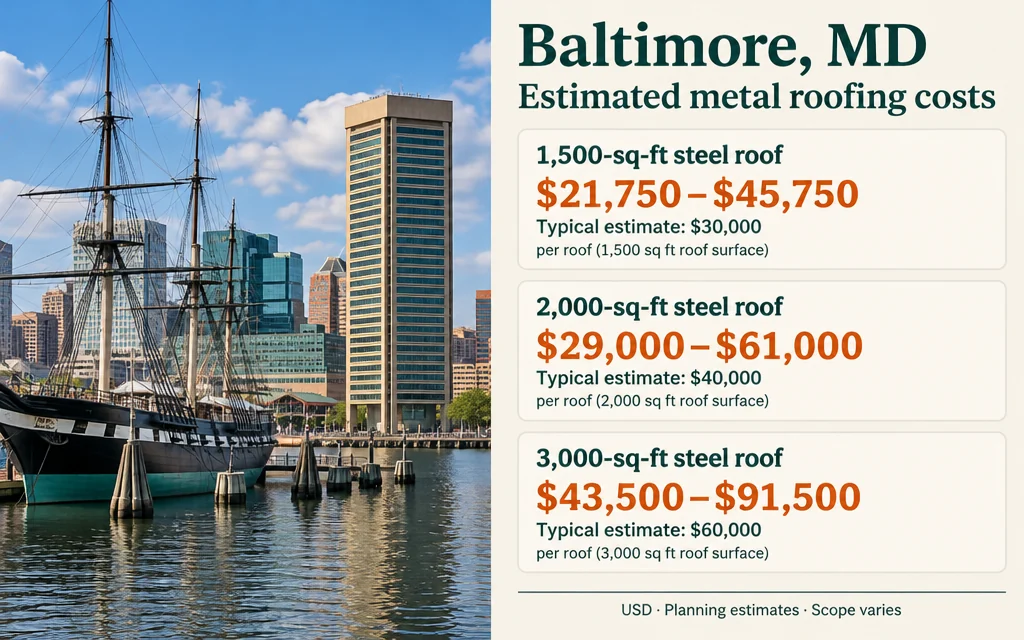
Calculated installed planning scenario for measured roof surface, including one-layer removal/disposal; conditional extras excluded.
Calculated installed planning scenario for measured roof surface, including one-layer removal/disposal; conditional extras excluded.
Calculated installed planning scenario for measured roof surface, including one-layer removal/disposal; conditional extras excluded.
Metal Roofing Pricing in Baltimore
Installed residential metal roofing prices in Baltimore span distinct tiers based on the panel system you choose. Budget $7.50–$16.50 per square foot of roof surface for entry-level exposed-fastener steel panels, or budget $14.50–$30.50 per square foot for residential standing-seam steel, which serves as the standard baseline for pitched homes.
Architectural copper sits at the top tier, budgeting $32–$65 per square foot installed. On a home with a 2,000-square-foot roof surface, a standing-seam steel replacement typically runs $29,000–$61,000, with a mid-range point near $40,000.
Roofing estimates reflect measured exterior roof surface area, which contractors price in "squares" of 100 square feet each. A home's interior living area does not match roof area. Roof pitch, overhangs, dormers, and gabled additions expand the required panel coverage. In Baltimore, where mansard fronts, rear dormers, and multi-level additions are common, field measurements must establish the true exterior area before setting a contract price.
The installed planning figures in this guide assume a standard baseline scope: stripping and disposing of one existing layer of asphalt shingles, installing high-temperature underlayment, fitting perimeter drip and rake flashings, and securing panels over a sound wood deck. Structural decking repairs and custom masonry flashing add to this baseline, while municipal building permit fees and filing requirements depend on your specific Baltimore property address and job valuation.
Residential Metal Roofing Systems Compared
Residential metal roof profiles differ in panel attachment, weather resistance, and how they accommodate thermal movement.
Concealed-fastener standing seam steel is the standard choice for pitched residential roofs. Panels join along raised vertical ribs that hide clips and screws beneath the seams, protecting fasteners from direct rain, snow, and ultraviolet exposure. Most residential jobs use 24-gauge Galvalume steel finished with a PVDF (Kynar 500) resin coating. Because the concealed clips allow panels to expand and contract with temperature shifts, standing seam handles slopes down to 2:12 or lower when mechanically seamed, budgeting $14.50–$30.50 per square foot installed.
Exposed-fastener ribbed steel panels budget lower, at $7.50–$16.50 per square foot installed. Installers drive fasteners directly through the panel face into the roof deck using screws fitted with rubber or EPDM washers. While economical for straightforward outbuildings or simpler roofs of 3:12 pitch or greater, the exposed washers degrade from sun exposure and temperature swings over 10 to 15 years, requiring regular inspection and eventual screw replacement.
Steel metal shingles budget $11–$22 per square foot installed. These stamped panels replicate traditional slate, wood shake, or tile profiles while keeping fasteners concealed under interlocking edges. They are often chosen when neighborhood design covenants or personal preference call for a conventional shingle appearance.
For properties exposed to brackish tidal air along Chesapeake waterways, standing seam aluminum budgets $17–$33 per square foot installed. Aluminum will not rust in salt air, though the metal is softer than steel under foot traffic. Premium architectural copper standing seam runs $32–$65 per square foot installed, delivering a hand-fabricated, unpainted metal that patinas naturally over decades.
| Service / assumptions | Low | Typical estimate | High | Pricing unit | Estimated labor time |
|---|---|---|---|---|---|
| Standing Seam Steel (Installed)Calculated standing-seam steel planning rate: comparable panel/accessory materials + installation labor + one-layer removal/disposal. Ordinary underlayment and details over sound decking included; conditional extra work excluded. | $14.50 | $20 | $30.50 | per sq ft of roof surface (installed) | 4–6 working days for a typical 2,000 sq ft roof |
| Exposed-Fastener Ribbed Steel (Installed)Includes 26- or 29-gauge ribbed/corrugated panels, exterior gasket screws, underlayment, trim, and one-layer tear-off. Requires screw maintenance over time. | $7.50 | $11.50 | $16.50 | per sq ft of roof surface (installed) | 3–5 working days for a typical 2,000 sq ft roof |
| Steel Metal Shingles (Installed)Stamped stone-coated or painted steel shingle profiles replicating slate or shake, including underlayment, trim, and one-layer removal. | $11 | $15.50 | $22 | per sq ft of roof surface (installed) | 4–7 working days for a typical 2,000 sq ft roof |
| Standing Seam Aluminum (Installed)Concealed-fastener 0.032-inch aluminum panels, ideal for properties near the Chesapeake Bay to prevent saltwater corrosion. | $17 | $23.50 | $33 | per sq ft of roof surface (installed) | 4–6 working days for a typical 2,000 sq ft roof |
| Standing Seam Copper (Installed)Premium 16-oz or 20-oz cold-rolled copper standing seam panels with hand-formed soldered pans and historical flashings. | $32 | $45 | $65 | per sq ft of roof surface (installed) | 6–10 working days for a typical 2,000 sq ft roof |
Cost Components of a Standing Seam Roof
A complete quote for a standing-seam steel roof divides into materials, installation labor, and preparation.
For 24-gauge Galvalume standing seam, panel and accessory materials budget $6–$13 per square foot of roof surface, with a typical allowance near $8.50. This covers factory-formed or site-rolled panels, concealed expansion clips, high-temperature synthetic underlayment, ridge caps, and perimeter trim. Heavy 22-gauge steel or custom coil finishes push material expenses higher.
Specialized sheet-metal labor is the largest single cost element, budgeting $7–$14.50 per square foot, with a typical rate of $9.50. Crews must hand-form valley pans, lock eaves, and fold seams around wall and roof transitions. Roofs with multiple hips, valleys, or steep pitches demand additional scaffolding and slow down daily installation rates. The schedules for these tasks are included in the overall job duration rather than scheduled separately.
Stripping one existing layer of asphalt shingles and disposing of the debris budgets $1.50–$3 per square foot (typical $2). This covers tearing down to the wood deck, magnetic sweeping for loose fasteners, and disposal fees.
| Service / assumptions | Low | Typical estimate | High | Pricing unit | Estimated labor time |
|---|---|---|---|---|---|
| Standing Seam Steel Materials AllowanceAllowance for 24-gauge Galvalume steel panels, clips, high-temperature underlayment, standard drip edge, rake, and ridge trim. | $6 | $8.50 | $13 | per sq ft of roof surface (materials only) | N/A |
| Standing Seam Steel Installation LaborSpecialized sheet metal labor for mechanical seaming, custom trims, valleys, and safety staging. Excludes tear-off. | $7 | $9.50 | $14.50 | per sq ft of roof surface (installation labor only) | N/A |
| One-Layer Roof Tear-Off and DisposalStripping one layer of existing asphalt shingles to bare decking, magnetic nail sweep, container haul-away, and landfill fees. | $1.50 | $2 | $3 | per sq ft of roof surface (one-layer removal and disposal) | N/A |
Whole-Roof Cost by Measured Roof Area
Total cost follows the measured exterior roof surface. For a smaller roof measuring 1,500 square feet, budget $21,750–$45,750 for standing-seam steel installed, with a typical project near $30,000.
On-site installation time is typically 3–4 working days.
A mid-sized home with 2,000 square feet of roof surface budgets $29,000–$61,000, with a typical project running about $40,000. Work on a roof of this size typically takes 4–6 working days, assuming workable weather.
Larger or more complex roofs measuring 3,000 square feet budget $43,500–$91,500, with a typical cost around $60,000 and an on-site timeline of 5–8 working days. Complex rooflines demand extensive safety staging, custom perimeter flashing fabrication, and careful hand-seaming around crickets and dormers.
| Service / assumptions | Low | Typical estimate | High | Pricing unit | Estimated labor time |
|---|---|---|---|---|---|
| Standing Seam Steel Roof (1,500 Sq Ft Surface)Calculated scenario: 1,500 sq ft of measured roof surface × standing-seam steel installed planning rate. Includes its same materials, installation, one-layer removal/disposal and sound-deck assumptions. Not a provider whole-roof quote. | $21,750 | $30,000 | $45,750 | per roof (1,500 sq ft roof surface) | 3–4 working days |
| Standing Seam Steel Roof (2,000 Sq Ft Surface)Calculated scenario: 2,000 sq ft of measured roof surface × standing-seam steel installed planning rate. Includes its same materials, installation, one-layer removal/disposal and sound-deck assumptions. Not a provider whole-roof quote. | $29,000 | $40,000 | $61,000 | per roof (2,000 sq ft roof surface) | 4–6 working days |
| Standing Seam Steel Roof (3,000 Sq Ft Surface)Calculated scenario: 3,000 sq ft of measured roof surface × standing-seam steel installed planning rate. Includes its same materials, installation, one-layer removal/disposal and sound-deck assumptions. Not a provider whole-roof quote. | $43,500 | $60,000 | $91,500 | per roof (3,000 sq ft roof surface) | 5–8 working days |
Metal Roofing vs. Architectural Asphalt Shingles
Architectural asphalt shingles carry a lower initial purchase price, budgeting $4.50–$9.50 per square foot installed for tear-off and replacement, compared to $14.50–$30.50 per square foot for standing-seam steel.
Choosing between the two depends on your budget, property plans, and tolerance for future re-roofing projects. In the Mid-Atlantic climate, architectural asphalt shingles are commonly warrantied for 20 to 30 years and routinely provide two decades of service before granular loss or weathering prompts replacement. By comparison, standing-seam steel panels with factory-applied PVDF finishes typically carry 30- to 40-year paint finish warranties and are designed for service lives of 40 to 50 years or more, reducing the frequency of future tear-offs.
Metal costs roughly two to three times more up front, but it does not shed protective granules or curl with age. If you plan to remain in your home long term, the initial investment helps offset the disruption and recurring labor expenses of periodic shingle replacement.
| Service / assumptions | Low | Typical estimate | High | Pricing unit | Estimated labor time |
|---|---|---|---|---|---|
| Architectural Asphalt Shingles ReferenceBaseline reference for architectural asphalt shingles including one-layer removal, synthetic underlayment, and standard flashings over sound decking. Published rate reference for the stated roofing scope and unit, not verification of this guide's modeled range, a complete roof quote or provider availability. Regional reference; not a verified Baltimore-specific quote.Published price reference ↗ | $4.50 | $6.50 | $9.50 | per sq ft of roof surface (installed) | 1–3 working days for a typical 2,000 sq ft roof |
| Comparison | Architectural asphalt | Standing-seam steel |
|---|---|---|
| Up-front planning estimate · 2,000 sq ft roof surface | $9,000–$19,000 | $29,000–$61,000 |
| What the baseline includes | Architectural asphalt, ordinary installed details, one-layer removal/disposal over sound decking. | Standing-seam steel, ordinary installed details, one-layer removal/disposal over sound decking. |
| Maintenance and repairs | Confirm product-specific inspections and repair terms. | Confirm seams, fasteners, coating, compatible repairs and inspection terms. |
| Insurance and ownership cost | Ask the insurer about the exact product and coverage. | Ask the insurer about accepted test documentation, any available credit and cosmetic-damage exclusions. |
These are calculated budgeting comparisons, not provider quotes or guaranteed lifetime savings. Compare your expected ownership period, specified products, actual maintenance proposals and written insurance terms.
| Decision point | Roof repair | Roof replacement | Metal roofing |
|---|---|---|---|
| Work being priced | A defined defect, such as damaged shingles or flashing. | Removal and installation of an agreed roof system across the measured roof surface. | A specified installed metal system; standing seam, exposed fasteners and metal shingles are different scopes. |
| What to inspect | The leak source, surrounding material and whether a durable localized fix is feasible. | The extent of deterioration, decking condition, roof details and suitable replacement systems. | The substrate, panel profile, coating, fasteners, roof geometry and installation details. |
| How to compare prices | Match the repair quantity, access, materials and included diagnosis. | Match measured roof area, material, tear-off layers, disposal and installed inclusions. | Match measured roof area, system, components, removal and conditional additional work. |
| Before deciding | Ask what the repair addresses and what existing problems would remain. | Ask whether repair remains practical and which additional items would change the total. | Ask about compatible materials, documented product/assembly ratings and product versus workmanship warranties. |
Age or a repair-cost percentage alone does not determine the right choice. Ask a qualified roofing contractor to assess the condition and explain viable options. A metal system is a material-specific installation choice, not a separate guarantee of durability or savings.
Additional Scope and Conditional Work
Initial estimates assume one existing layer of shingles and sound wood decking underneath. Once the old roof is removed, contractors frequently encounter conditions that require separate line-item allowances.
Stripping an unrecorded second layer of old roofing adds $60–$150 per roofing square (100 square feet) in extra labor and landfill fees. Rotted or soft plywood sheathing discovered after tear-off costs $90–$140 per 4-by-8-foot sheet installed. On older homes with spaced plank decking, contractors may need to overlay solid plywood or OSB to establish a flat, continuous nailing deck.
Wall, chimney, and roof penetrations require custom sheet-metal details. Counter-flashing a brick chimney averages $350–$1,100 per chimney, while integrating an existing curb-mounted skylight into the standing seam pans runs $400–$1,200 per skylight. Upgrading to a continuous vented ridge costs $18–$45 per linear foot. Where metal slopes shed snow over walkways or porches, installing seam-clamped snow retention brackets costs $45–$160 per linear foot. Detaching and resetting gutters to install eave metal adds $6–$16 per linear foot. Because these items are completed as part of the overall installation, their timing is integrated into the main job schedule.
| Service / assumptions | Low | Typical estimate | High | Pricing unit | Estimated labor time |
|---|---|---|---|---|---|
| Additional Layer Tear-OffLabor and disposal fee to strip a second or third existing roof layer beyond the standard baseline. | $60 | $90 | $150 | additional per roofing square (100 sq ft) | N/A |
| Decking Replacement (4x8 Sheet)Replaces rotted or damaged roof decking with 1/2-inch CDX plywood or OSB, fastened with ring-shank nails. | $90 | $115 | $140 | additional per 4-by-8-ft sheet (32 sq ft) | N/A |
| Chimney Flashing Kit and Counter-FlashingCustom-fabricated metal cricket, step flashing, and reglet counter-flashing cut into brick mortar joints. | $350 | $600 | $1,100 | additional per chimney | N/A |
| Skylight Flashing IntegrationCustom pan, saddle, and side flashing integrated with standing seam panels around an existing curb-mounted skylight. | $400 | $700 | $1,200 | additional per skylight | N/A |
| Vented Ridge UpgradePerforated or baffled metal ridge closures allowing continuous attic exhaust while preventing pest and wind-driven rain intrusion. | $18 | $28 | $45 | additional per linear ft | N/A |
| Snow Retention Rail SystemNon-penetrating seam-clamp bar or pad snow guard system installed along eaves to prevent sudden snow slides. | $45 | $85 | $160 | additional per linear ft | N/A |
| Gutter Detach and ResetTemporarily removing existing seamless gutters to install eave metal and drip flashing, then reinstalling. | $6 | $10 | $16 | additional per linear ft | N/A |
Weather Performance, Testing, and Insurance Realities
Metal roofing performs well against heavy rain, snow, and wind, but overall durability depends on the specific panel assembly and installation rather than broad material claims.
Many 24-gauge standing seam panels undergo laboratory testing under UL 2218 Class 4 standards for impact resistance. Class 4 testing demonstrates that the panel resisted structural puncture during laboratory steel-ball drop tests; it does not guarantee that hail will never cause cosmetic dimpling. Some insurance carriers offer rate credits for impact-rated roofs, but many policies attach cosmetic damage exclusions that deny claims for minor dents that do not cause active leaks. Verify your insurer's specific policy terms before purchasing.
Wind uplift resistance depends on panel gauge, seam locking profile, and clip fastening intervals. A standing-seam assembly tested to ASTM E1592 or UL 580 Class 90 standards provides reliable wind resistance when installed per manufacturer specifications. Fire performance is similarly assembly-dependent: standing seam achieves a Class A fire rating when installed over an approved non-combustible underlayment, but placing metal over combustible wood shakes without a listed barrier voids that rating.
Local Factors Driving Metal Roofing Costs in Baltimore
Local site access, architecture, and weather conditions directly affect project labor and material choices across Baltimore.
Urban property layout creates staging hurdles. Rowhouse blocks often feature narrow alleys, overhead utility wires, and scarce street parking. Contractors may be unable to park roll-forming trailers or boom lifts near the roofline, requiring crews to hand-carry panels and debris through narrow corridors, which adds labor time.
Historic district regulations can affect panel specifications. If a property falls within a Commission for Historical and Architectural Preservation (CHAP) district or local historic zone, guidelines may specify permissible seam heights, panel widths, fasteners, and finish colors. Snap-lock seams may need to be replaced with mechanically crimped seams to meet architectural standards.
Mid-Atlantic weather also influences underlayment selection. Baltimore experiences hot, humid summers and winter freeze-thaw cycles. Because metal roof decks can reach high temperatures, installers should specify full-coverage, high-temperature self-adhering synthetic underlayments rated up to 240 degrees Fahrenheit to prevent membrane degradation and sweating.
Hiring a Metal Roofing Contractor in Baltimore
Metal roofing requires distinct sheet-metal tools and skills that standard shingle crews do not always have. Take a methodical approach when reviewing contractor qualifications.
Verify that the contractor holds an active Maryland Home Improvement Commission (MHIC) license and carries current general liability and workers' compensation coverage. Ask whether the contractor will pull the required Baltimore City building permit or expects you to handle permitting, and ensure this responsibility is explicit in the proposal. Ask to see photographs of recently completed standing seam installations and request addresses where you can view their sheet-metal detailing in person.
Require each bid to provide a detailed, line-item scope of work. The quote should identify the metal alloy and gauge (such as 24-gauge Galvalume), panel seam style (snap-lock vs. mechanical double-lock), factory paint finish system, and clip type (expansion clips vs. fixed clips). It should also specify the brand and temperature rating of the underlayment, describe perimeter flashing fabrication, and list a per-sheet rate for unexpected deck repairs.
Review warranty terms carefully. Manufacturer finish warranties generally cover paint chalking and peeling for 30 to 40 years, but they do not cover water leaks caused by field installation errors. Make sure your contract includes an explicit, written workmanship warranty from the installer covering leak protection for at least 10 years.
Local income & housing costs
Baltimore city, Maryland · U.S. Census Bureau, 2025 ACS 1-year estimates.
per month · ±$69
Cash-rent units; includes applicable tenant-paid utilities
Census source ↗Dollar amounts use the survey period’s published basis. Income is annual; gross rent is monthly. Home value reflects owner-occupied housing values. Margins of error shown are at the ACS 90% confidence level. These statistics provide city context; service budgets use their own pricing evidence.
STATEWIDE COST CONTEXT
Maryland prices, income & labor costs
These Maryland figures provide background for this city guide. They describe different measures and reference years; employee wages are not prices charged by a contractor.
BEA SAIRPD
State price change indicator
129.82024 · index (2017 basis)
Annual figures & sources
| Year | Value | 90% margin of error | Source |
|---|---|---|---|
| 2020 | 111.4 | — | Official source |
| 2021 | 115.6 | — | Official source |
| 2022 | 121.8 | — | Official source |
| 2023 | 126.1 | — | Official source |
| 2024 | 129.8 | — | Official source |
Census ACS 1-year
Median household income
$107,7002025 · USD/year
Annual figures & sources
| Year | Value | 90% margin of error | Source |
|---|---|---|---|
| 2021 | $90,203 | ±$1,065 | Official source |
| 2022 | $94,991 | ±$1,080 | Official source |
| 2023 | $98,678 | ±$1,292 | Official source |
| 2024 | $102,905 | ±$1,404 | Official source |
| 2025 | $107,700 | ±$1,661 | Official source |
BLS OEWS
Roofers
$28.892025 · USD/hour
Annual figures & sources
| Year | Value | 90% margin of error | Source |
|---|---|---|---|
| 2025 | $28.89 | — | Official source |
State prices: BEA, 2020–2024. Household income: Census ACS, 2021–2025. Employee wages: BLS, May 2025 snapshot. The charts retain their own units and fitted scales.
Explore all Maryland living-cost data and trends →Local context and limitations
Direct public price lists for residential metal roofing in Baltimore city are limited, so the figures in this guide are modeled from regional Maryland supplier and installer benchmarks. Installation conditions vary across the city's housing stock, from rowhomes with masonry parapets and flat-to-steep transitions to detached suburban homes with multi-pitch rooflines. Proximity to the Chesapeake Bay and humid Mid-Atlantic summers make high-temperature underlayment and durable corrosion-resistant coatings key planning items. Always verify permit and historical district requirements directly with Baltimore City agencies for your specific address.
Frequently asked questions
What is the difference between standing seam and exposed-fastener metal roofs?
Standing seam uses raised vertical seams that conceal fasteners beneath interlocking metal edges, protecting screws from weather and allowing panels to expand naturally. Exposed-fastener roofs use flat or corrugated panels fastened straight through the exterior metal face with rubber-washer screws. Exposed systems cost less up front but require periodic inspection and screw replacement every 10 to 15 years as washer gaskets degrade.
Why is roof surface area different from a home's square footage?
Home square footage measures interior living floor space, whereas roof area measures the actual three-dimensional exterior plane. Roof slope, overhangs, gables, dormers, and multiple levels expand the exterior area. For instance, a 1,600-square-foot one-story home with standard eaves and an average slope typically requires around 2,000 square feet of actual roof panel coverage.
Can a metal roof be installed over existing asphalt shingles?
Whether you can overlay metal across existing shingles depends on local building code enforcement at your specific address and the panel manufacturer's warranty rules. While some retrofit systems allow placement over a single shingle layer using purlins or specialized underlayment, most roofing professionals strongly advise stripping down to the bare deck. A complete tear-off lets the crew inspect structural decking for moisture rot and guarantees a flat nailing plane.
Does a metal roof qualify for homeowner insurance discounts in Maryland?
Certain insurance carriers offer premium discounts if the installed metal roof achieves a certified UL 2218 Class 4 impact rating. However, discounts depend strictly on your carrier and specific policy language. Some insurers also add cosmetic damage exclusions that refuse payouts for non-leaking hail dents. Check with your insurance agent before choosing a panel.
Will a standing seam metal roof be noisy when it rains?
No. When standing seam panels are installed over solid wood decking with high-temperature underlayment and standard attic insulation, interior rainfall sound is virtually identical to an asphalt shingle roof. The solid roof deck and insulation absorb vibration and sound waves.
How does Galvalume steel compare to pure aluminum roofing?
Galvalume is sheet steel coated with an aluminum-zinc alloy that combines structural rigidity with corrosion protection. It is the most common choice for residential standing seam. Aluminum is a solid, non-ferrous metal that contains no iron and cannot rust, making it preferable for properties directly exposed to coastal salt air, though it carries a higher material cost and is slightly softer than steel.
Sources and methodology
Sources below retain their recorded retrieval dates and geographic scope. We checked the quoted rates against readable public pricing pages. The tables remain planning estimates, not provider quotes or a measured citywide survey. Per-square-foot references do not establish the modeled whole-roof totals or all their installed inclusions. Regional references are not verified Baltimore-specific quotes. Confirm removal, disposal, materials, labor and the complete scope in a written proposal.
Published pricing pages retrieved; quoted excerpts checked automatically. 3 distinct website domains. · Generated 2026-11-12
- Metal Roof Cost 2026: What to Budget in MarylandState / regional reference · Page retrieved 2026-11-12 · Price excerpt matched automatically
“Corrugated metal roofing runs $3.50 to $15 per square foot installed.”
Planning ranges may differ from these published examples; they are not provider quotes.
- Metal Roofing Maryland | Metal Roof Cost, Eastern ShoreState / regional reference · Page retrieved 2026-11-12 · Price excerpt matched automatically
“On Precision Exteriors estimates, standing seam usually costs about $15.00 to $24.80 per square foot of roof, installed.”
Planning ranges may differ from these published examples; they are not provider quotes.
- What Does a New Roof Cost in Michigan? Average Prices and Calculator Tips | The Roof CompanyState / regional reference · Page retrieved 2026-11-12 · Price excerpt matched automatically
“Standard 3-tab and architectural asphalt shingles cost between $5.46 and $6.41 per square foot installed.”
Planning ranges may differ from these published examples; they are not provider quotes.
Plan your metal roofing project
Choose your service and answer its project questions. Add notes or photos if helpful, then generate your project brief. The planner labels its budgeting assumptions separately. Use your plan to compare the scope and assumptions with a provider. Contact sharing and provider matching are not available yet.
Open the project planner →Share this city’s cost data
<> Embed Baltimore Cost Data on Your Site
The HTML table shows the prices at the time of copying. The iframe follows the published guide.