Detroit · MI · COST GUIDE
Metal Roofing Costs in Detroit, MI (2026)
For budgeting, standing-seam steel roofing is estimated at $11.50–$18.50 per sq ft of roof surface, and exposed-fastener steel at $5–$9.50 per sq ft. These installed planning ranges include one-layer removal/disposal over sound decking; compare the specified system and conditional extras.
Standing Seam Steel (Installed)
Budget estimate$11.50–$18.50per sq ft of roof surface (installed)
Planning range · Compare the roof area, material and included work in your quote.
Exposed Fastener Steel (Installed)
Budget estimate$5–$9.50per sq ft of roof surface (installed)
Planning range · Compare the roof area, material and included work in your quote.
Published examples apply to their stated scope. Budget ranges are estimates.
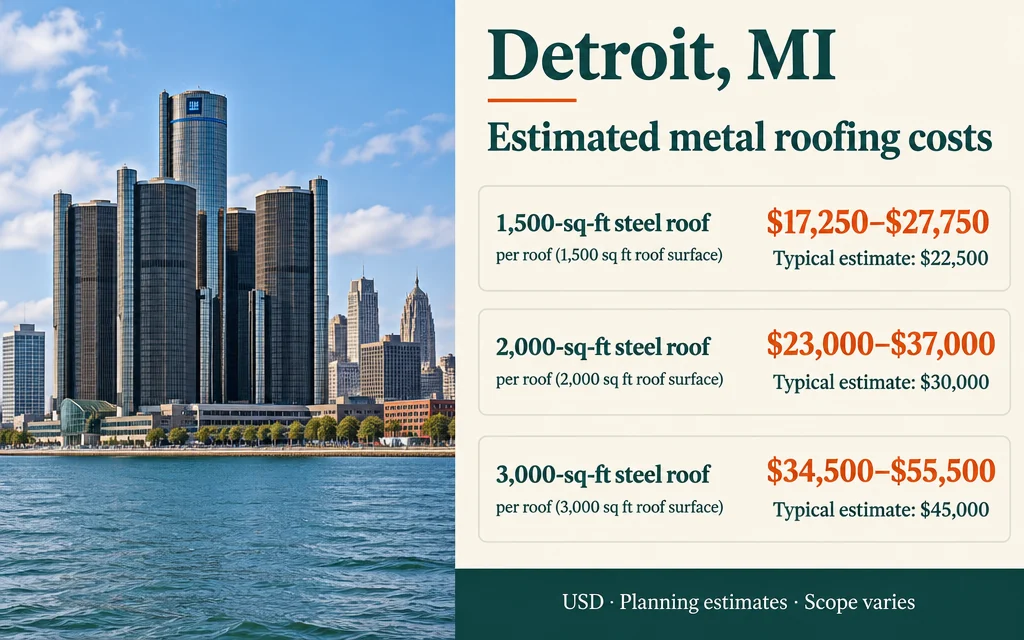
Calculated installed planning scenario for measured roof surface, including one-layer removal/disposal; conditional extras excluded.
Calculated installed planning scenario for measured roof surface, including one-layer removal/disposal; conditional extras excluded.
Calculated installed planning scenario for measured roof surface, including one-layer removal/disposal; conditional extras excluded.
Understanding Residential Metal Roofing in Detroit
Metal roofing appeals to Detroit homeowners looking to avoid replacing asphalt shingles every couple of decades. A properly detailed metal roof handles snow loading, resists high Great Lakes wind gusts, and sheds winter ice.
Always calculate costs using measured roof surface area rather than interior living space. A 1,500-square-foot Detroit bungalow often has between 1,800 and 2,200 square feet of roof surface once pitch, eaves, and porch overhangs are factored in. Standard installed baselines assume 24- or 26-gauge panels, concealed clips, perimeter flashing, standard synthetic underlayment, and tearing off one existing layer of asphalt shingles down to sound wood decking.
Metal Roofing Systems Compared
Residential metal systems differ in fastener design, longevity, and price point:
Standing-Seam Steel: The benchmark system for residential homes, running a planning rate to budget $11.50–$18.50 per sq ft of roof surface (installed). Formed from 24-gauge or 26-gauge Galvalume steel with a factory PVDF or Kynar finish, these panels lock over concealed clips. Hidden fasteners allow the metal to expand and contract smoothly between humid summer heat and sub-zero winter chills without placing stress on screw holes.
Exposed-Fastener Steel Panels: Commonly referred to as corrugated metal or ag-panels, budget $5–$9.50 per sq ft of roof surface (installed). These panels screw down directly through the face of the metal into the decking with neoprene-gasketed fasteners. While they provide an economical upfront price, the exterior rubber washers deteriorate under UV rays and freeze-thaw cycles, requiring periodic inspection and screw replacement.
Steel Metal Shingles: Stamped stone-coated or painted steel panels mimic traditional shakes or slate, budgeting $8.50–$15.50 per sq ft of roof surface (installed). They offer high impact resistance while keeping a lower profile suited to traditional neighborhood architecture.
Standing-Seam Aluminum: Built from 0.032-inch to 0.040-inch aluminum sheet, budgeting $13–$20 per sq ft of roof surface (installed). Aluminum provides excellent natural corrosion resistance and is lightweight, though it is softer than steel and can dent more easily during severe hail.
Standing-Seam Copper: Premium architectural copper runs a planning budget of $22–$36 per sq ft of roof surface (installed). Copper oxidizes into an earth-toned patina over time and requires no paint, but it demands master sheet-metal craftsmanship and represents the highest material cost in residential roofing.
| Service / assumptions | Low | Typical estimate | High | Pricing unit | Estimated labor time |
|---|---|---|---|---|---|
| Standing Seam Steel (Installed)Calculated standing-seam steel planning rate: 24/26-ga panel materials + installation labor + 1-layer tear-off. Standard underlayment included over sound decking; regional reference baseline. | $11.50 | $15 | $18.50 | per sq ft of roof surface (installed) | N/A |
| Exposed Fastener Steel (Installed)26- or 29-ga corrugated/ribbed steel with exterior gasket screws, basic synthetic underlayment, and 1-layer tear-off. Regional planning estimate. | $5 | $7.25 | $9.50 | per sq ft of roof surface (installed) | N/A |
| Steel Metal Shingles (Installed)Stamped stone-coated or painted steel shingle profiles with 1-layer tear-off and accessories. | $8.50 | $12 | $15.50 | per sq ft of roof surface (installed) | N/A |
| Standing Seam Aluminum (Installed)0.032 to 0.040 concealed clip aluminum system with high-temp underlayment and 1-layer removal. | $13 | $16.50 | $20 | per sq ft of roof surface (installed) | N/A |
| Standing Seam Copper (Installed)16-oz cold-rolled copper architectural standing seam with hand-formed seams and full tear-off. | $22 | $29 | $36 | per sq ft of roof surface (installed) | N/A |
Standing Seam Cost Breakdown
A complete installed standing-seam steel roof combines three primary cost components:
Materials Allowance: Budget $4.50–$7.50 per sq ft of roof surface (materials only) for 24-gauge or 26-gauge Galvalume panels, hidden clips, starter strips, ridge caps, and high-temperature synthetic underlayment.
Installation Labor: Budget $5.50–$9 per sq ft of roof surface (installation labor only) for experienced sheet-metal mechanics. Skilled installers cut, notch, and hem custom transition flashings around valleys and walls while maintaining proper panel float for thermal movement.
Tear-Off and Disposal: Budget $1.50–$2 per sq ft of roof surface (one-layer removal and disposal) for stripping one existing shingle layer, pulling nails, cleaning the wood deck, and hauling away debris.
Together, these component allowances form the baseline standing-seam steel planning rate of $11.50–$18.50 per sq ft of roof surface (installed) over sound decking.
| Service / assumptions | Low | Typical estimate | High | Pricing unit | Estimated labor time |
|---|---|---|---|---|---|
| Standing Seam Steel Materials24-ga Kynar steel panels, concealed expansion clips, trim flashings, and high-temp synthetic underlayment. | $4.50 | $6 | $7.50 | per sq ft of roof surface (materials only) | N/A |
| Standing Seam Steel LaborSpecialized metal roofing crew installation, panel hemming, field seaming, and standard ridge/eave details. | $5.50 | $7.25 | $9 | per sq ft of roof surface (installation labor only) | N/A |
| One-Layer Removal & DisposalTear-off of one layer of asphalt shingles, nail cleanup, ground protection, and local Wayne County dumping fees. | $1.50 | $1.75 | $2 | per sq ft of roof surface (one-layer removal and disposal) | N/A |
Cost by Measured Roof Area
Roofing contractors quote work based on measured roof surface area. Below are three representative Detroit home scenarios applying the standing-seam steel planning rate:
1,500-Square-Foot Roof: Typical for a smaller ranch, bungalow, or uncomplicated addition. At an installed planning rate, budget $17,250–$27,750 per roof (1,500 sq ft roof surface) for full tear-off and replacement. Elapsed on-site crew time is typically 3-4 days.
2,000-Square-Foot Roof: Common on two-story Colonials, Detroit duplexes, or mid-century split-levels. Budget $23,000–$37,000 per roof (2,000 sq ft roof surface), with an elapsed installation time of 4-6 days.
3,000-Square-Foot Roof: Common for larger multi-story homes, complex multi-gable layouts, or homes with extensive attached garages and covered porches. Budget $34,500–$55,500 per roof (3,000 sq ft roof surface), with on-site work spanning 6-8 days.
| Service / assumptions | Low | Typical estimate | High | Pricing unit | Estimated labor time |
|---|---|---|---|---|---|
| Standing Seam Steel (1,500 Sq Ft Roof)Calculated scenario: 1,500 sq ft of measured roof surface × standing-seam steel installed planning rate. Includes its same materials, installation, one-layer removal/disposal and sound-deck assumptions. Not a provider whole-roof quote. | $17,250 | $22,500 | $27,750 | per roof (1,500 sq ft roof surface) | 3-4 days |
| Standing Seam Steel (2,000 Sq Ft Roof)Calculated scenario: 2,000 sq ft of measured roof surface × standing-seam steel installed planning rate. Includes its same materials, installation, one-layer removal/disposal and sound-deck assumptions. Not a provider whole-roof quote. | $23,000 | $30,000 | $37,000 | per roof (2,000 sq ft roof surface) | 4-6 days |
| Standing Seam Steel (3,000 Sq Ft Roof)Calculated scenario: 3,000 sq ft of measured roof surface × standing-seam steel installed planning rate. Includes its same materials, installation, one-layer removal/disposal and sound-deck assumptions. Not a provider whole-roof quote. | $34,500 | $45,000 | $55,500 | per roof (3,000 sq ft roof surface) | 6-8 days |
Metal vs. Architectural Asphalt in Detroit
Standard architectural asphalt shingles serve as an installed baseline reference, budgeting $4.50–$7 per sq ft of roof surface (installed) with an on-site duration of 1-2 days. Standing-seam steel roofing, budgeting $11.50–$18.50 per sq ft of roof surface (installed), requires approximately two to three times that initial investment.
The difference centers on durability and life expectancy. Asphalt shingles exposed to Michigan winters and summer heat commonly need replacement every 18 to 22 years as granules loosen and seal strips fail. Standing-seam steel with a factory PVDF finish can perform for 50 years or longer when flashings and sealants are kept in good order.
For a home with 2,000 square feet of roof surface, standing-seam steel totals $23,000–$37,000 per roof. Homeowners who plan to stay in their property long enough to avoid one or two future tear-offs can justify that upfront cost. If you plan to sell within five to ten years, you are unlikely to recover the price premium through immediate property appreciation alone.
| Service / assumptions | Low | Typical estimate | High | Pricing unit | Estimated labor time |
|---|---|---|---|---|---|
| Architectural Asphalt Shingles (Installed Reference)Installed baseline reference including tear-off of 1 layer, synthetic underlayment, and standard flashings.Published price reference ↗ | $4.50 | $5.75 | $7 | per sq ft of roof surface (installed) | 1-2 days |
| Comparison | Architectural asphalt | Standing-seam steel |
|---|---|---|
| Up-front planning estimate · 2,000 sq ft roof surface | $9,000–$14,000 | $23,000–$37,000 |
| What the baseline includes | Architectural asphalt, ordinary installed details, one-layer removal/disposal over sound decking. | Standing-seam steel, ordinary installed details, one-layer removal/disposal over sound decking. |
| Maintenance and repairs | Confirm product-specific inspections and repair terms. | Confirm seams, fasteners, coating, compatible repairs and inspection terms. |
| Insurance and ownership cost | Ask the insurer about the exact product and coverage. | Ask the insurer about accepted test documentation, any available credit and cosmetic-damage exclusions. |
These are calculated budgeting comparisons, not provider quotes or guaranteed lifetime savings. Compare your expected ownership period, specified products, actual maintenance proposals and written insurance terms.
| Decision point | Roof repair | Roof replacement | Metal roofing |
|---|---|---|---|
| Work being priced | A defined defect, such as damaged shingles or flashing. | Removal and installation of an agreed roof system across the measured roof surface. | A specified installed metal system; standing seam, exposed fasteners and metal shingles are different scopes. |
| What to inspect | The leak source, surrounding material and whether a durable localized fix is feasible. | The extent of deterioration, decking condition, roof details and suitable replacement systems. | The substrate, panel profile, coating, fasteners, roof geometry and installation details. |
| How to compare prices | Match the repair quantity, access, materials and included diagnosis. | Match measured roof area, material, tear-off layers, disposal and installed inclusions. | Match measured roof area, system, components, removal and conditional additional work. |
| Before deciding | Ask what the repair addresses and what existing problems would remain. | Ask whether repair remains practical and which additional items would change the total. | Ask about compatible materials, documented product/assembly ratings and product versus workmanship warranties. |
Age or a repair-cost percentage alone does not determine the right choice. Ask a qualified roofing contractor to assess the condition and explain viable options. A metal system is a material-specific installation choice, not a separate guarantee of durability or savings.
Additional Scope and Conditional Work
Standard quotes assume clean wood sheathing underneath. When working on older homes, conditional repairs often surface during tear-off:
Decking Repairs: If removing old shingles uncovers rot or soft decking, replacing damaged sheathing runs to budget $75–$110 additional per 4-by-8-ft sheet (32 sq ft) for 1/2-inch CDX plywood or OSB.
Extra Layer Tear-Off: If the property has a second shingle layer underneath, hauling away extra debris adds a budget of $40–$70 additional per roofing square (100 sq ft).
Flashing Details: Installing custom-bent step and counterflashing around a brick chimney adds a budget of $350–$700 additional per chimney. Custom metal transition flashing for skylights runs a budget of $250–$500 additional per skylight.
Ventilation and Snow Retention: Upgrading to a continuous ventilated ridge cap adds a budget of $12–$22 additional per linear ft. Adding seam-mounted snow retention rails to keep sliding snow off sidewalks and gutters runs a budget of $25–$45 additional per linear ft.
Gutter Reset: Detaching gutters before metal installation and remounting them afterward adds a budget of $5–$10 additional per linear ft.
| Service / assumptions | Low | Typical estimate | High | Pricing unit | Estimated labor time |
|---|---|---|---|---|---|
| Extra Layer RemovalAdditional labor and disposal costs for removing a second or third existing roof layer. | $40 | $55 | $70 | additional per roofing square (100 sq ft) | N/A |
| Plywood/OSB Decking ReplacementReplaces rotted or damaged roof decking with 1/2-inch CDX plywood or OSB while deck is exposed. | $75 | $92.50 | $110 | additional per 4-by-8-ft sheet (32 sq ft) | N/A |
| Chimney Flashing Kit & IntegrationCustom-bent sheet metal step flashing and reglet-cut counterflashing for masonry chimneys. | $350 | $525 | $700 | additional per chimney | N/A |
| Skylight Flashing IntegrationSeamless curb transition flashing kit engineered specifically for metal roof panels. | $250 | $375 | $500 | additional per skylight | N/A |
| Ridge Ventilation UpgradeContinuous ventilated metal ridge cap including breathable insect and weather filter mesh. | $12 | $17 | $22 | additional per linear ft | N/A |
| Snow Retention Bar / Rail SystemSeam-clamped continuous aluminum or steel snow rails over pedestrian entryways and gutters. | $25 | $35 | $45 | additional per linear ft | N/A |
| Gutter Detach & ResetCareful removal of existing perimeter gutters before drip edge installation and re-hanging afterward. | $5 | $7.50 | $10 | additional per linear ft | N/A |
Performance Ratings, Snow Shedding, and Insurance Realities
Metal roofing delivers strong storm protection, but performance claims need realistic evaluation:
Impact Ratings: Many steel panels achieve a UL 2218 Class 4 rating, meaning the panel resists splitting or puncturing during standardized hail drop tests. However, a Class 4 rating is not a guarantee against visible dimpling or minor surface dents. Insurers may offer modest premium discounts for impact-rated materials, but some policies attach cosmetic damage exclusions that refuse claims for dented panels that do not leak. Verify specific coverage terms with your insurer before relying on insurance savings.
Wind Uplift: Concealed-clip standing seam holds up against high winds because clips are secured beneath the seams, eliminating exposed screw heads and preventing the shingle tab uplift common with asphalt.
Snow and Ice Movement: Metal roofs warm quickly in winter sunlight, causing accumulated snow packs to release in sudden slides. Uncontrolled snow avalanches can crush shrubbery, bend metal gutters, or endanger people below. Placing snow rails above doorways, garage aprons, and outdoor HVAC equipment keeps snow from sliding off in heavy sheets.
Energy Performance: Factory-applied cool-roof pigments reflect solar heat in summer, reducing attic temperatures. However, overall home comfort depends primarily on attic insulation depth and balanced ventilation rather than roof color alone.
Key Cost Drivers for Detroit Projects
Several project-specific factors influence where an estimate falls within regional ranges:
Roof Pitch and Complexity: Low-slope gable roofs with continuous straight runs allow rapid panel placement. Steep pitches (8/12 or greater), multiple dormers, valley intersections, and wall transitions demand hand-bent metal work, staging, and safety tie-offs that push labor rates up.
System Type: Exposed-fastener panels budget $5–$9.50 per sq ft of roof surface (installed) because they fasten quickly through the surface. Concealed-clip standing seam at $11.50–$18.50 per sq ft of roof surface (installed) requires precise clip placement, seam folding, and custom-fabricated edge details.
Panel Material and Gauge: Residential standing seam usually relies on 24- or 26-gauge steel. Lighter 29-gauge metal is cheaper but prone to oil-canning (surface ripple). Moving to aluminum at $13–$20 per sq ft of roof surface (installed) or copper at $22–$36 per sq ft of roof surface (installed) significantly increases material outlay.
Site Access and Property Lines: Tight lots, mature trees, overhead power drops, and limited driveway space make staging long metal panels difficult, increasing ground handling time.
Hiring a Metal Roofing Contractor in Detroit
Standing-seam installation requires sheet-metal sheet brakes, specialized hand seamers, and proven crew experience. Keep these practical steps in mind when reviewing bids:
Licensing and Permitting: Verify that the contractor holds an active Michigan residential builder or maintenance and alteration license. Confirm who will submit plans and pull permits with the Detroit Buildings, Safety Engineering, and Environmental Department (BSEED), and ensure required municipal inspections are written into the contract.
Warranties: Distinguish between the paint finish warranty (often 30 to 40 years for Kynar 500 or Hylar 5000 against chalking and fading) and the contractor's workmanship warranty. Workmanship coverage should protect against flashing, seam, and penetration leaks for at least five to ten years.
Detailed Scope: Require bids to specify the exact metal gauge, base metal (such as Galvalume AZ50 or AZ55), paint system, and underlayment specifications. Ask for a pre-negotiated per-sheet rate for any deteriorated roof decking discovered during tear-off.
Local income & housing costs
Detroit city, Michigan · U.S. Census Bureau, 2025 ACS 1-year estimates.
per month · ±$31
Cash-rent units; includes applicable tenant-paid utilities
Census source ↗Dollar amounts use the survey period’s published basis. Income is annual; gross rent is monthly. Home value reflects owner-occupied housing values. Margins of error shown are at the ACS 90% confidence level. These statistics provide city context; service budgets use their own pricing evidence.
STATEWIDE COST CONTEXT
Michigan prices, income & labor costs
These Michigan figures provide background for this city guide. They describe different measures and reference years; employee wages are not prices charged by a contractor.
BEA SAIRPD
State price change indicator
119.02024 · index (2017 basis)
Annual figures & sources
| Year | Value | 90% margin of error | Source |
|---|---|---|---|
| 2020 | 98.8 | — | Official source |
| 2021 | 102.7 | — | Official source |
| 2022 | 108.7 | — | Official source |
| 2023 | 113.6 | — | Official source |
| 2024 | 119.0 | — | Official source |
Census ACS 1-year
Median household income
$75,8322025 · USD/year
Annual figures & sources
| Year | Value | 90% margin of error | Source |
|---|---|---|---|
| 2021 | $63,498 | ±$526 | Official source |
| 2022 | $66,986 | ±$675 | Official source |
| 2023 | $69,183 | ±$694 | Official source |
| 2024 | $72,389 | ±$567 | Official source |
| 2025 | $75,832 | ±$691 | Official source |
BLS OEWS
Roofers
$28.622025 · USD/hour
Annual figures & sources
| Year | Value | 90% margin of error | Source |
|---|---|---|---|
| 2025 | $28.62 | — | Official source |
State prices: BEA, 2020–2024. Household income: Census ACS, 2021–2025. Employee wages: BLS, May 2025 snapshot. The charts retain their own units and fitted scales.
Explore all Michigan living-cost data and trends →Local context and limitations
Detroit experiences harsh freeze-thaw cycles, winter lake-effect snow squalls, and heavy seasonal thunderstorms. Metal roofing figures in this guide are planning estimates derived from regional Michigan benchmarks and component calculations rather than verified Detroit contractor surveys. Ice-dam protection and high-temperature self-adhering underlayment are critical along eaves. Smooth metal sheds accumulated snow quickly during mid-winter thaws, so snow guards are often budgeted over entry doors, walkways, and driveways. Roof geometry across Detroit ranges from steep multi-gabled historic brick homes to compact post-war ranches, and deck condition under old shingles will directly affect your final project scope.
Frequently asked questions
What is the primary difference between standing seam and exposed-fastener metal roofs?
Standing seam uses raised vertical seams that interlock over concealed clips, protecting fastener penetrations from weather and letting panels expand and contract with temperature changes. Exposed-fastener systems screw directly through the metal into the roof deck. While exposed panels cost less upfront, their rubber washers degrade over 10 to 15 years and need periodic inspection and tightening to prevent leaks.
Can a new metal roof be installed directly over existing asphalt shingles in Detroit?
Check with your contractor and the Detroit Buildings, Safety Engineering, and Environmental Department (BSEED) to verify whether an overlay is permissible for your address. Structural load limits, deck moisture, and manufacturer warranty guidelines vary by property. Most contractors recommend tearing off old shingles so the crew can inspect the wood decking for rot and provide a level deck for the metal panels.
How noisy is a metal roof during heavy rainstorms?
Over solid wood decking, quality underlayment, and standard attic insulation, a residential metal roof sounds similar to an asphalt shingle roof during rain. The loud drumming commonly associated with metal roofing happens mostly on uninsulated open-framed buildings like barns or sheds.
Do I need snow guards on a metal roof in Southeast Michigan?
Snow guards or continuous snow rail bars are strongly recommended above entryways, walkways, driveways, gutters, and ground-mounted HVAC units. Metal panels shed snow rapidly during mid-winter sunny days and thaws, creating potential slide hazards if left unmanaged.
Will installing a metal roof lower my homeowners insurance premiums?
Some insurers provide discounts for UL 2218 Class 4 impact-rated metal roofs, but credits are not guaranteed across all carriers. Certain policies also include cosmetic damage waivers that exclude payouts for minor hail dents that do not cause water leaks. Check with your insurance agent using the manufacturer's specification sheet before purchasing.
How do I calculate my roof's square footage compared to my home's floor plan?
Actual roof area is always larger than interior living space because of roof pitch, eaves, overhangs, and attached garages. A 1,500-square-foot Detroit home with a moderate 6/12 pitch typically measures between 1,800 and 2,100 square feet of actual roof surface.
Sources and methodology
Sources below retain their recorded retrieval dates and geographic scope. We checked the quoted rates against readable public pricing pages. The tables remain planning estimates, not provider quotes or a measured citywide survey. Per-square-foot references do not establish the modeled whole-roof totals or all their installed inclusions. Regional references are not verified Detroit-specific quotes. Confirm removal, disposal, materials, labor and the complete scope in a written proposal.
Published pricing pages retrieved; quoted excerpts checked automatically. 2 distinct website domains. · Generated 2026-11-12
- What Does a New Roof Cost in Michigan? Average Prices and Calculator Tips | The Roof CompanyState / regional reference · Page retrieved 2026-11-12 · Price excerpt matched automatically
“3-tab and architectural asphalt shingles cost between $5.46 and $6.41 per square foot installed.”
Planning ranges may differ from these published examples; they are not provider quotes.
- Metal Roof Cost in West Michigan | Stellar Roofing CompanyState / regional reference · Page retrieved 2026-11-12 · Price excerpt matched automatically
“Standing seam typically starts around $12 per square foot installed and can exceed $25 to $30, depending on the house.”
Planning ranges may differ from these published examples; they are not provider quotes.
Plan your metal roofing project
Choose your service and answer its project questions. Add notes or photos if helpful, then generate your project brief. The planner labels its budgeting assumptions separately. Use your plan to compare the scope and assumptions with a provider. Contact sharing and provider matching are not available yet.
Open the project planner →Share this city’s cost data
<> Embed Detroit Cost Data on Your Site
The HTML table shows the prices at the time of copying. The iframe follows the published guide.