Fayetteville · NC · COST GUIDE
Metal Roofing Costs in Fayetteville, NC (2026)
For budgeting, standing-seam steel roofing is estimated at $9.50–$15.75 per sq ft of roof surface, and exposed-fastener steel at $4.50–$8.50 per sq ft. These installed planning ranges include one-layer removal/disposal over sound decking; compare the specified system and conditional extras.
Standing Seam Steel (Installed)
Budget estimate$9.50–$15.75per sq ft of roof surface (installed)
Planning range · Compare the roof area, material and included work in your quote.
Exposed-Fastener Steel (Installed)
Budget estimate$4.50–$8.50per sq ft of roof surface (installed)
Planning range · Compare the roof area, material and included work in your quote.
Published examples apply to their stated scope. Budget ranges are estimates.
Calculated installed planning scenario for measured roof surface, including one-layer removal/disposal; conditional extras excluded.
Calculated installed planning scenario for measured roof surface, including one-layer removal/disposal; conditional extras excluded.
Calculated installed planning scenario for measured roof surface, including one-layer removal/disposal; conditional extras excluded.
Metal Roofing in the Fayetteville Area
Metal roofing is increasingly chosen for residential re-roofing across Cumberland County. Homeowners in Fayetteville turn to metal to handle high summer heat, resist wind uplift during summer storms, and avoid frequent re-roofing cycles.
A complete residential metal roof installation includes several coordinated layers: the structural roof deck, an underlayment moisture barrier, concealed clips or fasteners, perimeter trim, and flashing around all penetrations.
Roofing estimates rely on measured roof surface area rather than interior living space. Because roof planes extend past exterior walls at eaves and overhangs and expand with pitch, a 1,800-square-foot single-story home in Fayetteville often requires 2,100 to 2,400 square feet of actual roofing surface (21 to 24 roofing squares). Estimates that leave out old shingle removal, disposal, or flashings can look appealing at first but lead to surprise change orders. A complete budget accounts for the entire assembly from tear-off to ridge ventilation.
Residential Metal Roofing Systems Compared
Residential metal roofs fall into several profiles and fastening styles, each with different price points and maintenance expectations:
Standing-seam steel uses continuous vertical panels joined along raised seams, concealing clips and fasteners underneath. Concealed fasteners allow the metal to expand and contract freely during hot Fayetteville summer afternoons without placing shear stress on screw penetrations. Panels are commonly formed from 24-gauge or 26-gauge steel with a Galvalume protective coating and a durable PVDF/Kynar finish.
Exposed-fastener steel systems, often called 5V-crimp or corrugated panels, are secured by driving screws with rubber sealing washers directly through the face of the metal into decking or purlins. While upfront costs are lower, thermal cycling causes rubber washers to weather and loosen over time, requiring regular inspection and periodic fastener maintenance to prevent leaks.
Steel metal shingles are stamped modular panels shaped to mimic traditional slate, wood shake, or asphalt shingles. They offer concealed-fastener weather protection with a traditional appearance, installed piece by piece over solid decking.
Standing-seam aluminum provides a rustproof substrate. Although Fayetteville is roughly 80 miles inland from the coast and avoids saltwater spray, aluminum remains a durable choice near local lakes or for homeowners wanting complete corrosion protection. Aluminum expands more than steel with temperature swings and requires careful clip detailing.
Standing-seam copper sits at the top tier of architectural sheet metal. It needs no paint finish and develops an oxide patina over time. Hand-formed and soldered at critical junctions, copper delivers exceptional longevity when installed by skilled sheet-metal trades.
| Service / assumptions | Low | Typical estimate | High | Pricing unit | Estimated labor time |
|---|---|---|---|---|---|
| Standing Seam Steel (Installed)Calculated standing-seam steel planning rate: comparable panel/accessory materials + installation labor + one-layer removal/disposal. Ordinary underlayment and details over sound decking included; conditional extra work excluded. | $9.50 | $12.25 | $15.75 | per sq ft of roof surface (installed) | N/A |
| Exposed-Fastener Steel (Installed)Through-fastened ribbed corrugated or 5V-crimp 26-29 gauge steel panels including underlayment, trims, and one-layer tear-off. | $4.50 | $6.25 | $8.50 | per sq ft of roof surface (installed) | N/A |
| Metal Shingles Steel (Installed)Stamped steel modular shingle, slate, or tile profiles with concealed fasteners, underlayment, and one-layer tear-off. | $7.50 | $9.50 | $12.50 | per sq ft of roof surface (installed) | N/A |
| Standing Seam Aluminum (Installed)Concealed-fastener .032 or .040 aluminum standing seam, naturally corrosion-resistant, including underlayment and tear-off. | $11.50 | $14.50 | $18.50 | per sq ft of roof surface (installed) | N/A |
| Standing Seam Copper (Installed)Architectural 16-oz or 20-oz standing-seam copper with hand-formed details, high-temp underlayment, and one-layer tear-off. | $24 | $31 | $40 | per sq ft of roof surface (installed) | N/A |
Cost Components of a Standing Seam Roof
Reviewing how a quote breaks down helps you compare proposals fairly. A complete standing-seam steel roof installation combines three primary cost categories: materials, field labor, and the tear-off of the old roof.
Materials typically require budgeting $4.50–$7.25 per sq ft of roof surface (materials only). This covers 24-gauge or 26-gauge Galvalume panels, underlayment, expansion clips, fasteners, eave cleats, valley metal, transition flashing, and ridge caps.
Field installation labor accounts for budgeting $4–$6.75 per sq ft of roof surface (installation labor only). This reflects the trade work needed to layout panels, cut valleys, hem panel ends, lock standing seams, and flash penetrations.
Removing the existing asphalt shingle layer and hauling away debris requires budgeting $1–$1.75 per sq ft of roof surface (one-layer removal and disposal). Together, these allowances produce an installed planning rate of budgeting $9.50–$15.75 per sq ft of roof surface (installed) over a sound deck.
| Service / assumptions | Low | Typical estimate | High | Pricing unit | Estimated labor time |
|---|---|---|---|---|---|
| Standing Seam Steel Materials24-26 gauge Galvalume PVDF panels, clips, screws, flashings, transitions, and synthetic underlayment. | $4.50 | $5.75 | $7.25 | per sq ft of roof surface (materials only) | N/A |
| Standing Seam Installation LaborCrew labor for laying underlayment, panel fabrication/installation, seaming, valleys, ridges, and standard penetrations. | $4 | $5.25 | $6.75 | per sq ft of roof surface (installation labor only) | N/A |
| One-Layer Removal & DisposalStripping one layer of old asphalt shingles, hauling away, and Cumberland County disposal fees. | $1 | $1.25 | $1.75 | per sq ft of roof surface (one-layer removal and disposal) | N/A |
Project Cost by Roof Surface Area
Total project expense depends on your measured roof surface area and architectural complexity. Simple gable roofs with uninterrupted planes require fewer cuts and less labor, while complex hip designs with multiple dormers, hips, and valleys take longer to layout and trim.
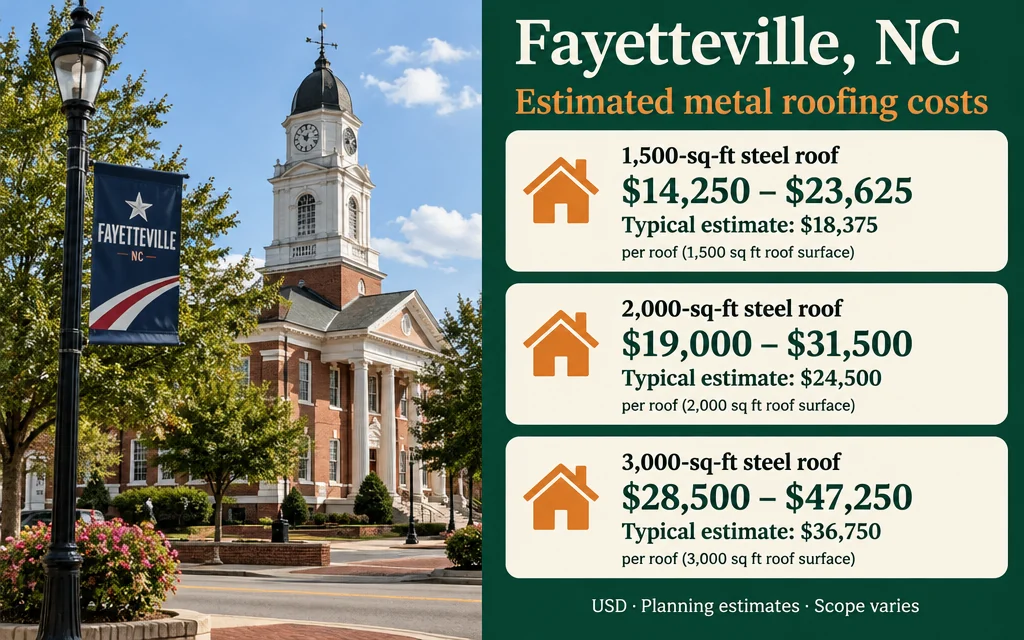
For a small home or detached garage with a 1,500-square-foot roof surface, budget $14,250–$23,625 per roof (1,500 sq ft roof surface) for a turnkey standing-seam steel system, with typical jobs landing near $18,375. On-site installation generally takes 2-4 working days.
A mid-sized home with a 2,000-square-foot roof surface runs budget $19,000–$31,500 per roof (2,000 sq ft roof surface), with a typical cost around $24,500 and an on-site timeline of 3-5 working days.
A larger home measuring 3,000 square feet of roof surface ranges from budget $28,500–$47,250 per roof (3,000 sq ft roof surface), averaging $36,750 and requiring 4-7 working days of crew time. These planning figures assume one-layer tear-off over sound decking.
| Service / assumptions | Low | Typical estimate | High | Pricing unit | Estimated labor time |
|---|---|---|---|---|---|
| 1,500 Sq Ft Standing Seam Steel RoofCalculated scenario: 1,500 sq ft of measured roof surface × standing-seam steel installed planning rate. Includes its same materials, installation, one-layer removal/disposal and sound-deck assumptions. Not a provider whole-roof quote. | $14,250 | $18,375 | $23,625 | per roof (1,500 sq ft roof surface) | 2-4 working days |
| 2,000 Sq Ft Standing Seam Steel RoofCalculated scenario: 2,000 sq ft of measured roof surface × standing-seam steel installed planning rate. Includes its same materials, installation, one-layer removal/disposal and sound-deck assumptions. Not a provider whole-roof quote. | $19,000 | $24,500 | $31,500 | per roof (2,000 sq ft roof surface) | 3-5 working days |
| 3,000 Sq Ft Standing Seam Steel RoofCalculated scenario: 3,000 sq ft of measured roof surface × standing-seam steel installed planning rate. Includes its same materials, installation, one-layer removal/disposal and sound-deck assumptions. Not a provider whole-roof quote. | $28,500 | $36,750 | $47,250 | per roof (3,000 sq ft roof surface) | 4-7 working days |
Metal vs. Architectural Asphalt Shingles
Deciding between standing-seam steel and architectural asphalt shingles involves weighing upfront investment against anticipated service life. In the Fayetteville market, a turnkey architectural asphalt shingle roof costs budget $4.25–$6.75 per sq ft of roof surface (installed), with a typical benchmark around $5.25.
Standing-seam steel averages around $12.25 per sq ft of roof surface (installed).
In central North Carolina, asphalt shingles often undergo significant thermal cycling, UV exposure, and algae growth over their service life. A properly detailed 24-gauge standing-seam steel roof lasts substantially longer with minimal maintenance beyond clearing debris and inspecting seals. If you plan to remain in your home for decades, investing in standing seam can eliminate future re-roofing cycles. If you plan to move within a few years, architectural asphalt shingles are generally the more practical near-term choice.
| Service / assumptions | Low | Typical estimate | High | Pricing unit | Estimated labor time |
|---|---|---|---|---|---|
| Architectural Asphalt Shingles ReferenceTurnkey architectural shingles installed over sound deck with synthetic underlayment and one-layer removal. Published rate reference for the stated roofing scope and unit, not verification of this guide's modeled range, a complete roof quote or provider availability. Regional reference; not a verified Fayetteville-specific quote.Published price reference ↗ | $4.25 | $5.25 | $6.75 | per sq ft of roof surface (installed) | 1-2 working days |
| Comparison | Architectural asphalt | Standing-seam steel |
|---|---|---|
| Up-front planning estimate · 2,000 sq ft roof surface | $8,500–$13,500 | $19,000–$31,500 |
| What the baseline includes | Architectural asphalt, ordinary installed details, one-layer removal/disposal over sound decking. | Standing-seam steel, ordinary installed details, one-layer removal/disposal over sound decking. |
| Maintenance and repairs | Confirm product-specific inspections and repair terms. | Confirm seams, fasteners, coating, compatible repairs and inspection terms. |
| Insurance and ownership cost | Ask the insurer about the exact product and coverage. | Ask the insurer about accepted test documentation, any available credit and cosmetic-damage exclusions. |
These are calculated budgeting comparisons, not provider quotes or guaranteed lifetime savings. Compare your expected ownership period, specified products, actual maintenance proposals and written insurance terms.
| Decision point | Roof repair | Roof replacement | Metal roofing |
|---|---|---|---|
| Work being priced | A defined defect, such as damaged shingles or flashing. | Removal and installation of an agreed roof system across the measured roof surface. | A specified installed metal system; standing seam, exposed fasteners and metal shingles are different scopes. |
| What to inspect | The leak source, surrounding material and whether a durable localized fix is feasible. | The extent of deterioration, decking condition, roof details and suitable replacement systems. | The substrate, panel profile, coating, fasteners, roof geometry and installation details. |
| How to compare prices | Match the repair quantity, access, materials and included diagnosis. | Match measured roof area, material, tear-off layers, disposal and installed inclusions. | Match measured roof area, system, components, removal and conditional additional work. |
| Before deciding | Ask what the repair addresses and what existing problems would remain. | Ask whether repair remains practical and which additional items would change the total. | Ask about compatible materials, documented product/assembly ratings and product versus workmanship warranties. |
Age or a repair-cost percentage alone does not determine the right choice. Ask a qualified roofing contractor to assess the condition and explain viable options. A metal system is a material-specific installation choice, not a separate guarantee of durability or savings.
Additional Scope and Conditional Work
Baseline metal roofing estimates assume the existing roof decking is flat, dry, and structurally sound once the old roof is removed. Uncovering hidden moisture damage or needing specialized trim creates separate line items.
If damaged plywood or OSB sheathing must be replaced, budget $65–$125 additional per 4-by-8-ft sheet (32 sq ft). Stripping a second or third existing roof layer adds budget $40–$85 additional per roofing square (100 sq ft) for extra crew labor and landfill disposal. Chimney flashings cut into mortar reglets cost budget $350–$850 additional per chimney. Custom curb flashing packages for skylights run budget $250–$650 additional per skylight.
Upgraded ridge ventilation with custom perforated baffles adds budget $12–$28 additional per linear ft. If snow bars or ice guards are needed over doorways or walkways, budget $10–$30 additional per linear ft. When standing-seam drip edges require detaching and resetting existing gutters, plan for budget $5–$14 additional per linear ft.
| Service / assumptions | Low | Typical estimate | High | Pricing unit | Estimated labor time |
|---|---|---|---|---|---|
| Additional Layer RemovalLabor and disposal for stripping a second or third existing roof layer beyond the baseline. | $40 | $55 | $85 | additional per roofing square (100 sq ft) | N/A |
| Decking Replacement (4x8 Sheet)Replacing damaged or rotten plywood/OSB sheathing while the roof deck is fully exposed. | $65 | $90 | $125 | additional per 4-by-8-ft sheet (32 sq ft) | N/A |
| Chimney Flashing PackageCustom fabricated metal apron, step, cricket, and counter-flashing cut into masonry mortar joints. | $350 | $550 | $850 | additional per chimney | N/A |
| Skylight Flashing PackageCustom fabricated curb flashing and weather seals compatible with standing seam panels. | $250 | $400 | $650 | additional per skylight | N/A |
| Ridge Ventilation UpgradeVented ridge cap assembly with perforated baffles and insect mesh designed for metal profiles. | $12 | $18 | $28 | additional per linear ft | N/A |
| Snow Retention Bar / GuardsClamp-on snow bars or individual guards installed over doorways or walkways to control ice shed. | $10 | $20 | $30 | additional per linear ft | N/A |
| Gutter Detach & ResetCarefully removing existing aluminum gutters prior to eave flashing and reinstalling afterward. | $5 | $8 | $14 | additional per linear ft | N/A |
Performance Ratings, Weather, and Code Standards
A metal roof's performance depends on the entire tested system rather than metal thickness alone. Many steel panels carry UL 2218 Class 4 impact resistance ratings, showing good resistance against hail.
A Class 4 rating does not guarantee that hail will never leave cosmetic dings; it indicates the metal resists puncturing and water intrusion during testing. Check with your insurance carrier regarding policy terms, as some insurers attach cosmetic damage exclusion endorsements that deny claims for harmless surface dents.
Wind uplift ratings, such as UL 580 Class 90, depend on proper clip spacing and solid fastener engagement with the deck. In Fayetteville, correct fastening per the North Carolina State Building Code helps panels resist convective storm gusts and tropical weather moving inland. Class A fire performance requires an approved underlayment assembly installed over an appropriate deck substrate. Factory-applied PVDF coatings also provide high solar reflectance, reducing attic heat buildup during peak summer months compared to traditional dark shingles.
Local Price Drivers in Cumberland County
Metal roofing proposals in Fayetteville reflect site conditions, roof architecture, and product specifications. Steep roof pitches require safety harness staging and slower panel handling, which increases overall labor costs compared to low-slope designs.
Multi-story homes or properties with tight property lines increase the time needed to stage long panels and handle tear-off debris.
Panel gauge is another significant cost factor. Heavy-duty 24-gauge steel costs more than lighter 26-gauge or 29-gauge metal, but it provides greater rigidity, resists oil-canning (visible surface waviness), and holds up better against falling branches and debris. Choosing mechanically seamed panels with double-locked ribs also commands higher labor fees than snap-lock profiles because the installer must run specialized electric seaming equipment along every seam on the roof.
Hiring a Metal Roofing Contractor in Fayetteville
Installing standing-seam metal roofing requires distinct tools, metal-brake folding skills, and fastening techniques that standard shingle installers may not use. Detailing around valleys, eaves, sidewalls, and penetrations determines whether the system stays watertight over its full lifespan.
When hiring in Fayetteville, confirm that the contractor holds an active license with the North Carolina Licensing Board for General Contractors for projects meeting statutory thresholds, and verify active general liability and workers' compensation policies. Request a written estimate detailing the metal gauge, base metal (such as Galvalume steel), paint system (like Kynar 500 or PVDF), underlayment type, and flashing details. Be sure to distinguish the manufacturer's paint warranty (often 30 to 40 years against peeling and fading) from the contractor's workmanship warranty covering leaks and installation details.
Local income & housing costs
Fayetteville city, North Carolina · U.S. Census Bureau, 2025 ACS 1-year estimates.
per month · ±$37
Cash-rent units; includes applicable tenant-paid utilities
Census source ↗Dollar amounts use the survey period’s published basis. Income is annual; gross rent is monthly. Home value reflects owner-occupied housing values. Margins of error shown are at the ACS 90% confidence level. These statistics provide city context; service budgets use their own pricing evidence.
STATEWIDE COST CONTEXT
North Carolina prices, income & labor costs
These North Carolina figures provide background for this city guide. They describe different measures and reference years; employee wages are not prices charged by a contractor.
BEA SAIRPD
State price change indicator
116.72024 · index (2017 basis)
Annual figures & sources
| Year | Value | 90% margin of error | Source |
|---|---|---|---|
| 2020 | 95.6 | — | Official source |
| 2021 | 102.1 | — | Official source |
| 2022 | 109.2 | — | Official source |
| 2023 | 113.8 | — | Official source |
| 2024 | 116.7 | — | Official source |
Census ACS 1-year
Median household income
$77,6382025 · USD/year
Annual figures & sources
| Year | Value | 90% margin of error | Source |
|---|---|---|---|
| 2021 | $61,972 | ±$541 | Official source |
| 2022 | $67,481 | ±$623 | Official source |
| 2023 | $70,804 | ±$547 | Official source |
| 2024 | $73,958 | ±$863 | Official source |
| 2025 | $77,638 | ±$876 | Official source |
BLS OEWS
Roofers
$23.562025 · USD/hour
Annual figures & sources
| Year | Value | 90% margin of error | Source |
|---|---|---|---|
| 2025 | $23.56 | — | Official source |
State prices: BEA, 2020–2024. Household income: Census ACS, 2021–2025. Employee wages: BLS, May 2025 snapshot. The charts retain their own units and fitted scales.
Explore all North Carolina living-cost data and trends →Local context and limitations
Fayetteville sits in North Carolina's Sandhills region, where long summer heat, humidity, and severe thunderstorm squalls place steady demands on roof performance. For metal assemblies, high-temperature synthetic underlayment protects against heat transfer better than standard felt. While Cumberland County is inland from ocean spray that necessitates aluminum, 24-gauge or 26-gauge Galvalume steel with a factory PVDF or Kynar 500 finish holds up well against heavy rainfall and summer sun. If your home is in a local historic district or neighborhood with architectural covenants, check profile and seam guidelines before ordering materials.
Frequently asked questions
What is the difference between standing seam and exposed fastener metal roofs?
Standing seam uses raised ribs with concealed clips fastened beneath the panels, allowing the metal to expand and contract smoothly without exposing screws to the weather. Exposed-fastener roofs use screws driven directly through the panel surface with rubber washers. Standing seam is designed for multi-decade durability with minimal maintenance, whereas exposed-fastener roofs require regular washer inspections and periodic screw replacements to prevent leaks.
How is roof surface area different from a home's floor square footage?
Interior square footage only measures heated living area on a flat horizontal plane. A roof covers overhangs, eaves, covered porches, and garages, and its pitch further increases the actual surface area. A 2,000-square-foot home in Fayetteville typically requires 2,400 to 2,800 square feet of actual roofing coverage depending on slope and layout.
Can a metal roof be installed over old asphalt shingles in Fayetteville?
While building codes may allow an overlay under specific structural conditions, full tear-off of old shingles is standard practice for quality residential standing-seam work. Removing the old roof allows the crew to inspect the deck for hidden moisture damage, ensures a flat installation surface, and lets high-temperature underlayment adhere directly to clean sheathing.
Does a metal roof lower homeowners insurance premiums in North Carolina?
Some insurance carriers offer discounts for roofs carrying UL 2218 Class 4 impact resistance ratings, but discounts are not universal. Check with your insurance provider before signing a contract to confirm whether your carrier offers premium reductions and whether cosmetic denting exclusions apply.
Are metal roofs noisy inside the house during heavy rain?
No. When installed over a solid plywood or OSB deck with quality underlayment and standard attic insulation, interior rain noise on a residential metal roof is comparable to conventional asphalt shingles.
What gauge of steel is best for a residential roof in Fayetteville?
For standing-seam residential applications, 24-gauge and 26-gauge Galvalume steel are the standard choices. Thicker 24-gauge steel provides superior stiffness and significantly minimizes the appearance of oil-canning, making it the preferred option for longer panel spans.
Sources and methodology
Sources below retain their recorded retrieval dates and geographic scope. We checked the quoted rates against readable public pricing pages. The tables remain planning estimates, not provider quotes or a measured citywide survey. Per-square-foot references do not establish the modeled whole-roof totals or all their installed inclusions. Regional references are not verified Fayetteville-specific quotes. Confirm removal, disposal, materials, labor and the complete scope in a written proposal.
Published pricing pages retrieved; quoted excerpts checked automatically. 2 distinct website domains. · Generated 2026-11-12
- Roof Installation in Thousand Oaks, CA - Costs 11 / 2026 - homeyouState / regional reference · Page retrieved 2026-11-12 · Price excerpt matched automatically
“The labor cost per square foot to install metal roofing averages $7 to $14 per square foot.”
Planning ranges may differ from these published examples; they are not provider quotes.
- Roof Replacement Cost in North Carolina [2026 Guide] | Pinnacle Home ImprovementsState / regional reference · Page retrieved 2026-11-12 · Price excerpt matched automatically
“Architectural/dimensional shingles: These upgraded products cost $5-8 per square foot installed.”
Planning ranges may differ from these published examples; they are not provider quotes.
Plan your metal roofing project
Choose your service and answer its project questions. Add notes or photos if helpful, then generate your project brief. The planner labels its budgeting assumptions separately. Use your plan to compare the scope and assumptions with a provider. Contact sharing and provider matching are not available yet.
Open the project planner →Share this city’s cost data
<> Embed Fayetteville Cost Data on Your Site
The HTML table shows the prices at the time of copying. The iframe follows the published guide.