Indianapolis · IN · COST GUIDE
Metal Roofing Costs in Indianapolis, IN (2026)
For budgeting, standing-seam steel roofing is estimated at $11–$19 per sq ft of roof surface, and exposed-fastener steel at $4.50–$8.50 per sq ft. These installed planning ranges include one-layer removal/disposal over sound decking; compare the specified system and conditional extras.
Standing Seam Steel Roof (Installed)
Budget estimate$11–$19per sq ft of roof surface (installed)
Planning range · Compare the roof area, material and included work in your quote.
Exposed-Fastener Steel Roof (Installed)
Budget estimate$4.50–$8.50per sq ft of roof surface (installed)
Planning range · Compare the roof area, material and included work in your quote.
Published examples apply to their stated scope. Budget ranges are estimates.
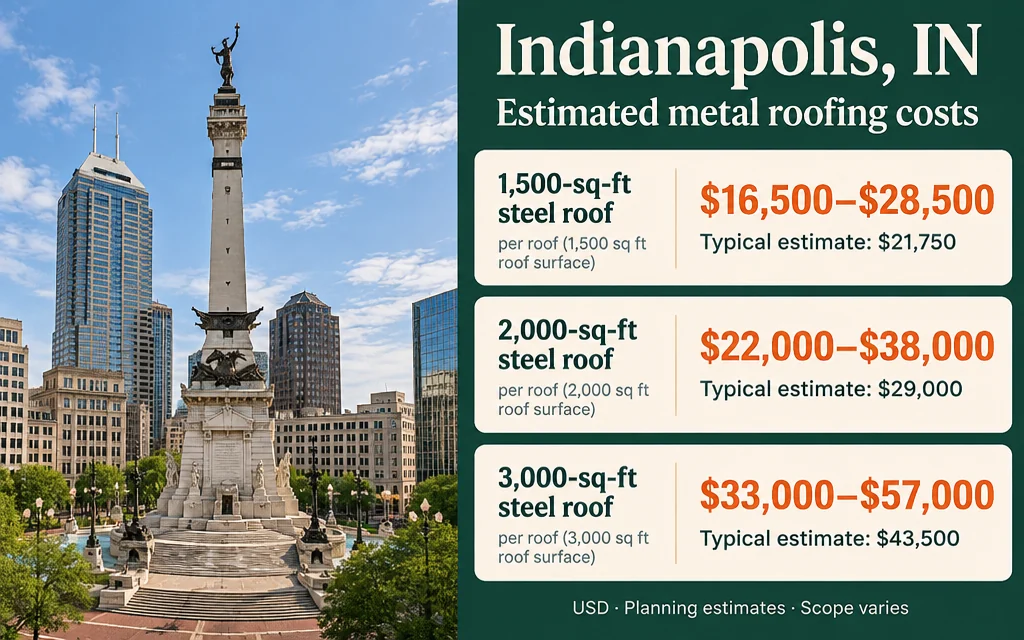
Calculated installed planning scenario for measured roof surface, including one-layer removal/disposal; conditional extras excluded.
Calculated installed planning scenario for measured roof surface, including one-layer removal/disposal; conditional extras excluded.
Calculated installed planning scenario for measured roof surface, including one-layer removal/disposal; conditional extras excluded.
Metal Roofing in the Indianapolis Market
Metal roofing in Indianapolis covers a wide spectrum of residential architecture, from historic renovations in Irvington to classic mid-century ranches on the south side. When gathering estimates, it helps to know that the term covers distinctly different systems with separate performance characteristics and budgets.
A full residential replacement quote covers more than just metal panels. A thorough proposal includes tearing off the old roof, hauling away debris, inspecting the wood deck, installing high-temperature underlayment, flashing eaves and valleys, detailing ridges and sidewalls, and skilled trades labor. In Indianapolis, budget $11–$19 per square foot of actual roof surface for standing seam steel, which totals $22,000–$38,000 on a typical 2,000-square-foot roof. Exposed-fastener utility panels sit lower on the price scale, while architectural metals such as aluminum and copper sit at a premium.
Comparing Residential Metal Roofing Systems
Standing seam concealed-fastener steel is the most common residential profile. Made from 24- or 26-gauge Galvalume steel with a factory-baked PVDF resin finish, the panels interlock along raised vertical seams elevated one to two inches above the roof deck.
Hidden clips secure the metal beneath the seam, shielding fasteners from rain, sun, and snowpack while allowing the metal to expand and contract freely along its length. For this system, budget $11–$19 per square foot installed.
Exposed-fastener steel panels—such as corrugated or ribbed profiles—cost less, running $4.50–$8.50 per square foot installed. These panels attach directly through the metal face into the roof deck with neoprene- or EPDM-gasketed screws. While budget-friendly, the assembly puts thousands of screw holes through the outer surface. Seasonal temperature shifts stress these penetration points over time, meaning homeowners must periodically inspect and maintain the rubber washers to prevent moisture intrusion.
Steel shingles provide an alternative traditional look resembling cedar shakes or slate, pricing at $8–$14 per square foot installed. Standing-seam aluminum systems run $14–$24 per square foot installed; aluminum will never rust, though its softer composition calls for thicker gauges to resist hail impact. For historic or specialty properties, standing-seam copper represents the top tier at $24–$45 per square foot installed, delivering decades of maintenance-free service that patinas over time.
| Service / assumptions | Low | Typical estimate | High | Pricing unit | Estimated labor time |
|---|---|---|---|---|---|
| Standing Seam Steel Roof (Installed)Calculated standing-seam steel planning rate: comparable panel/accessory materials + installation labor + one-layer removal/disposal. Ordinary underlayment and details over sound decking included; conditional extra work excluded. | $11 | $14.50 | $19 | per sq ft of roof surface (installed) | 3-5 business days |
| Exposed-Fastener Steel Roof (Installed)Includes tear-off, underlayment, ribbed/corrugated panels, gasketed screws, perimeter trims, and labor. | $4.50 | $6 | $8.50 | per sq ft of roof surface (installed) | 2-3 business days |
| Steel Metal Shingles (Installed)Stamped steel or stone-coated metal shingles mimicking shake/slate, installed over sound decking. | $8 | $10.50 | $14 | per sq ft of roof surface (installed) | 3-5 business days |
| Standing Seam Aluminum Roof (Installed)Rustproof .032 or .040 aluminum panels, PVDF finish, concealed clips, underlayment, tear-off, and labor. | $14 | $18 | $24 | per sq ft of roof surface (installed) | 3-5 business days |
| Standing Seam Copper Roof (Installed)Architectural 16-oz or 20-oz cold-rolled copper with hand-formed pans and soldered details over bare deck. | $24 | $32 | $45 | per sq ft of roof surface (installed) | 5-8 business days |
Labor, Materials, and Tear-Off Breakdown
Understanding how an estimate breaks into line items helps you compare competing proposals on an equal footing. For a standard residential standing seam steel installation in Indianapolis, costs divide into materials, skilled labor, and tear-off.
Materials—including 24- or 26-gauge PVDF-finished steel panels, high-temperature self-adhering underlayment, concealed clips, matching trim stock, and fasteners—account for $4.25–$7.50 per square foot. Installation labor runs $5.50–$9 per square foot, reflecting the time required to hand-form valleys, hem panel ends over drip edges, flash sidewalls, and mechanically seam panels where specified. Removing and disposing of a single layer of old asphalt shingles typically adds $1.25–$2.50 per square foot for tear-off labor, dumpster rental, and cleanup with a magnetic sweep.
| Service / assumptions | Low | Typical estimate | High | Pricing unit | Estimated labor time |
|---|---|---|---|---|---|
| Standing Seam Steel Panels & Materials24/26-gauge PVDF steel panels, concealed expansion clips, underlayment, standard ridge/eave trims. | $4.25 | $5.75 | $7.50 | per sq ft of roof surface (materials only) | N/A |
| Standing Seam Steel Installation LaborSkilled crew labor to layout panels, secure hidden clips, fold eaves, fit valleys, and install ridges. | $5.50 | $7 | $9 | per sq ft of roof surface (installation labor only) | 3-4 business days |
| One-Layer Shingle Removal & DisposalTear-off of one layer of asphalt shingles, site clean-up with magnetic sweep, and container haul-away fees. | $1.25 | $1.75 | $2.50 | per sq ft of roof surface (one-layer removal and disposal) | 1 business day |
Project Budgets by Roof Surface Area
Your roof's actual square footage is greater than the living space on your home floor plan. Overhangs, pitch steepness, dormers, and attached garages add measurable area to the total roof surface.
For a small ranch or bungalow with roughly 1,500 square feet of roof surface, a full standing seam steel roof replacement runs $16,500–$28,500, with a typical project cost near $21,750. A standard home measuring 2,000 square feet of roof area lands in the range of $22,000–$38,000, with a typical cost of $29,000. Larger properties or complex designs with 3,000 square feet of roof area budget in the range of $33,000–$57,000, averaging about $43,500. These figures assume sound existing wood decking and a single-layer tear-off under standard access conditions.
| Service / assumptions | Low | Typical estimate | High | Pricing unit | Estimated labor time |
|---|---|---|---|---|---|
| Small Home Roof (1,500 sq ft surface)Calculated scenario: 1,500 sq ft of measured roof surface × standing-seam steel installed planning rate. Includes its same materials, installation, one-layer removal/disposal and sound-deck assumptions. Not a provider whole-roof quote. | $16,500 | $21,750 | $28,500 | per roof (1,500 sq ft roof surface) | 3-4 business days |
| Standard Home Roof (2,000 sq ft surface)Calculated scenario: 2,000 sq ft of measured roof surface × standing-seam steel installed planning rate. Includes its same materials, installation, one-layer removal/disposal and sound-deck assumptions. Not a provider whole-roof quote. | $22,000 | $29,000 | $38,000 | per roof (2,000 sq ft roof surface) | 3-5 business days |
| Large Home Roof (3,000 sq ft surface)Calculated scenario: 3,000 sq ft of measured roof surface × standing-seam steel installed planning rate. Includes its same materials, installation, one-layer removal/disposal and sound-deck assumptions. Not a provider whole-roof quote. | $33,000 | $43,500 | $57,000 | per roof (3,000 sq ft roof surface) | 4-6 business days |
Metal Roofing vs. Architectural Asphalt Shingles
Standard architectural asphalt shingles remain the most widely installed residential roof covering in the Indianapolis area, pricing at $3.50–$7.50 per square foot installed under the same single-layer tear-off conditions. Choosing standing seam steel requires an upfront budget roughly two to three times that of architectural shingles.
Weighing this difference depends on how long you intend to own the property. Asphalt shingles in the Midwest endure wind, heavy precipitation, and summer sun, often needing replacement within 18 to 25 years. A properly detailed standing seam roof with a PVDF finish can last several decades longer with minimal maintenance. If you plan to stay in the home for decades, the extended lifespan offsets repeated reroofing cycles. If you plan to move within a few years, recouping the full investment through energy savings or resale equity alone is unlikely.
| Service / assumptions | Low | Typical estimate | High | Pricing unit | Estimated labor time |
|---|---|---|---|---|---|
| Architectural Shingles BenchmarkStandard architectural asphalt shingle baseline including one-layer tear-off, underlayment, and standard trim. Published rate reference for the stated roofing scope and unit, not verification of this guide's modeled range, a complete roof quote or provider availability. Regional reference; not a verified Indianapolis-specific quote.Published price reference ↗ | $3.50 | $5 | $7.50 | per sq ft of roof surface (installed) | 1-2 business days |
| Comparison | Architectural asphalt | Standing-seam steel |
|---|---|---|
| Up-front planning estimate · 2,000 sq ft roof surface | $7,000–$15,000 | $22,000–$38,000 |
| What the baseline includes | Architectural asphalt, ordinary installed details, one-layer removal/disposal over sound decking. | Standing-seam steel, ordinary installed details, one-layer removal/disposal over sound decking. |
| Maintenance and repairs | Confirm product-specific inspections and repair terms. | Confirm seams, fasteners, coating, compatible repairs and inspection terms. |
| Insurance and ownership cost | Ask the insurer about the exact product and coverage. | Ask the insurer about accepted test documentation, any available credit and cosmetic-damage exclusions. |
These are calculated budgeting comparisons, not provider quotes or guaranteed lifetime savings. Compare your expected ownership period, specified products, actual maintenance proposals and written insurance terms.
| Decision point | Roof repair | Roof replacement | Metal roofing |
|---|---|---|---|
| Work being priced | A defined defect, such as damaged shingles or flashing. | Removal and installation of an agreed roof system across the measured roof surface. | A specified installed metal system; standing seam, exposed fasteners and metal shingles are different scopes. |
| What to inspect | The leak source, surrounding material and whether a durable localized fix is feasible. | The extent of deterioration, decking condition, roof details and suitable replacement systems. | The substrate, panel profile, coating, fasteners, roof geometry and installation details. |
| How to compare prices | Match the repair quantity, access, materials and included diagnosis. | Match measured roof area, material, tear-off layers, disposal and installed inclusions. | Match measured roof area, system, components, removal and conditional additional work. |
| Before deciding | Ask what the repair addresses and what existing problems would remain. | Ask whether repair remains practical and which additional items would change the total. | Ask about compatible materials, documented product/assembly ratings and product versus workmanship warranties. |
Age or a repair-cost percentage alone does not determine the right choice. Ask a qualified roofing contractor to assess the condition and explain viable options. A metal system is a material-specific installation choice, not a separate guarantee of durability or savings.
Additional Roof Scope and Decking Items
Roofing estimates often include conditional line items for work that can only be verified once the existing roof surface is removed. If the crew discovers a second layer of old shingles, plan for an extra $40–$90 per roofing square (100 square feet) for secondary tear-off labor and hauling.
Any rotted or weakened decking must be replaced before metal panels can be fastened securely. Budget $75–$135 per 4x8-foot sheet of new plywood or OSB installed. Detailing flashings around a brick chimney costs $450–$1,000 per chimney, while curb-mounted skylight flashing kits run $350–$800 each. Upgrading to a profile-matched vented ridge costs $15–$40 per linear foot. To stop sliding snow from dumping on entryways or driveways, snow retention guards run $25–$65 per linear foot. Where existing gutters must be removed to secure drip edges correctly, detach-and-reset service adds $6–$18 per linear foot.
| Service / assumptions | Low | Typical estimate | High | Pricing unit | Estimated labor time |
|---|---|---|---|---|---|
| Additional Layer Removal & DisposalTear-off and disposal charges when a second shingle or wood-shake layer is encountered. | $40 | $60 | $90 | additional per roofing square (100 sq ft) | N/A |
| Plywood/OSB Decking ReplacementReplacement of rotted or sagging decking with 7/16-in OSB or 1/2-in CDX plywood while roof is stripped. | $75 | $100 | $135 | additional per 4-by-8-ft sheet (32 sq ft) | N/A |
| Chimney Metal Flashing & Counter-FlashingCustom-bent apron, step flashing, and reglet counter-flashing cut into brick masonry mortar joints. | $450 | $650 | $1,000 | additional per chimney | N/A |
| Skylight Flashing Kit & IntegrationCustom high-temp underlayment wrap, head sill, and matching side channel flashings for curb skylights. | $350 | $500 | $800 | additional per skylight | N/A |
| Standing Seam Vented Ridge UpgradePerforated metal or breathable baffle intake/exhaust system tailored to metal panel profiles. | $15 | $24 | $40 | additional per linear ft | N/A |
| Snow Retention Bar / Guard SystemContinuous bar or clamp-on seam guards installed above entrances and walkways to prevent avalanching. | $25 | $40 | $65 | additional per linear ft | N/A |
| Gutter Detach and ResetCareful removal and reinstallation of existing gutters to allow proper drip edge and fascia metal work. | $6 | $10 | $18 | additional per linear ft | N/A |
Durability, Testing Standards, and Weather Performance
Metal provides strong resistance to rain, wind, and freeze-thaw cycles, but its performance depends on system engineering rather than marketing labels. Ratings should always be reviewed alongside your specific assembly.
Impact performance is evaluated under UL 2218 standards, with many 24-gauge standing seam and metal shingle profiles earning a Class 4 rating. While a Class 4 rating indicates resistance to puncture and leaks during severe storms, it does not guarantee panels will avoid cosmetic dimpling during heavy hail. Check your insurance policy terms before purchasing: some homeowner policies include cosmetic damage exclusions that limit claims when panels are indented but watertight. Fire resistance depends on the complete roof deck assembly; metal panels achieve a Class A fire rating only when paired with approved underlayments over solid decking. Wind uplift capability relies on correct clip spacing and secure deck fastening to keep panels stable in heavy gusts.
Key Cost Drivers on Indianapolis Homes
Roof geometry has the greatest effect on labor costs. A straightforward gable roof with few penetrations allows swift panel layout, minimal off-cuts, and straightforward ridge capping.
Steep pitches (such as 10:12 or higher), intersecting hips, dormers, and multiple valleys require custom hand-brake bending on site, which increases labor time and material waste.
Panel gauge and paint finishes also affect pricing. Selecting 24-gauge steel instead of lighter 26-gauge steel adds rigidity and reduces visible surface waviness (oil canning). Factory-applied PVDF (Kynar 500) coatings offer strong color retention and UV protection over many years compared to economical silicone-modified polyester (SMP) finishes. Site access and urban lot lines can also influence final bids if staging areas or waste disposal require extra handling.
Contractor Vetting and Contract Checklist
Installing standing seam metal requires specific sheet-metal training and specialized tooling. An experienced metal contractor should handle seam folding, underlayment detailing, and thermal expansion allowances differently than a crew primarily focused on asphalt shingles.
Before signing an agreement, verify active general liability coverage and worker's compensation insurance. Confirm who is responsible for obtaining any required municipal permits for your address. Your written contract should itemize the steel gauge, panel profile, underlayment specifications, flashing materials, and per-sheet rates for decking repairs. Make sure the proposal clearly distinguishes between the manufacturer substrate or paint warranty and the contractor's written workmanship warranty covering installation leaks.
STATEWIDE COST CONTEXT
Indiana prices, income & labor costs
These Indiana figures provide background for this city guide. They describe different measures and reference years; employee wages are not prices charged by a contractor.
BEA SAIRPD
State price change indicator
115.42024 · index (2017 basis)
Annual figures & sources
| Year | Value | 90% margin of error | Source |
|---|---|---|---|
| 2020 | 96.0 | — | Official source |
| 2021 | 100.9 | — | Official source |
| 2022 | 106.7 | — | Official source |
| 2023 | 111.0 | — | Official source |
| 2024 | 115.4 | — | Official source |
Census ACS 1-year
Median household income
$74,5162025 · USD/year
Annual figures & sources
| Year | Value | 90% margin of error | Source |
|---|---|---|---|
| 2021 | $62,743 | ±$716 | Official source |
| 2022 | $66,785 | ±$659 | Official source |
| 2023 | $69,477 | ±$808 | Official source |
| 2024 | $71,959 | ±$630 | Official source |
| 2025 | $74,516 | ±$875 | Official source |
BLS OEWS
Roofers
$27.882025 · USD/hour
Annual figures & sources
| Year | Value | 90% margin of error | Source |
|---|---|---|---|
| 2025 | $27.88 | — | Official source |
State prices: BEA, 2020–2024. Household income: Census ACS, 2021–2025. Employee wages: BLS, May 2025 snapshot. The charts retain their own units and fitted scales.
Explore all Indiana living-cost data and trends →Local context and limitations
Indianapolis experiences wide continental temperature swings, ranging from hot, humid summer afternoons to sub-zero winter spells with active freeze-thaw cycles. Sheet metal responds to these shifts through continuous thermal expansion and contraction. Concealed-clip standing seam systems accommodate this movement through hidden expansion clips, reducing the risk of screw-hole elongation seen in exposed-fastener panels. Because local requirements can vary across Marion County and neighboring jurisdictions, confirm with your local building department whether specific ice-barrier underlayment depths are required at the eaves for your roof pitch. Homeowners in historic conservation areas, such as Lockerbie Square, Irvington, or Woodruff Place, should also verify profile and color guidelines with the relevant historic preservation commission before committing to a panel profile.
Frequently asked questions
What is the difference between standing seam and exposed fastener metal roofs?
Standing seam uses raised interlocking ribs and concealed clips that allow panels to expand and contract during seasonal temperature swings without exposing fasteners to weather. Exposed-fastener roofs use screws driven directly through the panel face with rubber sealing washers. Those washers face direct sun and weather exposure and should be inspected periodically for wear, loosening, or degradation.
Can a metal roof be installed over my old asphalt shingles in Indianapolis?
Installing standing seam directly over existing shingles is generally discouraged. Tearing off the old shingles lets the crew inspect the wood decking, repair rotted sections, and install a continuous high-temperature underlayment, which many manufacturers require for full warranty coverage. Always verify local permit rules and manufacturer specifications for your address before choosing an overlay.
Will installing a metal roof lower my homeowners insurance premiums?
Some insurers provide policy discounts for metal roofs carrying a UL 2218 Class 4 impact rating, but credits are not guaranteed or standard across all carriers. In addition, some policies add cosmetic damage endorsements, excluding payouts for panel dimples if the metal remains watertight. Contact your insurance agent to verify coverage terms before choosing a system.
How do snow guards work on an Indianapolis metal roof?
Because smooth metal sheds accumulated snow quickly once panels warm up, snow can slide off in large sheets. Snow guards or rail systems hold snow in place above walkways, doorways, and delicate landscape beds, allowing the snowpack to melt gradually rather than sliding off in an avalanche that could damage gutters or property below.
Does a metal roof make inside living spaces louder during rainstorms?
When installed over solid wood sheathing with quality synthetic underlayment and standard residential attic insulation, rain noise on a residential metal roof sounds very similar to rain on asphalt shingles. The loud drumming often associated with metal roofs occurs on open-framed buildings, such as pole barns and carports that lack finished ceilings and insulation.
What is Galvalume, and is it the same as aluminum?
Galvalume is not solid aluminum; it is steel sheet coated with an alloy of aluminum, zinc, and silicon to provide barrier and sacrificial corrosion protection. Solid aluminum panels contain no iron and cannot rust, but aluminum is a softer metal that generally carries a higher material cost than Galvalume steel.
Sources and methodology
Sources below retain their recorded retrieval dates and geographic scope. We checked the quoted rates against readable public pricing pages. The tables remain planning estimates, not provider quotes or a measured citywide survey. Per-square-foot references do not establish the modeled whole-roof totals or all their installed inclusions. Regional references are not verified Indianapolis-specific quotes. Confirm removal, disposal, materials, labor and the complete scope in a written proposal.
Published pricing pages retrieved; quoted excerpts checked automatically. 3 distinct website domains. · Generated 2026-11-12
- How To Calculate The Cost Of A Roof Replacement In Indianapolis INCity-specific page context · Page retrieved 2026-11-12 · Price excerpt matched automatically
“The cost of installing this type of roofing in Indianapolis is about $5 per square foot, which is within the average range for most places.”
Planning ranges may differ from these published examples; they are not provider quotes.
- How Much Does a Metal Roof Cost in Wilmington, NC? (2026) - 50 North Roofing CompanyState / regional reference · Page retrieved 2026-11-12 · Price excerpt matched automatically
“You will pay between $8.00 and $14.60 per square foot for metal roofing materials and installation .”
Planning ranges may differ from these published examples; they are not provider quotes.
- Roof Replacement Cost in North Carolina [2026 Guide] | Pinnacle Home ImprovementsState / regional reference · Page retrieved 2026-11-12 · Price excerpt matched automatically
“Architectural/dimensional shingles: These upgraded products cost $5-8 per square foot installed.”
Planning ranges may differ from these published examples; they are not provider quotes.
Plan your metal roofing project
Choose your service and answer its project questions. Add notes or photos if helpful, then generate your project brief. The planner labels its budgeting assumptions separately. Use your plan to compare the scope and assumptions with a provider. Contact sharing and provider matching are not available yet.
Open the project planner →Share this city’s cost data
<> Embed Indianapolis Cost Data on Your Site
The HTML table shows the prices at the time of copying. The iframe follows the published guide.