Jersey City · NJ · COST GUIDE
Metal Roofing Costs in Jersey City, NJ (2026)
For budgeting, standing-seam steel roofing is estimated at $15–$23 per sq ft of roof surface, and exposed-fastener steel at $9.50–$14.50 per sq ft. These installed planning ranges include one-layer removal/disposal over sound decking; compare the specified system and conditional extras.
Standing Seam Steel (Installed)
Budget estimate$15–$23per sq ft of roof surface (installed)
Planning range · Compare the roof area, material and included work in your quote.
Exposed Fastener Steel (Installed)
Budget estimate$9.50–$14.50per sq ft of roof surface (installed)
Planning range · Compare the roof area, material and included work in your quote.
Published examples apply to their stated scope. Budget ranges are estimates.
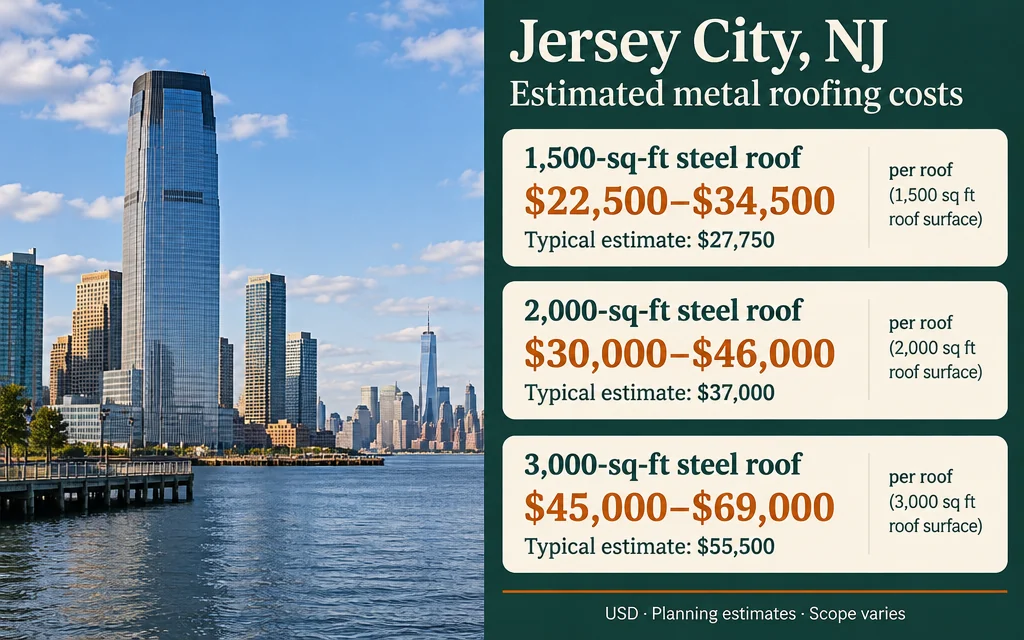
Calculated installed planning scenario for measured roof surface, including one-layer removal/disposal; conditional extras excluded.
Calculated installed planning scenario for measured roof surface, including one-layer removal/disposal; conditional extras excluded.
Calculated installed planning scenario for measured roof surface, including one-layer removal/disposal; conditional extras excluded.
Metal Roofing Investment Overview for Jersey City
Installing a metal roof in Jersey City represents a substantial upfront investment compared to traditional roofing materials. For standing-seam steel, budget $15–$23 per sq ft of roof surface installed.
On a home with a 2,000-square-foot roof surface, that places a complete installation at $30,000–$46,000 per roof. This planning baseline accounts for stripping one existing layer of asphalt shingles, laying high-temperature synthetic underlayment, and fastening custom-formed panels with concealed clips over sound decking.
While metal carries higher initial pricing than asphalt, it offers durable resistance to high winds and does not support the moss and algae growth common during humid Hudson County summers. Material selection plays a critical role in an urban waterfront environment: painted Galvalume steel (steel coated with an aluminum-zinc alloy) and aluminum perform well against moisture and airborne pollutants when treated with a factory polyvinylidene fluoride (PVDF) finish.
Residential Metal Roofing Systems Compared
Performance, maintenance demands, and overall expense vary significantly across metal profiles and attachment methods.
Concealed-fastener standing-seam steel is the residential standard for long-term installations across northern New Jersey. Vertical panels interlock over concealed clips fastened directly into the decking, allowing thermal expansion and contraction without stressing fastener points. For standing-seam steel, budget $15–$23 per sq ft installed.
Exposed-fastener steel systems, including corrugated and 5V-crimp sheets, cost less initially at $9.50–$14.50 per sq ft installed. However, these panels are secured through the exterior metal with thousands of neoprene-washer screws. Over time, sunlight and freeze-thaw cycles degrade the rubber washers, requiring periodic inspections and screw replacements to prevent leaks.
Steel metal shingles and stone-coated modular tiles budget $13.50–$19 per sq ft installed. These provide traditional slate or shake profiles while using concealed clips suited for residential rooflines.
Properties near brackish waterways or exposed to heavy coastal fog may benefit from standing-seam aluminum at $16–$24.50 per sq ft installed, which avoids red rust even if scratched. Architectural standing-seam copper sits at the top tier at $28–$48 per sq ft installed, requiring specialized sheet-metal fabrication and soldering for custom valleys and wall terminations.
| Service / assumptions | Low | Typical estimate | High | Pricing unit | Estimated labor time |
|---|---|---|---|---|---|
| Standing Seam Steel (Installed)Calculated standing-seam steel planning rate: comparable panel/accessory materials + installation labor + one-layer removal/disposal. Ordinary underlayment and details over sound decking included; conditional extra work excluded. | $15 | $18.50 | $23 | per sq ft of roof surface (installed) | 3 to 6 working days |
| Exposed Fastener Steel (Installed)Ribbed corrugated or 5V crimp steel with color-matched gasketed screws, including one-layer tear-off and synthetic underlayment. | $9.50 | $12 | $14.50 | per sq ft of roof surface (installed) | 2 to 4 working days |
| Steel Metal Shingles / Tiles (Installed)Stamped stone-coated or painted steel modular panels mimicking slate or wood shake, installed with concealed fasteners. | $13.50 | $16 | $19 | per sq ft of roof surface (installed) | 3 to 5 working days |
| Standing Seam Aluminum (Installed)0.032 or 0.040-inch aluminum alloy panels with concealed clips; optimal corrosion resistance for coastal Hudson County. | $16 | $19.50 | $24.50 | per sq ft of roof surface (installed) | 3 to 6 working days |
| Standing Seam Copper (Installed)16 oz or 20 oz architectural copper panels, soldered transitions, copper clips, and specialized architectural sheet metal labor. | $28 | $36 | $48 | per sq ft of roof surface (installed) | 5 to 10 working days |
Cost Components: Panels, Labor, and Tear-Off
A complete standing-seam steel quote is assembled from three core allowances: panel and accessory materials, skilled installation labor, and disposal of the previous roof covering.
Materials typically budget $5–$7.50 per sq ft of roof surface. This includes 24-gauge Galvalume panels with a PVDF finish, starter and edge trims, ridge caps, concealed expansion clips, and high-temperature self-adhering underlayment formulated specifically for high heat under metal surfaces.
Skilled installation labor accounts for the largest portion at $8.50–$13 per sq ft. Standing-seam systems demand specialized sheet-metal craft to hand-form watertight eave hems, fabricate transition flashing, and detail valleys, parapets, and sidewalls.
Stripping and disposing of one existing layer of asphalt shingles adds $1.50–$2.50 per sq ft. Combining these three allowances establishes the installed planning baseline of $15–$23 per sq ft of roof surface over sound decking.
| Service / assumptions | Low | Typical estimate | High | Pricing unit | Estimated labor time |
|---|---|---|---|---|---|
| Standing Seam Steel Materials Allowance24-ga Galvalume panels, factory PVDF coating, starter/ridge trim, concealed clips, screws, and high-temp underlayment. | $5 | $6.25 | $7.50 | per sq ft of roof surface (materials only) | N/A |
| Standing Seam Steel Installation LaborCrew labor for staging, panel roll-forming/fitting, concealed clip fastening, and standard rake, eave, and ridge flashing work. | $8.50 | $10.50 | $13 | per sq ft of roof surface (installation labor only) | 3 to 5 working days |
| One-Layer Removal & Disposal AllowanceStripping one layer of existing asphalt shingles down to wood deck, jobsite cleanup, magnetic sweep, and container haul-away. | $1.50 | $1.75 | $2.50 | per sq ft of roof surface (one-layer removal and disposal) | 1 to 2 working days |
Estimated Costs Across Common Roof Sizes
Roofing bids are based on actual roof surface area, which is larger than a home's interior square footage because of slope, pitch multipliers, overhangs, and architectural features.
A compact 1,500-square-foot roof surface—common on urban rowhouses and smaller footprint homes—ranges from $22,500–$34,500 per roof for fully installed standing-seam steel, typically requiring 3 to 5 working days of on-site work. A medium-sized 2,000-square-foot roof on a detached two-story house totals $30,000–$46,000 per roof with a typical schedule of 4 to 6 working days. For an expansive 3,000-square-foot roofline with multiple valleys and dormers, plan on $45,000–$69,000 per roof over 5 to 8 working days.
In dense Jersey City neighborhoods, site logistics often influence where a bid lands within these ranges. Setting up scaffolding along narrow lot boundaries, navigating overhead utility lines, and hand-carrying metal bundles to rear elevations increase the on-site crew hours necessary to finish the job safely.
| Service / assumptions | Low | Typical estimate | High | Pricing unit | Estimated labor time |
|---|---|---|---|---|---|
| 1,500 Sq Ft Standing Seam Steel RoofCalculated scenario: 1,500 sq ft of measured roof surface × standing-seam steel installed planning rate. Includes its same materials, installation, one-layer removal/disposal and sound-deck assumptions. Not a provider whole-roof quote. | $22,500 | $27,750 | $34,500 | per roof (1,500 sq ft roof surface) | 3 to 5 working days |
| 2,000 Sq Ft Standing Seam Steel RoofCalculated scenario: 2,000 sq ft of measured roof surface × standing-seam steel installed planning rate. Includes its same materials, installation, one-layer removal/disposal and sound-deck assumptions. Not a provider whole-roof quote. | $30,000 | $37,000 | $46,000 | per roof (2,000 sq ft roof surface) | 4 to 6 working days |
| 3,000 Sq Ft Standing Seam Steel RoofCalculated scenario: 3,000 sq ft of measured roof surface × standing-seam steel installed planning rate. Includes its same materials, installation, one-layer removal/disposal and sound-deck assumptions. Not a provider whole-roof quote. | $45,000 | $55,500 | $69,000 | per roof (3,000 sq ft roof surface) | 5 to 8 working days |
Standing Seam Metal vs. Architectural Asphalt
When evaluating long-term roofing options, architectural asphalt shingles serve as the standard regional benchmark, running $7–$11 per sq ft installed. Standing-seam steel requires roughly double that initial outlay.
Deciding between the two depends heavily on your planned tenure in the home. Industry references and manufacturer specifications indicate that architectural shingles in northern New Jersey generally deliver 20 to 25 years of service before wind stress, granular loss, and thermal cycling require replacement. In contrast, standing-seam steel with a factory PVDF finish often carries design-life expectations of 40 to 50 years or longer when properly maintained, potentially avoiding the disruption of a second reroofing project.
Standing-seam panels also resist wind-driven rain and wind uplift without shingle blow-off risks. However, if you plan to sell the home within the next five to ten years, you are unlikely to recoup the higher upfront investment through market resale value alone.
| Service / assumptions | Low | Typical estimate | High | Pricing unit | Estimated labor time |
|---|---|---|---|---|---|
| Architectural Asphalt Shingles (Reference)Benchmark comparison using dimensional shingles, underlayment, starter/ridge shingles, standard flashing, and one tear-off layer. | $7 | $8.75 | $11 | per sq ft of roof surface (installed) | 1 to 3 working days |
| Comparison | Architectural asphalt | Standing-seam steel |
|---|---|---|
| Up-front planning estimate · 2,000 sq ft roof surface | $14,000–$22,000 | $30,000–$46,000 |
| What the baseline includes | Architectural asphalt, ordinary installed details, one-layer removal/disposal over sound decking. | Standing-seam steel, ordinary installed details, one-layer removal/disposal over sound decking. |
| Maintenance and repairs | Confirm product-specific inspections and repair terms. | Confirm seams, fasteners, coating, compatible repairs and inspection terms. |
| Insurance and ownership cost | Ask the insurer about the exact product and coverage. | Ask the insurer about accepted test documentation, any available credit and cosmetic-damage exclusions. |
These are calculated budgeting comparisons, not provider quotes or guaranteed lifetime savings. Compare your expected ownership period, specified products, actual maintenance proposals and written insurance terms.
| Decision point | Roof repair | Roof replacement | Metal roofing |
|---|---|---|---|
| Work being priced | A defined defect, such as damaged shingles or flashing. | Removal and installation of an agreed roof system across the measured roof surface. | A specified installed metal system; standing seam, exposed fasteners and metal shingles are different scopes. |
| What to inspect | The leak source, surrounding material and whether a durable localized fix is feasible. | The extent of deterioration, decking condition, roof details and suitable replacement systems. | The substrate, panel profile, coating, fasteners, roof geometry and installation details. |
| How to compare prices | Match the repair quantity, access, materials and included diagnosis. | Match measured roof area, material, tear-off layers, disposal and installed inclusions. | Match measured roof area, system, components, removal and conditional additional work. |
| Before deciding | Ask what the repair addresses and what existing problems would remain. | Ask whether repair remains practical and which additional items would change the total. | Ask about compatible materials, documented product/assembly ratings and product versus workmanship warranties. |
Age or a repair-cost percentage alone does not determine the right choice. Ask a qualified roofing contractor to assess the condition and explain viable options. A metal system is a material-specific installation choice, not a separate guarantee of durability or savings.
Common Roof Add-Ons and Structural Decking Repairs
A standard metal roofing scope assumes installation over clean, structurally sound wood decking. Discovering damaged wood or adding specialty accessories creates itemized charges.
On older homes in Jersey City, contractors regularly find soft, rotted, or split sheathing near eaves and valleys once old shingles come off. Replacing damaged wood with new CDX plywood or OSB runs $75–$125 per 4-by-8-foot sheet. If tear-off reveals a second underlying layer of old shingles, removing and hauling it away adds $100–$175 per roofing square (100 square feet).
Penetrations require custom-formed sheet metal flashings. Flashing and counter-flashing an existing brick masonry chimney runs $400–$1,100 per chimney, while watertight curb flashing for skylights costs $350–$850 per skylight. Installing a continuous ventilated ridge cap adds $14–$30 per linear ft. For steep pitches positioned above public sidewalks, entries, or parking pads, non-penetrating seam-clamped snow retention systems run $18–$42 per linear ft. If existing gutters must be removed to fit new drip-edge profiles and rehung, budget $6–$16 per linear ft.
| Service / assumptions | Low | Typical estimate | High | Pricing unit | Estimated labor time |
|---|---|---|---|---|---|
| Additional Shingle Layer Tear-OffIncremental labor and disposal charge when a second or third existing roof layer is uncovered during strip-down. | $100 | $130 | $175 | additional per roofing square (100 sq ft) | N/A |
| Plywood / OSB Decking ReplacementInstalled 1/2-in or 5/8-in CDX plywood sheathing to replace deteriorated, dry-rotted, or broken substrate sections.Published price reference ↗ | $75 | $95 | $125 | additional per 4-by-8-ft sheet (32 sq ft) | N/A |
| Masonry Chimney Flashing & Cricket DetailCustom-bent metal step/counter flashing cut and mortared into chimney brickwork, including backer cricket diversion saddle. | $400 | $650 | $1,100 | additional per chimney | N/A |
| Skylight Flashing IntegrationDedicated watertight metal curb flashing package fabricated specifically to interface with standing seam panel profiles. | $350 | $550 | $850 | additional per skylight | N/A |
| Metal Ridge Ventilation UpgradeContinuous baffle-screened ventilated ridge cap system fabricated to vent metal attic plenums while blocking driven rain. | $14 | $20 | $30 | additional per linear ft | N/A |
| Snow Guard / Bar Retention SystemSeam-clamped non-penetrating aluminum/steel snow rails or pad blocks over high-traffic walkways, entry doors, and driveways. | $18 | $28 | $42 | additional per linear ft | N/A |
| Gutter Detach & ResetCarefully removing existing seamless gutters prior to drip edge metal installation and reinstalling them with heavy-duty brackets. | $6 | $10 | $16 | additional per linear ft | N/A |
Performance Standards: Wind, Hail, Fire, and Maritime Salt
Metal roofing provides exceptional durability, but real-world performance depends on the exact tested assembly rather than broad material claims.
Many residential steel panels carry a UL 2218 Class 4 impact rating, the highest lab benchmark for hail resistance. This test shows that dropped steel balls do not split or puncture the metal; it is not a guarantee that the roof will remain free of cosmetic indentations after severe hailstorms. Insurance policy provisions vary by underwriter, and some carriers offer rate discounts only with a cosmetic damage endorsement that excludes payouts for surface dents.
Wind uplift resistance relies on fastener frequency and clip design meeting UL 580 or UL 1897 standards. Noncombustible steel panels contribute to fire-resistant exterior construction, though achieving an overall Class A fire assembly requires approved high-temperature underlayment over solid wood decking.
Around the Hackensack and Hudson river areas, atmospheric salt and humidity make coating chemistry essential. Galvalume steel finished with a Kynar 500 or Hylar 5000 PVDF resin system provides strong defense against cut-edge corrosion and surface chalking.
Key Drivers of Metal Roofing Quotes in Jersey City
Roofing contractors build estimates based on roof geometry, material gauge, and site logistics.
Roof geometry drives installation hours more than footprint size. A straightforward two-sided gable roof goes up relatively fast. Complex rooflines with dormers, hips, valleys, and masonry parapets require extensive manual sheet-metal brake work and custom flashing transitions, increasing skilled labor hours.
Urban site conditions also affect overall project pricing. When tight lot lines leave no private driveway or yard space for a disposal container or boom truck, confirm whether the contractor's quote accounts for municipal street-occupancy permits, parking meter bagging, or pedestrian canopy setup if sidewalks are obstructed.
Panel gauge is another primary price driver. Heavy 24-gauge steel costs more than lighter 26-gauge or 29-gauge options, but it offers superior resistance to thermal 'oil canning' (surface waviness) and better withstands falling tree branches or minor foot traffic.
Hiring a Qualified Metal Roofing Contractor in Jersey City
Standing-seam installation requires architectural sheet-metal skills that differ significantly from asphalt shingle roofing. Improper detailing can cause persistent leaks at flashing transitions or prevent panels from expanding naturally with temperature swings.
Verify that the contractor holds an active New Jersey Home Improvement Contractor (HIC) registration and carries verified general liability and workers' compensation coverage. Ask whether the crew roll-forms panels on-site to custom lengths or orders factory-cut sections; continuous panels eliminate leak-prone horizontal end laps on long runs.
Ensure your written proposal specifies panel gauge (24-gauge is standard for quality residential work), substrate chemistry (specify Galvalume rather than basic electro-galvanized steel), paint coating type (PVDF), and the underlayment brand. Finally, confirm the boundary between the manufacturer's finish warranty—which covers paint peeling and chalking—and the roofer's workmanship warranty covering flashing watertightness and joint integrity.
Local income & housing costs
Jersey City city, New Jersey · U.S. Census Bureau, 2025 ACS 1-year estimates.
per month · ±$93
Cash-rent units; includes applicable tenant-paid utilities
Census source ↗Dollar amounts use the survey period’s published basis. Income is annual; gross rent is monthly. Home value reflects owner-occupied housing values. Margins of error shown are at the ACS 90% confidence level. These statistics provide city context; service budgets use their own pricing evidence.
STATEWIDE COST CONTEXT
New Jersey prices, income & labor costs
These New Jersey figures provide background for this city guide. They describe different measures and reference years; employee wages are not prices charged by a contractor.
BEA SAIRPD
State price change indicator
134.62024 · index (2017 basis)
Annual figures & sources
| Year | Value | 90% margin of error | Source |
|---|---|---|---|
| 2020 | 115.9 | — | Official source |
| 2021 | 119.0 | — | Official source |
| 2022 | 126.3 | — | Official source |
| 2023 | 131.3 | — | Official source |
| 2024 | 134.6 | — | Official source |
Census ACS 1-year
Median household income
$107,7972025 · USD/year
Annual figures & sources
| Year | Value | 90% margin of error | Source |
|---|---|---|---|
| 2021 | $89,296 | ±$1,088 | Official source |
| 2022 | $96,346 | ±$1,114 | Official source |
| 2023 | $99,781 | ±$1,061 | Official source |
| 2024 | $104,294 | ±$997 | Official source |
| 2025 | $107,797 | ±$1,374 | Official source |
BLS OEWS
Roofers
$36.832025 · USD/hour
Annual figures & sources
| Year | Value | 90% margin of error | Source |
|---|---|---|---|
| 2025 | $36.83 | — | Official source |
State prices: BEA, 2020–2024. Household income: Census ACS, 2021–2025. Employee wages: BLS, May 2025 snapshot. The charts retain their own units and fitted scales.
Explore all New Jersey living-cost data and trends →Local context and limitations
Metal roofing estimates for Jersey City reflect regional northern New Jersey trade pricing and urban site logistics. When properties have close lot lines or multi-story facades, contractors have to evaluate access for material staging and debris disposal on a per-property basis. If scaffolding or dumpsters must touch a sidewalk or public street, ask the contractor whether municipal right-of-way staging permits or street-occupancy approvals are required for your specific address. Moisture and salt air around Newark Bay and the Hudson River also make corrosion resistance a design priority; quotes often specify painted Galvalume or aluminum with a PVDF finish over unpainted galvanized steel. Because direct published pricing within Jersey City is limited and draws on regional benchmarks, request itemized quotes that specify panel gauge, staging methods, and flashing assemblies.
Frequently asked questions
What is the difference between standing seam and exposed-fastener metal roofs?
Standing seam uses vertical ribs joined by concealed clips underneath the metal, leaving no exposed screw penetrations and allowing panels to expand and contract smoothly. Exposed-fastener roofs are attached by driving screws through the panel surface into the roof deck. While exposed-fastener systems cost less initially, the thousands of exterior rubber washers can degrade over time from UV and weather exposure, requiring ongoing inspection and eventual replacement.
Can a metal roof be installed over an existing asphalt shingle roof?
Some manufacturers provide installation details for fastening over a single flat layer of shingles, but contractors widely advise tearing off old roofing down to the bare deck. Stripping the roof reveals damaged or rotted sheathing, avoids trapping moisture, ensures an even surface so metal panels do not buckle or exhibit oil canning, and allows proper installation of high-temperature underlayment. Verify with your local building department whether municipal code permits an overlay on your specific structure and whether the existing roof structure can carry the dead load.
How noisy is a metal roof during heavy rain or hail?
When installed over solid plywood or OSB decking, paired with high-temperature underlayment and standard attic insulation, a standing-seam metal roof is no louder than an asphalt shingle roof. The solid roof deck and ceiling insulation absorb acoustic vibration, unlike open-frame metal installations on agricultural outbuildings.
Will my homeowner's insurance policy offer a discount for installing a metal roof?
Some insurers offer rate credits for roofs certified with a UL 2218 Class 4 impact resistance rating, but discounts vary widely and are never guaranteed. Contact your insurance agent to verify eligible credits and ask whether the policy includes a cosmetic damage waiver that excludes coverage for superficial denting that does not cause leaks.
Why are snow guards necessary on a residential metal roof?
Smooth metal panels shed accumulated snow and ice quickly once sunlight warms the surface. On homes close to public sidewalks, entry doors, or driveways, sudden snow slides can damage gutters, crush foundation landscaping, or endanger pedestrians. Clamp-on snow guards or continuous rail retention systems hold snow on the roof until it melts gradually.
What gauge steel is recommended for a residential roof?
For residential standing seam, 24-gauge Galvalume steel is the standard recommendation. It offers structural rigidity, minimizes visible oil canning (surface rippling), and withstands storm debris better than thinner 26-gauge or 29-gauge panels.
Sources and methodology
Sources below retain their recorded retrieval dates and geographic scope. We checked the quoted rates against readable public pricing pages. The tables remain planning estimates, not provider quotes or a measured citywide survey. Per-square-foot references do not establish the modeled whole-roof totals or all their installed inclusions. Regional references are not verified Jersey City-specific quotes. Confirm removal, disposal, materials, labor and the complete scope in a written proposal.
Published pricing pages retrieved; quoted excerpts checked automatically. 2 distinct website domains. · Generated 2026-11-12
- Roof Replacement Cost in NJ: 2026 Price Per SquareState / regional reference · Page retrieved 2026-11-12 · Price excerpt matched automatically
“replacement decking runs $70 to $110 per sheet installed”
Planning ranges may differ from these published examples; they are not provider quotes.
- Metal Roof Cost In 2026: Homeowner's Pricing GuideState / regional reference · Page retrieved 2026-11-12 · Price excerpt matched automatically
“Steel roofing: $12 to $18 per square foot installed.”
Planning ranges may differ from these published examples; they are not provider quotes.
Plan your metal roofing project
Choose your service and answer its project questions. Add notes or photos if helpful, then generate your project brief. The planner labels its budgeting assumptions separately. Use your plan to compare the scope and assumptions with a provider. Contact sharing and provider matching are not available yet.
Open the project planner →Share this city’s cost data
<> Embed Jersey City Cost Data on Your Site
The HTML table shows the prices at the time of copying. The iframe follows the published guide.