Las Vegas · NV · COST GUIDE
Metal Roofing Costs in Las Vegas, NV (2026)
For budgeting, standing-seam steel roofing is estimated at $9.50–$16.50 per sq ft of roof surface, and exposed-fastener steel at $4.50–$8.50 per sq ft. These installed planning ranges include one-layer removal/disposal over sound decking; compare the specified system and conditional extras.
Standing Seam Steel (Concealed Fastener)
Budget estimate$9.50–$16.50per sq ft of roof surface (installed)
Planning range · Compare the roof area, material and included work in your quote.
Exposed Fastener Steel (Ribbed/Corrugated)
Budget estimate$4.50–$8.50per sq ft of roof surface (installed)
Planning range · Compare the roof area, material and included work in your quote.
Published examples apply to their stated scope. Budget ranges are estimates.
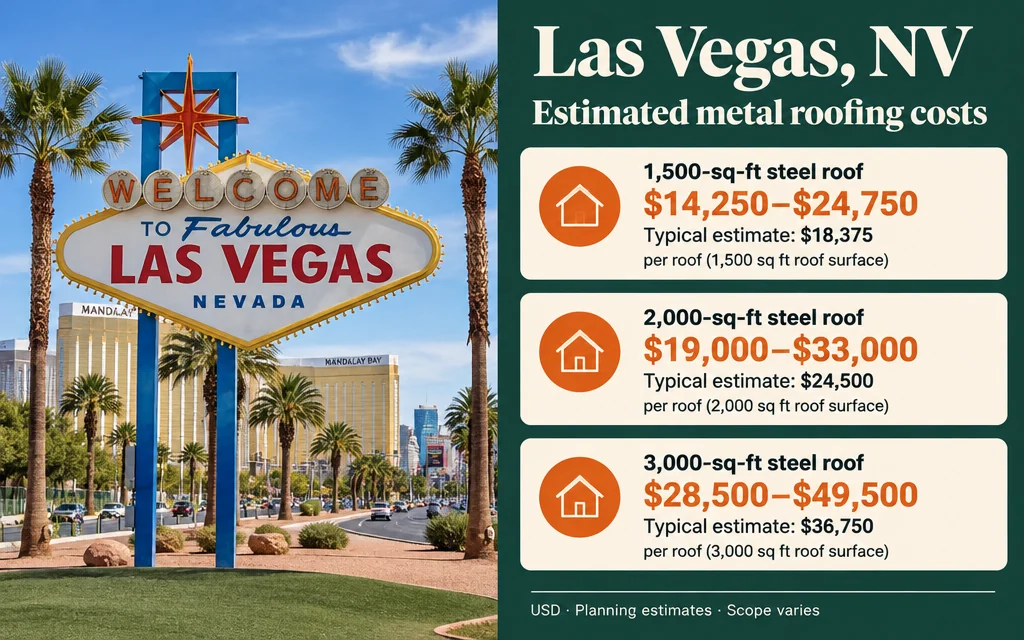
Calculated installed planning scenario for measured roof surface, including one-layer removal/disposal; conditional extras excluded.
Calculated installed planning scenario for measured roof surface, including one-layer removal/disposal; conditional extras excluded.
Calculated installed planning scenario for measured roof surface, including one-layer removal/disposal; conditional extras excluded.
Metal Roofing in Las Vegas: Costs and Considerations
Metal roofing offers an exceptionally durable, fire-resistant alternative to traditional concrete tile and architectural shingles in the Las Vegas Valley. While clay and concrete tile roofs remain common across local subdivisions, metal profiles provide substantial weight savings, long service lives, and strong solar reflectance when treated with factory cool-roof coatings.
Estimating a residential metal roof requires calculating measured roof surface area rather than home floor plans. Measured roof surface area is stated in roofing squares (100 square feet each) and is consistently larger than interior livable square footage due to slope, overhangs, and architectural hips or valleys. For instance, a single-story ranch home with 1,600 square feet of floor space frequently carries 1,900 to 2,100 square feet of roof surface. For preliminary budgeting, a complete standing-seam steel installation in Las Vegas is estimated at budget $9.50–$16.50 per square foot of roof surface, with a typical rate of $12.25. This baseline covers tear-off of one shingle layer, high-temperature underlayment, and standard trim over sound decking.
Metal Roofing Systems Compared
Selecting a metal roof profile directly shapes material performance, maintenance requirements, and overall project cost.
Standing-Seam Concealed-Fastener Steel (budget $9.50–$16.50 per sq ft installed, typical $12.25): The standard residential metal specification. Panels are roll-formed from 24-gauge or 26-gauge Galvalume sheet steel finished with factory-applied PVDF/Kynar coatings. The defining feature is concealed clips: panels lock together over clips fastened to the decking, keeping screw penetrations sheltered beneath the metal seam. This configuration lets panels expand and contract freely along the slope as temperatures shift throughout the desert day.
Exposed-Fastener Ribbed Steel Panels (budget $4.50–$8.50 per sq ft installed, typical $6.25): Known commonly as corrugated or ribbed sheet metal, often rolled from 26- to 29-gauge steel. Panels overlap and are secured by screws driven straight through the metal surface into the deck. Each screw relies on an elastomeric neoprene or EPDM washer to maintain a watertight seal. Because the washers and fastener heads remain directly exposed to desert sun and heat, building owners should anticipate scheduled inspections and periodic fastener maintenance or washer replacement as rubber seals age.
Steel Metal Shingles and Tiles (budget $8.50–$14.50 per sq ft installed, typical $11.00): Stamped steel shingles or stone-coated metal tiles mimic the visual profile of Spanish barrel tile, cedar shake, or slate while carrying a metal substrate. They are fastened with concealed screws, offering architectural styling often favored in master-planned communities.
Standing-Seam Aluminum (budget $11.50–$19 per sq ft installed, typical $14.50): Formed from 0.032-inch or 0.040-inch structural aluminum coil. Aluminum provides natural corrosion resistance in coastal climates; in landlocked Las Vegas, it serves primarily custom contemporary designs or low-weight structural requirements. Aluminum experiences greater thermal expansion per foot than steel and has a softer surface that requires careful handling.
Standing-Seam Copper (budget $24–$45 per sq ft installed, typical $32.00): A premium architectural metal formed from 16-ounce or 20-ounce cold-rolled copper sheet. Highly malleable and soldered at complex flashings, copper develops a deep bronze patina over time in dry desert air without requiring paint or protective coatings.
| Service / assumptions | Low | Typical estimate | High | Pricing unit | Estimated labor time |
|---|---|---|---|---|---|
| Standing Seam Steel (Concealed Fastener)Calculated standing-seam steel planning rate: comparable panel/accessory materials + installation labor + one-layer removal/disposal. Ordinary underlayment and details over sound decking included; conditional extra work excluded. | $9.50 | $12.25 | $16.50 | per sq ft of roof surface (installed) | N/A |
| Exposed Fastener Steel (Ribbed/Corrugated)26-29 gauge ribbed steel panels with exposed neoprene-washered screws, underlayment, and single tear-off. | $4.50 | $6.25 | $8.50 | per sq ft of roof surface (installed) | N/A |
| Steel Metal Shingles / TilesStamped stone-coated or painted steel shingle profiles mimicking tile or shake, inclusive of tear-off. | $8.50 | $11 | $14.50 | per sq ft of roof surface (installed) | N/A |
| Standing Seam Aluminum0.032 to 0.040-inch architectural aluminum standing seam, concealed clips, high-temp underlayment, and tear-off. | $11.50 | $14.50 | $19 | per sq ft of roof surface (installed) | N/A |
| Standing Seam Copper16-oz to 20-oz cold-rolled copper panels, custom hand-formed seams, specialty clips, and tear-off. | $24 | $32 | $45 | per sq ft of roof surface (installed) | N/A |
Cost Components: Materials, Labor, and Tear-Off
To evaluate written roofing estimates clearly, break down the standing-seam steel installed planning rate into its three constituent elements:
Materials Allowance (budget $4.50–$7.50 per sq ft, typical $5.50): Accounts for the 24- or 26-gauge finished Galvalume steel panels, concealed clips, ridge caps, eave trims, valley channels, transition flashings, and high-temperature synthetic underlayment. In the desert Southwest, standard organic roofing felt can break down under hot metal panels; installers utilize specialized self-adhering or synthetic underlayments formulated for elevated deck temperatures.
Installation Labor (budget $3.75–$6.75 per sq ft, typical $5.00): Reflects the skilled mechanical trade time required to hand-hem eaves, install concealed clips, align standing seams, fabricate valleys, and form custom counter-flashings at roof intersections. In Las Vegas, summer crew schedules often start at dawn to avoid handling extremely hot metal panels in the midday sun.
One-Layer Tear-Off & Disposal (budget $1.25–$2.25 per sq ft, typical $1.75): Covers stripping one layer of aged asphalt shingles down to the bare wooden substrate, hauling away debris, and paying regional disposal fees.
| Service / assumptions | Low | Typical estimate | High | Pricing unit | Estimated labor time |
|---|---|---|---|---|---|
| Standing Seam Steel Materials AllowancePanels, clips, high-temp underlayment, standard ridge/edge trim, fasteners, and sealant. | $4.50 | $5.50 | $7.50 | per sq ft of roof surface (materials only) | N/A |
| Standing Seam Steel Installation LaborMechanical panel fabrication, laying, clipping, seaming, and flashing detail labor on sound deck. | $3.75 | $5 | $6.75 | per sq ft of roof surface (installation labor only) | N/A |
| One-Layer Roof Removal & DisposalTear-off of one existing asphalt shingle layer down to deck, debris hauling, and dump fees. | $1.25 | $1.75 | $2.25 | per sq ft of roof surface (one-layer removal and disposal) | N/A |
Project Budgets by Roof Size
To plan whole-roof budgets, the calculated standing-seam steel installed rate ($9.50–$16.50 per sq ft) is multiplied by common residential roof surface areas. Durations reflect elapsed on-site crew work for standard conditions.
Compact Roof or Architectural Addition (1,500 sq ft roof surface): A smaller single-story layout or partial replacement project runs budget $14,250–$24,750 total, with a typical budget around $18,375. Elapsed crew time averages 3-5 business days.
Typical Las Vegas Single-Family Home (2,000 sq ft roof surface): A standard single-family home requiring 20 roofing squares averages $24,500, falling within a planning range of budget $19,000–$33,000. On-site installation typically spans 4-6 business days.
Large or Multi-Level Home (3,000 sq ft roof surface): Larger residential properties spanning 30 roofing squares budget in the range of budget $28,500–$49,500, with $36,750 representing a typical project benchmark. The crew schedule generally requires 5-8 business days.
| Service / assumptions | Low | Typical estimate | High | Pricing unit | Estimated labor time |
|---|---|---|---|---|---|
| Standing Seam Steel Roof (1,500 sq ft)Calculated scenario: 1,500 sq ft of measured roof surface × standing-seam steel installed planning rate. Includes its same materials, installation, one-layer removal/disposal and sound-deck assumptions. Not a provider whole-roof quote. | $14,250 | $18,375 | $24,750 | per roof (1,500 sq ft roof surface) | 3-5 business days |
| Standing Seam Steel Roof (2,000 sq ft)Calculated scenario: 2,000 sq ft of measured roof surface × standing-seam steel installed planning rate. Includes its same materials, installation, one-layer removal/disposal and sound-deck assumptions. Not a provider whole-roof quote. | $19,000 | $24,500 | $33,000 | per roof (2,000 sq ft roof surface) | 4-6 business days |
| Standing Seam Steel Roof (3,000 sq ft)Calculated scenario: 3,000 sq ft of measured roof surface × standing-seam steel installed planning rate. Includes its same materials, installation, one-layer removal/disposal and sound-deck assumptions. Not a provider whole-roof quote. | $28,500 | $36,750 | $49,500 | per roof (3,000 sq ft roof surface) | 5-8 business days |
Metal Roofing vs. Architectural Shingles
Standard architectural asphalt shingles in regional comparisons cost roughly budget $4–$7 per square foot installed, with a typical benchmark of $5.25. This places initial asphalt installation costs substantially below standing-seam steel.
However, the materials perform quite differently in intense desert heat. Asphalt shingles contain petroleum-based binders that can dry, curl, and lose granular surfacing under prolonged high solar radiation and extreme attic heat over time. While an asphalt roof in hot climates may require replacement sooner than one in moderate climates, a standing-seam Galvalume steel roof provides a continuous metal barrier impervious to UV dry-out.
In addition, metal roofing coated with high-reflectance PVDF pigments reflects a large share of solar radiation back into the atmosphere, which helps minimize summer solar heat gain into the attic compared to dark asphalt surfaces. For homeowners planning to stay in their homes long-term, the lower lifecycle maintenance of steel helps offset the higher initial price tag.
| Service / assumptions | Low | Typical estimate | High | Pricing unit | Estimated labor time |
|---|---|---|---|---|---|
| Architectural Asphalt Shingles ReferenceDimensional asphalt shingles installed including one layer tear-off, underlayment, and standard flashing. Published rate reference for the stated roofing scope and unit, not verification of this guide's modeled range, a complete roof quote or provider availability. Regional reference; not a verified Las Vegas-specific quote.Published price reference ↗ | $4 | $5.25 | $7 | per sq ft of roof surface (installed) | 1-3 business days |
| Comparison | Architectural asphalt | Standing-seam steel |
|---|---|---|
| Up-front planning estimate · 2,000 sq ft roof surface | $8,000–$14,000 | $19,000–$33,000 |
| What the baseline includes | Architectural asphalt, ordinary installed details, one-layer removal/disposal over sound decking. | Standing-seam steel, ordinary installed details, one-layer removal/disposal over sound decking. |
| Maintenance and repairs | Confirm product-specific inspections and repair terms. | Confirm seams, fasteners, coating, compatible repairs and inspection terms. |
| Insurance and ownership cost | Ask the insurer about the exact product and coverage. | Ask the insurer about accepted test documentation, any available credit and cosmetic-damage exclusions. |
These are calculated budgeting comparisons, not provider quotes or guaranteed lifetime savings. Compare your expected ownership period, specified products, actual maintenance proposals and written insurance terms.
| Decision point | Roof repair | Roof replacement | Metal roofing |
|---|---|---|---|
| Work being priced | A defined defect, such as damaged shingles or flashing. | Removal and installation of an agreed roof system across the measured roof surface. | A specified installed metal system; standing seam, exposed fasteners and metal shingles are different scopes. |
| What to inspect | The leak source, surrounding material and whether a durable localized fix is feasible. | The extent of deterioration, decking condition, roof details and suitable replacement systems. | The substrate, panel profile, coating, fasteners, roof geometry and installation details. |
| How to compare prices | Match the repair quantity, access, materials and included diagnosis. | Match measured roof area, material, tear-off layers, disposal and installed inclusions. | Match measured roof area, system, components, removal and conditional additional work. |
| Before deciding | Ask what the repair addresses and what existing problems would remain. | Ask whether repair remains practical and which additional items would change the total. | Ask about compatible materials, documented product/assembly ratings and product versus workmanship warranties. |
Age or a repair-cost percentage alone does not determine the right choice. Ask a qualified roofing contractor to assess the condition and explain viable options. A metal system is a material-specific installation choice, not a separate guarantee of durability or savings.
Additional Scope and Conditional Work
Base estimates assume the underlying wood roof deck is sound. If tear-off reveals water damage, or if your roof includes unique structural features, contractors price these items through standardized supplemental allowances:
Decking Replacement: Swapping out rotted or warped sheathing with new 1/2-inch CDX plywood or OSB runs budget $75–$130 per 4-by-8-foot sheet, with a typical cost of $95.00.
Additional Shingle Layer Tear-Off: Removing a second or third existing roof layer adds budget $35–$75 per roofing square (100 sq ft), averaging $50.00.
Chimney & Skylight Detail Flashing: Standing seam requires tailored, two-piece sheet metal flashing kits rather than basic mastic or step tins. Chimney cricket and counter-flashing assemblies budget $350–$850 per chimney (typical $550.00), while custom skylight flashing packages cost budget $250–$650 per unit (typical $400.00).
Continuous Ridge Ventilation: Integrating an attic exhaust ventilation profile into the ridge cap adds budget $12–$28 per linear foot, with $18.00 typical.
Snow Retention and Gutter Handling: While snow guards are unnecessary on the valley floor, high-elevation foothill properties may require clamp-on snow retention rails at budget $20–$48 per linear foot (typical $32.00). Detaching, storing, and resetting existing eaves gutters runs budget $4.50–$11 per linear foot, with $7.00 typical.
| Service / assumptions | Low | Typical estimate | High | Pricing unit | Estimated labor time |
|---|---|---|---|---|---|
| Additional Layer RemovalTear-off and disposal of a second or third shingle layer beyond the baseline first layer. | $35 | $50 | $75 | additional per roofing square (100 sq ft) | N/A |
| Plywood / OSB Decking ReplacementReplacement of damaged sheathing with 1/2-inch CDX plywood or OSB, exposed roof deck. | $75 | $95 | $130 | additional per 4-by-8-ft sheet (32 sq ft) | N/A |
| Chimney Flashing & Cricket AssemblyTwo-piece counter-flashing, back-pan, step flashing, and custom apron integration for metal roof. | $350 | $550 | $850 | additional per chimney | N/A |
| Skylight Flashing KitCustom-bent sheet metal head, sill, and side channel flashing package tied into seam profile. | $250 | $400 | $650 | additional per skylight | N/A |
| Continuous Vented Ridge UpgradePerforated insect-screen baffle and raised metal ridge cap assembly for attic exhaust. | $12 | $18 | $28 | additional per linear ft | N/A |
| Snow Retention Rail SystemClamp-on continuous aluminum or steel bar system that attaches to standing seams without penetrating panels. | $20 | $32 | $48 | additional per linear ft | N/A |
| Gutter Detach and ResetCarefully removing existing eaves gutters, storing on site, and re-mounting with new brackets upon roof completion. | $4.50 | $7 | $11 | additional per linear ft | N/A |
Performance Ratings, Insurance, and HOA Rules
Metal roofing carries rigorous performance ratings, but homeowners should examine specific product engineering sheets rather than assuming general performance guarantees.
Impact and Hail Standards: Quality standing seam steel often carries a UL 2218 Class 4 rating, verified via lab drop tests with steel balls. While Class 4 metal resists puncture and rupture from hail, it may still suffer aesthetic surface denting during severe storms. Do not count on insurance premium discounts automatically; verify with your specific carrier whether an impact-resistant credit applies in your ZIP code, and ask if your policy includes a cosmetic damage exclusion waiver.
Wind Uplift and Fire Performance: When installed over continuous solid decking with approved high-temperature underlayment, standing seam systems readily achieve Class A fire ratings and UL 580 Class 90 uplift certifications, offering solid resistance against high desert winds and windborne embers.
HOA and Community Guidelines: In master-planned developments across the Las Vegas area, Homeowners Association architectural review committees commonly restrict roofing finishes. Bare galvanized panels and bright commercial profiles are frequently prohibited. Homeowners should submit product specification cut-sheets, sample swatches, and reflectance data showing matte, low-gloss earth tones or approved metal tile profiles to secure committee approval before contracting work.
Cost Factors for Las Vegas Metal Roofs
Several primary variables dictate whether your Las Vegas metal roofing estimate lands near the lower or upper boundary of our planning range:
Roof Geometry and Pitch: A low-slope 4:12 gable roof with clean rectangular planes requires minimal scrap and straightforward seaming. In contrast, complex roofs featuring intersecting hips, dormers, and steep transitions increase metal cutting waste and crew installation hours significantly.
Steel Thickness (Gauge): Residential standing seam is rolled in 24-gauge or 26-gauge steel. The heavier 24-gauge material carries a higher material allowance but offers greater panel rigidity, helping minimize visual 'oil canning' (slight surface waviness caused by thermal expansion across flat panel centers).
Protective Paint Systems: High-performance PVDF (polyvinylidene fluoride) factory coatings, such as Kynar 500, offer proven resistance to color fade and chalking under desert UV exposure compared to entry-level polyester paint finishes, impacting initial panel pricing.
Site Staging and Access: Narrow side yards and zero-lot-line neighborhood layouts can restrict panel roll-former staging and debris trailer placement, which can influence crew setup time.
Hiring a Metal Roofing Contractor in Las Vegas
Standing seam installation requires specialized sheet-metal mechanical skills that differ from traditional shingle nailing. When reviewing proposals in the Las Vegas area, consider these practical vetting steps:
Verify Licensing and Scope: Verify that the contractor holds an active roofing contractor license with the Nevada State Contractors Board (such as a C-15 classification), and confirm that their approved monetary license limit matches or exceeds your project valuation. Inquire with the contractor and local building department to verify who will pull the required building permit for your specific jurisdiction.
Key Technical Questions for Contractors:
1. Do you fabricate standing seam panels on site using a portable roll-former or order factory pre-formed lengths?
2. Which brand and temperature-rating specification of underlayment will be applied beneath the metal panels?
3. Do you use sliding expansion clips to accommodate thermal expansion across the panel runs?
4. How are roof penetrations and plumbing stacks detailed? (Look for custom-formed, clamped metal boot details rather than reliance on exterior caulk beads alone).
5. What specific coverage is provided under the manufacturer's paint finish warranty versus your company's on-site workmanship warranty?
Review Itemized Contracts: Make sure written proposals specify the exact metal gauge, finish formulation, underlayment type, yard magnet clean-up procedures, and scheduled per-sheet decking replacement rates.
Local income & housing costs
Las Vegas city, Nevada · U.S. Census Bureau, 2025 ACS 1-year estimates.
per month · ±$54
Cash-rent units; includes applicable tenant-paid utilities
Census source ↗Dollar amounts use the survey period’s published basis. Income is annual; gross rent is monthly. Home value reflects owner-occupied housing values. Margins of error shown are at the ACS 90% confidence level. These statistics provide city context; service budgets use their own pricing evidence.
STATEWIDE COST CONTEXT
Nevada prices, income & labor costs
These Nevada figures provide background for this city guide. They describe different measures and reference years; employee wages are not prices charged by a contractor.
BEA SAIRPD
State price change indicator
123.62024 · index (2017 basis)
Annual figures & sources
| Year | Value | 90% margin of error | Source |
|---|---|---|---|
| 2020 | 101.7 | — | Official source |
| 2021 | 103.9 | — | Official source |
| 2022 | 111.8 | — | Official source |
| 2023 | 117.9 | — | Official source |
| 2024 | 123.6 | — | Official source |
Census ACS 1-year
Median household income
$85,1982025 · USD/year
Annual figures & sources
| Year | Value | 90% margin of error | Source |
|---|---|---|---|
| 2021 | $66,274 | ±$1,011 | Official source |
| 2022 | $72,333 | ±$1,026 | Official source |
| 2023 | $76,364 | ±$1,451 | Official source |
| 2024 | $81,134 | ±$1,112 | Official source |
| 2025 | $85,198 | ±$1,837 | Official source |
BLS OEWS
Roofers
$24.562025 · USD/hour
Annual figures & sources
| Year | Value | 90% margin of error | Source |
|---|---|---|---|
| 2025 | $24.56 | — | Official source |
State prices: BEA, 2020–2024. Household income: Census ACS, 2021–2025. Employee wages: BLS, May 2025 snapshot. The charts retain their own units and fitted scales.
Explore all Nevada living-cost data and trends →Local context and limitations
Las Vegas presents distinct environmental conditions for roofing installations. While Southern Nevada does not encounter coastal salt fog or heavy snow loads, intense desert sun and summer roof surface temperatures place severe demands on underlayment. Standard organic felt is unsuited beneath metal panels under prolonged high deck temperatures; installers generally specify high-temperature synthetic underlayments. Rapid daytime heating and nighttime cooling cycles also induce regular thermal expansion and contraction in metal panels. Concealed-clip standing seam assemblies accommodate this lateral movement through sliding clips, whereas exposed-fastener screws penetrate panels directly, leaving external rubber washers exposed to desert heat and UV radiation over time. In addition, many master-planned communities across Las Vegas have specific Homeowners Association (HOA) architectural rules regarding metal panel profiles, allowable surface sheen, and exterior colors.
Frequently asked questions
What is the difference between standing seam and exposed-fastener metal roofs?
Standing seam uses raised, interlocking vertical seams with concealed clips underneath, sheltering fasteners from sunlight and allowing the metal to expand and contract smoothly. Exposed-fastener roofs use screws driven directly through the panel surface, relying on external rubber washers that face direct desert sun exposure and require periodic inspection over time.
How do I calculate my roof surface area compared to my home's square footage?
Roof surface area is always greater than living area due to roof slope, overhangs, and architectural ridges. For a standard single-story home with a 4:12 pitch, multiply the ground-floor living area by approximately 1.15 to 1.25. For steeper slopes or intricate hip roofs, multiply by 1.25 to 1.40. A 2,000 sq ft home generally requires 2,300 to 2,800 sq ft of roofing coverage.
Can I install a metal roof over my existing shingles in Las Vegas?
Whether an overlay is allowed depends on your specific municipal jurisdiction, structural load limits, and manufacturer warranty requirements. You should verify local code allowances directly with the City of Las Vegas Building and Safety department or your applicable local building official. In practice, roofing contractors usually recommend a complete tear-off to bare wood decking. Stripping the aged shingles allows the crew to inspect sheathing for heat or water damage, apply a continuous high-temperature underlayment, and ensure an even substrate so metal panels lie flat without telegraphing surface bumps.
Will a metal roof lower my summer air conditioning costs?
Metal roofs coated with high-reflectance cool-roof pigments reflect a significant portion of solar heat instead of absorbing it like traditional dark shingles. By reducing roof deck solar absorption on extreme summer days, a cool-pigment metal roof can help lower heat transfer into the attic, though actual energy savings depend on attic insulation, ventilation, and home layout.
Will my HOA in Las Vegas allow a metal roof?
Many master-planned communities have architectural rules governing roofing styles. Unfinished, bright, or raw industrial metal profiles are almost universally prohibited. However, standing seam panels finished in matte earth tones or stone-coated steel shingles designed to mimic traditional tiles are often permitted subject to architectural review approval.
What underlayment is required under a metal roof in the Mojave Desert?
Installers should utilize a high-temperature synthetic or self-adhering underlayment rated to withstand elevated deck temperatures (often 240°F or higher). Standard asphalt-saturated organic felt or basic builder-grade membranes can degrade or bond improperly under metal panels during hot summer months.
Sources and methodology
Sources below retain their recorded retrieval dates and geographic scope. We checked the quoted rates against readable public pricing pages. The tables remain planning estimates, not provider quotes or a measured citywide survey. Per-square-foot references do not establish the modeled whole-roof totals or all their installed inclusions. Regional references are not verified Las Vegas-specific quotes. Confirm removal, disposal, materials, labor and the complete scope in a written proposal.
Published pricing pages retrieved; quoted excerpts checked automatically. 3 distinct website domains. · Generated 2026-11-12
- Roof Replacement Cost in Las Vegas 2026 | City Seamless RoofingCity-specific page context · Page retrieved 2026-11-12 · Price excerpt matched automatically
“Cost ranges by material Asphalt shingle: roughly $3.50–$5.50 per square foot installed; many whole-home projects land between $15,000 and $25,000.”
Planning ranges may differ from these published examples; they are not provider quotes.
 Provider badge
- Metal Roofing Systems: Everything You Need to KnowState / regional reference · Page retrieved 2026-11-12 · Price excerpt matched automatically
“Metal roofing for your residential property can vary from $5.50 to $12.00 per square foot installed.”
Planning ranges may differ from these published examples; they are not provider quotes.
- What Does a New Roof Cost in Michigan? Average Prices and Calculator Tips | The Roof CompanyState / regional reference · Page retrieved 2026-11-12 · Price excerpt matched automatically
“Standard 3-tab and architectural asphalt shingles cost between $5.46 and $6.41 per square foot installed.”
Planning ranges may differ from these published examples; they are not provider quotes.
Plan your metal roofing project
Choose your service and answer its project questions. Add notes or photos if helpful, then generate your project brief. The planner labels its budgeting assumptions separately. Use your plan to compare the scope and assumptions with a provider. Contact sharing and provider matching are not available yet.
Open the project planner →Share this city’s cost data
<> Embed Las Vegas Cost Data on Your Site
The HTML table shows the prices at the time of copying. The iframe follows the published guide.