Lubbock · TX · COST GUIDE
Metal Roofing Costs in Lubbock, TX (2026)
For budgeting, standing-seam steel roofing is estimated at $10–$17 per sq ft of roof surface, and exposed-fastener steel at $5–$8.50 per sq ft. These installed planning ranges include one-layer removal/disposal over sound decking; compare the specified system and conditional extras.
Standing Seam Steel Roof (Installed)
Budget estimate$10–$17per sq ft of roof surface (installed)
Planning range · Compare the roof area, material and included work in your quote.
Exposed-Fastener Ribbed Steel Roof (Installed)
Budget estimate$5–$8.50per sq ft of roof surface (installed)
Planning range · Compare the roof area, material and included work in your quote.
Published examples apply to their stated scope. Budget ranges are estimates.
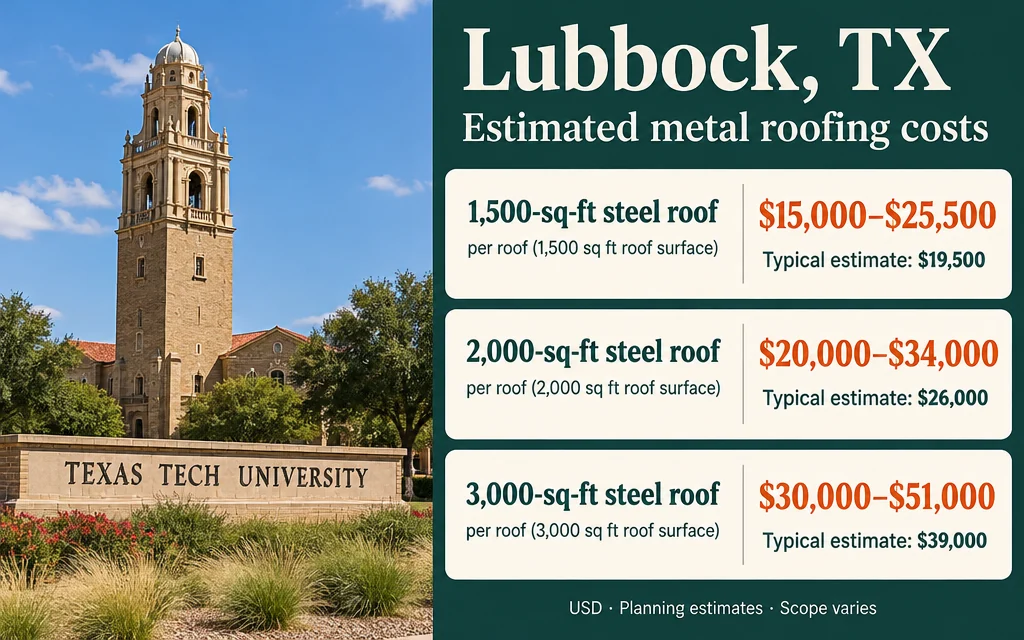
Calculated installed planning scenario for measured roof surface, including one-layer removal/disposal; conditional extras excluded.
Calculated installed planning scenario for measured roof surface, including one-layer removal/disposal; conditional extras excluded.
Calculated installed planning scenario for measured roof surface, including one-layer removal/disposal; conditional extras excluded.
Metal Roofing Investment in Lubbock
Installing a metal roof on a Lubbock home requires a higher upfront outlay than standard shingles, but it provides strong defense against high spring winds, windblown dust, and severe South Plains hail storms. For general planning, budget $10–$17 per sq ft of roof surface (installed) for a turnkey standing seam steel system with concealed fasteners.
For a home with 2,000 square feet of roof surface, overall budgeting runs $20,000–$34,000 per roof.
Roofing measurements reflect actual roof surface area rather than interior floor space. Eaves, overhangs, dormers, and roof pitch all add surface area beyond the home's ground footprint. Baseline estimates in this guide include removing and disposing of one existing roofing layer, installing high-temperature synthetic underlayment, fitting standard perimeter flashings, and fastening panels over sound plywood or oriented strand board (OSB) decking.
Metal Roofing Systems Compared
Residential metal roofs fall into several distinct product classes based on substrate, profile, and fastening design. Choosing the right profile affects both ongoing maintenance and wind endurance.
Concealed-fastener standing seam steel is the standard residential choice. Panels interlock at vertical seams over hidden clips and screws, letting the steel expand and contract freely during Lubbock's sharp daily temperature swings without placing tension on fastener points. Panels are typically fabricated from 24-gauge or 26-gauge Galvalume steel finished with a polyvinylidene fluoride (PVDF) coating to resist color fade and chalking under intense sun.
Exposed-fastener steel systems, such as R-panel and corrugated profiles, budget $5–$8.50 per sq ft of roof surface (installed). While economical, the screws pierce directly through the face of the panels. In West Texas heat, the rubber washers under these screws dry out over time from UV exposure, requiring periodic inspections and screw replacements to keep the seams watertight.
Stamped steel shingles budget $8.50–$13.50 per sq ft of roof surface (installed). These interlocking panels mimic shake, slate, or tile profiles and often use stone-granule coatings that mask minor hail dimples.
Standing seam aluminum systems budget $12–$19 per sq ft of roof surface (installed). Aluminum provides strong corrosion resistance, though its softer structure makes it more susceptible to hail dimples than heavy-gauge steel. Architectural standing seam copper budgets $20–$38 per sq ft of roof surface (installed), functioning primarily as a specialty accent on historic residences, porticos, and bay window overhangs.
| Service / assumptions | Low | Typical estimate | High | Pricing unit | Estimated labor time |
|---|---|---|---|---|---|
| Standing Seam Steel Roof (Installed)Calculated standing-seam steel planning rate: comparable panel/accessory materials + installation labor + one-layer removal/disposal. Ordinary underlayment and details over sound decking included; conditional extra work excluded. Published rate reference for the stated roofing scope and unit, not verification of this guide's modeled range, a complete roof quote or provider availability. Regional reference; not a verified Lubbock-specific quote.Published price reference ↗ | $10 | $13 | $17 | per sq ft of roof surface (installed) | 3 to 5 business days |
| Exposed-Fastener Ribbed Steel Roof (Installed)Includes R-panel or ribbed exposed-fastener steel panels, underlayment, and one-layer tear-off. | $5 | $6.75 | $8.50 | per sq ft of roof surface (installed) | 2 to 3 business days |
| Stone-Coated / Shingle Steel Roof (Installed)Stamped steel shingles or stone-coated steel tiles including underlayment and one-layer tear-off. | $8.50 | $10.50 | $13.50 | per sq ft of roof surface (installed) | 3 to 5 business days |
| Standing Seam Aluminum Roof (Installed)Concealed-fastener aluminum panel system; highly corrosion-resistant but softer under heavy hail. | $12 | $15 | $19 | per sq ft of roof surface (installed) | 3 to 5 business days |
| Standing Seam Copper Roof (Installed)Architectural grade 16 oz or 20 oz natural copper standing seam panels with hand-formed details. | $20 | $28 | $38 | per sq ft of roof surface (installed) | 5 to 8 business days |
Component Cost Breakdown for Standing Seam Steel
A comprehensive standing seam estimate is built from three core operational allowances: panel materials, installation labor, and the tear-off of previous roofing layers.
Materials and trim packages account for budget $4.50–$7.50 per sq ft of roof surface (materials only). This covers 24-gauge or 26-gauge Galvalume coil or pre-formed panels, floating expansion clips, concealed screws, eave and ridge closures, pipe boot flashing assemblies, and high-temperature self-adhering underlayment engineered for the elevated deck temperatures found beneath metal.
Installation labor accounts for budget $4.50–$7 per sq ft of roof surface (installation labor only). Standing seam roofing requires skilled mechanical sheet-metal tradespeople who measure panel runs, lock vertical seams, fold eave hems, and detail flashings around wall and valley transitions. Safe handling of long panels during gusty West Texas weather also influences daily crew scheduling.
Removal and disposal of one existing shingle layer accounts for budget $1–$2.50 per sq ft of roof surface (one-layer removal and disposal), running 1 to 2 business days. This covers stripping old shingles down to bare sheathing, seating or pulling loose nails, hauling debris to disposal facilities, and running rolling magnetic tools over the grounds.
| Service / assumptions | Low | Typical estimate | High | Pricing unit | Estimated labor time |
|---|---|---|---|---|---|
| Standing Seam Steel Materials Allowance24-26 gauge Galvalume steel panels, floating clips, concealed screws, high-temp underlayment, and basic trims. | $4.50 | $5.75 | $7.50 | per sq ft of roof surface (materials only) | N/A |
| Standing Seam Steel Labor AllowanceSkilled mechanical installation, edge hemming, transitions, and safety staging over sound deck. | $4.50 | $5.75 | $7 | per sq ft of roof surface (installation labor only) | N/A |
| One-Layer Tear-Off and Disposal AllowanceStripping existing asphalt shingles, fastener cleanup, debris hauling, and site disposal fees. | $1 | $1.50 | $2.50 | per sq ft of roof surface (one-layer removal and disposal) | 1 to 2 business days |
Estimated Project Budgets by Roof Size
Because roof layouts vary widely, project pricing depends strictly on total measured deck square footage rather than ground-floor living area. Typical planning ranges for standing seam steel installations across three common roof sizes include:
A compact 1,500-square-foot roof surface (common for smaller ranch-style homes or detached additions) budgets $15,000–$25,500 per roof, running 2 to 4 business days of on-site crew work under normal conditions.
A mid-sized 2,000-square-foot roof surface budgets $20,000–$34,000 per roof, typically requiring 3 to 5 business days.
A larger 3,000-square-foot roof surface with intersecting hips, valleys, and gables budgets $30,000–$51,000 per roof, with on-site installation running 4 to 7 business days.
Simple dual-slope gable roofs sit toward the lower end of these ranges. Roofs with steep pitches, dormers, masonry chimneys, or multi-story access require extra staging and fall protection that increase labor time.
| Service / assumptions | Low | Typical estimate | High | Pricing unit | Estimated labor time |
|---|---|---|---|---|---|
| Standing Seam Steel Roof: 1,500 sq ft AreaCalculated scenario: 1,500 sq ft of measured roof surface × standing-seam steel installed planning rate. Includes its same materials, installation, one-layer removal/disposal and sound-deck assumptions. Not a provider whole-roof quote. | $15,000 | $19,500 | $25,500 | per roof (1,500 sq ft roof surface) | 2 to 4 business days |
| Standing Seam Steel Roof: 2,000 sq ft AreaCalculated scenario: 2,000 sq ft of measured roof surface × standing-seam steel installed planning rate. Includes its same materials, installation, one-layer removal/disposal and sound-deck assumptions. Not a provider whole-roof quote. | $20,000 | $26,000 | $34,000 | per roof (2,000 sq ft roof surface) | 3 to 5 business days |
| Standing Seam Steel Roof: 3,000 sq ft AreaCalculated scenario: 3,000 sq ft of measured roof surface × standing-seam steel installed planning rate. Includes its same materials, installation, one-layer removal/disposal and sound-deck assumptions. Not a provider whole-roof quote. | $30,000 | $39,000 | $51,000 | per roof (3,000 sq ft roof surface) | 4 to 7 business days |
Standing Seam Metal vs. Architectural Asphalt Shingles
In Lubbock, architectural asphalt shingles budget $3.75–$6.25 per sq ft of roof surface (installed), with jobs typically running 1 to 2 business days. This makes asphalt substantially less expensive up front than standing seam steel.
However, long-term exposure on the South Plains creates clear performance trade-offs.
Asphalt shingles in Lubbock endure thermal cycling, dry heat, intense ultraviolet exposure, and wind-driven dust that gradually strip away protective mineral granules. Over time, seal strips can lose adhesion, leaving tabs vulnerable to unseating during severe localized downbursts. Shingle roofs in this region often require early replacement if recurring hail hits the property.
A properly installed standing seam steel roof creates a continuous, interlocking drainage plane with no exposed edges to lift in straight-line winds. When installed over sound decking with high-temperature underlayment, the panels provide decades of service life. While asphalt shingles may need one or more replacements over several decades, a standing seam installation generally requires only periodic inspections of perimeter sealants and plumbing pipe boots.
| Service / assumptions | Low | Typical estimate | High | Pricing unit | Estimated labor time |
|---|---|---|---|---|---|
| Architectural Asphalt Shingles ReferenceStandard architectural laminated shingle replacement baseline including one-layer tear-off and synthetic felt. | $3.75 | $4.75 | $6.25 | per sq ft of roof surface (installed) | 1 to 2 business days |
| Comparison | Architectural asphalt | Standing-seam steel |
|---|---|---|
| Up-front planning estimate · 2,000 sq ft roof surface | $7,500–$12,500 | $20,000–$34,000 |
| What the baseline includes | Architectural asphalt, ordinary installed details, one-layer removal/disposal over sound decking. | Standing-seam steel, ordinary installed details, one-layer removal/disposal over sound decking. |
| Maintenance and repairs | Confirm product-specific inspections and repair terms. | Confirm seams, fasteners, coating, compatible repairs and inspection terms. |
| Insurance and ownership cost | Ask the insurer about the exact product and coverage. | Ask the insurer about accepted test documentation, any available credit and cosmetic-damage exclusions. |
These are calculated budgeting comparisons, not provider quotes or guaranteed lifetime savings. Compare your expected ownership period, specified products, actual maintenance proposals and written insurance terms.
| Decision point | Roof repair | Roof replacement | Metal roofing |
|---|---|---|---|
| Work being priced | A defined defect, such as damaged shingles or flashing. | Removal and installation of an agreed roof system across the measured roof surface. | A specified installed metal system; standing seam, exposed fasteners and metal shingles are different scopes. |
| What to inspect | The leak source, surrounding material and whether a durable localized fix is feasible. | The extent of deterioration, decking condition, roof details and suitable replacement systems. | The substrate, panel profile, coating, fasteners, roof geometry and installation details. |
| How to compare prices | Match the repair quantity, access, materials and included diagnosis. | Match measured roof area, material, tear-off layers, disposal and installed inclusions. | Match measured roof area, system, components, removal and conditional additional work. |
| Before deciding | Ask what the repair addresses and what existing problems would remain. | Ask whether repair remains practical and which additional items would change the total. | Ask about compatible materials, documented product/assembly ratings and product versus workmanship warranties. |
Age or a repair-cost percentage alone does not determine the right choice. Ask a qualified roofing contractor to assess the condition and explain viable options. A metal system is a material-specific installation choice, not a separate guarantee of durability or savings.
Additional Scope and Conditional Expenses
Replacing a roof often reveals hidden deck conditions or requires specialty trim details that are billed as conditional additions:
Multiple roofing layers: When a home has two or more existing layers of roofing, stripping and disposing of each additional layer adds budget $40–$90 additional per roofing square (100 sq ft).
Decking repairs: Standing seam metal requires smooth, structurally sound decking. Rotted, soft, or water-damaged sheathing exposed after tear-off costs budget $75–$130 additional per 4-by-8-ft sheet (32 sq ft) of 7/16-inch OSB or CDX plywood.
Chimney flashing: Custom step-flashing and counter-flashing cut into brick mortar joints costs budget $400–$1,000 additional per chimney, depending on width and water flow lines. Skylight transition pan assemblies run budget $300–$750 additional per skylight.
Ventilation and accessories: Adding continuous standing seam ridge ventilation or off-ridge static exhaust units budgets $12–$32 additional per linear ft. Snow retention rails or cleat systems over doorways or walkways budget $20–$55 additional per linear ft. Detaching and resetting existing gutters to allow proper drip edge installation adds budget $6–$16 additional per linear ft.
| Service / assumptions | Low | Typical estimate | High | Pricing unit | Estimated labor time |
|---|---|---|---|---|---|
| Additional Roofing Layer Tear-OffCost to strip and dispose of a secondary or tertiary layer of existing roofing material. | $40 | $60 | $90 | additional per roofing square (100 sq ft) | N/A |
| OSB / Plywood Sheathing ReplacementReplacement of damaged or rotted 7/16-inch OSB or CDX plywood decking exposed after tear-off. | $75 | $95 | $130 | additional per 4-by-8-ft sheet (32 sq ft) | N/A |
| Custom Masonry Chimney Metal FlashingCustom-bent counter-flashing, step-flashing, and reglet cutting into brick mortar joints. | $400 | $650 | $1,000 | additional per chimney | N/A |
| Skylight Flashing IntegrationFabrication and installation of watertight transition pans and side flashings around roof skylights. | $300 | $475 | $750 | additional per skylight | N/A |
| Ventilation System Upgrade / Ridge VentBaffled continuous standing seam metal ridge vent or dedicated metal off-ridge static exhaust units. | $12 | $20 | $32 | additional per linear ft | N/A |
| Snow Retention Bar / Guard SystemClamp-on standing seam snow guards or rail assemblies over pedestrian walkways and entrances. | $20 | $35 | $55 | additional per linear ft | N/A |
| Gutter Detach and ResetCareful removal and reinstallation of existing seamless gutters to accommodate new perimeter metal drip edge. | $6 | $10 | $16 | additional per linear ft | N/A |
Performance Standards: Hail, Wind, and Fire
Evaluating manufacturer performance ratings helps set realistic expectations for metal roofing under South Plains weather events. Laboratory certifications test specific physical forces but do not represent unconditional guarantees against surface changes.
Impact Resistance (UL 2218): Most 24-gauge and 26-gauge steel panels achieve a Class 4 rating, showing that a two-inch steel ball dropped from 20 feet does not crack the metal substrate or rupture seams. However, Class 4 certification does not make steel dent-proof; large hail will leave surface dimples. In Texas, property insurers frequently ask homeowners to sign cosmetic damage exclusion endorsements in exchange for premium credits. Under such endorsements, the carrier will not pay to replace dented panels unless the metal is actually punctured or seams fail.
Wind Resistance (UL 580 / UL 1897): Standing seam assemblies lock onto continuous structural clips designed to resist high wind-uplift pressures, providing reliable performance during sustained West Texas wind events when clip spacing follows manufacturer uplift engineering.
Fire Safety (UL 790 Class A): When installed over non-combustible underlayment and solid decking, steel roofing provides Class A fire resistance, helping protect the roof deck from airborne embers during nearby brush or structure fires.
Key Drivers of Metal Roofing Costs in Lubbock
Several material specifications and site-specific conditions influence where an individual quote lands:
Steel Thickness (24-Gauge vs. 26-Gauge): 24-gauge steel is noticeably thicker than 26-gauge steel. Thicker steel panels carry a higher material cost but resist cosmetic hail dimpling better, handle higher wind uplift, and minimize visible oil-canning waviness across flat panel pans.
Coating Chemistry: Premium PVDF (Kynar 500) coatings carry an upcharge over basic Siliconized Modified Polyester (SMP) finishes. However, PVDF resins offer superior defense against color fading and chalking under the intense solar radiation of West Texas summers.
Roof Geometry and Pitch: Walkable, low-slope roof planes allow crews to move efficiently. Steep pitches require harness systems, staging planks, and specialized ladder brackets that slow installation speed and increase labor costs.
Roofline Complexity and Waste: Simple gable roofs allow panels to run in uniform rectangular cuts with minimal scrap. Rooflines with hips, valleys, and multiple dormers require diagonal field cuts, which increases waste factor and requires additional custom-formed trim pieces.
Hiring a Metal Roofing Contractor in Lubbock
Standing seam metal installation requires specialized sheet-metal fabrication techniques that differ significantly from asphalt shingle roofing. When evaluating contractors in Lubbock, keep these practical points in mind:
Verify that the contractor maintains an established business presence in the Lubbock area and carries active commercial general liability and workers' compensation coverage. Ask whether the crew installing your roof is in-house or subcontracted, and confirm who supervises daily on-site work.
Ask about panel fabrication. Some contractors order factory-cut panels from a regional distributor, while others use a mobile roll-forming machine to shape panels directly from coil stock at your property. On-site roll-forming allows continuous, custom-cut lengths that eliminate horizontal lap joints on long roof runs.
Request an itemized written quote. The proposal should clearly state the metal gauge, base substrate (such as Galvalume AZ50 or AZ55), paint system brand, underlayment type, flashing gauges, and cleanup terms. Ensure the estimate explicitly addresses whether the contractor pulls required municipal permits and schedules code inspections.
Local income & housing costs
Lubbock city, Texas · U.S. Census Bureau, 2025 ACS 1-year estimates.
per month · ±$56
Cash-rent units; includes applicable tenant-paid utilities
Census source ↗Dollar amounts use the survey period’s published basis. Income is annual; gross rent is monthly. Home value reflects owner-occupied housing values. Margins of error shown are at the ACS 90% confidence level. These statistics provide city context; service budgets use their own pricing evidence.
STATEWIDE COST CONTEXT
Texas prices, income & labor costs
These Texas figures provide background for this city guide. They describe different measures and reference years; employee wages are not prices charged by a contractor.
BEA SAIRPD
State price change indicator
120.02024 · index (2017 basis)
Annual figures & sources
| Year | Value | 90% margin of error | Source |
|---|---|---|---|
| 2020 | 103.4 | — | Official source |
| 2021 | 107.2 | — | Official source |
| 2022 | 113.1 | — | Official source |
| 2023 | 117.1 | — | Official source |
| 2024 | 120.0 | — | Official source |
Census ACS 1-year
Median household income
$82,6252025 · USD/year
Annual figures & sources
| Year | Value | 90% margin of error | Source |
|---|---|---|---|
| 2021 | $66,963 | ±$513 | Official source |
| 2022 | $72,284 | ±$443 | Official source |
| 2023 | $75,780 | ±$472 | Official source |
| 2024 | $79,721 | ±$564 | Official source |
| 2025 | $82,625 | ±$670 | Official source |
BLS OEWS
Roofers
$22.132025 · USD/hour
Annual figures & sources
| Year | Value | 90% margin of error | Source |
|---|---|---|---|
| 2025 | $22.13 | — | Official source |
State prices: BEA, 2020–2024. Household income: Census ACS, 2021–2025. Employee wages: BLS, May 2025 snapshot. The charts retain their own units and fitted scales.
Explore all Texas living-cost data and trends →Local context and limitations
Lubbock roofing faces intense sun, dry spring winds, and severe convective hail storms. For local residential standing seam, 24-gauge Galvalume steel with a PVDF (Kynar 500) finish is a common regional specification to limit panel chalking and resist denting. Check policy terms with your homeowner insurance carrier: while many metal profiles carry a UL 2218 Class 4 impact rating, Texas insurers often attach cosmetic damage waivers that exclude payouts for visible hail dimples unless the metal punctures or seams fail. Confirm with the City of Lubbock Building Safety department whether your specific address and scope require a residential re-roofing permit, and verify in writing whether your contractor handles permit filing and inspection scheduling.
Frequently asked questions
What is the primary difference between standing seam and exposed-fastener metal roofs?
Standing seam roofs use raised interlocking ribs fastened with concealed clips, hiding all screws beneath the metal and letting panels slide naturally as temperatures change. Exposed-fastener roofs use screws driven straight through the face of the panels with neoprene washers. In West Texas heat and sunlight, those exposed washers gradually degrade and require periodic checking or re-screwing.
Can a metal roof be installed directly over existing shingles in Lubbock?
Check your address's structural building requirements and manufacturer warranty terms before considering an overlay. While retrofit systems exist, standard trade practice recommends a full tear-off down to the bare wood sheathing. Stripping the old shingles allows your crew to find rotted decking, verify structural nailing, apply high-temperature underlayment smoothly, and avoid surface irregularities telegraphing through the metal panels.
Will a metal roof lower my home insurance premium in Texas?
Some Texas homeowners insurance carriers offer discounts for roofs carrying a Class 4 impact rating under UL 2218, but availability and savings vary by company and policy form. Check whether the insurer requires a cosmetic damage waiver. If signed, the company will not cover repairs for visible hail dents as long as the roof continues to shed water without leaks.
Why is 24-gauge steel preferred over 26-gauge steel on the South Plains?
The lower the gauge number, the thicker the metal. 24-gauge steel provides a sturdier panel that better resists denting from severe hail, reduces panel flutter during strong spring wind gusts, and reduces visible oil-canning along flat panel pans.
Do metal roofs attract lightning or create excessive noise in rain?
Metal roofs do not attract lightning, which strikes the highest point in an area regardless of surface material. When installed over solid wood sheathing and modern high-temperature synthetic underlayment, sound transmission during rainstorms is comparable to that of standard asphalt shingles.
What permits are required for a metal roof replacement in Lubbock?
Permit requirements depend on your property's jurisdiction and the specific scope of work. Contact the City of Lubbock Building Safety department to confirm whether your address requires a residential building permit and code inspection. Check your contractor's written estimate to confirm whether they pull the permit, schedule required municipal inspections, and include those fees in the contract total.
Sources and methodology
Sources below retain their recorded retrieval dates and geographic scope. We checked the quoted rates against readable public pricing pages. The tables remain planning estimates, not provider quotes or a measured citywide survey. Per-square-foot references do not establish the modeled whole-roof totals or all their installed inclusions. Regional references are not verified Lubbock-specific quotes. Confirm removal, disposal, materials, labor and the complete scope in a written proposal.
Published pricing pages retrieved; quoted excerpts checked automatically. 3 distinct website domains. · Generated 2026-11-12
- Metal Roofing Pricing Lubbock, TX | Rates 2026 | Lubbock Metal RoofingCity-specific page context · Page retrieved 2026-11-12 · Price excerpt matched automatically
“Metal Roof Replacement From $9/sq ft Full tear-off and replacement of hail-battered shingle or end-of-life metal roofs: old roofing hauled away”
Planning ranges may differ from these published examples; they are not provider quotes.
 Provider badge
- Metal Roofing Pricing Laredo, TX | Rates 2026 | Laredo Metal RoofingState / regional reference · Page retrieved 2026-11-12 · Price excerpt matched automatically
“Metal Roof Over Shingles (Retrofit) From $7/sq ft A new metal roof installed directly over your existing asphalt shingles: no tear-off, less waste, lower cost.”
Planning ranges may differ from these published examples; they are not provider quotes.
- Metal Roof Cost per Square Foot in Texas: Line by LineState / regional reference · Page retrieved 2026-11-11 · Price excerpt matched automatically
“For standing seam steel on a home, about $10 to $16 per square foot installed.”
Planning ranges may differ from these published examples; they are not provider quotes.
Plan your metal roofing project
Choose your service and answer its project questions. Add notes or photos if helpful, then generate your project brief. The planner labels its budgeting assumptions separately. Use your plan to compare the scope and assumptions with a provider. Contact sharing and provider matching are not available yet.
Open the project planner →Share this city’s cost data
<> Embed Lubbock Cost Data on Your Site
The HTML table shows the prices at the time of copying. The iframe follows the published guide.