Philadelphia · PA · COST GUIDE
Metal Roofing Costs in Philadelphia, PA (2026)
For budgeting, standing-seam steel roofing is estimated at $9–$17.25 per sq ft of roof surface, and exposed-fastener steel at $5–$9.50 per sq ft. These installed planning ranges include one-layer removal/disposal over sound decking; compare the specified system and conditional extras.
Standing Seam Steel Roof (Installed)
Budget estimate$9–$17.25per sq ft of roof surface (installed)
Planning range · Compare the roof area, material and included work in your quote.
Exposed-Fastener Steel Roof (Installed)
Budget estimate$5–$9.50per sq ft of roof surface (installed)
Planning range · Compare the roof area, material and included work in your quote.
Published examples apply to their stated scope. Budget ranges are estimates.
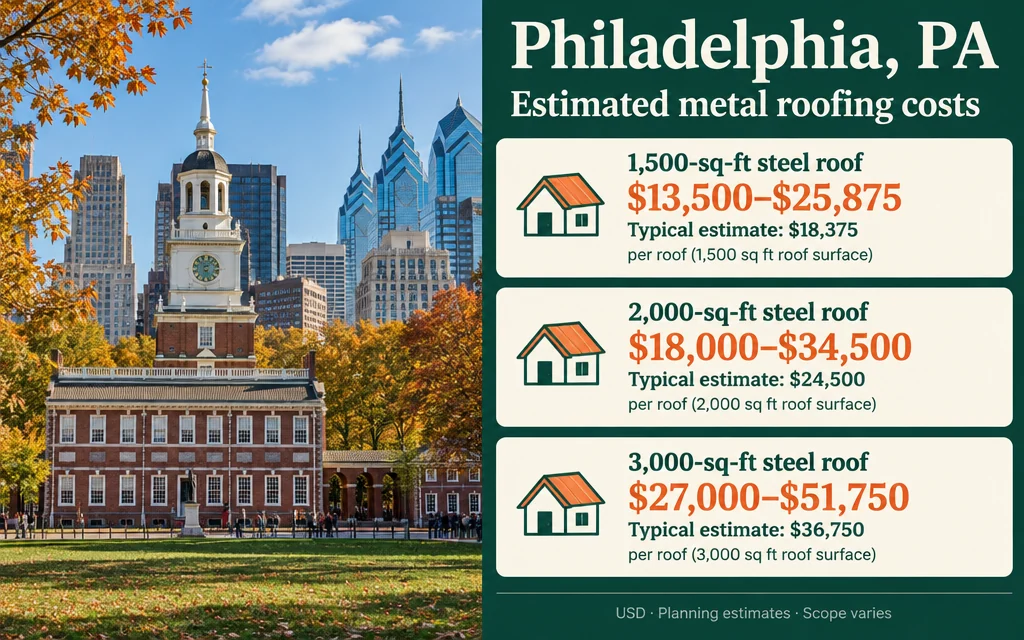
Calculated installed planning scenario for measured roof surface, including one-layer removal/disposal; conditional extras excluded.
Calculated installed planning scenario for measured roof surface, including one-layer removal/disposal; conditional extras excluded.
Calculated installed planning scenario for measured roof surface, including one-layer removal/disposal; conditional extras excluded.
Metal Roofing Pricing Overview for Philadelphia
A residential metal roof represents a substantial investment designed to withstand freeze-thaw cycles, coastal weather patterns, and humid Mid-Atlantic summers. Unlike simple roofing overlays, standard residential replacement requires removing existing materials down to the structural deck, inspecting the wood substrate, laying down specialized high-temperature underlayment, and fastening custom-formed metal panels.
Roofing square footage differs significantly from interior living area. A 1,500-square-foot rowhome or twin often has between 1,200 and 1,800 square feet of actual roof surface once pitch, overhangs, and dormer sidewalls are measured. In the roofing trade, 100 square feet of surface equals one roofing square.
For a standard residential standing seam steel installation in Philadelphia, budget $9–$17.25 per sq ft of roof surface (installed). That places a typical 1,500-square-foot roof surface at $13,500–$25,875 per roof, while a 2,000-square-foot pitched roof runs $18,000–$34,500 per roof.
Residential Metal Roofing Systems Compared
Not all metal roofs share the same design, life expectancy, or engineering. Homeowners must distinguish between five major panel systems when comparing proposals.
Concealed-fastener standing seam steel serves as the benchmark residential standard. Vertical ribs stand 1 to 1.75 inches high, locking together over concealed clips that anchor directly to the deck. Because the clips allow panels to expand and contract along their length during temperature swings, and no screws pierce the weathering face, this system delivers exceptional weather tightness on slopes as low as 2:12 or 3:12.
Exposed-fastener steel panels, such as corrugated or ribbed 5V-crimp profiles, use color-matched hex screws driven through the face of the metal with neoprene washers. While less expensive to manufacture and install (budget $5–$9.50 per sq ft of roof surface (installed)), exposed-fastener panels restrict natural thermal movement and require periodic gasket inspection and replacement every 10 to 15 years. They are commonly applied on porches, accessory structures, or detached garages.
Steel metal shingles replicate slate, cedar shakes, or architectural shingles while maintaining the durability of stamped 26-gauge steel coated with PVDF or stone granules (budget $8.50–$14.50 per sq ft of roof surface (installed)). They offer classic aesthetics without the structural weight of real slate.
Standing seam aluminum (budget $12–$20 per sq ft of roof surface (installed)) replaces steel with an inherently rust-proof non-ferrous substrate. While Galvalume—a steel core coated in zinc-aluminum alloy—offers strong corrosion defense, solid aluminum is impervious to red rust and is well-suited near brackish waterways. Finally, architectural copper standing seam represents the premium tier (budget $24–$42 per sq ft of roof surface (installed)). Copper forms a natural protective patina over decades, requiring no paint coatings and offering an exceptionally long service life.
| Service / assumptions | Low | Typical estimate | High | Pricing unit | Estimated labor time |
|---|---|---|---|---|---|
| Standing Seam Steel Roof (Installed)Calculated standing-seam steel planning rate: comparable panel/accessory materials + installation labor + one-layer removal/disposal. Ordinary underlayment and details over sound decking included; conditional extra work excluded. | $9 | $12.25 | $17.25 | per sq ft of roof surface (installed) | N/A |
| Exposed-Fastener Steel Roof (Installed)Ribbed or corrugated 26/29-gauge steel with external neoprene gasket screws, underlayment, and one-layer removal. Published rate reference for the stated roofing scope and unit, not verification of this guide's modeled range, a complete roof quote or provider availability. Regional reference; not a verified Philadelphia-specific quote.Published price reference ↗ | $5 | $7 | $9.50 | per sq ft of roof surface (installed) | N/A |
| Steel Metal Shingles (Installed)Stamped steel slate/shake profile shingles, concealed fasteners, trim package, underlayment, and one-layer tear-off. | $8.50 | $11 | $14.50 | per sq ft of roof surface (installed) | N/A |
| Standing Seam Aluminum Roof (Installed)0.032 or 0.040-inch aluminum alloy panels, non-corrosive clips, high-temp underlayment, and one-layer removal. | $12 | $15.50 | $20 | per sq ft of roof surface (installed) | N/A |
| Standing Seam Copper Roof (Installed)16-oz or 20-oz architectural copper panels, brass/copper clips, specialized underlayment, and removal. | $24 | $32 | $42 | per sq ft of roof surface (installed) | N/A |
Cost Breakdown: Standing Seam Steel Components
When evaluating a contractor's itemized proposal for a standard standing seam steel roof, the quote breaks down into three distinct operational allowances: materials, field labor, and demolition.
Materials and panel manufacturing represent budget $4.50–$8.50 per sq ft of roof surface (materials only). This includes 24-gauge or 26-gauge Galvalume-coated steel panels finished in Kynar 500 or Hylar 5000 PVDF resins, concealed sliding expansion clips, fasteners, eave and ridge flashing trims, and a self-adhering high-temperature underlayment rated to withstand the elevated temperatures generated beneath metal decks.
Installation labor accounts for budget $3.50–$6.50 per sq ft of roof surface (installation labor only). Forming standing seam profiles requires skilled sheet-metal tradespeople who hand-fold eaves, hem panel valleys, custom-notch ridge caps, and align seam locks. Labor rates reflect crew expertise, site staging, fall protection, and multi-day fabrication time.
Removal and disposal of the existing roof layer averages budget $1–$2.25 per sq ft of roof surface (one-layer removal and disposal) for a single layer of asphalt shingles. This covers manual tear-off, ground cleanup, debris haul-off, and local disposal fees. Combining materials, labor, and removal yields the complete installed baseline rate of $9–$17.25 per sq ft of roof surface (installed).
| Service / assumptions | Low | Typical estimate | High | Pricing unit | Estimated labor time |
|---|---|---|---|---|---|
| Standing Seam Steel Materials AllowanceGalvalume steel panels, concealed clips, fasteners, high-temperature underlayment, and matching perimeter trims. | $4.50 | $6 | $8.50 | per sq ft of roof surface (materials only) | N/A |
| Standing Seam Steel Installation LaborSkilled sheet-metal crew installation, panel hemming, eave locking, and ridge fabrication. Excludes tear-off. | $3.50 | $4.75 | $6.50 | per sq ft of roof surface (installation labor only) | N/A |
| One-Layer Roof Removal and DisposalTear-off of one existing asphalt shingle layer down to decking, cleanup, dumpster rental, and disposal fees. | $1 | $1.50 | $2.25 | per sq ft of roof surface (one-layer removal and disposal) | N/A |
Project Estimates by Roof Size
Roof surface area directly dictates material consumption, waste factor, and labor schedules. Below are planning estimates for three common residential roof footprints based on Philadelphia's standing-seam steel baseline rates.
A compact 1,500-square-foot roof surface, typical of many traditional Philadelphia two-story twins or urban cottages, runs $13,500–$25,875 per roof, with a typical cost around $18,375. An experienced crew usually completes this scale in 3-5 working days.
A mid-sized 2,000-square-foot roof plane, common on detached homes in areas like Roxborough or Mount Airy, averages $24,500, spanning an estimated range of $18,000–$34,500 per roof. Work on this footprint typically requires 4-6 working days on site.
A 3,000-square-foot roof surface covers larger suburban-style residences or multi-level roofs with extensive hip and valley junctions. Estimated budgets range from $27,000–$51,750 per roof, with a typical project cost of $36,750 and an expected schedule of 5-8 working days.
| Service / assumptions | Low | Typical estimate | High | Pricing unit | Estimated labor time |
|---|---|---|---|---|---|
| Standing Seam Steel Roof (1,500 sq ft)Calculated scenario: 1,500 sq ft of measured roof surface × standing-seam steel installed planning rate. Includes its same materials, installation, one-layer removal/disposal and sound-deck assumptions. Not a provider whole-roof quote. | $13,500 | $18,375 | $25,875 | per roof (1,500 sq ft roof surface) | 3-5 working days |
| Standing Seam Steel Roof (2,000 sq ft)Calculated scenario: 2,000 sq ft of measured roof surface × standing-seam steel installed planning rate. Includes its same materials, installation, one-layer removal/disposal and sound-deck assumptions. Not a provider whole-roof quote. | $18,000 | $24,500 | $34,500 | per roof (2,000 sq ft roof surface) | 4-6 working days |
| Standing Seam Steel Roof (3,000 sq ft)Calculated scenario: 3,000 sq ft of measured roof surface × standing-seam steel installed planning rate. Includes its same materials, installation, one-layer removal/disposal and sound-deck assumptions. Not a provider whole-roof quote. | $27,000 | $36,750 | $51,750 | per roof (3,000 sq ft roof surface) | 5-8 working days |
Comparing Standing Seam Metal to Architectural Asphalt
Architectural asphalt shingles remain a common residential roof covering due to their lower initial outlay. An installed architectural asphalt system with one-layer tear-off ranges from $4.50–$8 per sq ft of roof surface (installed), roughly half the entry cost of standing seam steel.
Evaluating the choice over a multi-decade ownership horizon reveals different tradeoffs. In Mid-Atlantic climates, asphalt shingles face heat degradation, moisture cycling, and wind-driven rain, often requiring replacement or heavy overhaul every 20 to 25 years. Adding minor storm repairs and eventual re-roofing narrows the lifetime cost gap.
A concealed standing seam steel roof requires a higher initial outlay (budget $9–$17.25 per sq ft of roof surface (installed)). However, 24-gauge or 26-gauge Galvalume panels finished with factory-applied PVDF coatings resist organic rot and shingle granule loss. With minimal maintenance beyond clearing debris from gutters and valleys, standing seam steel frequently serves for decades without panel failure. Homeowners planning to remain in their property long term, or looking to avoid repeated re-roofing disruptions, often find the lifecycle economics compelling despite the upfront premium.
| Service / assumptions | Low | Typical estimate | High | Pricing unit | Estimated labor time |
|---|---|---|---|---|---|
| Architectural Asphalt Shingles (Installed Reference)Baseline reference: dimensional asphalt shingles, underlayment, flashings, and one-layer removal over sound deck. | $4.50 | $6 | $8 | per sq ft of roof surface (installed) | 1-3 working days |
| Comparison | Architectural asphalt | Standing-seam steel |
|---|---|---|
| Up-front planning estimate · 2,000 sq ft roof surface | $9,000–$16,000 | $18,000–$34,500 |
| What the baseline includes | Architectural asphalt, ordinary installed details, one-layer removal/disposal over sound decking. | Standing-seam steel, ordinary installed details, one-layer removal/disposal over sound decking. |
| Maintenance and repairs | Confirm product-specific inspections and repair terms. | Confirm seams, fasteners, coating, compatible repairs and inspection terms. |
| Insurance and ownership cost | Ask the insurer about the exact product and coverage. | Ask the insurer about accepted test documentation, any available credit and cosmetic-damage exclusions. |
These are calculated budgeting comparisons, not provider quotes or guaranteed lifetime savings. Compare your expected ownership period, specified products, actual maintenance proposals and written insurance terms.
| Decision point | Roof repair | Roof replacement | Metal roofing |
|---|---|---|---|
| Work being priced | A defined defect, such as damaged shingles or flashing. | Removal and installation of an agreed roof system across the measured roof surface. | A specified installed metal system; standing seam, exposed fasteners and metal shingles are different scopes. |
| What to inspect | The leak source, surrounding material and whether a durable localized fix is feasible. | The extent of deterioration, decking condition, roof details and suitable replacement systems. | The substrate, panel profile, coating, fasteners, roof geometry and installation details. |
| How to compare prices | Match the repair quantity, access, materials and included diagnosis. | Match measured roof area, material, tear-off layers, disposal and installed inclusions. | Match measured roof area, system, components, removal and conditional additional work. |
| Before deciding | Ask what the repair addresses and what existing problems would remain. | Ask whether repair remains practical and which additional items would change the total. | Ask about compatible materials, documented product/assembly ratings and product versus workmanship warranties. |
Age or a repair-cost percentage alone does not determine the right choice. Ask a qualified roofing contractor to assess the condition and explain viable options. A metal system is a material-specific installation choice, not a separate guarantee of durability or savings.
Additional Work and Modification Costs
A base roofing contract assumes sound wood decking and standard roof perimeter flashings. In older Philadelphia neighborhoods, unforeseen structural conditions or architectural embellishments frequently require separate line-item add-ons.
If tear-off reveals rotted plank sheathing or water-damaged plywood near eaves, expect replacement decking to run budget $75–$130 per 4-by-8-ft sheet (32 sq ft). Removing a second existing layer of old shingles adds budget $45–$95 per roofing square (100 sq ft) due to extra labor and container disposal weight.
Flashing masonry chimneys requires custom sheet-metal step flashing, counter-flashing let into mortar joints, and a diverter cricket (budget $350–$850 per chimney). Skylight curb re-flashing costs budget $300–$750 per skylight. Upgrading ridge vents to metal-specific baffled ventilation packages averages budget $12–$28 per linear ft. Where sliding snow poses a hazard over walkways or front steps, pipe-style snow retention bars run budget $15–$40 per linear ft. If existing gutters must be detached and reset to accommodate metal drip edges, budget $6–$16 per linear ft.
| Service / assumptions | Low | Typical estimate | High | Pricing unit | Estimated labor time |
|---|---|---|---|---|---|
| Additional Layer RemovalLabor and disposal fees for stripping a second or third existing roof layer beyond the base quote. | $45 | $65 | $95 | additional per roofing square (100 sq ft) | N/A |
| Plywood / OSB Decking ReplacementFurnishing and fastening replacement 1/2-in or 5/8-in CDX plywood or OSB over deteriorated framing. | $75 | $95 | $130 | additional per 4-by-8-ft sheet (32 sq ft) | N/A |
| Chimney Flashing PackageCustom-bent metal cricket, base step flashing, and counter-flashing reglet-cut into brick masonry joints. | $350 | $550 | $850 | additional per chimney | 2-4 hours |
| Skylight Flashing Kit & IntegrationCustom transition flashing and waterproof membrane collar for curb-mounted or deck-mounted skylights. | $300 | $475 | $750 | additional per skylight | 1-3 hours |
| Metal Ridge Ventilation UpgradeBaffled metal ridge vent cap with exterior weather screening integrated into vertical seam profiles. | $12 | $18 | $28 | additional per linear ft | N/A |
| Snow Retention Guard SystemSeam-mounted bar or bracket snow guards over entryways and sidewalks to prevent sudden snow shedding. | $15 | $25 | $40 | additional per linear ft | N/A |
| Gutter Detach and ResetCarefully removing existing gutter runs for new metal drip edge installation, then re-hanging to proper slope. | $6 | $10 | $16 | additional per linear ft | N/A |
Performance Standards, Weathering, and Insurance
Metal roofing carries a reputation for durability, but homeowners should understand how specific product testing applies to real-world performance.
Impact resistance is measured under UL 2218, where Class 4 indicates the highest tested resistance against steel balls dropped in laboratory conditions. While a Class 4 rating shows the panel resists puncturing during hailstorms, it does not mean the metal is dent-proof. Some insurers offer premium credits for impact-rated roofs, but policies may include cosmetic damage waivers stating the insurer will not pay to replace panels that suffer cosmetic indentation without functional water leaks. Check with your insurance agent to see what applies to your policy.
Wind uplift resistance relies on tested attachment assemblies under ASTM E1592 or UL 580 standards. A standing seam system's uplift resistance depends on clip spacing, deck fastener gauge, and panel seam engagement. In fire resistance, metal panels are non-combustible (achieving a Class A assembly when combined with appropriate fire-rated underlayment over solid decking).
Energy performance stems from cool-roof paint pigments that reflect infrared radiation. High-reflectance PVDF coatings reduce attic heat gain during hot summer months, easing household cooling demands. Request manufacturer product test sheets directly from your estimator to verify these specifications.
Key Cost Drivers in Philadelphia
Several local variables dictate where an estimate falls within the planning range on Philadelphia projects.
Panel gauge and metallurgy strongly dictate raw material costs. Heavier 24-gauge steel resists visible surface waviness (oil-canning) and physical impact better than lightweight 29-gauge steel, but thicker metal commands higher material pricing. Factory-baked PVDF/Kynar coatings add cost over basic SMP (silicone-modified polyester) paints but provide superior resistance to color fading and chalking.
Roof geometry and pitch alter labor productivity. A simple gable roof installs rapidly with minimal waste. Conversely, a Victorian mansard, a roof broken by multiple dormers, or steep pitches require harness tie-offs, scaffolding, and extensive hand-shearing of panels, substantially increasing on-site crew hours.
Site access directly impacts contractor mobilization. Narrow city streets, tight street parking, shared party walls, and limited yard clearance make dumpster placement and panel staging more involved. Jobs that require staging panels onto multi-story structures or coordinating lift equipment naturally trend toward the higher end of installation labor.
Hiring a Metal Roofing Contractor in Philadelphia
Installing standing seam metal requires sheet-metal fabricators and trained installers, distinct from general asphalt shingle crews. Improper panel hemming, incorrect clip spacing, or overtightened fasteners can cause thermal buckling, oil-canning, and seam leaks.
When soliciting bids, check whether the contractor holds an active Pennsylvania Home Improvement Contractor (HIC) registration and carries commercial general liability and workers' compensation coverage. Ask whether panels will be factory pre-formed or roll-formed on-site from flat coil stock.
Key questions to ask during proposal review:
- Does the bid specify 24-gauge or 26-gauge steel, and what brand of PVDF finish is applied?
- Are panels secured with two-piece expansion clips to accommodate thermal movement?
- Is a high-temperature synthetic underlayment included across the entire deck?
- How will wall step flashing, valleys, and chimney penetrations be detailed?
- What is the difference between the manufacturer's finish warranty and the roofer's workmanship warranty?
- Who is responsible for pulling required building permits and arranging any needed street or sidewalk access permits?
Local income & housing costs
Philadelphia city, Pennsylvania · U.S. Census Bureau, 2025 ACS 1-year estimates.
per month · ±$37
Cash-rent units; includes applicable tenant-paid utilities
Census source ↗Dollar amounts use the survey period’s published basis. Income is annual; gross rent is monthly. Home value reflects owner-occupied housing values. Margins of error shown are at the ACS 90% confidence level. These statistics provide city context; service budgets use their own pricing evidence.
STATEWIDE COST CONTEXT
Pennsylvania prices, income & labor costs
These Pennsylvania figures provide background for this city guide. They describe different measures and reference years; employee wages are not prices charged by a contractor.
BEA SAIRPD
State price change indicator
120.72024 · index (2017 basis)
Annual figures & sources
| Year | Value | 90% margin of error | Source |
|---|---|---|---|
| 2020 | 102.3 | — | Official source |
| 2021 | 104.8 | — | Official source |
| 2022 | 111.8 | — | Official source |
| 2023 | 117.4 | — | Official source |
| 2024 | 120.7 | — | Official source |
Census ACS 1-year
Median household income
$81,4732025 · USD/year
Annual figures & sources
| Year | Value | 90% margin of error | Source |
|---|---|---|---|
| 2021 | $68,957 | ±$505 | Official source |
| 2022 | $71,798 | ±$557 | Official source |
| 2023 | $73,824 | ±$511 | Official source |
| 2024 | $77,545 | ±$816 | Official source |
| 2025 | $81,473 | ±$603 | Official source |
BLS OEWS
Roofers
$26.792025 · USD/hour
Annual figures & sources
| Year | Value | 90% margin of error | Source |
|---|---|---|---|
| 2025 | $26.79 | — | Official source |
State prices: BEA, 2020–2024. Household income: Census ACS, 2021–2025. Employee wages: BLS, May 2025 snapshot. The charts retain their own units and fitted scales.
Explore all Pennsylvania living-cost data and trends →Local context and limitations
Philadelphia's dense housing stock introduces distinct roofing factors. Many rowhouses, twins, and older single-family homes feature pitched street-facing mansards, dormers, or porch roofs that transition into low-slope flat roofs toward the rear. On multi-story or attached structures, check in advance whether contractors need special staging, street or sidewalk occupancy permits from the city, or alleyway access. If your property sits in a designated historic district, confirm with the Philadelphia Historical Commission whether specific seam heights, panel materials, or finish colors are restricted before ordering materials.
Frequently asked questions
What is the difference between standing seam and exposed-fastener metal roofs?
Standing seam uses raised interlocking seams that conceal all fasteners and mounting clips underneath the panels, allowing natural thermal expansion and preventing leak paths. Exposed-fastener panels use screws driven directly through the panel face with rubber washers, which sit exposed to weather and require periodic tightening or replacement every 10 to 15 years.
How do I calculate my roof surface area compared to my home's square footage?
Roof surface area is not the same as interior floor area. Roof area accounts for slope pitch, overhangs, eaves, and dormers. A single-story 1,500-square-foot footprint home with a standard slope typically has 1,700 to 1,900 square feet of actual roof plane surface.
Can a metal roof be installed directly over existing shingles in Philadelphia?
Local codes determine whether an overlay over a single layer of asphalt shingles is permitted for a specific property, but roofing professionals generally recommend a complete tear-off. Stripping old shingles allows inspection of the wood decking for rot, ensures a flat plane to prevent panel distortion, and avoids trapping moisture between layers.
Will my homeowner insurance provide a discount for installing a metal roof?
Some insurance carriers offer premium discounts for roofs with UL 2218 Class 4 impact-resistance ratings. However, discounts vary by carrier and location, and policies may include cosmetic exclusion clauses that deny payouts for hail dents that do not cause water penetration. Verify specific policy terms with your insurance agent.
Is standing seam metal noisy during heavy rainstorms?
No. When installed over solid wood sheathing and modern high-density synthetic underlayment, standard residential standing seam metal produces sound levels comparable to asphalt shingles. The underlying roof deck, insulation, and drywall absorb the impact resonance.
What metal gauge is recommended for residential roofs?
For standing seam steel, 24-gauge is the benchmark that minimizes visible surface waviness (oil-canning) and handles heavy snow loads. 26-gauge is a widely used residential alternative. Thin 29-gauge metal is primarily reserved for exposed-fastener utility or agricultural panels.
Sources and methodology
Sources below retain their recorded retrieval dates and geographic scope. We checked the quoted rates against readable public pricing pages. The tables remain planning estimates, not provider quotes or a measured citywide survey. Per-square-foot references do not establish the modeled whole-roof totals or all their installed inclusions. Regional references are not verified Philadelphia-specific quotes. Confirm removal, disposal, materials, labor and the complete scope in a written proposal.
Published pricing pages retrieved; quoted excerpts checked automatically. 2 distinct website domains. · Generated 2026-11-12
- How Much Does a Metal Roof Cost in Lancaster, PA? A Comprehensive Guide - Mountaintop ConstructionState / regional reference · Page retrieved 2026-11-12 · Price excerpt matched automatically
“Factors Affecting Metal Roofing Costs (+/- $10/Sq.Ft.) All of the following factors will affect installation costs for your roof replacement.”
Planning ranges may differ from these published examples; they are not provider quotes.
- Metal Roofing Panels Cost Guide | CGR Wholesale Rostraver PAState / regional reference · Page retrieved 2026-11-12 · Price excerpt matched automatically
“Basic corrugated steel systems fall at $7-11 per square foot while premium copper standing seam systems reach $20-27 per square foot installed.”
Planning ranges may differ from these published examples; they are not provider quotes.
Plan your metal roofing project
Choose your service and answer its project questions. Add notes or photos if helpful, then generate your project brief. The planner labels its budgeting assumptions separately. Use your plan to compare the scope and assumptions with a provider. Contact sharing and provider matching are not available yet.
Open the project planner →Share this city’s cost data
<> Embed Philadelphia Cost Data on Your Site
The HTML table shows the prices at the time of copying. The iframe follows the published guide.