Saint Paul · MN · COST GUIDE
Metal Roofing Costs in Saint Paul, MN (2026)
For budgeting, standing-seam steel roofing is estimated at $14–$22 per sq ft of roof surface, and exposed-fastener steel at $7.50–$13.50 per sq ft. These installed planning ranges include one-layer removal/disposal over sound decking; compare the specified system and conditional extras.
Standing Seam Steel (Installed)
Budget estimate$14–$22per sq ft of roof surface (installed)
Planning range · Compare the roof area, material and included work in your quote.
Exposed Fastener Steel (Installed)
Budget estimate$7.50–$13.50per sq ft of roof surface (installed)
Planning range · Compare the roof area, material and included work in your quote.
Published examples apply to their stated scope. Budget ranges are estimates.
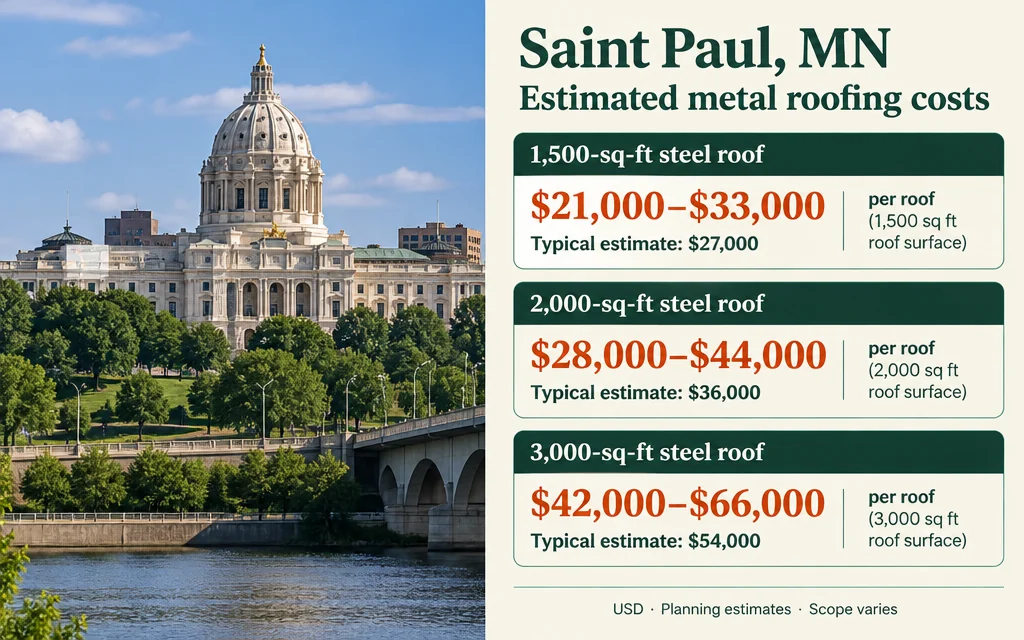
Calculated installed planning scenario for measured roof surface, including one-layer removal/disposal; conditional extras excluded.
Calculated installed planning scenario for measured roof surface, including one-layer removal/disposal; conditional extras excluded.
Calculated installed planning scenario for measured roof surface, including one-layer removal/disposal; conditional extras excluded.
Understanding Metal Roofing Costs in Saint Paul
Budgeting for a residential metal roof in Saint Paul means looking at the entire assembly rather than just panel purchase costs. A complete installation quote covers structural underlayment, flashings, labor, and fastener systems designed to handle Upper Midwest winters, ice accumulation, and humid summer storms.
Because direct published metal-roofing price lists for Saint Paul are limited, local planning relies on regional Twin Cities pricing models. For exposed-fastener ribbed steel panels, budget $7.50–$13.50 per sq ft of roof surface (installed). For a standard concealed-clip standing-seam steel roof, budget $14–$22 per sq ft of roof surface (installed), with a typical project averaging around $18 including tear-off of one asphalt layer over sound decking. Premium architectural copper standing seam sits at the high end, running budget $26–$45 per sq ft of roof surface (installed).
Roofing quotes are based on measured roof surface area—often calculated in roofing squares of 100 square feet—not interior living area. Pitch, overhangs, and dormers make roof surface area noticeably larger than the home footprint. When comparing quotes, verify that each contractor calculates pricing from actual roof surface area and itemizes materials, tear-off, and trim details.
Metal Roofing Systems Compared
Choosing a metal roof profile depends on your home's roof pitch, architectural style, and long-term maintenance expectations. Contractors in the Twin Cities area commonly install five distinct residential systems:
Standing-Seam Steel: The benchmark residential option. Panels feature raised vertical seams joined with concealed clips and screws hidden beneath the metal, protecting fasteners from weather and allowing thermal movement. Standard residential panels are 24- or 26-gauge Galvalume steel coated with a factory PVDF paint finish. Mechanical-lock seams suit lower slopes, while snap-lock profiles are common on standard pitches.
Exposed-Fastener Steel Panels: Commonly chosen for outbuildings, porches, or detached garages, these panels are fastened through the exterior face with screws and neoprene rubber washers. While initial costs are lower—budget $7.50–$13.50 per sq ft of roof surface (installed)—the exposed washers face UV degradation and thermal movement, requiring periodic inspection and screw maintenance.
Steel Shingles and Shake: Stamped modular steel panels designed to simulate cedar shakes, slate, or traditional shingles. They install with concealed clips and run budget $10–$19 per sq ft of roof surface (installed), offering strong hail impact resistance while blending into traditional neighborhood styles.
Standing-Seam Aluminum: Fabricated from 0.032-inch or 0.040-inch marine-grade aluminum, this system runs budget $16–$24 per sq ft of roof surface (installed). Because aluminum does not rust, it is often selected near open water or where complete corrosion resistance is desired. Aluminum expands and contracts more than steel, making engineered expansion clips critical.
Standing-Seam Copper: A long-lasting premium architectural material running budget $26–$45 per sq ft of roof surface (installed). Copper develops a protective patina over time and requires specialized mechanical seaming and soldering at roof transitions.
| Service / assumptions | Low | Typical estimate | High | Pricing unit | Estimated labor time |
|---|---|---|---|---|---|
| Standing Seam Steel (Installed)Calculated standing-seam steel planning rate: comparable panel/accessory materials + installation labor + one-layer removal/disposal. Ordinary underlayment and details over sound decking included; conditional extra work excluded. | $14 | $18 | $22 | per sq ft of roof surface (installed) | N/A |
| Exposed Fastener Steel (Installed)26- or 29-gauge ribbed or corrugated steel panels fastened with exposed neoprene-gasketed screws over sound deck. | $7.50 | $10 | $13.50 | per sq ft of roof surface (installed) | N/A |
| Steel Metal Shingles (Installed)Stamped stone-coated or painted steel shake, tile, or shingle profiles with concealed clips and one-layer tear-off. | $10 | $14 | $19 | per sq ft of roof surface (installed) | N/A |
| Standing Seam Aluminum (Installed)0.032" or 0.040" marine-grade aluminum standing seam with concealed expansion clips and full tear-off. | $16 | $20 | $24 | per sq ft of roof surface (installed) | N/A |
| Standing Seam Copper (Installed)16-oz to 20-oz architectural copper panels, mechanically double-locked seams, hand-crafted transitions. | $26 | $35 | $45 | per sq ft of roof surface (installed) | N/A |
Cost Components of a Standing Seam Roof
To evaluate a standing-seam steel proposal, break the contractor's installed rate into its primary categories: panel materials, specialized installation labor, and tear-off. On a project calculated around the typical rate of $18, the budget separates into three core allowances:
Panels and Accessory Materials: Budget $5.50–$9.50 per sq ft of roof surface (materials only) for 24- or 26-gauge Galvalume steel panels, custom ridge caps, drip edges, sidewall flashing, concealed clips, screws, and high-temperature synthetic underlayment. High-temperature underlayment is essential because metal roof surfaces transfer solar heat that can degrade standard asphalt felt underlayments.
Installation Labor: Budget $7.50–$10 per sq ft of roof surface (installation labor only) for skilled sheet-metal trades. Standing-seam installations demand precise layout, hand-forming or on-site roll-forming, hemmed eaves, watertight valley transitions, and expansion clips that accommodate winter cold and summer heat.
Tear-Off and Disposal: Budget $1–$2.50 per sq ft of roof surface (one-layer removal and disposal) to strip one layer of old asphalt shingles, haul debris, pay local disposal fees, and complete a magnetic nail sweep. Stripping down to bare wood allows full inspection of the roof deck and provides a flat, clean surface for self-adhering membranes.
| Service / assumptions | Low | Typical estimate | High | Pricing unit | Estimated labor time |
|---|---|---|---|---|---|
| Standing Seam Steel Materials Allowance24/26-gauge Galvalume panels, factory PVDF finish, concealed clips, high-temp synthetic underlayment, drip edge, ridge cap. | $5.50 | $7.50 | $9.50 | per sq ft of roof surface (materials only) | N/A |
| Standing Seam Installation Labor AllowanceSkilled sheet metal labor for panel layout, concealed clipping, seaming, valley flashing, and ridge venting. | $7.50 | $9 | $10 | per sq ft of roof surface (installation labor only) | N/A |
| One-Layer Tear-Off & Disposal AllowanceTear-off of one asphalt shingle layer, hauling, local Ramsey County disposal, and site cleanup. | $1 | $1.50 | $2.50 | per sq ft of roof surface (one-layer removal and disposal) | N/A |
Total Project Costs by Roof Surface Area
Total metal roofing costs correlate directly to the measured surface area of the roof deck. A compact single-story home might have 1,500 square feet of roof area, whereas a two-story home with dormers, valleys, and porch roofs can reach 3,000 square feet or more.
For a small roof measuring approximately 1,500 square feet of surface, budget $21,000–$33,000 per roof (1,500 sq ft roof surface) for a complete standing-seam steel installation, with a typical cost around $27,000. Elapsed on-site crew time for this footprint typically spans 3-4 business days.
For a mid-sized home with roughly 2,000 square feet of roof surface, budget $28,000–$44,000 per roof (2,000 sq ft roof surface), with a typical project cost near $36,000. Elapsed on-site crew time usually takes 4-5 business days.
For a larger or more complex roof with 3,000 square feet of surface, budget $42,000–$66,000 per roof (3,000 sq ft roof surface), averaging around $54,000. Elapsed on-site crew time generally takes 5-7 business days, depending on weather and roof steepness.
| Service / assumptions | Low | Typical estimate | High | Pricing unit | Estimated labor time |
|---|---|---|---|---|---|
| Standing Seam Steel (1,500 sq ft roof)Calculated scenario: 1,500 sq ft of measured roof surface × standing-seam steel installed planning rate. Includes its same materials, installation, one-layer removal/disposal and sound-deck assumptions. Not a provider whole-roof quote. | $21,000 | $27,000 | $33,000 | per roof (1,500 sq ft roof surface) | 3-4 business days |
| Standing Seam Steel (2,000 sq ft roof)Calculated scenario: 2,000 sq ft of measured roof surface × standing-seam steel installed planning rate. Includes its same materials, installation, one-layer removal/disposal and sound-deck assumptions. Not a provider whole-roof quote. | $28,000 | $36,000 | $44,000 | per roof (2,000 sq ft roof surface) | 4-5 business days |
| Standing Seam Steel (3,000 sq ft roof)Calculated scenario: 3,000 sq ft of measured roof surface × standing-seam steel installed planning rate. Includes its same materials, installation, one-layer removal/disposal and sound-deck assumptions. Not a provider whole-roof quote. | $42,000 | $54,000 | $66,000 | per roof (3,000 sq ft roof surface) | 5-7 business days |
Standing Seam Metal vs. Architectural Asphalt
Architectural asphalt shingles remain the dominant residential roof covering in the Twin Cities. For standard asphalt reroofing over sound decking, regional published pricing indicates you should budget $4.50–$8 per sq ft of roof surface (installed).
Standing-seam steel requires roughly two to three times that initial investment.
Weighing that cost difference depends on how long you intend to stay in your home. In Minnesota, quality architectural asphalt shingles typically provide 20 to 25 years of service before granular loss, edge curling, and freeze-thaw weathering require reroofing, with severe hail storms occasionally accelerating that cycle.
Over four or five decades, an asphalt roof typically needs to be replaced at least once, involving another tear-off, dump fees, and future labor rates. A well-installed 24-gauge standing-seam steel roof with a factory PVDF finish can last 50 years or longer with routine inspection. If you plan to move within 10 to 15 years, you may not recoup the upfront price difference through market resale value alone. For long-term homeownership, the extended service life and wind performance make standing seam an appealing upgrade.
| Service / assumptions | Low | Typical estimate | High | Pricing unit | Estimated labor time |
|---|---|---|---|---|---|
| Architectural Asphalt Shingles (Installed Reference)Standard architectural asphalt shingle replacement including one-layer tear-off, synthetic underlayment, and ridge cap. Published rate reference for the stated roofing scope and unit, not verification of this guide's modeled range, a complete roof quote or provider availability. Regional reference; not a verified Saint Paul-specific quote.Published price reference ↗ | $4.50 | $6 | $8 | per sq ft of roof surface (installed) | N/A |
| Comparison | Architectural asphalt | Standing-seam steel |
|---|---|---|
| Up-front planning estimate · 2,000 sq ft roof surface | $9,000–$16,000 | $28,000–$44,000 |
| What the baseline includes | Architectural asphalt, ordinary installed details, one-layer removal/disposal over sound decking. | Standing-seam steel, ordinary installed details, one-layer removal/disposal over sound decking. |
| Maintenance and repairs | Confirm product-specific inspections and repair terms. | Confirm seams, fasteners, coating, compatible repairs and inspection terms. |
| Insurance and ownership cost | Ask the insurer about the exact product and coverage. | Ask the insurer about accepted test documentation, any available credit and cosmetic-damage exclusions. |
These are calculated budgeting comparisons, not provider quotes or guaranteed lifetime savings. Compare your expected ownership period, specified products, actual maintenance proposals and written insurance terms.
| Decision point | Roof repair | Roof replacement | Metal roofing |
|---|---|---|---|
| Work being priced | A defined defect, such as damaged shingles or flashing. | Removal and installation of an agreed roof system across the measured roof surface. | A specified installed metal system; standing seam, exposed fasteners and metal shingles are different scopes. |
| What to inspect | The leak source, surrounding material and whether a durable localized fix is feasible. | The extent of deterioration, decking condition, roof details and suitable replacement systems. | The substrate, panel profile, coating, fasteners, roof geometry and installation details. |
| How to compare prices | Match the repair quantity, access, materials and included diagnosis. | Match measured roof area, material, tear-off layers, disposal and installed inclusions. | Match measured roof area, system, components, removal and conditional additional work. |
| Before deciding | Ask what the repair addresses and what existing problems would remain. | Ask whether repair remains practical and which additional items would change the total. | Ask about compatible materials, documented product/assembly ratings and product versus workmanship warranties. |
Age or a repair-cost percentage alone does not determine the right choice. Ask a qualified roofing contractor to assess the condition and explain viable options. A metal system is a material-specific installation choice, not a separate guarantee of durability or savings.
Additional Scope and Winter Accessories
Most residential reroofing jobs encounter conditions that fall outside standard per-square-foot baseline pricing. When reviewing quotes in Saint Paul, check for these conditional line items:
Decking Repairs: Removing old shingles may expose rotted or split decking near eaves and valleys. In older Saint Paul neighborhoods with spaced board sheathing, the deck may need an overlay of continuous sheathing to support standing-seam clips. For structural decking replacement, budget $75–$140 additional per 4-by-8-ft sheet (32 sq ft) installed.
Extra Layer Removal: If your roof has multiple shingle layers or cedar shakes under asphalt, budget $40–$90 additional per roofing square (100 sq ft) for the added labor and disposal.
Snow Retention Systems: Metal panels shed snow rapidly once indoor heat or sunshine warms the surface. In Saint Paul, sudden rooftop snow slides can crush gutters, damage landscaping, or pose hazards over walkways and driveways. Installing clamp-on snow brackets or two-pipe rail systems above high-traffic areas runs budget $25–$65 additional per linear ft.
Flashing Transitions: Custom chimney flashing with a two-piece counterflashing reglet runs budget $400–$1,200 additional per chimney. Custom standing-seam skylight flashing kits run budget $350–$950 additional per skylight.
Ventilation and Gutters: Integrating continuous baffled ridge venting beneath the metal cap runs budget $12–$26 additional per linear ft. Detaching and resetting sound existing seamless gutters around new metal drip edges runs budget $5–$15 additional per linear ft.
| Service / assumptions | Low | Typical estimate | High | Pricing unit | Estimated labor time |
|---|---|---|---|---|---|
| Additional Layer Tear-OffTear-off and disposal of a second or third shingle layer, or cedar shake beneath asphalt. | $40 | $60 | $90 | additional per roofing square (100 sq ft) | N/A |
| Plywood Decking ReplacementFurnish and install 1/2-inch CDX plywood or 7/16-inch OSB over damaged decking with roof already exposed. | $75 | $105 | $140 | additional per 4-by-8-ft sheet (32 sq ft) | N/A |
| Chimney Counter-Flashing & PanCustom two-piece masonry reglet counter-flashing, cricket pan, and hemmed apron detail in matching metal. | $400 | $750 | $1,200 | additional per chimney | N/A |
| Skylight Flashing KitCustom metal curb flashing pan, side channels, and top saddle integration into standing seam ribs. | $350 | $600 | $950 | additional per skylight | N/A |
| Continuous Baffled Ridge VentPerforated metal or baffled ridge ventilation system integrated under standing seam ridge cap. | $12 | $18 | $26 | additional per linear ft | N/A |
| Snow Guard / Pipe Rail RetentionClamp-on standing seam two-pipe rail system or heavy-duty pad snow guards over entries and walkways. | $25 | $40 | $65 | additional per linear ft | N/A |
| Gutter Detach and ResetCarefully unhooking sound existing seamless gutters and resecuring following metal drip edge installation. | $5 | $9 | $15 | additional per linear ft | N/A |
Performance Ratings, Wind, and Insurance in Minnesota
Metal roofing provides durable weather protection, but homeowners should separate laboratory test ratings from insurance policy terms and local performance.
Impact Ratings: Many 24- and 26-gauge steel standing-seam panels achieve a Class 4 impact rating under UL 2218 testing, meaning the metal resists ruptures or punctures from simulated hail. However, a Class 4 rating does not guarantee that panels will never dent cosmetically. Some Minnesota property insurers offer premium discounts for impact-rated roofs, but policies may include a cosmetic damage exclusion stating the insurer will not pay for dents that do not cause active water leakage. Always ask your insurance agent about specific policy endorsements before assuming you will receive a discount.
Wind Uplift: Concealed-clip standing-seam panels tested under UL 580 or ASTM E1592 standards offer strong resistance to wind uplift when fastened to manufacturer specifications. Because the seams interlock mechanically or snap together securely without tabs that can catch wind, standing seam performs well during intense summer thunderstorms.
Fire Ratings: Metal is noncombustible. When installed over solid sheathing with approved high-temperature underlayments, standing-seam assemblies typically qualify as Class A fire-rated construction.
Reflective Finishes: Factory PVDF finishes with cool-roof pigments reflect solar radiation. While winter heat retention depends on attic insulation and attic airflow, reflective coatings help moderate attic heat during humid Saint Paul summer days.
Key Drivers of Your Saint Paul Quote
When comparing standing-seam quotes from Twin Cities contractors, several site-specific variables explain why bids can differ substantially:
Roof Pitch and Complexity: A simple gable roof with minimal penetrations can be measured and installed relatively quickly. Roofs with multiple valleys, hips, dormers, and steep pitches (8:12 or steeper) require extensive hand-folding, custom transition pans, and safety staging, which raises labor hours and material trim waste.
Steel Thickness and Seam Type: Thicker 24-gauge steel costs more than lighter 26-gauge steel, but it provides better rigidity and helps minimize oil canning (visible surface waviness). Mechanically seamed profiles requiring motorized seaming machines on the roof take longer to install than snap-lock panels, increasing labor costs.
Underlayment Specifications: Because metal panels transfer heat during summer, high-temperature self-adhering membranes (rated to 240°F or higher) are recommended under standing seam. Bids that substitute cheaper standard underlayments may reduce the initial quote but compromise long-term vapor and heat protection.
Property Access: Many Saint Paul properties have tight side yards, shared driveways, and mature trees near rooflines. Limited access for staging equipment, roll-forming machines, or disposal trailers means crew members must move materials manually, adding on-site labor time.
Hiring a Metal Roofing Contractor in Saint Paul
Standing-seam installation requires sheet-metal tools and specialized folding techniques that standard shingle crews do not always possess. To evaluate contractors effectively, follow these practical steps:
Verify Licensing and Insurance: Check that your contractor holds an active residential building contractor license through state licensing boards, and request a certificate of insurance confirming general liability and workers' compensation coverage before signing an agreement.
Confirm Permit Responsibilities: Discuss permit procedures with each prospective contractor. Verify who will apply for any necessary city building permits and ensure the contract states that the contractor is responsible for scheduling required inspections for your specific address.
Check Standing-Seam Experience: Ask how many standing-seam metal roofs the crew has installed in the past two years, whether panels are factory-ordered to length or roll-formed on site, and what brand of coil stock and paint system they use.
Require an Itemized Contract: Make sure the written proposal details the metal gauge, seam height, finish type, underlayment brand, flashing details around chimneys and valleys, snow retention layout, and the exact per-sheet replacement rate for rotted decking.
STATEWIDE COST CONTEXT
Minnesota prices, income & labor costs
These Minnesota figures provide background for this city guide. They describe different measures and reference years; employee wages are not prices charged by a contractor.
BEA SAIRPD
State price change indicator
122.02024 · index (2017 basis)
Annual figures & sources
| Year | Value | 90% margin of error | Source |
|---|---|---|---|
| 2020 | 102.3 | — | Official source |
| 2021 | 107.2 | — | Official source |
| 2022 | 113.1 | — | Official source |
| 2023 | 118.5 | — | Official source |
| 2024 | 122.0 | — | Official source |
Census ACS 1-year
Median household income
$92,2972025 · USD/year
Annual figures & sources
| Year | Value | 90% margin of error | Source |
|---|---|---|---|
| 2021 | $77,720 | ±$915 | Official source |
| 2022 | $82,338 | ±$749 | Official source |
| 2023 | $85,086 | ±$768 | Official source |
| 2024 | $87,117 | ±$961 | Official source |
| 2025 | $92,297 | ±$1,085 | Official source |
BLS OEWS
Roofers
$35.812025 · USD/hour
Annual figures & sources
| Year | Value | 90% margin of error | Source |
|---|---|---|---|
| 2025 | $35.81 | — | Official source |
State prices: BEA, 2020–2024. Household income: Census ACS, 2021–2025. Employee wages: BLS, May 2025 snapshot. The charts retain their own units and fitted scales.
Explore all Minnesota living-cost data and trends →Local context and limitations
Check permit requirements directly with the Saint Paul municipal building office or ask your contractor to verify whether your specific address and scope of work require a building permit. Clarify whether the contractor or homeowner files the application and who schedules required inspections before work starts. Because of severe winter freeze-thaw cycles and heavy snow loads in the Upper Midwest, roof assemblies emphasize ice-barrier protection extending upward from roof eaves. For metal roofing assemblies, contractors typically specify high-temperature self-adhering membranes along eaves, valleys, and flashing junctions to resist summer heat buildup beneath the panels. In older Saint Paul homes, roof decks may feature spaced board sheathing rather than continuous modern plywood; if gap dimensions exceed manufacturer limits, the deck must be overlaid or re-sheathed before installing standing-seam panels.
Frequently asked questions
What is the primary difference between standing seam and exposed-fastener metal roofs?
Standing seam uses raised, interlocking seams with concealed clips and screws hidden beneath the metal surface, completely shielding fasteners from the elements and allowing panels to expand and contract naturally with temperature swings. Exposed-fastener systems use neoprene-washered screws driven directly through the exterior face of overlapping ribbed panels. In Saint Paul's climate, exposed rubber washers degrade under UV radiation and freeze-thaw cycles, requiring inspection, tightening, and eventual washer replacement over time.
Why are snow guards necessary on a Saint Paul metal roof?
Metal roof panels shed accumulated snow rapidly once attic heat or sunlight warms the panel surface. In Saint Paul, snow and ice can slide off suddenly in a rooftop avalanche. Installing engineered snow brackets or continuous pipe snow rails above pedestrian entrances, walkways, decks, and garage doors holds the snowpack in place, allowing it to melt off gradually without damaging gutters, landscaping, or property below.
Can a metal roof be installed directly over existing asphalt shingles in Saint Paul?
Whether an overlay is permissible depends on local building code interpretations, structural load calculations, and manufacturer warranty requirements for your specific property. Regardless of code allowances, contractors generally advise stripping existing shingles before installing standing seam. A full tear-off allows crews to inspect the wood deck for rot, prevents abrasive granules from scratching the panel undersides, and ensures high-temperature underlayments adhere cleanly to the deck.
Will installing a metal roof lower my homeowners insurance premium?
Some insurance companies in Minnesota offer discounts for roofs carrying a UL 2218 Class 4 impact rating. However, discounts vary by carrier and often come with a cosmetic damage waiver that excludes claims for visible hail dents that do not cause active leaks. Contact your insurance agent to confirm what discounts and policy endorsements apply before choosing your roof.
How noisy is a metal roof during heavy rain?
On a residential home with solid plywood or OSB roof decking, thick high-temperature underlayment, and a finished attic with insulation, a metal roof produces very little audible difference compared to asphalt shingles. The loud drumming often associated with metal roofs occurs primarily on uninsulated open-frame outbuildings or barns.
What is the difference between Galvalume steel and aluminum roofing?
Galvalume is carbon steel coated with an aluminum-zinc alloy that provides structural strength and sacrificial corrosion resistance, making it the standard choice for most residential standing-seam roofs. Aluminum is a solid non-ferrous metal that contains no iron and cannot rust, making it suitable near standing water or in highly humid environments, though it carries a higher initial material price.
Sources and methodology
Sources below retain their recorded retrieval dates and geographic scope. We checked the quoted rates against readable public pricing pages. The tables remain planning estimates, not provider quotes or a measured citywide survey. Per-square-foot references do not establish the modeled whole-roof totals or all their installed inclusions. Regional references are not verified Saint Paul-specific quotes. Confirm removal, disposal, materials, labor and the complete scope in a written proposal.
Published pricing pages retrieved; quoted excerpts checked automatically. 2 distinct website domains. · Generated 2026-11-12
- How Much Does a New Roof Cost in Minnesota? (2026)State / regional reference · Page retrieved 2026-11-12 · Price excerpt matched automatically
“Paul metro, installed 2026 pricing generally falls in these ranges: Architectural asphalt shingles: $4.50–$8.00 per sq. ft. — the most common choice for MN homes.”
Planning ranges may differ from these published examples; they are not provider quotes.
- Metal Roof Installation Cost in the Twin Cities | Kinmount ExteriorsState / regional reference · Page retrieved 2026-11-12 · Price excerpt matched automatically
“A metal roofing installation per square foot costs about $7.50 to $11.70.”
Planning ranges may differ from these published examples; they are not provider quotes.
Plan your metal roofing project
Choose your service and answer its project questions. Add notes or photos if helpful, then generate your project brief. The planner labels its budgeting assumptions separately. Use your plan to compare the scope and assumptions with a provider. Contact sharing and provider matching are not available yet.
Open the project planner →Share this city’s cost data
<> Embed Saint Paul Cost Data on Your Site
The HTML table shows the prices at the time of copying. The iframe follows the published guide.