Salt Lake City · UT · COST GUIDE
Metal Roofing Costs in Salt Lake City, UT (2026)
For budgeting, standing-seam steel roofing is estimated at $10–$16 per sq ft of roof surface, and exposed-fastener steel at $5–$10 per sq ft. These installed planning ranges include one-layer removal/disposal over sound decking; compare the specified system and conditional extras.
Standing Seam Steel (Concealed Fastener)
Budget estimate$10–$16per sq ft of roof surface (installed)
Planning range · Compare the roof area, material and included work in your quote.
Exposed-Fastener Corrugated/Ribbed Steel
Budget estimate$5–$10per sq ft of roof surface (installed)
Planning range · Compare the roof area, material and included work in your quote.
Published examples apply to their stated scope. Budget ranges are estimates.
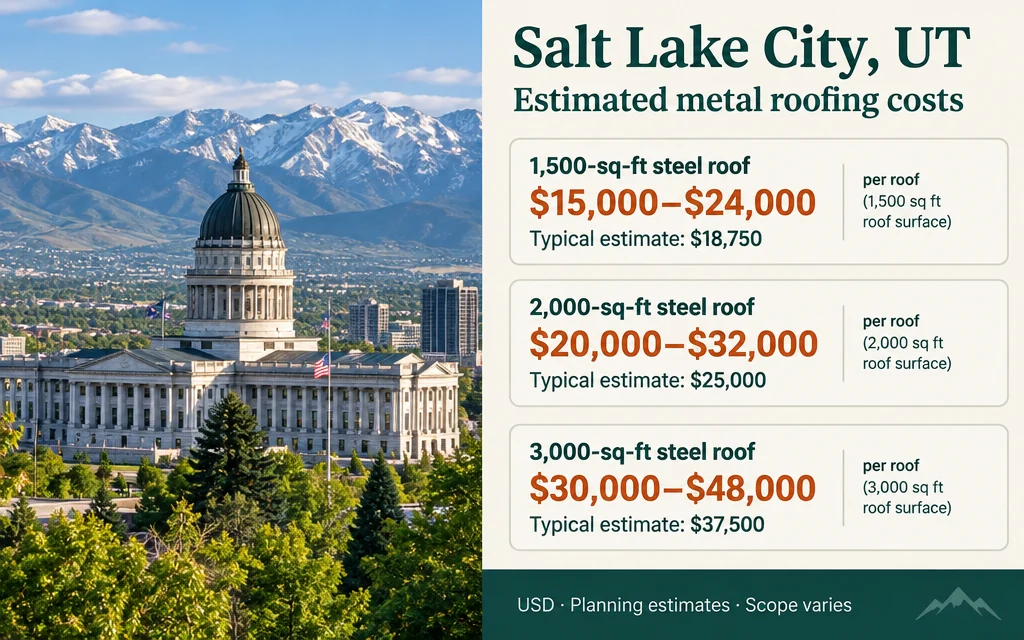
Calculated installed planning scenario for measured roof surface, including one-layer removal/disposal; conditional extras excluded.
Calculated installed planning scenario for measured roof surface, including one-layer removal/disposal; conditional extras excluded.
Calculated installed planning scenario for measured roof surface, including one-layer removal/disposal; conditional extras excluded.
Understanding Residential Metal Roofing in Salt Lake City
Metal roofing is often chosen along the Wasatch Front for winter shedding and roof durability. When comparing estimates, keep in mind that contractors calculate bids using measured roof surface area rather than your home's interior living area.
Roof surface area is measured in squares (where one square equals 100 square feet) and accounts for slope pitch, eaves, valleys, and dormers. A 2,000-square-foot home footprint in Salt Lake City often translates to a roof surface area of 2,200 to 2,600 square feet.
A complete residential proposal typically covers stripping one layer of old roofing, haul-away and disposal, high-temperature synthetic underlayment and ice barrier, panels, clips or screws, and perimeter flashing. Because verified Salt Lake City city-specific published contractor rate cards are limited, planning figures rely on regional Utah benchmarks. In the Salt Lake area, budgeting for a concealed-fastener standing seam steel roof runs $10–$16 per square foot installed over sound wood decking, with the middle of the range representing simpler roof shapes.
Metal Roofing Systems Compared: Profiles, Coatings, and Fasteners
The way a metal roof attaches to the deck and handles temperature swings directly influences installed costs and long-term upkeep.
Concealed-Fastener Standing Seam Steel: Considered the primary residential metal profile. Panels have vertical legs held in place by hidden clips anchored beneath the raised seams. Because the fasteners are covered, screw washers are not exposed to sun or weather. Budget $10–$16 per square foot installed for this system. Panels are commonly formed from 24-gauge or 26-gauge Galvalume steel with a factory PVDF finish, suited for roof pitches of 2:12 or steeper.
Exposed-Fastener Corrugated and Ribbed Steel: Originally common on agricultural or utility structures, these panels screw directly through the metal into the deck using rubber-gasketed fasteners. Installed pricing across Utah spans $5–$10 per square foot. Upfront costs are lower, but exposed washers face UV degradation and temperature shifts, requiring scheduled inspections and eventual screw maintenance.
Stamped Steel Metal Shingles: These mimic traditional asphalt shingles, slate, or cedar shakes while retaining steel's strength. Installed budgets run $10–$14 per square foot. They interlock with concealed clips and offer an alternative appearance for neighborhoods with architectural review guidelines.
Standing Seam Aluminum: Naturally corrosion resistant and well-suited for moisture-heavy environments. Aluminum standing seam runs $10–$18 per square foot installed. Aluminum expands and contracts more than steel during Wasatch seasonal temperature swings, making specialized thermal expansion clips essential.
Architectural Copper Standing Seam: A premium material priced at $20–$40 per square foot installed. Copper naturally oxidizes into a muted patina over time and requires specialized hand-soldered or folded sheet-metal work rather than paint finishes.
| Service / assumptions | Low | Typical estimate | High | Pricing unit | Estimated labor time |
|---|---|---|---|---|---|
| Standing Seam Steel (Concealed Fastener)Calculated standing-seam steel planning rate: comparable panel/accessory materials + installation labor + one-layer removal/disposal. Ordinary underlayment and details over sound decking included; conditional extra work excluded. | $10 | $12.50 | $16 | per sq ft of roof surface (installed) | N/A |
| Exposed-Fastener Corrugated/Ribbed SteelScrew-down 26-to-29-gauge panels with rubber-washer fasteners, underlayment, and one-layer tear-off. | $5 | $7.50 | $10 | per sq ft of roof surface (installed) | N/A |
| Steel Metal Shingles / TilesStamped steel shake or tile profile with interlocking concealed fasteners and one-layer removal. | $10 | $12 | $14 | per sq ft of roof surface (installed) | N/A |
| Standing Seam AluminumRustproof .032-to-.040-inch aluminum standing seam panels with thermal expansion clips and tear-off. | $10 | $14 | $18 | per sq ft of roof surface (installed) | N/A |
| Standing Seam Architectural Copper16-to-20-oz architectural copper standing seam panels with hand-formed details and tear-off. | $20 | $30 | $40 | per sq ft of roof surface (installed) | N/A |
Cost Components of a Standing Seam Steel Roof
When a contractor builds an estimate for a standing seam steel roof, the bid splits into materials, installation labor, and tear-off of the old roof covering:
Materials Allowance: Galvalume steel coil or pre-formed panels, concealed expansion clips, high-temperature self-adhering underlayment, drip edge, valley metal, and ridge accessories account for $4.50–$7 per square foot of roof surface.
Installation Labor: Skilled sheet-metal work—including on-site or shop pan forming, locking mechanical seams, and detailing dormers, crickets, and sidewalls—runs $4.50–$7 per square foot.
Tear-off and Disposal: Removing a single layer of existing asphalt shingles down to the deck, cleaning nails, and hauling the refuse to local transfer stations adds $1–$2 per square foot.
Combined, these allowances form the baseline installed standing-seam steel planning rate of $10–$16 per square foot for a sound deck.
| Service / assumptions | Low | Typical estimate | High | Pricing unit | Estimated labor time |
|---|---|---|---|---|---|
| Standing Seam Steel Materials AllowancePanels, concealed clips, high-temp synthetic underlayment, drip edge, ridge cap, and fasteners. | $4.50 | $5.50 | $7 | per sq ft of roof surface (materials only) | N/A |
| Standing Seam Steel Installation LaborSkilled labor for pan placement, seaming, flashing valleys, rakes, and standard penetrations. | $4.50 | $5.50 | $7 | per sq ft of roof surface (installation labor only) | N/A |
| One-Layer Shingle Removal and DisposalStripping single layer of asphalt shingles down to decking, nails swept, and hauled to landfill. | $1 | $1.50 | $2 | per sq ft of roof surface (one-layer removal and disposal) | N/A |
Hypothetical Project Budgets by Roof Size
Applying the baseline standing seam steel installed rate of $10–$16 per square foot gives practical planning benchmarks across common roof sizes:
1,500 Square Foot Roof (15 Roofing Squares): Common for smaller historic cottages, compact single-story homes, or simple cabins. Installed costs run $15,000–$24,000, with typical projects near [price:metal-roof-1500:typical]. Elapsed on-site crew time is typically 2 - 3 business days.
2,000 Square Foot Roof (20 Roofing Squares): Typical for mid-sized single-family homes or suburban ramblers. Installed planning budgets span $20,000–$32,000, with standard jobs around [price:metal-roof-2000:typical]. On-site installation generally takes 3 - 5 business days.
3,000 Square Foot Roof (30 Roofing Squares): Fits larger two-story homes, complex multi-gable layouts, or houses with attached multi-car garages. Installed costs range from $30,000–$48,000, with typical costs near [price:metal-roof-3000:typical]. Expect an elapsed crew schedule of 5 - 7 business days.
| Service / assumptions | Low | Typical estimate | High | Pricing unit | Estimated labor time |
|---|---|---|---|---|---|
| 1,500 sq ft Standing Seam Steel RoofCalculated scenario: 1,500 sq ft of measured roof surface × standing-seam steel installed planning rate. Includes its same materials, installation, one-layer removal/disposal and sound-deck assumptions. Not a provider whole-roof quote. | $15,000 | $18,750 | $24,000 | per roof (1,500 sq ft roof surface) | 2 - 3 business days |
| 2,000 sq ft Standing Seam Steel RoofCalculated scenario: 2,000 sq ft of measured roof surface × standing-seam steel installed planning rate. Includes its same materials, installation, one-layer removal/disposal and sound-deck assumptions. Not a provider whole-roof quote. | $20,000 | $25,000 | $32,000 | per roof (2,000 sq ft roof surface) | 3 - 5 business days |
| 3,000 sq ft Standing Seam Steel RoofCalculated scenario: 3,000 sq ft of measured roof surface × standing-seam steel installed planning rate. Includes its same materials, installation, one-layer removal/disposal and sound-deck assumptions. Not a provider whole-roof quote. | $30,000 | $37,500 | $48,000 | per roof (3,000 sq ft roof surface) | 5 - 7 business days |
Standing Seam Metal vs. Architectural Asphalt Shingles
Architectural asphalt shingles remain the most common residential roofing option in Utah, budgeting at $4–$6 per square foot installed. While standing seam steel costs substantially more upfront, the systems serve different homeownership plans.
In Salt Lake City, intense high-altitude sunlight and winter thermal cycling can cause asphalt shingles to lose granules and dry out over 20 to 25 years. Standing seam steel panels with factory-applied resin coatings resist UV exposure and shedding snow, typically lasting significantly longer without needing shingle patches or tab repairs.
Financially, homeowners planning to stay in their home for decades may find that avoiding a future tear-off and reroof balances the initial premium. However, if you anticipate moving within five to ten years, you are unlikely to recover the extra cost through property resale value alone.
| Service / assumptions | Low | Typical estimate | High | Pricing unit | Estimated labor time |
|---|---|---|---|---|---|
| Architectural Asphalt Shingle ReferenceStandard architectural shingles including synthetic underlayment, basic flashing, and tear-off. | $4 | $5 | $6 | per sq ft of roof surface (installed) | N/A |
| Comparison | Architectural asphalt | Standing-seam steel |
|---|---|---|
| Up-front planning estimate · 2,000 sq ft roof surface | $8,000–$12,000 | $20,000–$32,000 |
| What the baseline includes | Architectural asphalt, ordinary installed details, one-layer removal/disposal over sound decking. | Standing-seam steel, ordinary installed details, one-layer removal/disposal over sound decking. |
| Maintenance and repairs | Confirm product-specific inspections and repair terms. | Confirm seams, fasteners, coating, compatible repairs and inspection terms. |
| Insurance and ownership cost | Ask the insurer about the exact product and coverage. | Ask the insurer about accepted test documentation, any available credit and cosmetic-damage exclusions. |
These are calculated budgeting comparisons, not provider quotes or guaranteed lifetime savings. Compare your expected ownership period, specified products, actual maintenance proposals and written insurance terms.
| Decision point | Roof repair | Roof replacement | Metal roofing |
|---|---|---|---|
| Work being priced | A defined defect, such as damaged shingles or flashing. | Removal and installation of an agreed roof system across the measured roof surface. | A specified installed metal system; standing seam, exposed fasteners and metal shingles are different scopes. |
| What to inspect | The leak source, surrounding material and whether a durable localized fix is feasible. | The extent of deterioration, decking condition, roof details and suitable replacement systems. | The substrate, panel profile, coating, fasteners, roof geometry and installation details. |
| How to compare prices | Match the repair quantity, access, materials and included diagnosis. | Match measured roof area, material, tear-off layers, disposal and installed inclusions. | Match measured roof area, system, components, removal and conditional additional work. |
| Before deciding | Ask what the repair addresses and what existing problems would remain. | Ask whether repair remains practical and which additional items would change the total. | Ask about compatible materials, documented product/assembly ratings and product versus workmanship warranties. |
Age or a repair-cost percentage alone does not determine the right choice. Ask a qualified roofing contractor to assess the condition and explain viable options. A metal system is a material-specific installation choice, not a separate guarantee of durability or savings.
Potential Job Extras and Structural Add-Ons
Certain items fall outside a standard per-square-foot baseline and depend on roof condition, penetrations, and layout:
Decking Replacement: Once old shingles are off, damaged sheathing must be repaired. Expect $60–$85 per 4-by-8-foot sheet of OSB or CDX plywood, including labor and materials.
Extra Layer Removal: Homes with a second layer of asphalt shingles or old wood shakes underneath incur an extra $40–$75 per roofing square (100 square feet) for stripping and disposal.
Chimney Flashing and Crickets: Fabricating custom metal counter-flashing and a small deflection cricket behind a masonry chimney runs $400–$900 per chimney.
Skylight Detailing: Integrating flashing pans and sealed transitions around an existing curb-mounted skylight costs $300–$600 per unit.
Snow Retention Systems: Installing heavy-duty seam-clamp snow brackets or continuous pipe rails above walkways and doors ranges from $15–$35 per linear foot.
Ventilation Upgrades: Concealed, low-profile ridge vent systems engineered for metal profiles run $12–$25 per linear foot.
Gutter Detach and Reset: Removing existing gutters to install perimeter drip edge correctly and reinstalling them afterward costs $5–$12 per linear foot.
| Service / assumptions | Low | Typical estimate | High | Pricing unit | Estimated labor time |
|---|---|---|---|---|---|
| Extra Shingle Layer Tear-OffAdditional cost when removing a second layer of shingles or cedar shakes beneath the surface. | $40 | $55 | $75 | additional per roofing square (100 sq ft) | N/A |
| Decking Repair / Replacement (4x8 Sheet)Replacing damaged 7/16-inch OSB or 1/2-inch CDX plywood once existing deck is exposed.Published price reference ↗ | $60 | $75 | $85 | additional per 4-by-8-ft sheet (32 sq ft) | N/A |
| Masonry Chimney Flashing & CricketFabricating custom apron, step flashing, counter flashing, and cricket for metal roof profile. | $400 | $650 | $900 | additional per chimney | N/A |
| Skylight Flashing IntegrationCustom factory-welded or site-formed metal transition kit around existing skylight curbs. | $300 | $450 | $600 | additional per skylight | N/A |
| Concealed Ridge Ventilation UpgradeLow-profile perforated metal ridge vent system with insect screen matching panel profile. | $12 | $18 | $25 | additional per linear ft | N/A |
| Snow Retention Bar / Guard SystemContinuous pipe-style snow rail or heavy-duty seam-clamp snow brackets over entries and walkways. | $15 | $25 | $35 | additional per linear ft | N/A |
| Gutter Detach and ResetCareful detachment and reinstallation of existing gutters to install perimeter drip edge correctly. | $5 | $8 | $12 | additional per linear ft | N/A |
Weather Performance: Snow, Hail, Wind, and Fire
Metal roofing performs well in harsh climates, but physical ratings should be evaluated carefully based on verified product testing:
Hail and Impact: Many residential steel panels earn a UL 2218 Class 4 impact rating. This lab test confirms that steel balls dropped on the panel do not crack or fracture the metal. It is not a guarantee against cosmetic denting. If you seek an insurance rate reduction for a Class 4 roof, verify whether your carrier requires a cosmetic damage exclusion that waives claims for visual dimples that do not cause water intrusion.
Wind Uplift: Concealed-clip standing seam systems installed to manufacturer engineering standards resist strong uplift pressures, helping roofs endure mountain canyon wind gusts across the valley.
Fire Classification: Steel and aluminum panels are noncombustible. When installed over specified underlayments and solid wood decking, standing seam assemblies achieve Class A fire ratings, an important consideration for properties bordering foothill brush zones.
Snow Movement: Metal roofs release snow quickly once outdoor temperatures rise. While this prevents prolonged heavy dead loads, sudden snow slides can damage gutters or endanger people below unless snow retention rails are placed above doors and sidewalks.
Key Drivers of Metal Roofing Quotes in Utah
Metal roofing quotes vary widely depending on specific job site and material factors:
Roof Pitch and Access: Steep pitches require safety staging, specialized harness rigs, and slower panel handling, which increases installation labor. Flatter slopes require mechanical seaming rather than snap-lock seams to keep joints watertight.
Roof Geometry: A simple gable roof with straight runs takes substantially less time than a cut-up roof with multiple hips, valleys, wall flashing lines, and dormers. Each transition demands custom hand-formed sheet-metal details.
Metal Thickness and Finish: Panel thickness ranges from light 29-gauge steel to heavier 24-gauge panels. Heavier gauge steel provides greater panel rigidity and reduces visible surface waviness ('oil canning'). Higher-grade resin finishes like PVDF offer improved color retention under high-altitude ultraviolet light compared to standard polyester paints.
Decking Condition: Standing seam panels must lay over a continuous, solid surface. Older Salt Lake City homes originally roofed with cedar shakes over spaced skip-sheathing require full solid plywood or OSB overlay before underlayment can be installed.
Hiring a Metal Roofing Contractor in Salt Lake City
Standing seam installation is an architectural sheet-metal trade that differs significantly from shingling. When requesting proposals from local contractors, clarify these practical items:
Fabrication Method: Ask whether panels are roll-formed on-site from continuous coil or ordered from an off-site regional supplier. On-site forming allows continuous runs from ridge to eave without horizontal lap joints.
Underlayment Specifications: Confirm that the estimate includes high-temperature self-adhering membranes along the eaves and valleys and high-temperature synthetic underlayment across the field. Standard organic felt can soften and adhere to metal panels during hot summer months.
Warranty Coverage: Request clear written separation between the paint finish warranty provided by the coil manufacturer and the contractor's workmanship warranty covering labor and leak repair.
Permits and Licensing: Verify the contractor's active roofing license and workers' compensation coverage through the Utah Division of Professional Licensing (DOPL). Clarify in writing whether the contractor or property owner will submit drawings and pull required building permits with the local Salt Lake City building division before work begins.
Local income & housing costs
Salt Lake City city, Utah · U.S. Census Bureau, 2025 ACS 1-year estimates.
per month · ±$67
Cash-rent units; includes applicable tenant-paid utilities
Census source ↗Dollar amounts use the survey period’s published basis. Income is annual; gross rent is monthly. Home value reflects owner-occupied housing values. Margins of error shown are at the ACS 90% confidence level. These statistics provide city context; service budgets use their own pricing evidence.
STATEWIDE COST CONTEXT
Utah prices, income & labor costs
These Utah figures provide background for this city guide. They describe different measures and reference years; employee wages are not prices charged by a contractor.
BEA SAIRPD
State price change indicator
122.32024 · index (2017 basis)
Annual figures & sources
| Year | Value | 90% margin of error | Source |
|---|---|---|---|
| 2020 | 99.7 | — | Official source |
| 2021 | 103.0 | — | Official source |
| 2022 | 109.8 | — | Official source |
| 2023 | 115.3 | — | Official source |
| 2024 | 122.3 | — | Official source |
Census ACS 1-year
Median household income
$99,3112025 · USD/year
Annual figures & sources
| Year | Value | 90% margin of error | Source |
|---|---|---|---|
| 2021 | $79,449 | ±$1,246 | Official source |
| 2022 | $89,168 | ±$1,807 | Official source |
| 2023 | $93,421 | ±$1,383 | Official source |
| 2024 | $96,658 | ±$1,179 | Official source |
| 2025 | $99,311 | ±$2,056 | Official source |
BLS OEWS
Roofers
$23.402025 · USD/hour
Annual figures & sources
| Year | Value | 90% margin of error | Source |
|---|---|---|---|
| 2025 | $23.40 | — | Official source |
State prices: BEA, 2020–2024. Household income: Census ACS, 2021–2025. Employee wages: BLS, May 2025 snapshot. The charts retain their own units and fitted scales.
Explore all Utah living-cost data and trends →Local context and limitations
Salt Lake City homes sit in a mountain valley setting with high summer UV exposure, rapid freeze-thaw cycles, winter temperature inversions, and heavy foothill snow loads. For homes along the East Bench, snow retention brackets or continuous snow rails help prevent accumulated snow from sliding suddenly over entries and gutters. Local building departments enforce roof snow and wind requirements, and installing high-temperature ice-and-water barrier underlayment along eaves and valleys is common regional practice. Furthermore, existing asphalt shingles on older Salt Lake City bungalows or ranches often require complete tear-off down to the decking so contractors can inspect the sheathing before fastening metal panels.
Frequently asked questions
What is the difference between standing seam and exposed-fastener metal roofs?
Standing seam systems hide clips and fasteners under interlocking raised ribs, allowing the panels to expand and contract without stressing screw holes. Exposed-fastener corrugated roofs use screws driven directly through the panel face with rubber washers, which cost less upfront but require periodic gasket inspection and eventual replacement.
Do I need to remove my existing asphalt shingles before installing a metal roof?
Complete tear-off is standard practice in Salt Lake City. Removing the old shingles allows contractors to inspect the wood decking for rot, ensures a flat surface for concealed clips, avoids adding extra weight to the framing, and accommodates high-temperature underlayment.
Are metal roofs noisy during rainstorms?
When installed over solid wood sheathing, high-grade underlayment, and standard attic insulation, interior sound levels during rain or hail are comparable to traditional asphalt shingle roofs.
Why are snow guards recommended for metal roofs in Salt Lake City?
Metal has a low-friction surface that sheds snow quickly as temperatures fluctuate. Snow guards or continuous rails hold the snowpack in place, allowing it to melt gradually rather than sliding off in large sheets over doorways, sidewalks, and gutters.
Will installing a metal roof lower my homeowner's insurance premium?
Some carriers offer discounts for roofs with UL 2218 Class 4 impact ratings, but savings are not guaranteed. Ask your insurer about their specific policy terms, and check whether they attach a cosmetic damage endorsement that limits claims for minor surface dents.
What gauge steel is commonly used for residential standing seam?
Residential standing seam panels along the Wasatch Front are typically 24-gauge or 26-gauge steel. Heavier 24-gauge panels offer higher structural stiffness and help minimize visible oil canning across longer seam runs.
Sources and methodology
Sources below retain their recorded retrieval dates and geographic scope. We checked the quoted rates against readable public pricing pages. The tables remain planning estimates, not provider quotes or a measured citywide survey. Per-square-foot references do not establish the modeled whole-roof totals or all their installed inclusions. Regional references are not verified Salt Lake City-specific quotes. Confirm removal, disposal, materials, labor and the complete scope in a written proposal.
Published pricing pages retrieved; quoted excerpts checked automatically. 2 distinct website domains. · Generated 2026-11-12
- Roof Replacement Cost in Utah (2026 Pricing Guide) | IWC Roofing UtahState / regional reference · Page retrieved 2026-11-12 · Price excerpt matched automatically
“Replacing damaged OSB sheets adds $60–80 per sheet.”
Planning ranges may differ from these published examples; they are not provider quotes.
- Average Cost to Install a Metal Roof in Utah | Brady RoofingState / regional reference · Page retrieved 2026-11-12 · Price excerpt matched automatically
“Basic corrugated metal panels start around $8 per square foot installed, while premium standing seam systems run $12 to $16 per square foot.”
Planning ranges may differ from these published examples; they are not provider quotes.
Plan your metal roofing project
Choose your service and answer its project questions. Add notes or photos if helpful, then generate your project brief. The planner labels its budgeting assumptions separately. Use your plan to compare the scope and assumptions with a provider. Contact sharing and provider matching are not available yet.
Open the project planner →Share this city’s cost data
<> Embed Salt Lake City Cost Data on Your Site
The HTML table shows the prices at the time of copying. The iframe follows the published guide.