Tampa · FL · COST GUIDE
Metal Roofing Costs in Tampa, FL (2026)
For budgeting, standing-seam steel roofing is estimated at $10–$22 per sq ft of roof surface, and exposed-fastener steel at $7–$13 per sq ft. These installed planning ranges include one-layer removal/disposal over sound decking; compare the specified system and conditional extras.
Standing Seam Steel (Concealed Fastener)
Budget estimate$10–$22per sq ft of roof surface (installed)
Planning range · Compare the roof area, material and included work in your quote.
Exposed Fastener Steel (5V Crimp / Corrugated)
Budget estimate$7–$13per sq ft of roof surface (installed)
Planning range · Compare the roof area, material and included work in your quote.
Published examples apply to their stated scope. Budget ranges are estimates.
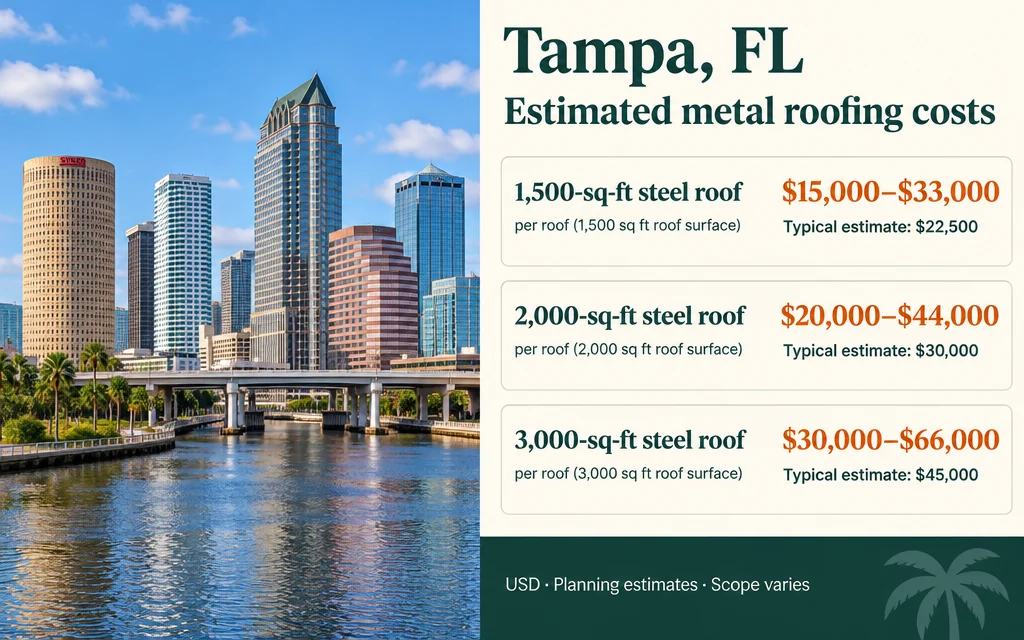
Calculated installed planning scenario for measured roof surface, including one-layer removal/disposal; conditional extras excluded.
Calculated installed planning scenario for measured roof surface, including one-layer removal/disposal; conditional extras excluded.
Calculated installed planning scenario for measured roof surface, including one-layer removal/disposal; conditional extras excluded.
Metal Roofing Pricing and Planning in Tampa
A residential metal roof replacement in Tampa requires balancing a substantial upfront investment against long-term resistance to high winds, severe downpours, and intense sun. For a concealed-fastener standing seam Galvalume steel roof, budget $10–$22 per sq ft of roof surface, with $15 representing a common midpoint on uncomplicated roof lines.
Exposed-fastener options, such as 5V crimp and corrugated profiles, offer a lower initial entry point; budget $7–$13 per sq ft installed. Because published local price points reflect broad planning ranges rather than binding bids, treat these figures as baseline estimates for initial budgeting.
All primary rates in this guide apply to measured roof surface area rather than interior living space. Eave overhangs, roof slope, covered porches, and attached garages make exterior roof area noticeably larger than your home's heated footprint. Each baseline installation figure includes tear-off and disposal of one asphalt shingle layer, high-temperature underlayment, standard perimeter flashing, and installation over sound wood decking.
Metal Roofing System Types Compared
Different metal systems carry distinct maintenance requirements and weather performance, directly affecting overall life-cycle cost in Central Florida.
Standing seam concealed-fastener steel uses 24- or 26-gauge Galvalume sheet finished with a factory fluoropolymer coating such as PVDF. Panels lock over concealed clips fastened to the decking, leaving no exposed screw holes and allowing panels to expand and contract freely during hot afternoons. For this profile, budget $10–$22 per sq ft installed.
Exposed-fastener steel panels, including traditional 5V crimp, attach with screws driven through the panel face with rubber sealing washers. Daily thermal expansion stresses these screw penetrations, requiring periodic inspections and eventual washer maintenance. For exposed-fastener steel, budget $7–$13 per sq ft installed.
Stone-coated steel shingles combine stamped 26-gauge Galvalume panels with ceramic granules to simulate Spanish barrel tile or cedar shake without adding excessive dead weight to the roof trusses. For stone-coated steel, budget $10–$18 per sq ft installed.
Standing seam aluminum (.032- to .040-inch thickness) is common near Hillsborough Bay and coastal waterways because aluminum does not rust when exposed to salt spray. For marine-grade aluminum, budget $13–$23 per sq ft installed.
Architectural copper provides exceptional longevity and weathers into a classic verdigris patina, but requires specialized hand-soldering and custom fabrication. For standing seam copper, budget $20–$38 per sq ft installed.
| Service / assumptions | Low | Typical estimate | High | Pricing unit | Estimated labor time |
|---|---|---|---|---|---|
| Standing Seam Steel (Concealed Fastener)Calculated standing-seam steel planning rate: comparable panel/accessory materials + installation labor + one-layer removal/disposal. Ordinary underlayment and details over sound decking included; conditional extra work excluded. | $10 | $15 | $22 | per sq ft of roof surface (installed) | N/A |
| Exposed Fastener Steel (5V Crimp / Corrugated)26- or 29-gauge Galvalume panels with gasketed screw fasteners, code underlayment, and one-layer tear-off. | $7 | $9.50 | $13 | per sq ft of roof surface (installed) | N/A |
| Stone-Coated Steel Shingles / TilesInterlocking stone-coated 26-gauge steel simulating shake or barrel tile, including tear-off and accessories. | $10 | $14 | $18 | per sq ft of roof surface (installed) | N/A |
| Standing Seam Aluminum (Coastal Grade).032 or .040-inch marine-grade aluminum standing seam with concealed clips, ideal for coastal salt air. Published rate reference for the stated roofing scope and unit, not verification of this guide's modeled range, a complete roof quote or provider availability.Published price reference ↗ | $13 | $17.50 | $23 | per sq ft of roof surface (installed) | N/A |
| Standing Seam Copper Architectural16-oz or 20-oz cold-rolled copper with brass clips and soldered details, complete installation baseline. | $20 | $28 | $38 | per sq ft of roof surface (installed) | N/A |
Cost Components for Standing Seam Steel
A detailed contractor proposal separates a standing seam steel project into materials, installation labor, and tear-off. Understanding these parts helps you spot bids that omit critical accessories or wind-resistance items.
Materials and underlayment make up $4.50–$9.50 per sq ft of roof surface. This covers 24-gauge Galvalume coil or pre-formed panels, continuous starter cleats, drip edges, ridge caps, valley flashings, self-adhering high-temperature underlayment, and expansion clips.
Installation labor accounts for $4.50–$10 per sq ft. Custom sheet-metal fabrication, precise eave hemming, watertight valley detailing, and mechanical seaming require specialized sheet-metal technicians. Meeting local wind-uplift attachment patterns requires tighter clip spacing, which adds on-site labor time.
Tear-off and disposal of one existing shingle layer costs $1–$2.50 per sq ft, covering container fees, haul-off, and magnetic sweeps for stray fasteners. Together, these three allowances combine to establish the complete $10–$22 per sq ft installed planning baseline.
| Service / assumptions | Low | Typical estimate | High | Pricing unit | Estimated labor time |
|---|---|---|---|---|---|
| Standing Seam Steel Materials & Underlayment24-gauge Galvalume panels, self-adhering high-temp underlayment, concealed clips, fasteners, and trim stock. | $4.50 | $6.50 | $9.50 | per sq ft of roof surface (materials only) | N/A |
| Standing Seam Steel Installation LaborSkilled sheet-metal crew labor for panel layout, seaming, hip/ridge/valley flashings, excluding removal. | $4.50 | $7 | $10 | per sq ft of roof surface (installation labor only) | N/A |
| One-Layer Shingle Removal & DisposalComplete tear-off of one layer of asphalt shingles down to decking, dumpster fees, and magnetic yard sweep. | $1 | $1.50 | $2.50 | per sq ft of roof surface (one-layer removal and disposal) | N/A |
Installed Cost by Roof Surface Area
Because roofing contractors calculate materials and labor from actual exterior surface area, total expenditure depends on your home's roof geometry. Below are modeled budgets for common residential roof sizes in Tampa, applying the standing seam steel baseline of $10–$22 per sq ft.
A compact 1,500-square-foot roof surface budgets $15,000–$33,000 installed, with $22,500 as a typical midpoint. Work on this roof size generally takes 3-5 days of on-site crew time.
A 2,000-square-foot roof surface budgets $20,000–$44,000 installed, averaging $30,000. Elapsed crew time generally spans 4-6 days.
A 3,000-square-foot roof surface on a larger single-story or complex multi-level home budgets $30,000–$66,000 installed, with $45,000 being typical. Expect an on-site installation schedule of 5-8 days.
| Service / assumptions | Low | Typical estimate | High | Pricing unit | Estimated labor time |
|---|---|---|---|---|---|
| Standing Seam Steel Roof (1,500 sq ft surface)Calculated scenario: 1,500 sq ft of measured roof surface × standing-seam steel installed planning rate. Includes its same materials, installation, one-layer removal/disposal and sound-deck assumptions. Not a provider whole-roof quote. | $15,000 | $22,500 | $33,000 | per roof (1,500 sq ft roof surface) | 3-5 days |
| Standing Seam Steel Roof (2,000 sq ft surface)Calculated scenario: 2,000 sq ft of measured roof surface × standing-seam steel installed planning rate. Includes its same materials, installation, one-layer removal/disposal and sound-deck assumptions. Not a provider whole-roof quote. | $20,000 | $30,000 | $44,000 | per roof (2,000 sq ft roof surface) | 4-6 days |
| Standing Seam Steel Roof (3,000 sq ft surface)Calculated scenario: 3,000 sq ft of measured roof surface × standing-seam steel installed planning rate. Includes its same materials, installation, one-layer removal/disposal and sound-deck assumptions. Not a provider whole-roof quote. | $30,000 | $45,000 | $66,000 | per roof (3,000 sq ft roof surface) | 5-8 days |
Standing Seam Metal vs. Architectural Asphalt Shingles
Choosing between standing seam metal and architectural shingles means weighing a higher initial outlay against long-term resistance to Central Florida's weather.
In Tampa, architectural asphalt shingles budget $4.50–$9 per sq ft installed, with $6.50 representing a standard project. A standing seam steel system runs $10–$22 per sq ft, requiring roughly double the upfront investment.
The trade-off centers on heat tolerance and wind performance. Prolonged sun exposure, intense summer heat cycles, and severe rain wear asphalt shingles down through granule loss and sealant failure. In contrast, concealed-fastener metal panels lock together without exposed fasteners, shedding heavy rain and handling thermal expansion without tab blow-offs. While shingles remain practical for keeping near-term replacement costs down, standing seam metal significantly extends reroofing cycles for owners planning to stay in their homes for decades.
| Service / assumptions | Low | Typical estimate | High | Pricing unit | Estimated labor time |
|---|---|---|---|---|---|
| Architectural Asphalt Shingles ReferenceInstalled architectural shingles including tear-off of one layer, synthetic underlayment, and standard flashings. | $4.50 | $6.50 | $9 | per sq ft of roof surface (installed) | N/A |
| Comparison | Architectural asphalt | Standing-seam steel |
|---|---|---|
| Up-front planning estimate · 2,000 sq ft roof surface | $9,000–$18,000 | $20,000–$44,000 |
| What the baseline includes | Architectural asphalt, ordinary installed details, one-layer removal/disposal over sound decking. | Standing-seam steel, ordinary installed details, one-layer removal/disposal over sound decking. |
| Maintenance and repairs | Confirm product-specific inspections and repair terms. | Confirm seams, fasteners, coating, compatible repairs and inspection terms. |
| Insurance and ownership cost | Ask the insurer about the exact product and coverage. | Ask the insurer about accepted test documentation, any available credit and cosmetic-damage exclusions. |
These are calculated budgeting comparisons, not provider quotes or guaranteed lifetime savings. Compare your expected ownership period, specified products, actual maintenance proposals and written insurance terms.
| Decision point | Roof repair | Roof replacement | Metal roofing |
|---|---|---|---|
| Work being priced | A defined defect, such as damaged shingles or flashing. | Removal and installation of an agreed roof system across the measured roof surface. | A specified installed metal system; standing seam, exposed fasteners and metal shingles are different scopes. |
| What to inspect | The leak source, surrounding material and whether a durable localized fix is feasible. | The extent of deterioration, decking condition, roof details and suitable replacement systems. | The substrate, panel profile, coating, fasteners, roof geometry and installation details. |
| How to compare prices | Match the repair quantity, access, materials and included diagnosis. | Match measured roof area, material, tear-off layers, disposal and installed inclusions. | Match measured roof area, system, components, removal and conditional additional work. |
| Before deciding | Ask what the repair addresses and what existing problems would remain. | Ask whether repair remains practical and which additional items would change the total. | Ask about compatible materials, documented product/assembly ratings and product versus workmanship warranties. |
Age or a repair-cost percentage alone does not determine the right choice. Ask a qualified roofing contractor to assess the condition and explain viable options. A metal system is a material-specific installation choice, not a separate guarantee of durability or savings.
Additional Work and Upgrades
Tearing off an old roof frequently uncovers damaged decking or requires custom flashings that fall outside the standard per-square-foot baseline.
Stripping an extra layer of shingles or roll roofing adds $40–$85 per roofing square (100 sq ft) for labor and disposal. Replacing moisture-damaged plywood or OSB sheathing costs $70–$130 per 4-by-8-foot sheet, including materials and code-spaced nailing.
Penetrations require dedicated sheet-metal details. Custom-fabricated chimney crickets and counter-flashing kits run $300–$850 per chimney. Waterproofing curbs and integrating skylights with custom flashing kits costs $250–$650 per unit. Upgrading to continuous perforated ridge ventilation with internal weather baffles runs $12–$32 per linear foot. Detaching and reinstalling existing aluminum gutters to fit new drip-edge metal runs $5–$15 per linear foot. Snow guard brackets budget $15–$40 per linear foot, though they are rarely specified for residential projects in Central Florida.
| Service / assumptions | Low | Typical estimate | High | Pricing unit | Estimated labor time |
|---|---|---|---|---|---|
| Extra Existing Layer Removal & Haul-OffLabor and disposal surcharge per 100 sq ft for stripping a second shingle layer or roll-roofing. | $40 | $55 | $85 | additional per roofing square (100 sq ft) | N/A |
| Damaged Plywood / OSB Decking ReplacementReplacement of water-damaged 1/2-inch or 5/8-inch CDX plywood or OSB, fastened with code ring-shank nails. | $70 | $95 | $130 | additional per 4-by-8-ft sheet (32 sq ft) | N/A |
| Chimney Metal Cricket & Flashing KitCustom-fabricated step flashing, saddle/cricket, and counter-flashing reglet cut into masonry. | $300 | $500 | $850 | additional per chimney | N/A |
| Skylight Flashing & Curb IntegrationWaterproof curb prep and custom sheet-metal flashing surround designed for standing seam panels. | $250 | $400 | $650 | additional per skylight | N/A |
| Continuous Perforated Ridge Vent UpgradeHigh-capacity vented ridge caps with bug mesh and internal baffles to resist wind-driven rain. | $12 | $20 | $32 | additional per linear ft | N/A |
| Snow Retention / Guard ClampsNon-penetrating seam-clamp snow brackets (rarely required in Central Florida; specialized commercial applications). | $15 | $25 | $40 | additional per linear ft | N/A |
| Gutter Detach & ReinstallCareful removal of existing aluminum seamless gutters during drip edge prep and reinstallation. | $5 | $9 | $15 | additional per linear ft | N/A |
Wind, Fire, and Impact Ratings in Tampa
Product ratings indicate how a roofing assembly performed under standardized laboratory testing. Understanding what these ratings cover helps you evaluate technical claims during quoting.
Wind uplift ratings in Florida depend on the complete roof deck assembly, not the panel alone. Panels, underlayment, fastener type, and clip spacing must match a tested system with an active Florida Product Approval or local engineering evaluation. When gathering estimates, ask each contractor for the approval document number showing compliance with the wind design criteria for your specific property address.
A UL 2218 Class 4 impact rating certifies that a panel resisted puncture by steel balls during factory drop tests. While this demonstrates structural integrity against hail, it does not guarantee the metal will resist cosmetic surface denting. In addition, many Florida homeowner policies include cosmetic damage endorsements that exclude panel replacement unless water penetrates the roof deck. Verify your policy coverage directly with your insurer rather than assuming premium reductions.
Fire resistance depends on the total roof assembly. Noncombustible steel panels over a compliant barrier underlayment can achieve a Class A fire rating, but individual metal sheets do not create a Class A assembly on their own.
Key Cost Drivers for Tampa Properties
Four main variables determine where a specific metal roofing quote falls within regional pricing ranges:
1. Distance to Open Saltwater: If your home is near Old Tampa Bay or Hillsborough Bay, airborne salt accelerates corrosion along raw cut edges of steel. Upgrading from standing seam steel ($10–$22 per sq ft) to marine-grade aluminum ($13–$23 per sq ft) raises material expense but prevents salt-induced finish breakdown.
2. Roof Geometry and Pitch: Straight gable profiles with continuous, uncomplicated panel runs require less labor and generate minimal scrap. In contrast, complex hip configurations, valleys, dormers, and steep pitches require extensive on-site hand-forming and cutting, which increases labor time and material waste.
3. Deck Condition and Fastener Spacing: During reroofing, wood decking must be inspected and often re-nailed to comply with high-wind attachment schedules. Confirm whether your contractor's quote includes inspecting and re-nailing the existing sheathing or lists it as a per-sheet change order.
4. Fastener Style: Choosing exposed-fastener steel ($7–$13 per sq ft) reduces immediate out-of-pocket costs compared to concealed standing seam ($10–$22 per sq ft), but introduces recurring maintenance for neoprene washer inspection and tightening.
Hiring a Metal Roofing Contractor in Tampa
Installing a concealed-fastener metal roof demands specialized equipment and trade experience. Take these steps when screening local contractors:
Verify that the contractor holds an active Florida Certified Roofing Contractor (CCC) license through the Department of Business and Professional Regulation (DBPR). Ask for certificates of general liability and workers' compensation insurance sent directly from the insurer. Inquire which local building agency holds jurisdiction over your address—such as the City of Tampa or Hillsborough County—and confirm in your written contract who is responsible for pulling the building permit before work starts.
Review the written scope to ensure it lists exact product details: the panel manufacturer, profile name, metal gauge (such as 24-gauge steel or .032-inch aluminum), finish system (such as PVDF/Kynar 500), underlayment type, and the Florida Product Approval number.
Separate manufacturer product warranties from the installer's workmanship warranty. Finish warranties cover chalking and color fading over a set term, while substrate warranties address perforation. Water leaks resulting from improper flashing, wrong clip intervals, or faulty valley detailing fall under the roofer's workmanship warranty. Request written terms specifying workmanship coverage length and repair response times.
Local income & housing costs
Tampa city, Florida · U.S. Census Bureau, 2025 ACS 1-year estimates.
per month · ±$70
Cash-rent units; includes applicable tenant-paid utilities
Census source ↗Dollar amounts use the survey period’s published basis. Income is annual; gross rent is monthly. Home value reflects owner-occupied housing values. Margins of error shown are at the ACS 90% confidence level. These statistics provide city context; service budgets use their own pricing evidence.
STATEWIDE COST CONTEXT
Florida prices, income & labor costs
These Florida figures provide background for this city guide. They describe different measures and reference years; employee wages are not prices charged by a contractor.
BEA SAIRPD
State price change indicator
127.92024 · index (2017 basis)
Annual figures & sources
| Year | Value | 90% margin of error | Source |
|---|---|---|---|
| 2020 | 105.3 | — | Official source |
| 2021 | 110.5 | — | Official source |
| 2022 | 118.8 | — | Official source |
| 2023 | 124.9 | — | Official source |
| 2024 | 127.9 | — | Official source |
Census ACS 1-year
Median household income
$80,8462025 · USD/year
Annual figures & sources
| Year | Value | 90% margin of error | Source |
|---|---|---|---|
| 2021 | $63,062 | ±$425 | Official source |
| 2022 | $69,303 | ±$616 | Official source |
| 2023 | $73,311 | ±$577 | Official source |
| 2024 | $77,735 | ±$564 | Official source |
| 2025 | $80,846 | ±$521 | Official source |
BLS OEWS
Roofers
$22.882025 · USD/hour
Annual figures & sources
| Year | Value | 90% margin of error | Source |
|---|---|---|---|
| 2025 | $22.88 | — | Official source |
State prices: BEA, 2020–2024. Household income: Census ACS, 2021–2025. Employee wages: BLS, May 2025 snapshot. The charts retain their own units and fitted scales.
Explore all Florida living-cost data and trends →Local context and limitations
In Tampa, wind-uplift criteria and salt-air exposure along Hillsborough Bay and Old Tampa Bay shape roof design. Permitting authorities enforce high-wind fastening and secondary water-barrier underlayment standards. When requesting bids, ask contractors to specify the exact product approval codes for your address. If your home sits within close proximity of open saltwater, check panel warranty boundaries carefully; standard Galvalume warranties often exclude coastal splash zones, leading many waterfront homeowners to specify aluminum systems.
Frequently asked questions
What is the difference between standing seam and exposed-fastener metal?
Standing seam uses interlocking vertical legs that conceal clips and fasteners underneath the panel, shielding penetrations from rain, sun, and thermal movement. Exposed-fastener panels are screwed directly through the exterior surface using neoprene washers. Standing seam requires a higher planning budget (budget $10–$22 per sq ft installed versus $7–$13), but avoids the routine washer inspections and resealing associated with through-fastened panels.
Can Galvalume steel be installed directly on Tampa Bay waterfront homes?
Galvalume steel manufacturers often limit or void finish and perforation warranties for homes within close proximity of saltwater due to marine salt spray. For waterfront locations along Old Tampa Bay, Hillsborough Bay, or salt canals, contractors generally recommend .032- or .040-inch marine-grade aluminum standing seam instead.
Does local building code require removing old shingles before installing metal?
Whether an existing shingle layer may legally remain depends on the building jurisdiction governing your address (such as the City of Tampa or unincorporated Hillsborough County), existing structural load calculations, and local enforcement of Florida Building Code reroofing standards. In practice, contractors almost universally recommend a complete tear-off down to the wood deck. Stripping old shingles allows crews to inspect the sheathing for hidden rot or termite damage, re-nail the deck to meet high-wind uplift standards, and install required secondary water-barrier underlayment directly on clean wood.
Will installing a metal roof reduce my Florida homeowners insurance premium?
A new roof installed with an active Florida Product Approval, secondary water barrier underlayment, and documented wind-rated attachments may qualify for insurance discounts under a Uniform Mitigation Inspection. However, policy credits depend entirely on your carrier and location. Contact your insurance agent before signing a contract to confirm which discounts apply to your home.
How do I calculate my roof surface area from my home's floor plan?
Exterior roof surface is always larger than heated interior square footage due to roof pitch, eave overhangs, covered porches, and attached garages. For instance, a home with 2,000 square feet of interior floor space often measures 2,400 to 2,800 square feet of exterior roof surface depending on the slope and layout. Contractors verify exact measurements using aerial measurement tools or on-site pitch calculations.
Is a residential metal roof noisy during heavy Florida rainstorms?
No. When installed over solid plywood or OSB decking with high-temperature underlayment and standard attic insulation, a residential metal roof dampens rain sound effectively. Interior noise levels are comparable to architectural asphalt shingles, unlike uninsulated metal panels on an open-frame pole barn.
Sources and methodology
Sources below retain their recorded retrieval dates and geographic scope. We checked the quoted rates against readable public pricing pages. The tables remain planning estimates, not provider quotes or a measured citywide survey. Per-square-foot references do not establish the modeled whole-roof totals or all their installed inclusions. Regional references are not verified Tampa-specific quotes. Confirm removal, disposal, materials, labor and the complete scope in a written proposal.
Published pricing pages retrieved; quoted excerpts checked automatically. 3 distinct website domains. · Generated 2026-11-12
- Metal Roof vs Shingles Cost Tampa FL (2026)City-specific page context · Page retrieved 2026-11-12 · Price excerpt matched automatically
“In Tampa, asphalt shingles cost $5 to $9 per square foot installed.”
Planning ranges may differ from these published examples; they are not provider quotes.
- Metal Roofing Suffolk & Norfolk VA | Standing Seam | BlackTree LLCState / regional reference · Page retrieved 2026-11-12 · Price excerpt matched automatically
“Metal roofing in Suffolk and Norfolk VA costs $9-$16 per square foot installed.”
Planning ranges may differ from these published examples; they are not provider quotes.
- Metal Roof Cost in Florida: 2026 Price Ranges | CoastlineCity-specific page context · Page retrieved 2026-11-12 · Price excerpt matched automatically
“Angi's national standing seam page (updated May 30, 2026) lists aluminum at $11 to $18 per square foot installed, against $10 to $16 for steel.”
Planning ranges may differ from these published examples; they are not provider quotes.
Plan your metal roofing project
Choose your service and answer its project questions. Add notes or photos if helpful, then generate your project brief. The planner labels its budgeting assumptions separately. Use your plan to compare the scope and assumptions with a provider. Contact sharing and provider matching are not available yet.
Open the project planner →Share this city’s cost data
<> Embed Tampa Cost Data on Your Site
The HTML table shows the prices at the time of copying. The iframe follows the published guide.