Manhattan · NY · COST GUIDE
Roof Repair Costs in Manhattan, NY (2026)
For budgeting, a small shingle repair is estimated at $350–$800 up to 100 sq ft patch, and pipe boot replacement at $250–$550 per penetration. These are different repair scopes; compare the table's assumptions with a written contractor quote.
Minor Asphalt Shingle Patch
Budget estimate$350–$800up to 100 sq ft patch
Planning range · Compare the repair scope, materials and included work in your quote.
Plumbing Vent Pipe Boot Replacement
Budget estimate$250–$550per penetration
Planning range · Compare the repair scope, materials and included work in your quote.
Published examples apply to their stated scope. Budget ranges are estimates.
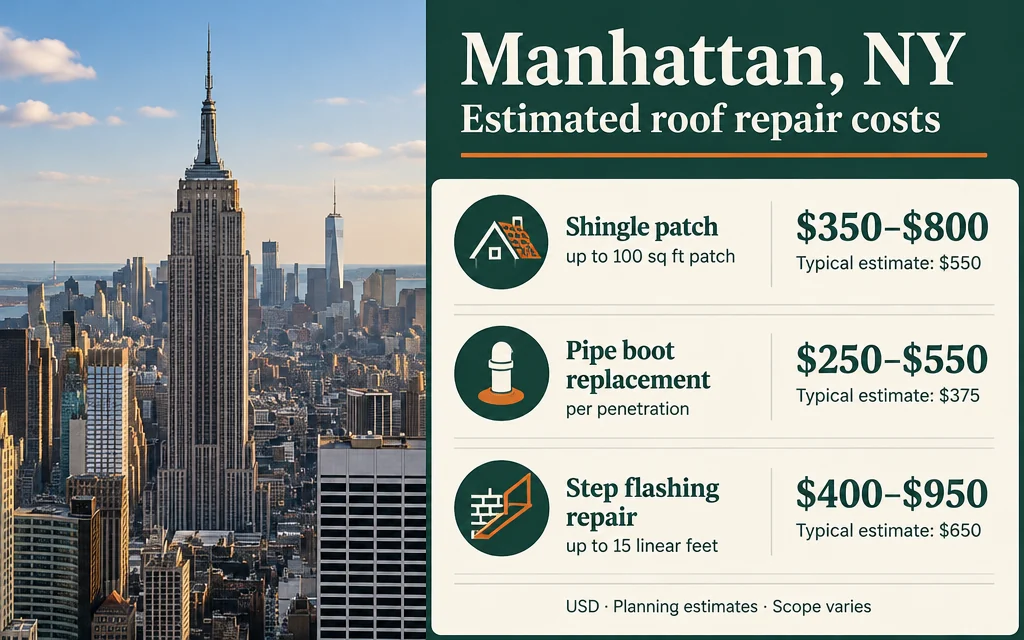
Planning estimate up to 100 sq ft patch. Applies to townhome mansards or peaked roof sections. Replaces up to one square of damaged or missing shingles with matching dimensional material.
Planning estimate per penetration. Removal of torn rubber collar or cracked lead boot, installation of new flashed pipe sleeve, and sealed tie-in to existing roof system.
Planning estimate up to 15 linear feet. Prying up perimeter shingles or membrane edge, replacing corroded metal steps along sidewalls, and resealing watertight joints.
Understanding Residential Roof Repairs in Manhattan
Maintaining a residential roof in Manhattan presents unique structural and logistical considerations compared to suburban markets. Most independent residential properties in the borough are historic townhomes, brownstones, and low-rise row structures with flat or low-slope roofing assemblies.
Rather than expansive shingle slopes, primary weather protection depends on continuous elastomeric or bituminous membranes bounded by brick or stone parapet walls.
Planning for a repair involves accounting for freeze-thaw cycles, trapped urban moisture, and wear around rooftop mechanical units. An isolated flat membrane patch budgets at $400–$1,200 up to 100 sq ft repair area. When sidewall flashing needs work, budget $400–$950 up to 15 linear feet. Addressing masonry transitions or rooftop openings also carries dedicated scopes: budget $450–$1,200 per chimney for counterflashing resets, or $450–$1,200 per skylight curb for curb resealing.
Unlike suburban properties where equipment can be staged across a driveway or yard, Manhattan work often involves moving materials through interior hallways, stairwells, or rooftop bulkhead doors. Tight street access and building staging requirements factor directly into contractor scheduling and project proposals.
Professional Inspection and Leak Diagnosis
Pinpointing a leak on an urban flat roof requires methodical investigation because water can travel along structural steel, timber joists, or concrete decks before emerging inside. A visible interior ceiling stain rarely aligns directly with the external breach.
A visual roof inspection in Manhattan budgets at $150–$400 per inspection and typically takes 1 to 2 hours (1 technician) to evaluate the surface membrane, drain bowls, coping stones, and penetrations.
Homeowners should distinguish between an informal sales walk-through and a formal diagnostic report. A contractor providing a brief sales visit is generally assessing whether to propose a broader replacement or major repair package. When a leak source is concealed beneath pavers, ballast, or multiple historical membrane layers, plan instead for a dedicated leak diagnostic investigation budgeting at $250–$650 per investigation.
During a dedicated diagnostic investigation, technicians spend 2 to 4 hours (1-2 technicians) tracing moisture migration, which may include using infrared thermal imaging, electronic leak testing, or controlled water testing across flashing joints. When booking, ask the contractor whether any diagnostic fee can be credited toward subsequent repair work.
| Service / assumptions | Low | Typical estimate | High | Pricing unit | Estimated labor time |
|---|---|---|---|---|---|
| Visual Roof Inspection & ReportIncludes full roof surface check, parapet and coping inspection, flashing assessment, and written summary. Free contractor visits are generally sales walk-throughs rather than diagnostic written reports. The source is a published task-price reference; the planning range and stated repair quantity remain estimates.Published price reference ↗ | $150 | $275 | $400 | per inspection | 1 to 2 hours (1 technician) |
| Comprehensive Leak Diagnostic & Water TestCovers thermal imaging, interior moisture tracing, and controlled water testing to locate tracking leaks behind parapets or under membranes. | $250 | $450 | $650 | per investigation | 2 to 4 hours (1-2 technicians) |
Common Residential Roof Leak Repairs and Costs
Most residential roof leaks in the borough develop at penetrations, masonry edges, and perimeter transitions rather than across the open field. Plumbing vent penetrations are common failure points; replacing a cracked rubber collar or lead boot budgets at $250–$550 per penetration and generally requires 1 to 2 hours (1 technician) of on-site crew work.
Skylights, which are widespread over brownstone stair halls and rear extensions, often leak when perimeter flashings loosen or sealants fail. Rebuilding curb membrane transitions and resetting metal flashing budgets at $450–$1,200 per skylight curb, taking 2 to 4 hours (2 workers). Chimneys projecting above party walls also face mortar deterioration; resetting counterflashing into masonry joints budgets at $450–$1,200 per chimney, taking 3 to 5 hours (2 workers).
For properties with sloped architectural elements, such as street-facing mansard sections or decorative dormers, small shingle repairs budget at $350–$800 up to 100 sq ft patch, taking 2 to 3 hours (2 workers). If moisture has breached the surface and degraded the protective layer underneath, budget $400–$950 up to 100 sq ft section to lift the surface, install self-adhering modified underlayment, and re-lay the covering in 2 to 4 hours (2 workers).
| Service / assumptions | Low | Typical estimate | High | Pricing unit | Estimated labor time |
|---|---|---|---|---|---|
| Minor Asphalt Shingle PatchApplies to townhome mansards or peaked roof sections. Replaces up to one square of damaged or missing shingles with matching dimensional material.Published price reference ↗ | $350 | $550 | $800 | up to 100 sq ft patch | 2 to 3 hours (2 workers) |
| Plumbing Vent Pipe Boot ReplacementRemoval of torn rubber collar or cracked lead boot, installation of new flashed pipe sleeve, and sealed tie-in to existing roof system. | $250 | $375 | $550 | per penetration | 1 to 2 hours (1 technician) |
| Step Flashing Repair & Re-securingPrying up perimeter shingles or membrane edge, replacing corroded metal steps along sidewalls, and resealing watertight joints. | $400 | $650 | $950 | up to 15 linear feet | 2 to 4 hours (2 workers) |
| Chimney Flashing & Counterflashing ResetGrinding mortar joints, installing new copper or aluminum counterflashing, step flashing at the base, and polyurethane masonry sealant. | $450 | $750 | $1,200 | per chimney | 3 to 5 hours (2 workers) |
| Skylight Flashing & Curb ResealDismantling perimeter flashing, rebuilding curb membrane transitions, applying self-adhered waterproofing membrane, and reinstalling metal flashing. | $450 | $700 | $1,200 | per skylight curb | 2 to 4 hours (2 workers) |
| Ridge Cap RepairReplacing cracked, wind-damaged, or loose ridge cap shingles or metal cap joints along peaked roof transitions. | $300 | $500 | $750 | up to 20 linear feet | 2 to 3 hours (2 workers) |
| Roof Valley Flashing RepairStripping surrounding material down to decking, installing ice-and-water barrier underlayment, and fitting new open metal or woven valley sections. | $600 | $950 | $1,450 | up to 15 linear feet | 3 to 5 hours (2 workers) |
| Underlayment Patch & Re-nailingLifting surface coverings to patch torn or rotted felt with high-temperature self-adhering modified membrane, then re-laying existing finish. | $400 | $650 | $950 | up to 100 sq ft section | 2 to 4 hours (2 workers) |
Material-Specific Repair Considerations
Flat and low-slope membranes dominate Manhattan rowhouses and townhomes. Modified bitumen, EPDM rubber, and liquid-applied coatings each require specific, chemically compatible patch materials.
Repairing an open lap joint, mechanical puncture, or membrane blister budgets at $400–$1,200 up to 100 sq ft repair area, taking 2 to 4 hours (2 workers). Modified bitumen requires torched or cold-adhered cap sheet materials, whereas EPDM relies on dedicated rubber primers and vulcanized seam tape; applying standard asphalt mastic to synthetic rubber can dissolve the membrane.
Architectural sheet metal is common across historic cornices, bay dormers, and decorative townhome canopies. Repairing loose panels, re-soldering cracked copper joints, or installing new gasketed fasteners on standing-seam sections budgets at $450–$1,400 up to 100 sq ft section, taking 3 to 5 hours (2 workers). Sheet metal restoration demands skilled soldering and detailing to accommodate natural thermal movement without buckling.
Historic slate and ceramic tile appear on select landmarked gables, rowhouse dormers, and mansards. Replacing broken or missing units budgets at $500–$1,500 up to 15 replaced units, taking 3 to 5 hours (2 workers). Technicians must use specialized slate rippers to pull fasteners without damaging surrounding historic tiles, securing replacement pieces with copper tabs or hooks.
| Service / assumptions | Low | Typical estimate | High | Pricing unit | Estimated labor time |
|---|---|---|---|---|---|
| Metal Panel Seam & Fastener RepairRe-crimping standing seams, replacing failed gasketed screws, soldering small copper tears, or applying elastomeric seam sealants on townhome bays. | $450 | $800 | $1,400 | up to 100 sq ft section | 3 to 5 hours (2 workers) |
| Historic Slate or Tile Spot RepairCareful extraction of broken slates using a slate ripper, sliding in matching salvaged slates or tiles, and securing with copper hooks or nails. | $500 | $900 | $1,500 | up to 15 replaced units | 3 to 5 hours (2 workers) |
| Flat Membrane Lap & Puncture PatchPriming, heat-welding, or torching modified bitumen/TPO/EPDM patches over open seams, punctures, or mechanical blisters on residential rowhouse roofs.Published price reference ↗ | $400 | $750 | $1,200 | up to 100 sq ft repair area | 2 to 4 hours (2 workers) |
Emergency Stabilization and Severe Storm Mitigation
When a severe storm, sudden freeze, or wind damage causes active interior water penetration, immediate stabilization takes priority over permanent restoration. Emergency roof tarping budgets at $450–$1,800 per tarp installation (up to 400 sq ft), taking 1 to 3 hours (2 workers).
Because technicians cannot drive ground stakes into a flat urban roof, temporary covers are secured using padded ballast, timber curbs, or specialized temporary hold-down methods.
A heavy-duty tarp is an interim safeguard designed to protect interior living spaces while waiting for rain to stop and the roof deck to dry. Attempting permanent hot-air welding or torch-down membrane repairs during active rain is ineffective, as trapped moisture generates steam blisters that ruin adhesion.
If a crew is dispatched outside normal operating hours, an additional fee applies. The after-hours and storm response fee budgets at $200–$450 flat additional surcharge to cover immediate mobilization, safety equipment, and hazardous weather conditions. The on-site repair timing is not established by this dispatch surcharge line item. Ask the contractor to confirm in advance whether this is a one-time dispatch charge or an hourly premium.
| Service / assumptions | Low | Typical estimate | High | Pricing unit | Estimated labor time |
|---|---|---|---|---|---|
| Emergency Roof Tarping & SecuringImmediate temporary weatherproofing using weighted heavy-duty reinforced tarps or heat-tacked poly membrane to halt active interior water entry. | $450 | $900 | $1,800 | per tarp installation (up to 400 sq ft) | 1 to 3 hours (2 workers) |
| After-Hours & Storm Response FeeAdditional fee applied for emergency dispatch on nights, weekends, or during ongoing severe weather events. Added to regular labor and repair costs. | $200 | $300 | $450 | flat additional surcharge | N/A |
Uncovering Concealed Structural Damage and Extra Costs
Once a contractor removes a leaking membrane or waterlogged insulation board, hidden rot in the substrate may be revealed. Replacing water-damaged structural plywood decking budgets at $120–$240 per 4x8 sheet (32 sq ft), taking 1 to 2 hours (2 workers) when the area is already exposed during repair.
Historic brownstones often have original tongue-and-groove pine board decks beneath modern layers, requiring custom carpentry if boards must be replaced.
Perimeter woodwork can also deteriorate if edge flashings fail. Repairing damaged wood or metal-clad fascia along roof edges budgets at $25–$70 per linear foot, taking 2 to 4 hours (2 workers), while replacing rotted soffit sections budgets at $25–$65 per linear foot, taking 2 to 4 hours (2 workers). Because small standalone tasks still require crew setup, per-foot repairs are generally most economical when completed alongside the primary leak repair.
Urban waste handling is another line item to anticipate. Bagging and carting away old membrane scrap, wet insulation, and corroded metal budgets at $150–$450 per repair job, taking 1 hour (2 workers). Street parking and container rules vary significantly by street, so crews frequently transport debris down through service pathways directly into commercial vehicles.
| Service / assumptions | Low | Typical estimate | High | Pricing unit | Estimated labor time |
|---|---|---|---|---|---|
| Plywood Roof Decking ReplacementCost per sheet to remove water-damaged plywood or pine tongue-and-groove planking and install new 5/8-inch CDX sheathing while roof is already exposed. | $120 | $175 | $240 | per 4x8 sheet (32 sq ft) | 1 to 2 hours (2 workers) |
| Wood/Metal Fascia Board RepairReplacing decayed timber fascia and capping with painted aluminum. Standalone work may be subject to contractor minimum service charges. | $25 | $45 | $70 | per linear foot | 2 to 4 hours (2 workers) |
| Soffit Vent & Panel RepairReplacing broken or rotted wood or aluminum soffit panels at overhangs. Standalone work may be subject to contractor minimum service charges. | $25 | $40 | $65 | per linear foot | 2 to 4 hours (2 workers) |
| Roofing Debris Bagging & Carting FeeContainerization, commercial carting, and disposal of torn-off membrane, metal, and damaged wood in accordance with NYC solid waste regulations. | $150 | $250 | $450 | per repair job | 1 hour (2 workers) |
Major Factors Driving Repair Quotes in Manhattan
Several distinct architectural and logistical conditions determine where a repair quote falls within regional ranges. Building height and access logistics are among the primary cost drivers.
Transporting materials and equipment up four or five flights of interior stairs or through a small roof bulkhead adds substantial labor time compared to staging from a suburban ground-level driveway.
Parapet wall condition also influences the total cost. On flat townhome roofs, leaks that appear to originate in the roofing membrane are frequently caused by failing mortar joints, unsealed brick faces, or cracked stone coping along the parapet. If water bypasses the membrane from above or behind, patching the flat surface alone will not resolve the issue, and masonry repairs or through-wall flashing may be required.
Historical designation can further affect materials and methodology. Properties in designated historic districts may be subject to preservation guidelines for visible roofing elements, dormers, cornices, and skylights. These guidelines can require matching historical copper detailing or natural slate rather than modern utility metals, directly affecting procurement costs.
Evaluating Spot Repairs Versus Roof Replacement
Deciding whether to perform a spot repair or plan for a full replacement depends on the condition of the overall membrane, the extent of moisture intrusion, and the building's maintenance history. A targeted repair makes sense when the roof membrane is otherwise supple, the underlying deck is sound, and the leak is isolated to an identifiable penetration, pipe boot, or open lap seam.
Conversely, when a flat roof shows extensive ponding, spongy insulation, or multiple previous patch layers that continue to fail, localized repairs often result in chasing leaks from one spot to another. Trapped moisture under a membrane degrades insulation value and accelerates wood rot in structural joists over time.
Another key consideration is the existing layer count. Homeowners should ask their roofing professional to determine how many roofing layers are already installed. You should verify with the contractor and municipal building authorities whether local code limits further overlays on your building type, which would require a full tear-off down to the deck rather than adding another layer.
| Decision point | Roof repair | Roof replacement | Metal roofing |
|---|---|---|---|
| Work being priced | A defined defect, such as damaged shingles or flashing. | Removal and installation of an agreed roof system across the measured roof surface. | A specified installed metal system; standing seam, exposed fasteners and metal shingles are different scopes. |
| What to inspect | The leak source, surrounding material and whether a durable localized fix is feasible. | The extent of deterioration, decking condition, roof details and suitable replacement systems. | The substrate, panel profile, coating, fasteners, roof geometry and installation details. |
| How to compare prices | Match the repair quantity, access, materials and included diagnosis. | Match measured roof area, material, tear-off layers, disposal and installed inclusions. | Match measured roof area, system, components, removal and conditional additional work. |
| Before deciding | Ask what the repair addresses and what existing problems would remain. | Ask whether repair remains practical and which additional items would change the total. | Ask about compatible materials, documented product/assembly ratings and product versus workmanship warranties. |
Age or a repair-cost percentage alone does not determine the right choice. Ask a qualified roofing contractor to assess the condition and explain viable options. A metal system is a material-specific installation choice, not a separate guarantee of durability or savings.
Hiring Licensed Contractors in Manhattan
Hiring a roofing contractor in Manhattan requires verifying credentialing, trade insurance, and project administrative procedures tailored to your specific address and building classification. Homeowners should ask the prospective contractor whether they hold an active Home Improvement Contractor license from the New York City Department of Consumer and Worker Protection (DCWP) and request their registration number for direct verification.
Before work begins, request an official Certificate of Insurance (COI) naming the property owner or building entity as an additional insured. Key items to verify directly with the insurer or broker include whether commercial general liability and workers' compensation coverage are in effect, and whether the policy contains any exclusions for roofing operations or building height limits.
Permit requirements should also be verified on a case-by-case basis. Ask the contractor and check with the NYC Department of Buildings (DOB) whether the planned scope of work requires an official work permit, who will be responsible for filing and obtaining sign-offs, and whether the address falls within a designated historic district overseen by the Landmarks Preservation Commission (LPC). Finally, obtain a clear written agreement specifying how concealed substrate rot or unforeseen structural framing repairs will be priced if uncovered during the work.
STATEWIDE COST CONTEXT
New York prices, income & labor costs
These New York figures provide background for this city guide. They describe different measures and reference years; employee wages are not prices charged by a contractor.
BEA SAIRPD
State price change indicator
133.52024 · index (2017 basis)
Annual figures & sources
| Year | Value | 90% margin of error | Source |
|---|---|---|---|
| 2020 | 115.3 | — | Official source |
| 2021 | 119.4 | — | Official source |
| 2022 | 124.9 | — | Official source |
| 2023 | 130.0 | — | Official source |
| 2024 | 133.5 | — | Official source |
Census ACS 1-year
Median household income
$89,2102025 · USD/year
Annual figures & sources
| Year | Value | 90% margin of error | Source |
|---|---|---|---|
| 2021 | $74,314 | ±$613 | Official source |
| 2022 | $79,557 | ±$722 | Official source |
| 2023 | $82,095 | ±$500 | Official source |
| 2024 | $85,820 | ±$653 | Official source |
| 2025 | $89,210 | ±$934 | Official source |
BLS OEWS
Roofers
$31.742025 · USD/hour
Annual figures & sources
| Year | Value | 90% margin of error | Source |
|---|---|---|---|
| 2025 | $31.74 | — | Official source |
State prices: BEA, 2020–2024. Household income: Census ACS, 2021–2025. Employee wages: BLS, May 2025 snapshot. The charts retain their own units and fitted scales.
Explore all New York living-cost data and trends →Local context and limitations
Manhattan residential roofing consists primarily of low-slope assemblies across historic brownstones, rowhouses, townhomes, and low-rise multi-family buildings. Common roofing membranes include multi-ply modified bitumen, EPDM rubber, and liquid-applied coatings, bordered by masonry parapet walls with metal coping and internal drainage bowls. Sloped asphalt shingles, slate, and standing-seam sheet metal appear mostly on select rowhouse mansards or historic cornices. Rooftop access often requires navigating internal stairs or roof bulkhead doors. Because city-specific pricing datasets are limited, ranges in this guide reflect regional New York benchmarks adapted for urban residential planning. Homeowners should verify whether their contractor holds active licensing through the New York City Department of Consumer and Worker Protection (DCWP) for home improvements and check whether landmark preservation rules apply to their specific address.
Frequently asked questions
How much does it cost to fix a typical flat roof leak in Manhattan?
Budget $400–$1,200 up to 100 sq ft repair area for a standard flat membrane repair, such as resealing an open lap seam, patching a puncture, or fixing a blister. If the leak also involves perimeter masonry or flashing transitions, resetting chimney flashing budgets at $450–$1,200 per chimney, while skylight curb repairs budget at $450–$1,200 per skylight curb.
What should I budget for an emergency roof leak repair?
Budget $450–$1,800 per tarp installation (up to 400 sq ft) for emergency tarping or temporary weatherproofing to halt active water entry. If the crew is dispatched after hours, on weekends, or during severe weather, expect an additional surcharge budgeting at $200–$450 flat additional surcharge.
How much does a professional roof inspection cost?
A visual roof inspection and written report budgets at $150–$400 per inspection, taking 1 to 2 hours (1 technician). For hidden leaks requiring electronic leak detection, moisture scanning, or water testing, a dedicated leak diagnostic investigation budgets at $250–$650 per investigation, taking 2 to 4 hours (1-2 technicians).
Do I need a New York City permit for a residential roof repair?
Permit requirements depend on the specific address, occupancy classification, and scope of work. While minor surface membrane patches or localized flashing repairs may not always trigger full structural filings, structural deck replacement, parapet reconstruction, or major alterations often do. Homeowners should verify requirements by consulting the NYC Department of Buildings (DOB) and checking whether the property is in an LPC historic district requiring landmark review.
What licensing should I verify for a Manhattan roofing contractor?
For work on one- to four-family residential properties, ask whether the contractor holds an active Home Improvement Contractor license issued by the NYC Department of Consumer and Worker Protection (DCWP). Request their registration number, verify active trade insurance, and ask for a Certificate of Insurance detailing commercial liability and workers' compensation coverage without roofing height exclusions.
How much does it cost to replace rotted roof decking under a leak?
Replacing water-damaged plywood decking budgets at $120–$240 per 4x8 sheet (32 sq ft) when the area is already exposed during leak repair, taking 1 to 2 hours (2 workers). Any underlying timber joist sistering, framing repairs, or replacement of historical tongue-and-groove planking represents separate carpentry work.
Sources and methodology
These planning estimates draw on publicly available pricing pages read on 2026-11-11. No city-specific prices were established by the cited pages, so the ranges use out-of-area references for budgeting. Published starting rates and individual provider prices are reference points, not final local quotes. Confirm service availability, minimum charges, included work and travel charges with the provider.
Published pricing pages retrieved; quoted excerpts checked automatically. 2 distinct website domains. · Generated 2026-11-11
- Cost to Repair a Roof Leak in NYC (2026): Real PricesState / regional reference · Page retrieved 2026-11-11 · Price excerpt matched automatically
“Shingle repair $350–$800”
Planning ranges may differ from these published examples; they are not provider quotes.
- Flat Roof Repair vs. Replacement in NYC: How to DecideState / regional reference · Page retrieved 2026-11-11 · Price excerpt matched automatically
“flat roof repairs cost $400–$1,200”
Planning ranges may differ from these published examples; they are not provider quotes.
- Roof Leak Repair Cost in NYC: 2026 Bronx Price GuideState / regional reference · Page retrieved 2026-11-11 · Price excerpt matched automatically
“roof inspection in NYC runs $150 to $400”
Planning ranges may differ from these published examples; they are not provider quotes.
Plan your roof repair project
Choose your service and answer its project questions. Add notes or photos if helpful, then generate your project brief. The planner labels its budgeting assumptions separately. Use your plan to compare the scope and assumptions with a provider. Contact sharing and provider matching are not available yet.
Open the project planner →Share this city’s cost data
<> Embed Manhattan Cost Data on Your Site
The HTML table shows the prices at the time of copying. The iframe follows the published guide.