Milwaukee · WI · COST GUIDE
Roof Repair Costs in Milwaukee, WI (2026)
For budgeting, a small shingle repair is estimated at $300–$600 per repair area, and pipe boot replacement at $250–$525 per penetration. These are different repair scopes; compare the table's assumptions with a written contractor quote.
Minor Shingle Patch Repair
Budget estimate$300–$600per repair area
Plumbing Pipe Boot Replacement
Budget estimate$250–$525per penetration
Planning range · Compare the repair scope, materials and included work in your quote.
Published examples apply to their stated scope. Budget ranges are estimates.
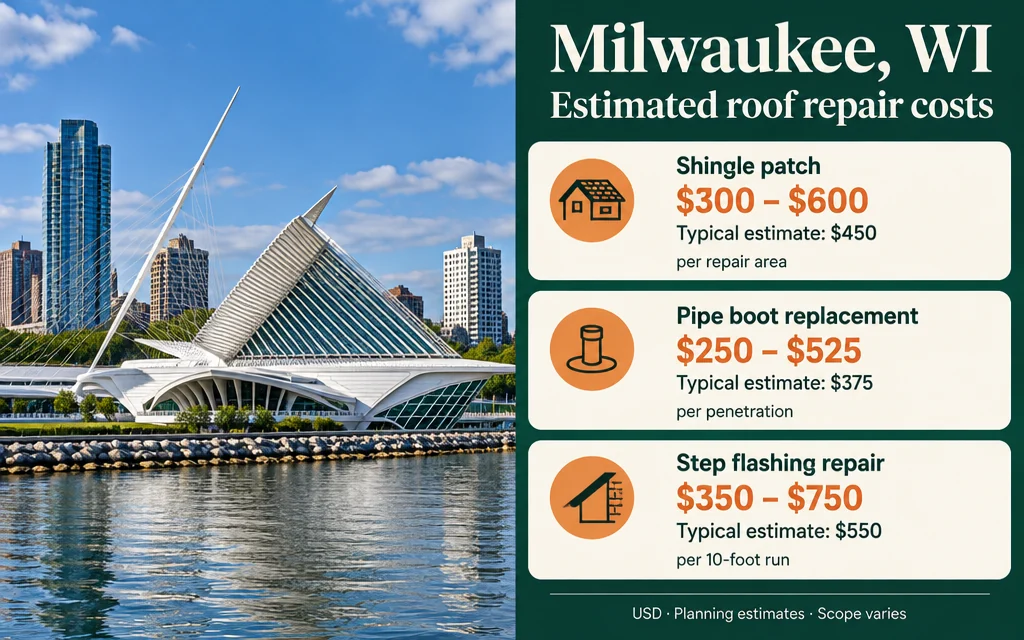
Planning estimate per repair area. Replacing 3 to 6 missing or damaged asphalt shingles up to roughly 10 sq ft including clean tear-out. The source is a published task-price reference; the planning range and stated repair quantity remain estimates.
Planning estimate per penetration. Modeled budgeting estimate for removal of failed rubber or lead vent collar, installation of new boot flashing, and shingle tie-in.
Planning estimate per 10-foot run. Reworking sidewall or dormer step flashing pieces with new moisture wrap and shingle course tie-in.
Overview of Roof Repair Pricing in Milwaukee
Roof repair costs in Milwaukee depend on the specific task, accessibility, and the underlying condition of the roof deck. For an isolated shingle patch covering up to 10 square feet, homeowners typically budget $300–$600 per repair area.
For addressing a failed vent collar, budget $250–$525 per penetration as a modeled planning estimate. When leaks involve complex transitions like valleys or masonry chimneys, project totals adjust upward to reflect custom sheet metal work and safety staging.
Roofing repairs in southeastern Wisconsin often involve weather-related urgency. Freeze-thaw cycles in late winter and heavy spring rains can turn small shingle failures into interior leaks. Understanding how contractors separate diagnostic leak tracing from physical repairs helps homeowners evaluate quotes accurately and avoid unexpected line items.
Roof Inspections and Leak Diagnosis
Before applying a patch, locating the true origin of moisture is essential. A comprehensive visual roof inspection typically budgets $175–$325 per visit and takes approximately 1-2 hours (1 inspector) on site.
This service provides an exterior condition evaluation of shingles, penetrations, and visible drainage paths. It is distinct from a brief visual sales check, which is often intended to explore full replacement rather than document localized repair options.
When water enters far from the visible ceiling stain, contractors perform targeted diagnostic tracing. A dedicated leak diagnostic service budgets $200–$400 per visit and typically takes 1-3 hours (1-2 technicians). Technicians examine attic framing, track moisture along rafters, inspect flashing collars, and conduct controlled water testing when necessary. Homeowners should verify whether the diagnostic fee can be credited toward subsequent repair work.
| Service / assumptions | Low | Typical estimate | High | Pricing unit | Estimated labor time |
|---|---|---|---|---|---|
| Comprehensive Roof InspectionFull visual evaluation of roofing surface, penetrations, and attic space; generates written condition summary. The source is a published task-price reference; the planning range and stated repair quantity remain estimates.Published price reference ↗ | $175 | $230 | $325 | per visit | 1-2 hours (1 inspector) |
| Roof Leak Diagnostic ServiceTargeted tracing of active leak sources via attic probing, moisture metering, or water testing. | $200 | $275 | $400 | per visit | 1-3 hours (1-2 technicians) |
Common Asphalt Shingle and Flashing Repairs
Most residential homes in Milwaukee are clad in asphalt shingles. Replacing a damaged section of 3 to 6 shingles budgets $300–$600 per repair area and usually takes 1-3 hours (1-2 roofers).
Failed rubber collars around plumbing vents are another frequent leak source; replacing a collar and tying it into existing courses budgets $250–$525 per penetration as a modeled planning estimate, taking 1-2 hours (1 roofer).
Sheet metal flashings protect vulnerable roof junctions and require custom fitting on site. Repairing a 10-foot run of step flashing along a sidewall or dormer budgets $350–$750 per 10-foot run and takes 2-4 hours (1-2 roofers). Rebuilding base and counter flashing around a brick chimney budgets $650–$1,350 per chimney, requiring 3-6 hours (2 roofers). Resealing integrated skylight curbs budgets $400–$900 per skylight and takes 2-4 hours (1-2 roofers).
High-volume drainage channels and ridges endure substantial runoff and wind pressure. Repairing damaged ridge caps budgets $325–$725 per 15-foot run, taking 2-3 hours (1-2 roofers). Restoring a worn roof valley with fresh ice protection and metal lining budgets $650–$1,400 per valley, taking 3-5 hours (2 roofers). When moisture penetrates beneath the surface, underlayment repairs budget $500–$1,200 per 100 sq ft, taking 3-5 hours (2 roofers).
| Service / assumptions | Low | Typical estimate | High | Pricing unit | Estimated labor time |
|---|---|---|---|---|---|
| Minor Shingle Patch RepairReplacing 3 to 6 missing or damaged asphalt shingles up to roughly 10 sq ft including clean tear-out. The source is a published task-price reference; the planning range and stated repair quantity remain estimates.Published price reference ↗ | $300 | $450 | $600 | per repair area | 1-3 hours (1-2 roofers) |
| Plumbing Pipe Boot ReplacementModeled budgeting estimate for removal of failed rubber or lead vent collar, installation of new boot flashing, and shingle tie-in. | $250 | $375 | $525 | per penetration | 1-2 hours (1 roofer) |
| Step Flashing RepairReworking sidewall or dormer step flashing pieces with new moisture wrap and shingle course tie-in. | $350 | $550 | $750 | per 10-foot run | 2-4 hours (1-2 roofers) |
| Chimney Flashing RebuildInstallation of fresh base, step, and counter flashing cut and mortared into masonry joints. | $650 | $950 | $1,350 | per chimney | 3-6 hours (2 roofers) |
| Skylight Flashing Reseal & RepairReplacing damaged perimeter flashing kit and ice-barrier perimeter; does not include window replacement. | $400 | $650 | $900 | per skylight | 2-4 hours (1-2 roofers) |
| Ridge Cap Shingle RepairFastening new high-wind ridge cap shingles and resealing exposed fasteners along roof peaks. | $325 | $500 | $725 | per 15-foot run | 2-3 hours (1-2 roofers) |
| Roof Valley RepairTear-off of worn valley shingles, installation of self-adhering membrane, and new closed or open metal lining. The source is a published task-price reference; the planning range and stated repair quantity remain estimates.Published price reference ↗ | $650 | $975 | $1,400 | per valley | 3-5 hours (2 roofers) |
| Roof Underlayment RepairStripping one roofing square to bare deck, laying synthetic felt or ice barrier, and re-shingling. | $500 | $800 | $1,200 | per 100 sq ft | 3-5 hours (2 roofers) |
Repairs for Metal, Tile, and Flat Roofs
Specialty roof systems require dedicated materials and specific fastening techniques. Localized metal roof repairs—such as tightening fasteners, replacing deteriorated washer gaskets, or resealing standing seams—budget $450–$1,250 per 100 sq ft and take 2-5 hours (2 roofers).
This scope addresses targeted panel maintenance rather than whole-roof metal replacement.
Historic or architecturally distinct properties may feature clay or concrete tile sections. Sourcing and replacing damaged tiles while patching the underlying barrier budgets $550–$1,500 per 50 sq ft and takes 3-6 hours (2 roofers). Tile repairs require careful staging and specialized equipment to avoid cracking adjacent fragile units.
Flat or low-slope sections over porches, rear additions, or dormers commonly utilize EPDM, TPO, or modified bitumen membranes. Patching punctures, re-priming seams, or resealing membrane curb edges budgets $400–$1,100 per patch area, typically taking 2-4 hours (1-2 roofers).
| Service / assumptions | Low | Typical estimate | High | Pricing unit | Estimated labor time |
|---|---|---|---|---|---|
| Metal Roof Panel RepairTightening fasteners, replacing aged rubber washers, sealing standing seams, or patching panel joints. | $450 | $750 | $1,250 | per 100 sq ft | 2-5 hours (2 roofers) |
| Tile Roof RepairReplacing cracked tiles and patching underlying membrane without breaking surrounding tiles. | $550 | $950 | $1,500 | per 50 sq ft | 3-6 hours (2 roofers) |
| Flat / Low-Slope Membrane RepairHeat-welding or priming and adhering EPDM, TPO, or modified bitumen patches over punctures or failed seams. | $400 | $675 | $1,100 | per patch area | 2-4 hours (1-2 roofers) |
Emergency Tarping and Storm Response
When severe wind or falling branches breach a roof during an active storm, permanent fixes must wait until weather conditions clear. Immediate emergency tarping budgets $350–$850 per tarped section and takes approximately 1-3 hours (2 roofers).
Crews secure heavy-duty tarps using wooden batten strips screwed or nailed into structural decking to prevent water intrusion into ceilings and insulation.
Tarping is strictly a temporary stabilization measure and does not constitute a permanent repair. If emergency dispatch is required outside normal business hours, such as late at night or on holidays, contractors may assess an after-hours surcharge budgeting $150–$400 per call-out. Homeowners should review the estimate to confirm how travel, after-hours rates, and standard labor are structured.
| Service / assumptions | Low | Typical estimate | High | Pricing unit | Estimated labor time |
|---|---|---|---|---|---|
| Emergency Roof TarpingSecuring heavy-duty waterproof tarp with wooden batten strips to prevent storm water intrusion. | $350 | $550 | $850 | per tarped section | 1-3 hours (2 roofers) |
| After-Hours Emergency SurchargeAdditional fee applied for rapid mobilization during nights, weekends, or severe holidays. | $150 | $250 | $400 | per call-out | N/A |
Hidden Rot and Associated Structural Repairs
When damaged shingles are stripped away, concealed rot is occasionally uncovered beneath worn underlayment. Replacing rotted 4x8-foot OSB or plywood roof decking budgets $90–$195 per 4x8 sheet and takes 1-2 hours (1-2 roofers), provided the repair area is already open and accessible.
Water spilling over gutters can also deteriorate adjacent trim. Repairing damaged exterior fascia boards budgets $20–$48 per linear foot, taking 2-4 hours (1-2 carpenters). Replacing rotted or detached soffit vents and panels budgets $18–$44 per linear foot, taking 2-4 hours (1-2 carpenters). Finally, hauling away stripped shingles and wood debris budgets $125–$350 per load, taking 1 hour (1 worker). Homeowners should confirm whether disposal fees are included in the baseline labor charge or listed as a separate line item.
| Service / assumptions | Low | Typical estimate | High | Pricing unit | Estimated labor time |
|---|---|---|---|---|---|
| Roof Decking ReplacementInstallation of 32 sq ft OSB/plywood sheet while roof is exposed; small jobs subject to base visit fees. | $90 | $135 | $195 | per 4x8 sheet | 1-2 hours (1-2 roofers) |
| Fascia Board RepairReplacing rotted wood or aluminum-wrapped fascia; assumes minimum job callout fee applies. | $20 | $32 | $48 | per linear foot | 2-4 hours (1-2 carpenters) |
| Soffit Vent & Panel RepairRepairing ventilated vinyl, aluminum, or wood soffit panels under roof eaves. | $18 | $28 | $44 | per linear foot | 2-4 hours (1-2 carpenters) |
| Roofing Debris Disposal & Haul-OffHaul-off and disposal fees for tear-off debris, old shingles, and rotted wood scraps. | $125 | $200 | $350 | per load | 1 hour (1 worker) |
Cost Drivers and Estimate Variables
Several site conditions influence repair pricing on Milwaukee homes. Roof pitch and building height are major factors: steep rooflines common on older two- and three-story residences require specialized harness anchor systems, ladder staging, and additional safety crew members, extending labor time compared to a low-pitch ranch.
Material compatibility also affects project costs. Matching discontinued shingle lines or older clay tiles may require sourcing specialty inventory or custom-bending sheet metal flashings on site. Urban lot constraints, such as tight property lines or nearby overhead utility wires, can slow down crew staging and debris handling. Homeowners should ensure their written estimate specifies hourly rates or unit prices for concealed structural damage discovered during tear-off.
Deciding Between Repair and Roof Replacement
Determining whether to perform a spot repair or plan for full replacement depends on the overall condition of the roof system and the history of leaks. If the roofing material is pliable, granules remain intact, and damage is confined to an isolated event—such as wind-blown shingles or a degraded pipe collar—a localized repair is usually the practical and cost-effective solution.
However, if an asphalt roof exhibits widespread granule loss, curling or brittle shingles across multiple exposures, or recurring leaks in multiple valleys, repeated spot fixes may yield diminishing returns. Working on an embrittled roof can also disturb adjacent shingles, creating new leak points. When considering substantial repair investments, request an evaluation of the roof deck and attic ventilation to assess the remaining service life of the entire system.
| Decision point | Roof repair | Roof replacement | Metal roofing |
|---|---|---|---|
| Work being priced | A defined defect, such as damaged shingles or flashing. | Removal and installation of an agreed roof system across the measured roof surface. | A specified installed metal system; standing seam, exposed fasteners and metal shingles are different scopes. |
| What to inspect | The leak source, surrounding material and whether a durable localized fix is feasible. | The extent of deterioration, decking condition, roof details and suitable replacement systems. | The substrate, panel profile, coating, fasteners, roof geometry and installation details. |
| How to compare prices | Match the repair quantity, access, materials and included diagnosis. | Match measured roof area, material, tear-off layers, disposal and installed inclusions. | Match measured roof area, system, components, removal and conditional additional work. |
| Before deciding | Ask what the repair addresses and what existing problems would remain. | Ask whether repair remains practical and which additional items would change the total. | Ask about compatible materials, documented product/assembly ratings and product versus workmanship warranties. |
Age or a repair-cost percentage alone does not determine the right choice. Ask a qualified roofing contractor to assess the condition and explain viable options. A metal system is a material-specific installation choice, not a separate guarantee of durability or savings.
Hiring a Qualified Milwaukee Roofing Contractor
When vetting roofing contractors in Milwaukee, ask prospective roofers to document their state and local operating credentials, such as Wisconsin Department of Safety and Professional Services (DSPS) Dwelling Contractor registrations. Ask each contractor whether they carry active commercial general liability insurance and workers' compensation coverage, and request certificates sent directly from their insurance provider before any crew member steps on site.
Permit requirements vary depending on your municipality, exact property address, and whether the scope involves minor cosmetic patching or structural deck and rafter work. Homeowners should ask the City of Milwaukee Department of Neighborhood Services or their local municipal building authority the following key questions:
- Does the planned repair scope require a building permit for this specific address?
- Will replacing decking or altering structural components trigger mandatory building inspections?
- Will the licensed contractor pull and sign for all necessary permits on your behalf?
Always obtain a detailed, written proposal outlining the precise materials, labor scope, cleanup protocols, and workmanship warranty terms before authorizing work.
Local income & housing costs
Milwaukee city, Wisconsin · U.S. Census Bureau, 2025 ACS 1-year estimates.
per month · ±$25
Cash-rent units; includes applicable tenant-paid utilities
Census source ↗Dollar amounts use the survey period’s published basis. Income is annual; gross rent is monthly. Home value reflects owner-occupied housing values. Margins of error shown are at the ACS 90% confidence level. These statistics provide city context; service budgets use their own pricing evidence.
STATEWIDE COST CONTEXT
Wisconsin prices, income & labor costs
These Wisconsin figures provide background for this city guide. They describe different measures and reference years; employee wages are not prices charged by a contractor.
BEA SAIRPD
State price change indicator
116.42024 · index (2017 basis)
Annual figures & sources
| Year | Value | 90% margin of error | Source |
|---|---|---|---|
| 2020 | 97.0 | — | Official source |
| 2021 | 101.7 | — | Official source |
| 2022 | 107.3 | — | Official source |
| 2023 | 112.3 | — | Official source |
| 2024 | 116.4 | — | Official source |
Census ACS 1-year
Median household income
$80,2132025 · USD/year
Annual figures & sources
| Year | Value | 90% margin of error | Source |
|---|---|---|---|
| 2021 | $67,125 | ±$605 | Official source |
| 2022 | $70,996 | ±$644 | Official source |
| 2023 | $74,631 | ±$774 | Official source |
| 2024 | $77,488 | ±$902 | Official source |
| 2025 | $80,213 | ±$703 | Official source |
BLS OEWS
Roofers
$28.542025 · USD/hour
Annual figures & sources
| Year | Value | 90% margin of error | Source |
|---|---|---|---|
| 2025 | $28.54 | — | Official source |
State prices: BEA, 2020–2024. Household income: Census ACS, 2021–2025. Employee wages: BLS, May 2025 snapshot. The charts retain their own units and fitted scales.
Explore all Wisconsin living-cost data and trends →Local context and limitations
Milwaukee roofing experiences intense seasonal wear driven by cold winters, heavy snow accumulations, and frequent freeze-thaw cycles that can cause ice dams along eaves and valleys. Older housing stock across Milwaukee neighborhoods often features steep rooflines, complex dormers, and multiple flashing junctions that require dedicated ladder staging and safety harness setups. Lake Michigan winds and strong seasonal storms also contribute to uplift on aging architectural and three-tab asphalt shingles.
Frequently asked questions
How much does a minor roof repair typically cost in Milwaukee?
Budget $300–$600 per repair area for a minor shingle patch covering up to 10 square feet. For replacing a damaged plumbing pipe boot collar, budget $250–$525 per penetration as a modeled planning estimate.
What is the difference between a roof inspection and a leak diagnosis?
A comprehensive visual roof inspection budgets $175–$325 per visit to evaluate overall surface condition and roof components. A targeted leak diagnostic service budgets $200–$400 per visit and involves tracing active entry points through attics, rafters, and exterior seams.
How much does it cost to repair a leaking chimney flashing?
Rebuilding and counter-flashing a chimney typically budgets $650–$1,350 per chimney. The total depends on chimney dimensions, masonry mortar condition, and roof pitch.
How much does emergency roof tarping cost during a storm?
Securing a waterproof tarp over an exposed section budgets $350–$850 per tarped section. If emergency mobilization is required late at night, on weekends, or during holidays, expect an after-hours surcharge budgeting $150–$400 per call-out.
Does replacing rotted roof decking add a lot to my repair bill?
Replacing rotted wood substrate budgets $90–$195 per 4x8 sheet while the section is exposed during repairs. If reaching the rotted wood requires unscheduled tear-off across a wider area, additional labor and shingle material costs apply.
Do I need a building permit for roof repairs in Milwaukee?
Whether a permit is needed depends on your exact property address and the structural scope of the work. Rather than assuming exemptions, verify with the City of Milwaukee Department of Neighborhood Services or your local municipal building inspection office: ask whether your specific repair scope requires a permit, whether replacing decking or framing triggers inspection, and whether your contractor will pull all required permits.
Sources and methodology
These planning estimates draw on publicly available pricing pages read on 2026-11-11. Some cited pages mention the target city; that alone does not verify service coverage or establish a citywide average. Published starting rates and individual provider prices are reference points, not final local quotes. Confirm service availability, minimum charges, included work and travel charges with the provider.
Published pricing pages retrieved; quoted excerpts checked automatically. 3 distinct website domains. · Generated 2026-11-11
- What roof repair costs in Milwaukee, repair pricing guideCity-specific page context · Page retrieved 2026-11-11 · Price excerpt matched automatically
“Roof valley repair $650-$1,400”
Planning ranges may differ from these published examples; they are not provider quotes.
 Provider badge
- Wisconsin Roofing Costs & Prices - ProMatcher Cost ReportState / regional reference · Page retrieved 2026-11-11 · Price excerpt matched automatically
“Roof Inspection in Wisconsin $229.51 per visit (two story home with typical roofline)”
Planning ranges may differ from these published examples; they are not provider quotes.
- Roof Leak Repair in Bayside, WI | Same-Week Leak Tracing & FixState / regional reference · Page retrieved 2026-11-11 · Price excerpt matched automatically
“shingle repair $300-$650”
Planning ranges may differ from these published examples; they are not provider quotes.
Plan your roof repair project
Choose your service and answer its project questions. Add notes or photos if helpful, then generate your project brief. The planner labels its budgeting assumptions separately. Use your plan to compare the scope and assumptions with a provider. Contact sharing and provider matching are not available yet.
Open the project planner →Share this city’s cost data
<> Embed Milwaukee Cost Data on Your Site
The HTML table shows the prices at the time of copying. The iframe follows the published guide.