San Diego · CA · COST GUIDE
Roof Repair Costs in San Diego, CA (2026)
For budgeting, a small shingle repair is estimated at $350–$900 per repair area, and pipe boot replacement at $350–$750 per penetration. These are different repair scopes; compare the table's assumptions with a written contractor quote.
Minor Shingle Repair
Budget estimate$350–$900per repair area
Local published example · Pioneer Roofing Company
Pipe Boot Replacement
Budget estimate$350–$750per penetration
Planning range · Compare the repair scope, materials and included work in your quote.
Published examples apply to their stated scope. Budget ranges are estimates.
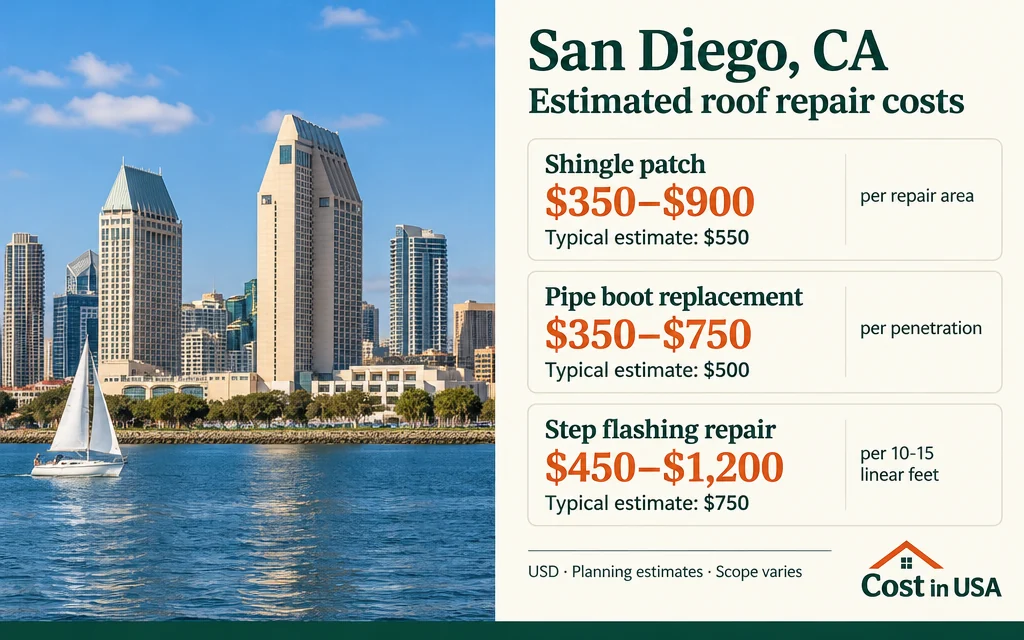
Planning estimate per repair area. Replacing damaged or missing architectural shingles up to 10–20 square feet, securing loosened fasteners, and resealing underlying tabs. Color match subject to weathering.
Planning estimate per penetration. Modeled budgeting estimate for removal of a decayed neoprene collar or damaged flashing, installing a new heavy-duty rubber or lead boot flashing, and interweaving it with adjacent roofing materials. Excludes internal plumbing stack rework.
Planning estimate per 10-15 linear feet. Reworking wall-roof junction flashing, removing bottom course, installing new corrosion-resistant aluminum or galvanized step tins, and counter-flashing into siding or stucco.
Roof Repair Pricing Overview for San Diego
Maintaining a residential roof in San Diego involves managing prolonged periods of solar radiation punctuated by intense winter storm cycles. Thermal movement and ultraviolet breakdown cause sealants and underlayments to deteriorate slowly, which can manifest as sudden interior leaks during wet winter atmospheric rivers.
When reviewing scopes of work, keep in mind that roofing is measured differently from ground-floor living space: contractors price materials and tear-offs in roofing squares, where one square equals 100 square feet of roof surface. Because of slopes, eaves, and architectural hips, roof area regularly exceeds a home's interior footprint.
Most routine repairs in San Diego fall into localized maintenance categories. An asphalt shingle patch on an accessible roof slope typically costs $350–$900 per repair area. However, San Diego's residential architecture includes a substantial share of Spanish barrel clay and concrete S-tile roofs. Tile systems require specialized handling to prevent cracking serviceable tiles during repairs, which typically increases labor requirements. Flashing repairs at complex intersections, such as rebuilding chimney flashing at $650–$1,800 per chimney, require custom metal fabrication and meticulous integration into adjacent roof planes.
Roof Inspections and Leak Diagnosis
Before undertaking any repair, an accurate assessment of the roof's condition and water-entry points is essential. Homeowners should distinguish between a broad roof condition inspection and an active leak diagnostic call.
A standard physical roof inspection costs $150–$450 per inspection and takes 1-2 hours (1 worker). During this assessment, the inspector evaluates visible surface conditions across tiles or shingles, checks metal flashings at valleys and penetrations, looks over gutters, and inspects accessible attic framing for evidence of moisture or inadequate ventilation.
When a specific leak must be located, a targeted leak diagnosis costs $200–$600 per diagnostic visit and typically requires 1.5-3 hours (1 worker). Pinpointing water intrusion is rarely as simple as looking directly above an interior ceiling stain, because runoff frequently penetrates high on a slope and tracks along rafters or underlayment before dripping down. Technicians may trace framing paths in the attic, use moisture meters, or deploy infrared imaging to identify the leak origin. While contractors frequently offer free sales estimates for entire roof replacements, an objective diagnostic assessment of isolated defects is usually billed as a standalone service call. Ask whether any diagnostic fee will be credited toward the repair balance if the contractor performs the remedial work.
| Service / assumptions | Low | Typical estimate | High | Pricing unit | Estimated labor time |
|---|---|---|---|---|---|
| Roof InspectionPhysical visual inspection covering roof plane, gutters, flashings, and attic space where accessible. Excludes intrusive moisture probing or certified escrow engineering reports. The source is a published task-price reference; the planning range and stated repair quantity remain estimates.Published price reference ↗ | $150 | $300 | $450 | per inspection | 1-2 hours (1 worker) |
| Leak DiagnosisSystematic water tracing, infrared thermal scan, or attic moisture tracing to pinpoint water entry origin. Diagnostic fee is distinct from subsequent repair work; ask if any credit applies. | $200 | $375 | $600 | per diagnostic visit | 1.5-3 hours (1 worker) |
Common Roof Component Repairs
San Diego roofs contain multiple penetrations and plane transitions that require targeted flashing details to remain watertight.
Plumbing vent collars are among the most frequent failure points. The rubber collars on pipe boots dry out and crack under persistent Southern California sunlight. Replacing a failed vent boot with a new lead or heavy-duty synthetic assembly carries a modeled budget estimate of $350–$750 per penetration and requires 1.5-3 hours (1 worker). Step flashing along sidewalls where roof slopes abut exterior stucco or siding costs $450–$1,200 per 10-15 linear feet, taking 2-4 hours (1-2 workers) to carefully loosen courses and step-weave new corrosion-resistant tins into place.
Chimneys and skylights require specialized sheet metal integration. Rebuilding skylight perimeter flashing runs $500–$1,400 per skylight over 2-4 hours (1-2 workers), while fabricating and sealing custom base, step, and counter-flashing on a chimney costs $650–$1,800 per chimney and requires 3-6 hours (2 workers). Along ridges, replacing weathered or loosened ridge cap shingles costs $400–$1,250 per 20-30 linear feet, taking 2-4 hours (1-2 workers). In valleys where rainfall gathers and runs off at high volume, tearing out degraded materials, installing new metal or self-adhering membrane, and re-weaving shingles costs $750–$2,200 per valley run over 4-8 hours (2 workers). When chronic leaks have degraded the secondary waterproofing under shingles or tiles, localized underlayment repair costs $800–$2,800 per 100 sq ft section and takes 4-8 hours (2 workers).
| Service / assumptions | Low | Typical estimate | High | Pricing unit | Estimated labor time |
|---|---|---|---|---|---|
| Minor Shingle RepairReplacing damaged or missing architectural shingles up to 10–20 square feet, securing loosened fasteners, and resealing underlying tabs. Color match subject to weathering.Published price reference ↗ | $350 | $550 | $900 | per repair area | 2-4 hours (1-2 workers) |
| Pipe Boot ReplacementModeled budgeting estimate for removal of a decayed neoprene collar or damaged flashing, installing a new heavy-duty rubber or lead boot flashing, and interweaving it with adjacent roofing materials. Excludes internal plumbing stack rework. | $350 | $500 | $750 | per penetration | 1.5-3 hours (1 worker) |
| Step Flashing RepairReworking wall-roof junction flashing, removing bottom course, installing new corrosion-resistant aluminum or galvanized step tins, and counter-flashing into siding or stucco. | $450 | $750 | $1,200 | per 10-15 linear feet | 2-4 hours (1-2 workers) |
| Chimney Flashing RepairFabricating and setting new base flashing, step tins, cricket junction, and reglet counter-flashing sealed with masonry polyurethane. Excludes major masonry repointing or chimney reconstruction. | $650 | $1,100 | $1,800 | per chimney | 3-6 hours (2 workers) |
| Skylight Flashing RepairReplacing perimeter apron, step flashing, and head kit around existing skylight curb. Excludes replacement of degraded acrylic or insulated glass units. | $500 | $850 | $1,400 | per skylight | 2-4 hours (1-2 workers) |
| Ridge Cap RepairStripping storm-damaged or weathered cap shingles, installing new ridge vent or ridge cap units, and hand-nailing with corrosion-resistant fasteners. | $400 | $750 | $1,250 | per 20-30 linear feet | 2-4 hours (1-2 workers) |
| Valley RepairTearing out shingles along a 10–20 linear foot valley, replacing failed metal valley flashing or self-adhering membrane, and re-weaving shingle cuts. The source is a published task-price reference; the planning range and stated repair quantity remain estimates.Published price reference ↗ | $750 | $1,400 | $2,200 | per valley run | 4-8 hours (2 workers) |
| Underlayment RepairCarefully lifting existing tile or shingles across a 100 sq ft section, replacing torn or dried-out organic felt with synthetic or SBS modified bitumen underlayment, and re-laying salvaged tiles or shingles. | $800 | $1,600 | $2,800 | per 100 sq ft section | 4-8 hours (2 workers) |
Material-Specific Repair Considerations
San Diego features a variety of architectural roofing materials, each requiring specific installation techniques and matching hardware.
Concrete S-tiles and Spanish barrel clay tiles are common throughout the region. While the tiles themselves can endure for decades, the organic felt underlayment beneath them often becomes brittle from trapped heat. A localized tile roof repair costs $650–$2,400 per affected section, taking 3-6 hours (2 workers). This work involves lifting sound tiles, replacing broken units with matching profiles, securing tiles with approved ties or clips, repointing mortar hips, and repairing compromised underlayment beneath the repair zone. Crews must use crawl boards or foam cushions to avoid breaking adjacent tiles while moving on the roof.
Low-slope and flat roofs, often installed over mid-century residences, home additions, or patio structures, rely on sealed membranes rather than overlapping shingles. Repairing seam splits, membrane punctures, or localized ponding depressions on built-up, modified bitumen, or TPO single-ply roofs costs $450–$1,600 per patch area over 2-5 hours (1-2 workers). For standing seam and exposed-fastener metal roofs, localized metal repair costs $600–$2,200 per repair area and takes 3-6 hours (1-2 workers), typically focusing on replacing deteriorated fastener washers, resealing flashing junctions, or re-crimping loosened seams.
| Service / assumptions | Low | Typical estimate | High | Pricing unit | Estimated labor time |
|---|---|---|---|---|---|
| Metal Roof RepairLocalized repair of standing seam or exposed-fastener metal roof, including tightening or upgrading failing neoprene washer fasteners, re-crimping seams, or replacing isolated transition flashings. Excludes full panel runs. The source is a published task-price reference; the planning range and stated repair quantity remain estimates.Published price reference ↗ | $600 | $1,200 | $2,200 | per repair area | 3-6 hours (1-2 workers) |
| Tile Roof RepairResetting displaced Spanish clay or concrete s-tiles, replacing cracked tiles with matched profile, and securing batten ties across an isolated 50–100 sq ft area. Excludes full slope underlayment strip-and-relay. | $650 | $1,350 | $2,400 | per affected section | 3-6 hours (2 workers) |
| Low-Slope Roof RepairPatching blistered, split, or ponding sections of flat roofs (modified bitumen, torch-down, or TPO single-ply) using heat-welded membrane or elastomeric compound. Excludes structural sloping. | $450 | $900 | $1,600 | per patch area | 2-5 hours (1-2 workers) |
Emergency Weather Protection and Surcharges
During winter storm fronts or heavy rain events, temporary stabilization is often necessary to stop active interior water damage before permanent repairs can be scheduled. Professional emergency tarping costs $350–$900 per service call, taking 1-3 hours (2 workers).
Contractors secure heavy-duty polyethylene tarps with 2x4 wood battens fastened directly into structural framing so the membrane can resist coastal wind gusts. Tarping is an interim measure designed only to shed water until dry weather permits a complete repair.
When roofers respond outside standard business hours—such as at night, on weekends, or during active storm conditions—companies frequently apply an after-hours surcharge of $200–$600 per emergency call. This fee is an additional charge above base labor and materials to offset emergency dispatch and hazardous working conditions. Safety must always come first: homeowners should never climb onto a wet roof or attempt to fasten tarps in stormy conditions. Wait for professional crews equipped with fall-arrest harnesses, roof brackets, and ladder stabilizers.
| Service / assumptions | Low | Typical estimate | High | Pricing unit | Estimated labor time |
|---|---|---|---|---|---|
| Emergency TarpingTemporary protection during or immediately after high winds or heavy rain using heavy-duty poly tarps secured with 2x4 furring strips. Temporary stabilization only; not a permanent repair. | $350 | $550 | $900 | per service call | 1-3 hours (2 workers) |
| After-Hours SurchargeAdditional fee for immediate weekend, holiday, or night dispatch during severe weather. Additional fee only; does not include physical labor or materials. | $200 | $350 | $600 | per emergency call | N/A |
Concealed Damage and Project Add-Ons
When roofers remove weathered shingles, tiles, or rotted flashings, they often discover moisture damage that was invisible from the ground or surface inspection. These concealed structural issues are handled as separate line items or through formal change orders.
The most common structural repair involves rotted plywood or oriented strand board (OSB) sheathing beneath old leaks. Replacing rotted roof decking costs $150–$400 per 4x8 ft sheet and takes 1-2 hours (1-2 workers). This rate applies when the overlying roofing material is already removed as part of the primary job; isolated small-area access will incur additional labor. Water overflowing from clogged gutters or deteriorated drip edges can also rot perimeter woodwork: repairing damaged fascia boards costs $25–$75 per linear foot over 2-4 hours (1-2 workers), while localized soffit repair costs $20–$70 per linear foot and takes 2-4 hours (1-2 workers). Both carpentry items are subject to minimum visit fees if not completed alongside a broader roofing scope.
Disposal is another factor to verify in your contract. Hauling away scrap metal, torn-off shingles, and deteriorated decking via a dedicated debris disposal fee costs $150–$450 per project load and takes 1-2 hours (1 worker). Review contractor bids carefully to verify whether disposal is included in the base repair scope or billed separately.
| Service / assumptions | Low | Typical estimate | High | Pricing unit | Estimated labor time |
|---|---|---|---|---|---|
| Decking Sheet ReplacementReplacement of rotted or water-softened 4x8 ft sheet (32 sq ft) of 7/16-inch OSB or 1/2-inch CDX plywood while surrounding roofing is already stripped. Minimum job charges may apply if performed as standalone work. | $150 | $250 | $400 | per 4x8 ft sheet | 1-2 hours (1-2 workers) |
| Fascia Board RepairRemoval and replacement of decayed 1x6 or 2x6 primed spruce/pine fascia board in 10–20 linear foot sections. Small repair jobs typically carry a minimum contractor visit charge ($250–$400). | $25 | $45 | $75 | per linear foot | 2-4 hours (1-2 workers) |
| Soffit RepairRepairing or replacing damaged vented or solid eave soffit panels in localized sections. Assumes ground or standard ladder reach; contractor minimum trip charges apply to isolated small sections. | $20 | $40 | $70 | per linear foot | 2-4 hours (1-2 workers) |
| Debris Disposal FeeHaul-away and recycling/landfill fees for old roofing materials, torn-off decking, and scrap metal. Often included in primary repair quote; confirm scope to avoid double billing. | $150 | $275 | $450 | per project load | 1-2 hours (1 worker) |
Key Cost Drivers for San Diego Roof Repairs
Several physical and logistical conditions dictate where a specific roof repair will land within standard pricing ranges.
Roof pitch and story height represent significant labor drivers. Low-pitch roofs allow workers to move and stage tools easily. Steeper slopes require safety harnesses, roof anchor installations, ladder leveling systems, and two-worker safety protocols, which reduces working speed and increases on-site hours. Multi-story houses on sloped lots in hillside neighborhoods like Mount Soledad or Point Loma often require complex staging and ladder configurations, increasing safety setup time.
Neighborhood density and site access also impact logistics. In older, densely built areas such as North Park, Normal Heights, and Little Italy, narrow side yards and restricted driveway access can make ladder staging and trash haul-out more labor-intensive. In addition, matching discontinued clay tile profiles or rare architectural shingles on older homes may require sourcing from salvage yards or custom sheet-metal shops, adding material lead time and labor expense.
Repairing Versus Replacing Your Roof
Deciding whether to continue repairing a roof or to invest in a complete replacement depends on the overall condition of the system rather than the presence of a single leak. When water intrusion is limited to an isolated issue—such as a split vent boot, a single damaged valley run, or storm-dislodged shingles on an otherwise sound plane—a targeted repair is generally the most economical choice.
Conversely, repeated repairs across multiple roof facets signal broader system failure. On asphalt shingle roofs, widespread granule loss in gutters, cupping or brittle tabs, and cracking when touched indicate that the asphalt binder has broken down. Nailing into brittle surrounding shingles often causes adjacent tabs to break, creating new leak points.
Tile roofs present a unique situation common across Southern California. Heavy concrete and clay tiles frequently remain in good shape long after the underlying felt underlayment has deteriorated from decades of heat. When multiple leaks occur across different roof planes, isolated underlayment repairs at $800–$2,800 per 100 sq ft section offer diminishing returns. In such cases, roofing professionals typically recommend a complete tile lift-and-relay (also called a tile re-set). In a lift-and-relay project, serviceable tiles are removed and stacked on-site, a new synthetic or modified bitumen underlayment system is installed across the entire roof deck, and the original tiles are reinstalled. For substantial re-roofing projects, consult your contractor about whether local energy codes or California Title 24 cool-roof standards apply to your specific address and roof slope.
| Decision point | Roof repair | Roof replacement | Metal roofing |
|---|---|---|---|
| Work being priced | A defined defect, such as damaged shingles or flashing. | Removal and installation of an agreed roof system across the measured roof surface. | A specified installed metal system; standing seam, exposed fasteners and metal shingles are different scopes. |
| What to inspect | The leak source, surrounding material and whether a durable localized fix is feasible. | The extent of deterioration, decking condition, roof details and suitable replacement systems. | The substrate, panel profile, coating, fasteners, roof geometry and installation details. |
| How to compare prices | Match the repair quantity, access, materials and included diagnosis. | Match measured roof area, material, tear-off layers, disposal and installed inclusions. | Match measured roof area, system, components, removal and conditional additional work. |
| Before deciding | Ask what the repair addresses and what existing problems would remain. | Ask whether repair remains practical and which additional items would change the total. | Ask about compatible materials, documented product/assembly ratings and product versus workmanship warranties. |
Age or a repair-cost percentage alone does not determine the right choice. Ask a qualified roofing contractor to assess the condition and explain viable options. A metal system is a material-specific installation choice, not a separate guarantee of durability or savings.
Hiring a Qualified Roofing Contractor in San Diego
Selecting an experienced and properly credentialed contractor ensures that repairs are completed safely and remain watertight. When screening roofing professionals, ask for their state license number and verify that they hold an active C-39 Roofing Contractor license in good standing with the California Contractors State License Board (CSLB).
Request written verification of active workers' compensation and general liability coverage directly from the contractor's insurance provider.
Building permit requirements depend on the specific scope of work, property jurisdiction, and whether structural framing or significant decking is being altered. Before work begins, verify permit rules for your specific property address with the City of San Diego Development Services Department (or the County of San Diego for unincorporated parcels). Ask prospective contractors directly whether their proposal covers obtaining any required permits and coordinating city inspections.
Obtain at least two to three written, itemized proposals that specify the materials, flashings, underlayments, disposal terms, and workmanship warranty. Avoid contractors who request large upfront cash deposits before materials are delivered or work begins, and verify that all debris has been hauled away and gutters cleared before issuing the final payment.
Local income & housing costs
San Diego city, California · U.S. Census Bureau, 2025 ACS 1-year estimates.
per month · ±$50
Cash-rent units; includes applicable tenant-paid utilities
Census source ↗Dollar amounts use the survey period’s published basis. Income is annual; gross rent is monthly. Home value reflects owner-occupied housing values. Margins of error shown are at the ACS 90% confidence level. These statistics provide city context; service budgets use their own pricing evidence.
STATEWIDE COST CONTEXT
California prices, income & labor costs
These California figures provide background for this city guide. They describe different measures and reference years; employee wages are not prices charged by a contractor.
BEA SAIRPD
State price change indicator
136.92024 · index (2017 basis)
Annual figures & sources
| Year | Value | 90% margin of error | Source |
|---|---|---|---|
| 2020 | 117.2 | — | Official source |
| 2021 | 122.0 | — | Official source |
| 2022 | 130.7 | — | Official source |
| 2023 | 135.2 | — | Official source |
| 2024 | 136.9 | — | Official source |
Census ACS 1-year
Median household income
$102,1592025 · USD/year
Annual figures & sources
| Year | Value | 90% margin of error | Source |
|---|---|---|---|
| 2021 | $84,907 | ±$542 | Official source |
| 2022 | $91,551 | ±$471 | Official source |
| 2023 | $95,521 | ±$611 | Official source |
| 2024 | $100,149 | ±$381 | Official source |
| 2025 | $102,159 | ±$390 | Official source |
BLS OEWS
Roofers
$30.582025 · USD/hour
Annual figures & sources
| Year | Value | 90% margin of error | Source |
|---|---|---|---|
| 2025 | $30.58 | — | Official source |
State prices: BEA, 2020–2024. Household income: Census ACS, 2021–2025. Employee wages: BLS, May 2025 snapshot. The charts retain their own units and fitted scales.
Explore all California living-cost data and trends →Local context and limitations
San Diego features a Mediterranean climate characterized by intense year-round sunshine, coastal marine moisture, and concentrated winter storm events. Prolonged ultraviolet exposure accelerates the drying and embrittlement of organic felt underlayment beneath concrete and Spanish clay tiles, which are common throughout neighborhoods such as Mission Hills, Kensington, Point Loma, and Rancho Bernardo. Marine air can also accelerate oxidation on metal flashings, making corrosion-resistant materials critical. Note that this guide focuses on residential properties within the municipal boundaries of the City of San Diego, where permit requirements and local building standards should be verified with the City of San Diego Development Services Department.
Frequently asked questions
How much does a typical roof repair cost in San Diego?
For common residential repairs in San Diego, budget $350–$900 per repair area for an asphalt shingle patch, or budget $750–$2,200 per valley run to rebuild a deteriorated valley. Final costs depend on your roofing material, the pitch of the roof, and staging access.
What does a professional roof inspection cost, and is it ever free?
A standalone physical roof inspection costs $150–$450 per inspection and takes 1-2 hours (1 worker). While roofing sales representatives often provide free assessments to bid on complete re-roofing jobs, paid inspections yield an objective condition report. If you have an active leak, a targeted leak diagnosis costs $200–$600 per diagnostic visit; ask if that fee can be applied toward the repair bill.
How much does it cost to repair a leaking pipe boot or vent collar?
Replacing a deteriorated vent pipe boot has a modeled budget estimate of $350–$750 per penetration and takes 1.5-3 hours (1 worker). This repair involves pulling back surrounding roofing, replacing the cracked rubber or metal boot with a new assembly, and interweaving the flashing back into the roofing courses. This is a modeled estimate for budgeting; verify exact costs with a written quote for your roof type.
When should a damaged tile roof in San Diego be repaired versus replaced?
Tile roofs should be repaired when damage is confined to a specific area. If an isolated patch of tiles is cracked or shifted, budget $650–$2,400 per affected section. However, when the underlying waterproof felt has dried out and failed across multiple slopes, an underlayment repair costs $800–$2,800 per 100 sq ft section. If leaks recur in multiple areas, a complete tile lift-and-relay is more practical and cost-effective than continuous patch repairs.
Do roof repairs in San Diego require a building permit?
Whether a permit is required depends on the scope of work, how much material is being replaced, and whether structural framing or extensive decking is modified. Contact the City of San Diego Development Services Department (or the County of San Diego for unincorporated parcels) to confirm requirements for your property, and verify in writing whether your contractor will handle any needed permits.
How does emergency roof tarping pricing work during a storm?
Emergency tarping to secure an active leak during severe weather costs $350–$900 per service call, taking 1-3 hours (2 workers). For dispatches occurring at night, on weekends, or during hazardous storm conditions, contractors charge an additional after-hours surcharge of $200–$600 per emergency call. Tarping is an interim measure to stop water intrusion until permanent repairs can be scheduled.
Sources and methodology
These planning estimates draw on publicly available pricing pages read on 2026-11-11. Some cited pages mention the target city; that alone does not verify service coverage or establish a citywide average. Published starting rates and individual provider prices are reference points, not final local quotes. Confirm service availability, minimum charges, included work and travel charges with the provider.
Published pricing pages retrieved; quoted excerpts checked automatically. 3 distinct website domains. · Generated 2026-11-11
- How Much Does Roof Repair Cost in San Diego? (2026 Pricing Guide) - Pioneer Roofing CompanyCity-specific page context · Page retrieved 2026-11-11 · Price excerpt matched automatically
“asphalt shingles” · “$350 to $1,500 for many common repairs”
Planning ranges may differ from these published examples; they are not provider quotes.
 Provider badge
- San Diego Roofing Costs & Prices - ProMatcher Cost ReportCity-specific page context · Page retrieved 2026-11-11 · Price excerpt matched automatically
“Roof Inspection $231.53 - $396.90 per visit (two story home with typical roofline)”
Planning ranges may differ from these published examples; they are not provider quotes.
- Roof Repair Cost California: $350-$5,000 (2026 Pricing)State / regional reference · Page retrieved 2026-11-11 · Price excerpt matched automatically
“Metal Roof Repair — $600 to $4,000”
Planning ranges may differ from these published examples; they are not provider quotes.
Plan your roof repair project
Choose your service and answer its project questions. Add notes or photos if helpful, then generate your project brief. The planner labels its budgeting assumptions separately. Use your plan to compare the scope and assumptions with a provider. Contact sharing and provider matching are not available yet.
Open the project planner →Share this city’s cost data
<> Embed San Diego Cost Data on Your Site
The HTML table shows the prices at the time of copying. The iframe follows the published guide.