Washington · DC · COST GUIDE
Roof Repair Costs in Washington, DC (2026)
For budgeting, a small shingle repair is estimated at $300–$950 per repair area (up to 100 sq ft), and pipe boot replacement at $250–$650 per boot assembly. These are different repair scopes; compare the table's assumptions with a written contractor quote.
Minor Shingle Repair
Budget estimate$300–$950per repair area (up to 100 sq ft)
Planning range · Compare the repair scope, materials and included work in your quote.
Plumbing Pipe Boot Replacement
Budget estimate$250–$650per boot assembly
Planning range · Compare the repair scope, materials and included work in your quote.
Published examples apply to their stated scope. Budget ranges are estimates.
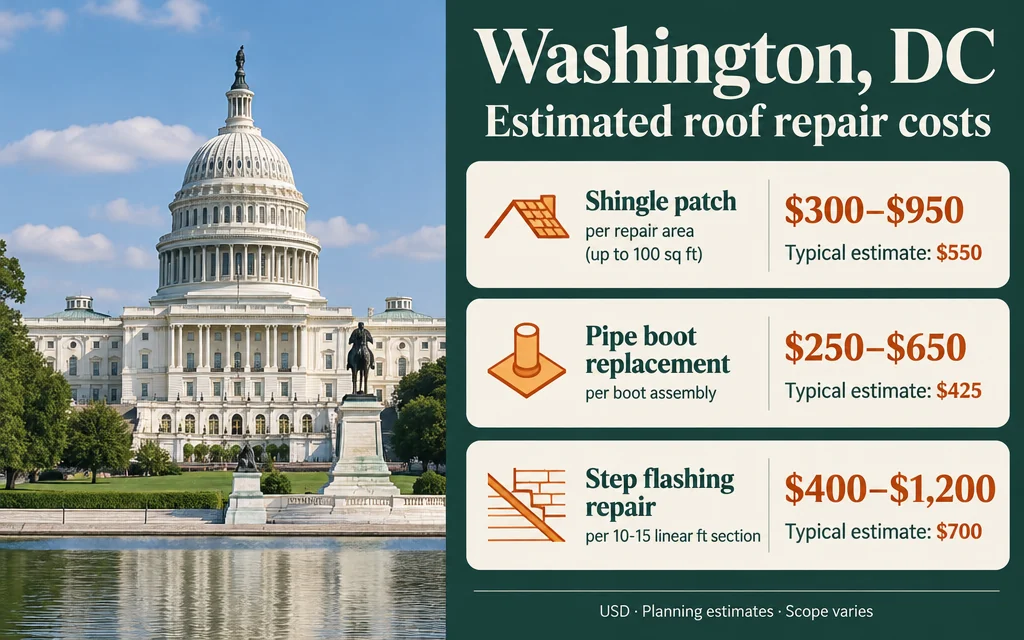
Planning estimate per repair area (up to 100 sq ft). Replacing missing, cracked, or wind-blown asphalt shingles on up to one roofing square (100 sq ft), including hand-sealing and nail fastening. Planning estimate for budgeting; published local task examples reflect broader repair ranges rather than fixed square-foot quotes.
Planning estimate per boot assembly. Removing deteriorated rubber or neoprene plumbing vent collar, installing heavy-duty flashing boot, and integrating with surrounding course of shingles. Planning estimate for budgeting; published trade references reflect task pricing rather than a guaranteed contractor quote.
Planning estimate per 10-15 linear ft section. Reworking wall-to-roof transitions, lifting overlapping siding or masonry counterflashing, replacing corroded aluminum or copper step tins, and resealing. The source is a published task-price reference; the planning range and stated repair quantity remain estimates.
Roof Repair Landscape in Washington, DC
Maintaining a residential roof in Washington, DC requires navigating an older, dense architectural fabric. Across neighborhoods like Dupont Circle, Capitol Hill, Petworth, and Columbia Heights, the predominant building style is the multi-story attached rowhouse, which frequently features a low-slope roof hidden behind a decorative masonry parapet or mansard front.
In suburban-style wards such as Forest Hills, Spring Valley, or Crestwood, single-family homes predominantly use steep architectural shingles, standing-seam metal, or historic natural slate.
Because of the District's urban density, overall repair costs are shaped heavily by setup logistics, ladder staging space, and vehicle positioning alongside material expenses. A spot repair that might take two hours on a single-story detached home can require specialized multi-ladder staging, safety gear, or interior roof-hatch access on a three-story DC rowhouse. Repair estimates in Washington reflect these urban working conditions alongside the skilled labor required for regional weather patterns, including humid summers, severe thunderstorms, and winter freeze-thaw cycles.
Roof Inspections and Active Leak Diagnosis
Homeowners dealing with water spots should distinguish between a routine preventive visual inspection and an active leak diagnostic session. A general visual assessment budgets $150–$450 per inspection, focusing on visible surface wear, gutter attachment, and flashing condition.
Crews generally complete this evaluation in 1-2 hours (1 inspector), providing an overview of overall roof condition.
When water is actively entering the living space, pinpointing the intrusion point requires a dedicated diagnostic visit, to budget $200–$600 per diagnostic visit over 1-3 hours (1-2 technicians). Finding a leak path on a roof requires systematic investigative work by technicians: tracing water trails through framing or ceiling joists, probing suspect flashing junctions, checking masonry parapet transitions, and running controlled isolation tests. Preliminary sales surveys offered after major storms rarely provide in-depth diagnostic troubleshooting. Homeowners should verify in advance whether the diagnostic fee will be credited toward subsequent permanent repairs.
| Service / assumptions | Low | Typical estimate | High | Pricing unit | Estimated labor time |
|---|---|---|---|---|---|
| Roof InspectionComprehensive visual assessment of roofing surfaces, flashings, gutters, and attic interior. A routine preventive or real estate inspection is distinct from an insurance adjustor or free storm survey. | $150 | $250 | $450 | per inspection | 1-2 hours (1 inspector) |
| Roof Leak Diagnosis & Water TestingSystematic investigation including attic tracing, moisture meter probing, and controlled isolation testing. May be partially credited toward repairs if contracted with the same company. | $200 | $350 | $600 | per diagnostic visit | 1-3 hours (1-2 technicians) |
Common Pitch and Shingle Roof Repairs
Most spot leak repairs on pitched surfaces address failed penetrations, metal flashings, or localized shingle loss rather than entire roof slopes. A deteriorating plumbing vent collar is resolved with a pipe boot replacement, which can budget $250–$650 per boot assembly and takes 1-2 hours (1 technician) on site.
Over time, sunlight and fluctuating temperatures cause factory rubber collars to crack, allowing water to run down the vent pipe into finished ceilings.
Wind events and localized weathering also impact vulnerable roof sections. For missing or storm-lifted shingles, budget $300–$950 per repair area (up to 100 sq ft), completed in 1-3 hours (1-2 technicians). When severe wind strips the ridge line, ridge cap shingle repairs budget $350–$1,000 per 15-20 linear ft over 2-3 hours (1-2 technicians). Valley transitions, where two roof planes channel heavy runoff, require more intensive labor: restoring a compromised valley budgets $600–$1,850 per 10-15 linear ft valley over 3-6 hours (2 technicians). Where water has bypassed surface materials and saturated the underlayment, spot underlayment repairs budget $450–$1,450 per 100 sq ft patch and take 2-4 hours (2 technicians).
| Service / assumptions | Low | Typical estimate | High | Pricing unit | Estimated labor time |
|---|---|---|---|---|---|
| Minor Shingle RepairReplacing missing, cracked, or wind-blown asphalt shingles on up to one roofing square (100 sq ft), including hand-sealing and nail fastening. Planning estimate for budgeting; published local task examples reflect broader repair ranges rather than fixed square-foot quotes.Published price reference ↗ | $300 | $550 | $950 | per repair area (up to 100 sq ft) | 1-3 hours (1-2 technicians) |
| Plumbing Pipe Boot ReplacementRemoving deteriorated rubber or neoprene plumbing vent collar, installing heavy-duty flashing boot, and integrating with surrounding course of shingles. Planning estimate for budgeting; published trade references reflect task pricing rather than a guaranteed contractor quote.Published price reference ↗ | $250 | $425 | $650 | per boot assembly | 1-2 hours (1 technician) |
| Step Flashing RepairReworking wall-to-roof transitions, lifting overlapping siding or masonry counterflashing, replacing corroded aluminum or copper step tins, and resealing. The source is a published task-price reference; the planning range and stated repair quantity remain estimates.Published price reference ↗ | $400 | $700 | $1,200 | per 10-15 linear ft section | 2-4 hours (1-2 technicians) |
| Chimney Flashing RepairRepointing mortar joints, fabricating and securing new base and counter-flashing, and installing or resetting cricket flashing behind wider brick chimneys. | $550 | $950 | $1,600 | per chimney | 3-5 hours (1-2 technicians) |
| Skylight Flashing RepairResealing or replacing surrounding curb and step flashing kits without replacing the glass glazing unit or skylight curb framing. | $450 | $800 | $1,400 | per skylight | 2-4 hours (1-2 technicians) |
| Ridge Cap Shingle RepairReplacing blown-off or cracked ridge cap shingles, refastening loose ridge vent sections, and securing new cap nails with elastomeric sealant. | $350 | $600 | $1,000 | per 15-20 linear ft | 2-3 hours (1-2 technicians) |
| Roof Valley Flashing & Leak RepairStripping shingles along intersection valley, replacing rusted metal valley liners or self-adhering ice-and-water underlayment, and weaving or cutting new shingles. The source is a published task-price reference; the planning range and stated repair quantity remain estimates.Published price reference ↗ | $600 | $1,100 | $1,850 | per 10-15 linear ft valley | 3-6 hours (2 technicians) |
| Spot Underlayment RepairCarefully lifting existing roofing materials, removing compromised felt or synthetic membrane, drying or patching the area, and layering waterproof underlayment. | $450 | $850 | $1,450 | per 100 sq ft patch | 2-4 hours (2 technicians) |
Specialty Materials: Flat Membranes, Slate, and Metal
Because Washington, DC has a large inventory of flat-roofed rowhouses and historic properties, roofing crews frequently work with materials beyond asphalt shingles. Low-slope rowhouse roofs rely primarily on single-ply membranes (such as EPDM rubber or TPO) or multi-ply modified bitumen.
When ponding water, mechanical punctures, or failed seams create leaks on a flat deck, repairing the membrane can budget $400–$1,350 per patched area (up to 50 sq ft) and takes 2-4 hours (1-2 technicians). These fixes involve specialized solvent cleaners, primers, and fully adhered or heat-welded patches.
Historic rowhouses and detached homes in Northwest DC frequently feature tin, standing seam copper, or natural slate. Repairing metal seams, securing backing fasteners, or soldering flashing corners on a metal roof budgets $450–$1,650 per localized repair area, taking 2-5 hours (1-2 technicians). Slate and tile repairs require careful hand labor to avoid damaging surrounding units; spot replacing cracked slates using a slate ripper and copper bibs budgets $500–$1,900 per 5-10 replacement tiles/slates over 2-5 hours (1-2 technicians). Homeowners should confirm that the contractor has direct experience with historic assemblies, as walking incorrectly on aged slate or using incompatible sealants on metal pans can cause costly secondary damage.
| Service / assumptions | Low | Typical estimate | High | Pricing unit | Estimated labor time |
|---|---|---|---|---|---|
| Metal Roof Seam & Fastener RepairAddressing backed-out fasteners, failed neoprene washer grommets, loose standing seams, or deteriorated sealant along joints on DC historic tin, steel, or copper roofs. | $450 | $900 | $1,650 | per localized repair area | 2-5 hours (1-2 technicians) |
| Tile or Slate Spot RepairCarefully sliding out cracked historic slate or clay tiles using a slate ripper, inserting matching salvage or new units, and securing with copper bibs or hooks. | $500 | $1,050 | $1,900 | per 5-10 replacement tiles/slates | 2-5 hours (1-2 technicians) |
| Flat / Low-Slope Membrane PatchCleaning membrane, priming, and heat-welding TPO/PVC or applying adhered EPDM rubber patches over punctures, seams, or ponding depression blisters typical of DC rowhouses. | $400 | $750 | $1,350 | per patched area (up to 50 sq ft) | 2-4 hours (1-2 technicians) |
Emergency Mitigation and After-Hours Calls
When a severe storm, falling branch, or sudden leak breaches an exterior roof, immediate mitigation is necessary to protect interior ceilings and finished spaces. Emergency roof tarping budgets $350–$1,200 per tarped area (up to 400 sq ft) and takes 1-3 hours (2 technicians).
Tarping is strictly temporary weatherproofing; it is designed to hold until weather clears and materials can be arranged for a permanent repair. Professional crews secure tarps using exterior furring strips anchored to structural decking rather than loose bricks or adhesive tape.
Homeowners requesting dispatch outside standard business hours, such as nights, weekends, or during severe holiday storm events, will encounter an emergency callout surcharge to budget $200–$600 per emergency dispatch. This dispatch fee is an additional charge added to standard labor and tarping materials. Homeowners should verify whether a company's emergency quote includes priority mobilization fees to avoid unexpected billing items.
| Service / assumptions | Low | Typical estimate | High | Pricing unit | Estimated labor time |
|---|---|---|---|---|---|
| Emergency Roof TarpingTemporary storm stabilization using heavy-duty reinforced woven poly tarps secured with 2x4 furring strips and screws to prevent water intrusion. Not a permanent fix. | $350 | $650 | $1,200 | per tarped area (up to 400 sq ft) | 1-3 hours (2 technicians) |
| Emergency Callout / After-Hours SurchargeAdditional fee for immediate weekend, holiday, severe storm, or overnight mobilization. Added to standard repair labor and materials. | $200 | $350 | $600 | per emergency dispatch | N/A |
Structural Substrates and Perimeter Add-Ons
Once surface coverings are removed during a repair, hidden damage and extra costs may emerge in the underlying carpentry. If trapped moisture has rotted the structural roof deck, replacing an exposed standard 4-by-8-foot sheet of OSB or CDX plywood budgets $95–$240 per 4x8 ft sheet (32 sq ft), taking 1-2 hours (1-2 technicians).
This rate assumes the damaged substrate is already exposed during adjacent repair work; dispatching a crew solely for isolated decking work typically incurs higher minimum service charges.
Perimeter roof structures such as eaves and overhangs often suffer localized decay from ice accumulation or clogged gutters. Replacing rotted fascia board behind gutter lines budgets $25–$75 per linear ft (10 ft min) over 2-4 hours (1-2 technicians), while fixing degraded soffit panels budgets $20–$70 per linear ft (10 ft min) over 2-4 hours (1-2 technicians). Both fascia and soffit tasks depend on minimum job thresholds, meaning short runs of five to ten feet are often billed closer to the contractor's half-day minimum charge. In addition, waste haul-away should be clarified in writing: dedicated debris disposal budgets $150–$450 per repair load, though many comprehensive proposals bundle old material disposal directly into their overall repair line items.
| Service / assumptions | Low | Typical estimate | High | Pricing unit | Estimated labor time |
|---|---|---|---|---|---|
| Plywood / OSB Decking ReplacementCost for one 4x8-foot sheet (32 sq ft) of 1/2-inch or 5/8-inch CDX plywood or OSB, fastened to rafters while roof covering is already stripped. Minimum callout fees may apply if performed alone. | $95 | $150 | $240 | per 4x8 ft sheet (32 sq ft) | 1-2 hours (1-2 technicians) |
| Fascia Board Repair / ReplacementReplacing rotted wood or composite fascia boards behind gutter lines. Minimum project charges typically apply for repairs under 20 linear feet. | $25 | $45 | $75 | per linear ft (10 ft min) | 2-4 hours (1-2 technicians) |
| Soffit Panel RepairRepairing or replacing rotted or damaged vented aluminum, vinyl, or painted beadboard soffit sections along eaves. | $20 | $40 | $70 | per linear ft (10 ft min) | 2-4 hours (1-2 technicians) |
| Roofing Debris Disposal & Haul-AwayCarting away old torn-off shingles, flashings, metal scrap, and underlayment in compliance with DC waste handling rules. Many comprehensive quotes already bundle disposal. | $150 | $275 | $450 | per repair load | N/A |
Cost Drivers: Urban Density and Historic Regulations
Roof repair pricing in Washington, DC is shaped by distinct structural and logistical factors that differ markedly from suburban jurisdictions. The height and accessibility of the structure represent the primary cost driver.
A three-story Victorian rowhouse requires extended ladder setups, interior roof-hatch access, or hoisting gear, requiring larger safety margins and longer labor hours than a single-story ranch home. Furthermore, narrow urban alleyways can limit access for service vehicles and staging equipment.
Regulatory considerations and preservation guidelines also influence project scopes. Properties located within designated historic districts must ensure that visible roof elements match existing historical profiles, materials, and detailing. Flashing repairs around masonry chimneys budget $550–$1,600 per chimney over 3-5 hours (1-2 technicians), and may require specialized mortar repointing to match older masonry assemblies. Lastly, wall-to-roof step flashing repairs budget $400–$1,200 per 10-15 linear ft section over 2-4 hours (1-2 technicians), often requiring crews to carefully detach adjacent siding or masonry counter-flashing.
Evaluating Repair Versus Roof Replacement
Deciding whether to continue spot-repairing an existing roof or commit to a full system replacement depends on overall roof condition, material age, and water intrusion patterns. An isolated leak caused by a failed plumbing boot, localized wind damage, or damaged counter-flashing around a skylight—which budgets $450–$1,400 per skylight over 2-4 hours (1-2 technicians)—is an ideal candidate for targeted repair.
If the underlying underlayment and field coverings across the rest of the slope remain sound, spot repairs provide an economical path to restore weather protection.
Conversely, when asphalt shingles exhibit widespread granular loss, curling tabs, and brittle cracking across multiple slopes, spot repairs often produce temporary, recurring leaks. Similarly, for flat-roof rowhouses, when an older EPDM or modified bitumen membrane develops widespread seam separation, multiple previous patch layers, or pervasive subsurface moisture trapping, individual patches become cost-ineffective. Homeowners should request that their roofer document the deck condition, provide attic interior inspection photos, and outline whether a proposed repair will provide a durable multi-year seal or merely serve as a short-term stopgap.
| Decision point | Roof repair | Roof replacement | Metal roofing |
|---|---|---|---|
| Work being priced | A defined defect, such as damaged shingles or flashing. | Removal and installation of an agreed roof system across the measured roof surface. | A specified installed metal system; standing seam, exposed fasteners and metal shingles are different scopes. |
| What to inspect | The leak source, surrounding material and whether a durable localized fix is feasible. | The extent of deterioration, decking condition, roof details and suitable replacement systems. | The substrate, panel profile, coating, fasteners, roof geometry and installation details. |
| How to compare prices | Match the repair quantity, access, materials and included diagnosis. | Match measured roof area, material, tear-off layers, disposal and installed inclusions. | Match measured roof area, system, components, removal and conditional additional work. |
| Before deciding | Ask what the repair addresses and what existing problems would remain. | Ask whether repair remains practical and which additional items would change the total. | Ask about compatible materials, documented product/assembly ratings and product versus workmanship warranties. |
Age or a repair-cost percentage alone does not determine the right choice. Ask a qualified roofing contractor to assess the condition and explain viable options. A metal system is a material-specific installation choice, not a separate guarantee of durability or savings.
Hiring a Qualified Roofing Contractor in the District
Selecting a roofing contractor in Washington, DC requires verifying credentials suited to local building styles and urban conditions. Homeowners should ask prospective contractors to supply proof of their District Basic Business License, active trade registrations, and certificates of insurance for both general liability and workers' compensation coverage directly from their insurance carrier before signing any agreement.
Permit requirements and public space guidelines depend on your property's address and the specific scope of the repair. Because municipal rules distinguish between minor surface maintenance and structural or extensive roof alterations, homeowners should clarify these questions directly with the DC Department of Buildings (DOB) and their contractor:
- Does this specific repair scope, square footage, or structural framing work require an official building permit?
- If scaffolding, ladders, or a disposal container must occupy a public sidewalk, street, or alley, will the contractor obtain the necessary DC public space permit?
- Is the property located within a designated historic district that requires review from the Historic Preservation Office (HPO) for visible exterior materials?
Always ensure that the written contract outlines the explicit scope of work, material specifications, cleanup responsibilities, and agreed per-sheet pricing for any rotted decking discovered once surface layers are removed.
Local income & housing costs
Washington city, District of Columbia · U.S. Census Bureau, 2025 ACS 1-year estimates.
per month · ±$51
Cash-rent units; includes applicable tenant-paid utilities
Census source ↗Dollar amounts use the survey period’s published basis. Income is annual; gross rent is monthly. Home value reflects owner-occupied housing values. Margins of error shown are at the ACS 90% confidence level. These statistics provide city context; service budgets use their own pricing evidence.
STATEWIDE COST CONTEXT
District of Columbia prices, income & labor costs
These District of Columbia figures provide background for this city guide. They describe different measures and reference years; employee wages are not prices charged by a contractor.
BEA SAIRPD
State price change indicator
135.92024 · index (2017 basis)
Annual figures & sources
| Year | Value | 90% margin of error | Source |
|---|---|---|---|
| 2020 | 116.1 | — | Official source |
| 2021 | 121.6 | — | Official source |
| 2022 | 130.7 | — | Official source |
| 2023 | 133.4 | — | Official source |
| 2024 | 135.9 | — | Official source |
Census ACS 1-year
Median household income
$109,5052025 · USD/year
Annual figures & sources
| Year | Value | 90% margin of error | Source |
|---|---|---|---|
| 2021 | $90,088 | ±$3,477 | Official source |
| 2022 | $101,027 | ±$2,737 | Official source |
| 2023 | $108,210 | ±$6,847 | Official source |
| 2024 | $109,707 | ±$4,149 | Official source |
| 2025 | $109,505 | ±$7,573 | Official source |
BLS OEWS
Roofers
$29.692025 · USD/hour
Annual figures & sources
| Year | Value | 90% margin of error | Source |
|---|---|---|---|
| 2025 | $29.69 | — | Official source |
State prices: BEA, 2020–2024. Household income: Census ACS, 2021–2025. Employee wages: BLS, May 2025 snapshot. The charts retain their own units and fitted scales.
Explore all District of Columbia living-cost data and trends →Local context and limitations
Washington, DC features distinct roofing patterns dominated by urban rowhouse architecture, historic preservation districts, and multi-story access conditions. Many District rowhouses feature low-slope roofs with EPDM or modified bitumen membranes behind decorative masonry parapets or front mansards, while detached homes across Northwest neighborhoods often feature steep slate, standing seam metal, or architectural shingles. Project logistics frequently involve narrow alley access, interior hatch access, and coordination for street parking or dumpster staging. Homeowners should verify specific permit and public space staging requirements with the DC Department of Buildings (DOB) for their specific address, and confirm any exterior review guidelines if the property sits within an established historic district.
Frequently asked questions
How much does a basic roof leak diagnosis cost in Washington, DC?
A dedicated leak diagnosis and water testing visit in Washington, DC budgets $200–$600 per diagnostic visit. On-site work generally takes 1-3 hours (1-2 technicians), during which a technician traces water stains, inspects attic framing, and checks exterior transitions. In some cases, a contractor may credit part of this diagnostic fee toward subsequent permanent repairs.
What is the typical cost to replace a leaking plumbing vent pipe boot?
Replacing a deteriorated plumbing pipe boot budgets $250–$650 per boot assembly. The repair typically takes 1-2 hours (1 technician) on site and involves removing surrounding shingles, replacing the cracked collar or boot assembly, and resealing the penetration into the roof course.
How much should I expect to pay for a shingle patch in Washington, DC?
A small asphalt shingle patch budgets $300–$950 per repair area (up to 100 sq ft). On-site work generally takes 1-3 hours (1-2 technicians). Final costs depend on roof slope, building height, access logistics, and whether replacement shingles match the existing exposure.
What does emergency roof tarping cost, and is it a permanent repair?
Emergency roof tarping budgets $350–$1,200 per tarped area (up to 400 sq ft) and takes 1-3 hours (2 technicians). Tarping is strictly temporary weatherproofing to limit interior water intrusion until weather clears and permanent repairs can be scheduled.
Does a roof repair in Washington, DC require a building permit?
Permit requirements depend on the address and the planned scope. Contact the DC Department of Buildings (DOB) and your roofer to verify:
- Does the planned work scope (such as replacing structural decking or making localized membrane repairs) require an official building permit?
- Will ladders, staging, or a waste container occupy the public sidewalk or street, requiring a District public space permit?
- If your home is in a historic district, does the Historic Preservation Office (HPO) need to approve visible materials?
How do DC historic district rules affect roof repair costs?
If a property is located in an established historic district, exterior repairs visible from a public street may require matching original materials, profiles, or seam details. Sourcing specialty items like historic natural slate, standing seam metal, or custom copper flashing requires specialized trade labor, which can increase overall project expenses compared to standard asphalt repairs.
Sources and methodology
These planning estimates draw on publicly available pricing pages read on 2026-11-11. Some cited pages mention the target city; that alone does not verify service coverage or establish a citywide average. Published starting rates and individual provider prices are reference points, not final local quotes. Confirm service availability, minimum charges, included work and travel charges with the provider.
Published pricing pages retrieved; quoted excerpts checked automatically. 3 distinct website domains. · Generated 2026-11-11
- Roofing Cost in Washington DC, District of Columbia 2026 – Rates & Estimates | Biddaro | BiddaroCity-specific page context · Page retrieved 2026-11-11 · Price excerpt matched automatically
“Roof Repair (patch / leak) $300 $1,500 per repair”
Planning ranges may differ from these published examples; they are not provider quotes.
- Roof Leak Repair Cost in 2026: From Drip to Fixed - Sonny's Renovations | Tenant Build-Outs DC & MDCity-specific page context · Page retrieved 2026-11-11 · Price excerpt matched automatically
“Valley repair $1,000 – $2,500”
Planning ranges may differ from these published examples; they are not provider quotes.
- Roof Repair Pricing | Nest Exteriors | Nest ExteriorsState / regional reference · Page retrieved 2026-11-11 · Price excerpt matched automatically
“Pipe Boot Replacement $1,500 - $2,300 Per boot”
Planning ranges may differ from these published examples; they are not provider quotes.
Plan your roof repair project
Choose your service and answer its project questions. Add notes or photos if helpful, then generate your project brief. The planner labels its budgeting assumptions separately. Use your plan to compare the scope and assumptions with a provider. Contact sharing and provider matching are not available yet.
Open the project planner →Share this city’s cost data
<> Embed Washington Cost Data on Your Site
The HTML table shows the prices at the time of copying. The iframe follows the published guide.