Houston · TX · COST GUIDE
Roof Replacement and New Roof Costs in Houston, TX (2026)
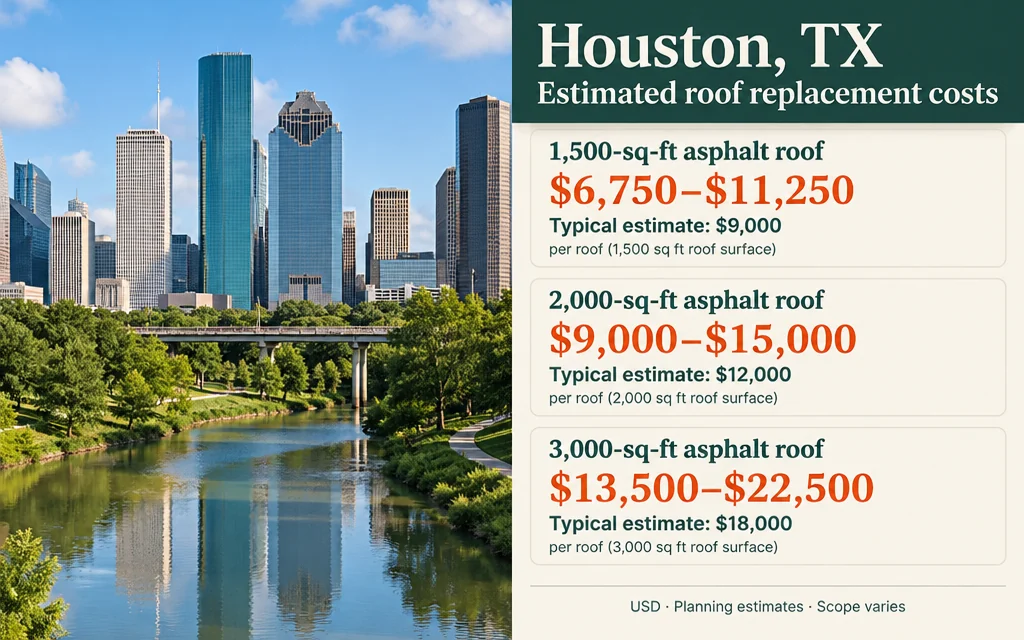
For budgeting, architectural asphalt replacement is estimated at $6,750–$11,250 for a 1,500-sq-ft roof and $9,000–$15,000 for a 2,000-sq-ft roof. These roof-surface scenarios include one-layer tear-off, disposal, labor and materials over sound decking; separately quoted extras are excluded.
Architectural asphalt: 1,500-sq-ft roof
Budget estimate$6,750–$11,250per roof (1,500 sq ft roof surface)
Planning range · Compare the roof area, material and included work in your quote.
Architectural asphalt: 2,000-sq-ft roof
Budget estimate$9,000–$15,000per roof (2,000 sq ft roof surface)
Planning range · Compare the roof area, material and included work in your quote.
Published examples apply to their stated scope. Budget ranges are estimates.
Calculated installed planning estimate for measured roof surface, with one-layer removal and disposal; extras excluded.
Calculated installed planning estimate for measured roof surface, with one-layer removal and disposal; extras excluded.
Calculated installed planning estimate for measured roof surface, with one-layer removal and disposal; extras excluded.
How much does a new roof cost in Houston?
Replacing an asphalt shingle roof on a home with a 2,000-square-foot roof surface in Houston typically costs $9,000–$15,000. On a unit basis, architectural asphalt shingles run $4.50–$7.50 per square foot of roof surface.
That baseline includes tearing off and hauling away one layer of old shingles, laying synthetic underlayment, installing metal drip edge along eaves and rakes, flashing standard penetrations and valleys, and nailing down new shingles over sound decking.
When homeowners look up new roof costs, they are almost always pricing a tear-off and replacement on an existing residence rather than new construction. New construction starts on bare framing with no old shingles to strip, no nails to pull, and no disposal dumpsters dedicated to demolition debris. On an occupied home, setting up tarps to protect siding and shrubs, stripping the old system down to the plywood, and running magnetic sweeps across the yard for stray nails account for a substantial share of total labor.
Roofing contractors measure surface area in "squares," where one square equals 100 square feet of roof plane. Because roof area reflects roof pitch, overhangs, hips, and gables, a home with 2,000 square feet of interior floor plan frequently has 2,400 to 2,800 square feet of actual roof surface. Always evaluate estimates using measured roof surface area rather than living area.
Roof Replacement Cost by Material
The roofing material you select is the largest single factor in your project total. Architectural asphalt shingles cost $4.50–$7.50 per square foot of roof surface installed.
They are the standard across Greater Houston, featuring laminated fiberglass-mat construction that handles coastal gusts and heavy rain significantly better than entry-level products.
Traditional three-tab asphalt shingles cost less at $3.50–$4.75 per square foot of roof surface installed. They have a flat, single-layer profile that makes them lighter and more vulnerable to wind uplift during severe storms. Premium designer shingles feature thicker dimensional profiles, deeper shadow lines, and heavier asphalt formulas, but contractors quote them at higher pricing tiers.
Metal roofing offers greater longevity and reflects solar heat during Houston's long cooling season. Concealed-fastener standing seam metal panels run $11–$21 per square foot of roof surface installed. Their hidden clip system allows panels to expand and contract smoothly in extreme heat without stressing screw penetrations. Exposed-fastener metal panels cost $6.50–$11 per square foot of roof surface installed, though the exposed neoprene washers require periodic inspection and maintenance as sun exposure degrades the rubber over time.
Tile roofing delivers a distinct look and exceptional durability but imposes substantial structural requirements. Concrete tile runs $9.50–$18 per square foot of roof surface installed, while Spanish clay tile ranges from $14–$26 per square foot of roof surface installed. Concrete and clay tiles weigh between 800 and 1,200 pounds per square—three to five times the weight of asphalt shingles. A structural assessment is necessary before converting an asphalt roof to tile to ensure your framing can support the dead load, and high-temperature underlayment is essential beneath the tiles.
| Service / assumptions | Low | Typical estimate | High | Pricing unit | Estimated labor time |
|---|---|---|---|---|---|
| Architectural Asphalt ShinglesIncludes complete tear-off and disposal of one existing asphalt layer, synthetic underlayment, starter course, standard ridge cap, drip edge, and flashing. | $4.50 | $6 | $7.50 | per sq ft of roof surface (installed) | 1-2 days for a 2,000 sq ft roof |
| Three-Tab Asphalt ShinglesBudget-grade single-layer shingle. Covers tear-off of one layer, underlayment, and standard drip edge. Limited wind performance in coastal storm zones. | $3.50 | $4 | $4.75 | per sq ft of roof surface (installed) | 1-2 days for a 2,000 sq ft roof |
| Standing Seam Metal RoofingConcealed-fastener 24- or 26-gauge steel standing seam panels, high-temperature underlayment, starter trims, ridge caps, tear-off of one existing layer, and cleanup. | $11 | $15.50 | $21 | per sq ft of roof surface (installed) | 3-5 days for a 2,000 sq ft roof |
| Exposed-Fastener Metal RoofingScrew-down 5V or corrugated metal panels with rubber washer fasteners, synthetic underlayment, flashing, and removal of one existing shingle layer. | $6.50 | $8.50 | $11 | per sq ft of roof surface (installed) | 2-4 days for a 2,000 sq ft roof |
| Concrete Tile RoofingStandard-weight concrete interlocking tiles, battens, heavy-duty underlayment, corrosion-resistant fasteners, and tear-off. Excludes framing reinforcement. | $9.50 | $13.50 | $18 | per sq ft of roof surface (installed) | 4-7 days for a 2,000 sq ft roof |
| Clay Tile RoofingBarrel or Spanish clay tiles over self-adhering modified bitumen underlayment, metal flashing details, and tear-off. Requires structural load assessment. | $14 | $19 | $26 | per sq ft of roof surface (installed) | 5-9 days for a 2,000 sq ft roof |
| Product type | How to compare |
|---|---|
| Three-tab asphalt | Compare the specified product and installed scope with the three-tab rate row. |
| Architectural asphalt | The baseline for the calculated roof-size budgets in this guide. |
| Premium or designer asphalt | Request a product-specific installed proposal; this guide does not invent a separate premium rate. |
Product names and grades alone do not establish an impact, wind or fire rating. Compare the exact product documentation, installation requirements and written warranty.
Roof Replacement Costs by Roof Surface Area
Your roof's total surface area—not your home's interior footprint—governs how many bundles of shingles, rolls of underlayment, and crew hours a job requires. Roof pitch, gables, dormers, and covered porches all add surface area beyond your interior living space.
The following planning estimates reflect baseline architectural shingles at $4.50–$7.50 per square foot of roof surface:
• 1,500 sq ft roof surface: Estimated at $6,750–$11,250, with typical on-site crew time of 1-2 days. This scale generally corresponds to a compact single-story home with a straightforward roofline.
• 2,000 sq ft roof surface: Estimated at $9,000–$15,000, with typical on-site crew time of 1-3 days. This represents a typical single-story suburban home with hips, valleys, and an attached garage.
• 3,000 sq ft roof surface: Estimated at $13,500–$22,500, with typical on-site crew time of 2-4 days. This covers larger one-story floor plans or two-story homes with multiple gables, complex valleys, and covered patio extensions.
These scenarios assume sound plywood or OSB decking, standard driveway access for tear-off dumpsters, and removal of a single shingle layer. Complex roof profiles or steep slopes will steer estimates toward the higher end of each bracket.
| Service / assumptions | Low | Typical estimate | High | Pricing unit | Estimated labor time |
|---|---|---|---|---|---|
| Architectural asphalt: 1,500-sq-ft roofCalculated planning scenario: 1,500 sq ft of measured roof surface × architectural-asphalt installed rate. Includes the same one-layer tear-off, disposal, labor, materials and sound-deck baseline; separately quoted extras excluded. | $6,750 | $9,000 | $11,250 | per roof (1,500 sq ft roof surface) | 1-2 days |
| Architectural asphalt: 2,000-sq-ft roofCalculated planning scenario: 2,000 sq ft of measured roof surface × architectural-asphalt installed rate. Includes the same one-layer tear-off, disposal, labor, materials and sound-deck baseline; separately quoted extras excluded. | $9,000 | $12,000 | $15,000 | per roof (2,000 sq ft roof surface) | 1-3 days |
| Architectural asphalt: 3,000-sq-ft roofCalculated planning scenario: 3,000 sq ft of measured roof surface × architectural-asphalt installed rate. Includes the same one-layer tear-off, disposal, labor, materials and sound-deck baseline; separately quoted extras excluded. | $13,500 | $18,000 | $22,500 | per roof (3,000 sq ft roof surface) | 2-4 days |
Low-Slope and Flat Roof Systems
Many Houston homes feature low-slope or flat roof sections over covered patios, carports, sunrooms, or mid-century architectural additions. Standard shingles rely on gravity to shed water and cannot be installed on slopes lower than 2:12, where water can back up under the laps.
These surfaces require a continuous membrane system.
Thermoplastic Polyolefin (TPO) costs $6–$12 per square foot of roof surface installed and is widely used for residential flat sections. TPO sheets are hot-air welded at the seams to create a continuous watertight membrane, and its bright white top sheet helps reflect solar radiation away from living spaces below. Ethylene Propylene Diene Monomer (EPDM), a synthetic black rubber membrane, runs $5–$10 per square foot of roof surface installed. EPDM handles thermal movement well, but its dark surface absorbs radiant heat unless treated with a reflective topcoat.
These membrane unit prices include the sheet, perimeter edge metal, wall flashings, and one-layer removal over sound decking. Tapered polyiso insulation boards, which create positive drainage toward scuppers or gutters on dead-flat decks, are priced separately when required.
| Service / assumptions | Low | Typical estimate | High | Pricing unit | Estimated labor time |
|---|---|---|---|---|---|
| TPO Flat Roof MembraneMechanically attached or fully adhered 60-mil white TPO membrane with heat-welded seams, cover board, and one-layer tear-off. Excludes tapered insulation.Published price reference ↗ | $6 | $8.50 | $12 | per sq ft of roof surface (installed) | 2-3 days for a 1,500 sq ft flat roof |
| EPDM Rubber Flat Roof MembraneFully adhered 60-mil black EPDM membrane with seam tape, termination bars, edge flashing, and one-layer tear-off. Tapered polyiso insulation quoted separately. | $5 | $7.50 | $10 | per sq ft of roof surface (installed) | 2-3 days for a 1,500 sq ft flat roof |
Tear-Off vs. Overlay: Comparing Replacement Options
Some contractors suggest an overlay (nailing a fresh shingle course directly over the old roof) to reduce labor hours and dumpster fees. While the upfront bid looks lower, an overlay introduces long-term trade-offs.
Check both local building regulations and manufacturer warranty terms before considering it. Some municipal jurisdictions prohibit multiple roofing layers, and most shingle manufacturers restrict warranty coverage on re-cover installations.
Beyond building codes, an overlay traps heat between the two asphalt layers, accelerating drying and granule loss in the top shingles during Houston summers. Nails driven through two shingle layers also have less holding power in the wood deck, making the roof more vulnerable to wind uplift during severe storms. Most importantly, an overlay covers up whatever is happening underneath. In humid environments, small roof leaks or inadequate attic ventilation can rot plywood sheathing without showing visible signs from above until the old shingles are completely stripped.
Our baseline pricing includes the complete tear-off and disposal of one shingle layer. If your roof already has two layers from an earlier re-cover, the crew must strip both down to the deck. Removing an additional layer runs $35–$75 per roofing square (100 square feet) to cover the extra labor and heavy disposal weight.
Common Extras and Unforeseen Repairs
You cannot see the condition of the structural deck until the old shingles and felt are pulled away. Once the crew reaches bare wood, damaged decking, rotted trim, or failing flashings may require attention.
Keeping a 10 to 15 percent contingency reserve helps handle these common line items:
• Decking Replacement: Water-damaged or delaminated sheathing cannot securely grip roofing nails. Replacing rotted 4-by-8-foot OSB or CDX plywood sheets costs $55–$95 per sheet, including labor and materials. Reputable contracts state this price per sheet up front.
• Fascia and Soffit Repairs: Clogged gutters or wind-driven rain can rot the structural trim along your eaves. Replacing rotted fascia boards runs $9–$22 per linear foot, while soffit panel replacement costs $8–$20 per square foot.
• Ridge Ventilation: Upgrading to a continuous shingle-over ridge vent costs $9–$20 per linear foot. Proper attic exhaust requires balanced intake vents along the soffits to allow heat and humidity to escape.
• Chimney and Skylight Flashing: Custom counter-flashing around a brick or siding chimney runs $350–$900 per chimney. Installing a new flashing kit around an existing skylight costs $250–$700 per skylight. Reusing old, fatigued flashing is a frequent cause of preventable leaks on newly installed roofs.
• Gutter Detach and Reset: When gutters block access to the eave edge metal, taking them down and rehanging them runs $4–$11 per linear foot.
| Service / assumptions | Low | Typical estimate | High | Pricing unit | Estimated labor time |
|---|---|---|---|---|---|
| Tear-Off Additional Shingle LayerAdditional labor and disposal fee to strip a second or third existing roof layer beyond the baseline single layer included in main rates. | $35 | $50 | $75 | additional per roofing square (100 sq ft) | N/A |
| Rotted Decking ReplacementMaterial and labor to replace deteriorated 7/16-inch OSB or 1/2-inch CDX plywood uncovered during tear-off, nailed to code.Published price reference ↗ | $55 | $75 | $95 | additional per 4-by-8-ft sheet (32 sq ft) | N/A |
| Fascia Board ReplacementReplacing rotted 1x6 or 1x8 primed spruce or composite fascia boards along eaves and rakes while old roof perimeter is exposed. | $9 | $15 | $22 | additional per linear ft | N/A |
| Soffit Panel ReplacementLabor and materials to replace damaged vented or solid soffit sections underneath overhangs, prepped for finish painting. | $8 | $14 | $20 | additional per sq ft | N/A |
| Continuous Ridge Vent UpgradeInstallation of high-flow shingle-over ridge vent across roof peaks to boost attic exhaust ventilation, paired with matching ridge caps. | $9 | $14 | $20 | additional per linear ft | N/A |
| Chimney Flashing ReplacementCustom fabrication and installation of aluminum or copper step and counter-flashing ground into masonry mortar joints with elastomeric sealant. | $350 | $550 | $900 | additional per chimney | N/A |
| Skylight Flashing KitReplacing perimeter step and head flashing kits with membrane integration around existing skylight curbs during field replacement. | $250 | $450 | $700 | additional per skylight | N/A |
| Gutter Detach and ResetTaking down undamaged seamless gutters to inspect and flash the eave, then rehanging, re-pitching, and securing after roof installation. | $4 | $7 | $11 | additional per linear ft | N/A |
Key Drivers of Roof Replacement Costs
In addition to your chosen material, several physical jobsite factors determine where your final estimate falls within the pricing spectrum:
1. Roof Pitch and Slope: Roofs with a slope above 6:12 require safety harnesses, roof jacks, and staging planks. Installers must work more deliberately, which adds crew hours and pushes labor rates higher.
2. Architectural Complexity: Valleys, hips, dormers, and multiple intersecting roof planes require precise cuts, extra metal flashing, and additional protective membrane. Complex layouts generate more material waste and demand more time than simple two-sided gable roofs.
3. Property Access and Height: Two- and three-story homes require longer ladders, additional fall protection, and extra ground spotting. If tight fence gates, air-conditioning condensers, or mature landscaping prevent parking a disposal trailer next to the roofline, workers must haul old shingles by hand across the yard.
4. Fastening Patterns and Storm Details: Coastal storm exposure often calls for a six-nail fastening pattern rather than standard four-nail placement, along with heavy-duty starter shingles along eaves and rakes to resist wind uplift.
5. Hidden Decking Deterioration: Prolonged humidity and minor, slow leaks can soften sheathing over time, requiring per-sheet plywood replacement once tear-off reveals the decking condition.
Repair vs. Replacement: Evaluating the Choice
Not every roof issue calls for a full tear-off. Deciding whether to repair or replace comes down to shingle condition, the location of the problem, and the age and wear of the roofing system.
A targeted repair makes practical sense when the shingles are still pliable and the problem is isolated—such as a split rubber pipe boot, a dislodged flashing piece around a vent, or a few blown-off shingles after a storm. In these scenarios, a roofer can lift surrounding shingles without damaging them, slide in replacement pieces, and seal the area without disturbing the rest of the roof.
A full replacement becomes necessary when wear is widespread across multiple roof facets. Warning signs include widespread granule loss leaving exposed black asphalt or fiberglass, brittle or curling shingle edges, and persistent leaks in multiple rooms. When shingles reach the end of their service life, summer heat bakes out the volatile oils, leaving them brittle. Trying to bend an aged shingle to slip new flashing underneath often snaps the material, causing leaks in neighboring sections. If an attic inspection shows widespread moisture staining across your decking, patching individual spots will not cure the underlying failure.
| Decision point | Roof repair | Roof replacement | Metal roofing |
|---|---|---|---|
| Work being priced | A defined defect, such as damaged shingles or flashing. | Removal and installation of an agreed roof system across the measured roof surface. | A specified installed metal system; standing seam, exposed fasteners and metal shingles are different scopes. |
| What to inspect | The leak source, surrounding material and whether a durable localized fix is feasible. | The extent of deterioration, decking condition, roof details and suitable replacement systems. | The substrate, panel profile, coating, fasteners, roof geometry and installation details. |
| How to compare prices | Match the repair quantity, access, materials and included diagnosis. | Match measured roof area, material, tear-off layers, disposal and installed inclusions. | Match measured roof area, system, components, removal and conditional additional work. |
| Before deciding | Ask what the repair addresses and what existing problems would remain. | Ask whether repair remains practical and which additional items would change the total. | Ask about compatible materials, documented product/assembly ratings and product versus workmanship warranties. |
Age or a repair-cost percentage alone does not determine the right choice. Ask a qualified roofing contractor to assess the condition and explain viable options. A metal system is a material-specific installation choice, not a separate guarantee of durability or savings.
Hiring a Roofing Contractor in Houston: Quotes and Verification
Because the State of Texas does not license residential roofing contractors at the state level, property owners need to take direct responsibility for screening candidates and vetting qualifications.
Start by requesting active certificates of insurance. Ask the contractor to have their insurance agent send certificates directly to you showing commercial general liability and workers' compensation coverage. Ask the company to confirm what specific policies cover their crew while working on your property, which helps protect you from unexpected liability risks.
Clarify permitting responsibilities before signing a contract. Permitting rules depend on whether your home is located within the incorporated City of Houston, an adjacent municipality, or an unincorporated section of Harris County. Contact your local city or county building department directly to verify permit requirements and windstorm inspection procedures for your address.
Review every written bid for itemized specifications. A comprehensive contract names the shingle manufacturer, product line, wind rating, underlayment type, flashing gauges, ventilation upgrades, and the agreed price per sheet for unexpected decking replacement.
Distinguish between the manufacturer's shingle warranty and the contractor's workmanship warranty. The shingle manufacturer covers factory defects in the material, not installation errors like high nailing or missing flashing. The contractor's workmanship warranty covers installation faults. Hire established companies with a verified physical address, and withhold final payment until the roof is finished, the yard has been checked with a magnetic nail sweep, and any required building inspections are complete.
Local income & housing costs
Houston city, Texas · U.S. Census Bureau, 2025 ACS 1-year estimates.
per month · ±$19
Cash-rent units; includes applicable tenant-paid utilities
Census source ↗Dollar amounts use the survey period’s published basis. Income is annual; gross rent is monthly. Home value reflects owner-occupied housing values. Margins of error shown are at the ACS 90% confidence level. These statistics provide city context; service budgets use their own pricing evidence.
STATEWIDE COST CONTEXT
Texas prices, income & labor costs
These Texas figures provide background for this city guide. They describe different measures and reference years; employee wages are not prices charged by a contractor.
BEA SAIRPD
State price change indicator
120.02024 · index (2017 basis)
Annual figures & sources
| Year | Value | 90% margin of error | Source |
|---|---|---|---|
| 2020 | 103.4 | — | Official source |
| 2021 | 107.2 | — | Official source |
| 2022 | 113.1 | — | Official source |
| 2023 | 117.1 | — | Official source |
| 2024 | 120.0 | — | Official source |
Census ACS 1-year
Median household income
$82,6252025 · USD/year
Annual figures & sources
| Year | Value | 90% margin of error | Source |
|---|---|---|---|
| 2021 | $66,963 | ±$513 | Official source |
| 2022 | $72,284 | ±$443 | Official source |
| 2023 | $75,780 | ±$472 | Official source |
| 2024 | $79,721 | ±$564 | Official source |
| 2025 | $82,625 | ±$670 | Official source |
BLS OEWS
Roofers
$22.132025 · USD/hour
Annual figures & sources
| Year | Value | 90% margin of error | Source |
|---|---|---|---|
| 2025 | $22.13 | — | Official source |
State prices: BEA, 2020–2024. Household income: Census ACS, 2021–2025. Employee wages: BLS, May 2025 snapshot. The charts retain their own units and fitted scales.
Explore all Texas living-cost data and trends →Local context and limitations
Permitting rules, wind-resistance codes, and inspection procedures depend on whether your property sits within the incorporated City of Houston, an adjoining municipality, or unincorporated Harris County. Certain designated coastal and high-wind areas may require windstorm certification for storm-insurance underwriting; confirm with the Texas Department of Insurance (TDI), the Texas Windstorm Insurance Association (TWIA), or your insurance agent for address-specific mandates. Because Texas does not license residential roofing contractors at the state level, verify contractor insurance coverage, municipal registrations, and building permit requirements directly before signing an agreement.
Frequently asked questions
How much does a new roof cost in Houston?
Replacing an asphalt shingle roof on a typical 2,000-square-foot roof surface runs $9,000–$15,000. On a unit basis, architectural shingles cost $4.50–$7.50 per square foot of roof surface, which covers tear-off of one layer, synthetic underlayment, drip edge, flashing, labor, and cleanup over sound wood decking.
How does a new roof compare to a tear-off replacement or an overlay?
A full roof replacement involves stripping all existing shingles down to the bare wood deck, inspecting the sheathing, installing fresh underlayment, and fastening new shingles. An overlay nails new shingles directly over the old layer to avoid tear-off expenses; however, it can trap heat, conceal rotted decking, and void manufacturer warranties. A new roof in new construction begins over freshly framed, bare sheathing with no old shingles or nails to remove.
How long does a roof replacement take on a Houston home?
A standard architectural asphalt roof replacement on a 2,000-square-foot roof surface typically takes 1-3 days of on-site crew work in dry weather. Steep pitches, complex roof geometries, or extensive decking repairs will extend that schedule.
What is the difference between architectural and three-tab shingles?
Three-tab shingles are flat, single-layer strip shingles costing $3.50–$4.75 per square foot of roof surface installed that provide basic wind protection. Architectural shingles cost $4.50–$7.50 per square foot of roof surface installed, feature a laminated multi-layer structure, and carry higher wind resistance ratings suited for coastal weather.
How much does it cost to replace rotted decking?
Replacing water-damaged 4-by-8-foot OSB or CDX plywood sheathing costs $55–$95 per sheet, including labor and materials. Reputable roofing contractors include a stated per-sheet rate in their contract so extra charges are clear if rot is uncovered.
Do I need a permit for a roof replacement in Houston?
Permit rules vary depending on whether your property is inside the incorporated City of Houston, an adjacent municipality, or an unincorporated section of Harris County. Building authorities maintain distinct permitting rules and inspection schedules for reroofing projects. Contact your local city or county building department directly to verify permit requirements for your address before work begins.
Sources and methodology
These planning estimates draw on publicly available pricing pages read on 2026-11-09. Some cited pages mention the target city; that alone does not verify service coverage or establish a citywide average. Published starting rates and individual provider prices are reference points, not final local quotes. Confirm service availability, minimum charges, included work and travel charges with the provider.
Published pricing pages retrieved; quoted excerpts checked automatically. 2 distinct website domains. · Generated 2026-11-09
- Smart Houston Commercial TPO Cost Guide (2026) | Achilles Powerful ProtectionCity-specific page context · Page retrieved 2026-11-09 · Price excerpt matched automatically
“A commercial TPO roof replacement in Houston runs $6.00 to $12.00 per square foot installed in 2026”
Planning ranges may differ from these published examples; they are not provider quotes.
- Houston Roof Replacement Cost Calculator | $8,000–$20,000City-specific page context · Page retrieved 2026-11-09 · Price excerpt matched automatically
“Decking, if needed $75 /sheet”
Planning ranges may differ from these published examples; they are not provider quotes.
Plan your roof replacement project
Choose your service and answer its project questions. Add notes or photos if helpful, then generate your project brief. The planner labels its budgeting assumptions separately. Use your plan to compare the scope and assumptions with a provider. Contact sharing and provider matching are not available yet.
Open the project planner →Share this city’s cost data
<> Embed Houston Cost Data on Your Site
The HTML table shows the prices at the time of copying. The iframe follows the published guide.