Aurora · CO · COST GUIDE
Metal Roofing Costs in Aurora, CO (2026)
For budgeting, standing-seam steel roofing is estimated at $11–$19 per sq ft of roof surface, and exposed-fastener steel at $7.50–$12 per sq ft. These installed planning ranges include one-layer removal/disposal over sound decking; compare the specified system and conditional extras.
Standing Seam Steel Roof (Installed)
Budget estimate$11–$19per sq ft of roof surface (installed)
Planning range · Compare the roof area, material and included work in your quote.
Exposed-Fastener Steel Roof (Installed)
Budget estimate$7.50–$12per sq ft of roof surface (installed)
Planning range · Compare the roof area, material and included work in your quote.
Published examples apply to their stated scope. Budget ranges are estimates.
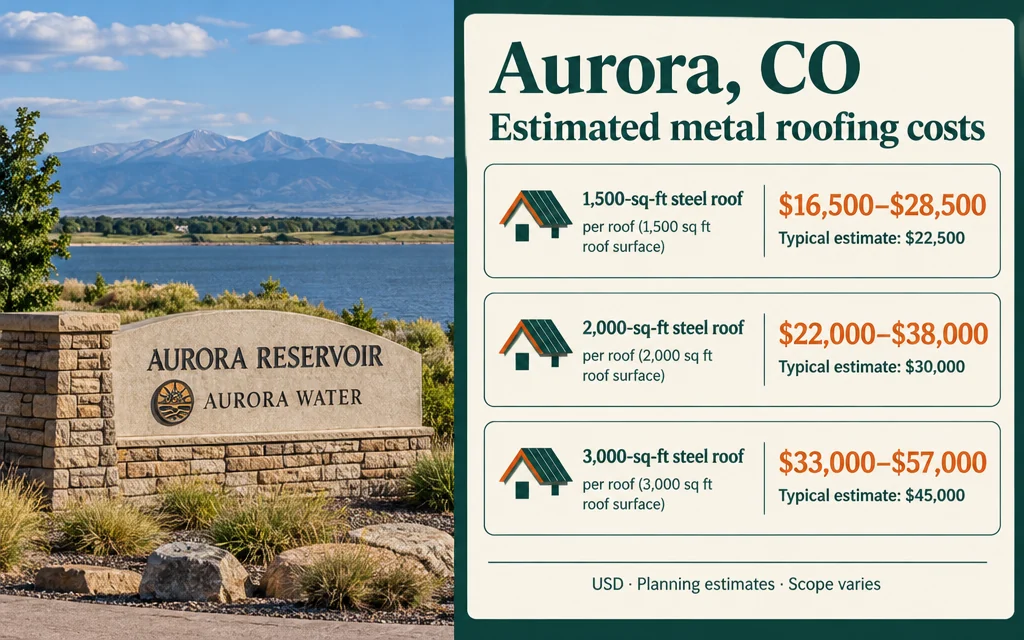
Calculated installed planning scenario for measured roof surface, including one-layer removal/disposal; conditional extras excluded.
Calculated installed planning scenario for measured roof surface, including one-layer removal/disposal; conditional extras excluded.
Calculated installed planning scenario for measured roof surface, including one-layer removal/disposal; conditional extras excluded.
Metal Roofing in Aurora: Overview and Planning Baseline
A residential metal roof is an engineered system composed of shaped metal panels, concealed clips, high-temperature underlayment, and custom perimeter flashings. In Aurora, homeowners frequently consider metal roofing to handle Front Range climate stresses: high-altitude solar radiation that dries out organic materials, sharp freeze-thaw cycles that test unsealed joints, and recurring spring hail activity across Arapahoe and Adams counties.
Budgeting for a metal roof starts with the measured roof surface area, which is larger than your home's interior living footprint because of roof pitch, dormers, eaves, and overhangs. In this guide, all installed planning estimates reflect a full baseline scope: tearing off and disposing of one layer of existing asphalt shingles, laying down high-temperature underlayment, installing standard ridge and drip edge flashings, and fastening panels over sound structural decking. While baseline architectural shingles in Aurora run budget $4.50–$8 per sq ft of roof surface (installed), a standing-seam steel roof represents a long-term investment that typically requires budget $11–$19 per sq ft of roof surface (installed).
Metal Roofing Systems Compared: Profiles, Metals, and Performance
Selecting the right metal system involves balancing architectural style, upfront costs, and ongoing maintenance expectations. Metal profiles perform very differently depending on fastener engineering and base metallurgy.
Concealed-fastener standing seam steel is the standard choice for Front Range residential applications, running budget $11–$19 per sq ft of roof surface (installed). Panels interlock at raised vertical seams using hidden clips, allowing the metal to expand and contract smoothly through Aurora's wide daily temperature swings. High-performance panels typically feature a Galvalume substrate (an aluminum-zinc alloy coating over steel) finished with a factory-applied polyvinylidene fluoride (PVDF) paint system that resists UV chalking and fading.
Exposed-fastener steel panels, such as corrugated or 5V-crimp profiles, cost noticeably less at budget $7.50–$12 per sq ft of roof surface (installed). However, these systems secure the metal using thousands of visible screws driven through the panel face with neoprene or EPDM sealing washers. Under intense high-altitude sunlight, these washers can dry out and degrade over 10 to 15 years, requiring regular inspections and eventual screw replacement to avoid leaks. While common on detached garages or agricultural outbuildings, exposed-fastener systems demand more ongoing attention than standing seam.
Steel metal shingles and tiles offer an alternative profile at budget $11–$16.50 per sq ft of roof surface (installed), mimicking the appearance of shake, slate, or barrel tile while using stamped 26-gauge steel. These systems often work well in neighborhoods with architectural guidelines that restrict vertical-rib standing seam designs.
For alternative metals, standing-seam aluminum runs budget $14–$22 per sq ft of roof surface (installed), while architectural standing-seam copper costs budget $22–$36 per sq ft of roof surface (installed). Aluminum provides excellent natural corrosion resistance and low weight, though it is softer under direct hail impact than heavy-gauge steel. Copper develops a natural protective patina, requires no factory finish, and offers exceptional longevity, but requires specialized artisan sheet-metal fabrication and a much higher project budget.
| Service / assumptions | Low | Typical estimate | High | Pricing unit | Estimated labor time |
|---|---|---|---|---|---|
| Standing Seam Steel Roof (Installed)Calculated standing-seam steel planning rate: comparable panel/accessory materials + installation labor + one-layer removal/disposal. Ordinary underlayment and details over sound decking included; conditional extra work excluded. | $11 | $15 | $19 | per sq ft of roof surface (installed) | 3-5 business days (2,000 sq ft roof) |
| Exposed-Fastener Steel Roof (Installed)26-gauge ribbed or corrugated steel panels secured with visible gasketed screws. Lower upfront cost but requires periodic washer maintenance. | $7.50 | $9.50 | $12 | per sq ft of roof surface (installed) | 2-3 business days (2,000 sq ft roof) |
| Steel Metal Shingles or Tile (Installed)Stone-coated steel or stamped painted steel shingles mimicking slate, shake, or clay tile. Interlocking panel design. | $11 | $14 | $16.50 | per sq ft of roof surface (installed) | 3-5 business days (2,000 sq ft roof) |
| Standing Seam Aluminum Roof (Installed)0.032 to 0.040 inch concealed-fastener aluminum panels. Naturally rustproof and lightweight; somewhat softer under direct hail impact than heavy steel. | $14 | $18 | $22 | per sq ft of roof surface (installed) | 3-5 business days (2,000 sq ft roof) |
| Standing Seam Copper Roof (Installed)16 oz or 20 oz architectural copper panels. Uncoated metal develops natural protective patina. Requires hand seaming and artisan installation. | $22 | $28 | $36 | per sq ft of roof surface (installed) | 5-8 business days (2,000 sq ft roof) |
Cost Components: Materials, Labor, and Tear-Off Breakdown
Every metal roof estimate is built from three main cost components: manufactured materials, mechanical installation labor, and the removal and disposal of the old roof covering. For a standard 24-gauge Galvalume standing-seam steel roof in Aurora, the combined baseline comes to budget $11–$19 per sq ft of roof surface (installed).
Manufactured materials account for budget $4.50–$8.50 per sq ft of roof surface (materials only). This covers roll-formed 24-gauge or 26-gauge steel panels with a factory finish, engineered two-piece expansion clips, corrosion-resistant fasteners, drip edge trims, rake trims, vented ridge caps, and high-temperature synthetic underlayment designed to tolerate the heat that builds beneath metal surfaces.
Skilled installation labor accounts for budget $5.50–$8 per sq ft of roof surface (installation labor only), with a typical 2,000-square-foot roof taking 3-5 business days (2,000 sq ft roof). Standing-seam roofing demands precise layout, custom hand-folding at hips and valleys, hemmed transitions at eaves, and clip placement that avoids binding panel travel. Complex roof geometries and steeper pitches increase crew time accordingly.
Tear-off and disposal of one existing shingle layer accounts for budget $1–$2.50 per sq ft of roof surface (one-layer removal and disposal), which usually takes 1-2 business days. This scope covers stripping old shingles down to the decking, pulling nails, cleaning the wood deck for inspection, hauling the debris, and paying regional disposal fees.
| Service / assumptions | Low | Typical estimate | High | Pricing unit | Estimated labor time |
|---|---|---|---|---|---|
| Standing Seam Steel Materials AllowanceIncludes 24-ga painted Galvalume panels, factory trims, clips, fasteners, and high-temperature underlayment. | $4.50 | $6.50 | $8.50 | per sq ft of roof surface (materials only) | N/A |
| Standing Seam Steel Installation LaborOn-site mechanical installation, layout, panel clipping, ridge hemming, and standard edge detailing. | $5.50 | $7 | $8 | per sq ft of roof surface (installation labor only) | 3-5 business days (2,000 sq ft roof) |
| One-Layer Shingle Removal and DisposalComplete tear-off of 1 existing asphalt shingle layer, sweeping deck, job site protection, hauling, and local disposal fees. | $1 | $1.50 | $2.50 | per sq ft of roof surface (one-layer removal and disposal) | 1-2 business days |
Installed Cost by Roof Surface Area
To evaluate total project cost accurately, review measured roof surface area rather than interior living space. A single-story home with 1,500 square feet of floor area often has 1,800 to 2,000 square feet of actual roof area once pitch multipliers, eaves, and garage coverage are included.
For a smaller home or simple roofline measuring 1,500 square feet of roof surface, a complete standing-seam steel replacement in Aurora budgets at $16,500–$28,500 per roof (1,500 sq ft roof surface), with a typical project taking 2-4 business days.
For a standard mid-sized home with 2,000 square feet of measured roof surface, expect an installed total of $22,000–$38,000 per roof (2,000 sq ft roof surface), with on-site work typically taking 3-5 business days.
For a larger property or an intricate multi-gabled layout measuring 3,000 square feet of roof surface, standard 24-gauge standing-seam steel budgets at $33,000–$57,000 per roof (3,000 sq ft roof surface), typically requiring 4-7 business days.
| Service / assumptions | Low | Typical estimate | High | Pricing unit | Estimated labor time |
|---|---|---|---|---|---|
| Standing Seam Steel Roof (1,500 Sq Ft)Calculated scenario: 1,500 sq ft of measured roof surface × standing-seam steel installed planning rate. Includes its same materials, installation, one-layer removal/disposal and sound-deck assumptions. Not a provider whole-roof quote. | $16,500 | $22,500 | $28,500 | per roof (1,500 sq ft roof surface) | 2-4 business days |
| Standing Seam Steel Roof (2,000 Sq Ft)Calculated scenario: 2,000 sq ft of measured roof surface × standing-seam steel installed planning rate. Includes its same materials, installation, one-layer removal/disposal and sound-deck assumptions. Not a provider whole-roof quote. | $22,000 | $30,000 | $38,000 | per roof (2,000 sq ft roof surface) | 3-5 business days |
| Standing Seam Steel Roof (3,000 Sq Ft)Calculated scenario: 3,000 sq ft of measured roof surface × standing-seam steel installed planning rate. Includes its same materials, installation, one-layer removal/disposal and sound-deck assumptions. Not a provider whole-roof quote. | $33,000 | $45,000 | $57,000 | per roof (3,000 sq ft roof surface) | 4-7 business days |
Metal vs. Asphalt Shingles: Ownership Costs and Lifecycle
Comparing standing-seam metal at budget $11–$19 per sq ft of roof surface (installed) to architectural asphalt shingles at budget $4.50–$8 per sq ft of roof surface (installed) shows that metal requires roughly two to three times the initial outlay. Evaluating this difference depends largely on how long you intend to own the home.
In Aurora's climate, conventional asphalt shingles face intense solar exposure, wind stresses, and hail impacts that can lead to replacement or repairs every 15 to 22 years. Over an extended ownership window, a property owner may pay for multiple shingle replacements alongside recurring storm deductibles.
A properly installed standing-seam steel roof often serves for 40 to 60 years with minimal routine upkeep. Fasteners are concealed beneath interlocked seams, eliminating exposed rubber washers, and the vertical seams shed heavy Front Range snow efficiently. If you plan to remain in your home for 15 or more years, the annualized investment in standing seam becomes far more comparable to asphalt while offering consistent durability between storm seasons.
| Service / assumptions | Low | Typical estimate | High | Pricing unit | Estimated labor time |
|---|---|---|---|---|---|
| Architectural Asphalt Shingles (Installed Reference)Standard architectural or Class 4 impact asphalt shingles with synthetic underlayment and 1-layer tear-off for comparative budgeting. | $4.50 | $6 | $8 | per sq ft of roof surface (installed) | 1-2 business days (2,000 sq ft roof) |
| Comparison | Architectural asphalt | Standing-seam steel |
|---|---|---|
| Up-front planning estimate · 2,000 sq ft roof surface | $9,000–$16,000 | $22,000–$38,000 |
| What the baseline includes | Architectural asphalt, ordinary installed details, one-layer removal/disposal over sound decking. | Standing-seam steel, ordinary installed details, one-layer removal/disposal over sound decking. |
| Maintenance and repairs | Confirm product-specific inspections and repair terms. | Confirm seams, fasteners, coating, compatible repairs and inspection terms. |
| Insurance and ownership cost | Ask the insurer about the exact product and coverage. | Ask the insurer about accepted test documentation, any available credit and cosmetic-damage exclusions. |
These are calculated budgeting comparisons, not provider quotes or guaranteed lifetime savings. Compare your expected ownership period, specified products, actual maintenance proposals and written insurance terms.
| Decision point | Roof repair | Roof replacement | Metal roofing |
|---|---|---|---|
| Work being priced | A defined defect, such as damaged shingles or flashing. | Removal and installation of an agreed roof system across the measured roof surface. | A specified installed metal system; standing seam, exposed fasteners and metal shingles are different scopes. |
| What to inspect | The leak source, surrounding material and whether a durable localized fix is feasible. | The extent of deterioration, decking condition, roof details and suitable replacement systems. | The substrate, panel profile, coating, fasteners, roof geometry and installation details. |
| How to compare prices | Match the repair quantity, access, materials and included diagnosis. | Match measured roof area, material, tear-off layers, disposal and installed inclusions. | Match measured roof area, system, components, removal and conditional additional work. |
| Before deciding | Ask what the repair addresses and what existing problems would remain. | Ask whether repair remains practical and which additional items would change the total. | Ask about compatible materials, documented product/assembly ratings and product versus workmanship warranties. |
Age or a repair-cost percentage alone does not determine the right choice. Ask a qualified roofing contractor to assess the condition and explain viable options. A metal system is a material-specific installation choice, not a separate guarantee of durability or savings.
Additional Scope Items and Unexpected Repairs
Every roof replacement involves site-specific conditions that fall outside standard baseline labor and materials. Knowing these line items early helps avoid surprises once work begins.
Decking repair is the most common unforeseen expense. Manufacturers and structural guidelines require metal panels to fasten into solid, sound decking. If tear-off exposes rotted, delaminated, or soft sheathing, replacement CDX plywood or OSB budgets at $65–$105 per 4-by-8-ft sheet (32 sq ft). If the home has an underlying secondary roof layer that must be removed, expect an additional $40–$95 additional per roofing square (100 sq ft).
Flashing around roof penetrations requires custom metalwork. Standard plumbing vent collars are included in base bids, but complex brick chimney transitions run budget $275–$750 per chimney for custom counterflashing and crickets, taking 2-4 hours. Flashing an existing skylight into a standing-seam profile budgets at $225–$600 per skylight and takes 2-4 hours.
Snow retention is an important consideration in Aurora. Because slick metal surfaces shed snow rapidly when warmed by sunlight, accumulated snowpack can slide abruptly over entryways and parked vehicles. Installing continuous snow rails or discrete seam-mounted snow guards runs budget $4–$12 per linear ft. Upgrading attic ridge ventilation runs budget $10–$24 per linear ft, and detaching and resetting existing seamless gutters to accommodate new drip edge profiles runs budget $4–$10 per linear ft.
| Service / assumptions | Low | Typical estimate | High | Pricing unit | Estimated labor time |
|---|---|---|---|---|---|
| Additional Roofing Layer RemovalApplies only if a second underlying layer of shingles or wood shakes is encountered and requires disposal. | $40 | $60 | $95 | additional per roofing square (100 sq ft) | N/A |
| Decking Replacement (4x8 Sheet)Replacement of rotted or warped 7/16-in OSB or 1/2-in CDX plywood sheathing uncovered during tear-off.Published price reference ↗ | $65 | $80 | $105 | additional per 4-by-8-ft sheet (32 sq ft) | N/A |
| Chimney Flashing / Cricket PackageCustom-fabricated metal step flashing, counterflashing, and small diversion cricket integrated into standing-seam profile. | $275 | $450 | $750 | additional per chimney | 2-4 hours |
| Skylight Flashing IntegrationEngineered metal flashing kit or custom sheet metal pan flashing for an existing skylight during reroofing. | $225 | $375 | $600 | additional per skylight | 2-4 hours |
| Ridge Ventilation UpgradeContinuous perforated or louvered standing-seam ridge vent caps to ensure attic air exhaust meets code requirements. | $10 | $16 | $24 | additional per linear ft | N/A |
| Snow Retention Rails / GuardsSeam-mounted continuous snow pipe or pad clamps installed over gutters, walkways, and entry doors.Published price reference ↗ | $4 | $7 | $12 | additional per linear ft | N/A |
| Gutter Detach and ResetCareful removal and reinstallation of existing seamless gutters to allow proper installation of new metal drip edge flashings. | $4 | $6 | $10 | additional per linear ft | N/A |
Performance Ratings: Hail, Wind, Fire, and Insurance Realities
Product literature often highlights metal roofs as exceptionally durable, but homeowners should distinguish between standardized laboratory test results and actual policy terms.
Most residential 24-gauge standing seam steel products carry a UL 2218 Class 4 impact rating, which indicates that panels resisted cracking or rupture during factory impact testing with 2-inch steel spheres. However, a Class 4 rating does not mean the roof will never dent. Severe Front Range hail storms can leave cosmetic dimples across flat panel pans even while the roof remains completely weathertight.
Homeowners insurance policies in Colorado frequently include cosmetic damage exclusions for metal roofing. Under these endorsements, carriers only pay for hail damage if the metal is punctured, seam integrity is compromised, or water enters the home. Superficial dents that do not cause leakage are often excluded from coverage. Before finalizing your roof choice, check your carrier's specific language regarding cosmetic exclusions and ask whether they provide any premium discount for an installed Class 4 system.
Metal assemblies also perform well in fire and wind assessments. When installed over compliant underlayment and solid sheathing, metal achieves a Class A fire rating, which helps protect the structure from airborne embers during nearby grass or brush fires. Engineered standing-seam assemblies held by floating clips also offer strong wind uplift resistance compared to standard shingle tabs.
Key Project Cost Drivers in Aurora
Several physical and logistical factors determine where a specific proposal lands within the $11–$19 per sq ft standing-seam steel range.
Roof geometry has the largest impact on installation labor. A straightforward gable roof with two broad planes installs quickly and efficiently. Conversely, roofs featuring steep pitches, dormers, hip transitions, dead valleys, and intersecting walls require custom hand-folding, hemmed flashing details, and extended crew time on site.
Panel gauge and seam construction also shape project pricing. Residential standing seam is usually installed in 24-gauge or 26-gauge steel. The lower the gauge number, the thicker and stiffer the material. Twenty-four-gauge steel helps minimize oil canning (visible panel waviness) and resists cosmetic denting better than lighter metal, though the coil stock is more expensive. Mechanically seamed profiles, which use a specialized tool to crimp panel seams along low slopes, require more labor to assemble than snap-lock seams but offer superior resistance to wind uplift and wind-driven moisture.
Permit requirements and inspection procedures depend on whether your property falls within the City of Aurora or unincorporated Arapahoe or Adams county land. Ask prospective contractors how they handle permitting, local inspections, and scheduling during busy post-storm repair cycles across the metro area.
Hiring a Metal Roofing Contractor in Aurora: Bid Checklist
Because metal roofing relies on sheet-metal fabrication and mechanical clip fastening rather than pneumatic shingle nailing, selecting an experienced installer is critical. A standing-seam roof cannot be patched easily; improper clip alignment or fastened seams can bind panel movement and cause noticeable distortion.
When reviewing contractor proposals in Aurora, use this practical checklist:
- Licensing and municipal permits: Ask the contractor for their active municipal contractor license details for Aurora or the applicable county, and verify that they will directly pull the required building permit for your address.
- Insurance coverage: Ask for a current Certificate of Insurance directly from the carrier showing active general liability coverage and verified Colorado workers' compensation for everyone working on your roof.
- Panel fabrication and movement: Ask whether panels are factory-formed or roll-formed on-site, and confirm that the installation uses floating expansion clips rather than fixed fasteners along continuous runs.
- Flashing and detail methods: Confirm that ridge, valley, and rake transitions will be hemmed into receiving flashings rather than secured with surface screws and exposed caulking.
- Underlayment type: Verify that the bid specifies a high-temperature synthetic underlayment or specialized high-temp self-adhering barrier suitable for service beneath metal panels.
- Clear unit pricing: Ensure the quote includes itemized rates for incidental repairs, such as replacing damaged decking sheets, handling an unexpected extra layer of old roofing, or adding snow retention rails.
Local income & housing costs
Aurora city, Colorado · U.S. Census Bureau, 2025 ACS 1-year estimates.
per month · ±$50
Cash-rent units; includes applicable tenant-paid utilities
Census source ↗Dollar amounts use the survey period’s published basis. Income is annual; gross rent is monthly. Home value reflects owner-occupied housing values. Margins of error shown are at the ACS 90% confidence level. These statistics provide city context; service budgets use their own pricing evidence.
STATEWIDE COST CONTEXT
Colorado prices, income & labor costs
These Colorado figures provide background for this city guide. They describe different measures and reference years; employee wages are not prices charged by a contractor.
BEA SAIRPD
State price change indicator
127.42024 · index (2017 basis)
Annual figures & sources
| Year | Value | 90% margin of error | Source |
|---|---|---|---|
| 2020 | 108.6 | — | Official source |
| 2021 | 112.0 | — | Official source |
| 2022 | 118.7 | — | Official source |
| 2023 | 122.7 | — | Official source |
| 2024 | 127.4 | — | Official source |
Census ACS 1-year
Median household income
$99,7292025 · USD/year
Annual figures & sources
| Year | Value | 90% margin of error | Source |
|---|---|---|---|
| 2021 | $82,254 | ±$791 | Official source |
| 2022 | $89,302 | ±$1,281 | Official source |
| 2023 | $92,911 | ±$1,057 | Official source |
| 2024 | $97,113 | ±$1,081 | Official source |
| 2025 | $99,729 | ±$1,273 | Official source |
BLS OEWS
Roofers
$24.882025 · USD/hour
Annual figures & sources
| Year | Value | 90% margin of error | Source |
|---|---|---|---|
| 2025 | $24.88 | — | Official source |
State prices: BEA, 2020–2024. Household income: Census ACS, 2021–2025. Employee wages: BLS, May 2025 snapshot. The charts retain their own units and fitted scales.
Explore all Colorado living-cost data and trends →Local context and limitations
Aurora sits at roughly 5,400 feet above sea level along Colorado's Front Range, where roof assemblies encounter intense solar exposure, wide daily temperature swings, and severe convective spring storms. Roof assemblies here undergo substantial thermal movement, which makes concealed-fastener standing seam systems with floating clips far more forgiving over time than exposed-fastener panels that rely on screw gaskets. Snow accumulation on smooth metal surfaces can shed rapidly during sunny winter afternoons, making engineered snow retention over entryways, garages, and pedestrian walks worth planning for. Before starting work, verify permit requirements, local building codes, and inspection schedules with the building department having jurisdiction over your specific Aurora street address, particularly when changing materials or replacing sheathing.
Frequently asked questions
What is the difference between standing seam and exposed-fastener metal roofs?
Standing seam uses raised interlocking seams and hidden clips that secure panels without puncturing the metal face, allowing smooth thermal expansion and contraction. Exposed-fastener roofs use visible screws driven through the panel with rubber washers, which dry out over time under Colorado sun and require periodic maintenance to prevent leaks.
Why is standing-seam metal more expensive than asphalt shingles in Aurora?
Standing seam requires heavier-gauge Galvalume steel, factory PVDF finishes, high-temperature underlayments, and specialized mechanical installation. While an asphalt shingle roof can often be installed in 1 to 2 business days, custom metal folding and panel hemming take roughly 3-5 business days (2,000 sq ft roof) of skilled labor for a typical 2,000-square-foot roof.
Do I need snow guards on a metal roof in Aurora?
Snow guards or continuous retention rails are strongly advised over entry doors, walkways, driveways, and gutters. Because metal roofs shed accumulated snow quickly once sunshine warms the panels, sliding snow blankets can drop suddenly without retention hardware.
Will a metal roof lower my homeowners insurance premiums?
Some insurers provide premium credits for roofs carrying a UL 2218 Class 4 impact rating, but discounts are not universal. Many Colorado policies also carry cosmetic damage exclusions, meaning the insurer will not pay for surface hail dents that do not cause leaks. Confirm terms with your agent before signing a contract.
Can a new metal roof be installed directly over existing shingles in Aurora?
Whether an overlay is permitted depends on the local building code for your address, structural roof load limits, and manufacturer warranty requirements. While battens over a single existing shingle layer are technically possible in some systems, stripping down to bare decking is the standard practice. A full tear-off allows the contractor to inspect sheathing for rot or soft spots, complete structural repairs, and install high-temperature underlayment directly over clean wood.
What gauge of steel is recommended for residential standing seam?
Twenty-four-gauge steel is the standard specification for residential standing seam in the Front Range. It provides good structural rigidity, reduces visible surface waviness (oil canning), and withstands storm debris better than lighter 26- or 29-gauge options.
Sources and methodology
These planning estimates draw on publicly available pricing pages read on 2026-11-12. No city-specific prices were established by the cited pages, so the ranges use out-of-area references for budgeting. Published starting rates and individual provider prices are reference points, not final local quotes. Confirm service availability, minimum charges, included work and travel charges with the provider.
Published pricing pages retrieved; quoted excerpts checked automatically. 2 distinct website domains. · Generated 2026-11-12
- Colorado Roof Replacement Cost Guide 2025 to 2026 | Pro Shield Roofing & PaintingState / regional reference · Page retrieved 2026-11-12 · Price excerpt matched automatically
“Decking replacement at $70 to $100 per sheet is common…”
Planning ranges may differ from these published examples; they are not provider quotes.
- Metal Roofing | Colorado Roof GuysState / regional reference · Page retrieved 2026-11-12 · Price excerpt matched automatically
“Snow retention systems cost $3-$8 per linear foot installed…”
Planning ranges may differ from these published examples; they are not provider quotes.
Plan your metal roofing project
Choose your service and answer its project questions. Add notes or photos if helpful, then generate your project brief. The planner labels its budgeting assumptions separately. Use your plan to compare the scope and assumptions with a provider. Contact sharing and provider matching are not available yet.
Open the project planner →Share this city’s cost data
<> Embed Aurora Cost Data on Your Site
The HTML table shows the prices at the time of copying. The iframe follows the published guide.