Denver · CO · COST GUIDE
Metal Roofing Costs in Denver, CO (2026)
For budgeting, standing-seam steel roofing is estimated at $13–$23 per sq ft of roof surface, and exposed-fastener steel at $8–$13.50 per sq ft. These installed planning ranges include one-layer removal/disposal over sound decking; compare the specified system and conditional extras.
Standing Seam Steel (Concealed Fastener)
Budget estimate$13–$23per sq ft of roof surface (installed)
Planning range · Compare the roof area, material and included work in your quote.
Exposed Fastener Steel (Corrugated / R-Panel)
Budget estimate$8–$13.50per sq ft of roof surface (installed)
Planning range · Compare the roof area, material and included work in your quote.
Published examples apply to their stated scope. Budget ranges are estimates.
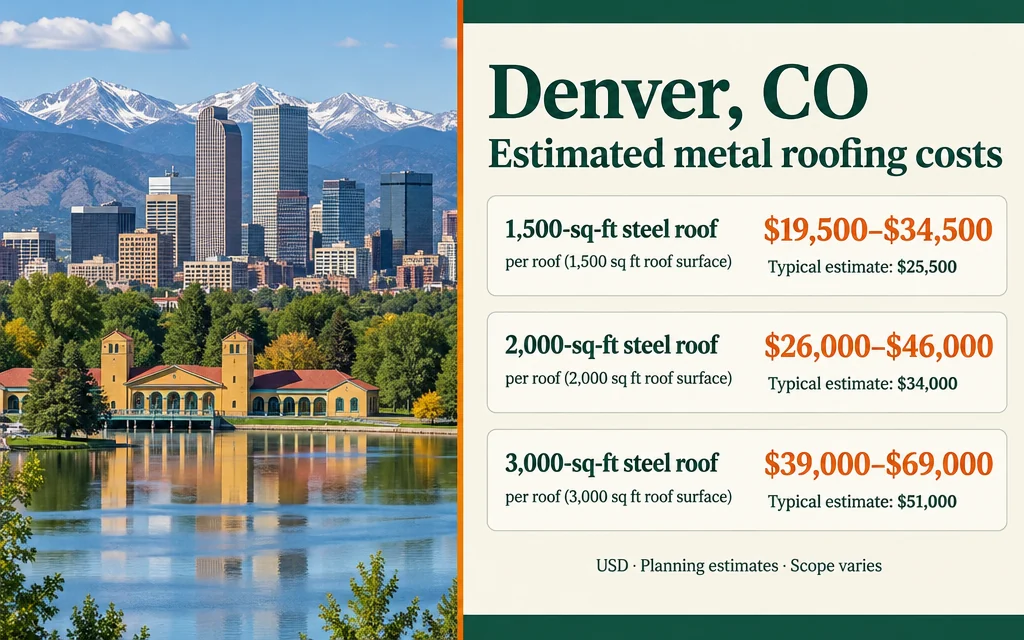
Calculated installed planning scenario for measured roof surface, including one-layer removal/disposal; conditional extras excluded.
Calculated installed planning scenario for measured roof surface, including one-layer removal/disposal; conditional extras excluded.
Calculated installed planning scenario for measured roof surface, including one-layer removal/disposal; conditional extras excluded.
Denver Metal Roofing Project Overview
A residential metal roof provides long-term protection against intense sun, sudden Front Range hailstorms, and winter freeze-thaw cycles. Unlike standard asphalt systems, standing-seam steel uses raised interlocking seams that conceal fasteners and shed snow efficiently.
For a home in Denver, planning estimates for complete metal roofing range from budget $8–$13.50 per sq ft of roof surface (installed) for utility exposed-fastener panels to $13–$23 per sq ft of roof surface (installed) for residential standing-seam steel. The baseline planning rate for concealed-fastener 24-gauge standing-seam steel centers around $17 per sq ft of roof surface (installed) over sound decking with single-layer tear-off included.
Roofing square footage differs substantially from interior living space. Eaves, overhangs, pitch factors, attached garages, and dormers mean an 1,800-square-foot Denver home often has 2,200 to 2,400 square feet of actual roof surface. Itemized proposals should clearly state the measured roof surface area rather than home floor plans.
Metal Roofing Systems Compared
Choosing a metal profile involves balancing upfront expenditure against maintenance expectations and architectural preferences. Profiles differ by fastening technique, gauge, and base metal.
Concealed-fastener standing-seam steel costs $13–$23 per sq ft of roof surface (installed). Clips and fasteners sit beneath interlocking vertical seams, accommodating thermal expansion and contraction during wide day-to-night temperature swings without straining fastener penetrations. Typical residential specifications use 24-gauge Galvalume steel finished with a PVDF fluoropolymer coating.
Exposed-fastener steel panels run $8–$13.50 per sq ft of roof surface (installed). These panels are screwed directly through the face of the metal with neoprene-gasketed screws. High-altitude ultraviolet radiation gradually degrades rubber washers over time, so exposed screws require regular inspection and washer replacement, making this profile better suited for detached garages, sheds, or agricultural structures.
Steel metal shingles cost $11–$18 per sq ft of roof surface (installed). These modular stamped panels resemble wood shake or slate while offering the structural durability of steel.
Standing-seam aluminum costs $16–$25 per sq ft of roof surface (installed). Aluminum is naturally corrosion-resistant, making it impervious to rust, though it is softer than steel and can dent more easily under severe hail.
Standing-seam copper occupies the highest architectural pricing tier at $28–$50 per sq ft of roof surface (installed). Copper develops a protective patina over time and is typically reserved for historic renovations or distinctive accent sections.
| Service / assumptions | Low | Typical estimate | High | Pricing unit | Estimated labor time |
|---|---|---|---|---|---|
| Standing Seam Steel (Concealed Fastener)Calculated standing-seam steel planning rate: comparable panel/accessory materials + installation labor + one-layer removal/disposal. Ordinary underlayment and details over sound decking included; conditional extra work excluded. | $13 | $17 | $23 | per sq ft of roof surface (installed) | N/A |
| Exposed Fastener Steel (Corrugated / R-Panel)26-gauge corrugated steel with visible gasketed screws; includes removal of one shingle layer. | $8 | $10.50 | $13.50 | per sq ft of roof surface (installed) | N/A |
| Steel Metal Shingles / TilesStone-coated or stamped steel modular shingles mimicking slate or shake; includes one-layer tear-off. | $11 | $14.50 | $18 | per sq ft of roof surface (installed) | N/A |
| Standing Seam Aluminum.032 or .040 architectural aluminum panels with concealed clips and one-layer tear-off. | $16 | $20 | $25 | per sq ft of roof surface (installed) | N/A |
| Standing Seam CopperSolid 16 oz or 20 oz architectural copper panels with hand-soldered or crimped flashings. Published rate reference for the stated roofing scope and unit, not verification of this guide's modeled range, a complete roof quote or provider availability. Regional reference; not a verified Denver-specific quote.Published price reference ↗ | $28 | $38 | $50 | per sq ft of roof surface (installed) | N/A |
Standing Seam Steel Cost Breakdown
Reviewing the component breakdown of a standing-seam estimate helps you verify whether competing contractors are quoting equivalent specifications. A complete residential standing-seam budget covers materials, specialized labor, and tear-off.
Materials run $5.50–$9 per sq ft of roof surface (materials only). This component covers factory-formed or site-rolled 24-gauge Galvalume panels, concealed floating clips, screws, high-temperature self-adhering underlayment, drip edge, valley flashing, ridge caps, and color-matched trim.
Installation labor accounts for $6.50–$11.50 per sq ft of roof surface (installation labor only). Forming standing seams, hand-fitting flashing around rakes and sidewalls, and aligning panels along eaves requires experienced sheet-metal mechanics.
Removal and disposal runs $1–$2.50 per sq ft of roof surface (one-layer removal and disposal) for a single layer of existing asphalt shingles. This covers stripping down to bare decking, hauling debris to an approved disposal facility, and conducting magnetic sweeps of the grounds.
| Service / assumptions | Low | Typical estimate | High | Pricing unit | Estimated labor time |
|---|---|---|---|---|---|
| Standing Seam Steel Materials AllowancePanels, concealed clips, screws, synthetic high-temp underlayment, and standard trim components. | $5.50 | $7.25 | $9 | per sq ft of roof surface (materials only) | N/A |
| Standing Seam Steel Labor AllowanceSkilled panel fastening, custom flashing fabrication, and seam locking on sound decking. | $6.50 | $8.25 | $11.50 | per sq ft of roof surface (installation labor only) | N/A |
| Single-Layer Removal & DisposalTear-off of one existing asphalt shingle layer and disposal fees at local transfer stations. | $1 | $1.50 | $2.50 | per sq ft of roof surface (one-layer removal and disposal) | N/A |
Denver Roof Size Scenarios
Roof area, pitch, and dormer configurations drive the total project commitment. A 1,500-square-foot roof surface on a compact Denver home runs budget $19,500–$34,500 per roof (1,500 sq ft roof surface), with a typical baseline around $25,500.
On-site installation time generally takes 3 to 5 business days.
For an average 2,000-square-foot roof surface, budget $26,000–$46,000 per roof (2,000 sq ft roof surface), with a typical midpoint of $34,000. On-site crew time runs 4 to 6 business days, depending on weather and roof complexity.
Larger homes or complex rooflines totaling 3,000 square feet of roof surface run budget $39,000–$69,000 per roof (3,000 sq ft roof surface), with typical planning costs of $51,000. Work typically spans 5 to 8 business days due to additional hips, valleys, and flashing junctions.
| Service / assumptions | Low | Typical estimate | High | Pricing unit | Estimated labor time |
|---|---|---|---|---|---|
| 1,500 Sq Ft Standing Seam Steel RoofCalculated scenario: 1,500 sq ft of measured roof surface × standing-seam steel installed planning rate. Includes its same materials, installation, one-layer removal/disposal and sound-deck assumptions. Not a provider whole-roof quote. | $19,500 | $25,500 | $34,500 | per roof (1,500 sq ft roof surface) | 3 to 5 business days |
| 2,000 Sq Ft Standing Seam Steel RoofCalculated scenario: 2,000 sq ft of measured roof surface × standing-seam steel installed planning rate. Includes its same materials, installation, one-layer removal/disposal and sound-deck assumptions. Not a provider whole-roof quote. | $26,000 | $34,000 | $46,000 | per roof (2,000 sq ft roof surface) | 4 to 6 business days |
| 3,000 Sq Ft Standing Seam Steel RoofCalculated scenario: 3,000 sq ft of measured roof surface × standing-seam steel installed planning rate. Includes its same materials, installation, one-layer removal/disposal and sound-deck assumptions. Not a provider whole-roof quote. | $39,000 | $51,000 | $69,000 | per roof (3,000 sq ft roof surface) | 5 to 8 business days |
Metal vs Architectural Asphalt Shingles
Architectural asphalt shingles in Denver run $4.50–$8.50 per sq ft of roof surface (installed), with a typical installed rate of $6.50. A standing-seam steel roof represents an initial outlay roughly two to three times greater.
Deciding between the two depends on how long you intend to stay in your home. Quality architectural shingles provide a reliable, budget-friendly surface, but Denver's intense UV radiation and hail cycles can degrade shingles more rapidly. Standing-seam steel eliminates recurrent shingle blow-offs and resists weathering far longer.
Over decades, a metal roof can avoid multiple tear-offs and replacements. However, if you plan to move within a few years, do not expect to recoup the full premium in resale value; buyers appreciate durable roofs, but appraisals rarely reflect a dollar-for-dollar premium.
| Service / assumptions | Low | Typical estimate | High | Pricing unit | Estimated labor time |
|---|---|---|---|---|---|
| Architectural Asphalt Shingles ReferenceClass 3/4 architectural shingle installation with equivalent single-layer removal and disposal. | $4.50 | $6.50 | $8.50 | per sq ft of roof surface (installed) | N/A |
| Comparison | Architectural asphalt | Standing-seam steel |
|---|---|---|
| Up-front planning estimate · 2,000 sq ft roof surface | $9,000–$17,000 | $26,000–$46,000 |
| What the baseline includes | Architectural asphalt, ordinary installed details, one-layer removal/disposal over sound decking. | Standing-seam steel, ordinary installed details, one-layer removal/disposal over sound decking. |
| Maintenance and repairs | Confirm product-specific inspections and repair terms. | Confirm seams, fasteners, coating, compatible repairs and inspection terms. |
| Insurance and ownership cost | Ask the insurer about the exact product and coverage. | Ask the insurer about accepted test documentation, any available credit and cosmetic-damage exclusions. |
These are calculated budgeting comparisons, not provider quotes or guaranteed lifetime savings. Compare your expected ownership period, specified products, actual maintenance proposals and written insurance terms.
| Decision point | Roof repair | Roof replacement | Metal roofing |
|---|---|---|---|
| Work being priced | A defined defect, such as damaged shingles or flashing. | Removal and installation of an agreed roof system across the measured roof surface. | A specified installed metal system; standing seam, exposed fasteners and metal shingles are different scopes. |
| What to inspect | The leak source, surrounding material and whether a durable localized fix is feasible. | The extent of deterioration, decking condition, roof details and suitable replacement systems. | The substrate, panel profile, coating, fasteners, roof geometry and installation details. |
| How to compare prices | Match the repair quantity, access, materials and included diagnosis. | Match measured roof area, material, tear-off layers, disposal and installed inclusions. | Match measured roof area, system, components, removal and conditional additional work. |
| Before deciding | Ask what the repair addresses and what existing problems would remain. | Ask whether repair remains practical and which additional items would change the total. | Ask about compatible materials, documented product/assembly ratings and product versus workmanship warranties. |
Age or a repair-cost percentage alone does not determine the right choice. Ask a qualified roofing contractor to assess the condition and explain viable options. A metal system is a material-specific installation choice, not a separate guarantee of durability or savings.
Common Project Add-Ons and Hidden Scope
Once an existing roof is stripped, several condition-specific requirements may arise that add to the baseline estimate.
If local building standards or structural calculations require stripping a second shingle layer, additional removal costs $40–$95 additional per roofing square (100 sq ft). Replacing rotted or water-damaged plywood sheathing uncovered during tear-off runs $75–$140 additional per 4-by-8-ft sheet (32 sq ft).
Flashing upgrades safeguard critical transitions. Custom chimney counter-flashing runs $400–$1,100 additional per chimney, and skylight flashing integration adds $350–$850 additional per skylight. Ridge ventilation upgrades run $14–$35 additional per linear ft.
Snow retention guards installed along eaves stop heavy snow packs from shedding suddenly onto entrances, decks, or gutters. A clamp-on bar or pad system runs $3–$8 additional per linear ft. If existing gutters must be taken down to secure drip edging and remounted afterward, plan for $4–$10 additional per linear ft.
| Service / assumptions | Low | Typical estimate | High | Pricing unit | Estimated labor time |
|---|---|---|---|---|---|
| Extra Layer RemovalLabor and disposal fee to strip a second or third existing roof layer down to decking. | $40 | $65 | $95 | additional per roofing square (100 sq ft) | N/A |
| Decking Repair / ReplacementInstallation of 1/2-inch CDX plywood or OSB sheathing with roof already stripped. | $75 | $100 | $140 | additional per 4-by-8-ft sheet (32 sq ft) | N/A |
| Custom Chimney FlashingCustom-bent color-matched step and counter flashing cut into masonry joints. | $400 | $650 | $1,100 | additional per chimney | N/A |
| Skylight Flashing IntegrationWaterproof curb flashing kit integrated into standing seam panel seams. | $350 | $550 | $850 | additional per skylight | N/A |
| Vented Ridge UpgradeContinuous baffle ridge ventilation compatible with metal panel profiles. | $14 | $22 | $35 | additional per linear ft | N/A |
| Snow Retention SystemColor-matched clamp-on snow fence or individual snow guards over pedestrian paths.Published price reference ↗ | $3 | $5.50 | $8 | additional per linear ft | N/A |
| Gutter Detach & ResetCarefully unclipping existing seamless gutters and re-hanging after drip edge installation. | $4 | $6.50 | $10 | additional per linear ft | N/A |
Hail, Wind, Fire, and Altitude Performance
Denver's elevation and Front Range climate subject roofing assemblies to demanding conditions. Many residential steel standing-seam panels hold a UL 2218 Class 4 impact rating.
This laboratory rating demonstrates that the metal resisted cracking or puncturing during steel-ball drop tests. It is not an absolute guarantee against cosmetic denting during severe hail events, though panels typically preserve water integrity even when dented.
Mechanically seamed or heavy-duty snap-lock panels installed to manufacturer fastening schedules offer high resistance to strong wind gusts off the foothills.
Steel is non-combustible and can achieve a Class A fire rating when installed over an approved assembly and compatible underlayment. In addition, factory-applied PVDF finishes reflect solar radiation, helping mitigate attic heat gain on sunny summer days.
Cost Factors for Denver Roofing Projects
Several physical and logistical details determine whether an estimate falls toward the lower or higher end of the range. Steep roof pitches require safety harness staging and slow panel handling, increasing on-site labor hours relative to walkable slopes.
Roof complexity is another key factor. Multiple dormers, hips, valleys, and plumbing stacks demand custom cuts, hemmed edges, and precision flashing rather than continuous panel runs. Direct site access also matters: narrow city driveways with limited staging room for panel trailers or roll-off dumpsters can add handling time.
To avoid permitting surprises, ask your contractor to confirm specific permit requirements, plan review fees, and inspection milestones directly with Denver Community Planning and Development for your address before work begins.
Hiring a Metal Roofing Contractor in Denver
Standing-seam installation requires specialized sheet-metal skills that differ significantly from asphalt shingle roofing. Panels must expand and contract smoothly within their clips, and transitions at valleys and rakes must be folded watertight without relying on exposed screws or heavy caulking.
Confirm that your contractor holds an active roofing contractor license and check that all registrations are valid for Denver work. Request certificates of general liability insurance and workers' compensation coverage for all on-site crew members before work commences.
Insist on a detailed proposal that specifies the panel steel gauge (typically 24-gauge for residential standing seam), paint finish warranty, underlayment type, and per-sheet decking replacement rates. Also verify what workmanship warranty the roofer offers alongside the manufacturer's finish coverage.
Local income & housing costs
Denver city, Colorado · U.S. Census Bureau, 2025 ACS 1-year estimates.
per month · ±$44
Cash-rent units; includes applicable tenant-paid utilities
Census source ↗Dollar amounts use the survey period’s published basis. Income is annual; gross rent is monthly. Home value reflects owner-occupied housing values. Margins of error shown are at the ACS 90% confidence level. These statistics provide city context; service budgets use their own pricing evidence.
STATEWIDE COST CONTEXT
Colorado prices, income & labor costs
These Colorado figures provide background for this city guide. They describe different measures and reference years; employee wages are not prices charged by a contractor.
BEA SAIRPD
State price change indicator
127.42024 · index (2017 basis)
Annual figures & sources
| Year | Value | 90% margin of error | Source |
|---|---|---|---|
| 2020 | 108.6 | — | Official source |
| 2021 | 112.0 | — | Official source |
| 2022 | 118.7 | — | Official source |
| 2023 | 122.7 | — | Official source |
| 2024 | 127.4 | — | Official source |
Census ACS 1-year
Median household income
$99,7292025 · USD/year
Annual figures & sources
| Year | Value | 90% margin of error | Source |
|---|---|---|---|
| 2021 | $82,254 | ±$791 | Official source |
| 2022 | $89,302 | ±$1,281 | Official source |
| 2023 | $92,911 | ±$1,057 | Official source |
| 2024 | $97,113 | ±$1,081 | Official source |
| 2025 | $99,729 | ±$1,273 | Official source |
BLS OEWS
Roofers
$24.882025 · USD/hour
Annual figures & sources
| Year | Value | 90% margin of error | Source |
|---|---|---|---|
| 2025 | $24.88 | — | Official source |
State prices: BEA, 2020–2024. Household income: Census ACS, 2021–2025. Employee wages: BLS, May 2025 snapshot. The charts retain their own units and fitted scales.
Explore all Colorado living-cost data and trends →Local context and limitations
Denver sits at an elevation of roughly 5,280 feet, exposing roof assemblies to intense ultraviolet radiation and sharp freeze-thaw cycles. Published public quotes for complete residential standing-seam and exposed-fastener steel systems in Denver are limited, so rates in this guide reflect modeled planning baselines that combine panel materials, installation labor, and single-layer shingle removal. Before signing a contract, verify permit filing responsibilities, mid-installation underlayment inspections, and licensing status directly with the City and County of Denver Community Planning and Development for your specific property.
Frequently asked questions
What is the difference between standing seam and exposed-fastener metal?
Standing seam uses raised vertical seams with hidden clips secured beneath the metal, shielding fasteners from weather exposure. Exposed-fastener panels are screwed directly through the panel surface with rubber-washer screws that face constant sun and temperature shifts.
How do contractors measure a roof for metal panels?
Roofers calculate the actual surface area of the roof deck in squares (100 square feet each), factoring in pitch, overhangs, valleys, and dormers, rather than using the home's interior living area.
Are snow guards necessary on a Denver metal roof?
Snow guards or snow rails are recommended above walkways, doorways, and garage approaches. Metal panels shed accumulated snow quickly during daytime thaws, and retention systems keep snow from sliding off in large, sudden sheets.
Can a standing-seam metal roof be installed over old shingles?
Whether an overlay is permitted depends on building code requirements and structural load limits for your specific address. However, contractors generally recommend tearing off existing shingles down to the deck so they can inspect the wood for rot, replace damaged boards, and lay high-temperature underlayment flat against sound sheathing.
Does a Class 4 metal roof guarantee an insurance discount?
No. While some insurance carriers offer discounts for impact-resistant Class 4 roofs, policy terms vary. Some insurers require cosmetic damage waivers that exclude coverage for dents that do not cause active leaks.
What is the difference between Galvalume and aluminum roofing?
Galvalume is a steel core coated with a zinc-aluminum alloy for strength and corrosion defense. Aluminum panels are solid aluminum, which will not rust, but the material is softer and generally carries a higher price tag than steel.
Sources and methodology
Sources below retain their recorded retrieval dates and geographic scope. We checked the quoted rates against readable public pricing pages. The tables remain planning estimates, not provider quotes or a measured citywide survey. Per-square-foot references do not establish the modeled whole-roof totals or all their installed inclusions. Regional references are not verified Denver-specific quotes. Confirm removal, disposal, materials, labor and the complete scope in a written proposal.
Published pricing pages retrieved; quoted excerpts checked automatically. 2 distinct website domains. · Generated 2026-11-12
- Metal Roofing | Colorado Roof GuysCity-specific page context · Page retrieved 2026-11-12 · Price excerpt matched automatically
“Snow retention systems cost $3-$8 per linear foot installed”
Planning ranges may differ from these published examples; they are not provider quotes.
 Provider badge
- 10 Best Roofing Companies Aurora, IL (2026 Updated)State / regional reference · Page retrieved 2026-11-12 · Price excerpt matched automatically
“Architectural shingles run $4.50 to $8.25 per square foot installed; standing seam metal $10 to $17; slate or copper above $20.”
Planning ranges may differ from these published examples; they are not provider quotes.
Plan your metal roofing project
Choose your service and answer its project questions. Add notes or photos if helpful, then generate your project brief. The planner labels its budgeting assumptions separately. Use your plan to compare the scope and assumptions with a provider. Contact sharing and provider matching are not available yet.
Open the project planner →Share this city’s cost data
<> Embed Denver Cost Data on Your Site
The HTML table shows the prices at the time of copying. The iframe follows the published guide.