Austin · TX · COST GUIDE
Metal Roofing Costs in Austin, TX (2026)
For budgeting, standing-seam steel roofing is estimated at $11–$20.50 per sq ft of roof surface, and exposed-fastener steel at $5.50–$9.50 per sq ft. These installed planning ranges include one-layer removal/disposal over sound decking; compare the specified system and conditional extras.
Standing Seam Steel Roof (Installed)
Budget estimate$11–$20.50per sq ft of roof surface (installed)
Planning range · Compare the roof area, material and included work in your quote.
Exposed Fastener Steel Roof (Installed)
Budget estimate$5.50–$9.50per sq ft of roof surface (installed)
Planning range · Compare the roof area, material and included work in your quote.
Published examples apply to their stated scope. Budget ranges are estimates.
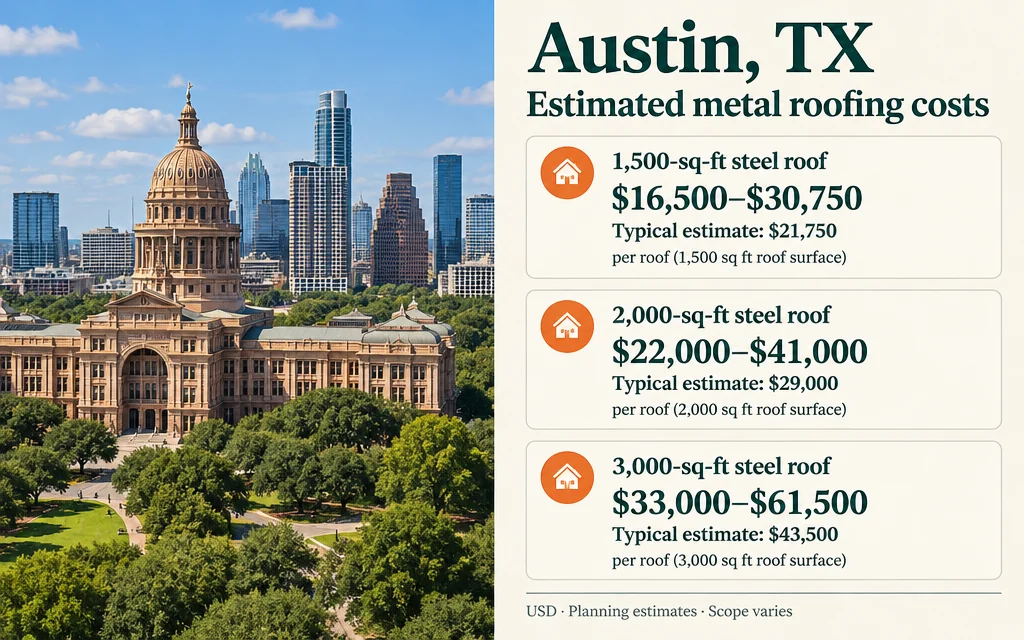
Calculated installed planning scenario for measured roof surface, including one-layer removal/disposal; conditional extras excluded.
Calculated installed planning scenario for measured roof surface, including one-layer removal/disposal; conditional extras excluded.
Calculated installed planning scenario for measured roof surface, including one-layer removal/disposal; conditional extras excluded.
Residential Metal Roofing in Austin
Installing a metal roof in Austin is an architectural upgrade designed to endure Central Texas weather. While standard asphalt shingles remain common in entry subdivisions, metal roofs—particularly concealed-fastener standing seam systems—are frequently chosen for custom builds, central Austin renovations, and Hill Country properties.
When evaluating project estimates, note that roofing is estimated by measured roof deck surface area rather than interior living space.
Because of pitch and overhangs, roof surface area is always larger than the home's footprint. For residential standing seam steel replacements across Austin, planning estimates budget $11–$20.50 per sq ft of roof surface (installed). That planning range assumes removing and disposing of a single layer of existing asphalt shingles, inspecting the underlying wood deck, installing high-temperature underlayment, and securing panels with concealed clips.
Metal roofs are not a single uniform product. Performance, maintenance schedules, and upfront pricing shift based on whether you choose standing seam steel, exposed-fastener panels, stamped metal shingles, aluminum, or copper.
Metal Roofing Systems Compared
Residential metal roof designs fall into several distinct profiles and material categories:
Standing Seam Concealed-Fastener Steel: The benchmark residential profile. Panels run from ridge to eave and connect using raised seams that snap together or are mechanically crimped over hidden clips. Because fasteners remain protected beneath the metal, panels expand and contract freely during hot afternoons without stressing screw penetrations. Profiles budget $11–$20.50 per sq ft of roof surface (installed).
Exposed-Fastener Steel (Corrugated or R-Panel): Overlapping steel sheets fastened directly through the panel face using neoprene or EPDM washer screws. While economical at $5.50–$9.50 per sq ft of roof surface (installed), exposed fasteners are prone to washer weathering and screw-hole movement over time under high solar exposure. They are most commonly installed on porches, detached carports, and utility outbuildings.
Steel Metal Shingles: Stamped, interlocking steel tiles or shingles designed to emulate shake, slate, or traditional clay profiles, often with a stone-granule coating. They offer an alternative where neighborhood architectural guidelines discourage vertical standing seams, budgeting $11–$17 per sq ft of roof surface (installed).
Standing Seam Aluminum: Highly corrosion-resistant and lighter than steel. In Central Texas, aluminum standing seam budgets $14–$24 per sq ft of roof surface (installed) and is typically chosen near coastal air, around swimming pools, or where structural weight is constrained.
Standing Seam Copper: Architectural sheet metal running $25–$48 per sq ft of roof surface (installed). Copper naturally oxidizes over years to a bronze and eventually green patina. It requires specialized craft skills, hand-formed soldered joints, and compatible fasteners to avoid galvanic reactions.
| Service / assumptions | Low | Typical estimate | High | Pricing unit | Estimated labor time |
|---|---|---|---|---|---|
| Standing Seam Steel Roof (Installed)Calculated standing-seam steel planning rate: comparable panel/accessory materials + installation labor + one-layer removal/disposal. Ordinary underlayment and details over sound decking included; conditional extra work excluded. | $11 | $14.50 | $20.50 | per sq ft of roof surface (installed) | 3 to 6 working days |
| Exposed Fastener Steel Roof (Installed)Corrugated or R-panel steel screwed through face with rubber washers; suitable for patios, outbuildings, or simple residential layouts. | $5.50 | $7.50 | $9.50 | per sq ft of roof surface (installed) | 2 to 4 working days |
| Steel Metal Shingles (Installed)Stamped stone-coated or painted steel interlocking tiles emulating wood shake or architectural slate. | $11 | $14 | $17 | per sq ft of roof surface (installed) | 4 to 7 working days |
| Standing Seam Aluminum Roof (Installed)Rust-proof 0.032 or 0.040 aluminum standing seam panels; best for coastal air, pool proximity, or low-weight structures. | $14 | $18 | $24 | per sq ft of roof surface (installed) | 3 to 6 working days |
| Standing Seam Copper Roof (Installed)16 oz or 20 oz architectural standing seam copper with soldered valleys, transitions, and copper fasteners. | $25 | $35 | $48 | per sq ft of roof surface (installed) | 7 to 14 working days |
Standing Seam Steel Cost Components
A complete contractor quote for standing seam steel combines material supply, installation labor, and tear-off. For planning purposes, the overall rate of $11–$20.50 per sq ft of roof surface breaks into three main allowances:
1. Materials and Trim Allowance ($2.50–$4.50 per sq ft of roof surface): Covers factory-formed or site-rolled steel panels, concealed clips, screws, high-temperature synthetic underlayment, ridge caps, valley metal, drip edges, and sealants. Premium coatings and heavier panel stock sit at the higher end of this allowance.
2. Installation Labor Allowance ($7.50–$13.50 per sq ft of roof surface): Metal roofing requires skilled sheet-metal work rather than standard shingle nailing. This includes decking layout, square alignment, custom valley flashing, panel engagement, and hand-detailing around rakes and eaves. Complex rooflines and steep pitches increase required crew hours.
3. One-Layer Tear-Off and Disposal ($1–$2.50 per sq ft of roof surface): Stripping one layer of old shingles down to the bare wooden deck, hauling waste, paying landfill fees, and sweeping the perimeter with magnetic rollers.
| Service / assumptions | Low | Typical estimate | High | Pricing unit | Estimated labor time |
|---|---|---|---|---|---|
| Standing Seam Steel Materials AllowanceCovers 24g Kynar Galvalume panels, concealed clips, fasteners, high-temp underlayment, and perimeter trims. | $2.50 | $3.50 | $4.50 | per sq ft of roof surface (materials only) | N/A |
| Standing Seam Steel Installation LaborSpecialized sheet-metal crew layout, panel forming, clip fastening, seam locking, and trim fabrication. | $7.50 | $9.50 | $13.50 | per sq ft of roof surface (installation labor only) | N/A |
| One-Layer Tear-Off and DisposalDismantling single layer of asphalt shingles, debris haul-off, dumpster fees, and magnetic yard cleanup. | $1 | $1.50 | $2.50 | per sq ft of roof surface (one-layer removal and disposal) | N/A |
Installed Budgets by Roof Size
Roof area exceeds home floor plan area due to roof slope, gables, and eaves. Planning estimates for standing seam steel on typical measured roof surfaces include:
1,500 Sq Ft Roof Surface: Calculated planning budget is $16,500–$30,750 per roof. Work on this surface area typically requires 3 to 5 working days of on-site crew time under clear weather.
2,000 Sq Ft Roof Surface: Calculated planning budget is $22,000–$41,000 per roof. On-site installation typically spans 4 to 6 working days.
3,000 Sq Ft Roof Surface: Calculated planning budget is $33,000–$61,500 per roof, representing larger footprint or multi-gable designs. Typical installation runs 5 to 8 working days.
These scenarios apply the standing seam steel installed rate across measured roof deck dimensions, assuming one-layer removal and sound decking. Flashing additions or deck repairs are priced separately.
| Service / assumptions | Low | Typical estimate | High | Pricing unit | Estimated labor time |
|---|---|---|---|---|---|
| 1,500 Sq Ft Standing Seam Steel RoofCalculated scenario: 1,500 sq ft of measured roof surface × standing-seam steel installed planning rate. Includes its same materials, installation, one-layer removal/disposal and sound-deck assumptions. Not a provider whole-roof quote. | $16,500 | $21,750 | $30,750 | per roof (1,500 sq ft roof surface) | 3 to 5 working days |
| 2,000 Sq Ft Standing Seam Steel RoofCalculated scenario: 2,000 sq ft of measured roof surface × standing-seam steel installed planning rate. Includes its same materials, installation, one-layer removal/disposal and sound-deck assumptions. Not a provider whole-roof quote. | $22,000 | $29,000 | $41,000 | per roof (2,000 sq ft roof surface) | 4 to 6 working days |
| 3,000 Sq Ft Standing Seam Steel RoofCalculated scenario: 3,000 sq ft of measured roof surface × standing-seam steel installed planning rate. Includes its same materials, installation, one-layer removal/disposal and sound-deck assumptions. Not a provider whole-roof quote. | $33,000 | $43,500 | $61,500 | per roof (3,000 sq ft roof surface) | 5 to 8 working days |
Standing Seam Metal vs. Architectural Asphalt
Upfront cost is the primary comparison point between standing seam steel and architectural asphalt shingles. For reference, architectural asphalt shingles budget $4.50–$6.50 per sq ft of roof surface (installed), including single-layer tear-off over sound decking.
By contrast, standing seam steel budgets $11–$20.50 per sq ft.
Asphalt shingles represent a lower initial capital outlay, but Central Texas summer heat, thermal cycling, and ultraviolet radiation gradually degrade organic asphalt binders and protective granules over time. A standing seam steel roof with a factory-applied fluoropolymer finish offers substantially greater resistance to UV fading and wind uplift.
For homeowners intending to hold a property for decades, the initial premium of a metal roof can be weighed against avoiding the re-roofing cycles, storm patch repairs, and periodic landfill fees associated with repeated asphalt replacements.
| Service / assumptions | Low | Typical estimate | High | Pricing unit | Estimated labor time |
|---|---|---|---|---|---|
| Architectural Asphalt Shingles ReferenceInstalled benchmark for architectural asphalt shingles with one-layer tear-off over sound decking. Published rate reference for the stated roofing scope and unit, not verification of this guide's modeled range, a complete roof quote or provider availability. Regional reference; not a verified Austin-specific quote.Published price reference ↗ | $4.50 | $5.50 | $6.50 | per sq ft of roof surface (installed) | 1 to 2 working days |
| Comparison | Architectural asphalt | Standing-seam steel |
|---|---|---|
| Up-front planning estimate · 2,000 sq ft roof surface | $9,000–$13,000 | $22,000–$41,000 |
| What the baseline includes | Architectural asphalt, ordinary installed details, one-layer removal/disposal over sound decking. | Standing-seam steel, ordinary installed details, one-layer removal/disposal over sound decking. |
| Maintenance and repairs | Confirm product-specific inspections and repair terms. | Confirm seams, fasteners, coating, compatible repairs and inspection terms. |
| Insurance and ownership cost | Ask the insurer about the exact product and coverage. | Ask the insurer about accepted test documentation, any available credit and cosmetic-damage exclusions. |
These are calculated budgeting comparisons, not provider quotes or guaranteed lifetime savings. Compare your expected ownership period, specified products, actual maintenance proposals and written insurance terms.
| Decision point | Roof repair | Roof replacement | Metal roofing |
|---|---|---|---|
| Work being priced | A defined defect, such as damaged shingles or flashing. | Removal and installation of an agreed roof system across the measured roof surface. | A specified installed metal system; standing seam, exposed fasteners and metal shingles are different scopes. |
| What to inspect | The leak source, surrounding material and whether a durable localized fix is feasible. | The extent of deterioration, decking condition, roof details and suitable replacement systems. | The substrate, panel profile, coating, fasteners, roof geometry and installation details. |
| How to compare prices | Match the repair quantity, access, materials and included diagnosis. | Match measured roof area, material, tear-off layers, disposal and installed inclusions. | Match measured roof area, system, components, removal and conditional additional work. |
| Before deciding | Ask what the repair addresses and what existing problems would remain. | Ask whether repair remains practical and which additional items would change the total. | Ask about compatible materials, documented product/assembly ratings and product versus workmanship warranties. |
Age or a repair-cost percentage alone does not determine the right choice. Ask a qualified roofing contractor to assess the condition and explain viable options. A metal system is a material-specific installation choice, not a separate guarantee of durability or savings.
Additional Work and Condition Scenarios
Baseline estimates assume sound roof decking and standard architectural geometry. During tear-off, roofers often discover conditions requiring separate line-item allowances:
Additional Layer Tear-Off: If earlier reroofing added shingles over an older roof, stripping each extra layer adds $100–$200 per roofing square (100 sq ft) for labor and disposal fees.
Decking Replacement: Standing seam panels must lay across a smooth, structurally sound deck to prevent visible telegraphing or clip pull-out. Replacing rotted or water-damaged plywood or OSB budgets $75–$105 per 4-by-8-ft sheet.
Penetration Flashings: Chimneys and skylights require custom fabrication rather than standard rubber boots. Chimney flashing renewal budgets $350–$850 per chimney, while skylight flashing renewal budgets $250–$600 per skylight.
Ventilation and Gutters: Upgrading static vents to continuous ridge ventilation budgets $12–$20 per linear ft. If existing seamless gutters must be detached and reset to install new perimeter drip edges, budget $4–$11 per linear ft.
| Service / assumptions | Low | Typical estimate | High | Pricing unit | Estimated labor time |
|---|---|---|---|---|---|
| Additional Layer Tear-OffExtra cost when stripping a second or third shingle layer before decking inspection. | $100 | $150 | $200 | additional per roofing square (100 sq ft) | N/A |
| Decking Replacement (4x8 Sheet)Replaces rotted or delaminated 1/2-inch or 5/8-inch CDX plywood or OSB deck with the roof exposed. | $75 | $85 | $105 | additional per 4-by-8-ft sheet (32 sq ft) | N/A |
| Chimney Flashing RenewalCustom soldered or backer-flashed sheet-metal cricket and counterflashing tailored for standing seam. | $350 | $550 | $850 | additional per chimney | N/A |
| Skylight Flashing RenewalCustom fabricated metal curb flashing kit integrated into adjoining standing seam ribs. | $250 | $400 | $600 | additional per skylight | N/A |
| Continuous Ridge Ventilation UpgradePerforated metal baffle and cap assembly installed along the roof ridge for exhaust airflow. | $12 | $15 | $20 | additional per linear ft | N/A |
| Snow Retention SystemBar-style or clamp-on seam guards for winter freeze protection over entryways or delicate landscaping. | $15 | $25 | $40 | additional per linear ft | N/A |
| Gutter Detach and ResetCarefully removing existing seamless gutters to allow new drip edge install, then re-hanging and sealing. | $4 | $7 | $11 | additional per linear ft | N/A |
Performance Ratings and Insurance Reality
Metal roofing carries rigorous laboratory test ratings, but homeowners should understand what those ratings cover:
Impact Resistance (UL 2218): Most 24-gauge standing seam panels achieve a Class 4 impact rating under UL 2218 steel-ball drop tests. This indicates that the metal resists splitting or structural fracture. It does not mean the roof cannot be dented; large hail may leave surface dimples without compromising water tightness.
Insurance Policies and Cosmetic Waivers: While some insurance carriers provide policy credits for Class 4 roofing, savings vary by carrier, policy tier, and territory. Inquire directly with your insurance agent about available discounts before purchasing. Also verify whether your policy includes a cosmetic damage exclusion, which denies payout if hail causes visual dents without piercing the metal or opening the seams.
Wind Uplift and Fire Performance: Concealed-clip standing seam assemblies frequently achieve high wind-uplift test ratings when installed with proper clip spacing. When installed over solid non-combustible underlayment and decking, metal roof assemblies achieve a Class A fire rating, an important consideration in brush-prone Hill Country terrain.
Key Project Cost Drivers
Quotes from local contractors for similar home footprints can vary based on several key project factors:
Panel Gauge: Steel panel thickness is measured by gauge; smaller numbers indicate thicker steel. While 26-gauge is common for budget installations, heavier 24-gauge steel is widely specified for residential standing seam. Thicker panels improve rigidity, resist hail impact, and help reduce optical waviness (oil-canning).
Protective Paint Finish: Residential steel panels commonly feature PVDF coatings (such as Kynar 500 or Hylar 5000), which resist chalking and color fading caused by intense ultraviolet light better than standard SMP coatings.
Roofline Geometry and Pitch: Low-pitch roofs allow straightforward foot access and efficient staging. As pitch steepens or rooflines introduce multiple valleys, dormers, and hips, crews require specialized harness rigging, which increases labor time.
Flashing and Trim Fabrication: Hemmed drip edge locks, two-piece counterflashings, and custom valley details require meticulous on-site sheet-metal braking, driving the labor portion of the bid.
Hiring a Metal Roofing Contractor in Austin
Standing seam installation requires sheet-metal trade expertise rather than general shingle nailing. When evaluating contractors in Austin, keep these steps in mind:
Verify Insurance and Registration: Confirm the company carries active commercial general liability insurance and workers' compensation coverage for roofing crews. Inquire about city registration and verify which party is responsible for pulling the building permit for your specific address.
Manufacturer Certification: Check whether the installer is certified by recognized roll-forming manufacturers. Certified contractors have completed profile-specific training and can often provide extended manufacturer weathertightness warranties.
Check Decking Allowances in Advance: Ensure the quote includes an explicit per-sheet price for rotted decking replacement (such as $75–$105 per 4-by-8-ft sheet) so rotted wood discoveries during tear-off do not generate unexpected charges.
Separate Workmanship from Finish Warranties: A 30- to 40-year coil finish warranty covers only paint fading and chalking from the manufacturer. It does not cover installation errors, flashing leaks, or clip spacing issues. Always ask for a written workmanship warranty from the installing contractor.
Local income & housing costs
Austin city, Texas · U.S. Census Bureau, 2025 ACS 1-year estimates.
per month · ±$27
Cash-rent units; includes applicable tenant-paid utilities
Census source ↗Dollar amounts use the survey period’s published basis. Income is annual; gross rent is monthly. Home value reflects owner-occupied housing values. Margins of error shown are at the ACS 90% confidence level. These statistics provide city context; service budgets use their own pricing evidence.
STATEWIDE COST CONTEXT
Texas prices, income & labor costs
These Texas figures provide background for this city guide. They describe different measures and reference years; employee wages are not prices charged by a contractor.
BEA SAIRPD
State price change indicator
120.02024 · index (2017 basis)
Annual figures & sources
| Year | Value | 90% margin of error | Source |
|---|---|---|---|
| 2020 | 103.4 | — | Official source |
| 2021 | 107.2 | — | Official source |
| 2022 | 113.1 | — | Official source |
| 2023 | 117.1 | — | Official source |
| 2024 | 120.0 | — | Official source |
Census ACS 1-year
Median household income
$82,6252025 · USD/year
Annual figures & sources
| Year | Value | 90% margin of error | Source |
|---|---|---|---|
| 2021 | $66,963 | ±$513 | Official source |
| 2022 | $72,284 | ±$443 | Official source |
| 2023 | $75,780 | ±$472 | Official source |
| 2024 | $79,721 | ±$564 | Official source |
| 2025 | $82,625 | ±$670 | Official source |
BLS OEWS
Roofers
$22.132025 · USD/hour
Annual figures & sources
| Year | Value | 90% margin of error | Source |
|---|---|---|---|
| 2025 | $22.13 | — | Official source |
State prices: BEA, 2020–2024. Household income: Census ACS, 2021–2025. Employee wages: BLS, May 2025 snapshot. The charts retain their own units and fitted scales.
Explore all Texas living-cost data and trends →Local context and limitations
Austin homes face prolonged summer heat, high ultraviolet exposure, and periodic severe hail. Under these conditions, the performance of a metal roof depends heavily on the paint finish (such as PVDF resin systems) and panel profile. Central Texas decking typically consists of OSB or plywood, which must be inspected after tear-off before placing high-temperature underlayment.
Frequently asked questions
What is the difference between standing seam and exposed-fastener metal roofs?
Standing seam uses concealed clips and interlocking ribs that keep fasteners hidden beneath the metal, allowing panels to expand and contract smoothly in high heat. Exposed-fastener roofs use screws driven directly through the panel surface with rubber washers. Over time under intense sun, those rubber washers can dry out and require inspection or fastener replacement.
How do I calculate the actual square footage of my roof?
Roof surface area is always larger than a home's interior floor plan because of overhangs, eaves, and slope geometry. A steeper pitch or complex roofline with dormers and hips creates significantly more surface area than a flat or low-pitch design. A professional contractor calculates the exact surface using pitch multipliers or aerial measurements.
Can a new metal roof be installed over my old asphalt shingles?
Professional standards for standing seam steel strongly favor tearing off existing shingles down to bare wood deck. A complete tear-off lets roofers inspect the decking for hidden moisture damage and ensures a flat surface for clip attachment. Check local building code requirements and your installer's specifications for your specific property.
Will a standing seam metal roof lower my homeowners insurance in Texas?
Some Texas homeowners insurance carriers offer premium discounts for installing a documented UL 2218 Class 4 impact-resistant roof. Check with your insurance provider to verify eligibility, required documentation, and whether a cosmetic damage exclusion endorsement applies to the policy.
Should I choose 24-gauge or 26-gauge steel for my Austin home?
For residential standing seam, 24-gauge steel is widely preferred over lighter 26-gauge. Thicker 24-gauge panels offer greater structural rigidity, help minimize visible surface waviness (oil-canning), and provide improved resistance to hail impacts.
Are metal roofs noisy during heavy Central Texas rainstorms?
No. When installed on a residential home over solid wood decking, underlayment, and a vented or insulated attic, a metal roof produces sound levels comparable to standard asphalt shingles. The noisy reputation comes from open-rafter metal roofs on uninsulated barns and commercial sheds.
Sources and methodology
Sources below retain their recorded retrieval dates and geographic scope. We checked the quoted rates against readable public pricing pages. The tables remain planning estimates, not provider quotes or a measured citywide survey. Per-square-foot references do not establish the modeled whole-roof totals or all their installed inclusions. Regional references are not verified Austin-specific quotes. Confirm removal, disposal, materials, labor and the complete scope in a written proposal.
Published pricing pages retrieved; quoted excerpts checked automatically. 3 distinct website domains. · Generated 2026-11-12
- Cost of Metal Roof vs Shingles in Texas: A Practical Comparison GuideState / regional reference · Page retrieved 2026-11-12 · Price excerpt matched automatically
“Standing seam metal roofs usually cost $10–$16 per square foot installed, putting the same 2,000 sq ft roof between $20,000–$36,000 in this region.”
Planning ranges may differ from these published examples; they are not provider quotes.
- Roof Replacement Cost California | 2026 Pricing GuideState / regional reference · Page retrieved 2026-11-12 · Price excerpt matched automatically
“Clay or Concrete Tile A California signature material, at $12.00 to $24.00 per sq ft for full replacement.”
Planning ranges may differ from these published examples; they are not provider quotes.
- Metal Roof Installation Cost McAllen TX: 2026 Pricing (RGV)State / regional reference · Page retrieved 2026-11-12 · Price excerpt matched automatically
“How metal compares to architectural shingles in McAllen Architectural shingles (GAF Timberline HDZ, Owens Corning Duration, CertainTeed Landmark) install at $4.50-6.50/sqft in McAllen.”
Planning ranges may differ from these published examples; they are not provider quotes.
Plan your metal roofing project
Choose your service and answer its project questions. Add notes or photos if helpful, then generate your project brief. The planner labels its budgeting assumptions separately. Use your plan to compare the scope and assumptions with a provider. Contact sharing and provider matching are not available yet.
Open the project planner →Share this city’s cost data
<> Embed Austin Cost Data on Your Site
The HTML table shows the prices at the time of copying. The iframe follows the published guide.