San Antonio · TX · COST GUIDE
Metal Roofing Costs in San Antonio, TX (2026)
For budgeting, standing-seam steel roofing is estimated at $9–$17 per sq ft of roof surface, and exposed-fastener steel at $5.50–$10.50 per sq ft. These installed planning ranges include one-layer removal/disposal over sound decking; compare the specified system and conditional extras.
Standing Seam Steel (Installed)
Budget estimate$9–$17per sq ft of roof surface (installed)
Planning range · Compare the roof area, material and included work in your quote.
Exposed-Fastener Steel (Installed)
Budget estimate$5.50–$10.50per sq ft of roof surface (installed)
Planning range · Compare the roof area, material and included work in your quote.
Published examples apply to their stated scope. Budget ranges are estimates.
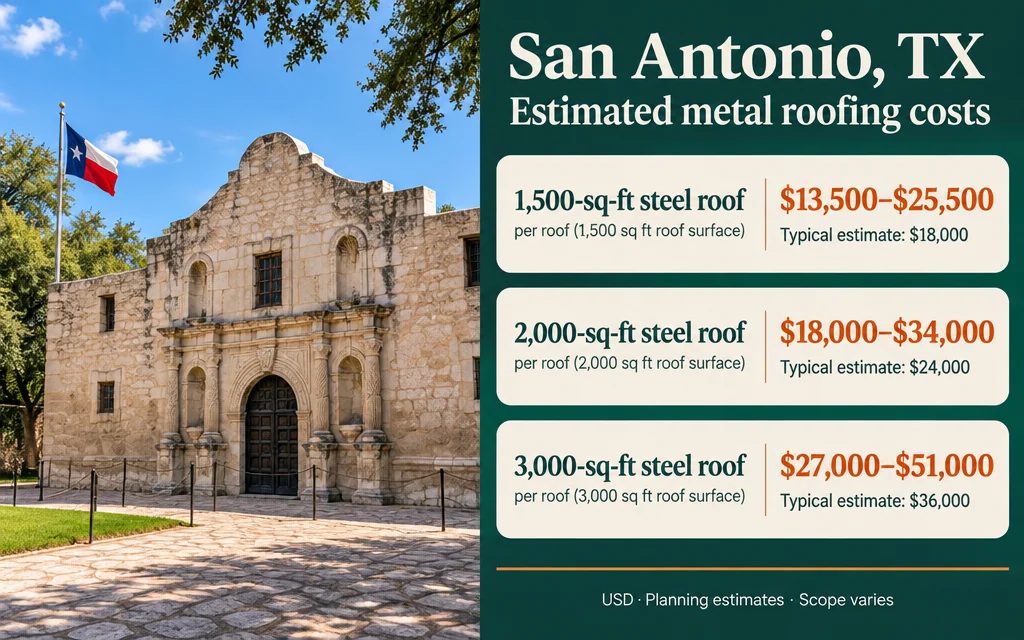
Calculated installed planning scenario for measured roof surface, including one-layer removal/disposal; conditional extras excluded.
Calculated installed planning scenario for measured roof surface, including one-layer removal/disposal; conditional extras excluded.
Calculated installed planning scenario for measured roof surface, including one-layer removal/disposal; conditional extras excluded.
Metal Roofing Pricing in San Antonio
For a standing seam steel profile, San Antonio homeowners planning a replacement should budget $9–$17, with a typical project landing near $12. This baseline figure reflects turnkey pricing: Galvalume steel panels, standard edge trim, clips, high-temperature underlayment, and the tear-off and haul-away of a single existing asphalt shingle layer over sound wood decking.
Roofing estimates are calculated on actual roof surface area rather than your home's interior living footprint. Roof slope, wide eaves, and dormers expand the exterior envelope, meaning a 2,000-square-foot living layout frequently measures 2,200 to 2,600 square feet of sloped roof plane. Roofing contractors express this in squares, where one roofing square equals 100 square feet. Always confirm whether an estimate's square-footage figure reflects ground footprint or true sloped deck measurements.
Comparing Residential Metal Roofing Systems
Different metal roofing systems bring distinct profiles, fastening methods, and installation labor requirements. Matching the profile to your home's structure and architecture helps balance performance with budget.
Concealed-fastener standing seam steel, budgeted at $9–$17, serves as the primary benchmark for residential installations. Panels interlock over concealed clips fastened directly to the deck, allowing the steel to expand and contract smoothly in hot weather without stressing fastener holes. Exposed-fastener steel panels run lower, budget $5.50–$10.50. While more accessible upfront, the thousands of exposed screws with neoprene washers require periodic monitoring, as solar exposure and temperature swings will eventually degrade rubber gaskets.
Stamped metal shingles and stone-coated steel tiles cost $9.50–$16, simulating the profile of slate or tile while retaining the strength of steel. In architectural applications where rust immunity is critical, standing seam aluminum ranges $11–$18.50. For historic structures or decorative accents, premium standing seam copper costs $18–$34, reflecting specialized hand fabrication and soldering.
| Service / assumptions | Low | Typical estimate | High | Pricing unit | Estimated labor time |
|---|---|---|---|---|---|
| Standing Seam Steel (Installed)Calculated standing-seam steel planning rate: comparable panel/accessory materials + installation labor + one-layer removal/disposal. Ordinary underlayment and details over sound decking included; conditional extra work excluded. Published rate reference for the stated roofing scope and unit, not verification of this guide's modeled range, a complete roof quote or provider availability. Regional reference; not a verified San Antonio-specific quote.Published price reference ↗ | $9 | $12 | $17 | per sq ft of roof surface (installed) | N/A |
| Exposed-Fastener Steel (Installed)Corrugated or R-panel profiles with visible gasketed screws. Lower initial expense, but requires fastener maintenance. | $5.50 | $8 | $10.50 | per sq ft of roof surface (installed) | N/A |
| Metal Shingles / Tile (Installed)Interlocking stamped steel shingles, shakes, or stone-coated steel profiles meeting strict architectural guidelines. | $9.50 | $13 | $16 | per sq ft of roof surface (installed) | N/A |
| Standing Seam Aluminum (Installed)0.032 to 0.040-inch aluminum panels, natural corrosion immunity, excellent for humid microclimates or brackish areas. | $11 | $14.50 | $18.50 | per sq ft of roof surface (installed) | N/A |
| Standing Seam Copper (Installed)16-ounce or 20-ounce cold-rolled copper panels, hand-soldered or mechanically locked seams for heritage and accent architecture. | $18 | $25 | $34 | per sq ft of roof surface (installed) | N/A |
Labor, Materials, and Tear-Off Breakdown
A standard residential standing seam proposal combines three primary trade allowances. Reviewing these components helps you understand where labor and material funds are allocated.
Materials Allowance: Galvalume steel panels, clips, factory trim, ridge caps, and high-temperature synthetic underlayment account for $3.50–$6. Galvalume utilizes an aluminum-zinc alloy coating over a steel substrate, providing galvanic corrosion defense underneath baked-on color coats.
Installation Labor: Skilled metal mechanics account for $4.50–$8.50. Standing seam panels require on-site roll-forming or brake bending, careful pan layout to avoid awkward edge slivers, and systematic clipping to accommodate movement.
Removal and Disposal: Stripping one layer of old composition roofing down to bare wood decking, running magnetic sweeps for stray fasteners, and hauling debris runs $1–$2.50. A smooth, clean deck is necessary before laying underlayment and clipping down standing seam metal.
| Service / assumptions | Low | Typical estimate | High | Pricing unit | Estimated labor time |
|---|---|---|---|---|---|
| Steel Standing Seam Materials AllowancePanels, concealed clips, screws, standard eave/ridge/valley trims, and high-temperature synthetic underlayment. | $3.50 | $4.50 | $6 | per sq ft of roof surface (materials only) | N/A |
| Steel Standing Seam Installation LaborSkilled crew labor for panel layout, clipping, seaming, standard edge flashing, and daily site safety management. | $4.50 | $6 | $8.50 | per sq ft of roof surface (installation labor only) | N/A |
| One-Layer Shingle Removal & DisposalTear-off of one asphalt shingle layer down to bare wood decking, hauling, and Bexar County transfer disposal fees. | $1 | $1.50 | $2.50 | per sq ft of roof surface (one-layer removal and disposal) | N/A |
Estimated Costs by Roof Surface Area
Project investment scales directly with the measured square footage of the roof surface. For a modest home with a 1,500-square-foot roof plane, a complete standing seam steel installation typically budgets $13,500–$25,500, with work generally running 3-4 working days under clear weather conditions.
A medium-sized home measuring 2,000 square feet of roof surface typically costs $18,000–$34,000, averaging roughly 4-6 working days on-site for a complete tear-off and panel install. For larger homes featuring 3,000 square feet of roof surface, plan for $27,000–$51,000, spanning about 5-8 working days depending on crew size and layout complexity.
Daily installation timing in San Antonio depends heavily on ambient conditions. In midsummer, panel surface temperatures rise quickly, often prompting crews to begin work at sunrise to handle panels safely and ensure crisp clip placement.
| Service / assumptions | Low | Typical estimate | High | Pricing unit | Estimated labor time |
|---|---|---|---|---|---|
| Standing Seam Steel Roof (1,500 sq ft)Calculated scenario: 1,500 sq ft of measured roof surface × standing-seam steel installed planning rate. Includes its same materials, installation, one-layer removal/disposal and sound-deck assumptions. Not a provider whole-roof quote. | $13,500 | $18,000 | $25,500 | per roof (1,500 sq ft roof surface) | 3-4 working days |
| Standing Seam Steel Roof (2,000 sq ft)Calculated scenario: 2,000 sq ft of measured roof surface × standing-seam steel installed planning rate. Includes its same materials, installation, one-layer removal/disposal and sound-deck assumptions. Not a provider whole-roof quote. | $18,000 | $24,000 | $34,000 | per roof (2,000 sq ft roof surface) | 4-6 working days |
| Standing Seam Steel Roof (3,000 sq ft)Calculated scenario: 3,000 sq ft of measured roof surface × standing-seam steel installed planning rate. Includes its same materials, installation, one-layer removal/disposal and sound-deck assumptions. Not a provider whole-roof quote. | $27,000 | $36,000 | $51,000 | per roof (3,000 sq ft roof surface) | 5-8 working days |
Metal Versus Architectural Asphalt Shingles
Upfront cost is the main distinction between standing seam steel and standard asphalt shingles. A turnkey architectural asphalt shingle roof in San Antonio averages $3.75–$6.50, compared to standing seam steel at $12 on sound decking.
However, longevity patterns diverge significantly under South Texas heat and periodic severe storms. Composition shingles dry out over extended UV exposure, often prompting replacement cycles earlier than metal. A properly clipped standing seam steel installation with a factory PVDF finish is built to endure several decades with minimal panel degradation.
While an architectural metal roof demands higher initial capital, it eliminates recurring shingle blow-offs and provides reflective thermal advantages. If you expect to remain in your home for decades, the extended service cycle can balance out the higher initial investment.
| Service / assumptions | Low | Typical estimate | High | Pricing unit | Estimated labor time |
|---|---|---|---|---|---|
| Architectural Asphalt Shingles ReferenceStandard architectural shingle baseline on sound decking, including one-layer removal, synthetic underlayment, and standard trims. | $3.75 | $4.75 | $6.50 | per sq ft of roof surface (installed) | N/A |
| Comparison | Architectural asphalt | Standing-seam steel |
|---|---|---|
| Up-front planning estimate · 2,000 sq ft roof surface | $7,500–$13,000 | $18,000–$34,000 |
| What the baseline includes | Architectural asphalt, ordinary installed details, one-layer removal/disposal over sound decking. | Standing-seam steel, ordinary installed details, one-layer removal/disposal over sound decking. |
| Maintenance and repairs | Confirm product-specific inspections and repair terms. | Confirm seams, fasteners, coating, compatible repairs and inspection terms. |
| Insurance and ownership cost | Ask the insurer about the exact product and coverage. | Ask the insurer about accepted test documentation, any available credit and cosmetic-damage exclusions. |
These are calculated budgeting comparisons, not provider quotes or guaranteed lifetime savings. Compare your expected ownership period, specified products, actual maintenance proposals and written insurance terms.
| Decision point | Roof repair | Roof replacement | Metal roofing |
|---|---|---|---|
| Work being priced | A defined defect, such as damaged shingles or flashing. | Removal and installation of an agreed roof system across the measured roof surface. | A specified installed metal system; standing seam, exposed fasteners and metal shingles are different scopes. |
| What to inspect | The leak source, surrounding material and whether a durable localized fix is feasible. | The extent of deterioration, decking condition, roof details and suitable replacement systems. | The substrate, panel profile, coating, fasteners, roof geometry and installation details. |
| How to compare prices | Match the repair quantity, access, materials and included diagnosis. | Match measured roof area, material, tear-off layers, disposal and installed inclusions. | Match measured roof area, system, components, removal and conditional additional work. |
| Before deciding | Ask what the repair addresses and what existing problems would remain. | Ask whether repair remains practical and which additional items would change the total. | Ask about compatible materials, documented product/assembly ratings and product versus workmanship warranties. |
Age or a repair-cost percentage alone does not determine the right choice. Ask a qualified roofing contractor to assess the condition and explain viable options. A metal system is a material-specific installation choice, not a separate guarantee of durability or savings.
Decking Repairs and Accessory Add-Ons
Published estimates assume the existing roof decking is structurally sound. Once old shingles are removed, rotted or delaminated plywood must be swapped out.
Replacing deteriorated decking runs $75–$130, which covers the sheet, fasteners, and installation labor.
If the home has an unrecorded second layer of older shingles that must be stripped, expect an extra fee of $55–$120 for additional tear-off labor and tipping fees.
Roof penetrations and architectural details require custom metal work. Fabricating and counter-flashing a masonry or framed chimney cricket budgets $300–$750, while tying flashing into a skylight runs $250–$650. Adding a continuous vented ridge system to support attic exhaust costs $12–$35. If the home has functional seamless gutters, contractors charge $4–$12 to unhook, protect, and remount them properly against the new metal edge trims.
| Service / assumptions | Low | Typical estimate | High | Pricing unit | Estimated labor time |
|---|---|---|---|---|---|
| Additional Roof Layer Tear-OffLabor and disposal fee to strip a second shingle layer or wood shake beneath existing shingles. | $55 | $80 | $120 | additional per roofing square (100 sq ft) | N/A |
| Decking Replacement (4x8 Sheet)Replacing rotted or delaminated 7/16-inch OSB or 1/2-inch CDX plywood discovered after tear-off. | $75 | $95 | $130 | additional per 4-by-8-ft sheet (32 sq ft) | N/A |
| Custom Metal Chimney Cricket & FlashingFabricating and counter-flashing metal pan or cricket around masonry or frame chimneys. | $300 | $475 | $750 | additional per chimney | N/A |
| Skylight Flashing IntegrationCustom-bent head, sill, and step flashing integrated seamlessly with raised panel seams. | $250 | $400 | $650 | additional per skylight | N/A |
| Vented Ridge Cap SystemPerforated z-bar baffles, mesh filters, and custom profile ridge caps for continuous attic exhaust. | $12 | $20 | $35 | additional per linear ft | N/A |
| Snow Guard / Pad SystemClamp-on snow bars or individual seam stops above pedestrian walkways, entry doors, or HVAC units. | $15 | $25 | $45 | additional per linear ft | N/A |
| Detach & Reset Existing GuttersCarefully unclamping, storing, and reinstalling existing seamless gutters to accommodate new drip edge and eave trim. | $4 | $7 | $12 | additional per linear ft | N/A |
Hail, Wind, Fire, and Thermal Performance
Residential metal roofs provide substantial protection against environmental wear, but specifications should be verified through third-party standards rather than general sales claims.
Impact Ratings: Heavy-gauge steel assemblies frequently achieve a UL 2218 Class 4 impact rating. This certification tests panel resistance to fracturing, though extreme hail can still leave cosmetic indentations without breaching weather tightness. Some insurers offer premium discounts for verified Class 4 systems; ask your agent whether your insurer requires a cosmetic damage exclusion endorsement that eliminates payouts for non-leaking dents.
Wind and Fire Defense: Concealed-clip standing seam systems installed according to manufacturer wind uplift schedules resist strong gust events. Steel is noncombustible, and when installed with approved underlayments over solid structural decking, it achieves a Class A fire rating.
Thermal Expansion: Metal panels expand and contract as temperatures cycle throughout the day. Using proper thermal expansion clips prevents panel binding and oil-canning waviness. Underneath the metal, standard organic felt deteriorates under elevated summer temperatures, making high-temperature synthetic or self-adhering membranes rated up to 240°F essential.
Cost Drivers and Estimate Variations
Quotes for similar home sizes can vary based on several technical and architectural variables:
Panel Gauge: Residential standing seam typically uses 24-gauge or 26-gauge steel. The thicker 24-gauge panel carries a higher material cost but provides superior dent resistance and greater rigidity across open pans, significantly limiting visual oil-canning.
Coating Type: Factory-applied paint systems differ in chemical composition. Polyvinylidene fluoride (PVDF) resin finishes provide superior color retention and chalking resistance under persistent sunlight compared to standard siliconized polyester finishes, though they command a material premium.
Roof Pitch and Geometry: Steep slopes demand specialized harness setups, staging brackets, and slower installation speeds. Similarly, complex hip-and-valley roofs, intersecting dormers, and multiple sidewall flashings require extensive hand brake work and lead to higher panel off-cut scrap than straight gable configurations.
Selecting Contractors and Reviewing Proposals
Standing seam installation demands architectural metal craftsmanship. Crews accustomed only to nailing down shingle bundles may lack experience with clip expansion spacing, fold details, and water-tight transition flashings.
When evaluating contractor proposals, insist on complete written specifications. Your quote should explicitly record the metal gauge, panel profile, clip spacing, paint finish type, and underlayment brand. Clarify whether trims will be shop-fabricated, roll-formed on-site, or purchased as standard factory accessories.
Confirm that your contractor carries active commercial general liability and workers' compensation coverage, and ask what written workmanship warranty covers the installation beyond the manufacturer's paint warranty. Finally, verify who pulls required building permits and coordinates local municipal building inspections before signing.
Local income & housing costs
San Antonio city, Texas · U.S. Census Bureau, 2025 ACS 1-year estimates.
per month · ±$27
Cash-rent units; includes applicable tenant-paid utilities
Census source ↗Dollar amounts use the survey period’s published basis. Income is annual; gross rent is monthly. Home value reflects owner-occupied housing values. Margins of error shown are at the ACS 90% confidence level. These statistics provide city context; service budgets use their own pricing evidence.
STATEWIDE COST CONTEXT
Texas prices, income & labor costs
These Texas figures provide background for this city guide. They describe different measures and reference years; employee wages are not prices charged by a contractor.
BEA SAIRPD
State price change indicator
120.02024 · index (2017 basis)
Annual figures & sources
| Year | Value | 90% margin of error | Source |
|---|---|---|---|
| 2020 | 103.4 | — | Official source |
| 2021 | 107.2 | — | Official source |
| 2022 | 113.1 | — | Official source |
| 2023 | 117.1 | — | Official source |
| 2024 | 120.0 | — | Official source |
Census ACS 1-year
Median household income
$82,6252025 · USD/year
Annual figures & sources
| Year | Value | 90% margin of error | Source |
|---|---|---|---|
| 2021 | $66,963 | ±$513 | Official source |
| 2022 | $72,284 | ±$443 | Official source |
| 2023 | $75,780 | ±$472 | Official source |
| 2024 | $79,721 | ±$564 | Official source |
| 2025 | $82,625 | ±$670 | Official source |
BLS OEWS
Roofers
$22.132025 · USD/hour
Annual figures & sources
| Year | Value | 90% margin of error | Source |
|---|---|---|---|
| 2025 | $22.13 | — | Official source |
State prices: BEA, 2020–2024. Household income: Census ACS, 2021–2025. Employee wages: BLS, May 2025 snapshot. The charts retain their own units and fitted scales.
Explore all Texas living-cost data and trends →Local context and limitations
San Antonio homes contend with intense solar radiation and periodic Central Texas hail. For long-term residential performance, 24-gauge Galvalume standing seam steel with a factory-applied PVDF finish and high-temperature synthetic underlayment provides greater thermal tolerance and dent resistance than lighter 29-gauge agricultural panels or basic organic felt.
Frequently asked questions
What is the difference between standing seam and exposed-fastener metal roofs?
Standing seam uses raised interlocking ribs with concealed clips anchored beneath the panels, allowing the metal to expand and contract smoothly without penetrating the exterior surface. Exposed-fastener roofs use flat sheets secured by screws driven straight through the metal with external rubber washers, which require periodic inspection and replacement as weather and sun degrade the gaskets.
Does my home's square footage equal my roof surface area?
No. Roof surface area is always larger than your interior floor plan. Roof pitch, overhangs, and dormers add surface area. A standard 2,000-square-foot home typically requires 2,200 to 2,600 square feet of measured roofing material depending on its architectural slope.
Will a metal roof lower my homeowners insurance premiums in San Antonio?
Some insurance carriers offer rate credits for roofs certified with a UL 2218 Class 4 impact rating. However, policies differ, and carriers may require signing a cosmetic damage exclusion. Contact your specific insurance provider to confirm eligibility and policy conditions before ordering materials.
Can a new metal roof be installed over old asphalt shingles?
Whether an overlay is permissible depends on local building codes, structural deck capacity, and manufacturer warranty guidelines. For standing seam steel, reputable contractors generally specify a complete tear-off to inspect the wood substrate and ensure concealed clips sit flush on a flat deck.
Why is high-temperature underlayment necessary under residential metal?
Metal roof panels absorb radiant heat, reaching elevated temperatures during peak summer afternoons. Standard organic roofing felt can soften or stick to the underside of hot metal. High-temperature synthetic or modified bitumen membranes withstand heat up to 240°F, creating a stable, waterproof secondary barrier.
What gauge of steel is recommended for a San Antonio home?
A 24-gauge Galvalume steel panel is the standard recommendation for residential standing seam. It provides superior rigidity that helps prevent visible oil-canning, holds up well against hail, and handles thermal stress better than lighter 26- or 29-gauge options.
Sources and methodology
Sources below retain their recorded retrieval dates and geographic scope. We checked the quoted rates against readable public pricing pages. The tables remain planning estimates, not provider quotes or a measured citywide survey. Per-square-foot references do not establish the modeled whole-roof totals or all their installed inclusions. Regional references are not verified San Antonio-specific quotes. Confirm removal, disposal, materials, labor and the complete scope in a written proposal.
Published pricing pages retrieved; quoted excerpts checked automatically. 2 distinct website domains. · Generated 2026-11-12
- 2026 Copper Roofing Cost in Houston: Best Price & ROI GuideState / regional reference · Page retrieved 2026-11-12 · Price excerpt matched automatically
“Price, Installation & ROI Copper roofing costs $15–$30/sq ft installed in Houston.”
Planning ranges may differ from these published examples; they are not provider quotes.
- Metal Roof Cost per Square Foot in Texas: Line by LineState / regional reference · Page retrieved 2026-11-12 · Price excerpt matched automatically
“For standing seam steel on a home, about $10 to $16 per square foot installed.”
Planning ranges may differ from these published examples; they are not provider quotes.
Plan your metal roofing project
Choose your service and answer its project questions. Add notes or photos if helpful, then generate your project brief. The planner labels its budgeting assumptions separately. Use your plan to compare the scope and assumptions with a provider. Contact sharing and provider matching are not available yet.
Open the project planner →Share this city’s cost data
<> Embed San Antonio Cost Data on Your Site
The HTML table shows the prices at the time of copying. The iframe follows the published guide.