Chandler · AZ · COST GUIDE
Metal Roofing Costs in Chandler, AZ (2026)
For budgeting, standing-seam steel roofing is estimated at $10–$17.50 per sq ft of roof surface, and exposed-fastener steel at $6.50–$11.50 per sq ft. These installed planning ranges include one-layer removal/disposal over sound decking; compare the specified system and conditional extras.
Standing-Seam Steel Roof (Installed)
Budget estimate$10–$17.50per sq ft of roof surface (installed)
Planning range · Compare the roof area, material and included work in your quote.
Exposed-Fastener Steel Roof (Installed)
Budget estimate$6.50–$11.50per sq ft of roof surface (installed)
Planning range · Compare the roof area, material and included work in your quote.
Published examples apply to their stated scope. Budget ranges are estimates.
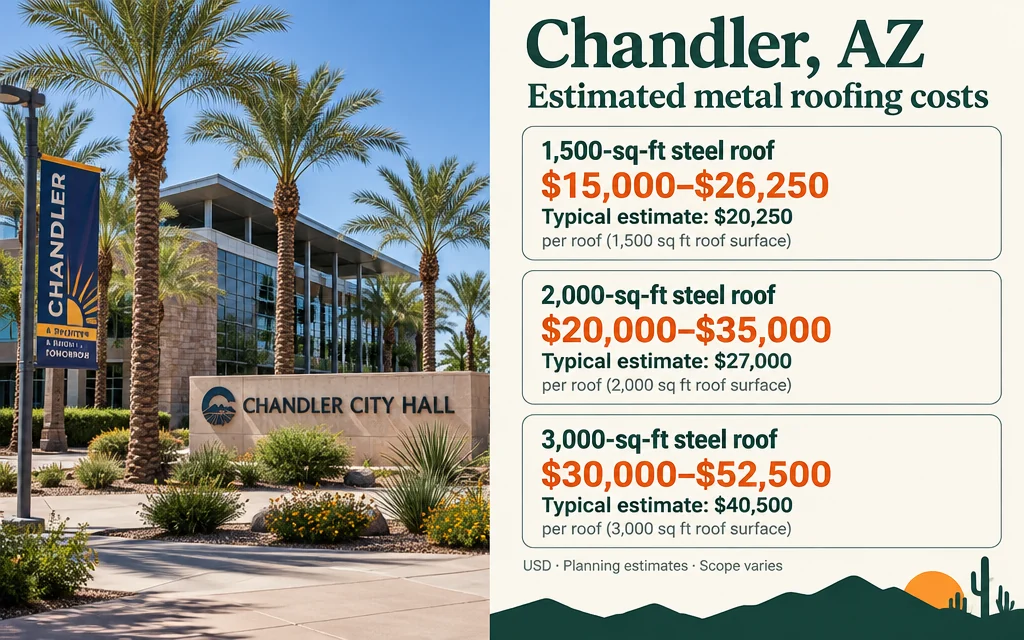
Calculated installed planning scenario for measured roof surface, including one-layer removal/disposal; conditional extras excluded.
Calculated installed planning scenario for measured roof surface, including one-layer removal/disposal; conditional extras excluded.
Calculated installed planning scenario for measured roof surface, including one-layer removal/disposal; conditional extras excluded.
Metal Roofing Pricing in Chandler
Planning a metal roof in Chandler requires balancing significant upfront installation costs against decades of desert sun exposure. Because published contractor pricing within city limits is sparse, these planning ranges draw on regional East Valley benchmarks.
For standard residential standing-seam steel, budget $10–$17.50 per sq ft of actual roof surface. This installed baseline covers 24- or 26-gauge Galvalume panels, concealed clips, high-temperature underlayment, baseline trim and perimeter flashing, along with the tear-off and disposal of one existing layer of asphalt shingles over sound decking. On-site installation usually runs 2-4 working days.
Your roof plane area will be larger than your home's interior square footage. Roof deck surface area includes eaves, overhangs, attached garages, and covered porches, further expanded by the roof's slope. For example, a single-story home with 1,800 square feet of conditioned living space in Chandler often measures between 2,200 and 2,600 square feet of actual roof deck once porches, garage planes, and pitch multipliers are accounted for. On a baseline 2,000-square-foot roof surface, total standing-seam investment budgets $20,000–$35,000.
Metal demands higher initial capital than composite shingles, but it will not dry out, crack, or shed mineral granules under continuous Arizona ultraviolet exposure. Final quotes fluctuate depending on metal gauge, panel profile, roof pitch, and whether your home requires custom transitions against parapets or stucco walls.
Residential Metal Roofing Systems Compared
Residential metal roofing encompasses multiple panel profiles, metals, and attachment methods, each with distinct labor requirements and long-term maintenance profiles.
Concealed-fastener standing-seam steel represents the residential standard, budgeting $10–$17.50 per sq ft installed. Formed from Galvalume-coated steel with a factory PVDF finish, the panels interlock over floating clips anchored to the deck. This concealed-clip assembly allows the metal to expand and contract across Chandler's wide day-to-night temperature swings without fatiguing fastener penetrations.
Exposed-fastener steel panels, such as corrugated or R-panel profiles, offer a lower initial cost at $6.50–$11.50 per sq ft installed, taking 1-3 working days. These sheets are secured by driving screws directly through the panel face into the structural decking. Under intense desert sun, the exposed rubber washers gradually dry out and degrade, creating a recurring maintenance cycle for fastener inspection and replacement.
Steel shingles and stamped metal shake budget $8–$13.50 per sq ft installed, taking 2-4 working days. They offer an architectural appearance similar to tile or slate while adding minimal structural dead load.
Standing-seam aluminum runs $11.50–$18.50 per sq ft installed and provides excellent natural corrosion protection, though steel remains far more common across central Arizona. Architectural copper standing seam is a premium custom option budgeting $24–$38 per sq ft installed, requiring specialized hand fabrication and on-site crew time of 5-10 working days.
| Service / assumptions | Low | Typical estimate | High | Pricing unit | Estimated labor time |
|---|---|---|---|---|---|
| Standing-Seam Steel Roof (Installed)Calculated standing-seam steel planning rate: comparable panel/accessory materials + installation labor + one-layer removal/disposal. Ordinary underlayment and details over sound decking included; conditional extra work excluded. Published rate reference for the stated roofing scope and unit, not verification of this guide's modeled range, a complete roof quote or provider availability. Regional reference; not a verified Chandler-specific quote.Published price reference ↗ | $10 | $13.50 | $17.50 | per sq ft of roof surface (installed) | 2-4 working days |
| Exposed-Fastener Steel Roof (Installed)Screw-down corrugated or ribbed panels (R-panel/PBR). Lower upfront cost but requires gasket maintenance. | $6.50 | $8.50 | $11.50 | per sq ft of roof surface (installed) | 1-3 working days |
| Steel Metal Shingles / Shake (Installed)Stone-coated or stamped steel panels mimicking tile, shake, or slate profiles. Includes 1-layer tear-off. | $8 | $10.50 | $13.50 | per sq ft of roof surface (installed) | 2-4 working days |
| Standing-Seam Aluminum Roof (Installed)Concealed-fastener aluminum panels, rust-impervious with PVDF finish. Includes standard tear-off. | $11.50 | $14.50 | $18.50 | per sq ft of roof surface (installed) | 2-4 working days |
| Standing-Seam Copper Roof (Installed)Premium architectural copper standing seam. Requires skilled hand soldering and custom metal fabrication. | $24 | $30 | $38 | per sq ft of roof surface (installed) | 5-10 working days |
Standing-Seam Steel Cost Breakdown
A clear standing-seam estimate breaks out material supplies, crew labor, and tear-off into defined allowances.
Materials and underlayment budget $4.50–$8 per sq ft. This line item includes 24- or 26-gauge Galvalume panels, concealed clips, closure strips, ridge caps, valley and drip trim, fasteners, and a high-temperature self-adhering underlayment. In the low desert, standard organic felts can soften or stick irregularly to the underside of hot metal panels, making high-temperature peel-and-stick membranes essential.
Installation labor accounts for $4.25–$7.50 per sq ft. Standing seam requires skilled metal mechanics to lay out seams, field-hem panel edges, space clips for thermal movement, and flash roof penetrations cleanly. Complex hip roofs and multi-level structures demand substantially more cutting and fabrication time.
Tear-off and disposal of one existing layer of asphalt shingles adds $1.25–$2 per sq ft, taking 1 working day. This allowance covers stripping the old roof down to structural decking, magnetic nail sweeps, hauling, and local disposal fees. If your home currently has heavy concrete tile, removal labor and bin weight surcharges will run higher.
| Service / assumptions | Low | Typical estimate | High | Pricing unit | Estimated labor time |
|---|---|---|---|---|---|
| Standing-Seam Steel Materials & Underlayment24/26-gauge Galvalume panels, clips, high-temp self-adhering underlayment, valley/trim metal, fasteners. | $4.50 | $6 | $8 | per sq ft of roof surface (materials only) | N/A |
| Standing-Seam Steel Installation LaborSkilled labor for panel layout, concealed clip fastening, standard edge hemming, and flashing details. | $4.25 | $6 | $7.50 | per sq ft of roof surface (installation labor only) | N/A |
| One-Layer Shingle Removal & DisposalTear-off of one asphalt shingle layer down to decking, cleanup, dumpster rental, and hauling fees. | $1.25 | $1.50 | $2 | per sq ft of roof surface (one-layer removal and disposal) | 1 working day |
Estimated Cost by Roof Size
Total metal roofing pricing tracks the measured square footage of the roof deck rather than the home's interior living area. The modeled scenarios below reflect a complete standing-seam steel system, including single-layer shingle tear-off and high-temperature underlayment over sound decking.
For a compact home or detached structure with a 1,500-square-foot roof plane, budget $15,000–$26,250 total, with crew work taking 2-3 working days.
For an average single-family home with a 2,000-square-foot roof surface, budget $20,000–$35,000 total, requiring 2-4 working days of on-site crew work.
For a larger custom home with a 3,000-square-foot roof surface, budget $30,000–$52,500 total, taking 3-5 working days.
These models assume single-story access and straightforward gable or hip geometry. Homes with steep slopes above 6:12, tight property lot setbacks that restrict material handling equipment, or multiple dormers will trend toward the higher end of these brackets.
| Service / assumptions | Low | Typical estimate | High | Pricing unit | Estimated labor time |
|---|---|---|---|---|---|
| Standing-Seam Steel Roof (1,500 sq ft)Calculated scenario: 1,500 sq ft of measured roof surface × standing-seam steel installed planning rate. Includes its same materials, installation, one-layer removal/disposal and sound-deck assumptions. Not a provider whole-roof quote. | $15,000 | $20,250 | $26,250 | per roof (1,500 sq ft roof surface) | 2-3 working days |
| Standing-Seam Steel Roof (2,000 sq ft)Calculated scenario: 2,000 sq ft of measured roof surface × standing-seam steel installed planning rate. Includes its same materials, installation, one-layer removal/disposal and sound-deck assumptions. Not a provider whole-roof quote. | $20,000 | $27,000 | $35,000 | per roof (2,000 sq ft roof surface) | 2-4 working days |
| Standing-Seam Steel Roof (3,000 sq ft)Calculated scenario: 3,000 sq ft of measured roof surface × standing-seam steel installed planning rate. Includes its same materials, installation, one-layer removal/disposal and sound-deck assumptions. Not a provider whole-roof quote. | $30,000 | $40,500 | $52,500 | per roof (3,000 sq ft roof surface) | 3-5 working days |
Metal Roofing vs. Architectural Asphalt Shingles
Comparing standing-seam steel to architectural asphalt shingles highlights a substantial difference in starting outlay. Standard architectural shingles run $4.50–$8.50 per sq ft installed, compared to $10–$17.50 per sq ft for standing-seam steel.
In the desert climate of the East Valley, composite materials endure unrelenting ultraviolet radiation and wide temperature swings, which accelerate granule loss and cause asphalt binders to dry out and curl over time. In contrast, steel standing-seam panels coated with factory-applied PVDF resin resist chalking and peeling without the drying and cracking seen in petroleum-based shingles.
Attic heat gain is another consideration. Standard asphalt shingles absorb solar radiation and conduct that heat into the roof deck. Factory-painted metal panels with cool-roof pigments reflect a higher portion of infrared rays, moderating roof surface temperatures during extended summer heat waves. While standing seam requires more initial capital, its longevity substantially limits the need for recurring re-roofing cycles.
| Service / assumptions | Low | Typical estimate | High | Pricing unit | Estimated labor time |
|---|---|---|---|---|---|
| Architectural Asphalt Shingles (Installed Reference)Reference baseline for architectural shingles including underlayment, drip edge, and 1-layer tear-off. | $4.50 | $6 | $8.50 | per sq ft of roof surface (installed) | 1-2 working days |
| Comparison | Architectural asphalt | Standing-seam steel |
|---|---|---|
| Up-front planning estimate · 2,000 sq ft roof surface | $9,000–$17,000 | $20,000–$35,000 |
| What the baseline includes | Architectural asphalt, ordinary installed details, one-layer removal/disposal over sound decking. | Standing-seam steel, ordinary installed details, one-layer removal/disposal over sound decking. |
| Maintenance and repairs | Confirm product-specific inspections and repair terms. | Confirm seams, fasteners, coating, compatible repairs and inspection terms. |
| Insurance and ownership cost | Ask the insurer about the exact product and coverage. | Ask the insurer about accepted test documentation, any available credit and cosmetic-damage exclusions. |
These are calculated budgeting comparisons, not provider quotes or guaranteed lifetime savings. Compare your expected ownership period, specified products, actual maintenance proposals and written insurance terms.
| Decision point | Roof repair | Roof replacement | Metal roofing |
|---|---|---|---|
| Work being priced | A defined defect, such as damaged shingles or flashing. | Removal and installation of an agreed roof system across the measured roof surface. | A specified installed metal system; standing seam, exposed fasteners and metal shingles are different scopes. |
| What to inspect | The leak source, surrounding material and whether a durable localized fix is feasible. | The extent of deterioration, decking condition, roof details and suitable replacement systems. | The substrate, panel profile, coating, fasteners, roof geometry and installation details. |
| How to compare prices | Match the repair quantity, access, materials and included diagnosis. | Match measured roof area, material, tear-off layers, disposal and installed inclusions. | Match measured roof area, system, components, removal and conditional additional work. |
| Before deciding | Ask what the repair addresses and what existing problems would remain. | Ask whether repair remains practical and which additional items would change the total. | Ask about compatible materials, documented product/assembly ratings and product versus workmanship warranties. |
Age or a repair-cost percentage alone does not determine the right choice. Ask a qualified roofing contractor to assess the condition and explain viable options. A metal system is a material-specific installation choice, not a separate guarantee of durability or savings.
Additional Scope and Conditional Work
A thorough roofing estimate outlines baseline installation alongside conditional repairs that can only be confirmed once the old roof is removed.
If the crew discovers a second underlying asphalt layer during tear-off, contractors typically charge an extra $40–$75 per 100 sq ft for additional labor and dump fees. Where moisture damage or dry rot has compromised decking, replacing damaged sheathing runs $75–$130 per 4-by-8-foot sheet installed.
Roof penetrations require custom flashing work. Installing or rebuilding step, counter, and cricket flashing around a masonry chimney runs $300–$850 per chimney. Custom curb flashing and back-pan fabrication for skylights adds $250–$650 per unit.
Attic ventilation upgrades, such as continuous vented ridge caps built for standing-seam ribs, budget $15–$38 per linear foot. Detaching and resetting existing seamless aluminum gutters to install proper eave drip edge costs $6–$16 per linear foot. Snow retention guards budget $20–$50 per linear foot, though they are rarely required in low-elevation Maricopa County communities.
| Service / assumptions | Low | Typical estimate | High | Pricing unit | Estimated labor time |
|---|---|---|---|---|---|
| Extra Roofing Layer RemovalAdditional labor and disposal fee when a second asphalt layer must be stripped. | $40 | $55 | $75 | additional per roofing square (100 sq ft) | N/A |
| Roof Decking Replacement (4x8 Sheet)Installed 1/2-inch or 5/8-inch OSB or CDX plywood to replace damaged or rotted substrate. | $75 | $95 | $130 | additional per 4-by-8-ft sheet (32 sq ft) | N/A |
| Chimney Flashing / Cricket FabricationCustom sheet metal step, counter flashing, and cricket fabrication behind masonry chimney. | $300 | $500 | $850 | additional per chimney | N/A |
| Skylight Flashing IntegrationCurved or raised panel curb integration with custom back-pan flashing for skylights. | $250 | $400 | $650 | additional per skylight | N/A |
| Metal Ridge Vent UpgradeContinuous perforated or baffled standing-seam ridge vent with closure strips. | $15 | $24 | $38 | additional per linear ft | N/A |
| Snow Retention SystemNon-penetrating seam-clamp snow guards or pipe rails (rarely needed in Chandler desert climate). | $20 | $32 | $50 | additional per linear ft | N/A |
| Gutter Detach & ResetCareful removal and reinstallation of existing seamless aluminum gutters to install eave trim. | $6 | $10 | $16 | additional per linear ft | N/A |
Desert Climate Performance and Code Ratings
Metal roofing performs well in desert conditions, but laboratory test ratings must be weighed against practical field conditions rather than broad assumptions.
Impact resistance is tested under UL 2218, where Class 4 represents the highest rating against steel-ball impact. While heavy-gauge steel panels frequently achieve Class 4 ratings, that classification does not guarantee panels will remain free of cosmetic indents after severe monsoon hail. Some insurance carriers offer premium discounts for impact-rated roofs, but policies often feature cosmetic damage endorsements that exclude cosmetic dents if water shedding remains intact.
Fire resistance depends on the complete tested roof assembly, not just the noncombustible metal outer layer. Achieving an overall Class A rating requires the specified combination of metal panel, approved underlayment, and roof deck substrate. Ask your installer to provide documentation for the exact tested assembly planned for your home.
During seasonal monsoon microbursts, wind uplift resistance depends heavily on perimeter trim fastening and clip spacing. Assemblies evaluated under standards like UL 580 Class 90 or ASTM E1592 deliver reliable wind resistance only when crews adhere strictly to manufacturer clip spacing along eaves, rakes, and ridges.
Local Cost Drivers and Pricing Variables
Several structural and material factors explain the price spread among metal roofing proposals in Chandler.
Roof complexity is the biggest driver of labor costs. A simple dual-plane gable roof allows long, uninterrupted panel runs with standard trim details. In contrast, roofs with intersecting hips, dead valleys, dormers, and clerestory walls require extensive hand cutting, bending, and panel hemming, which drives labor costs toward the upper end.
Property access also affects final pricing. Homes on tight lots with minimal side-yard clearance make it difficult to position telehandlers or rollforming equipment, forcing workers to carry panels manually. Roof pitches steeper than 6:12 demand additional safety equipment, which naturally slows down production rates.
Steel gauge and paint formulation represent key material choices. Specifying heavy 24-gauge Galvalume panels with a PVDF (Kynar) paint finish costs moderately more than thinner 29-gauge steel coated with standard polyester. In sunny Arizona conditions, PVDF coatings provide significantly better protection against color fade and surface chalking over time.
Hiring a Metal Roofing Contractor in Chandler
Installing standing seam requires dedicated metalworking tools, portable rollforming equipment, and trade experience that standard shingle contractors may not possess. Vetting potential contractors carefully ensures quality results.
Verify that the contractor holds an active residential roofing license in good standing with the Arizona Registrar of Contractors (ROC) and maintains active general liability and workers' compensation coverage. Inquire whether panels will be factory-formed and crated or rollformed directly on-site from flat coil stock, which avoids shipping dents and accommodates custom panel lengths.
Make sure your written estimate itemizes all materials by manufacturer, gauge, and finish, including the high-temperature underlayment rating and clip fasteners. The agreement should define unit prices for unforeseen decking repairs and detail flashing fabrication at parapets, stucco walls, and vents.
Before signing a contract, verify permitting responsibilities. Ask your roofer to confirm whether permits must be pulled through the City of Chandler Development Services department for your specific scope. In addition, submit your proposed panel profile, rib height, and color finish to your HOA architectural review committee for formal written approval prior to purchasing materials.
Local income & housing costs
Chandler city, Arizona · U.S. Census Bureau, 2025 ACS 1-year estimates.
per month · ±$69
Cash-rent units; includes applicable tenant-paid utilities
Census source ↗Dollar amounts use the survey period’s published basis. Income is annual; gross rent is monthly. Home value reflects owner-occupied housing values. Margins of error shown are at the ACS 90% confidence level. These statistics provide city context; service budgets use their own pricing evidence.
STATEWIDE COST CONTEXT
Arizona prices, income & labor costs
These Arizona figures provide background for this city guide. They describe different measures and reference years; employee wages are not prices charged by a contractor.
BEA SAIRPD
State price change indicator
124.52024 · index (2017 basis)
Annual figures & sources
| Year | Value | 90% margin of error | Source |
|---|---|---|---|
| 2020 | 103.8 | — | Official source |
| 2021 | 105.3 | — | Official source |
| 2022 | 116.1 | — | Official source |
| 2023 | 121.4 | — | Official source |
| 2024 | 124.5 | — | Official source |
Census ACS 1-year
Median household income
$82,9402025 · USD/year
Annual figures & sources
| Year | Value | 90% margin of error | Source |
|---|---|---|---|
| 2021 | $69,056 | ±$686 | Official source |
| 2022 | $74,568 | ±$932 | Official source |
| 2023 | $77,315 | ±$931 | Official source |
| 2024 | $81,486 | ±$684 | Official source |
| 2025 | $82,940 | ±$1,117 | Official source |
BLS OEWS
Roofers
$22.762025 · USD/hour
Annual figures & sources
| Year | Value | 90% margin of error | Source |
|---|---|---|---|
| 2025 | $22.76 | — | Official source |
State prices: BEA, 2020–2024. Household income: Census ACS, 2021–2025. Employee wages: BLS, May 2025 snapshot. The charts retain their own units and fitted scales.
Explore all Arizona living-cost data and trends →Local context and limitations
Direct published metal roofing price quotes within Chandler city limits are limited; the figures in this guide draw on regional East Valley and Arizona planning baselines. In the local desert climate, intense solar heat elevates roof surface temperatures well above ambient air, making high-temperature self-adhering underlayment rated to at least 250°F standard under metal panels. Many residential subdivisions in Chandler operate under deed restrictions or homeowners associations. Because price data cannot confirm whether your property allows metal roofing, verify your specific HOA covenants and architectural guidelines for permitted seam styles, rib heights, and reflectivity before ordering materials. You should also confirm building permit requirements and plan-submittal guidelines directly with the City of Chandler Development Services department.
Frequently asked questions
What is the difference between standing seam and exposed-fastener metal roofs?
Standing-seam panels lock together over concealed clips that allow the metal to slide freely during temperature shifts, keeping all fasteners protected beneath the seams. Exposed-fastener roofs use screws driven directly through the panel surface with rubber washers. In desert heat, those exposed rubber washers dry out and degrade over time, requiring periodic inspection and replacement to avoid leaks.
How do I estimate roof surface area from home living area?
Roof surface area exceeds interior living space because of covered patios, garages, overhangs, and roof pitch. Roofing contractors determine true square footage using aerial imagery or physical geometric takeoffs rather than a simple multiplication factor. For an 1,800-square-foot floor plan in Chandler, total deck surface often reaches 2,200 to 2,600 square feet depending on garage size, covered porch depth, and roof slope.
Why is high-temperature underlayment recommended under metal roofs in Chandler?
Desert solar radiation can heat metal panels to 160°F or higher. Standard asphalt felt or low-temperature synthetic underlayments can soften, stick to the underside of the panels, or break down prematurely under these conditions. A self-adhering underlayment rated to at least 250°F protects the wood deck beneath.
Will my Chandler HOA allow a standing-seam metal roof?
HOA rules depend on the recorded CC&Rs and design guidelines for your specific subdivision. Published price data cannot verify neighborhood architectural restrictions. Before signing a contract or ordering materials, contact your HOA architectural review committee to confirm whether metal roofing, specific panel profiles, seam heights, or finish colors are permitted on your home.
Does installing a metal roof lower my homeowners insurance rate?
Some insurers offer premium credits for UL 2218 Class 4 impact-rated metal roofs, but policy discounts vary by carrier and location. Some policies also include cosmetic damage endorsements that exclude coverage for hail dents if the metal's weather-tight integrity remains intact. Contact your insurance carrier to review your policy's specific terms.
Can a metal roof be installed directly over existing concrete roof tiles?
No. Concrete tiles must be completely removed down to the bare roof decking. Tiles do not offer a flat or stable surface for installing standing-seam clips, and removing them allows the crew to inspect the deck for damage and install the required high-temperature underlayment.
Sources and methodology
Sources below retain their recorded retrieval dates and geographic scope. We checked the quoted rates against readable public pricing pages. The tables remain planning estimates, not provider quotes or a measured citywide survey. Per-square-foot references do not establish the modeled whole-roof totals or all their installed inclusions. Regional references are not verified Chandler-specific quotes. Confirm removal, disposal, materials, labor and the complete scope in a written proposal.
Published pricing pages retrieved; quoted excerpts checked automatically. 3 distinct website domains. · Generated 2026-11-12
- Metal Roof Replacement Tempe AZ | Metal Roofing Cost & TypesState / regional reference · Page retrieved 2026-11-12 · Price excerpt matched automatically
“What Affects Cost Metal roof replacement cost factors Metal typically runs $9-$14 per square foot installed .”
Planning ranges may differ from these published examples; they are not provider quotes.
- Standing-Seam Roof Cost in Alaska: 2024 Price Guide & Licensing RulesState / regional reference · Page retrieved 2026-11-12 · Price excerpt matched automatically
“Break it down per square foot and most Alaska standing-seam projects land between $12.00 and $15.00, installed.”
Planning ranges may differ from these published examples; they are not provider quotes.
- Metal Roof Cost in Arizona (2026): Standing Seam & SteelState / regional reference · Page retrieved 2026-11-12 · Price excerpt matched automatically
“Metal Roof Cost in Arizona (2026): Standing Seam & Steel Metal Roof Cost in Arizona (2026 Pricing Guide) Installed cost per sq ft: $8–$14.”
Planning ranges may differ from these published examples; they are not provider quotes.
Plan your metal roofing project
Choose your service and answer its project questions. Add notes or photos if helpful, then generate your project brief. The planner labels its budgeting assumptions separately. Use your plan to compare the scope and assumptions with a provider. Contact sharing and provider matching are not available yet.
Open the project planner →Share this city’s cost data
<> Embed Chandler Cost Data on Your Site
The HTML table shows the prices at the time of copying. The iframe follows the published guide.