Mesa · AZ · COST GUIDE
Metal Roofing Costs in Mesa, AZ (2026)
For budgeting, standing-seam steel roofing is estimated at $9–$17.75 per sq ft of roof surface, and exposed-fastener steel at $5.50–$11 per sq ft. These installed planning ranges include one-layer removal/disposal over sound decking; compare the specified system and conditional extras.
Standing Seam Steel (Installed)
Budget estimate$9–$17.75per sq ft of roof surface (installed)
Planning range · Compare the roof area, material and included work in your quote.
Exposed-Fastener Ribbed Steel (Installed)
Budget estimate$5.50–$11per sq ft of roof surface (installed)
Planning range · Compare the roof area, material and included work in your quote.
Published examples apply to their stated scope. Budget ranges are estimates.
Calculated installed planning scenario for measured roof surface, including one-layer removal/disposal; conditional extras excluded.
Calculated installed planning scenario for measured roof surface, including one-layer removal/disposal; conditional extras excluded.
Calculated installed planning scenario for measured roof surface, including one-layer removal/disposal; conditional extras excluded.
Metal Roofing Investment Overview in Mesa
Installing a residential metal roof in Mesa is a long-term upgrade designed for desert sun and intense seasonal weather. For a standing-seam Galvalume steel system, budget $9–$17.75 per sq ft of roof surface (installed), with a typical project landing near $12.75.
Because public contractor pricing in Mesa is rarely published as a flat menu rate, these figures serve as planning estimates derived from regional Central Arizona data. On a home with 2,000 square feet of measured sloped roof area, that translates to budget $18,000–$35,500 per roof (2,000 sq ft roof surface). This baseline covers removing one existing layer of asphalt shingles, debris disposal, high-temperature self-adhering underlayment, 24- or 26-gauge concealed-clip panels, and standard perimeter trims over sound plywood decking.
Alternative metal systems match different architecture and budgets. Exposed-fastener ribbed steel panels budget $5.50–$11 per sq ft of roof surface (installed), while stone-coated steel shingles run $8–$13.50 per sq ft of roof surface (installed). For premium architectural metals, standing-seam aluminum budgets $11.50–$19.50 per sq ft of roof surface (installed), and natural copper budgets $24–$38 per sq ft of roof surface (installed). Because roof pitch, overhangs, and covered porches add area beyond a home's interior floor plan, get written quotes based on measured roof surface area rather than conditioned living space.
Comparing Residential Metal Roof Systems
Standing-seam steel with concealed fasteners is the primary profile used on homes for long-term desert exposure. Formed from 24-gauge or 26-gauge Galvalume steel, panels clip directly to the roof deck with hidden fasteners.
This allows the metal to slide smoothly through thermal expansion cycles without stressing screw penetrations. The raised vertical seams shed water reliably on slopes down to 2:12, or lower when mechanically seamed on site.
Exposed-fastener steel panels, such as corrugated or ribbed profiles, offer a lower upfront price point, with installed costs budgeting $5.50–$11 per sq ft of roof surface (installed). Screws penetrate directly through the exterior face into the wood deck and compress an EPDM or neoprene washer. Under Mesa's intense ultraviolet exposure, these external rubber washers degrade and require planned inspections and screw replacement over time to prevent leaks.
Stone-coated steel shingles combine stamped steel panels with an acrylic-bonded ceramic granule finish. They mimic the profile of traditional Spanish barrel tile or wood shakes, making them a practical alternative for neighborhoods with architectural covenants that prohibit industrial-style standing seams.
Standing-seam aluminum and natural copper serve specialized needs. Aluminum forms a protective oxide layer that resists corrosion, making it well-suited around swimming pools or patio misting systems. Natural copper requires master sheet-metal craftsmanship for soldered or double-locked seams, providing lasting performance without factory paint coatings.
| Service / assumptions | Low | Typical estimate | High | Pricing unit | Estimated labor time |
|---|---|---|---|---|---|
| Standing Seam Steel (Installed)Calculated standing-seam steel planning rate: comparable panel/accessory materials + installation labor + one-layer removal/disposal. Ordinary underlayment and details over sound decking included; conditional extra work excluded. Published rate reference for the stated roofing scope and unit, not verification of this guide's modeled range, a complete roof quote or provider availability. Regional reference; not a verified Mesa-specific quote.Published price reference ↗ | $9 | $12.75 | $17.75 | per sq ft of roof surface (installed) | N/A |
| Exposed-Fastener Ribbed Steel (Installed)Screw-through ribbed corrugated panels with gasketed fasteners and 1-layer tear-off. | $5.50 | $8 | $11 | per sq ft of roof surface (installed) | N/A |
| Stone-Coated Steel Shingles (Installed)Interlocking stamped steel panels with ceramic granules, including 1-layer tear-off. | $8 | $10.50 | $13.50 | per sq ft of roof surface (installed) | N/A |
| Standing Seam Aluminum (Installed)0.032 to 0.040 in. aluminum panels with concealed clips and 1-layer tear-off. | $11.50 | $15 | $19.50 | per sq ft of roof surface (installed) | N/A |
| Standing Seam Copper (Installed)16 oz natural architectural copper with soldered or double-locked seams and 1-layer tear-off. | $24 | $30 | $38 | per sq ft of roof surface (installed) | N/A |
Cost Components: Materials, Labor, and Tear-Off
Breaking down a bid into materials, labor, and tear-off helps you evaluate contractor proposals on an apples-to-apples basis. A standard standing-seam steel project combines three main parts.
Materials alone budget $4.50–$8.50 per sq ft of roof surface (materials only). This covers 24- or 26-gauge Galvalume panels or coil, concealed mounting clips, screws, high-temperature underlayment formulated for high metal deck temperatures, and prefabricated ridge and edge trims.
Specialized installation labor accounts for $3.50–$6.75 per sq ft of roof surface (installation labor only). Metal mechanics must square the layout, secure expansion clips, hem eaves into drip edge cleats without face nails, and fabricate transitions at valleys and walls. Stripping and disposing of a single layer of old asphalt shingles budgets $1–$2.50 per sq ft of roof surface (one-layer removal and disposal). Tearing off heavier roofing materials, such as concrete tile, involves higher labor and hauling costs that roofers quote separately.
| Service / assumptions | Low | Typical estimate | High | Pricing unit | Estimated labor time |
|---|---|---|---|---|---|
| Standing Seam Steel Materials AllowanceGalvalume steel panels, clips, fasteners, high-temp underlayment, and standard trims. | $4.50 | $6.25 | $8.50 | per sq ft of roof surface (materials only) | N/A |
| Standing Seam Steel Installation LaborSkilled labor for panel layout, concealed clipping, hemming, and standard trim work. | $3.50 | $5 | $6.75 | per sq ft of roof surface (installation labor only) | N/A |
| Existing Roof Tear-Off (One Layer)Stripping single shingle layer, hauling debris, dumpster fees, and magnetic yard cleanup. | $1 | $1.50 | $2.50 | per sq ft of roof surface (one-layer removal and disposal) | N/A |
Hypothetical Project Totals by Roof Size
Total costs scale with roof surface area and layout complexity. These planning budgets reflect a complete standing-seam Galvalume steel installation over sound wood decking, including single-layer asphalt shingle removal and disposal.
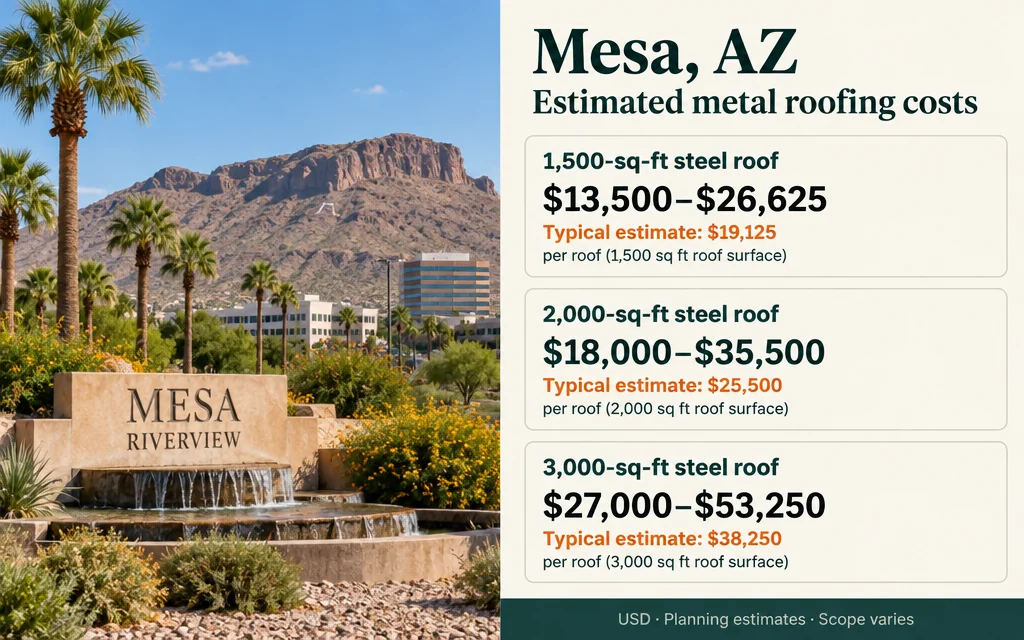
For a smaller home or patio property with a 1,500-square-foot roof surface, budget $13,500–$26,625 per roof (1,500 sq ft roof surface), with a typical project cost near $19,125. On-site installation generally takes 2-3 business days with standard access.
For a mid-sized single-family residence with a 2,000-square-foot roof surface, budget $18,000–$35,500 per roof (2,000 sq ft roof surface), with a typical midpoint of $25,500. Work on site typically spans 3-4 business days.
For a larger custom home or complex roof layout with 3,000 square feet of roof surface, budget $27,000–$53,250 per roof (3,000 sq ft roof surface), centering around $38,250. Projects of this scale generally run 4-6 business days depending on crew size, roof pitch, and staging constraints.
| Service / assumptions | Low | Typical estimate | High | Pricing unit | Estimated labor time |
|---|---|---|---|---|---|
| Standing Seam Steel Roof (1,500 sq ft)Calculated scenario: 1,500 sq ft of measured roof surface × standing-seam steel installed planning rate. Includes its same materials, installation, one-layer removal/disposal and sound-deck assumptions. Not a provider whole-roof quote. | $13,500 | $19,125 | $26,625 | per roof (1,500 sq ft roof surface) | 2-3 business days |
| Standing Seam Steel Roof (2,000 sq ft)Calculated scenario: 2,000 sq ft of measured roof surface × standing-seam steel installed planning rate. Includes its same materials, installation, one-layer removal/disposal and sound-deck assumptions. Not a provider whole-roof quote. | $18,000 | $25,500 | $35,500 | per roof (2,000 sq ft roof surface) | 3-4 business days |
| Standing Seam Steel Roof (3,000 sq ft)Calculated scenario: 3,000 sq ft of measured roof surface × standing-seam steel installed planning rate. Includes its same materials, installation, one-layer removal/disposal and sound-deck assumptions. Not a provider whole-roof quote. | $27,000 | $38,250 | $53,250 | per roof (3,000 sq ft roof surface) | 4-6 business days |
Metal Roofing vs. Architectural Asphalt
Standard architectural asphalt shingles remain the lower initial-cost choice, with replacements budgeting $4–$7.50 per sq ft of roof surface (installed), and a typical cost near $5.50. Standing-seam steel budgets $9–$17.75 per sq ft of roof surface (installed).
While asphalt requires less cash upfront, Mesa's intense heat and sun degrade organic and fiberglass asphalt mats rapidly. Repeated thermal cycles dry out the binders, causing granule loss and curling that shorten service intervals compared to cooler regions.
Standing-seam steel with factory PVDF resin coatings resists sun exposure without drying out or cracking. Reflective pigments bounce radiant solar energy away from the roof plane, reducing the heat passed through to the attic during triple-digit summer afternoons. For homeowners planning to stay in their home long term, the extended service life can offset the higher initial price tag.
| Service / assumptions | Low | Typical estimate | High | Pricing unit | Estimated labor time |
|---|---|---|---|---|---|
| Architectural Shingles (Installed Reference)Architectural asphalt shingles including 1-layer tear-off and synthetic underlayment. | $4 | $5.50 | $7.50 | per sq ft of roof surface (installed) | N/A |
| Comparison | Architectural asphalt | Standing-seam steel |
|---|---|---|
| Up-front planning estimate · 2,000 sq ft roof surface | $8,000–$15,000 | $18,000–$35,500 |
| What the baseline includes | Architectural asphalt, ordinary installed details, one-layer removal/disposal over sound decking. | Standing-seam steel, ordinary installed details, one-layer removal/disposal over sound decking. |
| Maintenance and repairs | Confirm product-specific inspections and repair terms. | Confirm seams, fasteners, coating, compatible repairs and inspection terms. |
| Insurance and ownership cost | Ask the insurer about the exact product and coverage. | Ask the insurer about accepted test documentation, any available credit and cosmetic-damage exclusions. |
These are calculated budgeting comparisons, not provider quotes or guaranteed lifetime savings. Compare your expected ownership period, specified products, actual maintenance proposals and written insurance terms.
| Decision point | Roof repair | Roof replacement | Metal roofing |
|---|---|---|---|
| Work being priced | A defined defect, such as damaged shingles or flashing. | Removal and installation of an agreed roof system across the measured roof surface. | A specified installed metal system; standing seam, exposed fasteners and metal shingles are different scopes. |
| What to inspect | The leak source, surrounding material and whether a durable localized fix is feasible. | The extent of deterioration, decking condition, roof details and suitable replacement systems. | The substrate, panel profile, coating, fasteners, roof geometry and installation details. |
| How to compare prices | Match the repair quantity, access, materials and included diagnosis. | Match measured roof area, material, tear-off layers, disposal and installed inclusions. | Match measured roof area, system, components, removal and conditional additional work. |
| Before deciding | Ask what the repair addresses and what existing problems would remain. | Ask whether repair remains practical and which additional items would change the total. | Ask about compatible materials, documented product/assembly ratings and product versus workmanship warranties. |
Age or a repair-cost percentage alone does not determine the right choice. Ask a qualified roofing contractor to assess the condition and explain viable options. A metal system is a material-specific installation choice, not a separate guarantee of durability or savings.
Additional Scope and Conditional Work
Every roof replacement involves site-specific conditions that fall outside standard baseline estimates. Clarifying these items in advance prevents unexpected change orders during construction.
If the existing roof has an extra layer of shingles beneath the surface, stripping and hauling it adds $40–$120 additional per roofing square (100 sq ft). Once the deck is exposed, any damaged or rotted sheathing must be replaced; 4-by-8-foot sheets of plywood or OSB budget $70–$130 additional per 4-by-8-ft sheet (32 sq ft), which covers material and carpentry labor.
Penetrations and roofline details require custom fabrication. Reflashing a chimney with counter-flashing and a diverter saddle budgets $300–$900 additional per chimney, while skylight curb flashing kits run $250–$750 additional per skylight. Adding continuous perforated ridge ventilation budgets $12–$32 additional per linear ft. Detaching gutters to install eave cleats and reinstalling them afterward adds $4–$12 additional per linear ft. On steep custom roofs or foothill transitions where retention is requested, non-penetrating seam-clamped snow rails budget $18–$50 additional per linear ft.
| Service / assumptions | Low | Typical estimate | High | Pricing unit | Estimated labor time |
|---|---|---|---|---|---|
| Additional Roof Layer Tear-OffDemolition and dumpster surcharge for each layer beyond the first. | $40 | $75 | $120 | additional per roofing square (100 sq ft) | N/A |
| Plywood/OSB Decking ReplacementReplacing water-damaged or warped 7/16 in. OSB or 1/2 in. CDX plywood sheet. | $70 | $95 | $130 | additional per 4-by-8-ft sheet (32 sq ft) | N/A |
| Custom Metal Chimney FlashingFabricating and counter-flashing step sheet metal and rear diverter cricket. | $300 | $550 | $900 | additional per chimney | N/A |
| Skylight Flashing IntegrationCurb re-flashing and panel integration kit for existing residential skylights. | $250 | $450 | $750 | additional per skylight | N/A |
| Ridge Ventilation UpgradePerforated metal baffle and vented ridge cap installation. | $12 | $20 | $32 | additional per linear ft | N/A |
| Snow Retention Rail SystemNon-penetrating seam clamps and continuous bar system (foothill/specialty applications). | $18 | $30 | $50 | additional per linear ft | N/A |
| Gutter Detach and ResetSafely taking down existing gutters for eave drip edge detailing and reinstalling. | $4 | $7 | $12 | additional per linear ft | N/A |
Desert Performance: Wind, Hail, Heat, and Fire
Evaluating a metal roof requires checking laboratory testing standards rather than generic sales claims. Many 24-gauge standing-seam steel profiles carry a UL 2218 Class 4 rating, showing that the metal resists tearing or puncturing during standardized hail impact tests.
However, homeowners should review their homeowner policy for cosmetic damage endorsements, as Class 4 performance does not guarantee insurance discounts or coverage for surface dents.
Wind uplift resistance depends on verified attachment engineering under standards such as UL 580 or UL 1897. During Mesa summer monsoons, sudden downburst winds place heavy uplift on eaves and rakes, making proper clip spacing and hemmed edge metal critical. Installed over an approved deck with compatible underlayment, metal systems routinely achieve a Class A fire rating, which helps protect against windblown embers from nearby desert brush.
Reflective performance matters in Mesa's climate. PVDF coatings certified by the Cool Roof Rating Council (CRRC) reflect solar radiation and release absorbed heat. Realized cooling energy savings still depend on ceiling insulation levels, ductwork sealing, and attic air circulation.
Key Cost Drivers in Mesa
Several project variables influence where an estimate falls within the planning range. Roof geometry is the biggest factor.
A simple gable roof with long, continuous runs requires less scrap and installs quickly. In contrast, complex roofs with hips, valleys, dormers, and clerestory walls demand extensive on-site metal bending and custom hand-detailing, which increases installation labor.
Decking conditions also determine the bottom line. If you are converting from concrete tile to standing seam, tear-off is substantially heavier and more labor-intensive than shingle removal. Furthermore, if the tile was installed over spaced battens or skip sheathing, the roofer must install continuous plywood sheathing across the roof before applying high-temperature underlayment and panels.
Job scheduling and access add local cost variations. In peak summer, crews in Mesa often shift to dawn starts to complete panel handling before the metal becomes too hot to touch. Restricted access, overhead utility lines, or multi-story elevations also add staging and material-handling time.
Hiring a Metal Roofing Contractor in Mesa
Installing standing-seam metal roofing calls for specific sheet-metal tooling and techniques that differ from asphalt shingle work. Before hiring, verify with the Arizona Registrar of Contractors that the business holds an active license in the appropriate residential roofing classification for your job scope.
Ask the contractor's insurance agent to send current certificates of general liability and workers' compensation coverage directly to your email.
Insist on detailed specifications in the written proposal. The estimate should identify the panel manufacturer, profile name, steel gauge (24- or 26-gauge is standard for residential standing seam; avoid 29-gauge agricultural utility metal), paint finish, underlayment type and temperature rating, and edge detailing. Confirm whether eaves and rakes will be secured with concealed hemmed cleats rather than exposed face screws.
Review warranty terms carefully. Separate the panel manufacturer's finish warranty, which covers paint chalking and fading, from the contractor's workmanship warranty, which covers installation integrity and leak prevention. Finally, ask your contractor to verify permit requirements for your specific address and scope with the City of Mesa development services department, and ensure the contract includes fixed per-sheet unit pricing for any damaged decking discovered during tear-off.
Local income & housing costs
Mesa city, Arizona · U.S. Census Bureau, 2025 ACS 1-year estimates.
per month · ±$51
Cash-rent units; includes applicable tenant-paid utilities
Census source ↗Dollar amounts use the survey period’s published basis. Income is annual; gross rent is monthly. Home value reflects owner-occupied housing values. Margins of error shown are at the ACS 90% confidence level. These statistics provide city context; service budgets use their own pricing evidence.
STATEWIDE COST CONTEXT
Arizona prices, income & labor costs
These Arizona figures provide background for this city guide. They describe different measures and reference years; employee wages are not prices charged by a contractor.
BEA SAIRPD
State price change indicator
124.52024 · index (2017 basis)
Annual figures & sources
| Year | Value | 90% margin of error | Source |
|---|---|---|---|
| 2020 | 103.8 | — | Official source |
| 2021 | 105.3 | — | Official source |
| 2022 | 116.1 | — | Official source |
| 2023 | 121.4 | — | Official source |
| 2024 | 124.5 | — | Official source |
Census ACS 1-year
Median household income
$82,9402025 · USD/year
Annual figures & sources
| Year | Value | 90% margin of error | Source |
|---|---|---|---|
| 2021 | $69,056 | ±$686 | Official source |
| 2022 | $74,568 | ±$932 | Official source |
| 2023 | $77,315 | ±$931 | Official source |
| 2024 | $81,486 | ±$684 | Official source |
| 2025 | $82,940 | ±$1,117 | Official source |
BLS OEWS
Roofers
$22.762025 · USD/hour
Annual figures & sources
| Year | Value | 90% margin of error | Source |
|---|---|---|---|
| 2025 | $22.76 | — | Official source |
State prices: BEA, 2020–2024. Household income: Census ACS, 2021–2025. Employee wages: BLS, May 2025 snapshot. The charts retain their own units and fitted scales.
Explore all Arizona living-cost data and trends →Local context and limitations
Mesa homes face sustained summer heat where roof deck temperatures reach levels that require high-temperature self-adhering underlayment beneath any metal roof assembly. Concealed-clip standing-seam profiles accommodate expansion and contraction during day-to-night temperature swings without placing shear stress on fastener holes. During late summer monsoon storms, strong localized wind gusts make verified perimeter fastening and tight rake closures essential. Master-planned communities across Mesa often have specific architectural guidelines, so check your association's rules regarding allowable panel profiles, finishes, and colors before ordering materials.
Frequently asked questions
What is the difference between standing seam and exposed-fastener metal roofs?
Standing seam uses raised vertical ribs anchored by concealed clips underneath the metal, leaving no screws exposed to sun and weather. Exposed-fastener systems use corrugated or ribbed panels secured with screws driven through the panel face. In desert climates with intense sun, the rubber washers on exposed screws degrade over time and require routine inspection and eventual replacement, making standing seam the more durable, lower-maintenance choice.
How much does a standing-seam metal roof cost per square foot in Mesa?
Budget $9–$17.75 per sq ft of roof surface (installed), with a typical project cost near $12.75. This planning estimate includes removing a single layer of old asphalt shingles, debris disposal, high-temperature underlayment, 24-gauge Galvalume panels, and complete edge flashing over sound decking.
Can I replace my Mesa concrete tile roof with a metal roof?
Yes, but it requires extra preparatory work. Removing concrete tile involves heavier physical labor and higher hauling fees than shingle tear-off. In addition, if the existing tile rests on spaced battens, solid plywood or OSB sheathing must be installed across the entire deck to create an approved surface for underlayment and concealed clips.
Will a metal roof lower my summer cooling bills in Mesa?
Metal panels finished with cool-roof PVDF coatings reflect solar heat rather than absorbing it into the structure. Actual electric bill savings depend on your attic insulation depth, attic ventilation, and ductwork condition, but cool-rated metal surfaces noticeably reduce heat buildup above the ceiling during hot summer months.
Do I need approval from my Mesa HOA before installing a metal roof?
Many planned communities in Mesa require architectural review committee approval prior to any roofing material change. HOAs often prohibit bare metal or high-gloss finishes and may require specific earth-tone colors, low-sheen finishes, or stone-coated steel profiles that match the neighborhood aesthetic.
How long does a metal roof replacement take on a Mesa home?
A standard 2,000-square-foot standing-seam steel roof replacement typically takes 3-4 business days on site. Complex rooflines, multiple shingle layers or heavy tile tear-offs, and summer heat scheduling adjustments can extend the project schedule.
Sources and methodology
Sources below retain their recorded retrieval dates and geographic scope. We checked the quoted rates against readable public pricing pages. The tables remain planning estimates, not provider quotes or a measured citywide survey. Per-square-foot references do not establish the modeled whole-roof totals or all their installed inclusions. Regional references are not verified Mesa-specific quotes. Confirm removal, disposal, materials, labor and the complete scope in a written proposal.
Published pricing pages retrieved; quoted excerpts checked automatically. 2 distinct website domains. · Generated 2026-11-12
- Metal Roof Cost in Arizona (2026): Standing Seam & SteelState / regional reference · Page retrieved 2026-11-12 · Price excerpt matched automatically
“Metal Roof Cost in Arizona (2026): Standing Seam & Steel Metal Roof Cost in Arizona (2026 Pricing Guide) Installed cost per sq ft: $8–$14.”
Planning ranges may differ from these published examples; they are not provider quotes.
- Standing Seam Metal Roofing in Phoenix: Cost & LifespanState / regional reference · Page retrieved 2026-11-12 · Price excerpt matched automatically
“In Phoenix, installed costs typically run $10–$18 per square foot for steel or aluminum panels, depending on panel gauge, roof complexity, and finish.”
Planning ranges may differ from these published examples; they are not provider quotes.
Plan your metal roofing project
Choose your service and answer its project questions. Add notes or photos if helpful, then generate your project brief. The planner labels its budgeting assumptions separately. Use your plan to compare the scope and assumptions with a provider. Contact sharing and provider matching are not available yet.
Open the project planner →Share this city’s cost data
<> Embed Mesa Cost Data on Your Site
The HTML table shows the prices at the time of copying. The iframe follows the published guide.