Columbus · GA · COST GUIDE
Metal Roofing Costs in Columbus, GA (2026)
For budgeting, standing-seam steel roofing is estimated at $9.50–$18.50 per sq ft of roof surface, and exposed-fastener steel at $5–$10 per sq ft. These installed planning ranges include one-layer removal/disposal over sound decking; compare the specified system and conditional extras.
Standing Seam Steel Roof (Installed)
Budget estimate$9.50–$18.50per sq ft of roof surface (installed)
Planning range · Compare the roof area, material and included work in your quote.
Exposed-Fastener Steel Roof (Installed)
Budget estimate$5–$10per sq ft of roof surface (installed)
Planning range · Compare the roof area, material and included work in your quote.
Published examples apply to their stated scope. Budget ranges are estimates.
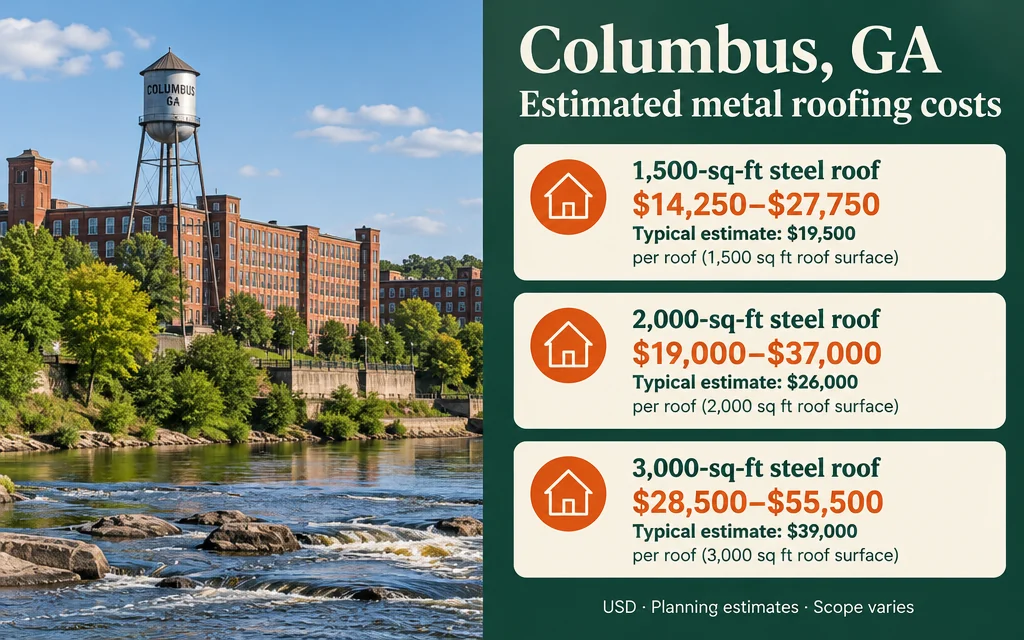
Calculated installed planning scenario for measured roof surface, including one-layer removal/disposal; conditional extras excluded.
Calculated installed planning scenario for measured roof surface, including one-layer removal/disposal; conditional extras excluded.
Calculated installed planning scenario for measured roof surface, including one-layer removal/disposal; conditional extras excluded.
Understanding Residential Metal Roofing in Columbus
Metal roofing in Columbus varies substantially in price based on panel design, fastener type, and roof geometry. For a standard concealed-clip standing-seam steel roof, budget $9.50–$18.50 per sq ft of roof surface (installed), with a typical baseline around $13.
In contrast, through-fastened ribbed steel panels run budget $5–$10 per sq ft of roof surface (installed).
Because standing seam and exposed-fastener profiles represent two distinct installation scopes, citywide numbers serve as planning estimates rather than exact bids. Roofing proposals are based on total measured surface area rather than your home's ground-floor footprint. For example, a single-story Columbus home with 1,500 square feet of interior floor space often has 1,800 to 2,200 square feet of actual roof surface once pitch, overhangs, and gables are calculated. The baseline figures here assume the tear-off of one layer of asphalt shingles, installation of high-temperature synthetic underlayment, standard trims, and panel attachment over structurally sound decking.
Metal Roofing Systems Compared
Choosing a metal roof involves balancing fastener engineering, expected maintenance, and upfront investment:
Standing-Seam Steel (Concealed Fastener): Fabricated from 24-gauge or 26-gauge Galvalume-coated steel with a factory-applied finish. Panels lock together over concealed clips fastened directly to the deck. These expansion clips allow the steel to expand and contract smoothly during hot summer afternoons without stressing panel penetrations. Budget $9.50–$18.50 per sq ft of roof surface (installed).
Exposed-Fastener Steel (Screw-Down Panels): Budget $5–$10 per sq ft of roof surface (installed). Panels attach with screws driven through the face of the metal into the sheathing or purlins. Neoprene or EPDM washers seal each screw penetration. Over time, UV exposure and continuous thermal movement cause these washers to dry out or back out, requiring periodic inspection and screw replacement.
Steel Shingles and Stone-Coated Tiles: Budget $9–$18 per sq ft of roof surface (installed). These stamped metal panels replicate the texture of traditional shake, slate, or barrel tile while using concealed clips to resist wind uplift.
Standing-Seam Aluminum: Budget $13–$23 per sq ft of roof surface (installed). Aluminum does not rust, making it a reliable option near the Chattahoochee River or on properties under heavy tree cover where moisture lingers.
Standing-Seam Copper: Architectural copper runs budget $28–$52 per sq ft of roof surface (installed). Copper requires specialized sheet-metal fabrication and soldering, making it most common for accent bays, porches, or historic renovations.
| Service / assumptions | Low | Typical estimate | High | Pricing unit | Estimated labor time |
|---|---|---|---|---|---|
| Standing Seam Steel Roof (Installed)Calculated standing-seam steel planning rate: materials + installation labor + one-layer removal/disposal. Ordinary underlayment and details over sound decking included; conditional extra work excluded. Regional reference rates provide planning context; verify written bids from local contractors.Published price reference ↗ | $9.50 | $13 | $18.50 | per sq ft of roof surface (installed) | N/A |
| Exposed-Fastener Steel Roof (Installed)Through-fastened ribbed steel panels (such as 5V crimp or AG-panel) with washered screws, trims, underlayment, and one-layer tear-off. Planning estimate; verify site-specific contractor bids. | $5 | $7.25 | $10 | per sq ft of roof surface (installed) | N/A |
| Steel Metal Shingles or Tiles (Installed)Stamped architectural steel shingles or stone-coated steel tiles with concealed fasteners, underlayment, and one-layer tear-off. | $9 | $13.50 | $18 | per sq ft of roof surface (installed) | N/A |
| Standing Seam Aluminum Roof (Installed)0.032 to 0.040-inch aluminum standing seam panels, naturally corrosion-proof, with concealed clips, underlayment, trims, and one-layer tear-off. | $13 | $17.50 | $23 | per sq ft of roof surface (installed) | N/A |
| Standing Seam Copper Roof (Installed)16-oz or 20-oz architectural copper standing seam panels with copper/brass clips, premium high-temp underlayment, and one-layer tear-off. | $28 | $38 | $52 | per sq ft of roof surface (installed) | N/A |
Cost Components of a Standing Seam Roof
A complete standing-seam steel estimate breaks down into materials, labor, and tear-off:
Materials Allowance: Budget $4.50–$8.50 per sq ft of roof surface (materials only), with typical projects landing near $6. This covers metal panels or coil, concealed clips, perimeter trims (eave, rake, ridge, and valley), fasteners, and high-temperature synthetic underlayment.
Installation Labor: Skilled sheet-metal installation requires budget $4–$7.50 per sq ft of roof surface (installation labor only), averaging $5.50. Straightforward gable layouts stay near the lower end, while hips, valleys, and dormers require custom hand cuts and hemmed closures that lift labor toward the upper bound.
Tear-Off and Disposal: Removing one layer of old asphalt shingles and hauling the debris to an authorized landfill costs budget $1–$2.50 per sq ft of roof surface (one-layer removal and disposal), with typical jobs around $1.50. Combined, these elements form our standard planning baseline of $13 per square foot over sound decking.
| Service / assumptions | Low | Typical estimate | High | Pricing unit | Estimated labor time |
|---|---|---|---|---|---|
| Standing Seam Steel Materials AllowancePanels, concealed clips, screws, ridge/eave/valley flashings, and high-temp synthetic underlayment for standing seam steel baseline. | $4.50 | $6 | $8.50 | per sq ft of roof surface (materials only) | N/A |
| Standing Seam Steel Installation LaborSpecialized sheet metal labor to lay underlayment, install clips, roll/form panels, and seam details, excluding tear-off. | $4 | $5.50 | $7.50 | per sq ft of roof surface (installation labor only) | N/A |
| One-Layer Shingle Removal and DisposalStripping one layer of old asphalt shingles, hauling debris, and roll-off dumpster disposal fees. | $1 | $1.50 | $2.50 | per sq ft of roof surface (one-layer removal and disposal) | N/A |
Total Project Estimates by Roof Size
Total installation cost scales directly with your roof's total measured surface area. For a smaller roof measuring 1,500 square feet, budget $14,250–$27,750 per roof (1,500 sq ft roof surface), with typical turnkey jobs pricing around $19,500.
On-site installation time for this size generally takes 2-3 working days.
A mid-sized home with 2,000 square feet of roof surface requires a planning budget of $19,000–$37,000 per roof (2,000 sq ft roof surface), with an average cost near $26,000. Elapsed crew time runs 3-4 working days.
For a larger 3,000-square-foot roof, estimates run budget $28,500–$55,500 per roof (3,000 sq ft roof surface), landing near $39,000. A crew typically finishes a project of this scale in 4-6 working days, depending on roof complexity and weather.
| Service / assumptions | Low | Typical estimate | High | Pricing unit | Estimated labor time |
|---|---|---|---|---|---|
| Standing Seam Steel Roof: 1,500 Sq FtCalculated scenario: 1,500 sq ft of measured roof surface × standing-seam steel installed planning rate. Includes its same materials, installation, one-layer removal/disposal and sound-deck assumptions. Not a provider whole-roof quote. | $14,250 | $19,500 | $27,750 | per roof (1,500 sq ft roof surface) | 2-3 working days |
| Standing Seam Steel Roof: 2,000 Sq FtCalculated scenario: 2,000 sq ft of measured roof surface × standing-seam steel installed planning rate. Includes its same materials, installation, one-layer removal/disposal and sound-deck assumptions. Not a provider whole-roof quote. | $19,000 | $26,000 | $37,000 | per roof (2,000 sq ft roof surface) | 3-4 working days |
| Standing Seam Steel Roof: 3,000 Sq FtCalculated scenario: 3,000 sq ft of measured roof surface × standing-seam steel installed planning rate. Includes its same materials, installation, one-layer removal/disposal and sound-deck assumptions. Not a provider whole-roof quote. | $28,500 | $39,000 | $55,500 | per roof (3,000 sq ft roof surface) | 4-6 working days |
Standing Seam Steel vs. Architectural Shingles
An architectural asphalt shingle roof in Columbus costs budget $4.25–$7.50 per sq ft of roof surface (installed), with an average around $5.75. A standing-seam steel roof at budget $9.50–$18.50 per sq ft of roof surface (installed) requires two to three times that initial outlay.
For homeowners planning to move within five to ten years, architectural shingles remain the practical financial choice. However, hot humid summers accelerate asphalt shingle aging through granule loss and drying asphalt.
Standing-seam steel accommodates daily temperature swings through mechanical expansion clips and durable paint coatings. If you plan to remain in your home long term, the extended service life and lower repair frequency can justify the higher upfront investment.
| Service / assumptions | Low | Typical estimate | High | Pricing unit | Estimated labor time |
|---|---|---|---|---|---|
| Architectural Asphalt Shingles (Reference)Benchmark reference: architectural shingles installed with synthetic underlayment, starter strips, ridge vent, and one-layer tear-off. | $4.25 | $5.75 | $7.50 | per sq ft of roof surface (installed) | N/A |
| Comparison | Architectural asphalt | Standing-seam steel |
|---|---|---|
| Up-front planning estimate · 2,000 sq ft roof surface | $8,500–$15,000 | $19,000–$37,000 |
| What the baseline includes | Architectural asphalt, ordinary installed details, one-layer removal/disposal over sound decking. | Standing-seam steel, ordinary installed details, one-layer removal/disposal over sound decking. |
| Maintenance and repairs | Confirm product-specific inspections and repair terms. | Confirm seams, fasteners, coating, compatible repairs and inspection terms. |
| Insurance and ownership cost | Ask the insurer about the exact product and coverage. | Ask the insurer about accepted test documentation, any available credit and cosmetic-damage exclusions. |
These are calculated budgeting comparisons, not provider quotes or guaranteed lifetime savings. Compare your expected ownership period, specified products, actual maintenance proposals and written insurance terms.
| Decision point | Roof repair | Roof replacement | Metal roofing |
|---|---|---|---|
| Work being priced | A defined defect, such as damaged shingles or flashing. | Removal and installation of an agreed roof system across the measured roof surface. | A specified installed metal system; standing seam, exposed fasteners and metal shingles are different scopes. |
| What to inspect | The leak source, surrounding material and whether a durable localized fix is feasible. | The extent of deterioration, decking condition, roof details and suitable replacement systems. | The substrate, panel profile, coating, fasteners, roof geometry and installation details. |
| How to compare prices | Match the repair quantity, access, materials and included diagnosis. | Match measured roof area, material, tear-off layers, disposal and installed inclusions. | Match measured roof area, system, components, removal and conditional additional work. |
| Before deciding | Ask what the repair addresses and what existing problems would remain. | Ask whether repair remains practical and which additional items would change the total. | Ask about compatible materials, documented product/assembly ratings and product versus workmanship warranties. |
Age or a repair-cost percentage alone does not determine the right choice. Ask a qualified roofing contractor to assess the condition and explain viable options. A metal system is a material-specific installation choice, not a separate guarantee of durability or savings.
Potential Additional Work and Add-On Costs
Standard proposals assume sound wooden decking and simple perimeter conditions. Field discoveries after tear-off can generate extra expenses:
Additional Shingle Layers: If your roof has a second shingle layer beneath the top layer, budget $40–$90 additional per roofing square (100 sq ft) for the additional labor and landfill tipping fees.
Decking Repairs: Standing-seam panels require a flat, solid deck. Replacing rotted plywood or OSB sheathing runs budget $75–$135 additional per 4-by-8-ft sheet (32 sq ft).
Chimney Flashings: Custom sheet-metal crickets and counter-flashing cut into masonry joints run budget $350–$850 additional per chimney.
Skylight Integration: Fabricating a raised metal curb and flashing kit around an existing skylight costs budget $275–$650 additional per skylight.
Ridge Ventilation: Installing a continuous, profile-matched metal ridge vent costs budget $14–$35 additional per linear ft.
Gutter Handling and Snow Retention: Detaching sound gutters to place eave drip edges and reinstalling them costs budget $6–$16 additional per linear ft. If snow guards are specified over entryways, budget $25–$65 additional per linear ft.
| Service / assumptions | Low | Typical estimate | High | Pricing unit | Estimated labor time |
|---|---|---|---|---|---|
| Extra Shingle Layer RemovalAdditional labor and disposal cost for stripping a second or third existing roof layer beyond the baseline. | $40 | $60 | $90 | additional per roofing square (100 sq ft) | N/A |
| Rotted Decking Replacement (Plywood/OSB)Material and labor to replace damaged or rotted 7/16-inch OSB or 1/2-inch CDX plywood sheathing when exposed. | $75 | $100 | $135 | additional per 4-by-8-ft sheet (32 sq ft) | N/A |
| Custom Chimney Flashing KitFabricating and counter-flashing into masonry joints with metal cricket fabrication as needed. | $350 | $550 | $850 | additional per chimney | N/A |
| Skylight Flashing IntegrationCustom metal curb flashing and water divergence detailing around existing curb-mounted skylights. | $275 | $425 | $650 | additional per skylight | N/A |
| Continuous Metal Ridge Vent UpgradeProfile-matched continuous metal ridge ventilation assembly with integrated insect/weather baffle. | $14 | $22 | $35 | additional per linear ft | N/A |
| Snow Retention Clamps or BarsSeam-clamped bar or bracket system to prevent roof shedding over entryways and landscaping. | $25 | $40 | $65 | additional per linear ft | N/A |
| Gutter Detach and ResetCarefully detaching sound existing gutters before eave metal installation and reinstalling after drip edge is placed. | $6 | $10 | $16 | additional per linear ft | N/A |
Performance Ratings and Wind, Hail, and Fire Standards
Standardized laboratory testing measures how metal systems react to physical stress, but these test results do not guarantee insurance discounts or complete immunity from severe storms.
Impact Ratings: Products tested under UL 2218 earn Class 1 through Class 4 ratings based on resistance to cracking under steel ball impacts. A Class 4 rating indicates the panel resisted rupturing, though it can still sustain visible surface dents from large hail. Ask your insurance representative whether your policy offers any discount for Class 4 materials, and check whether receiving that rate credit adds a cosmetic damage exclusion to your coverage.
Wind Uplift: Concealed-clip standing-seam systems tested to ASTM E1592 or UL 580 are designed to withstand high negative wind pressures by transferring forces through mechanical clips into the deck framing. Clip spacing must follow manufacturer engineering tables, with tighter spacing along eaves, rakes, and ridges.
Fire Classification: Most metal roof assemblies achieve a Class A fire rating when installed over approved underlayments and solid sheathing, confirming protection against exterior sparks and blowing embers.
Reflective Finishes: Modern factory finishes formulated with reflective pigments help reject solar radiation, reducing heat transfer into the attic when supported by proper intake and exhaust ventilation.
Local Cost Drivers in Columbus
Several site conditions determine where your project falls within our pricing ranges:
Roof Pitch and Geometry: Low-to-moderate pitches (4:12 to 6:12) with simple gable designs are faster to install. Steep pitches (8:12 and higher) or roofs with valleys, hips, and dormers require safety staging, manual panel trimming, and custom folded flashings, pushing labor toward $4–$7.50 per sq ft of roof surface (installation labor only).
Panel Gauge and Coating Quality: A 24-gauge panel offers higher stiffness and resists visible oil canning better than thinner 26-gauge stock. Premium polyvinylidene fluoride (PVDF) paint finishes cost more than standard polyester finishes, but they hold their color longer under Columbus's high summer UV levels.
Decking and Framing Condition: Older homes or roofs that suffered unnoticed moisture damage may need extensive sheet replacement or ventilation adjustments before the deck can accept metal panel clips.
Hiring a Metal Roofing Contractor in Columbus
Installing standing seam requires specialized sheet-metal tooling and mechanical detailing that differ from standard asphalt roofing.
Verify Insurance and Credentials: Confirm your contractor holds active Georgia business registration, general liability coverage, and workers' compensation. Ask for insurance certificates sent directly from the policy issuer.
Understand Panel Sourcing: Clarify whether the contractor orders factory-formed panels or rolls them on-site from coil stock with portable equipment. On-site roll-forming allows continuous panels from ridge to eave on long runs, avoiding horizontal splice joints.
Review Flashing Specifications: Ask the contractor to explain how they finish eaves, valleys, and wall steps. Durable standing-seam installations use hemmed closures and concealed fasteners rather than exposed screws or excessive exterior caulk beads.
Demand an Itemized Scope: Ensure the contract explicitly details the metal gauge, paint type, underlayment brand, fastener specifications, and the exact per-sheet replacement rate for any damaged decking discovered during tear-off.
Local income & housing costs
Columbus city, Georgia · U.S. Census Bureau, 2025 ACS 1-year estimates.
per month · ±$66
Cash-rent units; includes applicable tenant-paid utilities
Census source ↗Dollar amounts use the survey period’s published basis. Income is annual; gross rent is monthly. Home value reflects owner-occupied housing values. Margins of error shown are at the ACS 90% confidence level. These statistics provide city context; service budgets use their own pricing evidence.
STATEWIDE COST CONTEXT
Georgia prices, income & labor costs
These Georgia figures provide background for this city guide. They describe different measures and reference years; employee wages are not prices charged by a contractor.
BEA SAIRPD
State price change indicator
119.12024 · index (2017 basis)
Annual figures & sources
| Year | Value | 90% margin of error | Source |
|---|---|---|---|
| 2020 | 98.9 | — | Official source |
| 2021 | 104.3 | — | Official source |
| 2022 | 111.1 | — | Official source |
| 2023 | 116.3 | — | Official source |
| 2024 | 119.1 | — | Official source |
Census ACS 1-year
Median household income
$81,8472025 · USD/year
Annual figures & sources
| Year | Value | 90% margin of error | Source |
|---|---|---|---|
| 2021 | $66,559 | ±$712 | Official source |
| 2022 | $72,837 | ±$640 | Official source |
| 2023 | $74,632 | ±$833 | Official source |
| 2024 | $79,991 | ±$633 | Official source |
| 2025 | $81,847 | ±$761 | Official source |
BLS OEWS
Roofers
$22.572025 · USD/hour
Annual figures & sources
| Year | Value | 90% margin of error | Source |
|---|---|---|---|
| 2025 | $22.57 | — | Official source |
State prices: BEA, 2020–2024. Household income: Census ACS, 2021–2025. Employee wages: BLS, May 2025 snapshot. The charts retain their own units and fitted scales.
Explore all Georgia living-cost data and trends →Local context and limitations
Columbus experiences long, humid summers, strong sun, and periodic severe thunderstorms along the Chattahoochee River basin. Under these conditions, managing attic moisture and roof deck heat is essential. A sound high-temperature underlayment and properly balanced ridge and soffit ventilation help prevent moisture from collecting under the metal panels. If your property is located within a designated local historic district, check with local planning and historic preservation staff before purchasing materials. Some districts restrict through-fastened panels or specify rib dimensions on standing-seam installations.
Frequently asked questions
What is the primary difference between standing seam and exposed fastener metal roofs?
Standing seam uses raised interlocking seams that hide the fasteners beneath the panels, allowing the metal to move naturally over expansion clips as temperatures change. Exposed-fastener systems use screws driven directly through the panel face into the deck, requiring neoprene washers that must be inspected and replaced periodically as they weather.
Why is roof surface area larger than interior square footage?
Interior square footage measures horizontal floor space only. Roof surface area accounts for roof pitch, overhangs, gables, and dormers. In Columbus, a home with 1,500 square feet of floor space typically has 1,800 to 2,200 square feet of actual roof surface.
Can a metal roof be installed over existing asphalt shingles?
Whether an overlay is permitted depends on local building code rules, roof structure capacity, and manufacturer warranty guidelines for your specific property. Most metal roofing contractors recommend removing old shingles to inspect the wooden decking and lay high-temperature underlayment on a flat surface.
Will installing a metal roof reduce home insurance premiums in Georgia?
Some insurers provide premium credits for roofs carrying a UL 2218 Class 4 impact rating. However, discount policies vary by carrier, and accepting a credit may require signing a cosmetic damage exclusion that denies claims for surface denting that does not leak. Check with your insurance agent before choosing materials.
Are residential metal roofs noisy during rainfall?
When installed over solid plywood or OSB sheathing, a high-temperature synthetic underlayment, and a standard insulated attic space, rain noise on a metal roof is comparable to rain on asphalt shingles.
What steel gauge is best for residential standing seam?
For residential standing seam, 24-gauge steel is the standard recommendation. It offers good structural stiffness, resists wind uplift, and minimizes visible surface waviness known as oil canning compared to thinner 26-gauge panels.
Sources and methodology
Sources below retain their recorded retrieval dates and geographic scope. We checked the quoted rates against readable public pricing pages. The tables remain planning estimates, not provider quotes or a measured citywide survey. Per-square-foot references do not establish the modeled whole-roof totals or all their installed inclusions. Regional references are not verified Columbus-specific quotes. Confirm removal, disposal, materials, labor and the complete scope in a written proposal.
Published pricing pages retrieved; quoted excerpts checked automatically. 3 distinct website domains. · Generated 2026-11-12
- Metal Roof Cost in Columbus, GeorgiaCity-specific page context · Page retrieved 2026-11-12 · Price excerpt matched automatically
“Metal roof costs range from ranges from $6 to $10 per square foot (installed).”
Planning ranges may differ from these published examples; they are not provider quotes.
- Roof Installation in Thousand Oaks, CA - Costs 11 / 2026 - homeyouState / regional reference · Page retrieved 2026-11-12 · Price excerpt matched automatically
“The labor cost per square foot to install metal roofing averages $7 to $14 per square foot.”
Planning ranges may differ from these published examples; they are not provider quotes.
- How Much Does a Metal Roof Cost for a House?State / regional reference · Page retrieved 2026-11-12 · Price excerpt matched automatically
“Standing seam steel systems run approximately $16 per square foot installed.”
Planning ranges may differ from these published examples; they are not provider quotes.
Plan your metal roofing project
Choose your service and answer its project questions. Add notes or photos if helpful, then generate your project brief. The planner labels its budgeting assumptions separately. Use your plan to compare the scope and assumptions with a provider. Contact sharing and provider matching are not available yet.
Open the project planner →Share this city’s cost data
<> Embed Columbus Cost Data on Your Site
The HTML table shows the prices at the time of copying. The iframe follows the published guide.