Atlanta · GA · COST GUIDE
Metal Roofing Costs in Atlanta, GA (2026)
For budgeting, standing-seam steel roofing is estimated at $10–$16 per sq ft of roof surface, and exposed-fastener steel at $4.50–$7 per sq ft. These installed planning ranges include one-layer removal/disposal over sound decking; compare the specified system and conditional extras.
Standing Seam Steel (Installed)
Budget estimate$10–$16per sq ft of roof surface (installed)
Planning range · Compare the roof area, material and included work in your quote.
Exposed-Fastener Steel (Installed)
Budget estimate$4.50–$7per sq ft of roof surface (installed)
Planning range · Compare the roof area, material and included work in your quote.
Published examples apply to their stated scope. Budget ranges are estimates.
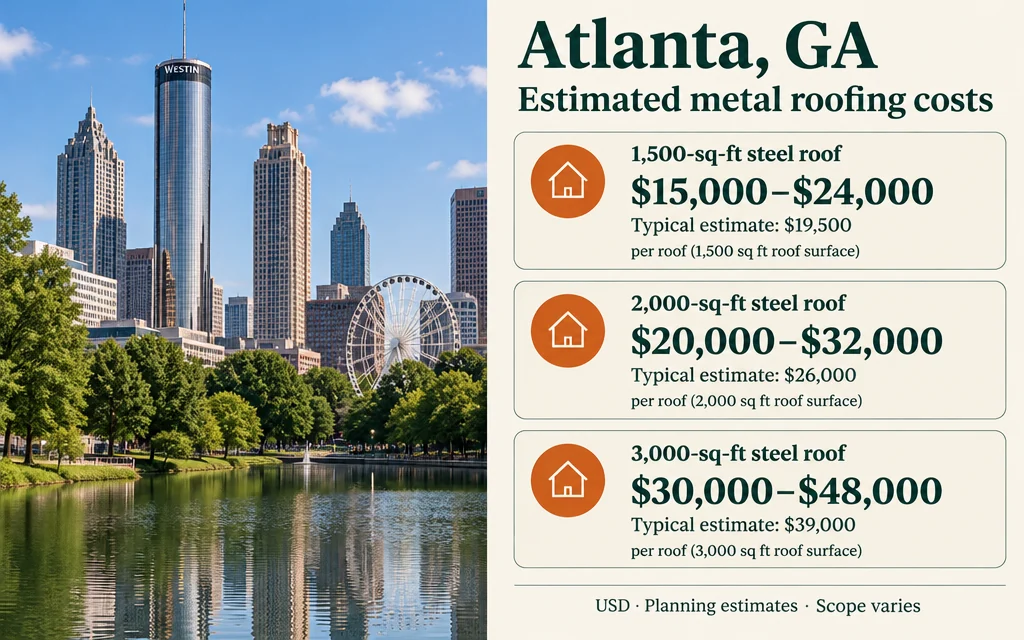
Calculated installed planning scenario for measured roof surface, including one-layer removal/disposal; conditional extras excluded.
Calculated installed planning scenario for measured roof surface, including one-layer removal/disposal; conditional extras excluded.
Calculated installed planning scenario for measured roof surface, including one-layer removal/disposal; conditional extras excluded.
Metal Roof System Overview for Atlanta Homes
A residential metal roof is an engineered system designed to shed heavy rain, resist wind gusts during summer thunderstorms, and handle routine thermal expansion. Unlike standard asphalt composition shingles that rely on overlapping granular tabs, metal installations use interlocking seams or continuous vertical panels over a prepared wood deck.
For a concealed-fastener standing seam steel roof in Atlanta, budget $10–$16 per sq ft of roof surface (installed). That estimate assumes tearing off one layer of existing asphalt shingles and installing new panels over sound wood decking. By contrast, exposed-fastener steel panels budget $4.50–$7 per sq ft of roof surface (installed).
Roofing estimates use the 'roofing square,' an industry measurement equal to 100 square feet of actual sloped roof area. Interior conditioned living space does not match roof surface one-to-one because of slopes, overhangs, and garage areas. A 2,000-square-foot single-story home with standard pitches typically encompasses 2,200 to 2,600 square feet of actual roof surface. When you compare quotes, confirm whether the written scope covers panel fabrication, tear-off, high-temperature underlayment, and custom perimeter flashing trims.
Residential Metal Roofing Systems Compared
Concealed-fastener standing seam steel is the standard profile for residential architectural metal roofs. Built from 24- or 26-gauge Galvalume steel, these panels lock together over concealed clips fastened to the roof deck, with an on-site installation schedule of 4-6 working days.
Because the clips let the metal float, long panel runs expand and contract in summer heat without pulling against screw holes. Panels coated with PVDF resins preserve their color under strong Georgia sunlight and work on low slopes down to 2:12 or lower when mechanically seamed.
Exposed-fastener steel panels, such as 5V crimp, AG-panel, or commercial R-panel, run $4.50–$7 per sq ft of roof surface (installed) and usually take 2-4 working days. Installers drive hex-head screws directly through the metal face into the roof deck, sealing each penetration with an external rubber washer. While economical for outbuildings, porches, or rural retreats, exposed screws restrict thermal expansion. Plan on routine roof inspections because washer seals degrade under heat and ultraviolet radiation over time.
Steel metal shingles and shakes budget $8–$13 per sq ft of roof surface (installed), with work typically taking 4-6 working days. These stamped, modular panels simulate wood shakes, slate, or tile while securing with concealed perimeter clips. They offer a traditional neighborhood profile often favored where subdivision guidelines limit commercial-style vertical ribs.
Specialty architectural metals carry higher initial costs. Standing seam aluminum runs $12–$18 per sq ft of roof surface (installed), requiring 4-6 working days using .032- to .040-inch marine-grade alloy. Aluminum naturally resists rust, making it suitable near lakes or persistently damp, shaded microclimates. Standing seam copper budgets $20–$35 per sq ft of roof surface (installed) with an installation window of 7-12 working days. Copper requires artisan hand-seaming, weathers into a natural patina, and requires no factory paint finish.
| Service / assumptions | Low | Typical estimate | High | Pricing unit | Estimated labor time |
|---|---|---|---|---|---|
| Standing Seam Steel (Installed)Calculated standing-seam steel planning rate: comparable panel/accessory materials + installation labor + one-layer removal/disposal. Ordinary underlayment and details over sound decking included; conditional extra work excluded. | $10 | $13 | $16 | per sq ft of roof surface (installed) | 4-6 working days |
| Exposed-Fastener Steel (Installed)Screw-down 26-29 gauge corrugated, R-panel, or 5V crimp steel panels with gasketed screws and 1-layer tear-off. | $4.50 | $5.50 | $7 | per sq ft of roof surface (installed) | 2-4 working days |
| Steel Metal Shingles (Installed)Stamped steel shake, tile, or slate profile with concealed interlocks and 1-layer tear-off. | $8 | $10.50 | $13 | per sq ft of roof surface (installed) | 4-6 working days |
| Standing Seam Aluminum (Installed)0.032 to 0.040-inch marine-grade aluminum alloy panels, concealed fasteners, and complete tear-off. | $12 | $15 | $18 | per sq ft of roof surface (installed) | 4-6 working days |
| Standing Seam Copper (Installed)16-20 oz cold-rolled architectural copper with hand-seamed or double-locked vertical seams. | $20 | $27.50 | $35 | per sq ft of roof surface (installed) | 7-12 working days |
Standing Seam Steel Cost Breakdown
A standard standing seam steel project breaks down into three distinct elements: panels and trim accessories, specialized installation labor, and demolition of the existing roofing layer.
Materials alone run $4–$7 per sq ft of roof surface (materials only). This covers 24- or 26-gauge Galvalume panels, factory PVDF coatings, continuous starter edges, ridge caps, gable rakes, engineered concealed expansion clips, fasteners, and high-temperature synthetic underlayment. High-temperature underlayment is essential under metal panels because steel transfers daytime heat that breaks down standard residential felt paper.
Skilled installation labor accounts for $5–$7.50 per sq ft of roof surface (installation labor only). Forming panel seams, hemming drip edges, custom-bending valley flashings, and detailing wall transitions require specialized sheet-metal equipment and training. Shingle crews rarely carry the brake tooling or experience necessary for concealed-clip installations.
Tear-off and disposal of a single existing asphalt shingle layer adds $1–$1.50 per sq ft of roof surface (one-layer removal and disposal). That fee covers labor to strip shingles, magnetic sweeps to collect dropped nails, roll-off dumpster delivery, and local disposal fees. Timing for materials delivery, labor, and tear-off is integrated directly into the overall project schedule rather than billed as separate calendar tasks.
| Service / assumptions | Low | Typical estimate | High | Pricing unit | Estimated labor time |
|---|---|---|---|---|---|
| Standing Seam Steel Materials Allowance24-ga Galvalume panels, factory PVDF coating, starter/drip edge, ridge cap, expansion clips, and high-temp underlayment. | $4 | $5.50 | $7 | per sq ft of roof surface (materials only) | N/A |
| Standing Seam Steel Installation LaborCertified installation labor for layout, field forming, seam seaming, and standard trim flashings excluding removal. | $5 | $6.25 | $7.50 | per sq ft of roof surface (installation labor only) | N/A |
| Single-Layer Roof Removal & DisposalTear-off of one layer of asphalt shingles or light metal, site cleanup, roll-off container, and dump fees. | $1 | $1.25 | $1.50 | per sq ft of roof surface (one-layer removal and disposal) | N/A |
Budgeting by Measured Roof Surface Area
To build an accurate project budget, measure your home's total exterior sloped roof area rather than relying on ground-floor living space. Complex hips, dormers, and porch roofs add measurable square footage.
For a compact home or detached garage measuring 1,500 square feet of roof surface, budget $15,000–$24,000 (typical $19,500) for a complete standing seam steel installation. That assumes single-layer removal over a sound substrate, with an elapsed crew schedule of 3-4 working days.
A mid-sized home with 2,000 square feet of roof area runs $20,000–$32,000 (typical $26,000), usually taking 4-6 working days on site.
Larger homes with 3,000 square feet of roof surface across multiple planes and valleys budget $30,000–$48,000 (typical $39,000), with on-site work running 6-9 working days. Unforeseen deck rot, weather delays, or steep architectural transitions will extend these timeframes.
| Service / assumptions | Low | Typical estimate | High | Pricing unit | Estimated labor time |
|---|---|---|---|---|---|
| Standing Seam Steel: 1,500 Sq Ft RoofCalculated scenario: 1,500 sq ft of measured roof surface × standing-seam steel installed planning rate. Includes its same materials, installation, one-layer removal/disposal and sound-deck assumptions. Not a provider whole-roof quote. | $15,000 | $19,500 | $24,000 | per roof (1,500 sq ft roof surface) | 3-4 working days |
| Standing Seam Steel: 2,000 Sq Ft RoofCalculated scenario: 2,000 sq ft of measured roof surface × standing-seam steel installed planning rate. Includes its same materials, installation, one-layer removal/disposal and sound-deck assumptions. Not a provider whole-roof quote. | $20,000 | $26,000 | $32,000 | per roof (2,000 sq ft roof surface) | 4-6 working days |
| Standing Seam Steel: 3,000 Sq Ft RoofCalculated scenario: 3,000 sq ft of measured roof surface × standing-seam steel installed planning rate. Includes its same materials, installation, one-layer removal/disposal and sound-deck assumptions. Not a provider whole-roof quote. | $30,000 | $39,000 | $48,000 | per roof (3,000 sq ft roof surface) | 6-9 working days |
Metal Roofing vs. Architectural Asphalt Shingles
Architectural asphalt shingles remain the baseline choice for Atlanta homes, budgeting $4.50–$6.50 per sq ft of roof surface (installed) with single-layer removal, usually installed in 1-3 working days. Standing seam steel costs roughly two to three times that baseline at $10–$16 per sq ft of roof surface (installed).
Compare that initial price difference against long-term maintenance and lifespan. Georgia's intense summer sun, humidity, and thermal cycling break down asphalt binders, eventually causing granule loss, curled edges, and fungal streaking. Standard asphalt roofs in the South typically require replacement or major work within 18 to 25 years.
A properly installed standing seam steel roof forms a durable barrier that needs little maintenance beyond clearing tree litter from internal valleys. But a higher upfront investment does not guarantee an immediate dollar-for-dollar bump in home resale value. If you plan to move within five to ten years, you may not recover the premium. Metal roofing delivers the strongest return for homeowners who plan to stay put for decades and avoid another full re-roofing cycle.
| Service / assumptions | Low | Typical estimate | High | Pricing unit | Estimated labor time |
|---|---|---|---|---|---|
| Architectural Asphalt Shingle ReferenceBaseline reference: lifetime architectural asphalt shingles with synthetic underlayment and 1-layer removal. Published rate reference for the stated roofing scope and unit, not verification of this guide's modeled range, a complete roof quote or provider availability. Regional reference; not a verified Atlanta-specific quote.Published price reference ↗ | $4.50 | $5.25 | $6.50 | per sq ft of roof surface (installed) | 1-3 working days |
| Comparison | Architectural asphalt | Standing-seam steel |
|---|---|---|
| Up-front planning estimate · 2,000 sq ft roof surface | $9,000–$13,000 | $20,000–$32,000 |
| What the baseline includes | Architectural asphalt, ordinary installed details, one-layer removal/disposal over sound decking. | Standing-seam steel, ordinary installed details, one-layer removal/disposal over sound decking. |
| Maintenance and repairs | Confirm product-specific inspections and repair terms. | Confirm seams, fasteners, coating, compatible repairs and inspection terms. |
| Insurance and ownership cost | Ask the insurer about the exact product and coverage. | Ask the insurer about accepted test documentation, any available credit and cosmetic-damage exclusions. |
These are calculated budgeting comparisons, not provider quotes or guaranteed lifetime savings. Compare your expected ownership period, specified products, actual maintenance proposals and written insurance terms.
| Decision point | Roof repair | Roof replacement | Metal roofing |
|---|---|---|---|
| Work being priced | A defined defect, such as damaged shingles or flashing. | Removal and installation of an agreed roof system across the measured roof surface. | A specified installed metal system; standing seam, exposed fasteners and metal shingles are different scopes. |
| What to inspect | The leak source, surrounding material and whether a durable localized fix is feasible. | The extent of deterioration, decking condition, roof details and suitable replacement systems. | The substrate, panel profile, coating, fasteners, roof geometry and installation details. |
| How to compare prices | Match the repair quantity, access, materials and included diagnosis. | Match measured roof area, material, tear-off layers, disposal and installed inclusions. | Match measured roof area, system, components, removal and conditional additional work. |
| Before deciding | Ask what the repair addresses and what existing problems would remain. | Ask whether repair remains practical and which additional items would change the total. | Ask about compatible materials, documented product/assembly ratings and product versus workmanship warranties. |
Age or a repair-cost percentage alone does not determine the right choice. Ask a qualified roofing contractor to assess the condition and explain viable options. A metal system is a material-specific installation choice, not a separate guarantee of durability or savings.
Additional Scope Items and Common Add-Ons
Roofing bids often outline conditional or add-on items that address specific structural repairs or exterior details. When a roof already holds two layers of old roofing, stripping that extra layer adds $40–$75 additional per roofing square (100 sq ft) for labor and disposal weight.
Decking repairs are impossible to confirm until the existing roof comes off. Summer humidity and poor attic ventilation can cause hidden plywood rot near eaves and valleys. Replacing rotted sheathing runs $75–$125 additional per 4-by-8-ft sheet (32 sq ft) for labor and materials.
Roof penetrations require custom sheet-metal detailing. Custom chimney counter-flashing costs $450–$750 additional per chimney, which covers fabricating an apron, step flashing, and counter-flashing set into masonry joints. Integrating a metal curb kit around a skylight adds $250–$500 additional per skylight.
Ventilation and accessory details also alter the final price. Upgrading to a baffled standing seam ridge vent costs $12–$20 additional per linear ft. Adding color-matched snow and ice retention cleats over entry doorways runs $15–$35 additional per linear ft. If existing seamless gutters must be taken down and re-hung to fit drip edge flashings, budget $5–$10 additional per linear ft. Standalone schedules for these specialty add-ons are not quoted separately; they are completed as part of the overall roofing job.
| Service / assumptions | Low | Typical estimate | High | Pricing unit | Estimated labor time |
|---|---|---|---|---|---|
| Additional Layer Removal & DisposalStripping and disposal for a secondary existing roofing layer beyond the single included base layer. | $40 | $55 | $75 | additional per roofing square (100 sq ft) | N/A |
| Roof Decking Replacement (4x8 Sheet)Replacement of damaged or rotted 1/2-inch CDX plywood or OSB sheathing while roof is stripped. | $75 | $95 | $125 | additional per 4-by-8-ft sheet (32 sq ft) | N/A |
| Custom Metal Chimney FlashingCustom sheet metal cricket, step flashing, apron, and counter-flashing let into masonry joints. | $450 | $600 | $750 | additional per chimney | N/A |
| Skylight Flashing Kit & IntegrationMetal curb flashing kit and membrane tie-in integrated into the surrounding metal roof profile. | $250 | $375 | $500 | additional per skylight | N/A |
| Continuous Metal Ridge Vent UpgradeBaffled, insect-screened standing seam ridge vent installation to optimize attic airflow. | $12 | $16 | $20 | additional per linear ft | N/A |
| Snow & Ice Retention GuardsSeam-clamped color-matched bar or cleat system over doorways and HVAC equipment. | $15 | $25 | $35 | additional per linear ft | N/A |
| Gutter Detach & ResetCarefully removing existing seamless gutters to install eave flashings and re-hanging afterward. | $5 | $7.50 | $10 | additional per linear ft | N/A |
Hail, Wind, and Energy Performance Ratings
Metal roofing components deliver reliable storm protection, but performance depends on verified manufacturer lab testing rather than generic sales descriptions. High-quality 24-gauge standing seam panels frequently hold UL 2218 Class 4 impact ratings, proving they resisted standardized steel ball impact drops without puncturing or splitting.
While Class 4 ratings confirm structural integrity against hail, cosmetic denting can still occur during severe storms. Check with your insurance carrier to see whether premium discounts apply to your address and whether your policy includes a cosmetic damage waiver that excludes payout for minor dimpling.
Wind uplift performance relies on clip spacing and panel engagement. When secured over solid decking with engineered screw schedules, mechanically locked standing seam assemblies can achieve UL 580 Class 90 ratings to hold fast against severe storm gusts.
Energy efficiency stems from surface coating technology. Factory finishes mixed with 'cool roof' reflective pigments reflect solar radiation away from the roof deck. On hot Atlanta afternoons, reflective panels reduce heat transfer into the attic, helping your air conditioning run more efficiently during peak cooling hours.
Cost Factors and Roof Complexity in Atlanta
Several physical property details dictate where your quote falls within regional ranges. Roof pitch is a leading factor: walkable slopes between 4:12 and 6:12 allow crews to stage panels and walk the deck without extra rigging.
Once slopes steepen beyond that, installers need roof jacks, staging scaffolding, and continuous safety tethering, which slows progress and increases labor costs.
Roof design also governs material scrap and fabrication hours. A simple gable roof with two straightforward planes requires minimal cutting and standard trim lengths. In contrast, complex architectural plans with dormers, hips, valleys, and brick abutments require hand-fitted transitions and custom brake-formed flashings, pushing up waste percentages and on-site hours.
Neighborhood staging access introduces real logistical costs. In older, tree-lined Atlanta neighborhoods, long drives, narrow streets, low-hanging branches, and tight lot lines can prevent tractor-trailers or roll-off dumpsters from parking near the home. Installers may have to drop coil stock off-site or carry panels by hand. Before signing a contract, verify how local building permitting and inspections will be handled for your parcel; reputable contractors include pulling the necessary permits in their written scope.
Hiring a Metal Roofing Contractor in Atlanta
Installing architectural sheet metal requires specialized bending brakes, hand seamers, and trained metal crews. When evaluating proposals, make sure the contractor specializes in standing seam systems rather than treating metal as a rare add-on to standard shingle work.
Before awarding a contract, clarify these essential questions with each bidder:
1. What specific certificates of general liability and workers' compensation insurance do you provide, and does the policy explicitly cover steep-slope architectural sheet metal work at my address?
2. What exact steel gauge (such as 24-gauge vs. 26-gauge) and paint system (PVDF/Kynar 500 vs. standard polyester) are listed in the proposal?
3. Will the panels be factory-ordered to length or roll-formed on site from flat coil stock?
4. What specific high-temperature synthetic underlayment brand is included, and does it meet the panel manufacturer's warranty requirements?
5. Are valleys, rakes, and eaves hemmed and hooked over starter cleats, or does the installation rely on exposed exterior caulk?
6. What manufacturer finish warranty and contractor workmanship guarantees come in writing, and what fixed unit price will apply per 4x8 sheet if damaged decking is found?
Local income & housing costs
Atlanta city, Georgia · U.S. Census Bureau, 2025 ACS 1-year estimates.
per month · ±$43
Cash-rent units; includes applicable tenant-paid utilities
Census source ↗Dollar amounts use the survey period’s published basis. Income is annual; gross rent is monthly. Home value reflects owner-occupied housing values. Margins of error shown are at the ACS 90% confidence level. These statistics provide city context; service budgets use their own pricing evidence.
STATEWIDE COST CONTEXT
Georgia prices, income & labor costs
These Georgia figures provide background for this city guide. They describe different measures and reference years; employee wages are not prices charged by a contractor.
BEA SAIRPD
State price change indicator
119.12024 · index (2017 basis)
Annual figures & sources
| Year | Value | 90% margin of error | Source |
|---|---|---|---|
| 2020 | 98.9 | — | Official source |
| 2021 | 104.3 | — | Official source |
| 2022 | 111.1 | — | Official source |
| 2023 | 116.3 | — | Official source |
| 2024 | 119.1 | — | Official source |
Census ACS 1-year
Median household income
$81,8472025 · USD/year
Annual figures & sources
| Year | Value | 90% margin of error | Source |
|---|---|---|---|
| 2021 | $66,559 | ±$712 | Official source |
| 2022 | $72,837 | ±$640 | Official source |
| 2023 | $74,632 | ±$833 | Official source |
| 2024 | $79,991 | ±$633 | Official source |
| 2025 | $81,847 | ±$761 | Official source |
BLS OEWS
Roofers
$22.572025 · USD/hour
Annual figures & sources
| Year | Value | 90% margin of error | Source |
|---|---|---|---|
| 2025 | $22.57 | — | Official source |
State prices: BEA, 2020–2024. Household income: Census ACS, 2021–2025. Employee wages: BLS, May 2025 snapshot. The charts retain their own units and fitted scales.
Explore all Georgia living-cost data and trends →Local context and limitations
Atlanta's climate brings hot summers, high humidity, frequent thunderstorms, and heavy tree canopy debris from mature pines and oaks. Steel roofing in north-central Georgia performs best when specified with factory-applied polyvinylidene fluoride (PVDF/Kynar 500) coatings over Galvalume steel to resist ultraviolet chalking and fade. In wooded neighborhoods, roof valleys and flashing transitions collect fallen needles and leaves, making smooth concealed-fastener standing seam profiles easier to maintain than exposed screw heads. Because direct city-level published price sheets are limited, the figures in this guide serve as regional planning benchmarks rather than binding contractor bids.
Frequently asked questions
What is the primary difference between standing seam and exposed fastener panels?
Standing seam roofs feature raised vertical ribs that snap or lock together over concealed clips, leaving zero fastener penetrations open to the weather and letting panels expand freely with temperature shifts. Exposed-fastener systems are screwed directly through the face of the metal into the roof deck. While exposed fasteners cost less upfront, their rubber washers degrade under sun exposure and can leak or back out after 10 to 15 years.
How do I calculate the measured roof surface area from my home's square footage?
Roof surface area is always greater than interior floor space because of pitch, overhangs, and attached garages. A 2,000-square-foot single-level ranch home with a modest 4:12 pitch typically encompasses 2,300 to 2,500 square feet of actual sloped roof surface (23 to 25 roofing squares). Professional contractors verify exact surface area using aerial satellite imaging or on-site laser measurements.
Can a metal roof be installed directly over existing shingles in Atlanta?
Whether an overlay is permitted depends on local building codes, structural load capacity, and manufacturer warranty rules. Even where permitted over a single smooth asphalt layer, roofing contractors usually recommend a complete tear-off. Stripping old shingles lets the crew inspect the wood deck for hidden moisture rot, ensures panels lay flat, and prevents trapping heat between old materials.
Will installing a metal roof reduce my home insurance premiums in Georgia?
Some insurance providers offer discounts on homeowner premiums for roofs carrying a verified UL 2218 Class 4 impact resistance rating. However, discounts vary by carrier and policy type. Check with your insurance agent beforehand, and confirm whether the policy includes a cosmetic damage exclusion that denies claims for minor hail dents that do not cause active leaks.
Are metal roofs significantly noisier during heavy Georgia rainstorms?
When installed over a standard solid plywood deck with high-temperature underlayment and conventional attic insulation, a metal roof sounds very similar to asphalt shingles during heavy rain. The wood sheathing, synthetic membrane, and attic insulation deaden the sound of raindrops, keeping indoor living spaces quiet.
What metal gauge and finish should I look for in an Atlanta residential quote?
For standing seam steel installations, look for 24-gauge Galvalume steel (or 26-gauge for narrow panel widths) coated with a PVDF resin-based finish like Kynar 500 or Hylar 5000. PVDF finishes resist chalking, fading, and micro-cracking caused by Georgia's strong ultraviolet sunlight far better than standard polyester coatings.
Sources and methodology
Sources below retain their recorded retrieval dates and geographic scope. We checked the quoted rates against readable public pricing pages. The tables remain planning estimates, not provider quotes or a measured citywide survey. Per-square-foot references do not establish the modeled whole-roof totals or all their installed inclusions. Regional references are not verified Atlanta-specific quotes. Confirm removal, disposal, materials, labor and the complete scope in a written proposal.
Published pricing pages retrieved; quoted excerpts checked automatically. 2 distinct website domains. · Generated 2026-11-12
- Metal Roofing in Georgia: Benefits, Costs, and ConsiderationsState / regional reference · Page retrieved 2026-11-12 · Price excerpt matched automatically
“Asphalt architectural shingles install at $4 to $8 per square foot by comparison.”
Planning ranges may differ from these published examples; they are not provider quotes.
- Roof Replacement Cost in Georgia (2026 Pricing Guide)State / regional reference · Page retrieved 2026-11-12 · Price excerpt matched automatically
“What is the cheapest roofing material in Georgia? 3-tab asphalt shingles are the cheapest option at $3.50 to $5.00 per sq ft installed.”
Planning ranges may differ from these published examples; they are not provider quotes.
Plan your metal roofing project
Choose your service and answer its project questions. Add notes or photos if helpful, then generate your project brief. The planner labels its budgeting assumptions separately. Use your plan to compare the scope and assumptions with a provider. Contact sharing and provider matching are not available yet.
Open the project planner →Share this city’s cost data
<> Embed Atlanta Cost Data on Your Site
The HTML table shows the prices at the time of copying. The iframe follows the published guide.