Atlanta · GA · COST GUIDE
Roof Replacement & New Roof Costs in Atlanta, GA (2026)
For budgeting, architectural asphalt replacement is estimated at $6,750–$11,250 for a 1,500-sq-ft roof and $9,000–$15,000 for a 2,000-sq-ft roof. These roof-surface scenarios include one-layer tear-off, disposal, labor and materials over sound decking; separately quoted extras are excluded.
Architectural asphalt: 1,500-sq-ft roof
Budget estimate$6,750–$11,250per roof (1,500 sq ft roof surface)
Planning range · Compare the roof area, material and included work in your quote.
Architectural asphalt: 2,000-sq-ft roof
Budget estimate$9,000–$15,000per roof (2,000 sq ft roof surface)
Planning range · Compare the roof area, material and included work in your quote.
Published examples apply to their stated scope. Budget ranges are estimates.
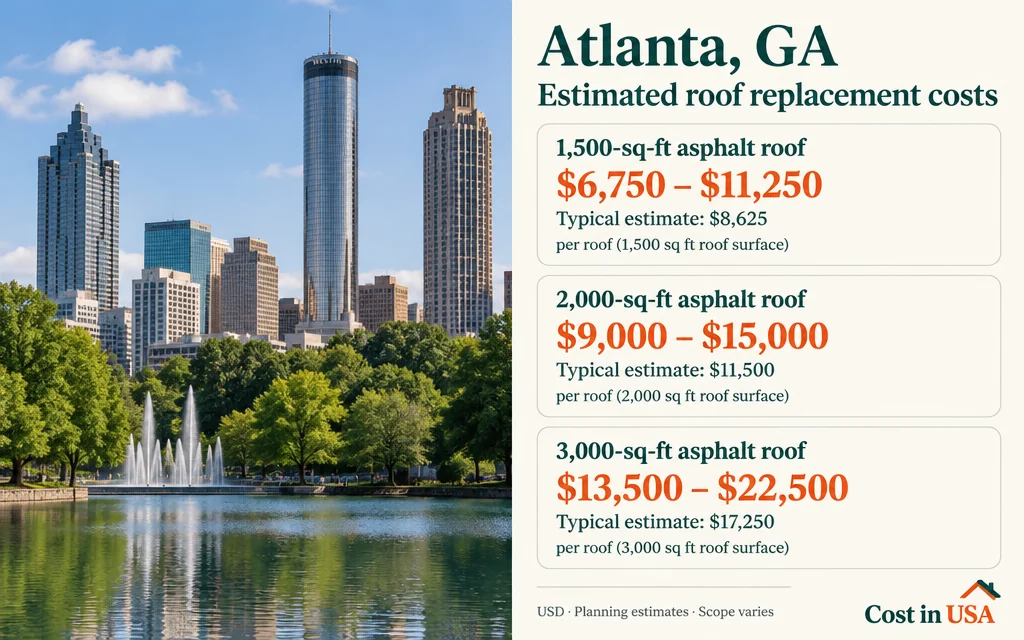
Calculated installed planning estimate for measured roof surface, with one-layer removal and disposal; extras excluded.
Calculated installed planning estimate for measured roof surface, with one-layer removal and disposal; extras excluded.
Calculated installed planning estimate for measured roof surface, with one-layer removal and disposal; extras excluded.
How much does a new roof cost in Atlanta?
Replacing an architectural asphalt shingle roof on an existing home in Atlanta typically means you should budget $4.50–$7.50 per sq ft of roof surface (installed). For a standard 2,000-square-foot roof surface, plan to budget $9,000–$15,000 per roof (2,000 sq ft roof surface), with typical projects landing near $11,500.
That installed baseline covers tear-off and disposal of one layer of old shingles, synthetic underlayment, drip edge along eaves and rakes, starter shingles, ridge caps, fasteners, cleanup, and crew labor over sound decking. It does not include optional ventilation upgrades, chimney reflashing, or replacing rotted wood decking discovered after the old roof is stripped.
Roof surface area differs significantly from interior living space. Pitch, overhangs, hips, and dormers expand the exterior footprint. A two-story home with 2,400 square feet of heated floor space may only need 1,400 square feet of roofing, while a sprawling 2,000-square-foot ranch home with deep eaves can measure 2,400 square feet of actual roof surface.
When homeowners ask about new roof costs, they almost always mean a complete replacement on an existing house. That differs from new construction, where crews install underlayment and shingles over clean, newly framed decking without the labor or disposal costs of removing old roofing.
Roofing Materials Compared for Atlanta Homes
Your material selection shapes project cost and dictates how well the roof withstands heat, rain, and tree debris.
Architectural asphalt shingles serve as the standard residential baseline; budget $4.50–$7.50 per sq ft of roof surface (installed). Their laminated construction provides greater wind resistance and dimensional texture than basic three-tab asphalt shingles, which budget $3.50–$5.25 per sq ft of roof surface (installed). While three-tab shingles cost less upfront, they offer lower wind resistance during severe summer squalls and are rarely selected for whole-house reroofing today.
Standing-seam metal roofing calls for a budget of $9–$16 per sq ft of roof surface (installed). With concealed fasteners, raised locking seams, and reflective factory finishes, standing seam sheds heavy rain quickly and reduces solar heat gain in warm attics. Exposed-fastener metal panels budget $6–$9.50 per sq ft of roof surface (installed); they offer a lower initial investment, but the exterior neoprene washer screws need routine inspection as washers weather. Concrete tile runs a budget of $10.50–$18.50 per sq ft of roof surface (installed), while clay tile reaches a budget of $14–$25 per sq ft of roof surface (installed). Both tile options provide exceptional durability, but their substantial weight requires a structural engineer or licensed builder to confirm framing capacity.
| Service / assumptions | Low | Typical estimate | High | Pricing unit | Estimated labor time |
|---|---|---|---|---|---|
| Architectural asphalt shingles (installed)Includes tear-off of one existing shingle layer, synthetic underlayment, starter course, drip edge, ridge cap, and labor over sound decking. Published rate reference for the stated roofing scope and unit, not verification of this guide's modeled range, a complete roof quote or provider availability. Regional reference; not a verified Atlanta-specific quote.Published price reference ↗ | $4.50 | $5.75 | $7.50 | per sq ft of roof surface (installed) | N/A |
| Three-tab asphalt shingles (installed)Budget strip shingle installation with one-layer removal; lower wind resistance than dimensional shingles. Published rate reference for the stated roofing scope and unit, not verification of this guide's modeled range, a complete roof quote or provider availability. Regional reference; not a verified Atlanta-specific quote.Published price reference ↗ | $3.50 | $4.25 | $5.25 | per sq ft of roof surface (installed) | N/A |
| Standing-seam metal roof (installed)Concealed fastener steel panels with high-temperature underlayment and full flashing package; includes tear-off. | $9 | $12 | $16 | per sq ft of roof surface (installed) | N/A |
| Exposed-fastener metal roof (installed)Screw-through ribbed steel panels; requires periodic washer inspection and fastener maintenance. | $6 | $7.75 | $9.50 | per sq ft of roof surface (installed) | N/A |
| Concrete tile roof (installed)Heavyweight concrete tiles with specialized battens and underlayment; requires structural load verification. | $10.50 | $14.50 | $18.50 | per sq ft of roof surface (installed) | N/A |
| Clay tile roof (installed)Premium barrel or flat clay tiles; exceptional longevity but requires verified roof framing capacity. | $14 | $19 | $25 | per sq ft of roof surface (installed) | N/A |
| Product type | How to compare |
|---|---|
| Three-tab asphalt | Compare the specified product and installed scope with the three-tab rate row. |
| Architectural asphalt | The baseline for the calculated roof-size budgets in this guide. |
| Premium or designer asphalt | Request a product-specific installed proposal; this guide does not invent a separate premium rate. |
Product names and grades alone do not establish an impact, wind or fire rating. Compare the exact product documentation, installation requirements and written warranty.
Roof Replacement Costs by Home and Roof Size
Roofers price materials and labor by the "square," which equals 100 square feet of roof surface. The examples below show complete architectural asphalt replacement estimates across three common footprints, derived from the baseline rate of $4.50–$7.50 per sq ft of roof surface (installed).
A compact 1,500-square-foot roof surface calls for a budget of $6,750–$11,250 per roof (1,500 sq ft roof surface), with typical jobs running about $8,625. On an accessible roof with straightforward slopes, on-site work typically takes 1-2 working days (crew of 5-6).
A mid-sized 2,000-square-foot roof surface calls for a budget of $9,000–$15,000 per roof (2,000 sq ft roof surface), with typical installations settling near $11,500. A crew usually completes tear-off and reroofing within 1-2 working days (crew of 5-6).
A larger 3,000-square-foot roof surface scales to a budget of $13,500–$22,500 per roof (3,000 sq ft roof surface), with mid-range projects landing around $17,250. This scope generally requires 2-3 working days (crew of 5-6). Complex roof geometries, steep rakes, or restricted site access for dump trailers will push both labor costs and timelines toward the upper end.
| Service / assumptions | Low | Typical estimate | High | Pricing unit | Estimated labor time |
|---|---|---|---|---|---|
| Architectural asphalt: 1,500-sq-ft roofCalculated planning scenario: 1,500 sq ft of measured roof surface × architectural-asphalt installed rate. Includes the same one-layer tear-off, disposal, labor, materials and sound-deck baseline; separately quoted extras excluded. | $6,750 | $8,625 | $11,250 | per roof (1,500 sq ft roof surface) | 1-2 working days (crew of 5-6) |
| Architectural asphalt: 2,000-sq-ft roofCalculated planning scenario: 2,000 sq ft of measured roof surface × architectural-asphalt installed rate. Includes the same one-layer tear-off, disposal, labor, materials and sound-deck baseline; separately quoted extras excluded. | $9,000 | $11,500 | $15,000 | per roof (2,000 sq ft roof surface) | 1-2 working days (crew of 5-6) |
| Architectural asphalt: 3,000-sq-ft roofCalculated planning scenario: 3,000 sq ft of measured roof surface × architectural-asphalt installed rate. Includes the same one-layer tear-off, disposal, labor, materials and sound-deck baseline; separately quoted extras excluded. | $13,500 | $17,250 | $22,500 | per roof (3,000 sq ft roof surface) | 2-3 working days (crew of 5-6) |
Low-Slope and Flat Roof Systems
Many Atlanta homes feature flat or low-pitch architectural elements, such as rear additions, covered back porches, or carports. Roof pitches shallower than 2:12 do not shed water fast enough for standard asphalt shingles, requiring a dedicated low-slope waterproofing membrane.
TPO (thermoplastic polyolefin) membrane roofing calls for a budget of $5.50–$10 per sq ft of roof surface (installed). The heat-welded seams form a continuous waterproof barrier, and the light-colored surface reflects intense summer heat. EPDM synthetic rubber membranes budget $5.25–$9.50 per sq ft of roof surface (installed). EPDM handles thermal movement and seasonal expansion reliably, though dark membranes absorb ambient warmth unless treated with an optional reflective coating.
Both membrane systems require proper attachment over clean insulation or cover boards sloped toward perimeter gutters. These single-ply products address specific low-pitch transitions rather than substituting for steep-slope shingles across the entire house.
| Service / assumptions | Low | Typical estimate | High | Pricing unit | Estimated labor time |
|---|---|---|---|---|---|
| TPO single-ply membrane (installed)Heat-welded thermoplastic membrane over cover board; suitable for flat or low-pitch additions and porches. | $5.50 | $7.50 | $10 | per sq ft of roof surface (installed) | N/A |
| EPDM rubber membrane (installed)Adhered synthetic vulcanized rubber membrane with seam tape; standard flat residential roofing system. | $5.25 | $7 | $9.50 | per sq ft of roof surface (installed) | N/A |
Tear-Off vs. Overlay: Protecting Your Decking
A full tear-off strips away old shingles and underlayment down to bare decking. An overlay, or reroof, nails a fresh layer directly over old shingles.
While an overlay bypasses immediate removal labor, it carries serious trade-offs in humid climates.
Leaving the old roof in place prevents crews from inspecting the wooden decking for rot, sagging, or water penetration around valleys and chimneys. Trapped moisture between two shingle layers accelerates deck degradation and causes the top shingles to curl or blister prematurely. Overlaying also adds substantial dead weight to your roof framing, and many shingle manufacturers limit warranty coverage on roof-over installations.
Building codes commonly set a two-layer ceiling for asphalt shingle assemblies, though local requirements should be verified with your municipal building department. If your roof already carries two layers, full removal is mandatory. Base replacement quotes include removing one layer; hauling away a second existing layer requires you to budget $110–$175 additional per roofing square (100 sq ft) for the extra crew labor and disposal weight.
Common Add-Ons, Flashing, and Hidden Repairs
Carpentry repairs and custom metal details are billed as separate line items when uncovered during the tear-off process.
Rotted or softened decking cannot be fully identified until old materials are stripped. For damaged 4x8-foot plywood or OSB sheets, budget $65–$150 additional per 4-by-8-ft sheet (32 sq ft). Replacing rotted wood fascia along the eaves means budgeting $14–$34 additional per linear ft, and repairing damaged vented soffit panels calls for a budget of $12–$28 additional per sq ft.
Balanced ventilation protects attic rafters from condensation and lowers summer cooling loads. Installing a continuous shingle-over ridge vent requires a budget of $9–$20 additional per linear ft. Rebuilding masonry chimney step and counterflashing means you should budget $400–$1,400 additional per chimney, while replacing step flashing on an existing skylight calls for a budget of $350–$850 additional per skylight. If gutters must be removed to install new drip edge and fascia cleanly, detaching and reinstalling them calls for a budget of $4.50–$11 additional per linear ft.
| Service / assumptions | Low | Typical estimate | High | Pricing unit | Estimated labor time |
|---|---|---|---|---|---|
| Second layer tear-off & disposalIncremental labor and dumpster weight fees when removing a second shingle layer. First layer included in base rate. | $110 | $140 | $175 | additional per roofing square (100 sq ft) | N/A |
| Roof decking replacement (4x8 sheet)Installed 7/16-inch OSB or CDX plywood to replace rotted decking exposed after shingle removal. | $65 | $95 | $150 | additional per 4-by-8-ft sheet (32 sq ft) | N/A |
| Fascia board replacementRemoval of damaged wood fascia and replacement with primed wood or composite board before gutter install. | $14 | $22 | $34 | additional per linear ft | N/A |
| Soffit repair or replacementVented vinyl, aluminum, or wood soffit replacement to maintain proper eave intake ventilation. | $12 | $18 | $28 | additional per sq ft | N/A |
| Shingle-over ridge vent installationContinuous ridge exhaust vent cut into peak and capped with matching ridge shingles, paired with eave vents. | $9 | $14 | $20 | additional per linear ft | N/A |
| Chimney flashing rebuildStep flashing, counterflashing cut into masonry joints, and rear cricket installation if needed. | $400 | $750 | $1,400 | additional per chimney | N/A |
| Skylight flashing kit installationStep flashing replacement and ice-and-water wrap around existing skylight curb without unit replacement. | $350 | $550 | $850 | additional per skylight | N/A |
| Gutter detach and resetCarefully taking down existing gutters to access drip edge or fascia, then reinstalling and leveling them. | $4.50 | $7 | $11 | additional per linear ft | N/A |
Key Factors Driving Roof Replacement Costs
Several job-site conditions influence where a project lands within the estimated price range.
Pitch and Roof Geometry: Walkable roofs with simple gables require minimal staging and allow crews to move quickly. In contrast, steep pitches require roof jacks, safety harnesses, and slower material handling. Intricate designs with multiple valleys, intersecting hips, and dormers require custom hand cuts and extensive flashing, raising labor hours.
Property Access and Ground Protection: Mature tree cover, steep driveways, and tight perimeter yards can prevent dump trailers and boom trucks from parking close to the roof edge. When workers must hand-carry bundles or wheelbarrow old shingles across landscaping, setup and cleanup labor increases.
Permit and Inspection Rules: Permitting thresholds and inspection requirements vary across the Atlanta area depending on the municipality, county, and project scope (such as whether structural decking or framing replacement is involved). Always verify permitting obligations directly with the local building office for your specific address, and confirm in writing whether you or your contractor is responsible for securing any necessary permits.
Repair vs. Replacement: Making the Right Call
Deciding whether to patch an isolated problem or replace the entire roof comes down to the extent of the damage, shingle flexibility, and the overall condition of the system.
A targeted repair makes sense when damage is localized. If a falling tree limb cracks several shingles, wind lifts a short section of ridge cap, or a pipe boot collar splits, a contractor can complete a spot fix without replacing sound surrounding roofing, as long as adjacent shingles remain pliable.
A full replacement is warranted when aging is widespread. Clear signs include extensive granule loss across major slopes, pervasive curling, brittle tabs that break during inspection, or leaks occurring in multiple rooms. Once shingles have baked through years of intense sun and lost their elasticity, nailing into them during a spot patch often cracks adjoining materials, making recurring repairs impractical.
| Decision point | Roof repair | Roof replacement | Metal roofing |
|---|---|---|---|
| Work being priced | A defined defect, such as damaged shingles or flashing. | Removal and installation of an agreed roof system across the measured roof surface. | A specified installed metal system; standing seam, exposed fasteners and metal shingles are different scopes. |
| What to inspect | The leak source, surrounding material and whether a durable localized fix is feasible. | The extent of deterioration, decking condition, roof details and suitable replacement systems. | The substrate, panel profile, coating, fasteners, roof geometry and installation details. |
| How to compare prices | Match the repair quantity, access, materials and included diagnosis. | Match measured roof area, material, tear-off layers, disposal and installed inclusions. | Match measured roof area, system, components, removal and conditional additional work. |
| Before deciding | Ask what the repair addresses and what existing problems would remain. | Ask whether repair remains practical and which additional items would change the total. | Ask about compatible materials, documented product/assembly ratings and product versus workmanship warranties. |
Age or a repair-cost percentage alone does not determine the right choice. Ask a qualified roofing contractor to assess the condition and explain viable options. A metal system is a material-specific installation choice, not a separate guarantee of durability or savings.
Hiring a Roofing Contractor in Atlanta
Thoroughly evaluating contractor credentials ensures quality installation and protects you from job-site liability.
Insurance and Qualifications: Request a certificate of general liability and workers' compensation coverage sent directly from the insurer. In Georgia, verify active business registration and any applicable trade credentials. Trade affiliations, such as membership in the Georgia Roofing Contractors Association (GARCA) or manufacturer-certified installer designations, reflect established business operations.
Detailed Scope of Work: Ensure your written contract details the shingle manufacturer, product line, underlayment type, drip edge gauge, valley protection, and ventilation layout. The estimate should also set transparent unit pricing for contingent repairs, such as per-sheet decking replacement, so unforeseen rot does not lead to surprise charges.
Payment Structure and Warranties: Confirm what the contractor's workmanship warranty covers versus the manufacturer's material warranty. Avoid contractors who demand full payment before work begins. A modest deposit to order materials and schedule the crew is customary, with the final payment due only after the roof is complete, the grounds are swept clean with a magnetic nail roller, and you have inspected the finished work.
Local income & housing costs
Atlanta city, Georgia · U.S. Census Bureau, 2025 ACS 1-year estimates.
per month · ±$43
Cash-rent units; includes applicable tenant-paid utilities
Census source ↗Dollar amounts use the survey period’s published basis. Income is annual; gross rent is monthly. Home value reflects owner-occupied housing values. Margins of error shown are at the ACS 90% confidence level. These statistics provide city context; service budgets use their own pricing evidence.
STATEWIDE COST CONTEXT
Georgia prices, income & labor costs
These Georgia figures provide background for this city guide. They describe different measures and reference years; employee wages are not prices charged by a contractor.
BEA SAIRPD
State price change indicator
119.12024 · index (2017 basis)
Annual figures & sources
| Year | Value | 90% margin of error | Source |
|---|---|---|---|
| 2020 | 98.9 | — | Official source |
| 2021 | 104.3 | — | Official source |
| 2022 | 111.1 | — | Official source |
| 2023 | 116.3 | — | Official source |
| 2024 | 119.1 | — | Official source |
Census ACS 1-year
Median household income
$81,8472025 · USD/year
Annual figures & sources
| Year | Value | 90% margin of error | Source |
|---|---|---|---|
| 2021 | $66,559 | ±$712 | Official source |
| 2022 | $72,837 | ±$640 | Official source |
| 2023 | $74,632 | ±$833 | Official source |
| 2024 | $79,991 | ±$633 | Official source |
| 2025 | $81,847 | ±$761 | Official source |
BLS OEWS
Roofers
$22.572025 · USD/hour
Annual figures & sources
| Year | Value | 90% margin of error | Source |
|---|---|---|---|
| 2025 | $22.57 | — | Official source |
State prices: BEA, 2020–2024. Household income: Census ACS, 2021–2025. Employee wages: BLS, May 2025 snapshot. The charts retain their own units and fitted scales.
Explore all Georgia living-cost data and trends →Local context and limitations
Atlanta homes face long, humid summers, heavy thunderstorm downpours, and dense tree canopies dominated by mature oaks and pines. Heavy shade slows moisture drying along valleys and lower-pitch sections, making adequate attic ventilation and algae-resistant granules practical priorities. Because direct city-level published rate sheets are limited, figures in this guide serve as regional planning estimates drawn from northern Georgia pricing. Building inspection policies and permit triggers vary between the City of Atlanta and surrounding Fulton or DeKalb county jurisdictions; confirm permit requirements and responsible parties with your local building department before signing a contract.
Frequently asked questions
How much does a new roof cost in Atlanta?
Replacing an architectural asphalt shingle roof on a typical 2,000-square-foot roof surface in Atlanta calls for a budget of $9,000–$15,000 per roof (2,000 sq ft roof surface), with average jobs landing near $11,500. Baseline rates run a budget of $4.50–$7.50 per sq ft of roof surface (installed), which covers tear-off of one layer, synthetic underlayment, drip edge, ridge caps, labor, and disposal over sound decking.
Is getting a new roof the same as roof replacement?
Homeowners often use the terms interchangeably, but they describe distinct scopes. A roof replacement strips old shingles and underlayment down to bare decking before installing a new system. An overlay nails new shingles over an existing layer. In new construction, a new roof installs materials over fresh, bare framing without the labor or disposal fees of removing an old roof.
How long does a roof replacement take on an Atlanta home?
A standard architectural asphalt installation on a 1,500-to-2,000-square-foot roof surface typically takes 1-2 working days (crew of 5-6). Larger roofs around 3,000 square feet usually take 2-3 working days (crew of 5-6). Decking rot, multi-layer tear-offs, steep slopes, or rain delays can extend the on-site timeline.
Does roof replacement in the Atlanta area require a permit?
Permit requirements depend on the governing municipality or county authority and the specific scope of work, such as whether structural roof framing or sheathing is modified. Because building rules differ between the City of Atlanta and surrounding jurisdictions, contact your local municipal or county building department to verify current requirements, and check that your contract identifies who pulls any required permits.
Can I install a metal roof over my existing shingles in Atlanta?
While certain installation methods may allow lightweight metal over a single layer of shingles in specific contexts, most contractors advise against it in hot, humid climates. Stripping down to the deck allows crews to inspect sheathing for rot or water damage before fastening panels. An overlay can also trap moisture between layers and may void or limit manufacturer warranties.
What happens if contractors find rotted decking under my old roof?
Rotted or sagging decking must be replaced before new underlayment can be nailed down. Replacing damaged 4x8-foot plywood or OSB sheets means you should budget $65–$150 additional per 4-by-8-ft sheet (32 sq ft). A reputable contractor will document the rotted areas with photos and charge according to the unit price defined in your contract.
Sources and methodology
These planning estimates draw on publicly available pricing pages read on 2026-11-10. No city-specific prices were established by the cited pages, so the ranges use out-of-area references for budgeting. Published starting rates and individual provider prices are reference points, not final local quotes. Confirm service availability, minimum charges, included work and travel charges with the provider.
Published pricing pages retrieved; quoted excerpts checked automatically. 2 distinct website domains. · Generated 2026-11-10
- How Much Does a Roof Cost in Atlanta? The 2026 Price Guide - Red Roofing & Gutters Red Roofing & GuttersState / regional reference · Page retrieved 2026-11-10 · Price excerpt matched automatically
“Here’s what Atlanta homeowners are paying per square foot installed in 2026, and why you might choose each: 3-tab asphalt shingles — roughly $4.40–$7.80/sq ft.”
Planning ranges may differ from these published examples; they are not provider quotes.
- Roof Replacement Cost in Marietta, GA (2026 Price Guide)State / regional reference · Page retrieved 2026-11-10 · Price excerpt matched automatically
“In October 2026, architectural shingle replacement here runs $4.50 to $7.00 per square foot installed, with a typical job landing between $12,000 and $22,000.”
Planning ranges may differ from these published examples; they are not provider quotes.
Plan your roof replacement project
Choose your service and answer its project questions. Add notes or photos if helpful, then generate your project brief. The planner labels its budgeting assumptions separately. Use your plan to compare the scope and assumptions with a provider. Contact sharing and provider matching are not available yet.
Open the project planner →Share this city’s cost data
<> Embed Atlanta Cost Data on Your Site
The HTML table shows the prices at the time of copying. The iframe follows the published guide.