Columbus · OH · COST GUIDE
Metal Roofing Costs in Columbus, OH (2026)
For budgeting, standing-seam steel roofing is estimated at $11–$17 per sq ft of roof surface, and exposed-fastener steel at $6.50–$11.50 per sq ft. These installed planning ranges include one-layer removal/disposal over sound decking; compare the specified system and conditional extras.
Standing Seam Steel Roof (Installed)
Budget estimate$11–$17per sq ft of roof surface (installed)
Planning range · Compare the roof area, material and included work in your quote.
Exposed-Fastener Steel Roof (Installed)
Budget estimate$6.50–$11.50per sq ft of roof surface (installed)
Planning range · Compare the roof area, material and included work in your quote.
Published examples apply to their stated scope. Budget ranges are estimates.
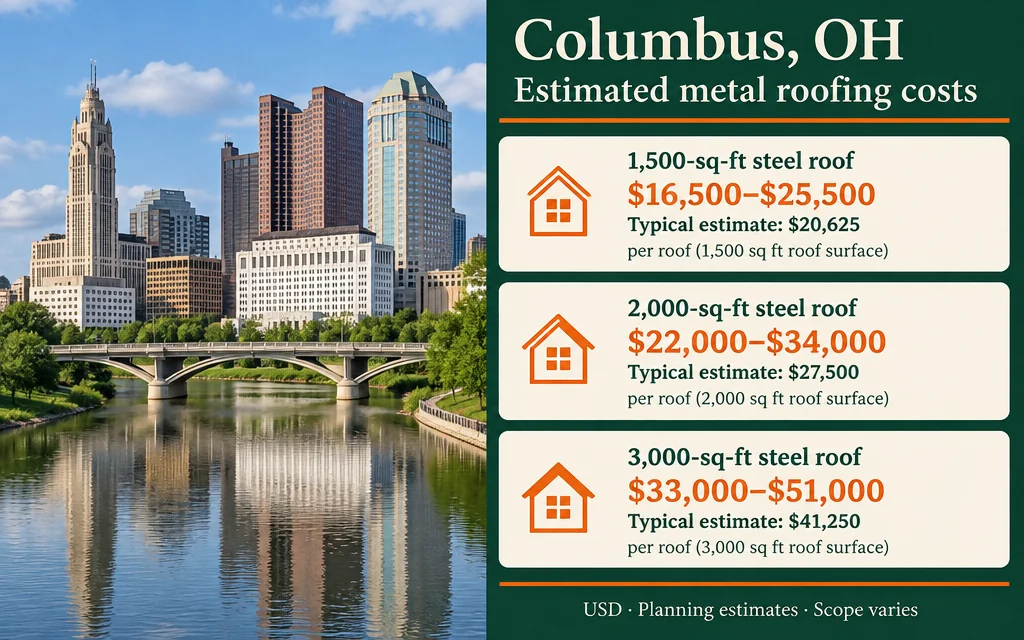
Calculated installed planning scenario for measured roof surface, including one-layer removal/disposal; conditional extras excluded.
Calculated installed planning scenario for measured roof surface, including one-layer removal/disposal; conditional extras excluded.
Calculated installed planning scenario for measured roof surface, including one-layer removal/disposal; conditional extras excluded.
Residential Metal Roofing in Columbus
Metal roofing in central Ohio has grown from an agricultural and commercial standard into a popular residential option. Homeowners across Columbus turn to metal primarily for resistance against wind, hail, and the wear caused by winter freezing cycles and humid summers.
Accurate budgeting starts with measuring actual roof plane area rather than interior living space. Pitch, overhangs, and dormers mean an 1,800-square-foot ranch frequently has 2,100 to 2,400 square feet of roof surface. For preliminary planning in Columbus, expect to budget $11–$17 per sq ft of roof surface (installed) for a turnkey standing seam steel system, or budget $6.50–$11.50 per sq ft of roof surface (installed) for exposed-fastener steel. These regional baseline figures cover standard panels, trim, synthetic underlayment, single-layer shingle removal, and disposal over sound decking.
Comparing Residential Metal Roofing Systems
Performance and installation details vary widely across metal roofing styles. The primary residential choice is concealed-fastener standing seam steel, which uses raised vertical seams with hidden attachment clips.
As central Ohio seasons shift, panels expand and contract freely along the concealed clips without stressing fastener holes. Most mechanical standing seam systems require a minimum roof slope of 2:12 (or 3:12 for snap-lock profiles), and panels are commonly manufactured from Galvalume steel with a factory PVDF finish.
Exposed-fastener steel panels budget lower up front, but their screws pass directly through the face of the metal into the decking below with rubber washers. Over time, sunlight and thermal expansion degrade those washers, requiring periodic inspections and maintenance. Stamped steel shingles press metal into slate or shake profiles, often with protective mineral granules, running budget $10–$16.50 per sq ft of roof surface (installed). Standing seam aluminum costs budget $12.50–$19.50 per sq ft of roof surface (installed) and provides natural corrosion resistance, while architectural copper represents the premium end at budget $25–$42 per sq ft of roof surface (installed).
| Service / assumptions | Low | Typical estimate | High | Pricing unit | Estimated labor time |
|---|---|---|---|---|---|
| Standing Seam Steel Roof (Installed)Calculated standing-seam steel planning rate: comparable panel/accessory materials + installation labor + one-layer removal/disposal. Ordinary underlayment and details over sound decking included; conditional extra work excluded. Published rate reference for the stated roofing scope and unit, not verification of this guide's modeled range, a complete roof quote or provider availability. Regional reference; not a verified Columbus-specific quote.Published price reference ↗ | $11 | $13.75 | $17 | per sq ft of roof surface (installed) | 3–5 days |
| Exposed-Fastener Steel Roof (Installed)Screw-down 26- or 29-gauge ribbed/corrugated steel panels with exposed neoprene-gasketed fasteners, including tear-off and standard flashing. | $6.50 | $8.50 | $11.50 | per sq ft of roof surface (installed) | 2–4 days |
| Steel Metal Shingles (Installed)Stamped painted or stone-coated steel modular shingles replicating slate, shake, or tile profiles, fully installed with underlayment. | $10 | $13 | $16.50 | per sq ft of roof surface (installed) | 3–5 days |
| Standing Seam Aluminum Roof (Installed)Concealed-fastener .032-gauge aluminum standing seam panels with natural rust resistance, ideal for damp or shaded sites. | $12.50 | $15.50 | $19.50 | per sq ft of roof surface (installed) | 3–5 days |
| Standing Seam Copper Roof (Installed)Architectural 16-oz or 20-oz cold-rolled copper panels with hand-crimped seams and copper clips; premium lifespan exceeding 75 years. | $25 | $33 | $42 | per sq ft of roof surface (installed) | 5–8 days |
Installed Cost Component Breakdown
A complete standing seam installation in Columbus combines three distinct cost elements: raw materials and trim, installation labor, and existing roof removal.
Materials account for a major share of the contract. For standing seam steel, budget $4.50–$7.25 per sq ft of roof surface (materials only) for 24- or 26-gauge Galvalume panels, underlayment, starter clips, drip edges, and ridge closures. Installation labor for trained sheet metal trades runs budget $5–$7.75 per sq ft of roof surface (installation labor only) for panel alignment, seam crimping, and flashing work, typically taking 3–5 days. Stripping one layer of old shingles down to sound decking and disposing of the debris adds budget $1.50–$2 per sq ft of roof surface (one-layer removal and disposal), which usually wraps up in 1 day.
| Service / assumptions | Low | Typical estimate | High | Pricing unit | Estimated labor time |
|---|---|---|---|---|---|
| Standing Seam Steel Materials Allowance24-ga Galvalume steel panels with PVDF finish, concealed clips, high-temp underlayment, ridge trim, z-closures, and drip edge. | $4.50 | $5.75 | $7.25 | per sq ft of roof surface (materials only) | N/A |
| Standing Seam Steel Installation LaborSkilled crew labor to form, lay, clip, lock, and detail standing seam panels on sound wood decking; excludes tear-off. | $5 | $6.25 | $7.75 | per sq ft of roof surface (installation labor only) | 3–5 days |
| One-Layer Shingle Removal & DisposalLabor to strip one layer of old asphalt shingles and underlayment down to bare deck, clean up site, haul away, and pay disposal fees. | $1.50 | $1.75 | $2 | per sq ft of roof surface (one-layer removal and disposal) | 1 day |
Budgeting by Roof Surface Area
Because metal roofing is priced by actual roof surface rather than indoor square footage, project quotes scale directly with the size and complexity of your roof planes.
A compact home or outbuilding with 1,500 square feet of roof surface lands at budget $16,500–$25,500 per roof (1,500 sq ft roof surface) for a turnkey steel standing seam system, typically taking 2–4 days of on-site crew work. A mid-sized two-story home with a 2,000-square-foot roof surface runs budget $22,000–$34,000 per roof (2,000 sq ft roof surface) with an elapsed time of 3–5 days. Larger roofs spanning 3,000 square feet of surface run budget $33,000–$51,000 per roof (3,000 sq ft roof surface) over 4–6 days. Complex roof geometries with hips, dormers, and multiple valleys require extra cutting and hand-crimped flashing, moving estimates toward the higher end of these ranges.
| Service / assumptions | Low | Typical estimate | High | Pricing unit | Estimated labor time |
|---|---|---|---|---|---|
| Standing Seam Steel Roof: 1,500 Sq FtCalculated scenario: 1,500 sq ft of measured roof surface × standing-seam steel installed planning rate. Includes its same materials, installation, one-layer removal/disposal and sound-deck assumptions. Not a provider whole-roof quote. | $16,500 | $20,625 | $25,500 | per roof (1,500 sq ft roof surface) | 2–4 days |
| Standing Seam Steel Roof: 2,000 Sq FtCalculated scenario: 2,000 sq ft of measured roof surface × standing-seam steel installed planning rate. Includes its same materials, installation, one-layer removal/disposal and sound-deck assumptions. Not a provider whole-roof quote. | $22,000 | $27,500 | $34,000 | per roof (2,000 sq ft roof surface) | 3–5 days |
| Standing Seam Steel Roof: 3,000 Sq FtCalculated scenario: 3,000 sq ft of measured roof surface × standing-seam steel installed planning rate. Includes its same materials, installation, one-layer removal/disposal and sound-deck assumptions. Not a provider whole-roof quote. | $33,000 | $41,250 | $51,000 | per roof (3,000 sq ft roof surface) | 4–6 days |
Standing Seam Metal vs. Architectural Shingles
Architectural asphalt shingles serve as the common baseline across central Ohio. An installed dimensional asphalt roof runs budget $4.50–$7 per sq ft of roof surface (installed), including single-layer tear-off and standard underlayment, typically completed in 1–2 days.
Standing seam steel requires a substantially larger initial commitment at budget $11–$17 per sq ft of roof surface (installed). The investment difference reflects durability and maintenance demands: while an asphalt roof in central Ohio typically faces replacement after two decades of sun, wind, and hail cycles, a properly detailed standing seam installation can last four to six decades. If you plan to remain in your home long term, metal reduces recurring maintenance calls and avoids having to buy a second full roof replacement down the road.
| Service / assumptions | Low | Typical estimate | High | Pricing unit | Estimated labor time |
|---|---|---|---|---|---|
| Architectural Asphalt Shingles (Reference)Standard residential reference: dimensional laminated asphalt shingles, one-layer tear-off, synthetic underlayment, drip edge, and ridge cap. | $4.50 | $5.50 | $7 | per sq ft of roof surface (installed) | 1–2 days |
| Comparison | Architectural asphalt | Standing-seam steel |
|---|---|---|
| Up-front planning estimate · 2,000 sq ft roof surface | $9,000–$14,000 | $22,000–$34,000 |
| What the baseline includes | Architectural asphalt, ordinary installed details, one-layer removal/disposal over sound decking. | Standing-seam steel, ordinary installed details, one-layer removal/disposal over sound decking. |
| Maintenance and repairs | Confirm product-specific inspections and repair terms. | Confirm seams, fasteners, coating, compatible repairs and inspection terms. |
| Insurance and ownership cost | Ask the insurer about the exact product and coverage. | Ask the insurer about accepted test documentation, any available credit and cosmetic-damage exclusions. |
These are calculated budgeting comparisons, not provider quotes or guaranteed lifetime savings. Compare your expected ownership period, specified products, actual maintenance proposals and written insurance terms.
| Decision point | Roof repair | Roof replacement | Metal roofing |
|---|---|---|---|
| Work being priced | A defined defect, such as damaged shingles or flashing. | Removal and installation of an agreed roof system across the measured roof surface. | A specified installed metal system; standing seam, exposed fasteners and metal shingles are different scopes. |
| What to inspect | The leak source, surrounding material and whether a durable localized fix is feasible. | The extent of deterioration, decking condition, roof details and suitable replacement systems. | The substrate, panel profile, coating, fasteners, roof geometry and installation details. |
| How to compare prices | Match the repair quantity, access, materials and included diagnosis. | Match measured roof area, material, tear-off layers, disposal and installed inclusions. | Match measured roof area, system, components, removal and conditional additional work. |
| Before deciding | Ask what the repair addresses and what existing problems would remain. | Ask whether repair remains practical and which additional items would change the total. | Ask about compatible materials, documented product/assembly ratings and product versus workmanship warranties. |
Age or a repair-cost percentage alone does not determine the right choice. Ask a qualified roofing contractor to assess the condition and explain viable options. A metal system is a material-specific installation choice, not a separate guarantee of durability or savings.
Additional Scope and Common Add-Ons
Standard proposals assume sound wooden decking and standard perimeter trims, but roof removal often uncovers conditions that require added scope.
Older Columbus homes with more than one existing layer of roofing incur an extra charge: budget $40–$75 additional per roofing square (100 sq ft) for the added tear-off labor and dumpster weight fees. Rotted or delaminated wood decking must be swapped out before dry-in, costing budget $75–$130 additional per 4-by-8-ft sheet (32 sq ft). Custom transitions around masonry chimneys run budget $350–$850 additional per chimney for crickets, apron flashing, and counter-flashing. Skylights require custom curb assemblies at budget $300–$700 additional per skylight. Adding a continuous vented ridge cap system budgets $15–$35 additional per linear ft, and installing snow retention rails over pedestrian paths costs budget $20–$48 additional per linear ft.
| Service / assumptions | Low | Typical estimate | High | Pricing unit | Estimated labor time |
|---|---|---|---|---|---|
| Additional Layer Tear-Off & DisposalAdditional labor and disposal surcharges when stripping a second or third existing roof layer beyond the baseline single layer. | $40 | $55 | $75 | additional per roofing square (100 sq ft) | N/A |
| Plywood / OSB Decking ReplacementReplacing damaged or rotted 1/2-inch or 5/8-inch CDX plywood or OSB sub-roofing discovered during tear-off. | $75 | $95 | $130 | additional per 4-by-8-ft sheet (32 sq ft) | N/A |
| Custom Metal Chimney Flashing KitCustom fabrication of cricket, step flashing, counter-flashing, and reglet joint sealing around masonry chimneys. | $350 | $550 | $850 | additional per chimney | N/A |
| Skylight Metal Flashing Kit & IntegrationCurb integration, apron, step flashing, and backpan flashing for standard residential skylights onto standing seam panels. | $300 | $450 | $700 | additional per skylight | N/A |
| Vented Ridge Cap System UpgradeContinuous baffle and mesh ridge vent system matched to panel profile to ensure balanced attic exhaust. | $15 | $22 | $35 | additional per linear ft | N/A |
| Snow Retention Rail SystemSeam-clamped bar or pad system to hold snow pack and prevent sudden sliding over pedestrian entryways and equipment. | $20 | $32 | $48 | additional per linear ft | N/A |
| Gutter Detach and ResetCarefully removing existing seamless gutters to install specialized drip edge trims, then remounting and re-pitching. | $8 | $12 | $18 | additional per linear ft | N/A |
Durability, Impact, and Energy Performance
Standing seam metal provides reliable resistance against harsh weather, but individual ratings should be confirmed against product specifications. Many steel panels carry a UL 2218 Class 4 impact rating, verifying resistance against hail penetration.
However, Class 4 testing does not guarantee immunity from surface dimpling or denting during severe storms. Some insurers offer premium discounts for Class 4 roofs, but policies may require accepting a cosmetic damage endorsement that excludes payouts for visible dents that do not cause active leaks. Confirm coverage details directly with your carrier.
Wind performance depends heavily on screw pattern spacing, clip frequency, and edge securement. Fire performance is similarly an assembly rating: steel panels installed over an approved, non-combustible underlayment achieve a Class A rating. Factory PVDF finishes reflect significant solar radiation to help limit roof heat absorption during warm Columbus summers, though heating efficiency during cold winters remains primarily controlled by attic air sealing and insulation levels.
Project Cost Drivers in Columbus
Specific property conditions in Columbus influence your final contractor proposal. Roof pitch is a major labor factor: walkable slopes below 6:12 allow crews to move freely and stage panels easily, while steep pitches common on older brick homes in German Village or Victorian Village demand safety harnesses, staging planks, and slower hoisting, which increases labor time.
Lot access also affects staging. Narrow city parcels with close property lines, overhead service drops, or tight driveways make dumpster placement and panel delivery more challenging than open suburban lots. Central Ohio roofing activity peaks between April and October, while scheduling during dry late-autumn or winter periods may offer more contractor availability.
Hiring a Metal Roofing Contractor in Columbus
Installing standing seam panels requires specialized sheet metal tools and techniques that differ from asphalt shingle installation. When speaking with local contractors, verify that they carry active general liability insurance and current Ohio Bureau of Workers' Compensation (BWC) coverage.
Ask which party will pull the required building permit with the City of Columbus or your local jurisdiction before work begins.
Request an itemized written quote detailing the panel profile, steel gauge (24-gauge is standard for residential standing seam to resist oil canning), paint coating type, underlayment brand, and flashing details for roof valleys and sidewalls. Clarify the distinction between the manufacturer finish warranty and the roofer’s workmanship warranty, and make sure the agreement specifies unit pricing for any decking repairs discovered after tear-off.
Local income & housing costs
Columbus city, Ohio · U.S. Census Bureau, 2025 ACS 1-year estimates.
per month · ±$26
Cash-rent units; includes applicable tenant-paid utilities
Census source ↗Dollar amounts use the survey period’s published basis. Income is annual; gross rent is monthly. Home value reflects owner-occupied housing values. Margins of error shown are at the ACS 90% confidence level. These statistics provide city context; service budgets use their own pricing evidence.
STATEWIDE COST CONTEXT
Ohio prices, income & labor costs
These Ohio figures provide background for this city guide. They describe different measures and reference years; employee wages are not prices charged by a contractor.
BEA SAIRPD
State price change indicator
114.72024 · index (2017 basis)
Annual figures & sources
| Year | Value | 90% margin of error | Source |
|---|---|---|---|
| 2020 | 96.2 | — | Official source |
| 2021 | 100.5 | — | Official source |
| 2022 | 106.2 | — | Official source |
| 2023 | 110.8 | — | Official source |
| 2024 | 114.7 | — | Official source |
Census ACS 1-year
Median household income
$74,8042025 · USD/year
Annual figures & sources
| Year | Value | 90% margin of error | Source |
|---|---|---|---|
| 2021 | $62,262 | ±$456 | Official source |
| 2022 | $65,720 | ±$618 | Official source |
| 2023 | $67,769 | ±$731 | Official source |
| 2024 | $72,212 | ±$538 | Official source |
| 2025 | $74,804 | ±$615 | Official source |
BLS OEWS
Roofers
$23.742025 · USD/hour
Annual figures & sources
| Year | Value | 90% margin of error | Source |
|---|---|---|---|
| 2025 | $23.74 | — | Official source |
State prices: BEA, 2020–2024. Household income: Census ACS, 2021–2025. Employee wages: BLS, May 2025 snapshot. The charts retain their own units and fitted scales.
Explore all Ohio living-cost data and trends →Local context and limitations
Columbus experiences four distinct seasons, including winter freeze-thaw cycles and severe summer thunderstorms. In historic or older neighborhoods such as Clintonville, German Village, and Victorian Village, steep roof pitches, custom dormers, and tight lot lines frequently add staging and custom sheet-metal flashing requirements. Suburban homes in areas like Dublin, Westerville, or Grove City typically feature simpler gable or hip layouts. Because public rate databases do not publish standardized Columbus metal roofing contracts, quotes shown here reflect regional Ohio pricing benchmarks and planning models rather than surveyed local rates. Building departments across Franklin County enforce specific residential codes; contact the City of Columbus Department of Building and Zoning Services or your municipal building office to confirm permit fees, drip-edge specifications, and required underlayment standards before contracting.
Frequently asked questions
What is the difference between standing seam and exposed-fastener metal roofs?
Standing seam uses raised interlocking ribs and concealed clips hidden under the panels, allowing the metal to expand and contract naturally without exposing screws to the weather. Exposed-fastener roofs use screws driven through the panel face with rubber washers, which cost less initially but require regular inspection and fastener upkeep as the washers age.
How much does a standing seam metal roof cost for a 2,000 sq ft roof in Columbus?
For a home with 2,000 square feet of roof surface, plan to budget between $22,000 and $34,000 for a turnkey steel standing seam system. This includes single-layer shingle tear-off, synthetic underlayment, trim fabrication, and installation labor over sound decking.
Can a metal roof be installed over old asphalt shingles in Columbus?
Whether an overlay is allowed depends on municipal building regulations and manufacturer specifications for your address. Ask your contractor and the Columbus Department of Building and Zoning Services if an overlay is permitted on your structure. Even where permitted, a complete tear-off is standard practice because it lets the crew inspect the wooden decking for rot, creates a smooth fastening surface, and allows for proper high-temperature underlayment installation.
Will a metal roof reduce homeowners insurance premiums in Ohio?
Some Ohio insurance carriers offer premium discounts for roofs with a UL 2218 Class 4 impact rating. However, discounts vary by carrier and policy, and some insurers require a cosmetic damage waiver that excludes claims for aesthetic dents. Contact your agent to verify terms before installation.
Are snow guards necessary on a Columbus metal roof?
Snow guards are recommended above high-traffic areas such as front walkways, entry doors, driveways, and exterior heat pumps. Metal panels shed accumulated snow quickly during winter thaw cycles, and snow retention rails help hold the snow pack to prevent heavy slides onto areas below.
How long does a standing seam metal roof typically last?
A 24- or 26-gauge Galvalume steel standing seam roof with a quality factory PVDF coating typically provides 40 to 60 years of service in central Ohio when installed properly. Premium metals like aluminum or copper can last 50 years or longer with minimal routine maintenance.
Sources and methodology
Sources below retain their recorded retrieval dates and geographic scope. We checked the quoted rates against readable public pricing pages. The tables remain planning estimates, not provider quotes or a measured citywide survey. Per-square-foot references do not establish the modeled whole-roof totals or all their installed inclusions. Regional references are not verified Columbus-specific quotes. Confirm removal, disposal, materials, labor and the complete scope in a written proposal.
Published pricing pages retrieved; quoted excerpts checked automatically. 3 distinct website domains. · Generated 2026-11-12
- Metal Roof Cost & Process Guide for Ohio | DR Roofing & RestorationState / regional reference · Page retrieved 2026-11-12 · Price excerpt matched automatically
“Roofers price by the square, so a 20-square roof at $12 per square foot is 2,000 square feet of installed roofing.”
Planning ranges may differ from these published examples; they are not provider quotes.
- Metal Roof Cost in Ohio 2026: Pros, Cons & vs ShinglesState / regional reference · Page retrieved 2026-11-12 · Price excerpt matched automatically
“Standing Seam Cost: $10-$16/sq ft installed Lifespan: 50+ years Fasteners: Concealed.”
Planning ranges may differ from these published examples; they are not provider quotes.
- How Long Does a Metal Roof Last in Akron, OH?State / regional reference · Page retrieved 2026-11-12 · Price excerpt matched automatically
“Current pricing for the region: Standing seam steel : $9–$16 per square foot installed, the best cost-to-durability ratio for most Akron homes.”
Planning ranges may differ from these published examples; they are not provider quotes.
Plan your metal roofing project
Choose your service and answer its project questions. Add notes or photos if helpful, then generate your project brief. The planner labels its budgeting assumptions separately. Use your plan to compare the scope and assumptions with a provider. Contact sharing and provider matching are not available yet.
Open the project planner →Share this city’s cost data
<> Embed Columbus Cost Data on Your Site
The HTML table shows the prices at the time of copying. The iframe follows the published guide.