Toledo · OH · COST GUIDE
Metal Roofing Costs in Toledo, OH (2026)
For budgeting, standing-seam steel roofing is estimated at $9.50–$18 per sq ft of roof surface, and exposed-fastener steel at $4.50–$9 per sq ft. These installed planning ranges include one-layer removal/disposal over sound decking; compare the specified system and conditional extras.
Standing Seam Steel (Concealed Fastener)
Budget estimate$9.50–$18per sq ft of roof surface (installed)
Planning range · Compare the roof area, material and included work in your quote.
Exposed Fastener Steel (Ribbed/Corrugated)
Budget estimate$4.50–$9per sq ft of roof surface (installed)
Planning range · Compare the roof area, material and included work in your quote.
Published examples apply to their stated scope. Budget ranges are estimates.
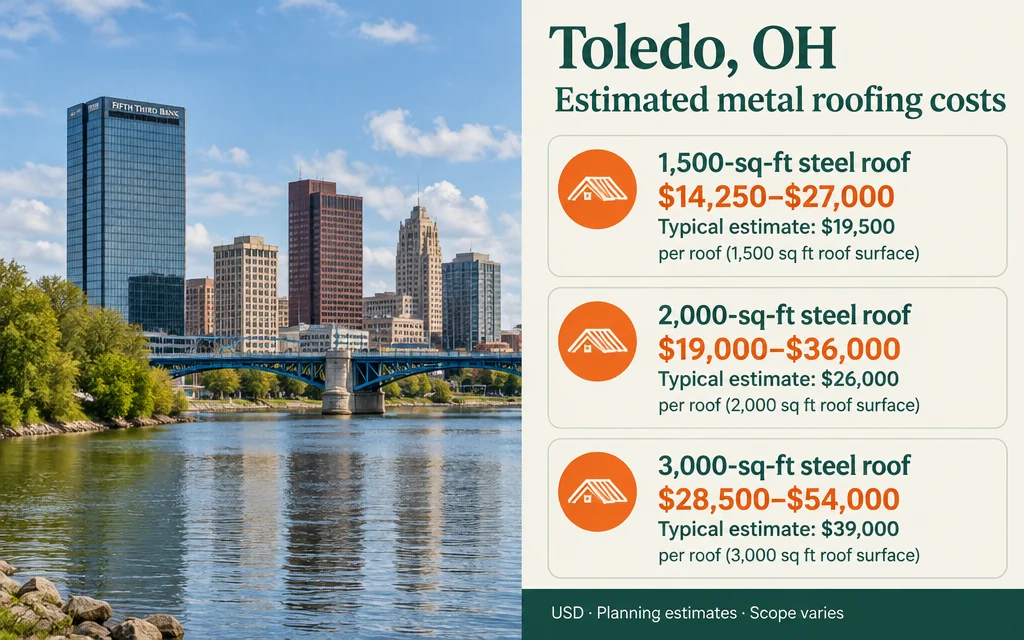
Calculated installed planning scenario for measured roof surface, including one-layer removal/disposal; conditional extras excluded.
Calculated installed planning scenario for measured roof surface, including one-layer removal/disposal; conditional extras excluded.
Calculated installed planning scenario for measured roof surface, including one-layer removal/disposal; conditional extras excluded.
Metal Roofing in Toledo: What Homeowners Should Expect
Metal roofing is increasingly chosen for single-family residences across Toledo, whether replacing worn shingles on older homes in the Old West End or finishing newer builds in surrounding suburbs. When preparing a budget, the essential calculation is your measured roof surface area rather than your home's interior square footage.
Slopes, dormers, eaves, and attached garage roofs expand the true surface you need to cover.
For planning in Toledo, an installed concealed-fastener standing seam steel roof runs in the range of $9.50–$18 per square foot of roof surface. For an average 2,000-square-foot roof plane, that puts the baseline estimate at roughly $19,000–$36,000. This planning figure covers removing one layer of existing asphalt shingles, hauling away debris, putting down quality underlayment, and securing new standing seam panels over sound sheathing.
While metal carries a higher initial invoice than conventional asphalt, it holds up exceptionally well against Northwest Ohio freeze-thaw cycles and lake-effect storms. That said, prices span a wide spectrum depending on panel profile, steel thickness, roof geometry, and fastener style.
Comparing Residential Metal Roofing Systems
Metal roofing encompasses several distinct panel designs and materials, each serving different project scopes and architectural styles:
1. Concealed-Fastener Standing Seam Steel: The benchmark system for residential roofing. Panels typically use 24- or 26-gauge Galvalume-coated steel protected by a durable PVDF/Kynar resin coating. Vertical ribs lock together over clips fastened to the decking, leaving the screws sheltered from the weather and allowing panels to expand and contract freely. Installed rates budget at $9.50–$18 per square foot.
2. Exposed-Fastener Ribbed Steel Panels: Frequently sold as corrugated, Tuff-Rib, or agricultural panels, these screw directly through the metal face into the roof deck using gasketed screws. Because the fasteners and washers are exposed to sun, wind, and freezing cycles, they require scheduled inspections and periodic fastener replacement. Exposed-fastener steel runs $4.50–$9 per square foot installed.
3. Steel Metal Shingles and Tiles: Stamped to mimic slate, wood shake, or standard architectural shingles, these modular panels interlock with hidden fasteners. They budget in the range of $7.50–$14 per square foot installed and are often chosen where strict neighborhood architectural rules limit vertical-seam panels.
4. Standing-Seam Aluminum: Fabricated from .032 to .040-inch aluminum, this option provides natural resistance to rust, making it well-suited for high-moisture settings near Lake Erie or the Maumee River. Aluminum expands more than steel and requires precise fastener spacing. Installed estimates range from $12–$20 per square foot.
5. Standing-Seam Copper: Premium architectural copper delivers generational durability and weathers into a classic patina. Requiring specialized soldering and copper clips, installed budgets span $22–$45 per square foot in Northwest Ohio.
| Service / assumptions | Low | Typical estimate | High | Pricing unit | Estimated labor time |
|---|---|---|---|---|---|
| Standing Seam Steel (Concealed Fastener)Calculated standing-seam steel planning rate: comparable panel/accessory materials + installation labor + one-layer removal/disposal. Ordinary underlayment and details over sound decking included; conditional extra work excluded. | $9.50 | $13 | $18 | per sq ft of roof surface (installed) | 4-7 days |
| Exposed Fastener Steel (Ribbed/Corrugated)Screw-down 26- to 29-gauge ribbed/corrugated panels with gasketed fasteners and one-layer tear-off. Requires ongoing washer maintenance. | $4.50 | $6.50 | $9 | per sq ft of roof surface (installed) | 2-4 days |
| Steel Metal Shingles / TilesStamped interlocking steel shingles simulating slate or shake, concealed fasteners, standard flashing, and one-layer removal. | $7.50 | $10.50 | $14 | per sq ft of roof surface (installed) | 3-6 days |
| Standing Seam Aluminum.032 to .040 inch painted aluminum panels with stainless fasteners, high corrosion resistance, and one-layer tear-off. | $12 | $15.50 | $20 | per sq ft of roof surface (installed) | 4-7 days |
| Standing Seam Copper16-oz to 20-oz architectural copper with soldered or double-lock seams, brass/copper clips, and one-layer tear-off. | $22 | $32 | $45 | per sq ft of roof surface (installed) | 6-12 days |
Understanding Standing Seam Steel Cost Breakdown
When a contractor prepares a turnkey estimate for a standing seam steel roof in Toledo, the price reflects three core cost components:
• Materials Allowance ($5–$9.50 per sq ft): Covers 24- or 26-gauge Galvalume panels or coil stock, factory-approved concealed expansion clips, pancake-head fasteners, trim flashing (eaves, valleys, ridge caps), and high-temperature synthetic or peel-and-stick underlayment.
• Installation Labor Allowance ($3.50–$6.50 per sq ft): Skilled sheet-metal work accounts for a large share of the cost. Installers must brake custom flashing on site, hem panel ends along eaves, square the panels, and seam transitions to prevent oil canning (visible surface rippling) and wind uplift.
• Tear-Off and Disposal ($1–$2 per sq ft): Includes stripping a single existing layer of asphalt shingles, pulling fasteners, cleaning the deck, hauling debris, and paying local Lucas County transfer and disposal fees. Multiple existing layers require extra labor and disposal charges.
| Service / assumptions | Low | Typical estimate | High | Pricing unit | Estimated labor time |
|---|---|---|---|---|---|
| Standing Seam Steel Materials Allowance24/26-ga Galvalume panels, concealed clips, high-temperature self-adhering underlayment, drip edge, ridge caps, and valley flashings. | $5 | $7 | $9.50 | per sq ft of roof surface (materials only) | N/A |
| Standing Seam Steel Installation LaborSpecialized sheet-metal crew labor for layout, custom brake fabrication, clip fastening, and panel seaming. Excludes tear-off. | $3.50 | $4.75 | $6.50 | per sq ft of roof surface (installation labor only) | N/A |
| One-Layer Removal & DisposalTear-off of one asphalt shingle layer, nail pulling, surface cleanup, roll-off dumpster haulage, and transfer fees. | $1 | $1.25 | $2 | per sq ft of roof surface (one-layer removal and disposal) | N/A |
Installed Budgets by Roof Surface Size
Roof planes are calculated by measuring the actual pitch and exterior area of each slope. Below are three representative planning scenarios for a turnkey standing seam steel roof in Toledo, assuming a single shingle tear-off over sound decking:
• Small Roof (1,500 sq ft surface area): Common for a small bungalow or compact ranch layout. Budget $14,250–$27,000 total, with elapsed on-site crew work typically taking 3-5 days.
• Average Home (2,000 sq ft surface area): Standard for a two-story home or larger single-level layout. Budget $19,000–$36,000, with installation generally requiring 4-7 days.
• Large Roof (3,000 sq ft surface area): Typical for sprawling suburban homes with attached multi-car garages and complex rooflines. Budget $28,500–$54,000, with on-site work running 5-8 days depending on weather and roof pitch.
| Service / assumptions | Low | Typical estimate | High | Pricing unit | Estimated labor time |
|---|---|---|---|---|---|
| Standing Seam Steel Roof (1,500 sq ft)Calculated scenario: 1,500 sq ft of measured roof surface × standing-seam steel installed planning rate. Includes its same materials, installation, one-layer removal/disposal and sound-deck assumptions. Not a provider whole-roof quote. | $14,250 | $19,500 | $27,000 | per roof (1,500 sq ft roof surface) | 3-5 days |
| Standing Seam Steel Roof (2,000 sq ft)Calculated scenario: 2,000 sq ft of measured roof surface × standing-seam steel installed planning rate. Includes its same materials, installation, one-layer removal/disposal and sound-deck assumptions. Not a provider whole-roof quote. | $19,000 | $26,000 | $36,000 | per roof (2,000 sq ft roof surface) | 4-7 days |
| Standing Seam Steel Roof (3,000 sq ft)Calculated scenario: 3,000 sq ft of measured roof surface × standing-seam steel installed planning rate. Includes its same materials, installation, one-layer removal/disposal and sound-deck assumptions. Not a provider whole-roof quote. | $28,500 | $39,000 | $54,000 | per roof (3,000 sq ft roof surface) | 5-8 days |
Metal vs Architectural Shingles: 30-Year Comparison
Architectural asphalt shingles remain the most common roofing surface in Toledo, budgeting at $4–$7.50 per square foot installed. By comparison, standing seam steel runs roughly two to three times that initial investment at $9.50–$18 per square foot.
Homeowners weigh that up-front price gap against long-term maintenance and replacement cycles. An asphalt shingle roof in Northwest Ohio typically endures heavy seasonal temperature shifts, granular loss, and wind stress that often prompt significant repair or a full replacement around the 18- to 25-year mark. In contrast, a well-detailed Galvalume standing seam system with a factory Kynar coating is built to last several decades with minimal routine service beyond checking sealants around pipe boots and flashings.
However, a metal roof is not necessarily the right financial move for every situation. If you expect to move within five years, you are unlikely to recoup the higher initial cost through added resale equity alone. For homeowners staying in their property long-term, investing once in standing seam can offer lasting weather protection and eliminate the need for another tear-off down the road.
| Service / assumptions | Low | Typical estimate | High | Pricing unit | Estimated labor time |
|---|---|---|---|---|---|
| Architectural Asphalt Shingles ReferenceBaseline comparison: laminated architectural shingles, synthetic underlayment, standard drip edge, and one-layer tear-off. Published rate reference for the stated roofing scope and unit, not verification of this guide's modeled range, a complete roof quote or provider availability. Regional reference; not a verified Toledo-specific quote.Published price reference ↗ | $4 | $5.50 | $7.50 | per sq ft of roof surface (installed) | 1-3 days |
| Comparison | Architectural asphalt | Standing-seam steel |
|---|---|---|
| Up-front planning estimate · 2,000 sq ft roof surface | $8,000–$15,000 | $19,000–$36,000 |
| What the baseline includes | Architectural asphalt, ordinary installed details, one-layer removal/disposal over sound decking. | Standing-seam steel, ordinary installed details, one-layer removal/disposal over sound decking. |
| Maintenance and repairs | Confirm product-specific inspections and repair terms. | Confirm seams, fasteners, coating, compatible repairs and inspection terms. |
| Insurance and ownership cost | Ask the insurer about the exact product and coverage. | Ask the insurer about accepted test documentation, any available credit and cosmetic-damage exclusions. |
These are calculated budgeting comparisons, not provider quotes or guaranteed lifetime savings. Compare your expected ownership period, specified products, actual maintenance proposals and written insurance terms.
| Decision point | Roof repair | Roof replacement | Metal roofing |
|---|---|---|---|
| Work being priced | A defined defect, such as damaged shingles or flashing. | Removal and installation of an agreed roof system across the measured roof surface. | A specified installed metal system; standing seam, exposed fasteners and metal shingles are different scopes. |
| What to inspect | The leak source, surrounding material and whether a durable localized fix is feasible. | The extent of deterioration, decking condition, roof details and suitable replacement systems. | The substrate, panel profile, coating, fasteners, roof geometry and installation details. |
| How to compare prices | Match the repair quantity, access, materials and included diagnosis. | Match measured roof area, material, tear-off layers, disposal and installed inclusions. | Match measured roof area, system, components, removal and conditional additional work. |
| Before deciding | Ask what the repair addresses and what existing problems would remain. | Ask whether repair remains practical and which additional items would change the total. | Ask about compatible materials, documented product/assembly ratings and product versus workmanship warranties. |
Age or a repair-cost percentage alone does not determine the right choice. Ask a qualified roofing contractor to assess the condition and explain viable options. A metal system is a material-specific installation choice, not a separate guarantee of durability or savings.
Additional Scope and Conditional Job Costs
Standard estimates assume installation over clean, sound sheathing. Specific architectural details or roof deck repairs will add separate line items:
• Extra Layer Tear-Off: If your roof has two layers of old shingles, removing the second layer adds $40–$90 per roofing square (100 square feet) for extra handling and disposal.
• Decking Repairs: Rotted OSB or plywood discovered after tear-off must be replaced. In Toledo, expect to budget $70–$135 per 4x8-foot sheet installed.
• Chimney and Skylight Flashings: Fabricating new counterflashing for a brick chimney adds $350–$900 per chimney. Custom metal curb kits for skylights budget at $300–$750 per unit.
• Continuous Ridge Ventilation: Upgrading to a perforated, vented metal ridge cap costs $14–$35 per linear foot, helping maintain balanced attic ventilation.
• Snow Retention Systems: Because snow slides easily down metal roofs, non-penetrating seam clamps or snow rails installed over entrances and walkways run $18–$45 per linear foot.
• Gutter Detach and Reset: Removing gutters to install eave metal properly and reattaching them afterward runs $6–$16 per linear foot.
| Service / assumptions | Low | Typical estimate | High | Pricing unit | Estimated labor time |
|---|---|---|---|---|---|
| Additional Roof Layer RemovalLabor and disposal surcharge for tearing off a second or third existing roof layer prior to metal decking prep. | $40 | $60 | $90 | additional per roofing square (100 sq ft) | N/A |
| Roof Decking Replacement (4x8 Sheet)Replacing deteriorated or rotted CDX plywood or OSB roof sheathing once old roofing is stripped. | $70 | $95 | $135 | additional per 4-by-8-ft sheet (32 sq ft) | N/A |
| Chimney Flashing & CounterflashingCustom-bent step flashing and reglet-cut masonry counterflashing designed for standing seam integration. | $350 | $550 | $900 | additional per chimney | N/A |
| Skylight Flashing Kit IntegrationFabricating and sealing curb flashing pan and side channels around an existing residential skylight. | $300 | $450 | $750 | additional per skylight | N/A |
| Continuous Vented Ridge UpgradeInstalling perforated metal ridge vent system with baffles for balanced attic exhaust airflow. | $14 | $22 | $35 | additional per linear ft | N/A |
| Snow Retention Rail / Cleat SystemNon-penetrating seam-clamped bar or two-pipe snow fence to prevent hazardous rooftop snow slides. | $18 | $28 | $45 | additional per linear ft | N/A |
| Gutter Detach & ReinstallCarefully detaching existing gutters to allow correct eave drip edge and hem installation, then resetting. | $6 | $10 | $16 | additional per linear ft | N/A |
Performance Ratings, Wind, Hail, and Insurance Truths
Metal panels carry strong industry ratings, but understanding how test standards work helps keep expectations grounded:
• Impact Resistance (UL 2218 Class 4): Many 24- and 26-gauge steel systems pass Class 4 impact testing, surviving laboratory drops of a 2-inch steel ball without cracking. However, Class 4 does not mean the roof is dent-proof. Severe hail can leave visible dimples across panel flats while the roof remains watertight. Before assuming an insurance discount, check with your carrier to see if they offer rate credits for Class 4 installations and whether they attach a cosmetic damage exclusion.
• Wind Uplift: Engineered standing seam roofs with proper clip spacing provide exceptional wind resistance, holding firm against powerful Lake Erie wind gusts. Exposed-fastener assemblies also perform well initially but rely on exposed screws that can back out or degrade over time.
• Fire Ratings: Steel itself is non-combustible, but a roofing assembly earns a Class A fire rating only as a complete package, including the specified fire-rated underlayment and underlying deck. Verify the assembly details on your contract.
• Energy Efficiency: Factory coatings formulated with reflective pigments reflect solar radiation, which can help moderate attic heat during humid Ohio summers. Overall energy savings still depend heavily on attic insulation and ventilation balance.
Local Factors Driving Metal Roof Pricing in Toledo
Several project variables influence where your standing seam quote falls within the $9.50–$18 planning range:
• Roof Pitch and Complexity: A simple 4:12 gable roof goes up quickly with minimal staging. By contrast, a steep 10:12 slope, complex valleys, wall step flashings, or multiple dormers require extensive fall-arrest equipment and custom hand-bent flashings, pushing labor to the high end.
• Steel Gauge: Steel thickness is measured in gauge, where a lower number indicates a thicker panel. Most residential standing seam uses 24- or 26-gauge steel. Thicker 24-gauge panels offer higher rigidity and better resistance to oil canning, but they carry higher raw coil costs than lighter 26- or 29-gauge options.
• Property Access: Narrow urban driveways or limited perimeter access make it difficult to position roll-forming trailers or drop roll-off dumpsters. If crews have to carry panels by hand across the yard, total labor hours increase.
• Seasonality: Northwest Ohio roofing crews experience heavy volume from late spring through autumn. Scheduling during early spring or late fall can sometimes offer scheduling flexibility, provided ambient temperatures remain high enough for self-adhering underlayments and flashings to seal properly.
Hiring a Metal Roofing Contractor in Northwest Ohio
Standing seam metal installation is a specialized craft that requires specific tools, including mechanical roll-formers and hand-bending brakes. When gathering bids in the Toledo area, consider these practical steps:
• Panel Sourcing: Ask whether the contractor rolls panels on-site from continuous coil stock or orders pre-cut panels from a distributor. Continuous panels cut to length on-site eliminate horizontal lap joints from ridge to eave.
• Written Itemization: Ensure each estimate clearly identifies the metal gauge, finish system (such as PVDF/Kynar 500), underlayment specifications, flashing materials, and unit rates for replacing damaged decking.
• Warranty Terms: A paint finish warranty from the manufacturer protects against fading and chalking, but it does not cover workmanship, seam leaks, or flashing mistakes. Ask the contractor for a separate written labor warranty that covers installation integrity.
• Permitting and Local Registration: Check that the roofer holds an active contractor registration with the City of Toledo Division of Building Inspection. Verify who will pull the building permit and confirm they carry adequate commercial general liability and active Ohio Bureau of Workers' Compensation (BWC) coverage.
Local income & housing costs
Toledo city, Ohio · U.S. Census Bureau, 2025 ACS 1-year estimates.
per month · ±$42
Cash-rent units; includes applicable tenant-paid utilities
Census source ↗Dollar amounts use the survey period’s published basis. Income is annual; gross rent is monthly. Home value reflects owner-occupied housing values. Margins of error shown are at the ACS 90% confidence level. These statistics provide city context; service budgets use their own pricing evidence.
STATEWIDE COST CONTEXT
Ohio prices, income & labor costs
These Ohio figures provide background for this city guide. They describe different measures and reference years; employee wages are not prices charged by a contractor.
BEA SAIRPD
State price change indicator
114.72024 · index (2017 basis)
Annual figures & sources
| Year | Value | 90% margin of error | Source |
|---|---|---|---|
| 2020 | 96.2 | — | Official source |
| 2021 | 100.5 | — | Official source |
| 2022 | 106.2 | — | Official source |
| 2023 | 110.8 | — | Official source |
| 2024 | 114.7 | — | Official source |
Census ACS 1-year
Median household income
$74,8042025 · USD/year
Annual figures & sources
| Year | Value | 90% margin of error | Source |
|---|---|---|---|
| 2021 | $62,262 | ±$456 | Official source |
| 2022 | $65,720 | ±$618 | Official source |
| 2023 | $67,769 | ±$731 | Official source |
| 2024 | $72,212 | ±$538 | Official source |
| 2025 | $74,804 | ±$615 | Official source |
BLS OEWS
Roofers
$23.742025 · USD/hour
Annual figures & sources
| Year | Value | 90% margin of error | Source |
|---|---|---|---|
| 2025 | $23.74 | — | Official source |
State prices: BEA, 2020–2024. Household income: Census ACS, 2021–2025. Employee wages: BLS, May 2025 snapshot. The charts retain their own units and fitted scales.
Explore all Ohio living-cost data and trends →Local context and limitations
Toledo's climate brings damp conditions off Lake Erie, lake-effect snow, and strong winter freeze-thaw cycles that elevate the risk of ice damming. Snow-retention rails or seam clamps are recommended over pedestrian doors, sidewalks, and driveways to manage shedding snow. Confirm local permit filing requirements with the City of Toledo Division of Building Inspection before signing an agreement, and verify that quotes specify high-temperature self-adhering underlayment along eaves and valleys.
Frequently asked questions
What is the difference between standing seam and exposed fastener metal roofs?
Standing seam panels feature raised ribs that lock over concealed clips secured to the roof deck, leaving no exposed screw holes. The clips allow the panels to slide slightly during thermal expansion and contraction. Exposed-fastener systems are screwed directly through the panel face using rubber-washer screws. Those rubber washers are exposed to the weather and will require periodic inspection and eventual replacement as they age.
Why is roof surface area different from home square footage?
Home square footage measures interior floor area. Roof surface area measures the actual exterior roof deck, factoring in roof pitch, overhangs, eaves, dormers, and garages. For example, a 1,500-square-foot ranch home with standard slopes and overhangs typically has between 1,800 and 2,000 square feet of actual roof surface.
Can I install a metal roof over my existing asphalt shingles in Toledo?
While building codes may allow a second layer in limited situations, removing old shingles is standard practice for standing seam metal. Stripping the deck allows the contractor to inspect for rotted sheathing, avoids panel distortion from uneven shingle surfaces, and ensures high-temperature underlayment adheres properly.
Are metal roofs noisy during heavy rain or hail?
When installed over solid plywood or OSB roof decking with quality underlayment and standard attic insulation, a metal roof produces sound levels comparable to asphalt shingles. The underlying wood sheathing and attic insulation dampen rain vibration effectively.
Will a new metal roof lower my homeowners insurance in Toledo?
Some insurance carriers provide policy discounts for metal roofs certified to UL 2218 Class 4 impact resistance standards. However, discounts vary by carrier and policy, and some insurers require signing a cosmetic damage exclusion that excludes non-leaking hail dents. Check directly with your insurance agent before committing.
Do I need snow retention guards on a metal roof in Northwest Ohio?
Snow guards or rails are strongly recommended over high-traffic areas such as front doors, walkways, garage entries, and outdoor mechanical units. Metal surfaces shed accumulated snow rapidly during sunny winter days, and retention systems help prevent heavy snow and ice from sliding off in a single sheet.
Sources and methodology
Sources below retain their recorded retrieval dates and geographic scope. We checked the quoted rates against readable public pricing pages. The tables remain planning estimates, not provider quotes or a measured citywide survey. Per-square-foot references do not establish the modeled whole-roof totals or all their installed inclusions. Regional references are not verified Toledo-specific quotes. Confirm removal, disposal, materials, labor and the complete scope in a written proposal.
Published pricing pages retrieved; quoted excerpts checked automatically. 3 distinct website domains. · Generated 2026-11-12
- Real Roof Replacement Costs in Toledo, Ohio 2025 GuideCity-specific page context · Page retrieved 2026-11-12 · Price excerpt matched automatically
“Per-square-foot breakdown: Basic asphalt shingle replacement starts at $4 to $6 per square foot.”
Planning ranges may differ from these published examples; they are not provider quotes.
- Are Metal Roofs More Expensive Than Shingles? Toledo RoofersCity-specific page context · Page retrieved 2026-11-12 · Price excerpt matched automatically
“Metal roofing , on the other hand, typically ranges between $8.00 to $14.00 per square foot installed , depending on material (steel, aluminum, zinc, etc.).”
Planning ranges may differ from these published examples; they are not provider quotes.
- What is the Average Cost to Replace a Roof in Ohio?State / regional reference · Page retrieved 2026-11-12 · Price excerpt matched automatically
“Architectural Asphalt Shingles: Often $5.50 to $9.50 per square foot installed, translating to about $8,250 to $14,250 for a 1,500-square-foot roof.”
Planning ranges may differ from these published examples; they are not provider quotes.
Plan your metal roofing project
Choose your service and answer its project questions. Add notes or photos if helpful, then generate your project brief. The planner labels its budgeting assumptions separately. Use your plan to compare the scope and assumptions with a provider. Contact sharing and provider matching are not available yet.
Open the project planner →Share this city’s cost data
<> Embed Toledo Cost Data on Your Site
The HTML table shows the prices at the time of copying. The iframe follows the published guide.