Fontana · CA · COST GUIDE
Metal Roofing Costs in Fontana, CA (2026)
For budgeting, standing-seam steel roofing is estimated at $12–$18 per sq ft of roof surface, and exposed-fastener steel at $7–$12 per sq ft. These installed planning ranges include one-layer removal/disposal over sound decking; compare the specified system and conditional extras.
Standing Seam Steel (Concealed Fastener)
Budget estimate$12–$18per sq ft of roof surface (installed)
Planning range · Compare the roof area, material and included work in your quote.
Exposed-Fastener Corrugated/Ribbed Steel
Budget estimate$7–$12per sq ft of roof surface (installed)
Planning range · Compare the roof area, material and included work in your quote.
Published examples apply to their stated scope. Budget ranges are estimates.
Calculated installed planning scenario for measured roof surface, including one-layer removal/disposal; conditional extras excluded.
Calculated installed planning scenario for measured roof surface, including one-layer removal/disposal; conditional extras excluded.
Calculated installed planning scenario for measured roof surface, including one-layer removal/disposal; conditional extras excluded.
Metal Roofing Pricing in Fontana
For a residential metal roof in Fontana, budget $7–$12 per sq ft of roof surface (installed) for exposed-fastener ribbed steel or budget $12–$18 per sq ft of roof surface (installed) for concealed-fastener standing seam steel. For standing seam steel—the benchmark profile for residential re-roofing—turnkey costs typically land near $15.
For a home with 2,000 square feet of roof surface, a turnkey standing seam replacement typically runs budget $24,000–$36,000 per roof (2,000 sq ft roof surface), which includes tear-off and disposal of a single existing roofing layer.
Roofing square footage measures the exterior surface of your roof deck rather than your home's interior living area. A single-story Fontana home with 1,600 square feet of interior floor space often measures between 1,900 and 2,200 square feet of roof surface once pitch, eaves, overhangs, and attached garages or patio covers are factored in. Roofing contractors measure and price projects in 'squares,' where one square equals 100 square feet.
Direct published contractor price sheets within Fontana are limited, so these baseline figures reflect regional California planning estimates. When evaluating bids, verify whether an estimate covers full panel fabrication, high-temperature synthetic underlayment, perimeter drip flashing, and local landfill disposal rather than materials alone.
Comparing Residential Metal Roof Systems
Residential metal roofing spans several distinct profiles that differ in fastening methods, weather resistance, and overall project investment.
Standing Seam Concealed-Fastener Steel: Budget $12–$18 per sq ft of roof surface (installed). This system features vertical interlocking ribs anchored with hidden clips and screws. Panels are commonly 24-gauge or 26-gauge Galvalume steel finished with a PVDF (Kynar 500) fluoropolymer coating. Because clips sit beneath the metal surface, fasteners remain shielded from Inland Empire sun, ultraviolet exposure, and daily thermal expansion. It accommodates roof pitches down to 2:12 (or 1:12 when mechanically seamed) and delivers the longest service life among common residential steel options.
Exposed-Fastener Corrugated or Ribbed Steel: Budget $7–$12 per sq ft of roof surface (installed). Panels overlap at the edges and are screwed directly through the face of the metal into the roof deck using hex screws with neoprene or EPDM washers. While economical upfront, the thousands of exposed rubber washers degrade under prolonged summer heat and require periodic inspection and eventual replacement to avoid leaks. They generally require a minimum roof slope of 3:12.
Steel Shingles or Stamped Tile Profiles: Budget $8.50–$15 per sq ft of roof surface (installed). These modular stone-coated or painted steel panels mimic traditional clay tile, wood shake, or slate. Interlocking clips keep fasteners protected, allowing homeowners in planned communities to achieve metal durability while preserving a neighborhood architectural aesthetic.
Standing Seam Aluminum: Budget $11.50–$18 per sq ft of roof surface (installed). Aluminum offers complete resistance to rust. Although coastal salt air is less prominent in Fontana, aluminum provides a lightweight option for homes with limited framing capacity, though it is softer and more prone to walking dents than steel.
Standing Seam Copper: Budget $22–$40 per sq ft of roof surface (installed). Architectural copper is a specialty installation primarily chosen for historic restorations or architectural accents like bay windows and porch porticos. Joined with hand-formed mechanical seams and brass or stainless steel clips, copper patinates naturally and requires no factory coating.
| Service / assumptions | Low | Typical estimate | High | Pricing unit | Estimated labor time |
|---|---|---|---|---|---|
| Standing Seam Steel (Concealed Fastener)Calculated standing-seam steel planning rate: comparable panel/accessory materials + installation labor + one-layer removal/disposal. Ordinary underlayment and details over sound decking included; conditional extra work excluded. Published rate reference for the stated roofing scope and unit, not verification of this guide's modeled range, a complete roof quote or provider availability. Regional reference; not a verified Fontana-specific quote.Published price reference ↗ | $12 | $15 | $18 | per sq ft of roof surface (installed) | N/A |
| Exposed-Fastener Corrugated/Ribbed Steel26-gauge or 29-gauge steel panels fastened with exposed gasketed screws. Includes tear-off, synthetic underlayment, and basic flashings. | $7 | $9.50 | $12 | per sq ft of roof surface (installed) | N/A |
| Steel Metal Shingles or Tile ProfilesStamped stone-coated or painted steel modular shingles mimicking tile or shake. Includes tear-off, underlayment, and standard trims. | $8.50 | $11.75 | $15 | per sq ft of roof surface (installed) | N/A |
| Standing Seam AluminumConcealed-fastener aluminum panels for high corrosion resistance. Includes tear-off, underlayment, and standard accessories. Published rate reference for the stated roofing scope and unit, not verification of this guide's modeled range, a complete roof quote or provider availability. Regional reference; not a verified Fontana-specific quote.Published price reference ↗ | $11.50 | $14.50 | $18 | per sq ft of roof surface (installed) | N/A |
| Standing Seam Copper16-oz or 20-oz architectural copper with hand-formed or mechanical seams and brass/stainless clips. Complete installed system. | $22 | $30 | $40 | per sq ft of roof surface (installed) | N/A |
Standing Seam Steel Cost Breakdown
To see how a typical installed rate of $15 is built, look at the individual component allowances for materials, skilled labor, and disposal over sound decking.
Materials and Underlayment: Budget $4.50–$7.75 per sq ft of roof surface (materials only). This component covers 24-gauge Galvalume steel panels, concealed expansion clips, perimeter drip edges, ridge caps, flashing trims, and high-temperature synthetic underlayment. In Fontana, high-temp underlayment is essential because elevated summer attic heat can cause conventional asphalt-saturated felt to degrade or adhere to the underside of metal panels.
Installation Labor: Budget $6.50–$8.75 per sq ft of roof surface (installation labor only). Standing seam steel demands specialized sheet-metal craftsmanship. Installers must align panel clips, field-cut hems, form watertight valley and eave transitions, and flash roof penetrations without relying on surface caulk. Labor rates reflect licensed California roofing crews handling custom layout work.
One-Layer Tear-Off and Disposal: Budget $1–$1.50 per sq ft of roof surface (one-layer removal and disposal). This covers stripping the existing single layer of composition shingles down to the bare deck, magnetic cleanup around the yard, hauling, and local transfer station fees. Homes with existing wood shake or multiple shingle layers require additional removal allowances.
| Service / assumptions | Low | Typical estimate | High | Pricing unit | Estimated labor time |
|---|---|---|---|---|---|
| Standing Seam Steel Materials & Underlayment24-gauge prefinished Galvalume panels, hidden expansion clips, high-temperature underlayment, ridge caps, and perimeter flashings. | $4.50 | $6.25 | $7.75 | per sq ft of roof surface (materials only) | N/A |
| Standing Seam Steel Installation LaborSkilled C-39 labor to install underlayment, clip panels, field-form seams and hemming, and flash valleys and ridges. Excludes tear-off. | $6.50 | $7.50 | $8.75 | per sq ft of roof surface (installation labor only) | N/A |
| One-Layer Tear-Off & DisposalRemoval of one existing layer of asphalt shingles down to deck, magnetic nail sweep, hauling, and San Bernardino County landfill disposal. | $1 | $1.25 | $1.50 | per sq ft of roof surface (one-layer removal and disposal) | N/A |
Project Budgets by Home and Roof Size
Roof area, roofline complexity, and access dictate final project totals. The following budget models illustrate turnkey standing seam steel replacements across representative roof surfaces in Fontana, assuming one-layer removal over sound decking.
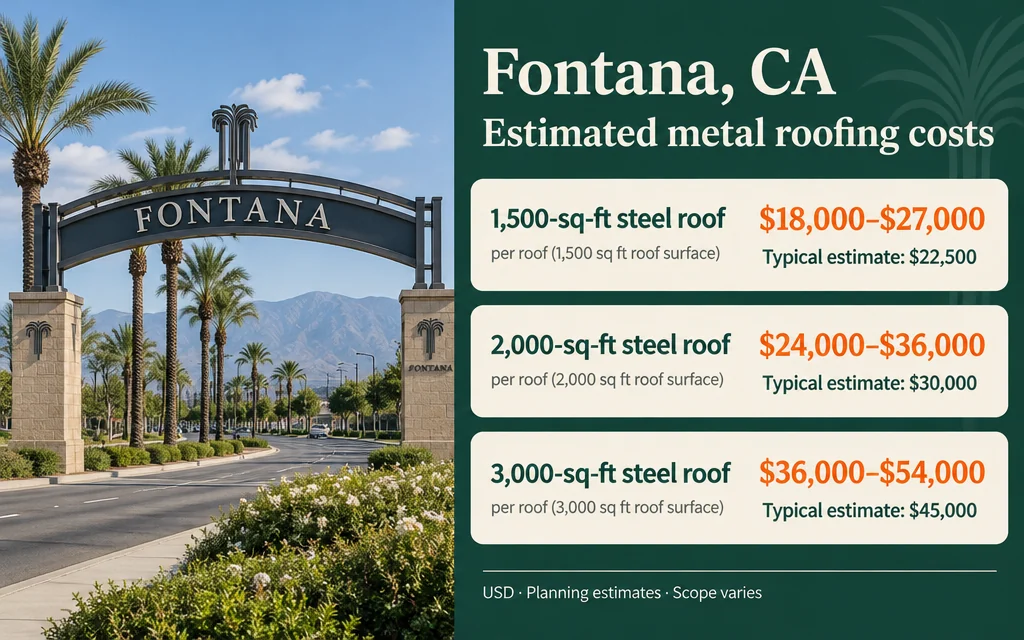
1,500 Square Feet of Roof Surface: Budget $18,000–$27,000 per roof (1,500 sq ft roof surface), with an average cost of $22,500. This size fits compact ranch homes or single-story properties with simple gable profiles. Typical crew duration is 3–4 working days.
2,000 Square Feet of Roof Surface: Budget $24,000–$36,000 per roof (2,000 sq ft roof surface), averaging $30,000 turnkey. This represents standard suburban single-family homes with intersecting gables or hip rooflines. Typical crew duration is 4–6 working days.
3,000 Square Feet of Roof Surface: Budget $36,000–$54,000 per roof (3,000 sq ft roof surface), with an average turnkey cost of $45,000. This applies to larger two-story homes or sprawling single-story layouts featuring multiple hips, valleys, attached multi-car garages, and covered porches. Typical crew duration is 5–8 working days.
| Service / assumptions | Low | Typical estimate | High | Pricing unit | Estimated labor time |
|---|---|---|---|---|---|
| Standing Seam Steel Roof (1,500 Sq Ft)Calculated scenario: 1,500 sq ft of measured roof surface × standing-seam steel installed planning rate. Includes its same materials, installation, one-layer removal/disposal and sound-deck assumptions. Not a provider whole-roof quote. | $18,000 | $22,500 | $27,000 | per roof (1,500 sq ft roof surface) | 3–4 working days |
| Standing Seam Steel Roof (2,000 Sq Ft)Calculated scenario: 2,000 sq ft of measured roof surface × standing-seam steel installed planning rate. Includes its same materials, installation, one-layer removal/disposal and sound-deck assumptions. Not a provider whole-roof quote. | $24,000 | $30,000 | $36,000 | per roof (2,000 sq ft roof surface) | 4–6 working days |
| Standing Seam Steel Roof (3,000 Sq Ft)Calculated scenario: 3,000 sq ft of measured roof surface × standing-seam steel installed planning rate. Includes its same materials, installation, one-layer removal/disposal and sound-deck assumptions. Not a provider whole-roof quote. | $36,000 | $45,000 | $54,000 | per roof (3,000 sq ft roof surface) | 5–8 working days |
Standing Seam Metal vs. Architectural Asphalt
Comparing standing seam steel to architectural shingles comes down to upfront investment versus long-term maintenance and replacement cycles.
For architectural asphalt shingles, budget $4.50–$7.50 per sq ft of roof surface (installed) for a tear-off and replacement. For a 2,000-square-foot roof surface, standing seam steel runs budget $24,000–$36,000 per roof (2,000 sq ft roof surface)—roughly double the upfront expense. If you plan to move within 5 to 7 years, asphalt shingles are generally the more practical financial choice, as short-term resale value rarely recaptures the full premium paid for metal.
For a long-term home, however, metal changes the math. Inland Empire sun, high summer temperatures, and seasonal high-wind conditions accelerate the breakdown of shingle granules and asphalt adhesives, often requiring replacement or major repairs after 18 to 22 years. A properly detailed 24-gauge standing seam steel roof installed with high-temperature underlayment provides an extended service life with minimal maintenance beyond routine valley cleaning, helping avoid the labor and disposal costs of a second tear-off down the road.
| Service / assumptions | Low | Typical estimate | High | Pricing unit | Estimated labor time |
|---|---|---|---|---|---|
| Architectural Asphalt Shingles ReferenceBaseline reference for architectural dimensional shingles including single-layer removal, synthetic felt, and standard flashing. | $4.50 | $6 | $7.50 | per sq ft of roof surface (installed) | N/A |
| Comparison | Architectural asphalt | Standing-seam steel |
|---|---|---|
| Up-front planning estimate · 2,000 sq ft roof surface | $9,000–$15,000 | $24,000–$36,000 |
| What the baseline includes | Architectural asphalt, ordinary installed details, one-layer removal/disposal over sound decking. | Standing-seam steel, ordinary installed details, one-layer removal/disposal over sound decking. |
| Maintenance and repairs | Confirm product-specific inspections and repair terms. | Confirm seams, fasteners, coating, compatible repairs and inspection terms. |
| Insurance and ownership cost | Ask the insurer about the exact product and coverage. | Ask the insurer about accepted test documentation, any available credit and cosmetic-damage exclusions. |
These are calculated budgeting comparisons, not provider quotes or guaranteed lifetime savings. Compare your expected ownership period, specified products, actual maintenance proposals and written insurance terms.
| Decision point | Roof repair | Roof replacement | Metal roofing |
|---|---|---|---|
| Work being priced | A defined defect, such as damaged shingles or flashing. | Removal and installation of an agreed roof system across the measured roof surface. | A specified installed metal system; standing seam, exposed fasteners and metal shingles are different scopes. |
| What to inspect | The leak source, surrounding material and whether a durable localized fix is feasible. | The extent of deterioration, decking condition, roof details and suitable replacement systems. | The substrate, panel profile, coating, fasteners, roof geometry and installation details. |
| How to compare prices | Match the repair quantity, access, materials and included diagnosis. | Match measured roof area, material, tear-off layers, disposal and installed inclusions. | Match measured roof area, system, components, removal and conditional additional work. |
| Before deciding | Ask what the repair addresses and what existing problems would remain. | Ask whether repair remains practical and which additional items would change the total. | Ask about compatible materials, documented product/assembly ratings and product versus workmanship warranties. |
Age or a repair-cost percentage alone does not determine the right choice. Ask a qualified roofing contractor to assess the condition and explain viable options. A metal system is a material-specific installation choice, not a separate guarantee of durability or savings.
Decking Repairs and Common Project Add-Ons
Standard proposals assume your roof sheathing is structurally solid once existing shingles are removed. When the bare wood is exposed, hidden damage or customized flashing needs can introduce add-on costs.
Plywood Decking Repairs: Budget $85–$115 additional per 4-by-8-ft sheet (32 sq ft) to replace rotted or delaminated 1/2-inch CDX plywood or OSB sheathing. Fasteners cannot securely anchor into compromised wood. If your home still has spaced wood-shake skip sheathing underneath, the entire deck must be sheeted with solid structural panels before installing metal clips.
Extra Layer Removal: If your existing roof has two layers of shingles or old roll roofing underneath, budget $40–$75 additional per roofing square (100 sq ft) for the added labor and disposal fees.
Chimney and Skylight Detailing: Budget $350–$750 additional per chimney for custom-fabricated metal crickets, step flashing, and counterflashing tied into the panel seams. Integrating existing curb-mounted skylights runs budget $250–$550 additional per skylight.
Ridge Ventilation: Upgrading to continuous, weather-baffled ridge vents designed for standing seam panels costs budget $12–$28 additional per linear ft.
Gutter Reset: If existing seamless gutters must be taken down and reinstalled to fit the new drip edge correctly, budget $6–$14 additional per linear ft. For homes in higher foothill elevations where frost or light snow sliding is a concern, snow guard systems run budget $20–$48 additional per linear ft.
| Service / assumptions | Low | Typical estimate | High | Pricing unit | Estimated labor time |
|---|---|---|---|---|---|
| Additional Roof Layer RemovalAdditional cost per square when an existing roof has a second shingle or rolled roofing layer requiring tear-off. | $40 | $55 | $75 | additional per roofing square (100 sq ft) | N/A |
| Plywood/OSB Decking ReplacementInstalled 1/2-inch CDX plywood or OSB sheathing sheet to replace rotted or damaged decking exposed during tear-off. | $85 | $95 | $115 | additional per 4-by-8-ft sheet (32 sq ft) | N/A |
| Custom Chimney Flashing KitFabrication and installation of custom apron, step flashing, cricket, and counterflashing integrated into standing seam roof. | $350 | $500 | $750 | additional per chimney | N/A |
| Skylight Flashing IntegrationCustom-bent head, sill, and side metal flashing integration for existing curb-mounted skylights. | $250 | $375 | $550 | additional per skylight | N/A |
| Metal Ridge Ventilation UpgradeContinuous baffle-protected ridge vent system engineered specifically for metal standing seam profiles. | $12 | $18 | $28 | additional per linear ft | N/A |
| Snow Retention Rail/Guard SystemClamp-attached non-penetrating seam snow guards for elevated foothill terrain subject to winter frost and sliding snow. | $20 | $32 | $48 | additional per linear ft | N/A |
| Gutter Detach & ReinstallTemporary removal and resetting of serviceable existing gutters to allow proper drip edge and fascia metal installation. | $6 | $9 | $14 | additional per linear ft | N/A |
Fire, Wind, and Energy Performance Ratings
A metal roof delivers strong physical protection, but ratings depend on the complete installed system rather than the metal alone.
Fire Classifications: While bare steel panels do not ignite, achieving an official Class A fire rating requires a listed assembly that includes approved fire-barrier underlayments over solid decking. For properties located in or near wildland-urban interface (WUI) foothill zones in northern Fontana, verify with your contractor and the Fontana Building and Safety Division whether your address requires a certified Class A assembly listing.
Wind Uplift: Cajon Pass wind corridors can produce severe gusts across Fontana. Standing seam profiles with engineered two-piece sliding clips or closely spaced fixed clips offer substantial uplift resistance compared to exposed-fastener sheets, whose fasteners can experience fatigue or tear through thin gauge panels during heavy buffeting.
Cool-Roof Reflectance: California energy standards establish minimum solar reflectance and thermal emittance values for residential re-roofing projects. Request confirmation from your contractor that the factory PVDF finish meets local Title 24 cool-roof requirements for your specific address and roof slope.
Insurance Policies: Premium reductions for impact-resistant (UL 2218 Class 4) or fire-rated roofs depend entirely on individual carrier guidelines. Never assume automatic policy discounts. Furthermore, ask your insurer whether your policy includes cosmetic damage exclusions, which may limit payouts if hail or wind creates visual dents that do not cause active water leaks.
Key Price Drivers on Fontana Roofs
Several project-specific factors influence whether a bid lands near the lower or upper end of the planning range.
Roof Pitch and Geometry: Low-pitch simple gables are easier and faster to install than steep 7:12 or 8:12 slopes with multiple intersecting valleys, dormers, and hips. Steep slopes demand personal fall arrest systems, specialized staging, and slower panel maneuvering, which increases labor time.
Steel Thickness and Coating: Selecting commercial-grade 24-gauge steel instead of 26-gauge adds to material costs but provides greater panel rigidity and reduces visible surface waviness (oil-canning). Factory-applied PVDF fluoropolymer finishes cost more than silicone-modified polyester (SMP) paints but provide superior defense against fading and chalking under intense Southern California sun.
Thermal Expansion Provisions: Metal roofs expand and contract as daily temperatures shift between cool winter nights and hot summer afternoons. Concealed sliding clips let panels glide freely without stressing seams. On exposed-fastener roofs, rigid fastening means thermal movement can eventually widen screw holes and degrade rubber washers over time.
Permit and Inspection Logistics: Check with your contractor regarding the specific permitting process with the Fontana Building and Safety Division. Verify whether the quote includes municipal permit fees, plan checks, and intermediate roof-deck inspections, or if those are billed separately.
Selecting a Qualified Metal Roofing Contractor
Installing architectural standing seam metal requires specific sheet-metal training that differs from standard shingle work. When vetting contractors in the Inland Empire, keep these steps in mind.
Licensing and Insurance: Verify that the contractor holds an active C-39 Roofing contractor license through the California Contractors State License Board (CSLB). Request current certificates of commercial general liability and workers' compensation coverage sent directly from the insurance carrier. Company status alone does not prove active policy standing.
Written Scope of Work: Insist on an itemized written estimate. The contract should identify the panel manufacturer, profile style (snap-lock vs. mechanical lock), steel gauge, paint system, clip spacing, underlayment type, flashing gauges, and the agreed unit price per sheet for any decking replacement found necessary during tear-off.
Workmanship vs. Material Warranties: Make sure you understand the difference between the manufacturer's finish warranty (typically 30 to 40 years against paint chalking and peeling) and the installer's workmanship warranty (often 2 to 10 years covering flashings and water tightness). Ask whether panels are factory pre-cut or formed on-site with a portable roll-former, and check recent local installations to assess seam straightness and detail quality.
Local income & housing costs
Fontana city, California · U.S. Census Bureau, 2025 ACS 1-year estimates.
per month · ±$174
Cash-rent units; includes applicable tenant-paid utilities
Census source ↗Dollar amounts use the survey period’s published basis. Income is annual; gross rent is monthly. Home value reflects owner-occupied housing values. Margins of error shown are at the ACS 90% confidence level. These statistics provide city context; service budgets use their own pricing evidence.
STATEWIDE COST CONTEXT
California prices, income & labor costs
These California figures provide background for this city guide. They describe different measures and reference years; employee wages are not prices charged by a contractor.
BEA SAIRPD
State price change indicator
136.92024 · index (2017 basis)
Annual figures & sources
| Year | Value | 90% margin of error | Source |
|---|---|---|---|
| 2020 | 117.2 | — | Official source |
| 2021 | 122.0 | — | Official source |
| 2022 | 130.7 | — | Official source |
| 2023 | 135.2 | — | Official source |
| 2024 | 136.9 | — | Official source |
Census ACS 1-year
Median household income
$102,1592025 · USD/year
Annual figures & sources
| Year | Value | 90% margin of error | Source |
|---|---|---|---|
| 2021 | $84,907 | ±$542 | Official source |
| 2022 | $91,551 | ±$471 | Official source |
| 2023 | $95,521 | ±$611 | Official source |
| 2024 | $100,149 | ±$381 | Official source |
| 2025 | $102,159 | ±$390 | Official source |
BLS OEWS
Roofers
$30.582025 · USD/hour
Annual figures & sources
| Year | Value | 90% margin of error | Source |
|---|---|---|---|
| 2025 | $30.58 | — | Official source |
State prices: BEA, 2020–2024. Household income: Census ACS, 2021–2025. Employee wages: BLS, May 2025 snapshot. The charts retain their own units and fitted scales.
Explore all California living-cost data and trends →Local context and limitations
Because Fontana frequently experiences severe seasonal wind gusts flowing south from the Cajon Pass, panel clip spacing and perimeter edge-metal detailing require careful planning for uplift resistance. For properties situated near northern foothill areas or potential fire hazard zones, verify address-specific requirements for Class A fire-rated assemblies and California Title 24 cool-roof reflectance standards directly with the Fontana Building and Safety Division before selecting panel finishes and underlayment.
Frequently asked questions
Why does standing seam cost more than exposed-fastener metal?
Standing seam uses heavier steel (typically 24-gauge), high-grade PVDF factory finishes, and concealed clips that allow silent thermal movement without piercing the panel surface. Exposed-fastener panels use thinner steel and exposed screws with rubber washers that deteriorate under Inland Empire heat and require periodic replacement.
How do I calculate the actual square footage of my roof?
Roof surface area is always larger than a home's interior living footprint. For a typical Fontana home, multiply ground-level square footage (including attached garages and porches) by 1.15 to 1.35 to account for slope and overhangs. An 1,800 sq ft footprint with a moderate 4:12 pitch typically yields around 2,100 to 2,300 sq ft of roof area.
Will a metal roof lower my home insurance premiums in California?
Some insurance carriers offer credits for certified Class A fire assemblies or UL 2218 Class 4 impact resistance, but reductions are never guaranteed. Many insurers also include cosmetic damage endorsements that exclude coverage for dents that do not cause functional leaks. Confirm exact policy terms directly with your insurance agent.
Can a metal roof be installed over my old asphalt shingles in Fontana?
While some roofing products allow direct retrofits, stripping the old shingles down to bare wood is strongly recommended. Complete removal lets the crew inspect the wood decking, install high-temperature underlayment, and verify clean fastening. Confirm local building department requirements for your address before considering an overlay.
Is metal roofing noisy when it rains?
No. When installed on a residential home over solid plywood or OSB decking and dense high-temperature underlayment, a metal roof produces sound levels comparable to asphalt shingles. The underlying deck, attic space, and ceiling insulation absorb the sound of rainfall.
What gauge of steel should I select for a home in Fontana?
For residential standing seam profiles, 24-gauge steel is the standard recommendation. It delivers strong resistance against wind uplift in Cajon Pass wind areas and minimizes surface oil-canning compared to lighter 26-gauge or 29-gauge metal.
Sources and methodology
Sources below retain their recorded retrieval dates and geographic scope. We checked the quoted rates against readable public pricing pages. The tables remain planning estimates, not provider quotes or a measured citywide survey. Per-square-foot references do not establish the modeled whole-roof totals or all their installed inclusions. Regional references are not verified Fontana-specific quotes. Confirm removal, disposal, materials, labor and the complete scope in a written proposal.
Published pricing pages retrieved; quoted excerpts checked automatically. 2 distinct website domains. · Generated 2026-11-12
- How Much Does a Standing Seam Metal Roof Cost in 2026?State / regional reference · Page retrieved 2026-11-11 · Price excerpt matched automatically
“The average cost to install an aluminum standing seam roof on a 2,500-square-foot roof is $25,000 to $42,500, or $10 to $17 per square foot.”
Planning ranges may differ from these published examples; they are not provider quotes.
- Metal Roof Replacement Cost California: 2026 GuideState / regional reference · Page retrieved 2026-11-11 · Price excerpt matched automatically
“Commercial metal roofing in California typically costs $7 to $20 per square foot installed for steel or aluminum standing seam systems.”
Planning ranges may differ from these published examples; they are not provider quotes.
Plan your metal roofing project
Choose your service and answer its project questions. Add notes or photos if helpful, then generate your project brief. The planner labels its budgeting assumptions separately. Use your plan to compare the scope and assumptions with a provider. Contact sharing and provider matching are not available yet.
Open the project planner →Share this city’s cost data
<> Embed Fontana Cost Data on Your Site
The HTML table shows the prices at the time of copying. The iframe follows the published guide.