Moreno Valley · CA · COST GUIDE
Metal Roofing Costs in Moreno Valley, CA (2026)
For budgeting, standing-seam steel roofing is estimated at $10–$18 per sq ft of roof surface, and exposed-fastener steel at $6–$11 per sq ft. These installed planning ranges include one-layer removal/disposal over sound decking; compare the specified system and conditional extras.
Standing-Seam Steel Roof (Installed)
Budget estimate$10–$18per sq ft of roof surface (installed)
Planning range · Compare the roof area, material and included work in your quote.
Exposed-Fastener Steel Roof (Installed)
Budget estimate$6–$11per sq ft of roof surface (installed)
Planning range · Compare the roof area, material and included work in your quote.
Published examples apply to their stated scope. Budget ranges are estimates.
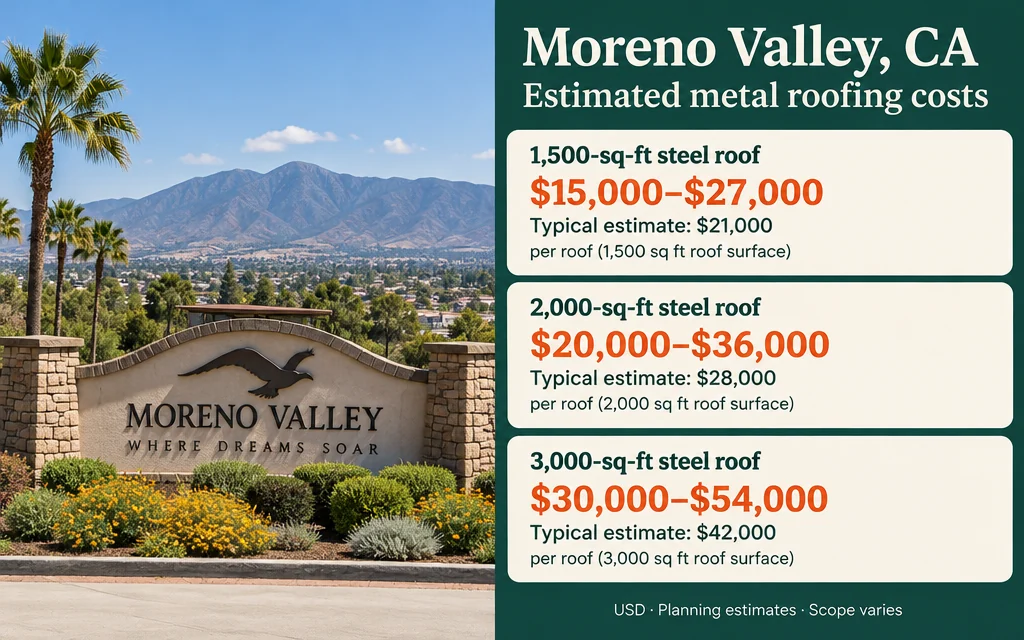
Calculated installed planning scenario for measured roof surface, including one-layer removal/disposal; conditional extras excluded.
Calculated installed planning scenario for measured roof surface, including one-layer removal/disposal; conditional extras excluded.
Calculated installed planning scenario for measured roof surface, including one-layer removal/disposal; conditional extras excluded.
Metal Roofing Estimates in Moreno Valley
A complete metal roof replacement in Moreno Valley protects your home against intense inland ultraviolet exposure, rapid day-to-night thermal swings, and seasonal desert winds. Unlike composition shingles that degrade under sustained dry heat, high-grade metal assemblies provide long-term structural durability.
When evaluating estimates, keep in mind that roofing contractors price their work based on the actual square footage of your roof deck—incorporating roof slope multipliers, overhangs, and dormers—rather than interior living area.
For residential properties, concealed-fastener standing-seam steel serves as the baseline system. Turnkey installations typically budget $10–$18 per sq ft of roof surface. This installed planning estimate covers tearing off one layer of existing shingles, inspecting the roof deck, laying high-temperature underlayment, and securing formed metal pans with concealed expansion clips. Essential perimeter flashings—including drip edges, rake trims, valley pans, and ridge caps—are part of the core scope. Complex roof features like masonry chimneys, skylight curbs, or stucco transitions require custom fabrication and appear as separate conditional line items.
Residential Metal Roofing Systems Compared
Choosing a panel profile and alloy determines your upfront budget, ongoing maintenance requirements, and architectural appearance.
Standing-Seam Steel (Concealed Fastener): The residential benchmark throughout the Inland Empire. Budget $10–$18 per sq ft of roof surface installed. Panels feature raised vertical seams joined over hidden clips, allowing metal to expand and contract smoothly between scorching afternoons and cooler desert nights. Most residential installations use 24-gauge or 26-gauge Galvalume steel finished with a durable PVDF (Kynar 500) resin paint.
Exposed-Fastener Ribbed Steel: Budget $6–$11 per sq ft of roof surface installed. Corrugated and ribbed metal panels are fastened using exterior screws with neoprene or EPDM washers driven directly through the metal face. While lower in initial expense, these exterior fasteners require scheduled inspections because rubber washers degrade and loosen after repeated sun exposure.
Stamped Steel Shingles or Tile: Budget $8.50–$15 per sq ft of roof surface installed. For neighborhoods where architectural review boards disallow standing-seam industrial profiles, stamped or stone-coated steel replicates shake, slate, or Spanish clay tile while delivering the lightweight strength of steel.
Standing-Seam Aluminum: Budget $11–$18 per sq ft of roof surface installed. Aluminum is impervious to rust, making it an essential upgrade along coastal shorelines. In Moreno Valley, where marine salt spray is absent, aluminum is an aesthetic option, though its higher thermal expansion demands careful clip layout.
Standing-Seam Copper: Budget $18–$32 per sq ft of roof surface installed. Copper offers unmatched architectural character, developing a natural protective patina over decades without factory coatings. It requires specialized sheet-metal hand-soldering and custom artisanal fabrication.
| Service / assumptions | Low | Typical estimate | High | Pricing unit | Estimated labor time |
|---|---|---|---|---|---|
| Standing-Seam Steel Roof (Installed)Calculated standing-seam steel planning rate: comparable panel/accessory materials + installation labor + one-layer removal/disposal. Ordinary underlayment and details over sound decking included; conditional extra work excluded. | $10 | $14 | $18 | per sq ft of roof surface (installed) | N/A |
| Exposed-Fastener Steel Roof (Installed)Corrugated or ribbed steel panels secured with exterior gasketed screws; includes tear-off, underlayment, and flashings. | $6 | $8 | $11 | per sq ft of roof surface (installed) | N/A |
| Steel Metal Shingles or Tile (Installed)Stamped or stone-coated steel shingles mimicking tile or shake profiles, fully installed with single tear-off. | $8.50 | $11.50 | $15 | per sq ft of roof surface (installed) | N/A |
| Standing-Seam Aluminum Roof (Installed)Turnkey installed .032-.040 aluminum standing-seam panels with clips, synthetic underlayment, and standard tear-off. | $11 | $14.50 | $18 | per sq ft of roof surface (installed) | N/A |
| Standing-Seam Copper Roof (Installed)Premium 16-20 oz architectural copper standing seam with hand-formed soldered flashing and custom artisanal fabrication. | $18 | $24 | $32 | per sq ft of roof surface (installed) | N/A |
Standing-Seam Cost Breakdown: Materials, Labor, and Teardown
Turnkey standing-seam steel estimates combine three primary components: raw materials and factory-formed accessories, skilled trade labor, and pre-existing roof removal.
Materials Allowance: Budget $4–$7 per sq ft of roof surface. This allowance covers 24-gauge or 26-gauge Galvalume steel pans, high-temperature synthetic underlayment engineered to withstand elevated deck heat under metal, concealed expansion clips, coated fasteners, eave and rake flashings, ridge caps, and high-grade sealants.
Installation Labor: Budget $5–$9 per sq ft of roof surface. Standing seam requires sheet-metal tradespeople to measure panels square to the eaves, hook bottom hems neatly into drip edges, form valleys without relying on exposed caulking, and place clips to accommodate thermal cycling.
One-Layer Tear-Off and Disposal: Budget $1–$2 per sq ft of roof surface. This covers stripping one pre-existing layer of asphalt shingles, pulling residual nails, sweeping the decking clean, and paying commercial disposal fees. Combining materials, labor, and single-layer tear-off over sound decking results in the installed baseline of $10–$18 per sq ft of roof surface.
| Service / assumptions | Low | Typical estimate | High | Pricing unit | Estimated labor time |
|---|---|---|---|---|---|
| Standing-Seam Steel Materials AllowancePanels, high-temperature underlayment, concealed clips, fasteners, eave/rake/ridge trims, and sealant. | $4 | $5.50 | $7 | per sq ft of roof surface (materials only) | N/A |
| Standing-Seam Steel Installation LaborOn-site panel alignment, clip fastening, seam locking, and installation of standard edge flashings. | $5 | $7 | $9 | per sq ft of roof surface (installation labor only) | N/A |
| Single-Layer Roof Tear-Off and DisposalRemoval of one existing layer of asphalt or composition shingles, surface nail sweep, and commercial disposal fees. | $1 | $1.50 | $2 | per sq ft of roof surface (one-layer removal and disposal) | N/A |
Installed Budgets Across Common Roof Sizes
A home's actual roof deck area is significantly larger than its interior footprint due to roof slope, eave overhangs, covered porches, and attached garages. For example, a single-story home with 1,600 square feet of conditioned floor area frequently has around 2,000 square feet of actual sloped roof surface.
Small Roof (1,500 sq ft roof surface): Representative of compact cottages or detached accessory dwellings. Budget $15,000–$27,000 for a turnkey standing-seam steel installation on a simple layout. On-site crew time typically runs 3-5 business days.
Medium Roof (2,000 sq ft roof surface): Typical for many single-family ranch and split-level homes in Moreno Valley. Planning estimates budget $20,000–$36,000 for a complete installation, with work taking 4-7 business days.
Large Roof (3,000 sq ft roof surface): Common on larger two-story homes or sprawling single-story layouts with multi-car garages. Budget $30,000–$54,000, depending on roof complexity and access. Elapsed crew time usually spans 6-10 business days.
| Service / assumptions | Low | Typical estimate | High | Pricing unit | Estimated labor time |
|---|---|---|---|---|---|
| Small Roof Replacement (1,500 sq ft)Calculated scenario: 1,500 sq ft of measured roof surface × standing-seam steel installed planning rate. Includes its same materials, installation, one-layer removal/disposal and sound-deck assumptions. Not a provider whole-roof quote. | $15,000 | $21,000 | $27,000 | per roof (1,500 sq ft roof surface) | 3-5 business days |
| Medium Roof Replacement (2,000 sq ft)Calculated scenario: 2,000 sq ft of measured roof surface × standing-seam steel installed planning rate. Includes its same materials, installation, one-layer removal/disposal and sound-deck assumptions. Not a provider whole-roof quote. | $20,000 | $28,000 | $36,000 | per roof (2,000 sq ft roof surface) | 4-7 business days |
| Large Roof Replacement (3,000 sq ft)Calculated scenario: 3,000 sq ft of measured roof surface × standing-seam steel installed planning rate. Includes its same materials, installation, one-layer removal/disposal and sound-deck assumptions. Not a provider whole-roof quote. | $30,000 | $42,000 | $54,000 | per roof (3,000 sq ft roof surface) | 6-10 business days |
Standing Seam Steel vs. Architectural Asphalt Shingles
Evaluating standing-seam steel against architectural shingles involves comparing initial capital expense with long-term resilience under hot, dry inland conditions.
Upfront Cost: Architectural shingles installed over sound decking with single-layer tear-off budget $5–$8.50 per sq ft of roof surface. Standing-seam steel demands higher initial expenditure, budgeting $10–$18 per sq ft of roof surface.
Performance in Inland Sun: Moreno Valley summers bring sustained triple-digit heat and intense UV radiation. Asphalt shingles gradually dry out, shedding protective granules and experiencing thermal curling at the edges over time. Standing-seam steel does not crack, split, or shed granules, and locked vertical seams prevent wind-driven uplift during gusty weather.
Maintenance and Planning: Asphalt shingles generally require earlier replacement and periodic inspection for blown-off tabs after severe Santa Ana wind events. Standing-seam panels utilize factory PVDF coatings that resist chalking and fading for decades. For homeowners planning to stay in their residence long-term, metal provides an exceptionally durable building envelope.
| Service / assumptions | Low | Typical estimate | High | Pricing unit | Estimated labor time |
|---|---|---|---|---|---|
| Architectural Asphalt Shingles (Reference)Installed baseline for architectural shingles including one-layer removal, synthetic felt, and standard flashings. Published rate reference for the stated roofing scope and unit, not verification of this guide's modeled range, a complete roof quote or provider availability. Regional reference; not a verified Moreno Valley-specific quote.Published price reference ↗ | $5 | $6.75 | $8.50 | per sq ft of roof surface (installed) | N/A |
| Comparison | Architectural asphalt | Standing-seam steel |
|---|---|---|
| Up-front planning estimate · 2,000 sq ft roof surface | $10,000–$17,000 | $20,000–$36,000 |
| What the baseline includes | Architectural asphalt, ordinary installed details, one-layer removal/disposal over sound decking. | Standing-seam steel, ordinary installed details, one-layer removal/disposal over sound decking. |
| Maintenance and repairs | Confirm product-specific inspections and repair terms. | Confirm seams, fasteners, coating, compatible repairs and inspection terms. |
| Insurance and ownership cost | Ask the insurer about the exact product and coverage. | Ask the insurer about accepted test documentation, any available credit and cosmetic-damage exclusions. |
These are calculated budgeting comparisons, not provider quotes or guaranteed lifetime savings. Compare your expected ownership period, specified products, actual maintenance proposals and written insurance terms.
| Decision point | Roof repair | Roof replacement | Metal roofing |
|---|---|---|---|
| Work being priced | A defined defect, such as damaged shingles or flashing. | Removal and installation of an agreed roof system across the measured roof surface. | A specified installed metal system; standing seam, exposed fasteners and metal shingles are different scopes. |
| What to inspect | The leak source, surrounding material and whether a durable localized fix is feasible. | The extent of deterioration, decking condition, roof details and suitable replacement systems. | The substrate, panel profile, coating, fasteners, roof geometry and installation details. |
| How to compare prices | Match the repair quantity, access, materials and included diagnosis. | Match measured roof area, material, tear-off layers, disposal and installed inclusions. | Match measured roof area, system, components, removal and conditional additional work. |
| Before deciding | Ask what the repair addresses and what existing problems would remain. | Ask whether repair remains practical and which additional items would change the total. | Ask about compatible materials, documented product/assembly ratings and product versus workmanship warranties. |
Age or a repair-cost percentage alone does not determine the right choice. Ask a qualified roofing contractor to assess the condition and explain viable options. A metal system is a material-specific installation choice, not a separate guarantee of durability or savings.
Conditional Scope and Add-On Costs
Every roofing project involves specific site conditions that fall outside standard baseline bids. Experienced contractors itemize these conditional scopes separately.
Additional Layer Removal: Budget $30–$70 per roofing square (100 sq ft) if your home has more than one pre-existing roof layer. Stripping extra layers increases manual crew hours and disposal fees.
Plywood Decking Replacement: Budget $60–$95 per 4-by-8-ft sheet of CDX plywood or OSB. Any dry-rotted or warped sheathing discovered after tear-off must be replaced to ensure metal expansion clips have a solid structural foundation.
Chimney and Skylight Flashings: Standard perimeter flashings are included in baseline estimates, but masonry chimneys budget $450–$950 per chimney and skylight curbs budget $350–$750 per unit for custom step, backpan, and counterflashing.
Continuous Ridge Ventilation: Budget $15–$40 per linear ft to incorporate continuous vented ridge caps that exhaust trapped attic heat without allowing weather infiltration.
Gutter Detach and Reset: Budget $6–$16 per linear ft when existing seamless gutters must be carefully taken down to install eave drip flashing and rehung afterward. If localized runoff or perimeter retention is required, snow and debris retention brackets budget $20–$55 per linear ft.
| Service / assumptions | Low | Typical estimate | High | Pricing unit | Estimated labor time |
|---|---|---|---|---|---|
| Additional Roofing Layer RemovalIncremental labor and haul-away charge to tear off a second pre-existing roof layer. | $30 | $45 | $70 | additional per roofing square (100 sq ft) | N/A |
| Plywood/OSB Decking ReplacementInstalled cost per 4x8 ft sheet of 1/2-inch CDX plywood or OSB to replace damaged structural sheathing. | $60 | $75 | $95 | additional per 4-by-8-ft sheet (32 sq ft) | N/A |
| Chimney Flashing and CounterflashingCustom-formed sheet-metal base flashing, step flashing, and reglet counterflashing for masonry chimneys. | $450 | $650 | $950 | additional per chimney | N/A |
| Skylight Flashing Kit / Curb FabricationCustom-bent backpan and step-flashing integration around existing skylight curbs. | $350 | $500 | $750 | additional per skylight | N/A |
| Continuous Ridge Ventilation UpgradeConcealed metal ridge vent profile installed with perforated baffles for continuous attic exhaust. | $15 | $25 | $40 | additional per linear ft | N/A |
| Snow Guard / Retention SystemSeam-mounted bar or bracket retention system for sliding snow and high-wind perimeter deflection. | $20 | $35 | $55 | additional per linear ft | N/A |
| Gutter Detach and ResetCarefully removing existing seamless gutters to install eave drip edge and reinstalling them post-roof. | $6 | $10 | $16 | additional per linear ft | N/A |
Ratings, Testing, and Insurance Realities
Understanding performance ratings helps homeowners distinguish verified engineering standards from marketing claims.
Impact Resistance (UL 2218): Most steel panels earn a Class 4 rating, meaning the panel resists cracking or tearing when struck by steel test spheres under laboratory conditions. Class 4 testing does not prevent superficial cosmetic denting. If your insurance carrier offers a premium credit for Class 4 roofs, confirm whether the policy requires a cosmetic damage waiver that excludes claims for visible dents that do not cause water leaks.
Fire Ratings (ASTM E108 / UL 790): While bare steel is naturally noncombustible, an entire roof system achieves an overall Class A fire rating only when installed with compatible fire-resistant underlayment over approved solid decking. Homeowners in foothill communities should confirm the specific fire-rated assembly with their installer.
Wind Uplift: Concealed standing-seam clips allow the roof to withstand severe wind forces without tearing through screw penetrations, making them well suited to the high winds common near the San Gorgonio Pass. Always request the manufacturer's certified wind uplift engineering sheet.
Key Factors Influencing Your Estimate
Several job-specific variables explain why proposals can differ significantly between homes with similar square footage.
Roof Pitch and Geometry: Low-pitch roofs that are easily walkable allow crews to stage materials and fasten seams efficiently. Steeper pitches require safety ropes, harness anchors, and specialized staging, which increases labor time. Similarly, rooflines with numerous valleys, hips, dormers, and intersecting ridges require extensive custom hand-cutting and flashing detail compared to simple gabled roofs.
Steel Thickness and Coating: Most residential work specifies 24-gauge or 26-gauge steel. The heavier 24-gauge metal provides superior stiffness that minimizes visible waviness (oil canning) under intense summer heat. Panels finished with premium PVDF resin (Kynar 500) carry a price premium over standard polyester coatings but retain their color and gloss much longer under harsh desert sun.
Property Access: Multi-story homes, tight property boundaries, mature landscaping, or overhead power lines complicate material hoisting and roll-off dumpster placement, resulting in additional labor time.
Hiring a Qualified Metal Roofing Contractor in Moreno Valley
Installing standing-seam metal roofing requires dedicated sheet-metal craftsmanship and tooling that differs markedly from composition shingle work. Before signing a contract, verify several critical details.
Licensing and Insurance: Verify that your contractor holds an active C-39 roofing license and workers' compensation coverage through the California Contractors State License Board (CSLB) online registry. Never allow an uninsured crew to work on your home.
Permits and Plan Review: Ask the contractor directly whether they will pull the building permit with the Moreno Valley Building Division. Inquire about any local requirements, including Title 24 cool-roof solar reflectance standards and municipal inspection schedules.
Detailed Scope of Work: Ensure your written estimate identifies the exact steel gauge, protective coating standard (such as Galvalume AZ50 or AZ55), paint finish brand, underlayment product, and seam profile. The proposal should also specify a clear unit rate for any structural decking repairs that may be discovered after tear-off.
Local income & housing costs
Moreno Valley city, California · U.S. Census Bureau, 2025 ACS 1-year estimates.
per month · ±$188
Cash-rent units; includes applicable tenant-paid utilities
Census source ↗Dollar amounts use the survey period’s published basis. Income is annual; gross rent is monthly. Home value reflects owner-occupied housing values. Margins of error shown are at the ACS 90% confidence level. These statistics provide city context; service budgets use their own pricing evidence.
STATEWIDE COST CONTEXT
California prices, income & labor costs
These California figures provide background for this city guide. They describe different measures and reference years; employee wages are not prices charged by a contractor.
BEA SAIRPD
State price change indicator
136.92024 · index (2017 basis)
Annual figures & sources
| Year | Value | 90% margin of error | Source |
|---|---|---|---|
| 2020 | 117.2 | — | Official source |
| 2021 | 122.0 | — | Official source |
| 2022 | 130.7 | — | Official source |
| 2023 | 135.2 | — | Official source |
| 2024 | 136.9 | — | Official source |
Census ACS 1-year
Median household income
$102,1592025 · USD/year
Annual figures & sources
| Year | Value | 90% margin of error | Source |
|---|---|---|---|
| 2021 | $84,907 | ±$542 | Official source |
| 2022 | $91,551 | ±$471 | Official source |
| 2023 | $95,521 | ±$611 | Official source |
| 2024 | $100,149 | ±$381 | Official source |
| 2025 | $102,159 | ±$390 | Official source |
BLS OEWS
Roofers
$30.582025 · USD/hour
Annual figures & sources
| Year | Value | 90% margin of error | Source |
|---|---|---|---|
| 2025 | $30.58 | — | Official source |
State prices: BEA, 2020–2024. Household income: Census ACS, 2021–2025. Employee wages: BLS, May 2025 snapshot. The charts retain their own units and fitted scales.
Explore all California living-cost data and trends →Local context and limitations
Moreno Valley experiences intense inland solar radiation, summer temperatures frequently climbing past 100 degrees Fahrenheit, and seasonal Santa Ana wind gusts through the San Gorgonio Pass region. In this climate, metal roofing is often selected for its noncombustible material properties, high solar reflectance, and wind resistance. Because Moreno Valley is inland and lacks coastal salt spray, standard 24-gauge Galvalume steel performs reliably without specialized marine coatings. Homeowners should verify cool-roof reflectivity standards and permit requirements with the Moreno Valley Building Division before finalizing roof specifications.
Frequently asked questions
What is the primary difference between standing seam and exposed-fastener metal roofs?
Standing-seam roofs use raised interlocking seams fastened by concealed clips beneath the metal, allowing panels to expand and contract smoothly during temperature swings without straining screw penetrations. Exposed-fastener roofs use screws driven through the face of the metal into the deck with rubber washers, which require periodic inspection because the exposed washers degrade under desert sun.
Why is my roof square footage higher than the square footage of my home?
Home square footage measures interior, horizontal floor space inside the exterior walls. Your roof must cover sloped deck surfaces, exterior eave overhangs, covered porches, and attached garages. Because sloped planes require more surface area than flat ground, your measured roof area will always exceed the interior footprint.
Can a new metal roof be installed directly over existing shingles in Moreno Valley?
Permit requirements and allowable roof layers must be verified for your specific property with the Moreno Valley Building Division and your engineer or contractor. In practice, roofing professionals strongly recommend removing existing shingles. A complete tear-off allows thorough inspection of the wood decking and ensures the metal panels lie flat without telegraphing shingle irregularities.
Will installing a metal roof lower my homeowners insurance premiums?
Some insurers provide policy discounts for metal roofs meeting Class 4 impact resistance or Class A fire assembly standards, but savings are not guaranteed across all carriers. Check directly with your insurance representative before installation, and confirm whether qualifying for a discount requires signing a cosmetic damage exclusion.
What steel gauge should I choose for a residential roof?
For residential standing seam, 24-gauge steel is widely recommended because its thickness provides greater rigidity and minimizes visible surface waviness (oil canning) during high summer temperatures. Lighter 26-gauge steel is also common for residential roofs, while thinner 29-gauge steel is generally intended for agricultural utility buildings.
Sources and methodology
Sources below retain their recorded retrieval dates and geographic scope. We checked the quoted rates against readable public pricing pages. The tables remain planning estimates, not provider quotes or a measured citywide survey. Per-square-foot references do not establish the modeled whole-roof totals or all their installed inclusions. Regional references are not verified Moreno Valley-specific quotes. Confirm removal, disposal, materials, labor and the complete scope in a written proposal.
Published pricing pages retrieved; quoted excerpts checked automatically. 3 distinct website domains. · Generated 2026-11-12
- Metal Roof Installation Services in Ontario, CA | Moreno Valley RoofingCity-specific page context · Page retrieved 2026-11-12 · Price excerpt matched automatically
“Installation Expenses - Labor costs for installing a metal roof generally fall between $5 and $12 per square foot.”
Planning ranges may differ from these published examples; they are not provider quotes.
- Leominster, MA Metal Roofing | Local Interlock® RooferState / regional reference · Page retrieved 2026-11-12 · Price excerpt matched automatically
“Most Interlock® roofs in New England come in at $16–$21 per square foot installed (USD).”
Planning ranges may differ from these published examples; they are not provider quotes.
- How Much Does a Metal Roof Cost Per Square Foot in 2026: A Complete Guide for California Homeowners - Cobex - Sacramento RooferState / regional reference · Page retrieved 2026-11-11 · Price excerpt matched automatically
“Cost Comparison Asphalt shingles often cost $3 to $6 per square foot for 3‑tab or $5 to $10 per square foot for architectural shingle installation.”
Planning ranges may differ from these published examples; they are not provider quotes.
Plan your metal roofing project
Choose your service and answer its project questions. Add notes or photos if helpful, then generate your project brief. The planner labels its budgeting assumptions separately. Use your plan to compare the scope and assumptions with a provider. Contact sharing and provider matching are not available yet.
Open the project planner →Share this city’s cost data
<> Embed Moreno Valley Cost Data on Your Site
The HTML table shows the prices at the time of copying. The iframe follows the published guide.