Norfolk · VA · COST GUIDE
Metal Roofing Costs in Norfolk, VA (2026)
For budgeting, standing-seam steel roofing is estimated at $12–$19 per sq ft of roof surface, and exposed-fastener steel at $7.50–$12 per sq ft. These installed planning ranges include one-layer removal/disposal over sound decking; compare the specified system and conditional extras.
Standing Seam Steel (Concealed Fastener)
Budget estimate$12–$19per sq ft of roof surface (installed)
Planning range · Compare the roof area, material and included work in your quote.
Exposed Fastener Steel (Ribbed/Corrugated)
Budget estimate$7.50–$12per sq ft of roof surface (installed)
Planning range · Compare the roof area, material and included work in your quote.
Published examples apply to their stated scope. Budget ranges are estimates.
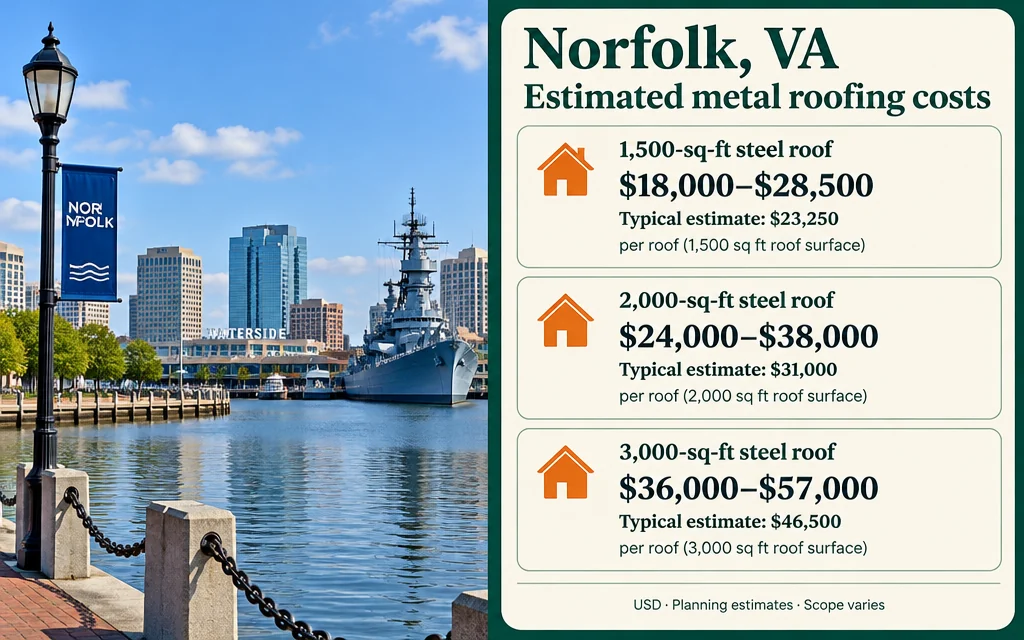
Calculated installed planning scenario for measured roof surface, including one-layer removal/disposal; conditional extras excluded.
Calculated installed planning scenario for measured roof surface, including one-layer removal/disposal; conditional extras excluded.
Calculated installed planning scenario for measured roof surface, including one-layer removal/disposal; conditional extras excluded.
Metal Roofing Investment in Norfolk
A metal roof is an engineered system designed to handle severe coastal weather, from humid summer heat to gale-force nor'easters. In Norfolk, a concealed-fastener standing-seam steel roof anchors interlocking panels over concealed clips secured directly to the deck.
For baseline planning, budget $12–$19 per sq ft of roof surface (installed), which covers panel materials, specialized sheet-metal labor, and the tear-off and disposal of a single layer of existing shingles over sound decking.
Roofing estimates reflect actual roof surface area rather than interior floor plans. Pitch, overhangs, and architectural features like dormers add substantial surface area. For instance, a single-story ranch with a 1,500-square-foot living footprint and a standard slope often carries 1,750 to 2,000 square feet of roof surface. On a 2,000-square-foot roof surface, standard standing-seam steel totals budget $24,000–$38,000 per roof (2,000 sq ft roof surface).
Homeowners in Hampton Roads turn to metal primarily to eliminate shingle blow-offs during tropical storms and to avoid repeated replacement cycles. While the upfront investment is higher than standard roofing, a properly installed metal roof provides decades of durable weatherproofing.
Residential Metal Roofing Systems Compared
Metal roofing includes several distinct systems with different fastening methods, metal compositions, and installed costs:
Standing-Seam Steel (Concealed Fastener): The benchmark residential profile. Continuous vertical panels interlock over concealed clips fastened directly to the deck. Made from 24- or 26-gauge Galvalume steel with a factory PVDF finish, the panels expand and contract freely along the clips without placing stress on fastener holes. Budget $12–$19 per sq ft of roof surface (installed).
Exposed-Fastener Steel (Ribbed/Corrugated): An economical alternative where screws penetrate through the exterior face of overlapping panels with elastomeric washers. Budget $7.50–$12 per sq ft of roof surface (installed). Because coastal sun, ozone, and seasonal temperature swings degrade exposed rubber washers over time, these roofs require scheduled fastener inspections and eventual washer replacement.
Steel Metal Shingles / Tiles: Stamped modular steel profiles that recreate the profile of slate, wood shakes, or clay barrel tiles while using concealed fasteners. Budget $11–$18 per sq ft of roof surface (installed). These are often chosen for historic properties or neighborhoods with strict architectural review boards that disallow vertical commercial seams.
Standing-Seam Aluminum: Recommended for immediate marine exposure along Chesapeake Bay and oceanfront stretches like Willoughby Spit and Ocean View. Because aluminum forms an inert protective oxide film, it resists rust along cut edges and surface scratches. Budget $14.50–$22.50 per sq ft of roof surface (installed).
Standing-Seam Copper: A premium architectural metal budget $28–$52 per sq ft of roof surface (installed). Copper requires no paint finish, naturally oxidizes into a verdigris patina, and is typically installed on historic accents, low-pitch porticos, or bay window roofs in Ghent and Freemason.
| Service / assumptions | Low | Typical estimate | High | Pricing unit | Estimated labor time |
|---|---|---|---|---|---|
| Standing Seam Steel (Concealed Fastener)Calculated standing-seam steel planning rate: comparable panel/accessory materials + installation labor + one-layer removal/disposal. Ordinary underlayment and details over sound decking included; conditional extra work excluded. Published rate reference for the stated roofing scope and unit, not verification of this guide's modeled range, a complete roof quote or provider availability. Regional reference; not a verified Norfolk-specific quote.Published price reference ↗ | $12 | $15.50 | $19 | per sq ft of roof surface (installed) | N/A |
| Exposed Fastener Steel (Ribbed/Corrugated)Screw-down residential ribbed panels including removal of one shingle layer; requires washer maintenance. | $7.50 | $9.50 | $12 | per sq ft of roof surface (installed) | N/A |
| Steel Metal Shingles / TilesStamped metal shingles resembling slate, shake, or tile; includes concealed fasteners and tear-off. Published rate reference for the stated roofing scope and unit, not verification of this guide's modeled range, a complete roof quote or provider availability.Published price reference ↗ | $11 | $14.50 | $18 | per sq ft of roof surface (installed) | N/A |
| Standing Seam Aluminum0.032 to 0.040-inch aluminum with concealed fasteners; ideal for saltwater exposure in coastal Norfolk. | $14.50 | $18 | $22.50 | per sq ft of roof surface (installed) | N/A |
| Standing Seam Copper16 oz architectural copper standing seam; unpainted, natural patina, historic applications. | $28 | $38 | $52 | per sq ft of roof surface (installed) | N/A |
Baseline Standing Seam Steel Breakdown
Reviewing individual scope components helps you compare contractor proposals effectively on sound decking:
Materials Allowance: Budget $4.75–$8.50 per sq ft of roof surface (materials only). This covers 24-gauge Galvalume steel panels, high-temperature self-adhering underlayment, floating expansion clips, stainless fasteners, color-matched flashings (eaves, rakes, valleys, sidewalls), closure strips, and butyl sealant tapes.
Installation Labor: Budget $6.25–$8.50 per sq ft of roof surface (installation labor only). Standing seam requires specialized sheet-metal trade skills. Installers lay out panel courses, hand-brake or mechanically seam ribs, anchor thermal-movement clips, custom-fabricate valley and wall transitions, and set safety rigging on sloped surfaces.
One-Layer Shingle Removal and Disposal: Budget $1–$2 per sq ft of roof surface (one-layer removal and disposal). This covers stripping the old asphalt layer down to the bare deck, pulling old nails, magnetic sweeping, hauling, and local landfill fees.
Combining these three component allowances establishes the baseline turnkey standing-seam steel rate of $12–$19 per sq ft of roof surface (installed).
| Service / assumptions | Low | Typical estimate | High | Pricing unit | Estimated labor time |
|---|---|---|---|---|---|
| Standing Seam Steel Materials AllowancePanels, concealed clips, high-temperature underlayment, drip edges, ridge trim, and sealants. | $4.75 | $6.50 | $8.50 | per sq ft of roof surface (materials only) | N/A |
| Standing Seam Steel Installation LaborSkilled sheet-metal mechanics installing underlayment, flashing fabrication, and panel seaming. | $6.25 | $7.50 | $8.50 | per sq ft of roof surface (installation labor only) | N/A |
| One-Layer Shingle Removal and DisposalStripping existing asphalt shingles to bare wood deck, pulling nails, hauling, and local disposal. | $1 | $1.50 | $2 | per sq ft of roof surface (one-layer removal and disposal) | N/A |
Project Budgets by Roof Size
Total installation costs scale with the measured surface area of the roof deck. These planning scenarios assume standard standing-seam steel installed over sound decking with single-layer shingle tear-off:
1,500 Sq Ft Roof Surface: For a compact bungalow or small ranch roof, budget $18,000–$28,500 per roof (1,500 sq ft roof surface). Elapsed on-site crew time typically runs 2 to 4 working days, depending on weather and roof pitch.
2,000 Sq Ft Roof Surface: For an average detached single-family home, budget $24,000–$38,000 per roof (2,000 sq ft roof surface). On-site crew time averages 3 to 6 working days.
3,000 Sq Ft Roof Surface: For larger two-story homes or properties with multiple hips, valleys, and dormers, budget $36,000–$57,000 per roof (3,000 sq ft roof surface). Detailed jobs of this scope typically require 5 to 8 working days.
| Service / assumptions | Low | Typical estimate | High | Pricing unit | Estimated labor time |
|---|---|---|---|---|---|
| Standing Seam Steel Roof (1,500 Sq Ft)Calculated scenario: 1,500 sq ft of measured roof surface × standing-seam steel installed planning rate. Includes its same materials, installation, one-layer removal/disposal and sound-deck assumptions. Not a provider whole-roof quote. | $18,000 | $23,250 | $28,500 | per roof (1,500 sq ft roof surface) | 2 to 4 working days |
| Standing Seam Steel Roof (2,000 Sq Ft)Calculated scenario: 2,000 sq ft of measured roof surface × standing-seam steel installed planning rate. Includes its same materials, installation, one-layer removal/disposal and sound-deck assumptions. Not a provider whole-roof quote. | $24,000 | $31,000 | $38,000 | per roof (2,000 sq ft roof surface) | 3 to 6 working days |
| Standing Seam Steel Roof (3,000 Sq Ft)Calculated scenario: 3,000 sq ft of measured roof surface × standing-seam steel installed planning rate. Includes its same materials, installation, one-layer removal/disposal and sound-deck assumptions. Not a provider whole-roof quote. | $36,000 | $46,500 | $57,000 | per roof (3,000 sq ft roof surface) | 5 to 8 working days |
Standing Seam Metal vs. Architectural Asphalt
Choosing between standing-seam steel and architectural asphalt shingles balances initial outlay against long-term maintenance.
For architectural asphalt shingles, planning quotes budget $4.50–$7 per sq ft of roof surface (installed), with an on-site installation time of 1 to 2 working days. Standing-seam steel sits at $12–$19 per sq ft of roof surface (installed), roughly two to three times higher initially.
In coastal environments, asphalt shingles are vulnerable to wind-driven uplift, seal-strip failure, and moisture degradation over time. A standing-seam steel roof locks together with concealed clips that resist severe wind pressures without exposed puncture points. While metal requires a larger initial budget, it eliminates periodic shingle blow-offs and short replacement cycles.
| Service / assumptions | Low | Typical estimate | High | Pricing unit | Estimated labor time |
|---|---|---|---|---|---|
| Architectural Asphalt Shingles ReferenceInstalled architectural shingles baseline including tear-off, underlayment, and standard ridge cap. | $4.50 | $5.75 | $7 | per sq ft of roof surface (installed) | 1 to 2 working days |
| Comparison | Architectural asphalt | Standing-seam steel |
|---|---|---|
| Up-front planning estimate · 2,000 sq ft roof surface | $9,000–$14,000 | $24,000–$38,000 |
| What the baseline includes | Architectural asphalt, ordinary installed details, one-layer removal/disposal over sound decking. | Standing-seam steel, ordinary installed details, one-layer removal/disposal over sound decking. |
| Maintenance and repairs | Confirm product-specific inspections and repair terms. | Confirm seams, fasteners, coating, compatible repairs and inspection terms. |
| Insurance and ownership cost | Ask the insurer about the exact product and coverage. | Ask the insurer about accepted test documentation, any available credit and cosmetic-damage exclusions. |
These are calculated budgeting comparisons, not provider quotes or guaranteed lifetime savings. Compare your expected ownership period, specified products, actual maintenance proposals and written insurance terms.
| Decision point | Roof repair | Roof replacement | Metal roofing |
|---|---|---|---|
| Work being priced | A defined defect, such as damaged shingles or flashing. | Removal and installation of an agreed roof system across the measured roof surface. | A specified installed metal system; standing seam, exposed fasteners and metal shingles are different scopes. |
| What to inspect | The leak source, surrounding material and whether a durable localized fix is feasible. | The extent of deterioration, decking condition, roof details and suitable replacement systems. | The substrate, panel profile, coating, fasteners, roof geometry and installation details. |
| How to compare prices | Match the repair quantity, access, materials and included diagnosis. | Match measured roof area, material, tear-off layers, disposal and installed inclusions. | Match measured roof area, system, components, removal and conditional additional work. |
| Before deciding | Ask what the repair addresses and what existing problems would remain. | Ask whether repair remains practical and which additional items would change the total. | Ask about compatible materials, documented product/assembly ratings and product versus workmanship warranties. |
Age or a repair-cost percentage alone does not determine the right choice. Ask a qualified roofing contractor to assess the condition and explain viable options. A metal system is a material-specific installation choice, not a separate guarantee of durability or savings.
Potential Roof Upgrades and Add-On Costs
An on-site inspection often reveals deck conditions or roof penetrations that require additional scope beyond the baseline estimate:
Additional Shingle Layer Removal: If your roof carries two or more layers of older roofing, budget $50–$135 additional per roofing square (100 sq ft) for the additional tear-off labor and dumpster fees.
Decking Replacement: Rotten or water-damaged sheathing must be replaced before installing underlayment. Budget $90–$140 additional per 4-by-8-ft sheet (32 sq ft) for structural plywood or OSB replacement.
Custom Chimney Flashing & Cricket: Flashing a masonry chimney into standing-seam panels requires a custom-bent apron, cricket, and counterflashing cut into mortar joints. Budget $400–$1,100 additional per chimney.
Skylight Flashing Integration: Custom sheet-metal curb flashing kits tailored to the panel profile budget $300–$750 additional per skylight.
Concealed Ridge Ventilation: Upgrading to a continuous, metal-specific ridge vent with built-in weather baffling costs $15–$38 additional per linear ft.
Snow Retention: For steep roof planes above exterior doorways or walkways, clamp-on snow cleats or retention bars cost $35–$110 additional per linear ft.
Gutter Detach and Reset: Removing existing gutters to access eave edges and reinstalling them post-roofing costs $6–$16 additional per linear ft.
| Service / assumptions | Low | Typical estimate | High | Pricing unit | Estimated labor time |
|---|---|---|---|---|---|
| Additional Roofing Layer RemovalLabor and disposal fee to strip a second or third existing roof layer down to wood decking. | $50 | $85 | $135 | additional per roofing square (100 sq ft) | N/A |
| Decking Replacement (4x8 Sheet)Replacement of rotted or warped plywood or OSB deck sheathing discovered upon tear-off. | $90 | $115 | $140 | additional per 4-by-8-ft sheet (32 sq ft) | N/A |
| Custom Chimney Flashing & CricketCustom-bent sheet metal saddle, step flashing, and counterflashing cut into mortar joints. | $400 | $650 | $1,100 | additional per chimney | N/A |
| Skylight Flashing IntegrationFabricated metal curb flashing assembly compatible with standing seam panel profiles. | $300 | $450 | $750 | additional per skylight | N/A |
| Concealed Ridge VentilationContinuous metal ridge vent with internal insect and wind-driven rain baffle. | $15 | $24 | $38 | additional per linear ft | N/A |
| Snow Retention Bar / CleatsClamp-on snow bars or individual seam clips installed along eaves to prevent sliding snow. | $35 | $60 | $110 | additional per linear ft | N/A |
| Gutter Detach and ResetCarefully removing existing gutters prior to eave flashing and re-mounting post-installation. | $6 | $10 | $16 | additional per linear ft | N/A |
Coastal Durability, Wind Ratings, and Codes
Understanding verified test standards helps cut through marketing claims:
Wind Uplift: Coastal areas experience high winds from nor'easters and tropical systems. Rather than trusting generic wind promises, look for systems tested under UL 580 (Class 90) or UL 1897 standards. Wind performance depends directly on deck attachment, panel gauge, clip spacing, and perimeter trim detailing specified in the manufacturer's engineering documentation.
Hail and Impact: Many steel profiles carry a UL 2218 Class 4 rating, confirming resistance to panel puncture during steel-ball drop tests. However, Class 4 certification does not guarantee immunity from cosmetic dimpling. Confirm with your insurance carrier whether your policy offers any rate adjustments for Class 4 roofs, and verify whether accepting a discount requires signing a cosmetic damage exclusion that waives claims for visible dents that do not cause active leaks.
Fire and Energy Performance: Metal roof systems installed over approved underlayments and solid sheathing can achieve a Class A fire rating. Factory-applied fluoropolymer coatings also provide solar reflectance that helps reduce radiant heat absorption into attic spaces compared with dark traditional materials.
Factors That Drive Local Installation Quotes
Several structural and site-specific factors explain why metal roofing proposals vary:
Roof Geometry and Pitch: Low-pitch roofs often require mechanically seamed ribs rather than snap-lock panels to prevent water infiltration, increasing installation time. Steep roofs demand safety staging and harness lines that slow crew progress. Complex rooflines with dormers, hips, and valleys require extensive custom cutting and flashing work.
Metal Selection for Coastal Exposure: For inland properties, standard 24-gauge Galvalume steel offers excellent strength. However, for homes right along the bay or tidal inlets, upgrading to standing-seam aluminum (budget $14.50–$22.50 per sq ft of roof surface installed) eliminates the edge creep and rust that can develop on cut steel edges.
Deck Flatness: Standing-seam panels run long and straight, meaning they telegraph dips, warped rafters, or uneven sheathing. Any substrate irregularities must be planed or sistered before panels are locked down.
Access and Lot Constraints: Historic or older residential areas often have narrow driveways, overhead wires, and limited staging space. If delivery trucks cannot place coils near the eaves or dumpsters cannot sit adjacent to the house, manual handling increases labor costs.
Hiring a Metal Roofing Contractor in Norfolk
Metal roofing requires specialized sheet-metal sheet mechanics rather than standard shingle roofers. When evaluating contractors, use these practical verification questions:
Licensing and Address Scope: Ask the contractor for their state license number, and verify with your local building department what permits are required for a complete roof replacement on your specific parcel. Confirm who is responsible for pulling the permit and scheduling required deck and final inspections.
Insurance Verification: Request a certificate of insurance sent directly from the broker confirming active general liability and workers' compensation coverage for roofing operations.
Panel Production Method: Ask whether panels will be factory-ordered to length or roll-formed on-site from master coils. Both methods work well, but on-site forming allows continuous ridge-to-eave panels on long runs, eliminating horizontal splice laps.
Underlayment Specifications: Verify that the proposal specifies a high-temperature synthetic underlayment or self-adhered membrane rated for metal roofing temperatures, rather than standard residential felt that can adhere to or degrade under hot metal panels.
Workmanship vs. Finish Warranty: Ensure the contract clearly distinguishes the manufacturer's paint finish warranty from the contractor's on-site installation and flashing warranty.
Local income & housing costs
Norfolk city, Virginia · U.S. Census Bureau, 2025 ACS 1-year estimates.
per month · ±$55
Cash-rent units; includes applicable tenant-paid utilities
Census source ↗Dollar amounts use the survey period’s published basis. Income is annual; gross rent is monthly. Home value reflects owner-occupied housing values. Margins of error shown are at the ACS 90% confidence level. These statistics provide city context; service budgets use their own pricing evidence.
STATEWIDE COST CONTEXT
Virginia prices, income & labor costs
These Virginia figures provide background for this city guide. They describe different measures and reference years; employee wages are not prices charged by a contractor.
BEA SAIRPD
State price change indicator
125.02024 · index (2017 basis)
Annual figures & sources
| Year | Value | 90% margin of error | Source |
|---|---|---|---|
| 2020 | 105.7 | — | Official source |
| 2021 | 111.5 | — | Official source |
| 2022 | 118.5 | — | Official source |
| 2023 | 122.1 | — | Official source |
| 2024 | 125.0 | — | Official source |
Census ACS 1-year
Median household income
$99,3222025 · USD/year
Annual figures & sources
| Year | Value | 90% margin of error | Source |
|---|---|---|---|
| 2021 | $80,963 | ±$731 | Official source |
| 2022 | $85,873 | ±$763 | Official source |
| 2023 | $89,931 | ±$970 | Official source |
| 2024 | $92,090 | ±$831 | Official source |
| 2025 | $99,322 | ±$1,105 | Official source |
BLS OEWS
Roofers
$23.282025 · USD/hour
Annual figures & sources
| Year | Value | 90% margin of error | Source |
|---|---|---|---|
| 2025 | $23.28 | — | Official source |
State prices: BEA, 2020–2024. Household income: Census ACS, 2021–2025. Employee wages: BLS, May 2025 snapshot. The charts retain their own units and fitted scales.
Explore all Virginia living-cost data and trends →Local context and limitations
Norfolk's coastal position along the Chesapeake Bay and the Elizabeth River brings persistent humidity, salt air, and storm activity. In waterfront neighborhoods like Ocean View or Willoughby Spit, homeowners often compare standing-seam aluminum with Galvalume steel because aluminum resists edge rust in direct marine exposure. When steel is installed, factory-applied fluoropolymer coatings like PVDF help guard against surface degradation. Fastener details also matter in coastal air: concealed stainless-steel clips and screws help avoid the galvanic corrosion common when standard carbon screws meet moist marine conditions.
Frequently asked questions
What is the difference between standing seam and exposed-fastener metal roofs?
Standing seam uses concealed clips under raised panel ribs, protecting screws from weather and allowing metal to move with temperature swings. Exposed-fastener roofs use screws driven directly through the panel face with rubber washers. While exposed-fastener systems cost less initially, the exterior washers require ongoing maintenance and eventual replacement.
Is aluminum or Galvalume steel better for a Norfolk home?
For most residential roofs set back from open water, 24-gauge Galvalume steel offers strong structural rigidity and cost efficiency. For properties directly on the Chesapeake Bay or oceanfront areas with persistent salt spray, aluminum is often preferred because it will not rust along cut edges or scratches.
Can a metal roof be installed directly over existing shingles in Norfolk?
Check with your local municipal building department and your metal panel manufacturer before considering an overlay at your specific address. Even where an overlay is technically allowed, full tear-off is widely recommended for standing seam. Removing old shingles lets the crew inspect the wood deck for hidden moisture damage, ensures a smooth flat surface, and allows proper placement of high-temperature underlayment.
Will a metal roof lower my homeowners insurance premium?
Some insurance companies provide discounts for UL 2218 Class 4 impact-rated roofs or certified high-wind assemblies, but policies vary. Check with your insurance provider directly. Be aware that some carriers require a cosmetic damage exclusion endorsement, meaning non-leaking dents from hail will not be covered.
Are metal roofs noisy during heavy coastal rainstorms?
When installed over solid wood decking with quality high-temperature underlayment and standard attic insulation, a residential metal roof produces sound levels comparable to asphalt shingles during rainstorms.
What steel gauge is typical for residential standing seam?
24-gauge steel is the standard choice for residential standing seam. It provides good wind resistance and panel rigidity while resisting oil canning (surface waviness) better than lighter 26- or 29-gauge options.
Sources and methodology
Sources below retain their recorded retrieval dates and geographic scope. We checked the quoted rates against readable public pricing pages. The tables remain planning estimates, not provider quotes or a measured citywide survey. Per-square-foot references do not establish the modeled whole-roof totals or all their installed inclusions. Regional references are not verified Norfolk-specific quotes. Confirm removal, disposal, materials, labor and the complete scope in a written proposal.
Published pricing pages retrieved; quoted excerpts checked automatically. 2 distinct website domains. · Generated 2026-11-12
- Metal Roof Costs in NoVA: 2025 Guide | Nest ExteriorsState / regional reference · Page retrieved 2026-11-12 · Price excerpt matched automatically
“They cost significantly less: typically $8 to $12 per square foot installed versus $14 to $19 for standing seam steel.”
Planning ranges may differ from these published examples; they are not provider quotes.
- Metal Roofing in Norfolk, VA | Free QuoteCity-specific page context · Page retrieved 2026-11-12 · Price excerpt matched automatically
“Metal shingle or stone-coated steel replacement Starting at $13/sq ft Stamped or stone-coated system for historic districts and HOAs; complexity and profile drive the number.”
Planning ranges may differ from these published examples; they are not provider quotes.
Plan your metal roofing project
Choose your service and answer its project questions. Add notes or photos if helpful, then generate your project brief. The planner labels its budgeting assumptions separately. Use your plan to compare the scope and assumptions with a provider. Contact sharing and provider matching are not available yet.
Open the project planner →Share this city’s cost data
<> Embed Norfolk Cost Data on Your Site
The HTML table shows the prices at the time of copying. The iframe follows the published guide.