Virginia Beach · VA · COST GUIDE
Metal Roofing Costs in Virginia Beach, VA (2026)
For budgeting, standing-seam steel roofing is estimated at $10–$16 per sq ft of roof surface, and exposed-fastener steel at $6–$11 per sq ft. These installed planning ranges include one-layer removal/disposal over sound decking; compare the specified system and conditional extras.
Standing Seam Steel (Installed)
Budget estimate$10–$16per sq ft of roof surface (installed)
Planning range · Compare the roof area, material and included work in your quote.
Exposed-Fastener Steel (Installed)
Budget estimate$6–$11per sq ft of roof surface (installed)
Planning range · Compare the roof area, material and included work in your quote.
Published examples apply to their stated scope. Budget ranges are estimates.
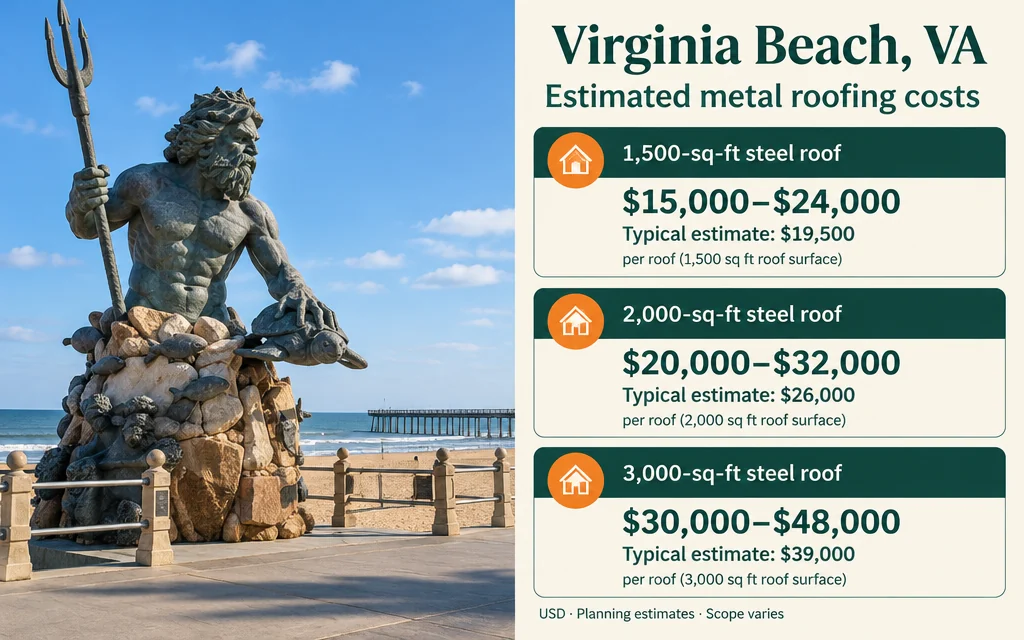
Calculated installed planning scenario for measured roof surface, including one-layer removal/disposal; conditional extras excluded.
Calculated installed planning scenario for measured roof surface, including one-layer removal/disposal; conditional extras excluded.
Calculated installed planning scenario for measured roof surface, including one-layer removal/disposal; conditional extras excluded.
Metal Roofing Pricing Overview in Virginia Beach
Metal roofing offers strong wind resistance and long service life against Virginia Beach coastal moisture, heat, and nor'easters. Residential costs depend primarily on the panel profile, base metal, gauge, and exposure to salt air.
A complete standing seam steel system on a standard single-family home generally lands at budget $10–$16 per sq ft of roof surface. This baseline planning scope includes tearing off one layer of existing shingles, hauling away debris, installing synthetic underlayment, and fastening concealed-clip panels with standard perimeter trim. By contrast, exposed-fastener steel panels run budget $6–$11 per sq ft, while specialty metals like aluminum run budget $13–$18 per sq ft and copper ranges budget $20–$35 per sq ft.
Keep in mind that measured roof surface area is always larger than interior living space. Overhangs, rake edges, and pitch add square footage beyond ground-floor dimensions. An installer calculates pricing against actual slope area, not floor plans.
Residential Metal Roofing Systems Compared
Choosing a metal profile involves balancing upfront costs against fastener design, maintenance needs, and coastal weather performance.
Concealed-Fastener Standing Seam Steel: The standard residential benchmark in Virginia Beach. Panels interlock vertically with raised ribs anchored by hidden clips underneath. Because fasteners stay shielded from UV exposure and rain, and the clips let panels expand and contract in high summer heat, maintenance stays low. Most homes use 24-gauge or 26-gauge Galvalume steel with a factory PVDF finish, budgeting $10–$16 per sq ft installed.
Exposed-Fastener Corrugated and Ribbed Steel: Panels such as 5V-crimp or R-panel overlap and fasten directly through the metal face using screws with rubber or EPDM washers. At budget $6–$11 per sq ft installed, this is an economical choice, but washer weathering requires routine fastener inspection and eventual gasket replacement. It is commonly chosen for detached garages, porches, or outbuildings.
Steel Metal Shingles: Stamped metal shingles replicate slate, shake, or dimensional asphalt while retaining steel strength. Fastened with hidden clips, they budget $9–$15 per sq ft installed and offer an alternative look where neighborhood architectural guidelines apply.
Standing Seam Aluminum: A common choice for waterfront properties along the Oceanfront, North End, or Chesapeake Bay. Aluminum naturally resists salt-spray corrosion at raw cut edges where steel can show edge creep over time. Aluminum standing seam budgets $13–$18 per sq ft installed.
Standing Seam Copper: A premium architectural metal valued for long service life and natural patina development. Installed copper runs budget $20–$35 per sq ft, reflecting specialized hand-forming labor and raw material expense. It is most frequently used on accent roofs, bay windows, and historic restorations.
| Service / assumptions | Low | Typical estimate | High | Pricing unit | Estimated labor time |
|---|---|---|---|---|---|
| Standing Seam Steel (Installed)Calculated standing-seam steel planning rate: comparable panel/accessory materials + installation labor + one-layer removal/disposal. Ordinary underlayment and details over sound decking included; conditional extra work excluded. | $10 | $13 | $16 | per sq ft of roof surface (installed) | N/A |
| Exposed-Fastener Steel (Installed)Corrugated or ribbed panels (e.g. 5V, R-panel) screwed through panel face with neoprene washers. Includes 1-layer tear-off. | $6 | $8.50 | $11 | per sq ft of roof surface (installed) | N/A |
| Steel Metal Shingles (Installed)Concealed fastener stamped steel shingles replicating shake, slate, or tile. Includes 1-layer tear-off. | $9 | $12 | $15 | per sq ft of roof surface (installed) | N/A |
| Standing Seam Aluminum (Installed)0.032 - 0.040 in marine-grade aluminum standing seam. Ideal for oceanfront and bay properties subject to salt fog.Published price reference ↗ | $13 | $15.50 | $18 | per sq ft of roof surface (installed) | N/A |
| Standing Seam Copper (Installed)16 oz architectural standing seam copper with soldered details. Includes 1-layer tear-off. | $20 | $27.50 | $35 | per sq ft of roof surface (installed) | N/A |
Cost Components of a Standing Seam Steel Installation
Understanding how a contractor builds an estimate helps you evaluate quotes fairly. On a baseline Galvalume standing seam steel roof in Virginia Beach, total installed pricing breaks down into three core elements:
1. Materials and Accessories (budget $4.50–$7 per sq ft): Includes roll-formed standing seam panels, concealed expansion clips, corrosion-resistant fasteners, high-temperature synthetic underlayment, drip edges, ridge caps, vented Z-bars, valley metal, and perimeter sealants.
2. Installation Labor (budget $4.50–$7 per sq ft): Metal roofing requires sheet-metal layout and detailing, including field-hemming eaves and rakes, mechanical seam locking, and flashing around chimneys and vent pipes. Crews typically spend several consecutive working days on-site depending on roof size.
3. Tear-Off and Disposal (budget $1–$2 per sq ft): Stripping one layer of old asphalt shingles down to the deck, magnetic sweeping for loose nails, and paying local landfill disposal fees. Complete removal ensures the decking is inspected for rot before panels go down.
| Service / assumptions | Low | Typical estimate | High | Pricing unit | Estimated labor time |
|---|---|---|---|---|---|
| Standing Seam Steel Materials & AccessoriesPanels, concealed clips, high-temp synthetic underlayment, drip edge, ridge cap, and perimeter trim. | $4.50 | $5.75 | $7 | per sq ft of roof surface (materials only) | N/A |
| Standing Seam Steel Installation LaborSkilled labor for panel roll-forming, seaming, hemming, flashing, and trim installation over sound deck. | $4.50 | $5.75 | $7 | per sq ft of roof surface (installation labor only) | N/A |
| One-Layer Tear-Off & DisposalRemoval of 1 layer of asphalt shingles, site clean-up, magnetic nail sweep, and local disposal dump fees. | $1 | $1.50 | $2 | per sq ft of roof surface (one-layer removal and disposal) | N/A |
Estimated Total Costs by Roof Size
Roofing projects are priced by actual roof surface area, not interior square footage. Below are calculated budget scenarios for complete standing seam steel roofs across three typical home sizes, assuming sound decking, standard pitch, and single-layer removal:
1,500 Sq Ft Roof Surface (compact single-story home or cottage): Typical project budget is $19,500, with an estimated on-site installation timeline of 3-5 working days.
2,000 Sq Ft Roof Surface (mid-sized single-family residence): Typical project budget is $26,000, with an installation timeline of 4-7 working days.
3,000 Sq Ft Roof Surface (larger two-story residence or complex roofline): Typical project budget is $39,000, with an installation timeline of 6-10 working days.
Steeper slopes (above 7:12), multiple dormers, valley intersections, or limited staging access push overall costs toward the upper end of these ranges.
| Service / assumptions | Low | Typical estimate | High | Pricing unit | Estimated labor time |
|---|---|---|---|---|---|
| Standing Seam Steel Roof (1,500 sq ft)Calculated scenario: 1,500 sq ft of measured roof surface × standing-seam steel installed planning rate. Includes its same materials, installation, one-layer removal/disposal and sound-deck assumptions. Not a provider whole-roof quote. | $15,000 | $19,500 | $24,000 | per roof (1,500 sq ft roof surface) | 3-5 working days |
| Standing Seam Steel Roof (2,000 sq ft)Calculated scenario: 2,000 sq ft of measured roof surface × standing-seam steel installed planning rate. Includes its same materials, installation, one-layer removal/disposal and sound-deck assumptions. Not a provider whole-roof quote. | $20,000 | $26,000 | $32,000 | per roof (2,000 sq ft roof surface) | 4-7 working days |
| Standing Seam Steel Roof (3,000 sq ft)Calculated scenario: 3,000 sq ft of measured roof surface × standing-seam steel installed planning rate. Includes its same materials, installation, one-layer removal/disposal and sound-deck assumptions. Not a provider whole-roof quote. | $30,000 | $39,000 | $48,000 | per roof (3,000 sq ft roof surface) | 6-10 working days |
Standing Seam Metal vs. Architectural Asphalt Shingles
Comparing standing seam steel with architectural asphalt shingles highlights differences in upfront cost, service life, and storm readiness.
Initial Investment: Architectural shingles have a lower upfront cost, budgeting $4–$8 per sq ft installed in Virginia Beach. Standing seam steel requires a larger initial outlay, budgeting $10–$16 per sq ft installed. On a per-square-foot basis, metal costs roughly double to triple an asphalt replacement.
Performance and Maintenance: Asphalt shingles can suffer granule loss and tab lifting during coastal wind events and nor'easters. Standing seam steel uses interlocking vertical ribs and concealed clips engineered to resist high wind uplift when fastened to local code. Because metal sheds water cleanly and resists moss and algae growth, routine maintenance is usually limited to clearing debris from valleys and checking pipe boot seals.
Long-Term Planning: If you expect to move within a few years, asphalt shingles provide practical weatherproofing with smaller upfront expense. For long-term homeownership, standing seam metal offers a longer service life with far fewer repair visits following heavy coastal winds.
| Service / assumptions | Low | Typical estimate | High | Pricing unit | Estimated labor time |
|---|---|---|---|---|---|
| Architectural Asphalt Shingles (Reference)Standard dimensional asphalt shingles installed over sound decking with 1-layer tear-off, underlayment, and standard flashing.Published price reference ↗ | $4 | $6 | $8 | per sq ft of roof surface (installed) | N/A |
| Comparison | Architectural asphalt | Standing-seam steel |
|---|---|---|
| Up-front planning estimate · 2,000 sq ft roof surface | $8,000–$16,000 | $20,000–$32,000 |
| What the baseline includes | Architectural asphalt, ordinary installed details, one-layer removal/disposal over sound decking. | Standing-seam steel, ordinary installed details, one-layer removal/disposal over sound decking. |
| Maintenance and repairs | Confirm product-specific inspections and repair terms. | Confirm seams, fasteners, coating, compatible repairs and inspection terms. |
| Insurance and ownership cost | Ask the insurer about the exact product and coverage. | Ask the insurer about accepted test documentation, any available credit and cosmetic-damage exclusions. |
These are calculated budgeting comparisons, not provider quotes or guaranteed lifetime savings. Compare your expected ownership period, specified products, actual maintenance proposals and written insurance terms.
| Decision point | Roof repair | Roof replacement | Metal roofing |
|---|---|---|---|
| Work being priced | A defined defect, such as damaged shingles or flashing. | Removal and installation of an agreed roof system across the measured roof surface. | A specified installed metal system; standing seam, exposed fasteners and metal shingles are different scopes. |
| What to inspect | The leak source, surrounding material and whether a durable localized fix is feasible. | The extent of deterioration, decking condition, roof details and suitable replacement systems. | The substrate, panel profile, coating, fasteners, roof geometry and installation details. |
| How to compare prices | Match the repair quantity, access, materials and included diagnosis. | Match measured roof area, material, tear-off layers, disposal and installed inclusions. | Match measured roof area, system, components, removal and conditional additional work. |
| Before deciding | Ask what the repair addresses and what existing problems would remain. | Ask whether repair remains practical and which additional items would change the total. | Ask about compatible materials, documented product/assembly ratings and product versus workmanship warranties. |
Age or a repair-cost percentage alone does not determine the right choice. Ask a qualified roofing contractor to assess the condition and explain viable options. A metal system is a material-specific installation choice, not a separate guarantee of durability or savings.
Additional Scope, Deck Repairs, and Flashing Work
Standard installation estimates assume sound wood decking and standard penetrations. When tear-off uncovers hidden moisture damage or custom details are needed, contractors charge for specific line items:
Plywood Deck Replacement: Once old shingles come off, the deck is inspected for rotted or soft wood. Replacing damaged 4-by-8-foot sheets of 1/2-inch CDX plywood or OSB budgets $80–$140 per sheet, including material, fastening, and labor.
Extra Layer Tear-Off: If an older roof has a second shingle layer underneath, stripping and hauling that additional layer budgets $35–$65 per roofing square (100 sq ft).
Flashing Penetrations: Standard pipe boots are generally included in base estimates, but custom masonry flashings require extra fabrication. Counter-flashing a brick chimney budgets $450–$900 per chimney. Custom skylight flashing kits budget $300–$650 per skylight.
Ventilation and Accessories: Upgrading to continuous vented ridge cap assemblies budgets $15–$30 per linear ft. Detaching and resetting existing gutters to install new drip edges correctly budgets $6–$14 per linear ft. Where snow or ice slide protection is needed over entryways or heat pumps, snow guard systems budget $40–$90 per linear ft.
| Service / assumptions | Low | Typical estimate | High | Pricing unit | Estimated labor time |
|---|---|---|---|---|---|
| Additional Shingle Layer Tear-OffRemoval and disposal of a 2nd or 3rd pre-existing roof layer beyond the 1st baseline layer. | $35 | $50 | $65 | additional per roofing square (100 sq ft) | N/A |
| Rotted Decking ReplacementReplacement of damaged 1/2 in CDX plywood or OSB sub-roofing discovered during tear-off. | $80 | $110 | $140 | additional per 4-by-8-ft sheet (32 sq ft) | N/A |
| Custom Chimney FlashingCustom-bent counter-flashing, step-flashing, and cricket fabrication for masonry chimneys. | $450 | $650 | $900 | additional per chimney | N/A |
| Skylight Flashing Kit & IntegrationCustom sheet-metal flashing transitions and ice-and-water detailing around existing skylights. | $300 | $450 | $650 | additional per skylight | N/A |
| Continuous Vented Ridge UpgradeHigh-profile perforated metal vented ridge cap assembly with insect/mesh baffles. | $15 | $22 | $30 | additional per linear ft | N/A |
| Snow Retention Bar / Guard SystemNon-penetrating seam-clamped snow guards or bar systems over doorways, porches, or heat pumps. | $40 | $65 | $90 | additional per linear ft | N/A |
| Gutter Detach and ResetRemoving existing gutters to install new eave metal/drip edges correctly, then re-hanging with new brackets. | $6 | $10 | $14 | additional per linear ft | N/A |
Performance Ratings, Wind Codes, and Insurance
Evaluating manufacturer technical ratings and local building requirements helps clarify what metal roofing delivers:
Impact Resistance (UL 2218 Class 4): Many metal roof panels achieve a Class 4 rating by resisting simulated 2-inch steel ball drops without rupturing the panel surface. However, a Class 4 rating does not guarantee full storm immunity or insurance premium discounts. Some homeowner policies include cosmetic damage exclusions, meaning cosmetic dimples that do not cause active leaks may not be covered.
Wind Uplift and Coastal Codes: The Virginia Uniform Statewide Building Code outlines design wind load criteria for coastal jurisdictions. Virginia Beach installations require verified clip spacing and perimeter fastening capable of meeting tested wind uplift standards such as UL 580 Class 90 or ASTM E1592.
Fire Ratings: Metal roofs typically achieve a Class A fire rating when installed over solid decking with fire-rated underlayment. The metal panels themselves are non-combustible.
Insurance Policies: Some carriers offer premium discounts for impact-rated Class 4 systems or continuous metal assemblies, but discounts are not universal or guaranteed. Ask your insurance agent what specific documentation and product certifications your carrier requires for any potential rate adjustments.
Key Cost Drivers for Virginia Beach Homes
Several site-specific variables decide whether your estimate lands near the lower or upper end of the price band:
Roof Geometry and Pitch: A simple 4:12 gable roof with two continuous planes is the most straightforward to install. Steeper pitches require fall-protection gear and staging that slow crew progress. Complex layouts with intersecting valleys, hips, and dormers require extensive hand-formed trim metal.
Substrate Metal Selection: Standard Galvalume steel (aluminum-zinc coated) is economical and performs well across inland neighborhoods. For properties close to open salt water along the Atlantic or Chesapeake Bay, salt fog can accelerate edge corrosion, making standing seam aluminum (budget $13–$18 per sq ft) the preferred material.
Panel Gauge: Residential standing seam typically uses 24-gauge or 26-gauge steel. Thicker 24-gauge panels offer greater structural rigidity and help minimize oil-canning (surface waviness), though they carry slightly higher material costs than 26-gauge metal.
Site Access and Staging: Multi-story coastal homes with narrow side yards often require crane lifts or ladder hoists to move long panels to the roof deck, adding staging time and equipment fees.
Hiring a Metal Roofing Contractor in Virginia Beach
Installing metal roofing requires different tools and sheet-metal skills than nailing asphalt shingles. Use these guidelines when evaluating local contractors:
Licensing and Insurance: Verify that the contractor holds an active Virginia Class A Contractor License with a Home Improvement (HIC) or Building Technical (BLD) classification through the Virginia Department of Professional and Occupational Regulation (DPOR). Confirm with the Virginia Beach Planning and Permits department what credentials are required to pull a residential roofing permit, and request active proof of general liability and workers' compensation coverage directly from the roofer's insurance agent.
Panel Fabrication and Metallurgy: Ask whether the contractor rolls panels on-site using a portable roll-former or orders factory-cut lengths. Near coastal waters, verify fastener metallurgy, such as stainless steel clips and screws, to prevent galvanic reaction with the panels.
Itemized Scope: Make sure the contract details the metal gauge, finish type, underlayment specification, seam height, clip type, and the price per sheet for repairing rotted roof decking.
Workmanship Warranty: Differentiate between the manufacturer's paint/finish warranty (protecting against chalking and peeling) and the contractor's workmanship warranty covering flashing transitions, penetrations, and installation integrity.
Local income & housing costs
Virginia Beach city, Virginia · U.S. Census Bureau, 2025 ACS 1-year estimates.
per month · ±$50
Cash-rent units; includes applicable tenant-paid utilities
Census source ↗Dollar amounts use the survey period’s published basis. Income is annual; gross rent is monthly. Home value reflects owner-occupied housing values. Margins of error shown are at the ACS 90% confidence level. These statistics provide city context; service budgets use their own pricing evidence.
STATEWIDE COST CONTEXT
Virginia prices, income & labor costs
These Virginia figures provide background for this city guide. They describe different measures and reference years; employee wages are not prices charged by a contractor.
BEA SAIRPD
State price change indicator
125.02024 · index (2017 basis)
Annual figures & sources
| Year | Value | 90% margin of error | Source |
|---|---|---|---|
| 2020 | 105.7 | — | Official source |
| 2021 | 111.5 | — | Official source |
| 2022 | 118.5 | — | Official source |
| 2023 | 122.1 | — | Official source |
| 2024 | 125.0 | — | Official source |
Census ACS 1-year
Median household income
$99,3222025 · USD/year
Annual figures & sources
| Year | Value | 90% margin of error | Source |
|---|---|---|---|
| 2021 | $80,963 | ±$731 | Official source |
| 2022 | $85,873 | ±$763 | Official source |
| 2023 | $89,931 | ±$970 | Official source |
| 2024 | $92,090 | ±$831 | Official source |
| 2025 | $99,322 | ±$1,105 | Official source |
BLS OEWS
Roofers
$23.282025 · USD/hour
Annual figures & sources
| Year | Value | 90% margin of error | Source |
|---|---|---|---|
| 2025 | $23.28 | — | Official source |
State prices: BEA, 2020–2024. Household income: Census ACS, 2021–2025. Employee wages: BLS, May 2025 snapshot. The charts retain their own units and fitted scales.
Explore all Virginia living-cost data and trends →Local context and limitations
Coastal Virginia Beach homes face wind-driven rain, salt spray, nor'easters, and sustained summer humidity. Galvalume-coated steel works well across inland residential neighborhoods, but homes directly exposed to oceanfront or tidal bay air often use painted or bare aluminum standing seam to protect cut edges against corrosion. The Virginia Uniform Statewide Building Code incorporates local design wind speeds that dictate fastener spacing, clip intervals, and perimeter drip edge detailing. Permit fees and submittal requirements depend on project valuation and structural work; verify building permit fees and application steps directly with the Virginia Beach Planning and Permits department for your address.
Frequently asked questions
What is the difference between standing seam and exposed-fastener metal roofing?
Standing seam uses vertical interlocking seams secured by hidden clips beneath the panels, leaving no exposed screw holes and allowing panels to expand and contract naturally. Exposed-fastener roofs use screws driven directly through the panel surface with rubber sealing washers. While exposed-fastener systems cost less upfront, their washers degrade over time from UV and weather exposure, requiring periodic inspection and eventual fastener replacement.
Why is aluminum recommended over steel for homes near Virginia Beach waters?
Galvalume steel has a protective zinc-aluminum coating, but salt spray near open water can attack raw cut edges, fastener penetrations, and scratch points. Aluminum contains no iron, making it naturally resistant to red rust and better suited for homes directly exposed to oceanfront and bay salt air.
Can a metal roof be installed directly over existing shingles in Virginia Beach?
While retrofits over a single shingle layer may be technically permissible under certain building configurations, a complete tear-off is widely recommended. Removing old shingles allows crews to inspect the wood decking for rotted boards, prevents adding excess dead weight, and ensures a flat surface that prevents panel distortion.
Will installing a metal roof reduce my homeowner insurance premiums?
Some insurance carriers offer premium discounts for Class 4 impact-rated panels or continuous metal roofing, but discounts vary by provider and policy. Some carriers also include cosmetic damage waivers that exclude coverage for visible hail dimples that do not cause active leaks. Confirm specific policy terms with your insurance agent before choosing a material.
How do I calculate the actual surface area of my roof compared to my home's floor plan?
Roof surface area exceeds interior living space because pitch, eaves, and overhangs expand the overall plane. A roof's true square footage depends on the slope multiplier and architectural features like hips, dormers, and gables. Roofing contractors calculate true surface area using aerial measurement software or on-site manual slope calculations rather than ground-floor dimensions.
Sources and methodology
These planning estimates draw on publicly available pricing pages read on 2026-11-12. Some cited pages mention the target city; that alone does not verify service coverage or establish a citywide average. Published starting rates and individual provider prices are reference points, not final local quotes. Confirm service availability, minimum charges, included work and travel charges with the provider.
Published pricing pages retrieved; quoted excerpts checked automatically. 2 distinct website domains. · Generated 2026-11-12
- Standing Seam Metal Roofing in Virginia Beach, VA | Virginia Beach Metal RoofingCity-specific page context · Page retrieved 2026-11-12 · Price excerpt matched automatically
“Standing seam installation, aluminum Starting at $13/sq ft Salt-resistant panels for Oceanfront and bay homes”
Planning ranges may differ from these published examples; they are not provider quotes.
 Provider badge
- Roof Replacement Cost Virginia Beach: 2026 Budget GuideCity-specific page context · Page retrieved 2026-11-12 · Price excerpt matched automatically
“Architectural shingles: about $4 to $8 per sq ft installed Standing-seam metal: about $8 to $16 per sq ft installed”
Planning ranges may differ from these published examples; they are not provider quotes.
Plan your metal roofing project
Choose your service and answer its project questions. Add notes or photos if helpful, then generate your project brief. The planner labels its budgeting assumptions separately. Use your plan to compare the scope and assumptions with a provider. Contact sharing and provider matching are not available yet.
Open the project planner →Share this city’s cost data
<> Embed Virginia Beach Cost Data on Your Site
The HTML table shows the prices at the time of copying. The iframe follows the published guide.