Sacramento · CA · COST GUIDE
Metal Roofing Costs in Sacramento, CA (2026)
For budgeting, standing-seam steel roofing is estimated at $10–$16.50 per sq ft of roof surface, and exposed-fastener steel at $7–$12 per sq ft. These installed planning ranges include one-layer removal/disposal over sound decking; compare the specified system and conditional extras.
Standing Seam Steel (Concealed Fastener)
Budget estimate$10–$16.50per sq ft of roof surface (installed)
Planning range · Compare the roof area, material and included work in your quote.
Exposed-Fastener Corrugated Steel
Budget estimate$7–$12per sq ft of roof surface (installed)
Planning range · Compare the roof area, material and included work in your quote.
Published examples apply to their stated scope. Budget ranges are estimates.
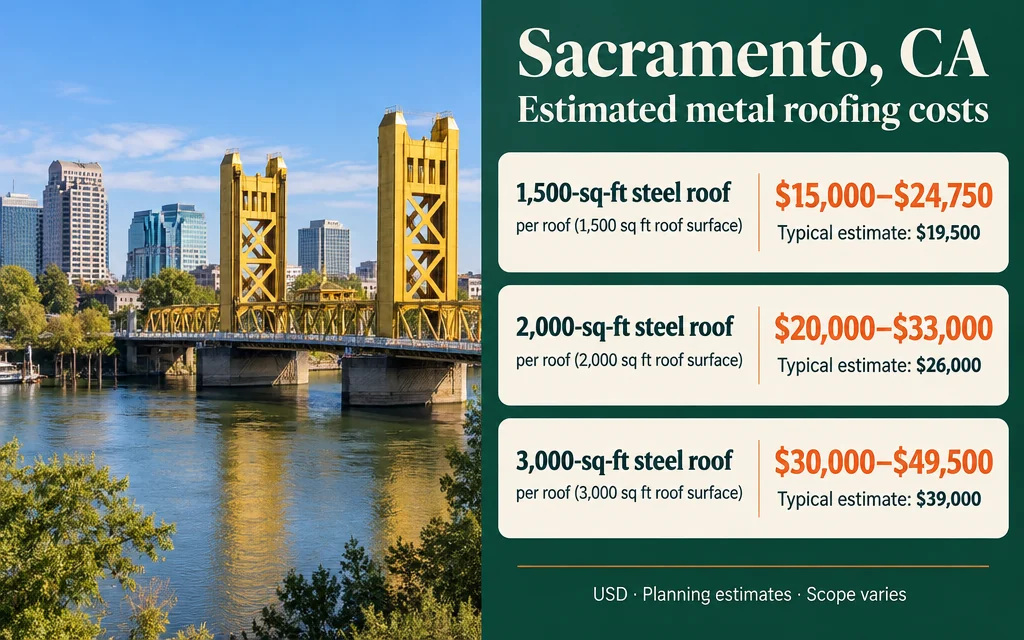
Calculated installed planning scenario for measured roof surface, including one-layer removal/disposal; conditional extras excluded.
Calculated installed planning scenario for measured roof surface, including one-layer removal/disposal; conditional extras excluded.
Calculated installed planning scenario for measured roof surface, including one-layer removal/disposal; conditional extras excluded.
Metal Roofing Pricing in Sacramento
For a standard single-family home in Sacramento, a full standing-seam steel roof replacement typically budgets $10–$16.50 per square foot of roof surface. That planning figure covers stripping one existing layer of asphalt shingles, hauling away the debris, laying high-temperature underlayment, and installing 24- or 26-gauge panels with standard perimeter flashing over sound wood decking.
Outbuildings, detached garages, and budget-conscious projects often utilize exposed-fastener corrugated steel instead, which budgets $7–$12 per square foot installed.
Roofing bids are based on actual roof surface area rather than interior living space. Pitch multipliers, eaves, and attached garage roofs mean an 1,800-square-foot single-story home typically requires 2,200 to 2,500 square feet of roofing material. For a representative 2,000-square-foot roof surface, Sacramento homeowners can expect to budget $20,000–$33,000 installed for standing-seam steel.
Metal requires a higher upfront commitment than standard composite shingles, but its durable factory finish withstands the Central Valley's intense summer sun without the granule loss or curling common to asphalt under sustained heat.
Residential Metal Roofing Systems Compared
Metal roofing encompasses several distinct systems with different fastening methods, service expectations, and price points:
Standing-seam steel (concealed fastener) serves as the primary residential benchmark across Northern California, budgeting $10–$16.50 per square foot installed. Fasteners and clips remain protected under interlocking vertical ribs. This profile allows panels to expand and contract smoothly during daily temperature swings between scorching afternoons and cooler Delta evenings. Most residential projects use 24- or 26-gauge Galvalume steel with a factory PVDF or Kynar finish.
Exposed-fastener corrugated steel budgets $7–$12 per square foot installed. Screws penetrate the panel faces directly, sealed with neoprene or EPDM washers. While economical upfront, Valley sun degrades these rubber washers over time, requiring periodic inspections and fastener maintenance to avoid leaks.
Stone-coated steel shingles and tiles budget $9–$15 per square foot installed. These stamped metal panels replicate barrel tile, wood shake, or dimensional shingles, making them common in neighborhoods where HOA architectural guidelines disallow vertical standing-seam ribs.
Standing-seam aluminum budgets $11–$18 per square foot installed. Aluminum is naturally corrosion-proof and lighter than steel. While essential along coastal saltwater zones, in Sacramento it is primarily selected for weight-sensitive framing or specific architectural preferences.
Standing-seam copper represents a premium architectural option, budgeting $20–$35 per square foot installed. Copper patinas over time and demands master sheet-metal craftsmanship, primarily specified for historic properties or distinctive accent overhangs.
| Service / assumptions | Low | Typical estimate | High | Pricing unit | Estimated labor time |
|---|---|---|---|---|---|
| Standing Seam Steel (Concealed Fastener)Calculated standing-seam steel planning rate: comparable panel/accessory materials + installation labor + one-layer removal/disposal. Ordinary underlayment and details over sound decking included; conditional extra work excluded. | $10 | $13 | $16.50 | per sq ft of roof surface (installed) | 4-6 business days |
| Exposed-Fastener Corrugated SteelRibbed corrugated steel panels with exposed neoprene-gasketed fasteners; common for outbuildings, ADUs, and budget projects. | $7 | $9.50 | $12 | per sq ft of roof surface (installed) | 2-4 business days |
| Stone-Coated Steel / Metal ShinglesStamped steel tiles mimicking asphalt, shake, or barrel tile profiles; ideal for HOA architectural guidelines. | $9 | $12 | $15 | per sq ft of roof surface (installed) | 3-5 business days |
| Standing Seam AluminumLightweight rust-proof .032-.040 aluminum panels with concealed fastening system. | $11 | $14.50 | $18 | per sq ft of roof surface (installed) | 4-6 business days |
| Standing Seam CopperArtisan architectural copper panels with soldered flashings for historic homes and premium accents. | $20 | $27.50 | $35 | per sq ft of roof surface (installed) | 7-12 business days |
Standing-Seam Component Breakdown
Understanding how contractors structure an estimate makes it easier to evaluate competing bids. A typical $13.00 per square foot standing-seam steel installation breaks into three core allowances:
Materials allowance budgets $4.50–$7 per square foot (typical $5.50). This covers 24- or 26-gauge factory-finished Galvalume panels, concealed expansion clips, structural fasteners, ridge caps, perimeter trims, and high-temperature underlayment designed to tolerate deck temperatures over 200°F.
Installation labor allowance budgets $4.50–$7.50 per square foot (typical $6.00). This covers roof layout, panel roll-forming or interlocking, valley details, and hand-folding rake, drip, and eave edge transitions.
Tear-off and disposal allowance budgets $1–$2 per square foot (typical $1.50). This includes stripping one layer of old asphalt shingles down to the deck, ground protection, magnetic nail sweeps, hauling, and local transfer-station disposal fees.
| Service / assumptions | Low | Typical estimate | High | Pricing unit | Estimated labor time |
|---|---|---|---|---|---|
| Standing Seam Steel Materials AllowanceFactory-finished PVDF panels, clips, structural screws, high-temp underlayment, and standard trims. | $4.50 | $5.50 | $7 | per sq ft of roof surface (materials only) | N/A |
| Standing Seam Steel Installation LaborSkilled labor for panel cutting, layout, clip attachment, seaming, and standard perimeter transitions. | $4.50 | $6 | $7.50 | per sq ft of roof surface (installation labor only) | N/A |
| One-Layer Tear-Off and DisposalComplete removal of single asphalt shingle layer, transport, and local landfill fees. | $1 | $1.50 | $2 | per sq ft of roof surface (one-layer removal and disposal) | N/A |
Project Budgets by Roof Surface Area
Project costs track actual roof surface area, slope, and roofline complexity rather than interior floor plans. On a straightforward roof with sound decking and a single-layer tear-off, installed budgets scale across typical home sizes:
Small roof (1,500 sq ft surface): Common on compact single-story homes or bungalows. Budget $15,000–$24,750 installed, with a mid-range baseline around $19,500. On-site work generally spans 3-5 business days.
Medium roof (2,000 sq ft surface): Typical for standard single-story ranch homes or compact two-story floor plans. Budget $20,000–$33,000 installed, with an average around $26,000. Expect on-site crew work to take 4-6 business days.
Large roof (3,000 sq ft surface): Found on larger homes or properties with multiple hips, valleys, and dormers. Budget $30,000–$49,500 installed, averaging roughly $39,000. Installation typically requires 5-8 business days.
| Service / assumptions | Low | Typical estimate | High | Pricing unit | Estimated labor time |
|---|---|---|---|---|---|
| Standing Seam Steel - 1,500 Sq Ft RoofCalculated scenario: 1,500 sq ft of measured roof surface × standing-seam steel installed planning rate. Includes its same materials, installation, one-layer removal/disposal and sound-deck assumptions. Not a provider whole-roof quote. | $15,000 | $19,500 | $24,750 | per roof (1,500 sq ft roof surface) | 3-5 business days |
| Standing Seam Steel - 2,000 Sq Ft RoofCalculated scenario: 2,000 sq ft of measured roof surface × standing-seam steel installed planning rate. Includes its same materials, installation, one-layer removal/disposal and sound-deck assumptions. Not a provider whole-roof quote. | $20,000 | $26,000 | $33,000 | per roof (2,000 sq ft roof surface) | 4-6 business days |
| Standing Seam Steel - 3,000 Sq Ft RoofCalculated scenario: 3,000 sq ft of measured roof surface × standing-seam steel installed planning rate. Includes its same materials, installation, one-layer removal/disposal and sound-deck assumptions. Not a provider whole-roof quote. | $30,000 | $39,000 | $49,500 | per roof (3,000 sq ft roof surface) | 5-8 business days |
Metal Roofing vs. Architectural Asphalt in Sacramento
Standing-seam steel (budgeting $10–$16.50 per sq ft installed) costs roughly two to two-and-a-half times more upfront than architectural asphalt shingles (budgeting $4.50–$7.50 per sq ft installed). Choosing between them involves balancing upfront budget against anticipated service life and maintenance requirements.
Sacramento's summer heat tests asphalt roofing materials. Sustained periods of triple-digit temperatures cause asphalt binders to dry out, shed protective granules, and curl at the edges over time. While architectural shingles carry multi-decade manufacturer warranties, severe thermal cycling in the Central Valley often accelerates surface aging compared to milder coastal climates. By contrast, factory-coated standing-seam steel panels with PVDF resin finishes resist UV degradation and do not dry out or crack.
Because an asphalt roof may require replacement or major maintenance sooner under intense sun exposure, the long-term lifecycle cost difference between systems can narrow. Metal also sheds absorbed heat rapidly once evening Delta breezes arrive, helping reduce attic heat retention.
| Service / assumptions | Low | Typical estimate | High | Pricing unit | Estimated labor time |
|---|---|---|---|---|---|
| Architectural Asphalt Shingles ReferenceStandard architectural asphalt shingle replacement including single-layer tear-off and synthetic underlayment. Published rate reference for the stated roofing scope and unit, not verification of this guide's modeled range, a complete roof quote or provider availability. Regional reference; not a verified Sacramento-specific quote.Published price reference ↗ | $4.50 | $6 | $7.50 | per sq ft of roof surface (installed) | 1-3 business days |
| Comparison | Architectural asphalt | Standing-seam steel |
|---|---|---|
| Up-front planning estimate · 2,000 sq ft roof surface | $9,000–$15,000 | $20,000–$33,000 |
| What the baseline includes | Architectural asphalt, ordinary installed details, one-layer removal/disposal over sound decking. | Standing-seam steel, ordinary installed details, one-layer removal/disposal over sound decking. |
| Maintenance and repairs | Confirm product-specific inspections and repair terms. | Confirm seams, fasteners, coating, compatible repairs and inspection terms. |
| Insurance and ownership cost | Ask the insurer about the exact product and coverage. | Ask the insurer about accepted test documentation, any available credit and cosmetic-damage exclusions. |
These are calculated budgeting comparisons, not provider quotes or guaranteed lifetime savings. Compare your expected ownership period, specified products, actual maintenance proposals and written insurance terms.
| Decision point | Roof repair | Roof replacement | Metal roofing |
|---|---|---|---|
| Work being priced | A defined defect, such as damaged shingles or flashing. | Removal and installation of an agreed roof system across the measured roof surface. | A specified installed metal system; standing seam, exposed fasteners and metal shingles are different scopes. |
| What to inspect | The leak source, surrounding material and whether a durable localized fix is feasible. | The extent of deterioration, decking condition, roof details and suitable replacement systems. | The substrate, panel profile, coating, fasteners, roof geometry and installation details. |
| How to compare prices | Match the repair quantity, access, materials and included diagnosis. | Match measured roof area, material, tear-off layers, disposal and installed inclusions. | Match measured roof area, system, components, removal and conditional additional work. |
| Before deciding | Ask what the repair addresses and what existing problems would remain. | Ask whether repair remains practical and which additional items would change the total. | Ask about compatible materials, documented product/assembly ratings and product versus workmanship warranties. |
Age or a repair-cost percentage alone does not determine the right choice. Ask a qualified roofing contractor to assess the condition and explain viable options. A metal system is a material-specific installation choice, not a separate guarantee of durability or savings.
Additional Scope and Conditional Work Items
Standard metal roofing estimates assume an intact wood deck and straightforward roof geometry. Once the existing roof is stripped or an estimator conducts a detailed attic inspection, several conditional scope additions may apply:
Plywood or OSB decking repair: Metal requires a continuous, structurally sound deck. Rotted boards, moisture-damaged sheets, or wide gaps in older board sheathing must be repaired. Budget $75–$120 per 4-by-8-foot sheet installed.
Additional shingle layer removal: If the structure has two or more existing layers of roofing, removing each extra layer adds $35–$65 per roofing square (100 sq ft) for the additional weight, labor, and disposal fees.
Chimney and skylight flashing: Standard wall flashings are included in base labor, but masonry chimneys and skylights require custom field-fabricated metal kits. Budget $350–$750 per chimney and $250–$500 per skylight.
Ridge ventilation: Cutting back deck sheathing and installing screened standing-seam ridge vents runs $12–$25 per linear foot.
Gutter handling: Seamless gutters often need to be detached and re-hung to secure the perimeter drip-edge hem properly. Budget $4–$8 per linear foot.
| Service / assumptions | Low | Typical estimate | High | Pricing unit | Estimated labor time |
|---|---|---|---|---|---|
| Additional Layer Tear-OffStripping and disposing of a second or third existing shingle layer beyond base allowance. | $35 | $45 | $65 | additional per roofing square (100 sq ft) | N/A |
| Plywood / OSB Decking ReplacementReplacing deteriorated or rotted structural 1/2-inch CDX plywood or OSB sheeting. | $75 | $95 | $120 | additional per 4-by-8-ft sheet (32 sq ft) | N/A |
| Custom Chimney Flashing KitCustom-bent metal head, step, and counter-flashing around brick or stucco chimneys. | $350 | $500 | $750 | additional per chimney | N/A |
| Skylight Flashing IntegrationField-fabricated metal curb flashing kit for curb-mounted skylights. | $250 | $375 | $500 | additional per skylight | N/A |
| Continuous Ridge Ventilation UpgradeSlot cutting, screened metal ridge cap vent assembly meeting Title 24 attic airflow. | $12 | $18 | $25 | additional per linear ft | N/A |
| Snow Retention Rail SystemNon-penetrating clamp-on seam snow guards (primarily for high-elevation or foothill properties). | $18 | $26 | $36 | additional per linear ft | N/A |
| Gutter Detach and ResetRemoving existing gutters to install perimeter drip edge flashings and re-hanging with new brackets. | $4 | $6 | $8 | additional per linear ft | N/A |
Codes, Fire Ratings, and Climate Performance in Sacramento
When evaluating metal roofing for a Sacramento property, consider how specific performance standards apply to your installation:
Fire resistance: Metal panels are non-combustible. A standing-seam system can achieve an assembly Class A fire rating when installed over an approved fire-resistant underlayment or gypsum cap sheet. For properties in or near designated wildland-urban interface zones, confirm with your contractor that the entire proposed roof assembly—not just the metal surface—satisfies local fire-safety requirements.
Wind uplift: Properly engineered standing-seam profiles attached to manufacturer clip spacing resist strong uplift during winter storm fronts. Because seams are locked mechanically or snapped securely over hidden clips, wind cannot easily lift individual tabs as it can with weathered shingles.
Impact ratings: Many residential steel profiles achieve a UL 2218 Class 4 impact rating. This certification indicates resistance against punctures from hail or falling tree limbs, though cosmetic surface denting can still occur under heavy impacts. Check with your insurance carrier whether they offer premium discounts for Class 4 installations, and verify whether the policy contains a cosmetic damage endorsement excluding cosmetic dents.
Title 24 cool-roof compliance: California's Energy Code (Title 24) establishes solar reflectance and thermal emittance thresholds for residential reroofing projects in specific climate zones. Request the Cool Roof Rating Council (CRRC) product rating for your chosen panel profile and color before ordering materials.
Key Cost Drivers for Sacramento Metal Roofs
Two properties with identical floor plans can receive very different bids based on four practical site factors:
Roof pitch and complexity: Moderate slopes allow roofers to move and stage materials efficiently. Slopes steeper than 6:12 require safety staging, roof brackets, and slower installation. Multiple hips, valleys, gables, and dormers increase off-cut scrap and require hand-fabricated flashing work, adding substantial skilled labor hours.
Panel profile and attachment: Snap-lock standing-seam panels lock together over concealed clips with minimal specialized machinery, keeping labor closer to baseline. Mechanically seamed profiles require an electric seamer run down every vertical rib, which increases labor time and equipment costs.
Steel gauge: Residential projects generally specify 24-gauge or 26-gauge steel. The heavier 24-gauge steel carries a higher material cost but provides superior resistance against panel waviness (oil-canning) and better dent protection.
Access and staging constraints: Narrow property setbacks, two-story walls, and mature landscaping complicate delivery and staging of long metal panels. If panels must be hand-carried through tight side yards or maneuvered around power lines, expect higher site staging allowances.
Hiring a Metal Roofing Contractor in Sacramento
Standing-seam installation requires specialized sheet-metal fabrication skills, precise layout work, and proper clip alignment. Techniques used for asphalt shingles do not transfer to metal.
Contractor verification: Confirm the roofer holds an active C-39 Roofing contractor license in good standing with the California Contractors State License Board (CSLB). Request certificates of general liability and workers' compensation coverage delivered directly from their insurance carrier.
Key scope questions to ask before signing:
1. What steel gauge and profile are specified in this estimate (for example, 24-gauge snap-lock or 26-gauge mechanical seam)?
2. Does the paint finish carry a factory PVDF/Kynar coating, and does the specific color meet Title 24 cool-roof requirements for our address?
3. What underlayment will be installed, and is it a high-temperature self-adhering membrane rated for metal roofing?
4. Are the panel clips fixed or sliding expansion clips designed to accommodate thermal movement?
5. Does your bid include obtaining the building permit from the local building department, or is that billed separately?
6. How is damaged or rotted decking priced and documented if uncovered during tear-off?
Local income & housing costs
Sacramento city, California · U.S. Census Bureau, 2025 ACS 1-year estimates.
per month · ±$48
Cash-rent units; includes applicable tenant-paid utilities
Census source ↗Dollar amounts use the survey period’s published basis. Income is annual; gross rent is monthly. Home value reflects owner-occupied housing values. Margins of error shown are at the ACS 90% confidence level. These statistics provide city context; service budgets use their own pricing evidence.
STATEWIDE COST CONTEXT
California prices, income & labor costs
These California figures provide background for this city guide. They describe different measures and reference years; employee wages are not prices charged by a contractor.
BEA SAIRPD
State price change indicator
136.92024 · index (2017 basis)
Annual figures & sources
| Year | Value | 90% margin of error | Source |
|---|---|---|---|
| 2020 | 117.2 | — | Official source |
| 2021 | 122.0 | — | Official source |
| 2022 | 130.7 | — | Official source |
| 2023 | 135.2 | — | Official source |
| 2024 | 136.9 | — | Official source |
Census ACS 1-year
Median household income
$102,1592025 · USD/year
Annual figures & sources
| Year | Value | 90% margin of error | Source |
|---|---|---|---|
| 2021 | $84,907 | ±$542 | Official source |
| 2022 | $91,551 | ±$471 | Official source |
| 2023 | $95,521 | ±$611 | Official source |
| 2024 | $100,149 | ±$381 | Official source |
| 2025 | $102,159 | ±$390 | Official source |
BLS OEWS
Roofers
$30.582025 · USD/hour
Annual figures & sources
| Year | Value | 90% margin of error | Source |
|---|---|---|---|
| 2025 | $30.58 | — | Official source |
State prices: BEA, 2020–2024. Household income: Census ACS, 2021–2025. Employee wages: BLS, May 2025 snapshot. The charts retain their own units and fitted scales.
Explore all California living-cost data and trends →Local context and limitations
Sacramento experiences hot, dry summers where daytime temperatures frequently exceed 100°F, followed by evening cooling from the Delta breeze and wet winter storms. That daily temperature fluctuation causes metal panels to expand and contract repeatedly. Concealed-fastener standing-seam panels accommodate this movement with sliding clips, whereas exposed screws with rubber washers face direct UV exposure and degrade sooner. Before selecting a system, verify Title 24 cool-roof solar reflectance standards for your specific address with the local building department, and confirm your estimate specifies a high-temperature self-adhered underlayment rated for metal applications.
Frequently asked questions
What is the primary difference between standing seam and corrugated metal?
Standing-seam systems use concealed clips and raised interlocking seams that protect fasteners from weather exposure while allowing panels to expand and contract smoothly. Corrugated panels rely on exposed screws driven through the panel face with rubber washers. Under Sacramento's intense summer sun, those exposed rubber washers degrade and loosen over time, requiring periodic inspection and re-tightening to stop leaks.
Why is roof surface area larger than my home's interior square footage?
Roofing bids are based on exterior roof surface area, not interior living area. Eaves, overhangs, attached garages, and the roof's slope all add measurable area. A 2,000-square-foot home typically has 2,400 to 2,800 square feet of actual roof surface once pitch multipliers and perimeter overhangs are added.
Will a metal roof lower my cooling bills during Sacramento summers?
Factory-applied cool-roof coatings reflect solar radiation and re-emit heat efficiently. Paired with adequate attic ventilation and a proper high-temperature underlayment, a cool-rated metal roof can reduce heat transfer into the attic space, helping air conditioners operate more efficiently during prolonged Valley heat waves.
Can I install a new metal roof directly over my existing asphalt shingles?
Address-specific building code allowances and permit rules must be verified with the local building department. While overlays are occasionally permitted under strict conditions, standing-seam manufacturers and experienced installers generally advise a complete tear-off. Stripping old shingles allows inspection of the decking for dry rot and creates a smooth, flat deck that prevents panel distortion.
Do insurance companies give discounts for metal roofing in Sacramento?
Some insurers provide rate credits for roofs carrying a UL 2218 Class 4 impact rating or an engineered Class A fire assembly, but policies and discount amounts vary by provider and address. Some policies also include cosmetic damage endorsements that waive payout for dents that do not cause active leaks. Confirm acceptable documentation directly with your insurance agent before choosing materials.
How long does a standing seam metal roof replacement take to complete?
A standard residential standing-seam installation typically takes 4-6 business days of on-site crew work once materials are delivered, compared to 1-3 business days for architectural asphalt. Roofs with steep pitches, multiple dormers, or extensive deck repairs require additional time.
Sources and methodology
Sources below retain their recorded retrieval dates and geographic scope. We checked the quoted rates against readable public pricing pages. The tables remain planning estimates, not provider quotes or a measured citywide survey. Per-square-foot references do not establish the modeled whole-roof totals or all their installed inclusions. Regional references are not verified Sacramento-specific quotes. Confirm removal, disposal, materials, labor and the complete scope in a written proposal.
Published pricing pages retrieved; quoted excerpts checked automatically. 3 distinct website domains. · Generated 2026-11-12
- Metal Roof Cost in 2026, What Homeowners Need to Know - Cobex - Sacramento RooferCity-specific page context · Page retrieved 2026-11-12 · Price excerpt matched automatically
“Some sources note a range of $6 to $12 per square foot installed, especially for corrugated metal or basic standing seam systems.”
Planning ranges may differ from these published examples; they are not provider quotes.
- Metal Roofing Fresno CA: Professional Installation & CostsState / regional reference · Page retrieved 2026-11-12 · Price excerpt matched automatically
“Installation costs for metal roofing in Fresno typically range from $9 to $12 per square foot, depending on the material and complexity.”
Planning ranges may differ from these published examples; they are not provider quotes.
- What Does a New Roof Cost in Michigan? Average Prices and Calculator Tips | The Roof CompanyState / regional reference · Page retrieved 2026-11-12 · Price excerpt matched automatically
“Standard 3-tab and architectural asphalt shingles cost between $5.46 and $6.41 per square foot installed.”
Planning ranges may differ from these published examples; they are not provider quotes.
Plan your metal roofing project
Choose your service and answer its project questions. Add notes or photos if helpful, then generate your project brief. The planner labels its budgeting assumptions separately. Use your plan to compare the scope and assumptions with a provider. Contact sharing and provider matching are not available yet.
Open the project planner →Share this city’s cost data
<> Embed Sacramento Cost Data on Your Site
The HTML table shows the prices at the time of copying. The iframe follows the published guide.