San Francisco · CA · COST GUIDE
Metal Roofing Costs in San Francisco, CA (2026)
For budgeting, standing-seam steel roofing is estimated at $12–$22 per sq ft of roof surface, and exposed-fastener steel at $7–$12.50 per sq ft. These installed planning ranges include one-layer removal/disposal over sound decking; compare the specified system and conditional extras.
Standing Seam Steel (Installed)
Budget estimate$12–$22per sq ft of roof surface (installed)
Planning range · Compare the roof area, material and included work in your quote.
Exposed-Fastener Steel (Installed)
Budget estimate$7–$12.50per sq ft of roof surface (installed)
Planning range · Compare the roof area, material and included work in your quote.
Published examples apply to their stated scope. Budget ranges are estimates.
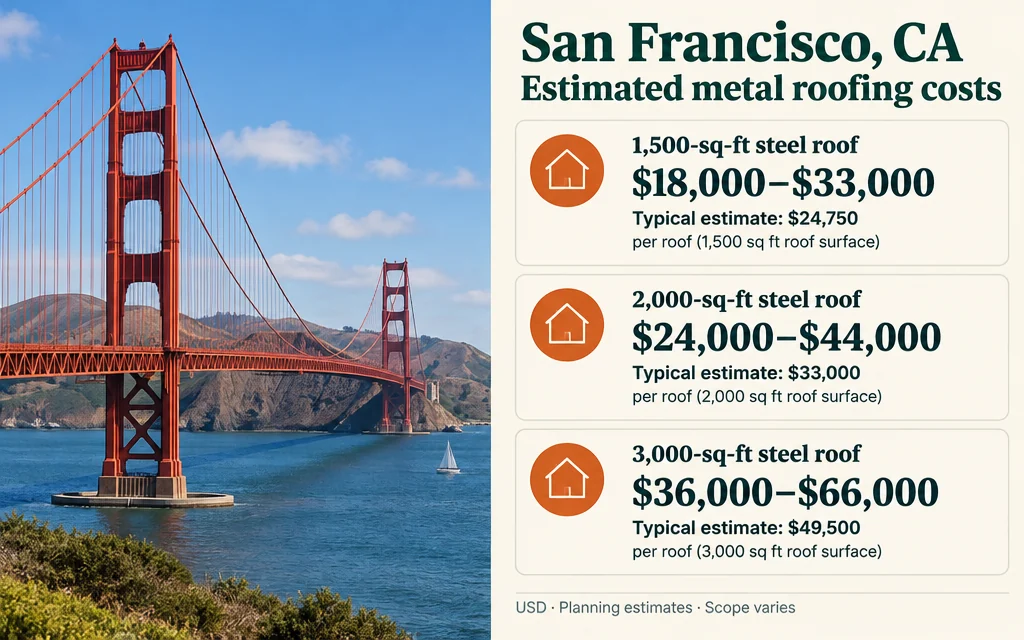
Calculated installed planning scenario for measured roof surface, including one-layer removal/disposal; conditional extras excluded.
Calculated installed planning scenario for measured roof surface, including one-layer removal/disposal; conditional extras excluded.
Calculated installed planning scenario for measured roof surface, including one-layer removal/disposal; conditional extras excluded.
San Francisco Metal Roofing Investment Overview
A residential metal roof replacement in San Francisco is a substantial exterior upgrade. For budgeting a concealed-fastener standing seam steel roof, plan on $12–$22 per sq ft of actual roof surface area.
This planning baseline assumes full tear-off and disposal of a single existing asphalt layer, high-temperature synthetic underlayment, flashings, standard clips, and installation labor over sound wood decking.
On a typical home with 2,000 square feet of measured roof surface, standing seam replacement usually totals $24,000–$44,000. Exposed-fastener corrugated steel starts lower, budgeting $7–$12.50, while premium standing seam copper can run $24–$50 or more for specialized architectural sheet metal work.
Because reliable published citywide metal roofing contracts vary widely, treat these figures as modeled planning benchmarks rather than fixed bids. San Francisco bids often reflect higher regional labor rates and dense urban logistics. Panel deliveries onto narrow streets or steep grades require careful staging, so ask your contractor how materials will arrive and whether local street-use permits are needed for dumpsters or hoisting equipment.
Comparing Residential Metal Roof Systems
Each metal roofing profile and alloy serves distinct architectural styles and exposure levels:
Standing Seam Steel (Concealed Fastener): Vertical seams snap or mechanically lock together over concealed clips, allowing the metal to expand and contract freely through daily temperature shifts without stressing attachment points. Built from Galvalume-coated steel with a durable factory finish, this profile works down to low pitches (2:12 when mechanically seamed, or 3:12 and steeper for snap-lock). With no fasteners penetrating the exposed panel face, leak vulnerability remains very low.
Exposed-Fastener Ribbed Steel: Common in corrugated and 5V crimp profiles, these panels screw directly through the metal face into the decking using rubber-gasketed fasteners. At $7–$12.50, they carry a lower initial purchase price. However, coastal sun and damp marine air can degrade neoprene washers over time, requiring periodic inspections and eventual screw replacement. Most homeowners reserve this profile for secondary buildings or canopies rather than main living structures.
Steel Metal Shingles: Stamped to mimic slate, cedar shake, or standard architectural shingles, stone-coated or painted steel shingles budget $9–$16.50. They combine metal durability with traditional aesthetics suited to classic residential neighborhoods.
Standing Seam Aluminum: Budgeting $13.50–$24.50, aluminum panels offer natural rust resistance. In San Francisco neighborhoods subject to persistent Pacific fog and marine salt air, aluminum is frequently chosen over steel because cut edges and incidental installation scratches will not rust.
Standing Seam Copper: Budgeting $24–$50, copper is an architectural metal typically reserved for bay window caps, dormers, and historic restorations. It requires no protective paint, develops a natural protective patina, and is installed by specialized sheet-metal artisans.
| Service / assumptions | Low | Typical estimate | High | Pricing unit | Estimated labor time |
|---|---|---|---|---|---|
| Standing Seam Steel (Installed)Calculated standing-seam steel planning rate: comparable panel/accessory materials + installation labor + one-layer removal/disposal. Ordinary underlayment and details over sound decking included; conditional extra work excluded. | $12 | $16.50 | $22 | per sq ft of roof surface (installed) | 3 to 6 working days |
| Exposed-Fastener Steel (Installed)Corrugated or ribbed screw-down panels with rubber washers. Economical, requires gasket maintenance every 10-15 years. | $7 | $9.50 | $12.50 | per sq ft of roof surface (installed) | 2 to 4 working days |
| Metal Shingles / Stone-Coated (Installed)Stamped steel shingles or stone-coated steel mimicking slate, shake, or tile. Good architectural fit for historic styles. | $9 | $12.50 | $16.50 | per sq ft of roof surface (installed) | 3 to 5 working days |
| Standing Seam Aluminum (Installed)Rustproof alloy recommended for San Francisco coastal fog and salt-air zones within 2 miles of the ocean. | $13.50 | $18 | $24.50 | per sq ft of roof surface (installed) | 3 to 6 working days |
| Standing Seam Copper (Installed)Architectural grade 16-20 oz copper with custom hand-formed seams. 75-100+ year service life, develops natural patina. | $24 | $35 | $50 | per sq ft of roof surface (installed) | 5 to 10 working days |
Standing Seam Steel Cost Breakdown
Evaluating competing bids is easier when you see how a standing seam quote breaks down into materials, labor, and prep work:
Panel Materials and Underlayment ($4.50–$8.50): This component allowance covers 24-gauge Galvalume steel panels, high-temperature peel-and-stick underlayment, concealed expansion clips, fasteners, drip edge, ridge caps, and valley stock. High-temperature underlayment is essential under metal because panels transfer solar heat directly down to the roof deck.
Installation Labor ($6.25–$11): Skilled sheet-metal fabrication represents the largest portion of the budget. Crew members bend custom hems at eaves and rakes, set clips to engineered spacing, and lock vertical seams. San Francisco labor rates, trade specialization, and local operating costs place installation expenses toward the upper end of regional averages.
Tear-Off and Disposal ($1.25–$2.50): Stripping a single layer of existing asphalt shingles down to bare wood, loading disposal bins, and paying regional transfer station tipping fees make up the remainder of the baseline installed estimate.
| Service / assumptions | Low | Typical estimate | High | Pricing unit | Estimated labor time |
|---|---|---|---|---|---|
| Standing Seam Steel Materials Allowance24-gauge Galvalume panels, high-temp synthetic underlayment, clips, trim, fasteners, and flashing stock. | $4.50 | $6.25 | $8.50 | per sq ft of roof surface (materials only) | N/A |
| Standing Seam Installation Labor AllowanceSkilled sheet metal union or specialized trade labor for roll-forming, seaming, hemming, and perimeter detail work. | $6.25 | $8.50 | $11 | per sq ft of roof surface (installation labor only) | 3 to 5 working days |
| One-Layer Removal & Disposal AllowanceStripping single shingle layer down to decking, container staging, and Bay Area transfer station tipping fees. | $1.25 | $1.75 | $2.50 | per sq ft of roof surface (one-layer removal and disposal) | 1 to 2 working days |
Roof Size Scenarios and Pricing
A roof's surface area is almost always larger than the home's interior footprint. Slope, eaves, dormers, and overhangs all add measurable square footage.
The planning scenarios below assume standing seam steel installed over sound decking, including single-layer tear-off:
1,500 Sq Ft Roof Surface: A compact single-story home or rear addition (15 roofing squares) budgets $18,000–$33,000, with typical on-site crew work taking 3 to 5 working days.
2,000 Sq Ft Roof Surface: A standard detached home (20 squares) budgets $24,000–$44,000, running 4 to 7 working days on site.
3,000 Sq Ft Roof Surface: A larger multi-level home with intersecting roof planes and valleys (30 squares) budgets $36,000–$66,000, taking 5 to 9 working days of crew time.
These scenarios serve as planning frameworks. Have a contractor measure your actual roof pitch and geometry on site before establishing your final replacement budget.
| Service / assumptions | Low | Typical estimate | High | Pricing unit | Estimated labor time |
|---|---|---|---|---|---|
| 1,500 Sq Ft Roof Replacement (Standing Seam)Calculated scenario: 1,500 sq ft of measured roof surface × standing-seam steel installed planning rate. Includes its same materials, installation, one-layer removal/disposal and sound-deck assumptions. Not a provider whole-roof quote. | $18,000 | $24,750 | $33,000 | per roof (1,500 sq ft roof surface) | 3 to 5 working days |
| 2,000 Sq Ft Roof Replacement (Standing Seam)Calculated scenario: 2,000 sq ft of measured roof surface × standing-seam steel installed planning rate. Includes its same materials, installation, one-layer removal/disposal and sound-deck assumptions. Not a provider whole-roof quote. | $24,000 | $33,000 | $44,000 | per roof (2,000 sq ft roof surface) | 4 to 7 working days |
| 3,000 Sq Ft Roof Replacement (Standing Seam)Calculated scenario: 3,000 sq ft of measured roof surface × standing-seam steel installed planning rate. Includes its same materials, installation, one-layer removal/disposal and sound-deck assumptions. Not a provider whole-roof quote. | $36,000 | $49,500 | $66,000 | per roof (3,000 sq ft roof surface) | 5 to 9 working days |
Standing Seam Steel vs. Architectural Asphalt Shingles
Choosing between standing seam metal and architectural asphalt shingles involves balancing upfront expenditure against long-term maintenance needs:
Upfront Investment: Installing architectural asphalt shingles in the Bay Area budgets $6–$12 per sq ft. In comparison, standing seam steel budgets $12–$22. Expect a standing seam metal roof to require roughly 1.5 to 2 times the upfront budget of asphalt.
Durability Expectations: Asphalt shingles rely on mineral granules to shield the underlying asphalt from UV radiation and weather. In damp coastal climates with frequent fog and wind-driven rain, asphalt shingles often face earlier granule loss and moss accumulation, leading homeowners to reroof sooner. Standing seam steel features durable factory coatings and concealed fasteners that do not degrade like exposed shingle tabs, though finish warranties and performance will vary by manufacturer and alloy.
Weather and Detailing: Standing seam roofs offer excellent rain shedding and wind uplift resistance because panels lock together continuously from ridge to eave. However, metal systems demand careful detailing at transitions, particularly where dissimilar metals meet (such as copper downspouts or lead pipe flashings touching steel) to avoid galvanic corrosion.
| Service / assumptions | Low | Typical estimate | High | Pricing unit | Estimated labor time |
|---|---|---|---|---|---|
| Architectural Asphalt Shingles ReferenceInstalled benchmark for architectural laminate shingles with 1-layer tear-off, underlayment, and standard flashings. Published rate reference for the stated roofing scope and unit, not verification of this guide's modeled range, a complete roof quote or provider availability. Regional reference; not a verified San Francisco-specific quote.Published price reference ↗ | $6 | $8.50 | $12 | per sq ft of roof surface (installed) | 1 to 3 working days |
| Comparison | Architectural asphalt | Standing-seam steel |
|---|---|---|
| Up-front planning estimate · 2,000 sq ft roof surface | $12,000–$24,000 | $24,000–$44,000 |
| What the baseline includes | Architectural asphalt, ordinary installed details, one-layer removal/disposal over sound decking. | Standing-seam steel, ordinary installed details, one-layer removal/disposal over sound decking. |
| Maintenance and repairs | Confirm product-specific inspections and repair terms. | Confirm seams, fasteners, coating, compatible repairs and inspection terms. |
| Insurance and ownership cost | Ask the insurer about the exact product and coverage. | Ask the insurer about accepted test documentation, any available credit and cosmetic-damage exclusions. |
These are calculated budgeting comparisons, not provider quotes or guaranteed lifetime savings. Compare your expected ownership period, specified products, actual maintenance proposals and written insurance terms.
| Decision point | Roof repair | Roof replacement | Metal roofing |
|---|---|---|---|
| Work being priced | A defined defect, such as damaged shingles or flashing. | Removal and installation of an agreed roof system across the measured roof surface. | A specified installed metal system; standing seam, exposed fasteners and metal shingles are different scopes. |
| What to inspect | The leak source, surrounding material and whether a durable localized fix is feasible. | The extent of deterioration, decking condition, roof details and suitable replacement systems. | The substrate, panel profile, coating, fasteners, roof geometry and installation details. |
| How to compare prices | Match the repair quantity, access, materials and included diagnosis. | Match measured roof area, material, tear-off layers, disposal and installed inclusions. | Match measured roof area, system, components, removal and conditional additional work. |
| Before deciding | Ask what the repair addresses and what existing problems would remain. | Ask whether repair remains practical and which additional items would change the total. | Ask about compatible materials, documented product/assembly ratings and product versus workmanship warranties. |
Age or a repair-cost percentage alone does not determine the right choice. Ask a qualified roofing contractor to assess the condition and explain viable options. A metal system is a material-specific installation choice, not a separate guarantee of durability or savings.
Conditional Upgrades and Site Repairs
Standard proposals assume sound wood decking and standard flashing tie-ins. When unexpected deck issues or architectural details arise, conditional line items apply:
Plywood Decking Replacement: Rotted or water-softened sheathing cannot firmly anchor metal clips. Replacing damaged boards with fresh 4-by-8 sheets runs $75–$150 per sheet. Older San Francisco homes built with spaced skip-sheathing from historic wood shakes require a continuous structural wood deck laid over the entire surface before metal can be installed.
Multiple Shingle Layers: When stripping reveals an older secondary roofing layer underneath, removing it adds $60–$150 per roofing square for extra labor and landfill weight.
Chimneys and Skylights: Metal requires custom-bent counter-flashing ground into masonry joints rather than basic surface sealant. Chimney flashing additions budget $500–$1,400, while custom skylight integration runs $400–$1,100.
Gutters and Ridge Ventilation: Detaching and reinstalling usable gutters to set new eave trims costs $6–$16 per linear ft. Upgrading to a baffled continuous ridge vent engineered for metal profiles adds $18–$45 per linear ft.
| Service / assumptions | Low | Typical estimate | High | Pricing unit | Estimated labor time |
|---|---|---|---|---|---|
| Additional Roofing Layer RemovalLabor and disposal surcharges when uncovering a second shingle layer or wood shakes beneath existing roof. | $60 | $100 | $150 | additional per roofing square (100 sq ft) | N/A |
| Plywood / OSB Decking ReplacementPlanning allowance for replacing rotted or damaged sheathing with 1/2-inch CDX plywood or OSB during reroofing. Actual cost depends on local lumber rates and site accessibility. | $75 | $110 | $150 | additional per 4-by-8-ft sheet (32 sq ft) | N/A |
| Custom Metal Chimney FlashingPlanning allowance for two-piece stepped base and counter-flashing ground into masonry mortar joints. Standard roof perimeter trims are included in base installation. | $500 | $850 | $1,400 | additional per chimney | N/A |
| Skylight Flashing & Curb IntegrationCustom-formed back-pan, step-flashing, and seal kit for deck- or curb-mounted skylights to prevent water damming. | $400 | $650 | $1,100 | additional per skylight | N/A |
| Continuous Vented Ridge UpgradeBaffled, insect-screened ridge vent system engineered specifically for metal standing seam roof profiles. | $18 | $28 | $45 | additional per linear ft | N/A |
| Snow Guard / Debris Rail SystemSeam-clamped bar or rail system used above entrances and pedestrian paths to prevent wet leaf or debris slides. | $20 | $35 | $60 | additional per linear ft | N/A |
| Gutter Detach & ReinstallCareful removal and reinstallation of sound gutters to install continuous eave edge metal and underlayment wrap. | $6 | $10 | $16 | additional per linear ft | N/A |
Safety, Fire, and Wind Performance
Evaluating roofing performance ratings requires looking at the entire roof assembly rather than just the metal skin:
Fire Classifications: While steel and aluminum panels are non-combustible, a metal panel alone does not automatically make a Class A roof assembly. Achieving a Class A rating depends on the complete system, which frequently requires an approved fire-resistant underlayment or gypsum thermal barrier over combustible wood decking. Ask your contractor for the manufacturer's specific tested assembly documentation if your project requires Class A compliance.
Wind Uplift: Mechanically locked standing seam profiles deliver high wind resistance when anchored using calculated clip spacing. Properly detailed edge metal and ridge caps prevent coastal gusts and atmospheric river storm fronts from catching panel edges.
Impact Ratings and Insurance Realities: Many metal roofing products achieve a UL 2218 Class 4 impact rating during laboratory testing. While this demonstrates resistance against panel splitting or cracking under impact, it does not make the metal immune to cosmetic denting. Furthermore, insurance premium discounts for Class 4 installations are not universal, and many insurance policies include cosmetic damage waivers that exclude coverage for dents that do not cause active leaks. Verify specific policy terms with your insurer before factoring in savings.
San Francisco Cost Drivers
Several local variables influence why roofing bids differ across San Francisco neighborhoods:
Roof Pitch and Building Height: Multi-story row homes and structures on steep hillside lots demand extra scaffolding, staging, and fall-arrest systems. Roof pitches steeper than 7:12 slow down installation speeds and raise labor allowances.
Access and Staging: Zero-lot-line properties, narrow streets, and limited curb parking create substantial delivery challenges. Maneuvering long metal panels into tight yards or onto tall roofs requires specialized logistics. Ask prospective contractors whether their proposal accounts for street-space occupancy permits from the city for staging containers or cranes.
Title 24 Energy Standards: Ask your contractor how California Title 24 cool-roof requirements apply to your specific address and roof slope. If required, panels must feature Cool Roof Rating Council (CRRC) certified reflective pigments, which can influence coating choices and material costs.
Panel Gauge and Profile: Thicker 24-gauge steel provides greater rigidity and minimizes visible surface waviness (oil-canning) compared to thinner 26-gauge options, though it costs more. For coastal durability, high-performance PVDF (Kynar 500) resin coatings resist fading and chalking far better than standard polyester finishes.
Contractor Vetting and Contract Protocols
Installing architectural metal roofing demands specialized sheet-metal training beyond standard shingle application. Use these guidelines when reviewing local contractors:
Verify Licensing and Active Coverage: Ensure the business holds an active C-39 roofing contractor license with the California Contractors State License Board (CSLB). Request current proof of general liability insurance and workers' compensation coverage for all crew members working on your property.
Clarify Written Specifications: Your written contract should specify the exact panel manufacturer, metal gauge, profile design (snap-lock versus mechanical seam lock), factory finish type, and specific underlayment brand. Verify that single-layer tear-off, debris disposal, and city building permits are explicitly included in the base proposal.
Distinguish Material vs. Labor Warranties: The panel manufacturer warranty covers substrate corrosion and finish fading, typically spanning 25 to 40 years. Your contractor provides a separate workmanship warranty—often 5 to 10 years—covering flashing junctions and leak prevention. Clarify in writing who is responsible for servicing each warranty.
Establish Predetermined Repair Rates: Before work starts, establish fixed unit rates in the contract for incidental repairs, such as replacing damaged plywood sheets or rebuilding rotten fascia discovered once the existing roof is stripped.
Local income & housing costs
San Francisco city, California · U.S. Census Bureau, 2025 ACS 1-year estimates.
per month · ±$83
Cash-rent units; includes applicable tenant-paid utilities
Census source ↗Dollar amounts use the survey period’s published basis. Income is annual; gross rent is monthly. Home value reflects owner-occupied housing values. Margins of error shown are at the ACS 90% confidence level. These statistics provide city context; service budgets use their own pricing evidence.
STATEWIDE COST CONTEXT
California prices, income & labor costs
These California figures provide background for this city guide. They describe different measures and reference years; employee wages are not prices charged by a contractor.
BEA SAIRPD
State price change indicator
136.92024 · index (2017 basis)
Annual figures & sources
| Year | Value | 90% margin of error | Source |
|---|---|---|---|
| 2020 | 117.2 | — | Official source |
| 2021 | 122.0 | — | Official source |
| 2022 | 130.7 | — | Official source |
| 2023 | 135.2 | — | Official source |
| 2024 | 136.9 | — | Official source |
Census ACS 1-year
Median household income
$102,1592025 · USD/year
Annual figures & sources
| Year | Value | 90% margin of error | Source |
|---|---|---|---|
| 2021 | $84,907 | ±$542 | Official source |
| 2022 | $91,551 | ±$471 | Official source |
| 2023 | $95,521 | ±$611 | Official source |
| 2024 | $100,149 | ±$381 | Official source |
| 2025 | $102,159 | ±$390 | Official source |
BLS OEWS
Roofers
$30.582025 · USD/hour
Annual figures & sources
| Year | Value | 90% margin of error | Source |
|---|---|---|---|
| 2025 | $30.58 | — | Official source |
State prices: BEA, 2020–2024. Household income: Census ACS, 2021–2025. Employee wages: BLS, May 2025 snapshot. The charts retain their own units and fitted scales.
Explore all California living-cost data and trends →Local context and limitations
San Francisco roofing projects face coastal marine exposure and dense urban logistics. In neighborhoods with heavy fog and salt air, corrosion resistance is critical; contractors often recommend aluminum or Galvalume steel finished with high-grade PVDF coatings rather than basic painted steel. Tight streets, steep grades, and zero lot lines make material delivery and container staging tricky, so confirm with your roofer whether the San Francisco Department of Public Works requires temporary street-space or occupancy permits. In addition, ask your installer to verify if California Title 24 cool-roof requirements apply to your specific building slope and project scope.
Frequently asked questions
Why is standing seam preferred over exposed-fastener metal in San Francisco?
Standing seam conceals clips beneath interlocking raised seams, allowing panels to expand and contract smoothly without placing stress on fasteners. Exposed-fastener systems rely on screws driven through the panel face with rubber washers; over time, marine air, temperature swings, and UV exposure can degrade these washers and create potential leak points.
Is steel or aluminum better for homes in San Francisco?
Aluminum is often preferred in coastal neighborhoods exposed to regular marine fog and ocean winds because it is naturally rustproof. Galvalume-coated steel performs well across inland microclimates, but cut edges or deep surface scratches on steel can become vulnerable to corrosion in high-salt coastal environments.
How do contractors calculate my roof surface area?
Roofers calculate surface area in square feet or roofing squares (one square equals 100 square feet), which is separate from interior living space. Pitch, eaves, dormers, and gables make roof surface area larger than a home's floor plan. Installers verify these measurements using aerial imaging tools or on-site manual measurements.
Can a metal roof be installed over existing shingles in San Francisco?
While building codes may allow an overlay under narrow conditions, contractors generally recommend stripping down to the roof deck on San Francisco homes. Full tear-off lets the crew inspect the decking for dry rot, ensures a flat surface to prevent metal panel distortion, and prevents unnecessary weight buildup on older framing.
Does installing a metal roof lower my homeowner insurance premium?
A Class 4 impact rating or Class A fire assembly may qualify for premium discounts with certain insurance carriers, but savings are never guaranteed. Many insurers also include cosmetic damage waivers, meaning they will not cover surface dents that leave the roof watertight. Confirm policy rules with your insurance agent directly.
What is oil-canning and how can it be avoided?
Oil-canning is a visible wave or ripple along the flat face of metal panels caused by uneven decking, overtightened fasteners, or normal thermal movement. While it does not affect structural integrity, you can minimize it by specifying thicker 24-gauge metal, narrower panel widths, panels with striations or stiffening ribs, and ensuring a flat roof deck.
Sources and methodology
Sources below retain their recorded retrieval dates and geographic scope. We checked the quoted rates against readable public pricing pages. The tables remain planning estimates, not provider quotes or a measured citywide survey. Per-square-foot references do not establish the modeled whole-roof totals or all their installed inclusions. Regional references are not verified San Francisco-specific quotes. Confirm removal, disposal, materials, labor and the complete scope in a written proposal.
Published pricing pages retrieved; quoted excerpts checked automatically. 3 distinct website domains. · Generated 2026-11-12
- Metal Roofing Pricing San Francisco, CA | Rates 2026 | San Francisco Metal RoofingCity-specific page context · Page retrieved 2026-11-12 · Price excerpt matched automatically
“Metal Roof Replacement From $9/sq ft Full tear-off and replacement of worn shingle”
Planning ranges may differ from these published examples; they are not provider quotes.
 Provider badge
- Corrugated Metal Roofing in California: Cost and LifespanState / regional reference · Page retrieved 2026-11-12 · Price excerpt matched automatically
“Corrugated Metal Roofing Cost per Square Foot Published cost guides put corrugated, exposed-fastener metal at roughly $5 to $10 per square foot installed.”
Planning ranges may differ from these published examples; they are not provider quotes.
- Roof Replacement Cost in the Bay Area | ViewPoint RoofingState / regional reference · Page retrieved 2026-11-12 · Price excerpt matched automatically
“Architectural Shingles About $7 to $12 per square foot installed.”
Planning ranges may differ from these published examples; they are not provider quotes.
Plan your metal roofing project
Choose your service and answer its project questions. Add notes or photos if helpful, then generate your project brief. The planner labels its budgeting assumptions separately. Use your plan to compare the scope and assumptions with a provider. Contact sharing and provider matching are not available yet.
Open the project planner →Share this city’s cost data
<> Embed San Francisco Cost Data on Your Site
The HTML table shows the prices at the time of copying. The iframe follows the published guide.