San Francisco · CA · COST GUIDE
Roof Replacement & New Roof Costs in San Francisco, CA (2026)
For budgeting, architectural asphalt replacement is estimated at $9,000–$16,500 for a 1,500-sq-ft roof and $12,000–$22,000 for a 2,000-sq-ft roof. These roof-surface scenarios include one-layer tear-off, disposal, labor and materials over sound decking; separately quoted extras are excluded.
Architectural asphalt: 1,500-sq-ft roof
Budget estimate$9,000–$16,500per roof (1,500 sq ft roof surface)
Planning range · Compare the roof area, material and included work in your quote.
Architectural asphalt: 2,000-sq-ft roof
Budget estimate$12,000–$22,000per roof (2,000 sq ft roof surface)
Planning range · Compare the roof area, material and included work in your quote.
Published examples apply to their stated scope. Budget ranges are estimates.
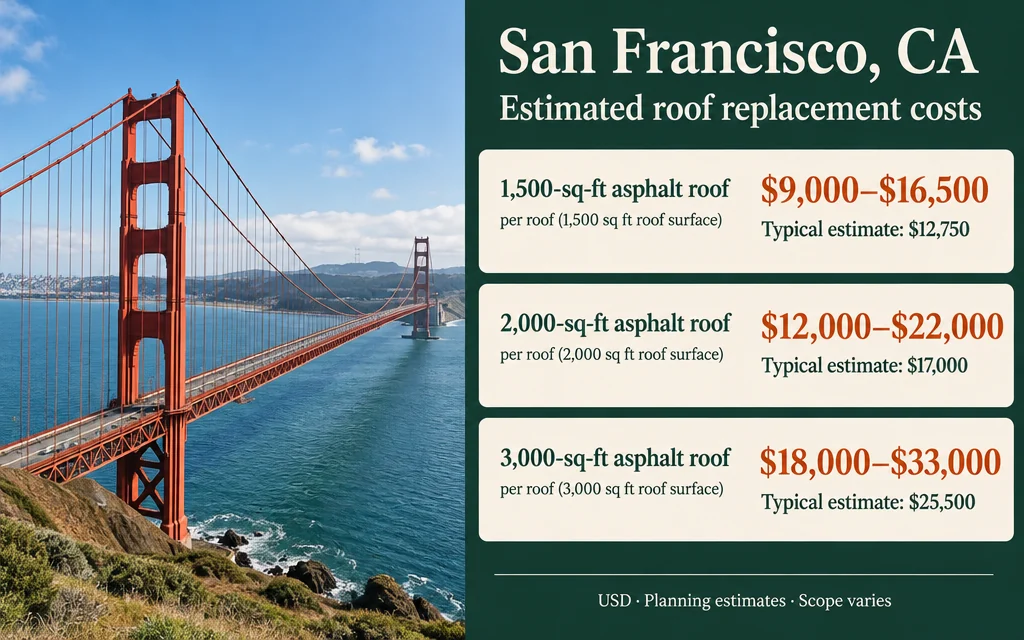
Calculated installed planning estimate for measured roof surface, with one-layer removal and disposal; extras excluded.
Calculated installed planning estimate for measured roof surface, with one-layer removal and disposal; extras excluded.
Calculated installed planning estimate for measured roof surface, with one-layer removal and disposal; extras excluded.
How much does a new roof cost in San Francisco?
When property owners in San Francisco evaluate new roof costs, they are almost always budgeting for a complete roof replacement on an existing building. For planning on a sloped roof, architectural asphalt shingles run $6–$11 per sq ft of roof surface installed over sound sheathing.
Across standard roof surface dimensions, that calculates to budget $9,000–$16,500 for an illustrative 1,500-square-foot roof surface, budget $12,000–$22,000 for a 2,000-square-foot surface, and budget $18,000–$33,000 for a 3,000-square-foot surface. These calculated planning benchmarks cover tearing off and hauling away one existing roofing layer, synthetic underlayment, perimeter drip edge, ridge caps, and site cleanup.
New roof construction on an addition or newly built home differs from replacement work. New construction fastens directly to bare rafters and newly installed sheathing, with no aged materials to strip, transport, or dispose of. Full replacements involve extra labor, waste disposal fees, and tight neighborhood staging logistics to remove old layers cleanly before new materials go down.
Roofing Material Comparison: Shingles, Metal, and Tile
Your material selection shapes both the initial budget and long-term maintenance requirements. Architectural asphalt shingles (budget $6–$11 per sq ft of roof surface) serve as the common baseline across San Francisco, offering laminated fiberglass construction and solid resistance to marine wind.
Basic three-tab asphalt shingles (budget $4–$7 per sq ft of roof surface) have a lower initial price point. Their lighter, single-layer profile offers less resistance to wind uplift, making them more vulnerable on exposed hillsides or ocean-facing ridges. Premium designer shingles feature thicker dimensional profiles that simulate slate or cedar shakes, with pricing established by specific product lines rather than a flat category rate.
Metal systems provide long-term durability against coastal humidity. Standing-seam metal roofs (budget $16–$27.50 per sq ft of roof surface) rely on concealed fasteners and raised interlocking seams to block driving rain. Exposed-fastener corrugated metal panels (budget $9.50–$16.50 per sq ft of roof surface) cost less upfront, but the fastener washers require periodic inspection. Concrete tile (budget $9–$19 per sq ft of roof surface) and clay tile (budget $13–$26 per sq ft of roof surface) suit Mediterranean and Spanish revival architecture, though their substantial dead load requires a structural assessment of your roof framing before installation.
| Service / assumptions | Low | Typical estimate | High | Pricing unit | Estimated labor time |
|---|---|---|---|---|---|
| Architectural Asphalt ShinglesIncludes complete tear-off and disposal of one existing layer, synthetic underlayment, drip edge, ridge cap, and labor over sound decking. Published rate reference for the stated roofing scope and unit, not verification of this guide's modeled range, a complete roof quote or provider availability. Regional reference; not a verified San Francisco-specific quote.Published price reference ↗ | $6 | $8.50 | $11 | per sq ft of roof surface (installed) | 1 to 3 working days (illustrative 2,000 sq ft roof, 4-person crew) |
| Three-Tab Asphalt ShinglesEntry-level strip shingles with basic 60 mph wind rating; less durable in coastal fog and high-wind exposures. | $4 | $5.50 | $7 | per sq ft of roof surface (installed) | 1 to 2 working days (illustrative 2,000 sq ft roof, 4-person crew) |
| Standing-Seam Metal RoofConcealed fastener 24- to 26-gauge steel or aluminum panels with high wind, fire, and corrosion resistance. | $16 | $21 | $27.50 | per sq ft of roof surface (installed) | 3 to 5 working days (illustrative 2,000 sq ft roof, 3- to 4-person crew) |
| Exposed-Fastener Corrugated MetalThrough-fastened corrugated or rib metal panels; requires periodic gasket fastener inspections. | $9.50 | $13 | $16.50 | per sq ft of roof surface (installed) | 2 to 4 working days (illustrative 2,000 sq ft roof, 3- to 4-person crew) |
| Concrete Tile RoofingDurable Class A fire-rated tile. Heavy profile requires structural confirmation of roof framing capacity. | $9 | $14 | $19 | per sq ft of roof surface (installed) | 3 to 6 working days (illustrative 2,000 sq ft roof, 4-person crew) |
| Clay Tile RoofingTraditional barrel or Spanish Mission terra-cotta clay tile; heavy dead load requires structural engineer review. | $13 | $19 | $26 | per sq ft of roof surface (installed) | 4 to 7 working days (illustrative 2,000 sq ft roof, 4-person crew) |
| Product type | How to compare |
|---|---|
| Three-tab asphalt | Compare the specified product and installed scope with the three-tab rate row. |
| Architectural asphalt | The baseline for the calculated roof-size budgets in this guide. |
| Premium or designer asphalt | Request a product-specific installed proposal; this guide does not invent a separate premium rate. |
Product names and grades alone do not establish an impact, wind or fire rating. Compare the exact product documentation, installation requirements and written warranty.
Roof Replacement Costs by Size in San Francisco
Roofing estimates are based on actual roof surface area measured in roofing squares (100 square feet per square), not interior living floor area. Pitch, overhangs, hips, and dormers make the exterior roof plane significantly larger than the home's interior footprint.
A 1,500-square-foot flat often has 1,800 square feet or more of roof surface once slopes and eaves are measured.
Baseline architectural asphalt planning scenarios across standard roof surfaces include:
• 1,500 sq ft roof surface: budget $9,000–$16,500, with typical on-site crew work running 1 to 2 working days (4-person crew).
• 2,000 sq ft roof surface: budget $12,000–$22,000, with typical on-site crew work running 2 to 3 working days (4-person crew).
• 3,000 sq ft roof surface: budget $18,000–$33,000, with typical on-site crew work running 3 to 4 working days (4- to 5-person crew).
Multi-story homes, steep mansards, and hillside lots push pricing toward the top of these ranges because crews need specialized staging, fall-arrest equipment, and slower material hoisting.
| Service / assumptions | Low | Typical estimate | High | Pricing unit | Estimated labor time |
|---|---|---|---|---|---|
| Architectural asphalt: 1,500-sq-ft roofCalculated planning scenario: 1,500 sq ft of measured roof surface × architectural-asphalt installed rate. Includes the same one-layer tear-off, disposal, labor, materials and sound-deck baseline; separately quoted extras excluded. | $9,000 | $12,750 | $16,500 | per roof (1,500 sq ft roof surface) | 1 to 2 working days (4-person crew) |
| Architectural asphalt: 2,000-sq-ft roofCalculated planning scenario: 2,000 sq ft of measured roof surface × architectural-asphalt installed rate. Includes the same one-layer tear-off, disposal, labor, materials and sound-deck baseline; separately quoted extras excluded. | $12,000 | $17,000 | $22,000 | per roof (2,000 sq ft roof surface) | 2 to 3 working days (4-person crew) |
| Architectural asphalt: 3,000-sq-ft roofCalculated planning scenario: 3,000 sq ft of measured roof surface × architectural-asphalt installed rate. Includes the same one-layer tear-off, disposal, labor, materials and sound-deck baseline; separately quoted extras excluded. | $18,000 | $25,500 | $33,000 | per roof (3,000 sq ft roof surface) | 3 to 4 working days (4- to 5-person crew) |
Low-Slope and Flat Roofing Options in San Francisco
Many San Francisco residences—including Victorian flats, Edwardians, and Sunset District homes—incorporate low-slope or completely flat roof sections where traditional shingles cannot shed water.
Single-ply Thermoplastic Polyolefin (TPO) membranes (budget $7–$12.50 per sq ft of roof surface) are common for residential flat sections. TPO seams are hot-air welded into a continuous waterproof barrier, and its reflective surface helps meet Title 24 cool-roof expectations. Ethylene Propylene Diene Monomer (EPDM) synthetic rubber roofing (budget $6.50–$12 per sq ft of roof surface) provides an elastomeric alternative.
Standard low-slope estimates assume installation over sound decking and basic insulation board. If your flat roof collects standing water around parapets or internal drains, your contractor may recommend custom tapered insulation to direct runoff toward scuppers or roof drains.
| Service / assumptions | Low | Typical estimate | High | Pricing unit | Estimated labor time |
|---|---|---|---|---|---|
| TPO Low-Slope MembraneWhite reflective 60-mil single-ply TPO membrane mechanically fastened or fully adhered over standard insulation. | $7 | $9.50 | $12.50 | per sq ft of roof surface (installed) | 2 to 4 working days (illustrative 2,000 sq ft roof, 3- to 4-person crew) |
| EPDM Low-Slope Rubber MembraneVulcanized synthetic rubber membrane adhered over insulation; dark surface may require coating to meet Title 24 cool-roof standards. | $6.50 | $9 | $12 | per sq ft of roof surface (installed) | 2 to 4 working days (illustrative 2,000 sq ft roof, 3- to 4-person crew) |
Tear-Off, Layer Removal, and Surface Preparation
The baseline figures in this guide include removing and hauling away a single existing roofing layer down to the wooden decking. Confirm with your contractor and local building authorities whether an overlay is code-permissible on your structure, but stripping down to the deck remains standard trade practice.
Removing the old roof gives the crew an unobstructed view of the underlying decking, allowing them to spot rot, sagging rafters, or hidden moisture damage before nailing down new materials.
When a home already has two or more roof layers, contractors charge extra to strip each additional course. Removing and hauling away an extra layer runs an incremental $100–$250 per roofing square (100 sq ft). Additional layers add substantial hauling weight, transfer-station tipping fees, and tear-off labor.
Decking Repairs and Common Project Add-Ons
Once the old roof is removed, damaged wood or aging flashings often require carpentry repairs before the new roof is laid. Standard project add-ons include:
• Decking replacement: Installing new 1/2-inch CDX plywood or OSB sheathing costs budget $95–$210 per 4-by-8-ft sheet.
• Fascia board replacement: Replacing deteriorated or rotted exterior fascia boards runs budget $15–$28 per linear foot.
• Soffit repairs: Rebuilding water-damaged eave or overhang soffits runs budget $12–$26 per square foot.
• Continuous ridge venting: Adding shingle-over ridge exhaust venting runs budget $11–$24 per linear foot.
• Chimney reflashing: Cutting and installing new step and counter flashing into masonry joints costs budget $450–$1,200 per chimney.
• Skylight reflashing: Installing factory flashing kits around existing curb-mounted skylights runs budget $350–$850 per skylight.
• Gutter detach and reset: Taking down and rehanging gutters to install new perimeter drip edge costs budget $5–$14 per linear foot.
| Service / assumptions | Low | Typical estimate | High | Pricing unit | Estimated labor time |
|---|---|---|---|---|---|
| Extra Layer Tear-Off & DisposalApplies only when removing a second or third existing roof layer beyond the one layer included in base reroof rates. | $100 | $160 | $250 | additional per roofing square (100 sq ft) | N/A |
| Plywood / OSB Decking ReplacementInstalled 1/2-inch CDX plywood or OSB sheathing to replace water-damaged deck boards exposed during tear-off. | $95 | $140 | $210 | additional per 4-by-8-ft sheet (32 sq ft) | N/A |
| Fascia Board ReplacementReplacement of damaged or rotted 2x6 or 2x8 spruce/pine/fir exterior fascia trim. | $15 | $20 | $28 | additional per linear ft | N/A |
| Soffit ReplacementMaterial and carpentry labor to replace deteriorated eave or overhang soffit panels. | $12 | $18 | $26 | additional per sq ft | N/A |
| Continuous Ridge Vent UpgradeShingle-over continuous ridge exhaust vent; requires adequate lower soffit intake venting to operate efficiently. | $11 | $16 | $24 | additional per linear ft | N/A |
| Masonry Chimney ReflashingNew galvanized or copper step flashing and counter flashing ground and sealed into chimney mortar joints. | $450 | $750 | $1,200 | additional per chimney | N/A |
| Skylight Reflashing KitFactory step and head flashing kit installed around existing curb-mounted skylights during roof replacement. | $350 | $550 | $850 | additional per skylight | N/A |
| Gutter Detach & ResetCareful removal and reinstallation of existing gutters when needed to access eaves and install new perimeter drip edge. | $5 | $9 | $14 | additional per linear ft | N/A |
Cost Drivers: Access, Labor, Permits, and Site Complexity in San Francisco
Several local building conditions directly influence San Francisco roofing estimates:
1. Labor and Overhead: Bay Area construction wages, required insurance coverages, and general operating expenses run higher than national averages, lifting baseline labor rates.
2. Tight Staging and Zero Lot Lines: Attached row homes, shared party walls, and narrow roadways restrict space for debris bins and material delivery trucks. Contractors may need specialized boom lifts or street-space permits to stage equipment curbside; check requirements with San Francisco Public Works.
3. Local Permitting: Check with the San Francisco Department of Building Inspection (SFDBI) to determine permit requirements, fee calculations, and inspection schedules for your specific property and scope of work, and confirm whether permit management is included in your contractor's quote.
4. Coastal Weather and Fog: Neighborhoods exposed to persistent marine fog face high atmospheric moisture and salt air. These conditions require corrosion-resistant fasteners, quality underlayments, and careful flashing around parapets, firewalls, and chimneys.
Repair vs. Replace: Making the Right Decision
An isolated leak does not always mean you need an entirely new roof. If moisture enters around a cracked plumbing vent pipe, a displaced flashing strip at a dormer, or a few damaged shingles on an otherwise sound roof, a targeted repair is often the practical choice.
Full replacement becomes necessary when roofing materials show signs of widespread aging or system breakdown. Common indicators include extensive granule loss exposing shingle fiberglass, curled or brittle shingles across multiple roof planes, recurrent leaks in separate areas, or sagging sheathing. When multiple slopes show significant wear, repeated patchwork repairs often cost more over time than replacing the roof system entirely.
| Decision point | Roof repair | Roof replacement | Metal roofing |
|---|---|---|---|
| Work being priced | A defined defect, such as damaged shingles or flashing. | Removal and installation of an agreed roof system across the measured roof surface. | A specified installed metal system; standing seam, exposed fasteners and metal shingles are different scopes. |
| What to inspect | The leak source, surrounding material and whether a durable localized fix is feasible. | The extent of deterioration, decking condition, roof details and suitable replacement systems. | The substrate, panel profile, coating, fasteners, roof geometry and installation details. |
| How to compare prices | Match the repair quantity, access, materials and included diagnosis. | Match measured roof area, material, tear-off layers, disposal and installed inclusions. | Match measured roof area, system, components, removal and conditional additional work. |
| Before deciding | Ask what the repair addresses and what existing problems would remain. | Ask whether repair remains practical and which additional items would change the total. | Ask about compatible materials, documented product/assembly ratings and product versus workmanship warranties. |
Age or a repair-cost percentage alone does not determine the right choice. Ask a qualified roofing contractor to assess the condition and explain viable options. A metal system is a material-specific installation choice, not a separate guarantee of durability or savings.
Hiring a Roofing Contractor in San Francisco
Always verify contractor licensing and insurance credentials before signing a reroofing agreement. In California, roofing contractors should hold an active C-39 Roofing license from the Contractors State License Board (CSLB).
Request written proof of active workers' compensation insurance and commercial general liability coverage.
Request itemized proposals that specify product lines, underlayment grade, flashing materials, ventilation upgrades, and debris disposal terms. Clarify with your contractor whether their scope includes pulling required municipal permits and arranging any street-space permits needed for dumpsters or lifts. Structure payments around documented project milestones, and make sure final payment is contingent on passing required city inspections.
Local income & housing costs
San Francisco city, California · U.S. Census Bureau, 2025 ACS 1-year estimates.
per month · ±$83
Cash-rent units; includes applicable tenant-paid utilities
Census source ↗Dollar amounts use the survey period’s published basis. Income is annual; gross rent is monthly. Home value reflects owner-occupied housing values. Margins of error shown are at the ACS 90% confidence level. These statistics provide city context; service budgets use their own pricing evidence.
STATEWIDE COST CONTEXT
California prices, income & labor costs
These California figures provide background for this city guide. They describe different measures and reference years; employee wages are not prices charged by a contractor.
BEA SAIRPD
State price change indicator
136.92024 · index (2017 basis)
Annual figures & sources
| Year | Value | 90% margin of error | Source |
|---|---|---|---|
| 2020 | 117.2 | — | Official source |
| 2021 | 122.0 | — | Official source |
| 2022 | 130.7 | — | Official source |
| 2023 | 135.2 | — | Official source |
| 2024 | 136.9 | — | Official source |
Census ACS 1-year
Median household income
$102,1592025 · USD/year
Annual figures & sources
| Year | Value | 90% margin of error | Source |
|---|---|---|---|
| 2021 | $84,907 | ±$542 | Official source |
| 2022 | $91,551 | ±$471 | Official source |
| 2023 | $95,521 | ±$611 | Official source |
| 2024 | $100,149 | ±$381 | Official source |
| 2025 | $102,159 | ±$390 | Official source |
BLS OEWS
Roofers
$30.582025 · USD/hour
Annual figures & sources
| Year | Value | 90% margin of error | Source |
|---|---|---|---|
| 2025 | $30.58 | — | Official source |
State prices: BEA, 2020–2024. Household income: Census ACS, 2021–2025. Employee wages: BLS, May 2025 snapshot. The charts retain their own units and fitted scales.
Explore all California living-cost data and trends →Local context and limitations
San Francisco reroofing projects frequently involve tight site conditions, such as zero-lot-line row homes, multi-story Victorian and Edwardian architecture, steep hillside parcels, and persistent marine layer dampness. Reroofing permits are administered by the San Francisco Department of Building Inspection (SFDBI); confirm current permit requirements, fee calculations, and inspection triggers for your specific address and scope directly with the department. Energy standards, including California Title 24 solar reflectance requirements, vary by roof slope and climate zone and should be reviewed with your installer. When staging debris bins, chutes, or cranes on public sidewalks or streets, confirm local street-space occupancy permit requirements with San Francisco Public Works before work begins.
Frequently asked questions
Is getting a new roof the same as roof replacement?
On an existing home, 'new roof' and 'roof replacement' refer to the same job: tearing off existing roofing materials down to the structural sheathing and installing a new roof system. New construction roofing applies to a new home or addition where there are no existing materials to strip or discard.
How much does an average roof replacement cost in San Francisco?
For an illustrative 2,000-square-foot pitched roof using architectural asphalt shingles, planning estimates run budget $12,000–$22,000 installed over sound sheathing. Flat-roof replacements using single-ply TPO membrane typically run budget $7–$12.50 per sq ft of roof surface.
Do I need a building permit to replace my roof in San Francisco?
Verify permit requirements, plan check triggers, and fee schedules directly with the San Francisco Department of Building Inspection (SFDBI) for your address and project type. Check your written estimate to confirm whether your contractor handles permit applications and final inspection scheduling.
How long does a residential roof replacement take in San Francisco?
For an illustrative 2,000-square-foot pitched roof, architectural asphalt shingle replacement usually takes 2 to 3 working days (4-person crew). A flat single-ply TPO installation on the same surface area typically requires 2 to 4 working days (illustrative 2,000 sq ft roof, 3- to 4-person crew). Multi-story structures, steep slopes, or unexpected decking rot can extend the schedule.
Can I install a new roof over my old shingles to save money?
Check with your contractor and the local building department to verify whether an overlay is permissible under structural and building codes for your home. Even where permitted, contractors generally advise a complete tear-off down to the decking to inspect for dry rot and moisture damage before installing new shingles.
Does my new roof need to comply with California Title 24 cool-roof requirements?
California Title 24 energy standards set specific solar reflectance and thermal emittance requirements for reroofing projects depending on local climate zone and roof pitch. Major manufacturers produce compliant asphalt shingles and single-ply membranes; verify the exact Title 24 compliance details applicable to your address with your contractor.
Sources and methodology
These planning estimates draw on publicly available pricing pages read on 2026-11-09. Some cited pages mention the target city; that alone does not verify service coverage or establish a citywide average. Published starting rates and individual provider prices are reference points, not final local quotes. Confirm service availability, minimum charges, included work and travel charges with the provider.
Published pricing pages retrieved; quoted excerpts checked automatically. 2 distinct website domains. · Generated 2026-11-09
- The San Francisco Cost Guide to New Roofs & Replacements (2026 Edition)City-specific page context · Page retrieved 2026-11-09 · Price excerpt matched automatically
“Material Comparison Table Material Cost Per Sq Ft (Installed) Lifespan in SF Best For Asphalt Shingles $6–$8 20–25 years Budget-conscious”
Planning ranges may differ from these published examples; they are not provider quotes.
- Roof Replacement Cost in the Bay Area | ViewPoint RoofingState / regional reference · Page retrieved 2026-11-09 · Price excerpt matched automatically
“Architectural Shingles About $7 to $12 per square foot installed.”
Planning ranges may differ from these published examples; they are not provider quotes.
Plan your roof replacement project
Choose your service and answer its project questions. Add notes or photos if helpful, then generate your project brief. The planner labels its budgeting assumptions separately. Use your plan to compare the scope and assumptions with a provider. Contact sharing and provider matching are not available yet.
Open the project planner →Share this city’s cost data
<> Embed San Francisco Cost Data on Your Site
The HTML table shows the prices at the time of copying. The iframe follows the published guide.