Seattle · WA · COST GUIDE
Metal Roofing Costs in Seattle, WA (2026)
For budgeting, standing-seam steel roofing is estimated at $13–$22.50 per sq ft of roof surface, and exposed-fastener steel at $8.50–$14.50 per sq ft. These installed planning ranges include one-layer removal/disposal over sound decking; compare the specified system and conditional extras.
Standing-Seam Steel (Installed)
Budget estimate$13–$22.50per sq ft of roof surface (installed)
Planning range · Compare the roof area, material and included work in your quote.
Exposed-Fastener Ribbed Steel (Installed)
Budget estimate$8.50–$14.50per sq ft of roof surface (installed)
Planning range · Compare the roof area, material and included work in your quote.
Published examples apply to their stated scope. Budget ranges are estimates.
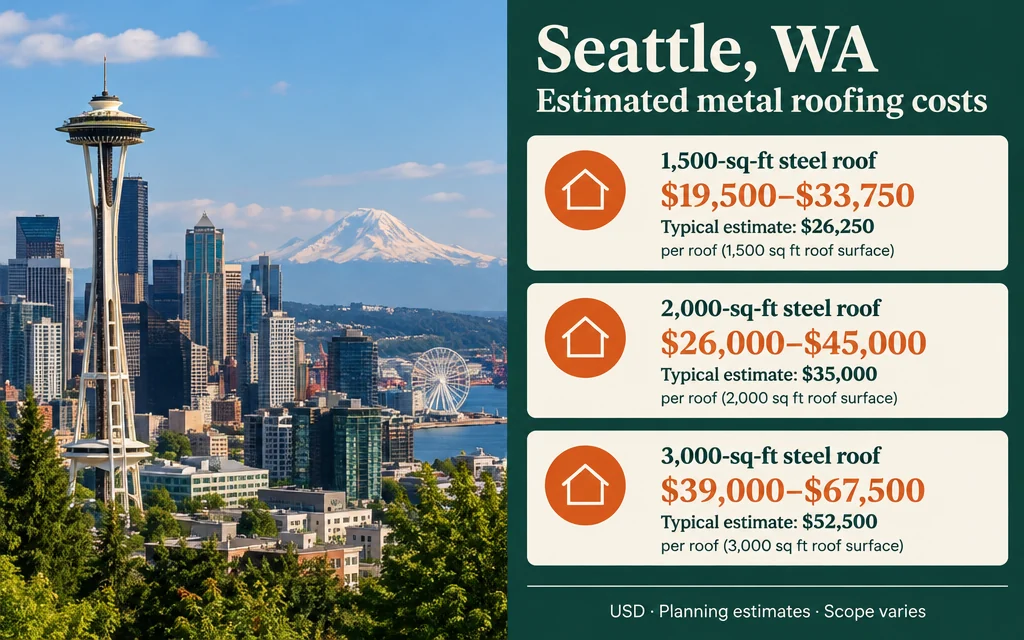
Calculated installed planning scenario for measured roof surface, including one-layer removal/disposal; conditional extras excluded.
Calculated installed planning scenario for measured roof surface, including one-layer removal/disposal; conditional extras excluded.
Calculated installed planning scenario for measured roof surface, including one-layer removal/disposal; conditional extras excluded.
Metal Roofing in the Seattle Climate
Metal roofing offers a weather-resistant profile well matched to the Pacific Northwest's extended wet season. Seattle averages around 150 days of measurable precipitation annually, accompanied by persistent dampness from October through May.
On heavily shaded lots, organic debris from surrounding evergreens tends to cling to shingle roofs, fostering moss growth that can lift edges and retain moisture. In contrast, smooth metal panels allow leaves and wet needles to wash down into gutters during regular rain.
Because direct, itemized public price lists for residential metal roofing in Seattle are scarce, the figures in this guide serve as regional planning estimates rather than guaranteed local contractor quotes. When estimating your project, calculate total sloped roof surface rather than interior floor space, since pitch, dormers, and eaves expand your square footage. For standard standing-seam steel, budget $13–$22.50 per sq ft of roof surface (installed) over sound wood decking. This installed planning baseline includes tearing off one existing shingle layer, installing synthetic underlayment, baseline trim profiles, and skilled panel installation.
Comparing Residential Metal Roofing Systems
Different metal roofing profiles manage weather exposure, thermal movement, and maintenance differently.
Concealed-fastener standing-seam steel features raised interlocking seams anchored to the deck with hidden clips. These clips let the panels expand and contract smoothly during temperature swings without placing shear stress on fastener points. For standard 24-gauge Galvalume panels with a factory finish, budget $13–$22.50 per sq ft of roof surface (installed).
Exposed-fastener steel panels, such as corrugated or ribbed profiles, screw through the exterior face of the metal directly into the decking using neoprene-gasketed screws. They provide an economical metal alternative at budget $8.50–$14.50 per sq ft of roof surface (installed). Because the rubber washers remain exposed to ultraviolet light, rain, and temperature cycling, plan on periodic inspections and eventual screw maintenance to prevent leaks.
Stamped steel shingles recreate the look of slate, tile, or shake while using concealed fasteners, budgeting $14–$19 per sq ft of roof surface (installed). For homes directly exposed to saltwater breezes along Puget Sound or Elliott Bay, standing-seam aluminum budgets $18–$25 per sq ft of roof surface (installed) and naturally resists red rust. Architectural standing-seam copper represents a premium, untreated metal at budget $30–$48 per sq ft of roof surface (installed), slowly weathering into a distinctive natural patina.
| Service / assumptions | Low | Typical estimate | High | Pricing unit | Estimated labor time |
|---|---|---|---|---|---|
| Standing-Seam Steel (Installed)Calculated standing-seam steel planning rate: comparable panel/accessory materials + installation labor + one-layer removal/disposal. Ordinary underlayment and details over sound decking included; conditional extra work excluded. | $13 | $17.50 | $22.50 | per sq ft of roof surface (installed) | N/A |
| Exposed-Fastener Ribbed Steel (Installed)Through-fastened ribbed or corrugated steel panels with gasketed screws and standard perimeter flashing. | $8.50 | $11.50 | $14.50 | per sq ft of roof surface (installed) | N/A |
| Stamped Steel Shingles (Installed)Modular interlocking steel shingles or shake profiles with concealed fasteners. | $14 | $16.50 | $19 | per sq ft of roof surface (installed) | N/A |
| Standing-Seam Aluminum (Installed)Corrosion-resistant .032 or .040 aluminum standing-seam panels recommended for marine environments. | $18 | $21.50 | $25 | per sq ft of roof surface (installed) | N/A |
| Standing-Seam Copper (Installed)Solid 16 oz or 20 oz natural architectural copper standing seam hand-seamed on site. | $30 | $38 | $48 | per sq ft of roof surface (installed) | N/A |
Baseline Component Breakdown for Standing-Seam Steel
To evaluate a contractor's estimate accurately, look at how the standing-seam steel baseline of budget $13–$22.50 per sq ft of roof surface (installed) divides into materials, labor, and site preparation:
Materials: Budget $4.50–$8 per sq ft of roof surface (materials only). This covers 24-gauge Galvalume steel pans or coil stock, concealed expansion clips, high-temperature synthetic underlayment, starter strips, and standard perimeter trims.
Installation Labor: Budget $7–$12 per sq ft of roof surface (installation labor only). Architectural metal installation requires specialized sheet-metal labor to fold drip edges, lock standing seams, detail valleys, and build custom curb transitions.
One-Layer Tear-Off and Disposal: Budget $1.50–$2.50 per sq ft of roof surface (one-layer removal and disposal). This covers stripping a single layer of composition shingles down to bare wood, magnetic yard sweeps, debris hauling, and transfer station fees. Structural decking repairs or removing secondary roofing layers are separate conditional add-ons.
| Service / assumptions | Low | Typical estimate | High | Pricing unit | Estimated labor time |
|---|---|---|---|---|---|
| Standing-Seam Steel Materials24-gauge Galvalume panels or coil, concealed clips, high-temp underlayment, and standard transition trims. | $4.50 | $6 | $8 | per sq ft of roof surface (materials only) | N/A |
| Standing-Seam Steel Installation LaborSpecialty architectural metal installation, panel roll-forming/seaming, and perimeter metal flashing. | $7 | $9.50 | $12 | per sq ft of roof surface (installation labor only) | N/A |
| One-Layer Tear-Off & DisposalStripping single existing asphalt roof layer, hauling, and regional transfer station disposal fees. | $1.50 | $2 | $2.50 | per sq ft of roof surface (one-layer removal and disposal) | N/A |
Project Cost Scenarios by Roof Size
Total metal roofing costs depend on measured roof area, which is larger than your home's ground footprint due to slope and overhangs.
For a compact home with 1,500 square feet of roof surface, standing-seam steel typically budgets $19,500–$33,750 per roof (1,500 sq ft roof surface), with on-site installation running 3 to 5 business days.
For an average home measuring 2,000 square feet of roof surface, expect to budget $26,000–$45,000 per roof (2,000 sq ft roof surface), requiring 4 to 7 business days of crew time on site.
A larger or more complex architectural layout with 3,000 square feet of roof surface budgets $39,000–$67,500 per roof (3,000 sq ft roof surface), taking 6 to 9 business days.
Roof geometry heavily influences where your estimate lands within these brackets. A simple gable roof with two broad planes requires fewer custom cuts and less labor. Conversely, hips, valleys, dormers, and steep slopes demand extensive on-site hand-braking and flashing adjustments, adding hours to crew time.
| Service / assumptions | Low | Typical estimate | High | Pricing unit | Estimated labor time |
|---|---|---|---|---|---|
| 1,500 Sq Ft Roof AreaCalculated scenario: 1,500 sq ft of measured roof surface × standing-seam steel installed planning rate. Includes its same materials, installation, one-layer removal/disposal and sound-deck assumptions. Not a provider whole-roof quote. | $19,500 | $26,250 | $33,750 | per roof (1,500 sq ft roof surface) | 3 to 5 business days |
| 2,000 Sq Ft Roof AreaCalculated scenario: 2,000 sq ft of measured roof surface × standing-seam steel installed planning rate. Includes its same materials, installation, one-layer removal/disposal and sound-deck assumptions. Not a provider whole-roof quote. | $26,000 | $35,000 | $45,000 | per roof (2,000 sq ft roof surface) | 4 to 7 business days |
| 3,000 Sq Ft Roof AreaCalculated scenario: 3,000 sq ft of measured roof surface × standing-seam steel installed planning rate. Includes its same materials, installation, one-layer removal/disposal and sound-deck assumptions. Not a provider whole-roof quote. | $39,000 | $52,500 | $67,500 | per roof (3,000 sq ft roof surface) | 6 to 9 business days |
Cost and Lifecycle Comparison: Metal vs. Architectural Asphalt
Standard architectural asphalt shingles budget $6.50–$11 per sq ft of roof surface (installed) based on regional benchmarks, with installation requiring 2 to 3 business days. That makes asphalt approximately half the initial expense of standing-seam steel at budget $13–$22.50 per sq ft of roof surface (installed).
Despite the higher upfront investment, the two materials require very different care in Western Washington. In shaded Seattle neighborhoods, asphalt shingles tend to trap fallen pine and cedar needles, which leads to moss accumulation along key moisture channels. Keeping asphalt clear requires regular gentle washing or chemical moss treatments to prevent premature granule deterioration.
A quality standing-seam steel roof sheds organic debris more cleanly and eliminates granular loss. While avoiding future asphalt reroofing cycles helps balance out the higher initial investment over decades, how much value you capture depends on how long you own the property.
| Service / assumptions | Low | Typical estimate | High | Pricing unit | Estimated labor time |
|---|---|---|---|---|---|
| Architectural Asphalt Shingles ReferenceInstalled baseline for standard architectural laminate shingles including tear-off over sound decking. Published rate reference for the stated roofing scope and unit, not verification of this guide's modeled range, a complete roof quote or provider availability. Regional reference; not a verified Seattle-specific quote.Published price reference ↗ | $6.50 | $8.50 | $11 | per sq ft of roof surface (installed) | 2 to 3 business days |
| Comparison | Architectural asphalt | Standing-seam steel |
|---|---|---|
| Up-front planning estimate · 2,000 sq ft roof surface | $13,000–$22,000 | $26,000–$45,000 |
| What the baseline includes | Architectural asphalt, ordinary installed details, one-layer removal/disposal over sound decking. | Standing-seam steel, ordinary installed details, one-layer removal/disposal over sound decking. |
| Maintenance and repairs | Confirm product-specific inspections and repair terms. | Confirm seams, fasteners, coating, compatible repairs and inspection terms. |
| Insurance and ownership cost | Ask the insurer about the exact product and coverage. | Ask the insurer about accepted test documentation, any available credit and cosmetic-damage exclusions. |
These are calculated budgeting comparisons, not provider quotes or guaranteed lifetime savings. Compare your expected ownership period, specified products, actual maintenance proposals and written insurance terms.
| Decision point | Roof repair | Roof replacement | Metal roofing |
|---|---|---|---|
| Work being priced | A defined defect, such as damaged shingles or flashing. | Removal and installation of an agreed roof system across the measured roof surface. | A specified installed metal system; standing seam, exposed fasteners and metal shingles are different scopes. |
| What to inspect | The leak source, surrounding material and whether a durable localized fix is feasible. | The extent of deterioration, decking condition, roof details and suitable replacement systems. | The substrate, panel profile, coating, fasteners, roof geometry and installation details. |
| How to compare prices | Match the repair quantity, access, materials and included diagnosis. | Match measured roof area, material, tear-off layers, disposal and installed inclusions. | Match measured roof area, system, components, removal and conditional additional work. |
| Before deciding | Ask what the repair addresses and what existing problems would remain. | Ask whether repair remains practical and which additional items would change the total. | Ask about compatible materials, documented product/assembly ratings and product versus workmanship warranties. |
Age or a repair-cost percentage alone does not determine the right choice. Ask a qualified roofing contractor to assess the condition and explain viable options. A metal system is a material-specific installation choice, not a separate guarantee of durability or savings.
Decking Repairs and Common Job Add-Ons
Uncovering the decking during tear-off often reveals structural conditions or architectural penetrations that require itemized line items.
Older Seattle homes that once had cedar shakes may have spaced skip-sheathing beneath existing asphalt. Because standing seam requires a continuous, solid nail base, any wide gaps must be sheeted over before dry-in. Installing replacement CDX plywood or OSB budgets $90–$150 additional per 4-by-8-ft sheet (32 sq ft). If the crew uncovers an unexpected second layer of shingles, stripping and disposing of it budgets $100–$200 additional per roofing square (100 sq ft).
Penetrations and ventilation details require custom metal work: custom-fabricated metal chimney counterflashing budgets $450–$1,100 additional per chimney, while a metal skylight flashing kit budgets $350–$850 additional per skylight. Concealed ridge ventilation integrated beneath the ridge cap budgets $18–$45 additional per linear ft. To prevent winter snow and slush from sliding off slick metal planes onto entryways, seam-mounted snow retention rails budget $25–$65 additional per linear ft. Detaching and resetting gutters to secure drip edge profiles budgets $8–$22 additional per linear ft.
| Service / assumptions | Low | Typical estimate | High | Pricing unit | Estimated labor time |
|---|---|---|---|---|---|
| Extra Layer Tear-OffDisposal and labor surcharge per square for removing a second or third existing roof layer. | $100 | $150 | $200 | additional per roofing square (100 sq ft) | N/A |
| Plywood Decking ReplacementInstalled cost per 4x8 ft 1/2-inch CDX plywood or OSB sheet with roof exposed. | $90 | $120 | $150 | additional per 4-by-8-ft sheet (32 sq ft) | N/A |
| Custom Metal Chimney FlashingCustom-bent counterflashing, cricket/saddle fabrication, and masonry reglet cut. | $450 | $700 | $1,100 | additional per chimney | N/A |
| Metal Skylight Flashing KitSpecialized raised curb metal flashing kit and integration with standing-seam pans. | $350 | $550 | $850 | additional per skylight | N/A |
| Concealed Ridge VentilationPerforated baffled ridge vent profile installed beneath standing-seam cap. | $18 | $28 | $45 | additional per linear ft | N/A |
| Snow Retention Bar / Guard SystemNon-penetrating seam-clamped snow rail or pipe retention over doorways and entry paths. | $25 | $40 | $65 | additional per linear ft | N/A |
| Gutter Detach & ResetRemoving existing gutters to install drip edge metal and re-hanging upon completion. | $8 | $14 | $22 | additional per linear ft | N/A |
Testing, Warranties, and Seattle Weather Realities
Broad marketing phrases like 'lifetime' or 'storm-proof' do not replace standardized laboratory tests. The real-world performance of a metal roof depends on the tested assembly and proper field execution.
Many standing-seam panels carry UL 2218 Class 4 impact ratings and UL 580 wind uplift classifications. The UL 2218 test verifies that dropped steel balls did not crack the metal under laboratory conditions, but it does not guarantee that panels will never dent during severe hail or tree branch strikes. Nor does a lab rating ensure storm resilience if perimeter flashings and eaves are incorrectly secured.
Similarly, a Class A fire rating applies to the complete roof assembly—including specific fire-resistant underlayments and solid decking—rather than the bare metal panels alone. Premium reductions for impact-resistant roofs vary by carrier and policy type. Check directly with your insurance agent to verify whether discounts apply to your home and whether accepting a credit adds a cosmetic damage waiver that excludes coverage for non-leaking dents.
Cost Factors for Metal Roofing in Seattle
Several jobsite conditions dictate where a metal roofing quote falls within our planning ranges:
Roof Pitch and Access: Roofs with a pitch of 7:12 or steeper require continuous harness tie-offs, specialized staging, and slower crew movement. In tight Seattle neighborhoods with narrow side setbacks, steep street parking, or established perimeter plantings, staging a roll-forming trailer or positioning a debris container requires extra coordination and time.
Gauge and Coating Quality: Residential standing seam is typically installed in 24-gauge Galvalume steel. Thinner 26-gauge or 29-gauge metal is more susceptible to visible oil-canning—surface waviness caused by normal thermal expansion—and offers less panel rigidity. High-performance polyvinylidene fluoride (PVDF) resin finishes provide superior resistance to color fading and chalking under damp, shaded conditions compared to standard polyester coatings.
Panel Fabrication Method: Some contractors bring portable roll-forming machines directly to the jobsite to run continuous pans from coil stock to the exact length of your eaves. On-site roll-forming eliminates horizontal panel laps on long runs and adapts easily to irregular roof framing.
Hiring and Vetting Metal Roofers in Seattle
Installing architectural metal roofing requires different skills and specialized forming equipment than laying asphalt shingles. Installers without sheet-metal training may lean on exposed face screws, heavy sealant joints, or generic flashings that fail in wet coastal weather.
When reviewing bids for your project, confirm these practical details:
1. Registration and safety standing: Check the contractor's registration on the Washington State Department of Labor & Industries (L&I) portal to verify active status, general liability insurance, and current workers' compensation coverage for steep-slope roofing.
2. Address-specific permitting: Ask your roofer whether a building permit is required for your address through the Seattle Department of Construction and Inspections (SDCI) or your local jurisdiction, and verify in writing who pulls the permit and coordinates required deck or final inspections.
3. Written material specifications: Ensure your proposal specifies the metal gauge (such as 24-gauge), panel seam style, underlayment brand, clip spacing, and paint warranty terms.
4. Wood replacement rates: Make sure your agreement specifies a clear, fixed rate per sheet for replacing deteriorated plywood or OSB, rather than leaving sheathing repairs to an open-ended labor-and-materials charge.
Local income & housing costs
Seattle city, Washington · U.S. Census Bureau, 2025 ACS 1-year estimates.
per month · ±$47
Cash-rent units; includes applicable tenant-paid utilities
Census source ↗Dollar amounts use the survey period’s published basis. Income is annual; gross rent is monthly. Home value reflects owner-occupied housing values. Margins of error shown are at the ACS 90% confidence level. These statistics provide city context; service budgets use their own pricing evidence.
STATEWIDE COST CONTEXT
Washington prices, income & labor costs
These Washington figures provide background for this city guide. They describe different measures and reference years; employee wages are not prices charged by a contractor.
BEA SAIRPD
State price change indicator
132.32024 · index (2017 basis)
Annual figures & sources
| Year | Value | 90% margin of error | Source |
|---|---|---|---|
| 2020 | 112.9 | — | Official source |
| 2021 | 118.6 | — | Official source |
| 2022 | 127.8 | — | Official source |
| 2023 | 130.6 | — | Official source |
| 2024 | 132.3 | — | Official source |
Census ACS 1-year
Median household income
$101,9462025 · USD/year
Annual figures & sources
| Year | Value | 90% margin of error | Source |
|---|---|---|---|
| 2021 | $84,247 | ±$844 | Official source |
| 2022 | $91,306 | ±$841 | Official source |
| 2023 | $94,605 | ±$1,221 | Official source |
| 2024 | $99,389 | ±$1,322 | Official source |
| 2025 | $101,946 | ±$719 | Official source |
BLS OEWS
Roofers
$29.162025 · USD/hour
Annual figures & sources
| Year | Value | 90% margin of error | Source |
|---|---|---|---|
| 2025 | $29.16 | — | Official source |
State prices: BEA, 2020–2024. Household income: Census ACS, 2021–2025. Employee wages: BLS, May 2025 snapshot. The charts retain their own units and fitted scales.
Explore all Washington living-cost data and trends →Local context and limitations
Seattle's maritime climate brings long stretches of cool rain and overcast days from autumn through spring, creating chronic dampness under Douglas fir, western red cedar, and bigleaf maple canopies. Asphalt shingles can trap wet needle litter and foster moss along shaded eaves, whereas smooth metal panels shed debris more easily. Near Puget Sound and Elliott Bay, marine salt air can accelerate edge oxidation on basic steel; standing-seam aluminum or heavy factory-applied resin coatings offer better corrosion resistance in these microclimates.
Frequently asked questions
What is the difference between standing seam and exposed-fastener metal roofs?
Standing seam conceals all clips and screws beneath interlocking raised seams, allowing panels to expand and contract smoothly without placing shear strain on fasteners. Exposed-fastener systems use screws driven directly through the metal face with rubber washers. Over time, sunlight and weather cause those washers to degrade, requiring periodic inspections and screw replacements to prevent leaks.
How do contractors calculate my roof's actual square footage?
Roof area is calculated across the sloped exterior surface rather than interior floor space. Pitch, overhangs, gables, and dormers make the exterior plane significantly larger than the home's footprint. Roofing contractors measure this area in 'squares', where one square equals 100 square feet of surface.
Can a metal roof be installed directly over existing shingles in Seattle?
Whether an overlay is permitted depends on your local building department, applicable building codes, and manufacturer warranty guidelines. You will need to verify whether local rules allow an overlay for your address and whether the underlying rafters can bear the added dead load. Even where allowed, tearing down to bare decking is commonly chosen to inspect sheathing for hidden rot and avoid an uneven surface.
Does a metal roof make rain sound noticeably loud inside the house?
On a typical residential home with solid plywood decking, quality underlayment, and standard attic insulation, indoor rain noise is comparable to that of asphalt shingles. Loud drumming sounds occur primarily on open-framed, uninsulated structures like agricultural outbuildings and carports.
Do I need snow guards on a metal roof in Seattle?
While heavy snow is infrequent in Seattle, winter storms regularly deposit wet, slushy snow that slides rapidly off smooth metal panels during afternoon thaws. Installing non-penetrating seam-clamped snow guards above walkways, entry doors, and delicate gutters prevents heavy slush from dropping unexpectedly.
Will my homeowner insurance offer a discount for installing a metal roof?
Discounts depend entirely on your specific insurance carrier, policy terms, and roof specifications. Some carriers provide credits for impact-resistant assemblies, while others do not offer any premium reduction. Contact your insurance agent directly to ask if your address qualifies for discounts and whether claiming a credit adds a cosmetic damage waiver that excludes coverage for non-leaking dents.
Sources and methodology
Sources below retain their recorded retrieval dates and geographic scope. We checked the quoted rates against readable public pricing pages. The tables remain planning estimates, not provider quotes or a measured citywide survey. Per-square-foot references do not establish the modeled whole-roof totals or all their installed inclusions. Regional references are not verified Seattle-specific quotes. Confirm removal, disposal, materials, labor and the complete scope in a written proposal.
Published pricing pages retrieved; quoted excerpts checked automatically. 2 distinct website domains. · Generated 2026-11-12
- Washington Roof Cost Calculator (FREE, 3 easy steps) | Valentine RoofingState / regional reference · Page retrieved 2026-11-12 · Price excerpt matched automatically
“Shingle Damage Washington residents can expect to pay an average of $24 per square foot for shingle repair/replacement.”
Planning ranges may differ from these published examples; they are not provider quotes.
- How Much Does a New Roof Cost in Seattle? (2026 Guide)State / regional reference · Page retrieved 2026-11-12 · Price excerpt matched automatically
“Architectural asphalt shingles are the most affordable option, typically $9–$15 per square foot installed.”
Planning ranges may differ from these published examples; they are not provider quotes.
Plan your metal roofing project
Choose your service and answer its project questions. Add notes or photos if helpful, then generate your project brief. The planner labels its budgeting assumptions separately. Use your plan to compare the scope and assumptions with a provider. Contact sharing and provider matching are not available yet.
Open the project planner →Share this city’s cost data
<> Embed Seattle Cost Data on Your Site
The HTML table shows the prices at the time of copying. The iframe follows the published guide.