Tri-Cities · WA · COST GUIDE
Metal Roofing Costs in Tri-Cities, WA (2026)
For budgeting, standing-seam steel roofing is estimated at $9–$17 per sq ft of roof surface, and exposed-fastener steel at $6.50–$11.50 per sq ft. These installed planning ranges include one-layer removal/disposal over sound decking; compare the specified system and conditional extras.
Standing Seam Steel Roof (Installed)
Budget estimate$9–$17per sq ft of roof surface (installed)
Planning range · Compare the roof area, material and included work in your quote.
Exposed Fastener Steel Roof (Installed)
Budget estimate$6.50–$11.50per sq ft of roof surface (installed)
Planning range · Compare the roof area, material and included work in your quote.
Published examples apply to their stated scope. Budget ranges are estimates.
Calculated installed planning scenario for measured roof surface, including one-layer removal/disposal; conditional extras excluded.
Calculated installed planning scenario for measured roof surface, including one-layer removal/disposal; conditional extras excluded.
Calculated installed planning scenario for measured roof surface, including one-layer removal/disposal; conditional extras excluded.
Understanding Residential Metal Roofing in the Tri-Cities
Choosing a metal roof in the Tri-Cities involves matching panel design and attachment methods to Eastern Washington's climate. Extended summer heat and direct sun exposure give way to freezing winter nights and frequent wind through the Columbia Basin.
For a standard standing-seam steel roof—including tear-off of one existing asphalt shingle layer over sound wood decking—budget $9–$17 per sq ft of roof surface (installed). Because roof pitch, overhangs, and attached garages expand total surface area beyond a home's interior floor plan, whole-roof costs depend on actual measured sloped area. For a measured 2,000-square-foot roof, our calculated planning scenario totals budget $18,000–$34,000 per roof (2,000 sq ft roof surface).
Agricultural and utility structures often rely on exposed-fastener corrugated sheets, but single-family homes typically use concealed-clip standing seam or stamped metal shingles. Concealed clips allow panels to slide naturally as temperatures cycle, preventing thermal stress on fastener holes.
Comparing Metal Roof Profiles and Materials
Residential metal systems differ in profile, attachment mechanics, and installed cost:
Standing Seam Steel (Concealed Fastener): The residential metal standard. Panels lock together over hidden clips screwed into the roof deck. This assembly lets the steel expand and contract along its length as outdoor temperatures swing, avoiding tension on screw penetrations. Factory PVDF finishes help prevent chalking and fading under high UV conditions.
Exposed-Fastener Steel: Overlapping ribbed panels attached by driving screws with rubber washers directly through the metal face. Initial costs are lower, running budget $6.50–$11.50 per sq ft of roof surface (installed). Because the sheet expands while screws remain anchored, the exposed washers weather over time, requiring scheduled inspections and gasket maintenance.
Stamped Metal Shingles: Formed to resemble cedar shakes, slate, or concrete tile using interlocking coated steel panels. Budget $11.50–$19.50 per sq ft of roof surface (installed). The higher investment accounts for detailed hand-fitting and flashing along hips, valleys, and sidewalls.
Standing Seam Aluminum: A premium concealed-clip option budgeting $14–$23 per sq ft of roof surface (installed). Aluminum provides natural corrosion protection in coastal environments. In the semi-arid Columbia Basin, Galvalume-coated steel is far more common, but aluminum is sometimes specified for custom architectural designs.
Standing Seam Copper: An architectural metal running budget $28–$48 per sq ft of roof surface (installed). Copper oxidizes over decades to form a protective patina. Regional residential projects usually reserve it for small accents, porch roofs, or bay windows rather than entire homes.
| Service / assumptions | Low | Typical estimate | High | Pricing unit | Estimated labor time |
|---|---|---|---|---|---|
| Standing Seam Steel Roof (Installed)Calculated standing-seam steel planning rate: comparable panel/accessory materials + installation labor + one-layer removal/disposal. Ordinary underlayment and details over sound decking included; conditional extra work excluded. | $9 | $13 | $17 | per sq ft of roof surface (installed) | N/A |
| Exposed Fastener Steel Roof (Installed)Ribbed/corrugated panels with gasketed screw fasteners directly through face; lower cost utility and residential option. | $6.50 | $9 | $11.50 | per sq ft of roof surface (installed) | N/A |
| Stamped Metal Shingles (Installed)Interlocking stone-coated or painted stamped steel shingles replicating shake, slate, or tile profiles. | $11.50 | $15.50 | $19.50 | per sq ft of roof surface (installed) | N/A |
| Standing Seam Aluminum Roof (Installed)Concealed fastener aluminum system; highly corrosion-resistant but priced higher than Galvalume steel. | $14 | $18.50 | $23 | per sq ft of roof surface (installed) | N/A |
| Standing Seam Copper Roof (Installed)Solid copper standing seam panels with natural patina aging; premium architectural accent or whole-roof system. | $28 | $36 | $48 | per sq ft of roof surface (installed) | N/A |
Cost Breakdown: Standing Seam Steel Components
A typical installed planning rate of $13.00 per square foot for standing-seam steel breaks down into three distinct operational segments: tear-off, materials, and skilled installation labor.
Old Roof Removal and Disposal: Budget $1–$2 per sq ft of roof surface (one-layer removal and disposal) to strip one layer of old asphalt shingles, haul the debris, and cover local disposal fees. Stripping down to the bare deck lets the crew verify whether wood sheathing is sound before panels are laid.
Materials and Trim Accessories: Delivered metal components account for budget $4.25–$8.25 per sq ft of roof surface (materials only). This includes 24- or 26-gauge Galvalume steel panels, concealed expansion clips, fasteners, high-temperature synthetic underlayment, drip edge, valley metal, and ridge caps.
Installation Labor: Standing-seam installation labor runs budget $3.75–$6.75 per sq ft of roof surface (installation labor only). The trade requires specialized sheet-metal work, including hand-hemming panel ends at eaves, field-forming transitions around penetrations, and maintaining clip alignment to meet wind-uplift requirements.
| Service / assumptions | Low | Typical estimate | High | Pricing unit | Estimated labor time |
|---|---|---|---|---|---|
| Standing Seam Steel Materials & Accessories24/26-ga Galvalume panels, clips, fasteners, high-temp underlayment, drip edge, valleys, and ridge components. | $4.25 | $6.25 | $8.25 | per sq ft of roof surface (materials only) | N/A |
| Standing Seam Installation Labor OnlyCrew labor for layout, cutting, seaming, hemming, and perimeter trim installation; excludes tear-off. | $3.75 | $5.25 | $6.75 | per sq ft of roof surface (installation labor only) | N/A |
| One-Layer Removal & DisposalTear-off of one layer of asphalt shingles, site cleanup, magnetic sweep, dumpster, and haul-away fees. | $1 | $1.50 | $2 | per sq ft of roof surface (one-layer removal and disposal) | N/A |
Whole-Roof Budget Estimates by Home Size
To evaluate total project costs, review these calculated scenarios for standing-seam steel over sound decking, including single-layer shingle tear-off and standard perimeter trim:
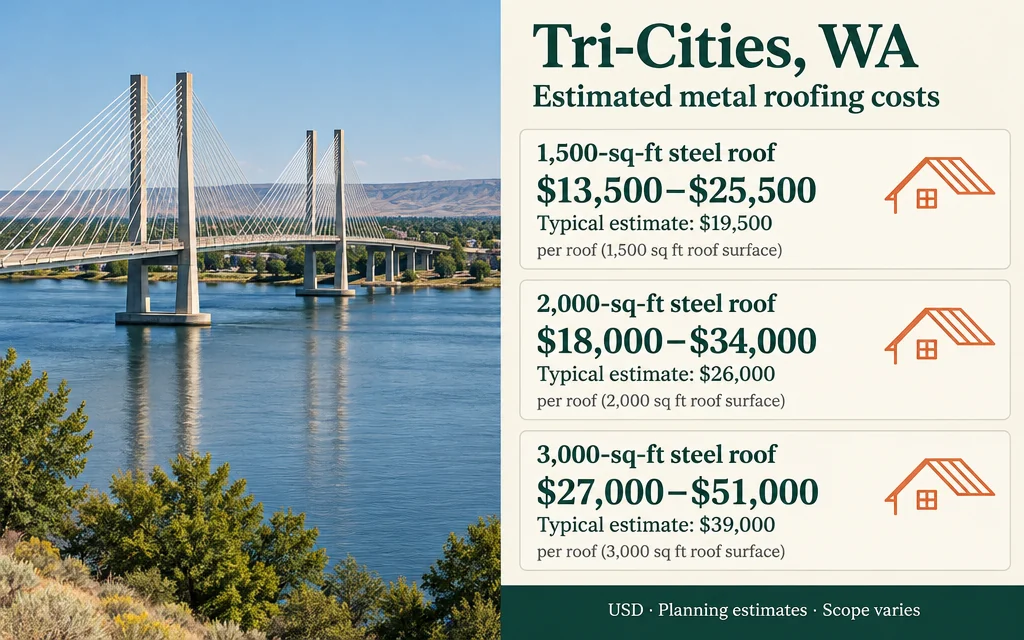
1,500 Sq Ft Roof Area: Common for compact single-level homes. The calculated installed scenario is budget $13,500–$25,500 per roof (1,500 sq ft roof surface), with typical planning around $19,500. On-site installation typically takes 2 to 3 days.
2,000 Sq Ft Roof Area: Standard for mid-sized single-family houses. Calculated project costs run budget $18,000–$34,000 per roof (2,000 sq ft roof surface), centering around $26,000. On-site installation typically spans 3 to 4 days.
3,000 Sq Ft Roof Area: Typical for larger multi-story layouts or ranch-style homes with multi-car garages. Budget $27,000–$51,000 per roof (3,000 sq ft roof surface), with a median projection around $39,000. On-site installation typically spans 4 to 6 days.
Actual roof area is always greater than ground-level floor space. Because roof pitch, eaves, dormers, and attached covered spaces expand the sloped surface, your installer must measure the actual roof plane rather than estimating from interior square footage.
| Service / assumptions | Low | Typical estimate | High | Pricing unit | Estimated labor time |
|---|---|---|---|---|---|
| Standing Seam Steel: 1,500 Sq Ft RoofCalculated scenario: 1,500 sq ft of measured roof surface × standing-seam steel installed planning rate. Includes its same materials, installation, one-layer removal/disposal and sound-deck assumptions. Not a provider whole-roof quote. | $13,500 | $19,500 | $25,500 | per roof (1,500 sq ft roof surface) | 2 to 3 days |
| Standing Seam Steel: 2,000 Sq Ft RoofCalculated scenario: 2,000 sq ft of measured roof surface × standing-seam steel installed planning rate. Includes its same materials, installation, one-layer removal/disposal and sound-deck assumptions. Not a provider whole-roof quote. | $18,000 | $26,000 | $34,000 | per roof (2,000 sq ft roof surface) | 3 to 4 days |
| Standing Seam Steel: 3,000 Sq Ft RoofCalculated scenario: 3,000 sq ft of measured roof surface × standing-seam steel installed planning rate. Includes its same materials, installation, one-layer removal/disposal and sound-deck assumptions. Not a provider whole-roof quote. | $27,000 | $39,000 | $51,000 | per roof (3,000 sq ft roof surface) | 4 to 6 days |
Standing Seam Steel vs. Architectural Asphalt Shingles
Upfront cost is the clearest dividing line between metal and conventional asphalt roofing. For reference, installed architectural asphalt shingles run budget $4.50–$8.50 per sq ft of roof surface (installed), while standing-seam steel runs budget $9–$17 per sq ft of roof surface (installed).
Asphalt shingles have a lower initial price point, but intense summer heat and direct sun in the Columbia Basin can accelerate granule loss and dry out binders over time. High river winds can also lift tab edges on older shingles.
Standing-seam steel uses interlocking seams anchored to the deck without exposed face screws, giving it superior wind resistance. Factory-applied coatings protect against UV fading, and underlying Galvalume treatments prevent rust. The trade-off is an initial cost roughly double that of asphalt, and repairing a mechanically damaged metal panel requires specialized sheet-metal labor.
| Service / assumptions | Low | Typical estimate | High | Pricing unit | Estimated labor time |
|---|---|---|---|---|---|
| Architectural Shingles (Installed Reference)Dimensional asphalt shingles including tear-off, synthetic underlayment, and standard drip edge. Published rate reference for the stated roofing scope and unit, not verification of this guide's modeled range, a complete roof quote or provider availability. Regional reference; not a verified Tri-Cities-specific quote.Published price reference ↗ | $4.50 | $6.50 | $8.50 | per sq ft of roof surface (installed) | N/A |
| Comparison | Architectural asphalt | Standing-seam steel |
|---|---|---|
| Up-front planning estimate · 2,000 sq ft roof surface | $9,000–$17,000 | $18,000–$34,000 |
| What the baseline includes | Architectural asphalt, ordinary installed details, one-layer removal/disposal over sound decking. | Standing-seam steel, ordinary installed details, one-layer removal/disposal over sound decking. |
| Maintenance and repairs | Confirm product-specific inspections and repair terms. | Confirm seams, fasteners, coating, compatible repairs and inspection terms. |
| Insurance and ownership cost | Ask the insurer about the exact product and coverage. | Ask the insurer about accepted test documentation, any available credit and cosmetic-damage exclusions. |
These are calculated budgeting comparisons, not provider quotes or guaranteed lifetime savings. Compare your expected ownership period, specified products, actual maintenance proposals and written insurance terms.
| Decision point | Roof repair | Roof replacement | Metal roofing |
|---|---|---|---|
| Work being priced | A defined defect, such as damaged shingles or flashing. | Removal and installation of an agreed roof system across the measured roof surface. | A specified installed metal system; standing seam, exposed fasteners and metal shingles are different scopes. |
| What to inspect | The leak source, surrounding material and whether a durable localized fix is feasible. | The extent of deterioration, decking condition, roof details and suitable replacement systems. | The substrate, panel profile, coating, fasteners, roof geometry and installation details. |
| How to compare prices | Match the repair quantity, access, materials and included diagnosis. | Match measured roof area, material, tear-off layers, disposal and installed inclusions. | Match measured roof area, system, components, removal and conditional additional work. |
| Before deciding | Ask what the repair addresses and what existing problems would remain. | Ask whether repair remains practical and which additional items would change the total. | Ask about compatible materials, documented product/assembly ratings and product versus workmanship warranties. |
Age or a repair-cost percentage alone does not determine the right choice. Ask a qualified roofing contractor to assess the condition and explain viable options. A metal system is a material-specific installation choice, not a separate guarantee of durability or savings.
Additional Work, Decking, and Flashing Considerations
Standard metal roofing estimates assume an uncomplicated roof layout and sound decking. Unforeseen conditions or layout features often add to the final invoice:
Multiple Layer Tear-Off: Removing a second or third existing roof layer increases labor and landfill weight, running budget $40–$80 additional per roofing square (100 sq ft).
Decking Repairs: Standing seam requires a flat, firm nailing base. Replacing deteriorated or sagging sheathing discovered after tear-off costs budget $85–$150 additional per 4-by-8-ft sheet (32 sq ft) installed.
Chimneys and Skylights: Custom-fabricating counter-flashing, step flashing, and an upstream cricket around a chimney runs budget $450–$1,100 additional per chimney. Rebuilding curb flashing around an existing skylight runs budget $300–$650 additional per skylight.
Attic Ventilation: Upgrading to a profile-matched continuous vented ridge system costs budget $12–$26 additional per linear ft.
Snow Retention: Smooth metal panels shed snow quickly during sunny afternoon warm-ups. Installing clamp-on snow guards above entryways, driveways, or heat pump units runs budget $18–$42 additional per linear ft.
Gutter Reset: If existing gutters block the installation of new eave trim, unclipping and resetting them costs budget $5–$12 additional per linear ft.
| Service / assumptions | Low | Typical estimate | High | Pricing unit | Estimated labor time |
|---|---|---|---|---|---|
| Extra Layer Removal & Haul-AwayStripping and disposing of a second or third existing roof layer beyond the standard single-layer allowance. | $40 | $60 | $80 | additional per roofing square (100 sq ft) | N/A |
| Plywood/OSB Deck Replacement SheetReplacing deteriorated or rotted structural 4x8 ft roof sheathing discovered after tear-off. | $85 | $115 | $150 | additional per 4-by-8-ft sheet (32 sq ft) | N/A |
| Custom Chimney Flashing & CricketHand-fabricated metal step, apron, and counter-flashing with cricket diverter where required. | $450 | $700 | $1,100 | additional per chimney | N/A |
| Skylight Flashing IntegrationEngineered curb flashing kit and waterproof membrane tie-in for existing skylights. | $300 | $450 | $650 | additional per skylight | N/A |
| Continuous Vented Ridge UpgradeProfile-cut ventilated ridge closures and baffle caps designed specifically for standing seam panels. | $12 | $18 | $26 | additional per linear ft | N/A |
| Snow Guard / Retention SystemNon-penetrating seam-clamp snow brackets or bar systems over pathways and door entries. | $18 | $28 | $42 | additional per linear ft | N/A |
| Gutter Detach & ReinstallCarefully unclipping existing gutters to allow eave flashing installation, then remounting to new fascia detail. | $5 | $8 | $12 | additional per linear ft | N/A |
Codes, Weather Resistance, and Insurance Standards
Metal roofing performs reliably in severe weather, but performance depends on tested panel assemblies, contractor workmanship, and your insurance carrier's guidelines.
Impact Ratings (UL 2218): Many standing-seam profiles achieve UL 2218 Class 4 impact ratings, indicating the metal resists puncturing during severe hail. However, panels can still sustain cosmetic denting. Insurance premium discounts are not automatic; check with your carrier to see if they offer a premium credit and whether their policy includes a cosmetic damage waiver.
Fire Classification (UL 790): Metal is noncombustible, but achieving a complete Class A fire-rated assembly requires an approved deck and underlayment combination. If your property borders dry open brushland, confirm with your roofer that the specified assembly carries a verified Class A rating.
Wind Uplift: Concealed-clip systems engineered to UL 580 or UL 1897 standards hold up well against seasonal gusts because the clips secure panel seams directly to the deck without vulnerable edge tabs.
Solar Reflectance: Cool-roof finishes with high solar reflectance keep panel surface temperatures lower during hot summer days, moderating heat transfer into the attic space.
Key Cost Drivers for Tri-Cities Metal Projects
Several project-specific factors determine where a written proposal lands within the planning range:
Roof Geometry and Pitch: Walkable pitches (3:12 to 5:12) are faster to stage and seam. Steeper slopes require safety harnesses, scaffolding, and slower handling, which raises labor costs. Complex roof lines with multiple valleys, hips, and dormers create more trim scrap and require extensive custom flashing.
Steel Gauge and Panel Profile: Heavier 24-gauge steel offers greater stiffness and resists visible surface waviness (oil-canning) better than lighter 26-gauge material, but it carries a higher material cost. Confirm whether panels are roll-formed in a factory or formed on site by the crew.
Site Access and Building Height: Multi-story structures or narrow side yards restrict staging, requiring extra crew time to lift and carry long panels safely without crimping.
Permit Jurisdiction and Sales Tax: Whether your property is located in Kennewick, Pasco, Richland, or an unincorporated county area determines the exact building permit fees, plan check criteria, and local retail sales tax rate. Ask contractors whether these charges are itemized or included in the base proposal.
Vetting Contractors and Reviewing Estimates
Standing-seam installation requires dedicated sheet-metal equipment and specific hand tools. When evaluating contractor proposals in the Tri-Cities, follow these screening steps:
Check Registration and Insurance: Verify the contractor's active status through the Washington State Department of Labor & Industries. Confirm they carry active general liability insurance and up-to-date workers' compensation coverage.
Require Specific Material Details: Ensure your written contract lists the exact panel profile, steel gauge, protective coating (such as Galvalume AZ50 or AZ55), factory paint system (such as Kynar 500/Hylar 5000 PVDF), clip spacing, and brand of high-temperature underlayment.
Inspect Eave and Valley Detailing: Professional standing-seam work uses folded hems hooked over concealed starter cleats along eaves and valleys. Avoid bids that rely on exposed face screws and heavy caulking beads at critical water transitions.
Separate Manufacturer and Labor Warranties: Distinguish between the manufacturer's coating warranty (covering chalking and peeling for 30 to 40 years) and the roofing contractor's workmanship warranty covering installation details and flashings.
STATEWIDE COST CONTEXT
Washington prices, income & labor costs
These Washington figures provide background for this city guide. They describe different measures and reference years; employee wages are not prices charged by a contractor.
BEA SAIRPD
State price change indicator
132.32024 · index (2017 basis)
Annual figures & sources
| Year | Value | 90% margin of error | Source |
|---|---|---|---|
| 2020 | 112.9 | — | Official source |
| 2021 | 118.6 | — | Official source |
| 2022 | 127.8 | — | Official source |
| 2023 | 130.6 | — | Official source |
| 2024 | 132.3 | — | Official source |
Census ACS 1-year
Median household income
$101,9462025 · USD/year
Annual figures & sources
| Year | Value | 90% margin of error | Source |
|---|---|---|---|
| 2021 | $84,247 | ±$844 | Official source |
| 2022 | $91,306 | ±$841 | Official source |
| 2023 | $94,605 | ±$1,221 | Official source |
| 2024 | $99,389 | ±$1,322 | Official source |
| 2025 | $101,946 | ±$719 | Official source |
BLS OEWS
Roofers
$29.162025 · USD/hour
Annual figures & sources
| Year | Value | 90% margin of error | Source |
|---|---|---|---|
| 2025 | $29.16 | — | Official source |
State prices: BEA, 2020–2024. Household income: Census ACS, 2021–2025. Employee wages: BLS, May 2025 snapshot. The charts retain their own units and fitted scales.
Explore all Washington living-cost data and trends →Local context and limitations
Summer heat, strong sunlight, and river-corridor wind gusts across the Tri-Cities create demanding conditions for residential roofs. Standing-seam installations benefit from high-temperature synthetic underlayments beneath the metal panels to prevent adhesive breakdown. Because building permits, inspections, and retail sales taxes vary depending on your specific jurisdiction—whether inside Kennewick, Pasco, Richland, or unincorporated Benton or Franklin County—ask each contractor to confirm in writing who pulls the permit and whether local sales taxes and fees are included in the quote.
Frequently asked questions
What is the difference between standing seam and exposed-fastener metal roofs?
Standing seam uses concealed clips under interlocking ridges, allowing panels to slide freely as temperatures change with no exterior screw holes. Exposed-fastener roofs use screws driven directly through the metal face with rubber washers, which lowers initial costs but requires periodic fastener inspections and gasket maintenance.
How much does a standing seam metal roof cost in the Tri-Cities?
Installed planning estimates for standing-seam steel range from $9.00 to $17.00 per square foot of roof surface, including single-layer shingle tear-off. For a typical 2,000-square-foot roof, calculated planning scenarios range from $18,000 to $34,000 depending on panel gauge, roof pitch, and architectural complexity.
Why is measured roof area larger than home square footage?
Interior floor area measures flat living space inside exterior walls. Total roof surface must account for the exterior building footprint, roof slope, eave overhangs, and attached unheated spaces like garages, porches, and carports.
Can a metal roof be installed directly over existing asphalt shingles?
Whether an overlay is code-compliant depends on local building rules and the structural condition of the existing roof. Most metal manufacturers recommend tearing off old shingles so the wood deck can be inspected and covered with an approved high-temperature underlayment.
Will installing a metal roof reduce my homeowners insurance premium?
Some insurance carriers offer premium discounts for UL 2218 Class 4 impact resistance or Class A fire ratings, but credits are not guaranteed. Some policies also attach a cosmetic damage waiver. Contact your insurance agent to see what documentation your policy requires.
Are metal roofs noisy when it rains?
When installed over solid plywood or OSB sheathing with high-temperature underlayment and a standard insulated attic space, metal roofs do not produce noticeable indoor rainfall noise compared to traditional asphalt shingles.
Sources and methodology
Sources below retain their recorded retrieval dates and geographic scope. We checked the quoted rates against readable public pricing pages. The tables remain planning estimates, not provider quotes or a measured citywide survey. Per-square-foot references do not establish the modeled whole-roof totals or all their installed inclusions. Regional references are not verified Tri-Cities-specific quotes. Confirm removal, disposal, materials, labor and the complete scope in a written proposal.
Published pricing pages retrieved; quoted excerpts checked automatically. 3 distinct website domains. · Generated 2026-11-12
- Metal Roofing Cost in Washington: 2026 PricesState / regional reference · Page retrieved 2026-11-12 · Price excerpt matched automatically
“A practical planning range Published installer ranges place standing seam metal roofing at $10 to $16 per square foot , including materials and installation.”
Planning ranges may differ from these published examples; they are not provider quotes.
- Aluminum Roof Construction Services in Richland, WA | Kennewick RoofingState / regional reference · Page retrieved 2026-11-12 · Price excerpt matched automatically
“Installation Expenses - Labor costs for installing an aluminum roof generally fall between $4 and $8 per square foot.”
Planning ranges may differ from these published examples; they are not provider quotes.
- Roof Replacement Cost in Seattle, WA (2026 Guide) | Wolfy's RoofingState / regional reference · Page retrieved 2026-11-12 · Price excerpt matched automatically
“Roughly $6.50 to $10.50 per square foot installed for architectural asphalt shingles and $12.50 to $20.50 for standing-seam metal, including tear-off of one layer.”
Planning ranges may differ from these published examples; they are not provider quotes.
Plan your metal roofing project
Choose your service and answer its project questions. Add notes or photos if helpful, then generate your project brief. The planner labels its budgeting assumptions separately. Use your plan to compare the scope and assumptions with a provider. Contact sharing and provider matching are not available yet.
Open the project planner →Share this city’s cost data
<> Embed Tri-Cities Cost Data on Your Site
The HTML table shows the prices at the time of copying. The iframe follows the published guide.