Tri-Cities · WA · COST GUIDE
Roof Repair Costs in Tri-Cities, WA (2026)
For budgeting, a small shingle repair is estimated at $250–$750 per repair area (up to 10 sq ft), and pipe boot replacement at $150–$450 per boot. These are different repair scopes; compare the table's assumptions with a written contractor quote.
Minor Shingle Repair
Budget estimate$250–$750per repair area (up to 10 sq ft)
Planning range · Compare the repair scope, materials and included work in your quote.
Plumbing Pipe Boot Replacement
Budget estimate$150–$450per boot
Planning range · Compare the repair scope, materials and included work in your quote.
Published examples apply to their stated scope. Budget ranges are estimates.
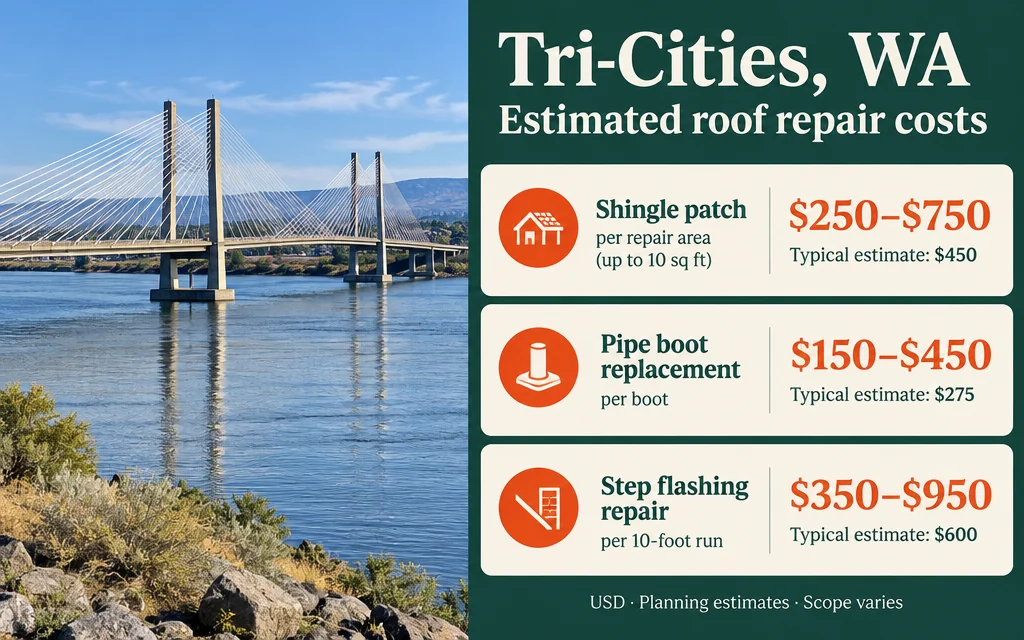
Planning estimate per repair area (up to 10 sq ft). Replacement of a small cluster of wind-damaged or cracked architectural or 3-tab shingles including resealing with roofing mastic.
Planning estimate per boot. Removal of failed neoprene or lead boot, installation of new vent collar, and re-weaving surrounding shingles with proper fasteners. The source is a published task-price reference; the planning range and stated repair quantity remain estimates.
Planning estimate per 10-foot run. Reworking wall-to-roof transition metal step cards, integrating underlayment, and securing counterflashing or siding overlap.
Roof Repair Pricing Overview for Tri-Cities
Roof repairs in the Tri-Cities area cover varied scopes, from minor shingle repairs estimated at $250–$750 per repair area (up to 10 sq ft) to chimney flashing rebuilds at $500–$1,400 per chimney. The regional climate in the Columbia Basin subjects residential roof assemblies to intense seasonal swings.
High summer heat dries out asphalt compounds and cracks rubber vent collars, while sustained winds down the Columbia River basin catch exposed shingle edges.
Most repair visits address interior ceiling water stains, wind-lifted shingles, or worn penetrations found during an inspection. Replacing a degraded plumbing pipe boot runs $150–$450 per boot, while rebuilding a leaking roof valley costs $450–$1,350 per valley (up to 15 ft). Because individual contractor price books are not uniformly published across Kennewick, Pasco, and Richland, understanding each quote's included labor, materials, and repair boundaries ensures estimates reflect a complete fix rather than a quick surface patch.
Inspection and Diagnostic Fees
A professional roof inspection in the Tri-Cities area is estimated at $150–$450 per inspection, typically taking 1-2 hours (1 technician). This service includes examining accessible roof planes, checking attic insulation and framing for moisture where accessible, evaluating perimeter drip edges, and reviewing flashings and penetrations.
While some roofers offer free storm-damage visual checks, those assessments primarily identify whether a full reroof or an insurance claim is warranted rather than delivering a comprehensive diagnostic report.
When water is entering an unknown location, contractors perform a dedicated leak diagnosis, estimated at $200–$550 per diagnostic visit and requiring 1-3 hours (1-2 technicians). Pinpointing water intrusion often involves attic moisture tracing, thermal imaging, and examining suspect flashing and valley seams. Leak diagnosis and hands-on repair are distinct billing scopes, though some Tri-Cities contractors will credit part or all of the diagnostic fee toward the repair if hired for the corrective work.
| Service / assumptions | Low | Typical estimate | High | Pricing unit | Estimated labor time |
|---|---|---|---|---|---|
| Professional Roof InspectionComprehensive visual inspection of roof covering, flashing, gutters, and attic penetration points. Does not include intrusive diagnostic testing.Published price reference ↗ | $150 | $250 | $450 | per inspection | 1-2 hours (1 technician) |
| Dedicated Leak DiagnosisTargeted water testing, attic inspection, and tracing leak path to identify entry points. May be credited toward repair if performed by same contractor. | $200 | $350 | $550 | per diagnostic visit | 1-3 hours (1-2 technicians) |
Common Asphalt Shingle Roof Repairs
Asphalt shingles are the primary roofing material across Kennewick, Pasco, and Richland. Repairing wind-lifted or cracked shingles over an area up to 10 square feet costs $250–$750 per repair area (up to 10 sq ft) and takes 1-3 hours (1-2 roofers).
To complete this work correctly, a technician breaks the adhesive seal on adjoining shingles, pulls corroded fasteners, slides in matching replacements, and reseals each tab with roofing mastic.
Plumbing vent collars are another common failure point. Replacing a degraded pipe boot costs $150–$450 per boot, requiring 1-2 hours (1 roofer). Flashing repairs along walls, chimneys, and roof penetrations require additional labor and metal-fitting skills. Repairing a 10-foot run of wall step flashing runs $350–$950 per 10-foot run over 2-4 hours (1-2 roofers). Rebuilding defective chimney flashing runs $500–$1,400 per chimney across 3-5 hours (1-2 roofers), while skylight perimeter flashing runs $450–$1,200 per skylight over 2-4 hours (1-2 roofers). In addition, repairing damaged ridge caps costs $250–$750 per 10-foot section in 1-3 hours (1 roofer), repairing a leaking valley runs $450–$1,350 per valley (up to 15 ft) over 3-5 hours (2 roofers), and patching damaged underlayment beneath shingles averages $350–$1,100 per repair area (up to 50 sq ft) taking 2-4 hours (2 roofers).
| Service / assumptions | Low | Typical estimate | High | Pricing unit | Estimated labor time |
|---|---|---|---|---|---|
| Minor Shingle RepairReplacement of a small cluster of wind-damaged or cracked architectural or 3-tab shingles including resealing with roofing mastic. | $250 | $450 | $750 | per repair area (up to 10 sq ft) | 1-3 hours (1-2 roofers) |
| Plumbing Pipe Boot ReplacementRemoval of failed neoprene or lead boot, installation of new vent collar, and re-weaving surrounding shingles with proper fasteners. The source is a published task-price reference; the planning range and stated repair quantity remain estimates.Published price reference ↗ | $150 | $275 | $450 | per boot | 1-2 hours (1 roofer) |
| Step Flashing RepairReworking wall-to-roof transition metal step cards, integrating underlayment, and securing counterflashing or siding overlap. | $350 | $600 | $950 | per 10-foot run | 2-4 hours (1-2 roofers) |
| Chimney Flashing RebuildFabrication and installation of new step, apron, cricket, or counter-flashing with mortar joint re-caulking or reglet cuts. The source is a published task-price reference; the planning range and stated repair quantity remain estimates.Published price reference ↗ | $500 | $850 | $1,400 | per chimney | 3-5 hours (1-2 roofers) |
| Skylight Flashing RepairReplacement of factory flashing kit or field-fabricated metal flashing surrounding a standard curb or deck-mounted skylight. | $450 | $750 | $1,200 | per skylight | 2-4 hours (1-2 roofers) |
| Ridge Cap RepairRemoving damaged ridge shingles, installing replacement cap shingles over ridge vent or hip line, and resealing nail penetrations. The source is a published task-price reference; the planning range and stated repair quantity remain estimates.Published price reference ↗ | $250 | $450 | $750 | per 10-foot section | 1-3 hours (1 roofer) |
| Roof Valley RepairTear-off along the valley centerline, installing heavy ice and water barrier, and reinstalling closed-cut or open metal valley channel. The source is a published task-price reference; the planning range and stated repair quantity remain estimates.Published price reference ↗ | $450 | $800 | $1,350 | per valley (up to 15 ft) | 3-5 hours (2 roofers) |
| Underlayment Patch RepairStripping back existing surface materials to replace deteriorated felt or synthetic underlayment and sealing seams. | $350 | $650 | $1,100 | per repair area (up to 50 sq ft) | 2-4 hours (2 roofers) |
Repairs on Metal, Tile, and Low-Slope Roofs
Homes with standing-seam metal, concrete tile, or flat roof sections require specialized trade techniques and materials. Patching an isolated section of a metal roof costs $350–$1,200 per repair area and takes 2-4 hours (1-2 technicians).
This work typically involves backing out deteriorated gasketed fasteners, installing oversized screws with fresh EPDM washers, resealing standing seams with butyl tape, or fabricating custom metal splice sleeves. Applying generic silicone caulk over metal seams is an improper method that quickly degrades under hot Columbia Basin summer sun.
Tile roof repairs run $400–$1,300 per repair area (up to 10 tiles) over 2-4 hours (1-2 technicians). The process requires carefully sliding out cracked concrete or clay tiles without breaking adjacent units, repairing any damaged underlayment membrane underneath, and resetting replacement tiles on battens with approved mechanical clips or adhesive foam. Low-slope surfaces such as TPO or EPDM membranes over carports, porches, or additions cost $300–$950 per repair area (up to 25 sq ft) to service, requiring 2-4 hours (1-2 technicians) to hot-air weld thermoplastic patches or prime and apply cured membrane adhesive patches over puncture points.
| Service / assumptions | Low | Typical estimate | High | Pricing unit | Estimated labor time |
|---|---|---|---|---|---|
| Metal Roof Panel RepairReplacing exposed fasteners with oversized gasketed screws, patching panel seams, or resealing standing-seam transition details. | $350 | $650 | $1,200 | per repair area | 2-4 hours (1-2 technicians) |
| Concrete / Clay Tile RepairLocating and replacing cracked or slipped concrete or clay tiles, securing batten connections, and repairing underlying felt patch. | $400 | $750 | $1,300 | per repair area (up to 10 tiles) | 2-4 hours (1-2 technicians) |
| Flat / Low-Slope Membrane RepairHeat-welding TPO/PVC patches, adhering EPDM membrane patches, or repairing open seams and perimeter terminations. | $300 | $550 | $950 | per repair area (up to 25 sq ft) | 2-4 hours (1-2 technicians) |
Emergency Call-Outs and Temporary Tarping
When severe wind storms or sudden roof punctures cause active interior water leaks, homeowners often need immediate temporary protection. Professional emergency tarping costs $300–$900 per tarped area (up to 200 sq ft) and requires 1-2 hours (2 roofers).
Reliable contractors secure heavy-duty tarps using solid lumber furring strips screwed through the tarp hem into structural decking or rafter tails to shed water cleanly during sustained winds.
Emergency dispatch outside of standard business hours, including nights, weekends, and holidays, usually incurs an additional after-hours surcharge of $150–$450 per call-out. This dispatch surcharge is an incremental line item added to the response service rather than a standalone scheduled repair duration. Homeowners should treat tarping strictly as a temporary hold to prevent water intrusion while awaiting daylight, safe weather conditions, material delivery, and formal repair scheduling.
| Service / assumptions | Low | Typical estimate | High | Pricing unit | Estimated labor time |
|---|---|---|---|---|---|
| Emergency Roof TarpingSecuring heavy-duty reinforced poly tarp with lumber furring strips screwed into decking or rafters to halt active water intrusion. | $300 | $550 | $900 | per tarped area (up to 200 sq ft) | 1-2 hours (2 roofers) |
| Emergency After-Hours SurchargeAdditional fee for emergency mobilization during nights, weekends, or severe active wind and rain storm events. | $150 | $275 | $450 | per call-out | N/A |
Decking, Structural Wood, and Added Line Items
Roof leaks that remain undetected behind insulation or inside soffits frequently rot the structural sheathing beneath the shingles. Replacing damaged roof decking costs $85–$220 per 4x8 sheet (32 sq ft), requiring 1-2 hours (1-2 roofers).
This rate assumes the outer roofing material is already stripped away as part of the primary repair; it does not represent an entire roof structural rebuild. If a contractor uncovers extensive rot after exposing the deck, a change order will outline the additional sheets.
Water migrating along eaves can also damage perimeter woodwork. Fascia board replacement costs $15–$45 per linear foot (minimum 10 ft job) taking 2-4 hours (1-2 carpenters), while repairing vented soffit panels runs $18–$50 per linear foot (minimum 10 ft job) across 2-4 hours (1-2 carpenters). Both trim items carry minimum call-out thresholds when performed as standalone work. Hauling and disposal of discarded shingles, saturated insulation, and scrap wood typically costs $100–$350 per small repair job. Debris removal is performed alongside the repair rather than on an independent schedule; verify whether disposal is included in the contractor's base bid.
| Service / assumptions | Low | Typical estimate | High | Pricing unit | Estimated labor time |
|---|---|---|---|---|---|
| Plywood / OSB Decking ReplacementRemoval of rotted OSB or CDX plywood sheathing, fitting new 1/2-inch or 5/8-inch panel over rafters, and fastening. Assumes surface roofing is already removed. | $85 | $140 | $220 | per 4x8 sheet (32 sq ft) | 1-2 hours (1-2 roofers) |
| Fascia Board ReplacementReplacing rotted wood or composite fascia board behind gutters. Minimum service call or small-project job charges usually apply. | $15 | $28 | $45 | per linear foot (minimum 10 ft job) | 2-4 hours (1-2 carpenters) |
| Soffit Panel RepairReplacing vented aluminum, vinyl, or wood soffit panels under eaves. Minimum trip charges typically apply to standalone repairs. | $18 | $32 | $50 | per linear foot (minimum 10 ft job) | 2-4 hours (1-2 carpenters) |
| Debris Removal and DisposalHauling and disposal of torn-off shingles, rotted wood, and scrap flashing at local transfer stations. Verify if already included in base labor quote. | $100 | $200 | $350 | per small repair job | N/A |
Cost Factors and Quote Variables
Several primary variables dictate where a roof repair quote lands within regional pricing ranges. Roof slope and building height heavily impact labor time; steep pitches or multi-story structures require personal fall arrest systems, roof staging, and extra safety rigging, which increases crew labor hours.
Limited ladder placement due to dense landscaping, narrow side yards, or elevated decks can also add setup complexity.
Material compatibility is another major factor. Tri-Cities homes often feature discontinued architectural shingles from past decades. Sourcing matching color profiles may require specialized distributor searches, or a roofer may recommend harvesting original shingles from an inconspicuous rear roof plane to place on a prominent front facet. Seasonal conditions also play a role: intense summer heat may limit work to early morning hours to keep shingles pliable without scuffing the surface, while winter cold can slow mastic bonding.
Repairing Versus Replacing Your Roof
Deciding whether to patch an existing roof or commit to a full reroof depends on physical roof condition rather than arbitrary rules of thumb. A spot repair makes practical sense when damage is localized to a single point of failure—such as a branch puncture, a cracked pipe boot, or several wind-displaced shingles—provided the remainder of the roof covering is pliable, retains good granule coverage, and has intact underlayment.
Conversely, when shingles exhibit widespread granule loss, curling edges, fiberglass mat exposure, or repeated leaks across multiple roof planes, ongoing spot repairs become cost-ineffective. In the Tri-Cities, a complete tear-off and reroof represents a major whole-home investment based on total roof square footage and deck condition. If an inspection reveals widespread decking sag, multiple prior leak repairs, or brittle shingles that crack whenever lifted for patching, investing in a complete replacement provides long-term weather protection and manufacturer warranty coverage.
| Decision point | Roof repair | Roof replacement | Metal roofing |
|---|---|---|---|
| Work being priced | A defined defect, such as damaged shingles or flashing. | Removal and installation of an agreed roof system across the measured roof surface. | A specified installed metal system; standing seam, exposed fasteners and metal shingles are different scopes. |
| What to inspect | The leak source, surrounding material and whether a durable localized fix is feasible. | The extent of deterioration, decking condition, roof details and suitable replacement systems. | The substrate, panel profile, coating, fasteners, roof geometry and installation details. |
| How to compare prices | Match the repair quantity, access, materials and included diagnosis. | Match measured roof area, material, tear-off layers, disposal and installed inclusions. | Match measured roof area, system, components, removal and conditional additional work. |
| Before deciding | Ask what the repair addresses and what existing problems would remain. | Ask whether repair remains practical and which additional items would change the total. | Ask about compatible materials, documented product/assembly ratings and product versus workmanship warranties. |
Age or a repair-cost percentage alone does not determine the right choice. Ask a qualified roofing contractor to assess the condition and explain viable options. A metal system is a material-specific installation choice, not a separate guarantee of durability or savings.
Hiring a Qualified Contractor in Tri-Cities
When evaluating roofing professionals in the Tri-Cities area, verify credentials through the Washington State Department of Labor & Industries (L&I) contractor verification tool. Confirm that their registration as a general or specialty construction contractor is active, verify their surety bond, and request proof of general liability insurance and workers' compensation coverage before work begins.
Permit requirements depend on the exact property address and planned scope of work. Kennewick, Pasco, and Richland operate separate municipal building divisions, while properties in unincorporated areas fall under Benton County or Franklin County jurisdiction. Ask the local building department and your contractor whether your planned work—such as replacing framing, structural decking, or larger reroofing sections—requires a building permit, and confirm who is responsible for pulling it. Require contractors to detail the entire scope in writing, including material specifications, labor warranty terms, and specific change-order rates for hidden rot.
STATEWIDE COST CONTEXT
Washington prices, income & labor costs
These Washington figures provide background for this city guide. They describe different measures and reference years; employee wages are not prices charged by a contractor.
BEA SAIRPD
State price change indicator
132.32024 · index (2017 basis)
Annual figures & sources
| Year | Value | 90% margin of error | Source |
|---|---|---|---|
| 2020 | 112.9 | — | Official source |
| 2021 | 118.6 | — | Official source |
| 2022 | 127.8 | — | Official source |
| 2023 | 130.6 | — | Official source |
| 2024 | 132.3 | — | Official source |
Census ACS 1-year
Median household income
$101,9462025 · USD/year
Annual figures & sources
| Year | Value | 90% margin of error | Source |
|---|---|---|---|
| 2021 | $84,247 | ±$844 | Official source |
| 2022 | $91,306 | ±$841 | Official source |
| 2023 | $94,605 | ±$1,221 | Official source |
| 2024 | $99,389 | ±$1,322 | Official source |
| 2025 | $101,946 | ±$719 | Official source |
BLS OEWS
Roofers
$29.162025 · USD/hour
Annual figures & sources
| Year | Value | 90% margin of error | Source |
|---|---|---|---|
| 2025 | $29.16 | — | Official source |
State prices: BEA, 2020–2024. Household income: Census ACS, 2021–2025. Employee wages: BLS, May 2025 snapshot. The charts retain their own units and fitted scales.
Explore all Washington living-cost data and trends →Local context and limitations
Tri-Cities encompasses Kennewick, Pasco, and Richland, alongside West Richland across Benton and Franklin counties. The regional semi-arid climate brings summer temperatures frequently exceeding 100 degrees Fahrenheit, freezing winter conditions, and strong Columbia Basin wind gusts. Thermal expansion and contraction stress plumbing pipe boots and flashing joints, while wind events regularly lift unsealed shingle tabs. Because verified city-specific published rates are limited in the Tri-Cities, these planning ranges reflect regional Washington benchmark estimates. Homeowners should verify work scopes against written, itemized quotes from local contractors.
Frequently asked questions
How much does a minor roof repair cost in Tri-Cities, WA?
Budget $250–$750 per repair area (up to 10 sq ft) for a small shingle repair in the Tri-Cities area. Typical crew duration is 1-3 hours (1-2 roofers). This covers swapping out damaged shingles, securing adjacent tabs, and sealing nail penetrations with roofing mastic.
What is the typical cost to fix a leaking pipe vent boot?
Budget $150–$450 per boot to replace a degraded plumbing vent boot, with typical on-site work taking 1-2 hours (1 roofer). This scope includes loosening neighboring shingles, removing the deteriorated collar, installing the replacement boot, and refastening the surrounding courses.
Do I need a building permit for roof repair in Kennewick, Pasco, or Richland?
Permit requirements depend on your exact property address and the repair scope. Rather than assuming exemptions, verify directly with your local building official—such as the City of Kennewick, City of Pasco, City of Richland, or Benton or Franklin county building departments. Key questions to ask include whether structural work such as rafter repair or decking replacement triggers a permit, whether surface shingle patches are exempt, and whether the contractor or homeowner must pull the permit.
How much does professional emergency roof tarping cost?
Emergency roof tarping is estimated at $300–$900 per tarped area (up to 200 sq ft), usually taking 1-2 hours (2 roofers). If an emergency crew responds after normal business hours, expect an additional after-hours fee of $150–$450 per call-out.
Why do roof flashings leak more frequently in the Columbia Basin?
The local climate experiences significant thermal variation, with intense summer sun heating roof surfaces well above ambient temperatures followed by freezing winter conditions. This thermal cycling causes metal flashing, masonry, and sealants to expand and contract at different rates, eventually splitting sealant joints and loosening fasteners.
Can rotted plywood decking be repaired without tearing off the entire roof?
Yes. If localized leaks rot the sheathing, a roofer can remove shingles over the affected area and replace the sheathing at an estimated $85–$220 per 4x8 sheet (32 sq ft), taking 1-2 hours (1-2 roofers). Shingle replacement and underlayment work over that area are priced separately.
Sources and methodology
These planning estimates draw on publicly available pricing pages read on 2026-11-11. No city-specific prices were established by the cited pages, so the ranges use out-of-area references for budgeting. Published starting rates and individual provider prices are reference points, not final local quotes. Confirm service availability, minimum charges, included work and travel charges with the provider.
Published pricing pages retrieved; quoted excerpts checked automatically. 2 distinct website domains. · Generated 2026-11-11
- Roofing Costs in Washington State: Complete 2025 Price Guide | Washington Contractor DirectoryState / regional reference · Page retrieved 2026-11-11 · Price excerpt matched automatically
“pipe boot replacement $100”
Planning ranges may differ from these published examples; they are not provider quotes.
- Roof Leak Repair Cost in Kitsap County, WA (2026)State / regional reference · Page retrieved 2026-11-11 · Price excerpt matched automatically
“Chimney flashing repair $400–$900”
Planning ranges may differ from these published examples; they are not provider quotes.
Plan your roof repair project
Choose your service and answer its project questions. Add notes or photos if helpful, then generate your project brief. The planner labels its budgeting assumptions separately. Use your plan to compare the scope and assumptions with a provider. Contact sharing and provider matching are not available yet.
Open the project planner →Share this city’s cost data
<> Embed Tri-Cities Cost Data on Your Site
The HTML table shows the prices at the time of copying. The iframe follows the published guide.