Gilbert · AZ · COST GUIDE
Roof Repair Costs in Gilbert, AZ (2026)
For budgeting, a small shingle repair is estimated at $250–$750 up to 100 sq ft patch, and pipe boot replacement at $225–$550 per penetration. These are different repair scopes; compare the table's assumptions with a written contractor quote.
Minor Shingle Repair
Budget estimate$250–$750up to 100 sq ft patch
Planning range · Compare the repair scope, materials and included work in your quote.
Plumbing Pipe Boot Replacement
Budget estimate$225–$550per penetration
Planning range · Compare the repair scope, materials and included work in your quote.
Published examples apply to their stated scope. Budget ranges are estimates.
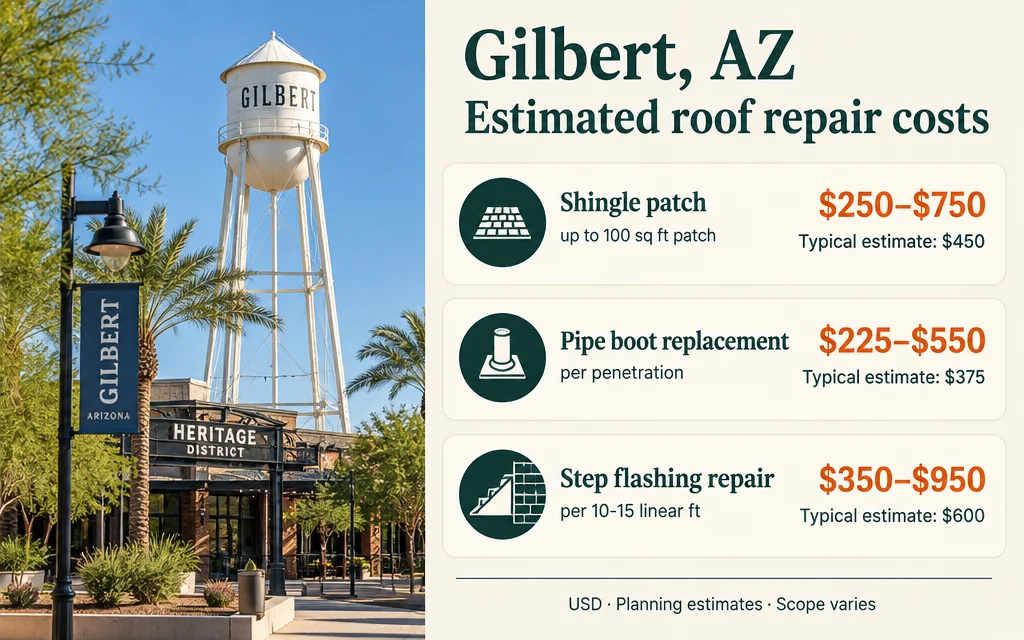
Planning estimate up to 100 sq ft patch. Replacement of missing, torn, or wind-blown asphalt shingles, resealing surrounding courses, and nailing down loose tabs. The source is a published task-price reference; the planning range and stated repair quantity remain estimates.
Planning estimate per penetration. Removal of sun-degraded neoprene flashing, installation of a heavy-duty UV-resistant boot, and integration into adjacent shingle or tile courses. The source is a published task-price reference; the planning range and stated repair quantity remain estimates.
Planning estimate per 10-15 linear ft. Prying back adjacent roofing material along exterior wall junctions, installing new galvanized or aluminum step cards, and resealing counter-flashing.
Roof Repair Realities in Gilbert
Maintaining a residential roof in Gilbert means contending with extreme thermal cycling and sudden desert weather shifts. Summer attic temperatures routinely climb above 140 degrees Fahrenheit, accelerating the thermal breakdown of roofing adhesives, pipe collars, and organic underlayments.
During the late summer monsoon season, fierce haboobs and high-wind microbursts drive torrential rain across neighborhood rooflines, testing seals that have baked in dry heat for months.
Most homeowners in Gilbert live under concrete tile systems, which are durable but frequently misunderstood. While a concrete tile can easily endure 50 years of direct sun, the waterproof felt underlayment beneath it generally has a shorter working life of 15 to 25 years in the desert. Asphalt shingle roofs, common in several older neighborhoods, face intense UV exposure that causes early granule loss, tab curling, and brittleness. Flat roofs over patios or southwest-style architecture require consistent surface maintenance to withstand intense solar radiation and seasonal standing water.
Diagnostic Evaluations Versus Sales Inspections
When facing an active leak or visible damage, distinguishing between a sales consultation and an independent diagnostic inspection protects your budget. Roofing salespeople routinely offer free inspections following summer storms, but these walk-throughs are designed to evaluate whether a full roof replacement claim is viable.
They rarely provide an in-depth tracing of subtle moisture paths or deliver an actionable repair report.
A standalone professional roof inspection typically runs $150–$350 per inspection and takes 1-2 hours (1 inspector). A qualified inspector conducts a top-down roof walk, checks roof penetrations and flashing terminations, evaluates the attic deck from the interior, and documents findings in an objective photographic report. For elusive leaks where water travels across trusses or rafters before staining drywall, dedicated leak diagnosis costs $200–$500 per diagnostic visit, requiring 1.5-3 hours (1-2 technicians). Always ask contractors whether their diagnostic fee will be credited toward repair labor if they are hired for the fix.
| Service / assumptions | Low | Typical estimate | High | Pricing unit | Estimated labor time |
|---|---|---|---|---|---|
| Professional Roof InspectionFormal assessment including roof surface walk, attic inspection, and a written condition report with photographs. Visual sales checks from storm contractors are not equivalent to full diagnostic reports.Published price reference ↗ | $150 | $235 | $350 | per inspection | 1-2 hours (1 inspector) |
| Roof Leak Tracing and DiagnosisSystematic moisture tracing across tiles, battens, flashings, and attic decking to pinpoint concealed water entry. Diagnostic fees are sometimes credited toward subsequent repair contracts. | $200 | $325 | $500 | per diagnostic visit | 1.5-3 hours (1-2 technicians) |
Standard Roof Repairs and Scopes of Work
Most residential repairs address isolated failures around penetrations, flashings, or specific drainage paths. Pipe boots suffer severe degradation from desert heat; replacing a cracked rubber collar with a UV-resistant boot runs $225–$550 per penetration and requires 1.5-2.5 hours (1 roofer).
When windstorms strip asphalt shingles, a patch covering up to 100 square feet typically costs $250–$750 up to 100 sq ft patch over 2-4 hours (1-2 roofers).
Wall junctions, valleys, and curbs are common points of failure during heavy downpours. Repairing corroded or slipped step flashing along a sidewall costs $350–$950 per 10-15 linear ft, taking 2.5-4 hours (1-2 roofers) to pull adjacent tiles or shingles, fit new metal cards, and seal counter-flashing. Skylight curbs require careful attention; a curb re-flashing project averages $400–$1,100 per skylight curb and lasts 2.5-4.5 hours (1-2 roofers). Chimney flashing repairs run $450–$1,200 per chimney for 3-5 hours (2 roofers). Repairing cracked mortar or re-securing loose hip and ridge components costs $300–$900 per 15-20 linear ft over 2-3.5 hours (1-2 roofers), while cleaning out and rebuilding a compromised drainage valley costs $550–$1,600 per valley run (approx. 15-20 ft) over 4-6 hours (2 roofers).
| Service / assumptions | Low | Typical estimate | High | Pricing unit | Estimated labor time |
|---|---|---|---|---|---|
| Minor Shingle RepairReplacement of missing, torn, or wind-blown asphalt shingles, resealing surrounding courses, and nailing down loose tabs. The source is a published task-price reference; the planning range and stated repair quantity remain estimates.Published price reference ↗ | $250 | $450 | $750 | up to 100 sq ft patch | 2-4 hours (1-2 roofers) |
| Plumbing Pipe Boot ReplacementRemoval of sun-degraded neoprene flashing, installation of a heavy-duty UV-resistant boot, and integration into adjacent shingle or tile courses. The source is a published task-price reference; the planning range and stated repair quantity remain estimates.Published price reference ↗ | $225 | $375 | $550 | per penetration | 1.5-2.5 hours (1 roofer) |
| Step Flashing RepairPrying back adjacent roofing material along exterior wall junctions, installing new galvanized or aluminum step cards, and resealing counter-flashing. | $350 | $600 | $950 | per 10-15 linear ft | 2.5-4 hours (1-2 roofers) |
| Chimney Flashing RepairRemoval of failed flashing layers, fabrication of apron, step, and cricket flashing, and cutting new counter-flashing reglets into stucco or masonry. | $450 | $750 | $1,200 | per chimney | 3-5 hours (2 roofers) |
| Skylight Flashing RepairLifting roofing surrounding the curb, applying high-temperature self-adhered membrane, installing a matched metal flashing kit, and resetting roofing. | $400 | $650 | $1,100 | per skylight curb | 2.5-4.5 hours (1-2 roofers) |
| Ridge Cap RepairRe-mortaring and mechanical fastening of dislodged concrete or clay ridge trim tiles, or replacing blown-off asphalt ridge cap shingles. | $300 | $550 | $900 | per 15-20 linear ft | 2-3.5 hours (1-2 roofers) |
| Roof Valley RepairClearing debris, removing perimeter field tiles or shingles, replacing deteriorated valley flashing or modified bitumen underlayment, and reinstalling covering. | $550 | $950 | $1,600 | per valley run (approx. 15-20 ft) | 4-6 hours (2 roofers) |
| Tile Underlayment Repair (Lift & Reset)Carefully removing existing clay or concrete tiles without breakage, discarding dried-out organic felt, installing high-performance synthetic or modified bitumen underlayment, and relaying original tiles. | $800 | $1,500 | $2,600 | per 100-200 sq ft section | 5-8 hours (2 roofers) |
Repair Considerations by Roofing Material
Repair techniques and costs vary significantly across the primary roofing styles found in Gilbert subdivisions.
Tile Roofs: The most frequent repair on a concrete or clay roof is addressing slipped, cracked, or misaligned tiles. A spot fix for 5 to 10 tiles costs $300–$950 per 5-10 cracked/slipped tiles and takes 2-4 hours (1-2 roofers). However, if the underlying waterproofing has failed, the contractor must perform a lift-and-reset service. A localized tile underlayment repair covering 100 to 200 square feet costs $800–$2,600 per 100-200 sq ft section across 5-8 hours (2 roofers). The crew carefully stacks existing tiles, replaces brittle felt with high-temperature self-adhered synthetic membrane, installs new valley metal or drip edge, and reinstalls the original tiles.
Low-Slope and Flat Roofs: Sunrooms, patio extensions, and Santa Fe-style homes commonly use modified bitumen, single-ply TPO, or spray polyurethane foam (SPF). Localized patching of blisters, split seams, or damaged foam costs $350–$1,150 up to 100 sq ft flat/low-slope section and takes 2.5-4 hours (1-2 roofers). SPF roofs require regular protective silicone or acrylic coatings to prevent sunlight from eroding the foam core.
Metal Roofs: Standing seam and exposed-fastener metal roofs expand and contract heavily under desert temperature swings. Tightening backed-out gasketed screws, patching panel gouges, or resealing perimeter trim costs $400–$1,350 per damaged panel or seam run for 3-5 hours (1-2 roofers).
| Service / assumptions | Low | Typical estimate | High | Pricing unit | Estimated labor time |
|---|---|---|---|---|---|
| Metal Roof Panel and Seam RepairReplacing damaged exposed fasteners with oversized gasketed screws, tightening standing seams, patching minor panel penetrations, or replacing isolated panels. | $400 | $750 | $1,350 | per damaged panel or seam run | 3-5 hours (1-2 roofers) |
| Tile Roof Spot RepairReplacing cracked, chipped, or displaced concrete or clay tiles with matching profiles, verifying underlying felt condition, and securing loose field units. The source is a published task-price reference; the planning range and stated repair quantity remain estimates.Published price reference ↗ | $300 | $575 | $950 | per 5-10 cracked/slipped tiles | 2-4 hours (1-2 roofers) |
| Low-Slope or Flat Roof RepairAddressing ponding areas, repairing open seams on single-ply membranes (TPO or PVC), or patching and recoating localized areas on spray polyurethane foam (SPF) systems. | $350 | $650 | $1,150 | up to 100 sq ft flat/low-slope section | 2.5-4 hours (1-2 roofers) |
Emergency Weather Protection and Surcharges
When a severe summer dust storm or monsoon microburst tears away shingles or dislodges ridge caps, immediate mitigation is necessary to prevent indoor flooding. Emergency roof tarping costs $300–$850 per roof slope (up to 300 sq ft), requiring 1.5-3 hours (2 roofers).
Crews use heavy-duty tarps anchored with wood battens to resist desert wind gusts.
Homeowners should remember that emergency tarping is purely temporary stabilization, not a permanent repair. If a contractor responds during severe weather, outside normal working hours, on weekends, or during holidays, expect an after-hours surcharge of $150–$400 flat surcharge per service call. This surcharge is an additional dispatch fee and does not replace the cost of labor or repair materials. If a written quote already includes emergency mobilization in its primary rate, confirm that this surcharge is not billed a second time.
| Service / assumptions | Low | Typical estimate | High | Pricing unit | Estimated labor time |
|---|---|---|---|---|---|
| Emergency Roof TarpingTemporary securement of heavy-duty reinforced tarps weighted with lumber battens to prevent interior water damage during active weather. Tarping does not constitute permanent repair. | $300 | $500 | $850 | per roof slope (up to 300 sq ft) | 1.5-3 hours (2 roofers) |
| Emergency After-Hours SurchargeAdditional fee charged for dispatching crews during weekends, severe nighttime storm events, or holidays. This fee is added to standard repair or tarping labor. | $150 | $250 | $400 | flat surcharge per service call | N/A |
Hidden Damage and Additional Project Expenses
Water intrusion often extends beyond the visible surface of the roof. When shingles or tiles are removed, contractors frequently discover rotted or water-damaged roof sheathing.
Replacing deteriorated 1/2-inch or 5/8-inch OSB or CDX plywood costs $95–$220 per 4x8 sheet (32 sq ft) when the roof framing is already exposed, taking 0.5-1 hour (2 roofers). Isolated carpentry calls that require separate mobilization will carry higher minimum trip fees.
Moisture running down roof edges often damages perimeter woodwork. Replacing dry-rotted or sun-split wood fascia board costs $25–$75 per linear foot (10-20 ft small job) over 2-4 hours (1-2 carpenters). Corresponding soffit repairs run $30–$90 per linear foot (10-20 ft small job) taking 2-4 hours (1-2 carpenters). Finally, hauling away broken clay tiles, heavy mortar caps, and torn underlayment incurs a disposal fee of $150–$450 per repair project load over 1-2 hours (1 worker). Always verify your written estimate to ensure that debris disposal is clearly accounted for rather than appearing as an unexpected change order.
| Service / assumptions | Low | Typical estimate | High | Pricing unit | Estimated labor time |
|---|---|---|---|---|---|
| Roof Decking Replacement (Plywood/OSB)Installation of 1/2-inch or 5/8-inch CDX plywood or OSB sheathing over rotted framing, priced assuming overlying roofing is already removed. Minimum repair trip fees apply if contracted independently. | $95 | $145 | $220 | per 4x8 sheet (32 sq ft) | 0.5-1 hour (2 roofers) |
| Wood Fascia Board RepairRemoval and replacement of dry-rotted or sun-damaged pine or cedar fascia boards behind gutters or drip edges. Minimum job minimums apply for short lengths. | $25 | $45 | $75 | per linear foot (10-20 ft small job) | 2-4 hours (1-2 carpenters) |
| Soffit Panel RepairRepairing ventilated or solid wood, composite, or stucco-adjacent eave soffits damaged by long-term moisture intrusion or pest nesting. | $30 | $55 | $90 | per linear foot (10-20 ft small job) | 2-4 hours (1-2 carpenters) |
| Roofing Debris Hauling and DisposalCollection, loading, transportation, and Maricopa County transfer station fees for heavy discarded materials like concrete tiles and old sheathing. Verify whether your primary proposal already bundles cleanup. | $150 | $275 | $450 | per repair project load | 1-2 hours (1 worker) |
Key Factors Influencing Repair Estimates
Several site-specific variables drive quote variations among roofing companies in Gilbert.
Roof Pitch and Access: Multi-story homes, steep-slope pitches, and properties with tight zero-lot-line setbacks require special safety harness equipment and extra staging time, increasing labor rates compared to accessible single-story ranch homes.
Material Sourcing and Profile Matching: Concrete tiles manufactured two or three decades ago may have obsolete dimensions or discontinued color blends. Finding matching salvage tiles or custom-glazing replacements increases sourcing time and per-unit costs.
Underlayment Condition: If an older roof has organic 30-pound or 40-pound felt that has baked into a brittle sheet, lifting a small patch of tiles often causes adjoining felt to crack. What begins as a small flash repair can quickly expand into a multi-square lift-and-reset.
Scope Clarity and Hidden Conditions: Quotes should clearly delineate whether rotten rafter tails, rusted valley metal, or deteriorated fascia are included in the base scope or handled as contingency change orders with pre-agreed hourly and material rates.
Repairing Versus Replacing Your Gilbert Roof
Deciding whether to patch a roof or replace the entire system is a condition-based choice that depends on system age, maintenance history, and material type.
On a concrete tile roof, the tiles themselves rarely need complete replacement. If your home is experiencing multiple leaks across separate sections and the underlying felt has turned brittle, patching isolated spots provides only short-term relief before leaks reappear in adjacent areas. In such situations, a full lift-and-reset—where existing tiles are removed, modern high-performance underlayment is installed across all slopes, and the original tiles are reinstalled—is generally more economical than repeated emergency repair visits.
For asphalt shingle roofs, widespread granule loss, tab curling across multiple exposures, or widespread storm damage indicates that the protective surface is failing. When deterioration spans multiple slopes, a full re-roof provides unified warranty coverage and protects against cascading deck rot. Conversely, an isolated leak caused by a cracked plumbing boot, a slipped valley run, or a cluster of dislodged tiles on an otherwise sound roof is a practical candidate for targeted repair.
| Decision point | Roof repair | Roof replacement | Metal roofing |
|---|---|---|---|
| Work being priced | A defined defect, such as damaged shingles or flashing. | Removal and installation of an agreed roof system across the measured roof surface. | A specified installed metal system; standing seam, exposed fasteners and metal shingles are different scopes. |
| What to inspect | The leak source, surrounding material and whether a durable localized fix is feasible. | The extent of deterioration, decking condition, roof details and suitable replacement systems. | The substrate, panel profile, coating, fasteners, roof geometry and installation details. |
| How to compare prices | Match the repair quantity, access, materials and included diagnosis. | Match measured roof area, material, tear-off layers, disposal and installed inclusions. | Match measured roof area, system, components, removal and conditional additional work. |
| Before deciding | Ask what the repair addresses and what existing problems would remain. | Ask whether repair remains practical and which additional items would change the total. | Ask about compatible materials, documented product/assembly ratings and product versus workmanship warranties. |
Age or a repair-cost percentage alone does not determine the right choice. Ask a qualified roofing contractor to assess the condition and explain viable options. A metal system is a material-specific installation choice, not a separate guarantee of durability or savings.
Hiring a Qualified Roofing Contractor
Protecting your home investment requires hiring a reputable contractor who complies with state and local standards. When comparing roofing contractors in Gilbert, ask each company to provide their active Arizona Registrar of Contractors (ROC) license number, and verify their current standing, classification, and disciplinary record directly on the ROC portal before signing an agreement.
Always ask prospective roofers for direct certificates of active general liability insurance and workers' compensation coverage for their crew. Request itemized, written estimates that explicitly outline the scope of work, material grades, tear-off depths, debris removal, and workmanship warranties.
Permit requirements depend on your jurisdiction and project scope. Ask the contractor to clarify permitting obligations, and verify requirements directly with the Town of Gilbert Building Division, or with the Maricopa County Planning and Development Department if your home sits within an unincorporated county pocket.
Local income & housing costs
Gilbert town, Arizona · U.S. Census Bureau, 2025 ACS 1-year estimates.
per month · ±$82
Cash-rent units; includes applicable tenant-paid utilities
Census source ↗Dollar amounts use the survey period’s published basis. Income is annual; gross rent is monthly. Home value reflects owner-occupied housing values. Margins of error shown are at the ACS 90% confidence level. These statistics provide city context; service budgets use their own pricing evidence.
STATEWIDE COST CONTEXT
Arizona prices, income & labor costs
These Arizona figures provide background for this city guide. They describe different measures and reference years; employee wages are not prices charged by a contractor.
BEA SAIRPD
State price change indicator
124.52024 · index (2017 basis)
Annual figures & sources
| Year | Value | 90% margin of error | Source |
|---|---|---|---|
| 2020 | 103.8 | — | Official source |
| 2021 | 105.3 | — | Official source |
| 2022 | 116.1 | — | Official source |
| 2023 | 121.4 | — | Official source |
| 2024 | 124.5 | — | Official source |
Census ACS 1-year
Median household income
$82,9402025 · USD/year
Annual figures & sources
| Year | Value | 90% margin of error | Source |
|---|---|---|---|
| 2021 | $69,056 | ±$686 | Official source |
| 2022 | $74,568 | ±$932 | Official source |
| 2023 | $77,315 | ±$931 | Official source |
| 2024 | $81,486 | ±$684 | Official source |
| 2025 | $82,940 | ±$1,117 | Official source |
BLS OEWS
Roofers
$22.762025 · USD/hour
Annual figures & sources
| Year | Value | 90% margin of error | Source |
|---|---|---|---|
| 2025 | $22.76 | — | Official source |
State prices: BEA, 2020–2024. Household income: Census ACS, 2021–2025. Employee wages: BLS, May 2025 snapshot. The charts retain their own units and fitted scales.
Explore all Arizona living-cost data and trends →Local context and limitations
Gilbert and the broader East Valley experience severe climate conditions that dictate roofing performance. While concrete and clay barrel tiles dominate local master-planned communities, the desert sun bakes organic and standard asphalt felt underlayments beneath those tiles, often causing waterproofing breakdown within 15 to 25 years even when surface tiles remain intact. Summer monsoon storms generate sudden microbursts, blowing dust, and high winds that shift unfastened tiles, expose degraded underlayment, and dislodge shingle tabs. Flat patio extensions and parapet roofs frequently feature foam or modified bitumen that require UV-resistant coatings to prevent thermal cracking.
Frequently asked questions
How much does a typical roof repair cost in Gilbert, AZ?
A minor shingle patch typically budgets at $250–$750 up to 100 sq ft patch, while replacing 5 to 10 cracked or slipped tiles costs $300–$950 per 5-10 cracked/slipped tiles. For flashing work, step flashing runs $350–$950 per 10-15 linear ft, and localized tile underlayment repairs budget at $800–$2,600 per 100-200 sq ft section. Total costs depend on roof slope, access conditions, and whether underlying sheathing is damaged.
Why are tile roof leaks so common in Gilbert even when tiles are not broken?
Concrete and clay tiles are a shedding surface rather than an impermeable barrier. Water naturally runs between and under tiles during heavy monsoon downpours. The true waterproofing is the underlayment underneath. In the desert climate, intense heat bakes traditional asphalt felt underlayment, making it brittle and prone to cracking after 15 to 25 years, allowing water to reach the attic deck even with intact surface tiles.
How much does it cost to replace a damaged plumbing vent boot?
Replacing a plumbing pipe boot in Gilbert typically budgets at $225–$550 per penetration. The job requires 1.5-2.5 hours (1 roofer) to remove surrounding tiles or shingles, fit a new UV-resistant boot, and properly tie the flashing back into the existing roof system.
What is the cost of an emergency roof tarp during monsoon season?
Emergency tarping services generally budget at $300–$850 per roof slope (up to 300 sq ft), taking 1.5-3 hours (2 roofers). If dispatch occurs after hours, during an active weekend storm, or on a holiday, an additional dispatch charge of $150–$400 flat surcharge per service call usually applies.
Do I need a building permit for roof repairs in Gilbert?
Permit requirements depend on the exact scope of work and municipal jurisdiction. To determine whether your project requires a permit, contact the Town of Gilbert Building Division directly with your specific address and scope. For properties located in unincorporated county pockets, verify requirements with the Maricopa County Planning and Development Department. Routine maintenance or minor cosmetic fixes may be treated differently from structural decking replacement or major re-roofing, so ask your contractor to specify permit responsibilities in your written proposal.
Can I replace just the broken tiles on my roof without replacing the underlayment?
Yes, if the underlying waterproofing membrane remains flexible and intact, replacing cracked or displaced tiles costs $300–$950 per 5-10 cracked/slipped tiles over 2-4 hours (1-2 roofers). However, if the technician finds that the underlayment has dried out or torn, replacing surface tiles alone will not halt water penetration. In that scenario, a localized lift-and-reset underlayment repair costing $800–$2,600 per 100-200 sq ft section is needed.
Sources and methodology
These planning estimates draw on publicly available pricing pages read on 2026-11-11. No city-specific prices were established by the cited pages, so the ranges use out-of-area references for budgeting. Published starting rates and individual provider prices are reference points, not final local quotes. Confirm service availability, minimum charges, included work and travel charges with the provider.
Published pricing pages retrieved; quoted excerpts checked automatically. 3 distinct website domains. · Generated 2026-11-11
- Arizona Roofing Costs & Prices - ProMatcher Cost ReportState / regional reference · Page retrieved 2026-11-11 · Price excerpt matched automatically
“Roof Inspection in Arizona $237.57 per visit (two story home with typical roofline)”
Planning ranges may differ from these published examples; they are not provider quotes.
- How Much Does Roof Repair Cost in Phoenix AZ (2026 Guide) - Phoenix Roofing HubState / regional reference · Page retrieved 2026-11-11 · Price excerpt matched automatically
“Tile roof repair $500 – $2,500”
Planning ranges may differ from these published examples; they are not provider quotes.
- Shingle Roof Repair Cost: 2026 Pricing Guide | EstimationPro AI BlogGeographic scope unconfirmed · Page retrieved 2026-11-11 · Price excerpt matched automatically
“shingle roof repairs run $350 to $1,500”
Planning ranges may differ from these published examples; they are not provider quotes.
Plan your roof repair project
Choose your service and answer its project questions. Add notes or photos if helpful, then generate your project brief. The planner labels its budgeting assumptions separately. Use your plan to compare the scope and assumptions with a provider. Contact sharing and provider matching are not available yet.
Open the project planner →Share this city’s cost data
<> Embed Gilbert Cost Data on Your Site
The HTML table shows the prices at the time of copying. The iframe follows the published guide.