Phoenix · AZ · COST GUIDE
Roof Repair Costs in Phoenix, AZ (2026)
For budgeting, a small shingle repair is estimated at $350–$750 per patch, and pipe boot replacement at $450–$1,200 per penetration. These are different repair scopes; compare the table's assumptions with a written contractor quote.
Minor Shingle Patch (Up to 100 sq ft)
Budget estimate$350–$750per patch
Plumbing Pipe Boot Replacement
Budget estimate$450–$1,200per penetration
Published examples apply to their stated scope. Budget ranges are estimates.
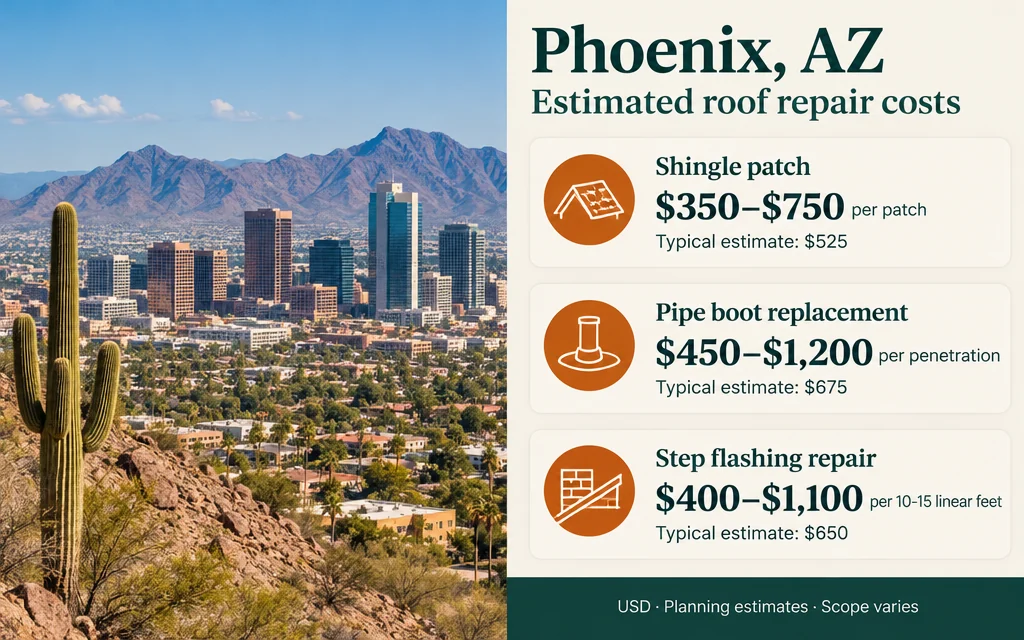
Planning estimate per patch. Includes replacing blown-off or sun-brittle shingles, resealing surrounding tabs, and inspecting exposed fasteners.
Planning estimate per penetration. Removal of surrounding tile or shingle material, installation of high-temp UV collar or lead flashing boot, and watertight tie-in.
Planning estimate per 10-15 linear feet. Refitting or replacing wall-junction aluminum/galvanized step cards, resealing counter-flashing into stucco or brick.
Understanding Phoenix Roof Repair Dynamics
Roofing repairs in Phoenix encounter distinct environmental demands shaped by intense sun exposure and seasonal weather patterns. With prolonged high temperatures and heavy ultraviolet radiation, common roof coverings experience accelerated aging.
Shingles curl as protective granules wear, low-slope elastomeric coatings degrade, and organic underlayment sheets installed beneath concrete tiles dry out and become brittle.
Concrete and clay tile roofs are common throughout Valley neighborhoods, but homeowners often misread where water intrusion begins. Exterior tiles act primarily as an impact and shedding layer, while the underlying membrane provides the true water-shedding boundary. When a leak appears during seasonal summer rains, simply resetting an exterior tile rarely addresses water traveling along deteriorated underlayment down to framing penetrations, making targeted diagnostics essential.
Diagnosis and Diagnostic Scopes
A preliminary visual estimate for a full roof replacement is distinct from an investigative leak diagnostic call. Visual replacement walkthroughs are often offered without charge, but isolating an active concealed leak involves dedicated labor.
A formal roof inspection averages a budget of $125–$300 per inspection, typically taking 1-2 hours (1 worker), which provides a written overview of condition and attic framing. When tracing active or intermittent water intrusion, a dedicated leak diagnostic visit carries a planning estimate of $275–$500 per diagnostic visit, running 2-3 hours (1-2 workers). For tile roofs, this work involves lifting courses along suspect paths to evaluate underlayment condition, flashing seals, and roof decking. Low-slope surfaces may require moisture meters or thermal imaging. Homeowners should clarify in advance whether the diagnostic fee can be credited toward subsequent repair work on the property.
| Service / assumptions | Low | Typical estimate | High | Pricing unit | Estimated labor time |
|---|---|---|---|---|---|
| Standard Formal Roof InspectionFormal written diagnostic evaluation including attic access and photo report. Visual estimates for replacement are commonly free. The source is a published task-price reference; the planning range and stated repair quantity remain estimates.Published price reference ↗ | $125 | $180 | $300 | per inspection | 1-2 hours (1 worker) |
| Roof Leak Diagnostic & Water TestingTargeted diagnostic tracing active water paths via physical tile lifts, controlled water testing, or infrared thermal scanning. | $275 | $385 | $500 | per diagnostic visit | 2-3 hours (1-2 workers) |
Common Component Repairs and Flashing Fixes
Most residential service calls in Phoenix involve failed penetrations, transitions, or valleys rather than wide-scale deck failure. A common vulnerable point is the plumbing vent pipe collar.
Standard neoprene rubber collars degrade under intense desert sunlight, allowing rainwater to channel down the vent pipe into ceiling drywall. Replacing a plumbing vent collar carries a modeled cost of $450–$1,200 per penetration and requires 2-3 hours (1-2 workers), covering the removal of surrounding shingles or tiles, seating a UV-rated collar or lead flashing boot, and integrating it into the water plane.
Drainage valleys are another high-wear area. Heavy rain and blowing dust can cause debris to collect under valley tiles, disrupting runoff pathways. A valley flashing and underlayment repair budgets at $900–$2,400 per valley section and takes 4-6 hours (2 workers).
Wall junctions and roof features require custom sheet metal detailing. Step flashing repair and resealing against exterior walls budgets at $400–$1,100 per 10-15 linear feet, taking 3-4 hours (2 workers). Chimney flashing refurbishment runs $500–$1,500 per chimney, taking 4-5 hours (2 workers). Skylight perimeter flashing repairs budget at $450–$1,300 per skylight and take 3-4 hours (2 workers), while ridge cap repair and mortar pointing costs $350–$1,150 per 15-20 linear feet with a typical crew time of 2-4 hours (2 workers).
| Service / assumptions | Low | Typical estimate | High | Pricing unit | Estimated labor time |
|---|---|---|---|---|---|
| Minor Shingle Patch (Up to 100 sq ft)Includes replacing blown-off or sun-brittle shingles, resealing surrounding tabs, and inspecting exposed fasteners. | $350 | $525 | $750 | per patch | 2-3 hours (1-2 workers) |
| Plumbing Pipe Boot ReplacementRemoval of surrounding tile or shingle material, installation of high-temp UV collar or lead flashing boot, and watertight tie-in. | $450 | $675 | $1,200 | per penetration | 2-3 hours (1-2 workers) |
| Step Flashing Repair & ResealingRefitting or replacing wall-junction aluminum/galvanized step cards, resealing counter-flashing into stucco or brick. | $400 | $650 | $1,100 | per 10-15 linear feet | 3-4 hours (2 workers) |
| Chimney Flashing RefurbishmentRebuilding base and counter-flashing aprons around masonry or framed chimney stalks, integrating cricket flashing. | $500 | $850 | $1,500 | per chimney | 4-5 hours (2 workers) |
| Skylight Perimeter Flashing KitRebuilding curb perimeter seals, step flashing cards, and saddle flashing without replacing the existing skylight dome. | $450 | $750 | $1,300 | per skylight | 3-4 hours (2 workers) |
| Ridge Cap Repair & Mortar PointingRebedding loose ridge tiles in fresh mortar or replacing cracked asphalt hip-and-ridge shingle caps stripped by monsoon winds. | $350 | $600 | $1,150 | per 15-20 linear feet | 2-4 hours (2 workers) |
| Valley Flashing & Underlayment RepairLifting tile or shingle course along converging drainage valleys, laying self-adhering membrane, and reinstalling metal valley trough. | $900 | $1,500 | $2,400 | per valley section | 4-6 hours (2 workers) |
| Tile Lift and Underlayment Patch (R&R)Carefully removing existing concrete tiles, discarding cracked organic felt, rolling commercial synthetic or self-adhering underlayment, and resetting tiles. | $850 | $1,600 | $3,200 | per 100-200 sq ft area | 1 working day (2-3 workers) |
Material Specifics: Tile, Shingles, Metal, and Foam
Because residential architecture in Phoenix utilizes multiple roofing systems, repair techniques vary by surface type.
Concrete and clay tiles are sturdy, but individual units can crack from fallen limbs or roof maintenance traffic. A localized tile roof spot repair carries a planning estimate of $385–$1,250 per spot repair, taking 2-4 hours (1-2 workers). If the underlying membrane has deteriorated over a broader section, a tile remove-and-replace (R&R) repair costs $850–$3,200 per 100-200 sq ft area, taking 1 working day (2-3 workers). The crew carefully lifts and stacks existing tiles, replaces the underlayment, and resets the original tiles.
Asphalt shingle repairs budget at $350–$750 per patch, taking 2-3 hours (1-2 workers). Matching existing shingles can be difficult because desert sun bleaches granules, meaning fresh patches may appear darker than adjacent weathered slopes.
Low-slope roofs on Southwestern-style parapet homes or mid-century properties require distinct patching methods. Repairing flat and spray polyurethane foam (SPF) surfaces budgets at $500–$2,200 per section, taking 3-5 hours (2 workers), which involves clearing damaged foam pockets, applying compatible caulking or polyurethane material, and resealing with a reflective topcoat. For standing seam or corrugated metal panels, spot repairs budget at $450–$1,400 per damaged area, running 3-4 hours (2 workers) to replace degraded fastener washers and seal lap seams.
| Service / assumptions | Low | Typical estimate | High | Pricing unit | Estimated labor time |
|---|---|---|---|---|---|
| Standing Seam / Corrugated Metal Spot RepairReplacing degraded neoprene washer screws, sealing failed transition joints, or panel crimp restoration on metal roofs. | $450 | $800 | $1,400 | per damaged area | 3-4 hours (2 workers) |
| Tile Roof Damage Spot RepairSourcing and swapping cracked concrete/clay barrel tiles, repairing broken mortar blocks, and adjusting slipped batten hangers. | $385 | $650 | $1,250 | per spot repair | 2-4 hours (1-2 workers) |
| Flat & Foam (SPF) Roof PatchingCutting out blisters or bird pecks in polyurethane foam roofs, applying elastomeric caulk/polyurethane coating, or patching modified bitumen seams. | $500 | $950 | $2,200 | per section | 3-5 hours (2 workers) |
Emergency Mitigation and Storm Tarping
When monsoon storms produce localized wind damage or sudden roof breaches, immediate temporary mitigation prevents progressive moisture damage to insulation and ceilings. Emergency weatherproofing tarping carries a planning range of $350–$950 per tarped area and requires 1-2 hours (2 workers) of on-site crew labor.
Tarping provides short-term stabilization rather than a permanent seal. Professional crews secure UV-resistant tarps using lumber battens fastened mechanically along perimeter edges and over ridgelines to prevent strong wind gusts from tearing the material loose.
When dispatch is requested during severe storms, on weekends, or outside regular business hours, an emergency call-out surcharge averages $200–$500 per dispatch. This dispatch fee compensates mobilization and logistics, and is typically billed on top of standard material and repair line items.
| Service / assumptions | Low | Typical estimate | High | Pricing unit | Estimated labor time |
|---|---|---|---|---|---|
| Emergency Weatherproofing TarpImmediate temporary tie-down of 20x20 ft heavy-duty tarp secured with 2x4 furring strips to arrest storm leaks. | $350 | $550 | $950 | per tarped area | 1-2 hours (2 workers) |
| Emergency Call-Out / After-Hours FeeSupplemental charge for immediate night, weekend, or severe storm emergency service. Added to repair line items. | $200 | $325 | $500 | per dispatch | N/A |
Hidden Damage and Scope Extras
The final scope of a roof repair can expand once outer layers are lifted to expose the underlying structure. Undetected seepage over multiple storm seasons frequently causes localized wood rot on roof decking.
Replacing rotted structural sheathing budgets at $90–$190 per 4x8 ft sheet (32 sq ft), taking 1-2 hours (2 workers) while the overlying roofing material is dismantled. When water reaches the eaves, rotted fascia boards must be renewed before drip edge or gutter brackets can be secured, running $25–$75 per linear foot with an on-site duration of 2-4 hours (2 workers). Overhang soffit replacement costs $30–$85 per linear foot, taking 2-4 hours (2 workers). Homeowners should also verify whether haul-away is included, as roof waste haul-off and disposal fees budget at $125–$450 per load / job when heavy tile shards or soaked wood must be transported to a transfer station.
| Service / assumptions | Low | Typical estimate | High | Pricing unit | Estimated labor time |
|---|---|---|---|---|---|
| Roof Deck Sheathing ReplacementReplacing water-rotted or delaminated 1/2-inch OSB or plywood structural decking while overlying roofing is removed. | $90 | $135 | $190 | per 4x8 ft sheet (32 sq ft) | 1-2 hours (2 workers) |
| Eave / Rake Fascia Board RepairReplacing dry-rotted or monsoon-damaged 2x6 pine fascia boards; subject to contractor small-project minimums. | $25 | $45 | $75 | per linear foot | 2-4 hours (2 workers) |
| Overhang Soffit ReplacementRepairing localized water-damaged stucco, plywood, or fiber-cement soffit panels underneath roof overhangs. | $30 | $55 | $85 | per linear foot | 2-4 hours (2 workers) |
| Roof Waste Haul-Off & Disposal FeeHeavy materials disposal fees for broken tiles, torn felt, and spoiled lumber at municipal transfer stations. | $125 | $250 | $450 | per load / job | N/A |
Key Cost Drivers in the Phoenix Metro
Several site-specific variables influence whether a repair quote falls toward the lower or higher end of local price bands.
Roof Pitch and Staging: Single-story homes with walkable roof pitches require standard staging, keeping crew setup straightforward. In contrast, multi-story residences with steep pitches or high parapet walls require safety tie-offs, ladders, and specialized scaffolding, which increases total crew time.
Material Sourcing: Discontinued tile profiles can add labor and material costs. When an older concrete tile shape is no longer in active production, contractors must locate compatible salvage or yard stock to maintain roof uniformity.
Access and Obstacles: Properties with tight side yards, perimeter walls, swimming pools, or rooftop solar equipment near the repair area limit direct access, requiring additional precautions and manual material handling.
Repair Versus Full Replacement Considerations
Deciding between a targeted repair and a broader replacement requires evaluating the general condition of the roof system rather than just the visible leak location.
On concrete tile roofs, the outer tiles often outlast the underlying waterproofing layer. When an isolated leak occurs around a single pipe collar while surrounding underlayment remains pliable, a localized repair costing $450–$1,200 per penetration is a sensible approach. However, if lifting test tiles reveals that the underlayment has become brittle across entire slopes, water will likely find adjacent entry points during subsequent rains. In that scenario, scheduling an underlayment replacement (R&R) across the affected section provides a durable solution compared to repeated spot patches.
For asphalt shingle roofs, localized wind damage on an otherwise pliable surface is well suited for a minor patch costing $350–$750 per patch. Conversely, when shingles across sun-exposed slopes show widespread cracking, cupping, and extensive granule loss, patching single tabs provides only temporary benefit, signaling the need for an overall replacement plan.
| Decision point | Roof repair | Roof replacement | Metal roofing |
|---|---|---|---|
| Work being priced | A defined defect, such as damaged shingles or flashing. | Removal and installation of an agreed roof system across the measured roof surface. | A specified installed metal system; standing seam, exposed fasteners and metal shingles are different scopes. |
| What to inspect | The leak source, surrounding material and whether a durable localized fix is feasible. | The extent of deterioration, decking condition, roof details and suitable replacement systems. | The substrate, panel profile, coating, fasteners, roof geometry and installation details. |
| How to compare prices | Match the repair quantity, access, materials and included diagnosis. | Match measured roof area, material, tear-off layers, disposal and installed inclusions. | Match measured roof area, system, components, removal and conditional additional work. |
| Before deciding | Ask what the repair addresses and what existing problems would remain. | Ask whether repair remains practical and which additional items would change the total. | Ask about compatible materials, documented product/assembly ratings and product versus workmanship warranties. |
Age or a repair-cost percentage alone does not determine the right choice. Ask a qualified roofing contractor to assess the condition and explain viable options. A metal system is a material-specific installation choice, not a separate guarantee of durability or savings.
Hiring a Roofer, Permits, and Quote Verification
Before approving roof repair work in Phoenix, verify professional credentials and clarify administrative requirements for your specific property address:
- Licensing and Standing: Ask the contractor for their Arizona Registrar of Contractors (ROC) license number, license classification, and legal entity name, and confirm their active standing and disciplinary record directly through the ROC database.
- Permitting Questions: Contact the City of Phoenix Planning & Development Department or the municipal building safety division serving your address before work begins. Ask directly whether your planned repair scope—such as structural roof deck replacement, rafter repairs, or component flashing—triggers a building permit requirement, and confirm whether the licensed contractor or the property owner must obtain it.
- Insurance Verification: Request certificates of commercial general liability and workers' compensation coverage issued directly to you by the contractor's insurance carrier.
- Itemized Scope: Ensure all estimates provide written line-item details, including labor, materials, per-sheet decking replacement terms, cleanup procedures, and separate workmanship warranty conditions.
Local income & housing costs
Phoenix city, Arizona · U.S. Census Bureau, 2025 ACS 1-year estimates.
per month · ±$36
Cash-rent units; includes applicable tenant-paid utilities
Census source ↗Dollar amounts use the survey period’s published basis. Income is annual; gross rent is monthly. Home value reflects owner-occupied housing values. Margins of error shown are at the ACS 90% confidence level. These statistics provide city context; service budgets use their own pricing evidence.
STATEWIDE COST CONTEXT
Arizona prices, income & labor costs
These Arizona figures provide background for this city guide. They describe different measures and reference years; employee wages are not prices charged by a contractor.
BEA SAIRPD
State price change indicator
124.52024 · index (2017 basis)
Annual figures & sources
| Year | Value | 90% margin of error | Source |
|---|---|---|---|
| 2020 | 103.8 | — | Official source |
| 2021 | 105.3 | — | Official source |
| 2022 | 116.1 | — | Official source |
| 2023 | 121.4 | — | Official source |
| 2024 | 124.5 | — | Official source |
Census ACS 1-year
Median household income
$82,9402025 · USD/year
Annual figures & sources
| Year | Value | 90% margin of error | Source |
|---|---|---|---|
| 2021 | $69,056 | ±$686 | Official source |
| 2022 | $74,568 | ±$932 | Official source |
| 2023 | $77,315 | ±$931 | Official source |
| 2024 | $81,486 | ±$684 | Official source |
| 2025 | $82,940 | ±$1,117 | Official source |
BLS OEWS
Roofers
$22.762025 · USD/hour
Annual figures & sources
| Year | Value | 90% margin of error | Source |
|---|---|---|---|
| 2025 | $22.76 | — | Official source |
State prices: BEA, 2020–2024. Household income: Census ACS, 2021–2025. Employee wages: BLS, May 2025 snapshot. The charts retain their own units and fitted scales.
Explore all Arizona living-cost data and trends →Local context and limitations
Residential roofing in Phoenix features concrete tile, asphalt shingles, and flat spray polyurethane foam (SPF) or modified bitumen membranes. The Sonoran Desert climate creates distinct material demands: prolonged solar radiation and elevated surface temperatures break down organic felt underlayment beneath concrete tiles over time, even while the exterior tiles remain intact. Summer monsoon storms also bring sudden microbursts, wind-driven moisture, and localized dust buildup that test flashing transitions and plumbing collar seals. Service areas encompass Phoenix proper, Ahwatukee, Arcadia, and North Phoenix, with comparable labor markets operating across Maricopa County.
Frequently asked questions
What does a minor roof repair typically cost in Phoenix?
Budget $350–$750 per patch for minor asphalt shingle repairs, or budget $385–$1,250 per spot repair for isolated damaged tiles. These planning ranges include standard materials, basic sealing, and the necessary on-site crew labor.
Why does tile roof underlayment fail in the desert?
While concrete and clay tiles endure severe heat, temperatures beneath the tiles stay elevated. Over years of thermal cycling and intense heat, asphalt-saturated organic felt dries out, loses flexibility, and cracks, allowing rainwater to reach the roof deck.
Do I need a building permit for roof repairs in Phoenix?
Permit thresholds depend on the specific scope of work and municipal building rules. Before scheduling work, contact the City of Phoenix Planning & Development Department to confirm whether your planned repairs—such as replacing structural roof decking, altering rafter framing, or patching surface components—require a building permit and municipal inspection at your specific property address.
Can I replace just the pipe boot without repairing the tile?
Properly installing a pipe boot requires removing the surrounding tiles or shingles to tie the flashing flange directly into the water plane. Expect to budget $450–$1,200 per penetration, which covers lifting adjacent courses, installing the collar, and resealing the assembly.
How quickly can emergency roof tarping be completed?
Emergency tarping typically requires 1-2 hours (2 workers) of crew time once technicians arrive on site. If service is required during storm events, at night, or over weekends, an after-hours surcharge of $200–$500 per dispatch may be applied.
What is the difference between a free roof inspection and leak diagnosis?
A standard visual inspection or replacement walkthrough is often offered at no charge, while a formal written condition evaluation budgets at $125–$300 per inspection. An investigative leak diagnostic visit budgets at $275–$500 per diagnostic visit, covering active troubleshooting such as lifting tiles, testing drainage lines, or attic inspections to trace hidden moisture tracks.
Sources and methodology
These planning estimates draw on publicly available pricing pages read on 2026-11-11. Some cited pages mention the target city; that alone does not verify service coverage or establish a citywide average. Published starting rates and individual provider prices are reference points, not final local quotes. Confirm service availability, minimum charges, included work and travel charges with the provider.
Published pricing pages retrieved; quoted excerpts checked automatically. 2 distinct website domains. · Generated 2026-11-11
- Roof Repair Phoenix AZ · Free Quote · 5.0★ | Power PeakCity-specific page context · Page retrieved 2026-11-11 · Price excerpt matched automatically
“Flashing or pipe-boot replacement” · “$450 - $1,200”
Planning ranges may differ from these published examples; they are not provider quotes.
 Provider badge
- Arizona Roofing Costs & Prices - ProMatcher Cost ReportState / regional reference · Page retrieved 2026-11-11 · Price excerpt matched automatically
“Roof Inspection in Arizona $237.57 per visit (two story home with typical roofline)”
Planning ranges may differ from these published examples; they are not provider quotes.
Plan your roof repair project
Choose your service and answer its project questions. Add notes or photos if helpful, then generate your project brief. The planner labels its budgeting assumptions separately. Use your plan to compare the scope and assumptions with a provider. Contact sharing and provider matching are not available yet.
Open the project planner →Share this city’s cost data
<> Embed Phoenix Cost Data on Your Site
The HTML table shows the prices at the time of copying. The iframe follows the published guide.