New York City · NY · COST GUIDE
Roof Replacement and New Roof Costs in New York City, NY (2026)
For budgeting, architectural asphalt replacement is estimated at $7,500–$15,000 for a 1,500-sq-ft roof and $10,000–$20,000 for a 2,000-sq-ft roof. These roof-surface scenarios include one-layer tear-off, disposal, labor and materials over sound decking; separately quoted extras are excluded.
Architectural asphalt: 1,500-sq-ft roof
Budget estimate$7,500–$15,000per roof (1,500 sq ft roof surface)
Planning range · Compare the roof area, material and included work in your quote.
Architectural asphalt: 2,000-sq-ft roof
Budget estimate$10,000–$20,000per roof (2,000 sq ft roof surface)
Planning range · Compare the roof area, material and included work in your quote.
Published examples apply to their stated scope. Budget ranges are estimates.
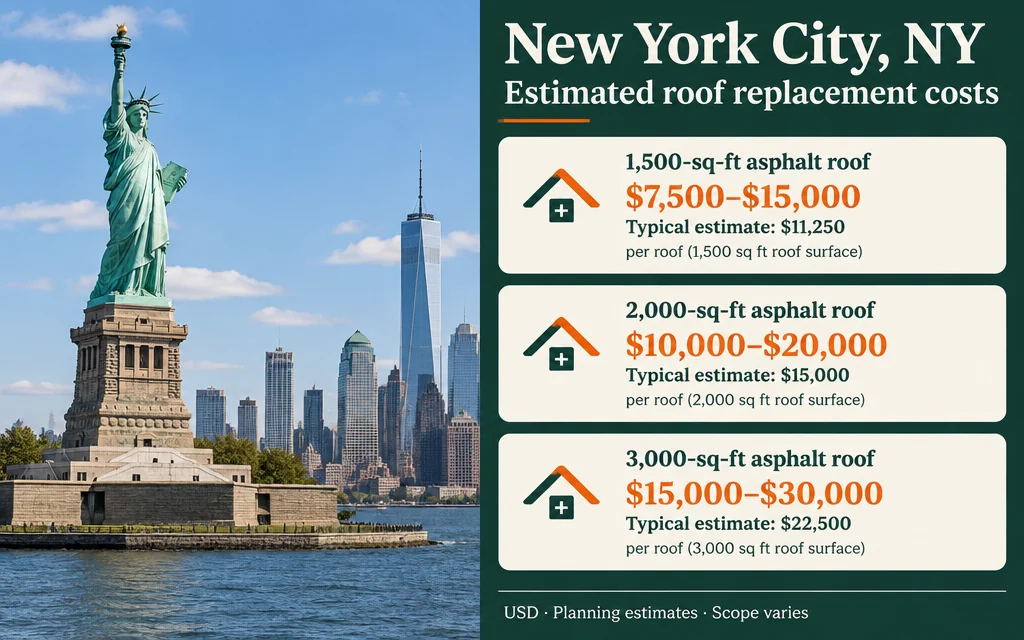
Calculated installed planning estimate for measured roof surface, with one-layer removal and disposal; extras excluded.
Calculated installed planning estimate for measured roof surface, with one-layer removal and disposal; extras excluded.
Calculated installed planning estimate for measured roof surface, with one-layer removal and disposal; extras excluded.
How much does a new roof cost in New York City?
For a detached pitched roof in New York City, replacing an architectural asphalt shingle roof is estimated at $10,000–$20,000 for a 2,000-square-foot roof surface, with a typical project cost of $15,000. Total project pricing scales directly with measured roof surface area rather than your home's interior living footprint.
A smaller detached home with a 1,500-square-foot roof surface runs an estimated $7,500–$15,000, while a larger 3,000-square-foot roof surface runs $15,000–$30,000. For attached rowhouses and multi-family brownstones with flat or low-slope decks, single-ply TPO membrane installation runs $8–$14 per square foot, and EPDM rubber runs $6.50–$12 per square foot.
Project pricing separates new construction from full replacements. A new roof on new construction starts over clean, newly framed decking without any old material to strip away or haul off. A replacement involves tearing off existing shingle or membrane layers down to the wood deck, hauling and disposing of heavy debris, inspecting the wood sheathing for rot, and installing fresh underlayment and flashings. In dense urban neighborhoods, site staging, building height, and container logistics also influence final contractor bids.
Roof replacement material comparisons
Architectural asphalt shingles serve as the standard pricing baseline for pitched residential roofs at $5–$10 per square foot installed. These laminated dimensional shingles offer improved wind resistance over traditional three-tab shingles, which run $4–$7 per square foot installed.
While three-tab shingles carry a lower initial price tag, their lighter, single-layer profile makes them more vulnerable to blow-offs during coastal windstorms. Premium or designer shingles use the same asphalt-fiberglass core but feature thicker multi-layer cuts that simulate slate or cedar shake.
Metal roofing requires a larger upfront investment but provides a long service life. Standing seam metal systems cost $11–$19 per square foot installed, using concealed fasteners that protect penetrations from driving rain and snow. Exposed-fastener corrugated or ribbed metal panels run $8–$13 per square foot installed, though their exterior rubber-gasket screws require periodic inspection and eventual tightening. Heavy tile options, such as concrete tile at $13–$22 per square foot or clay tile at $16–$26 per square foot, add significant dead load to roof framing. If you are considering switching from asphalt shingles to tile, have a licensed structural engineer verify that your rafters and bearing walls can carry the load.
| Service / assumptions | Low | Typical estimate | High | Pricing unit | Estimated labor time |
|---|---|---|---|---|---|
| Architectural Asphalt ShinglesIncludes complete tear-off of one existing shingle layer, synthetic underlayment, starter shingles, flashing check, and disposal. | $5 | $7.50 | $10 | per sq ft of roof surface (installed) | 1-3 days (crew of 4-6 for 2,000 sq ft) |
| Three-Tab Asphalt ShinglesIncludes single-layer removal, 15-lb felt or entry synthetic felt, and clean-up over sound existing decking. | $4 | $5.50 | $7 | per sq ft of roof surface (installed) | 1-2 days (crew of 4-5 for 2,000 sq ft) |
| Standing Seam Metal RoofIncludes 24- or 26-gauge concealed fastener steel panels, high-temp underlayment, eave trim, and single-layer tear-off. | $11 | $15 | $19 | per sq ft of roof surface (installed) | 3-5 days (crew of 3-4 for 2,000 sq ft) |
| Exposed Fastener Metal RoofIncludes corrugated or ribbed steel panels, gasketed screws, synthetic underlayment, and one-layer removal. | $8 | $10.50 | $13 | per sq ft of roof surface (installed) | 2-4 days (crew of 3-4 for 2,000 sq ft) |
| Concrete Tile RoofIncludes standard concrete profile tiles, heavyweight underlayment, and tear-off. Excludes framing reinforcement. | $13 | $17 | $22 | per sq ft of roof surface (installed) | 4-7 days (crew of 4-5 for 2,000 sq ft) |
| Clay Tile RoofIncludes traditional barrel or flat clay tiles, premium self-adhering underlayment, and tear-off. Excludes structural upgrades. | $16 | $21 | $26 | per sq ft of roof surface (installed) | 5-8 days (crew of 4-5 for 2,000 sq ft) |
| Product type | How to compare |
|---|---|
| Three-tab asphalt | Compare the specified product and installed scope with the three-tab rate row. |
| Architectural asphalt | The baseline for the calculated roof-size budgets in this guide. |
| Premium or designer asphalt | Request a product-specific installed proposal; this guide does not invent a separate premium rate. |
Product names and grades alone do not establish an impact, wind or fire rating. Compare the exact product documentation, installation requirements and written warranty.
Roof replacement costs by roof size in New York City
Roofing contractors price replacements based on actual roof surface area, which accounts for pitch, overhangs, hips, valleys, and dormers. Because of slope and eaves, a roof's surface area is always larger than a home's square footage on the ground.
For a detached home with a 1,500-square-foot roof surface, an architectural asphalt shingle replacement costs an estimated $7,500–$15,000, averaging $11,250. On-site installation typically takes 1-2 days (crew of 4-5).
A mid-sized home measuring 2,000 square feet of roof surface runs an estimated $10,000–$20,000, with a midpoint of $15,000, taking 2-3 days (crew of 4-6). A larger home with 3,000 square feet of roof surface ranges from $15,000–$30,000, averaging $22,500 and taking 2-4 days (crew of 5-7). These baseline scenarios include stripping and disposing of one existing layer of shingles, laying synthetic underlayment, checking flashings, and fastening new shingles over sound wood decking. Any deteriorated decking or custom flashing rebuilds are priced as incremental extras.
| Service / assumptions | Low | Typical estimate | High | Pricing unit | Estimated labor time |
|---|---|---|---|---|---|
| Architectural asphalt: 1,500-sq-ft roofCalculated planning scenario: 1,500 sq ft of measured roof surface × architectural-asphalt installed rate. Includes the same one-layer tear-off, disposal, labor, materials and sound-deck baseline; separately quoted extras excluded. | $7,500 | $11,250 | $15,000 | per roof (1,500 sq ft roof surface) | 1-2 days (crew of 4-5) |
| Architectural asphalt: 2,000-sq-ft roofCalculated planning scenario: 2,000 sq ft of measured roof surface × architectural-asphalt installed rate. Includes the same one-layer tear-off, disposal, labor, materials and sound-deck baseline; separately quoted extras excluded. | $10,000 | $15,000 | $20,000 | per roof (2,000 sq ft roof surface) | 2-3 days (crew of 4-6) |
| Architectural asphalt: 3,000-sq-ft roofCalculated planning scenario: 3,000 sq ft of measured roof surface × architectural-asphalt installed rate. Includes the same one-layer tear-off, disposal, labor, materials and sound-deck baseline; separately quoted extras excluded. | $15,000 | $22,500 | $30,000 | per roof (3,000 sq ft roof surface) | 2-4 days (crew of 5-7) |
Low-slope and flat roofing options in New York City
Flat and low-slope roof profiles are standard on rowhouses, brownstones, and multi-unit buildings across New York City. Standard asphalt shingles rely on gravity to shed water and cannot be installed on roof pitches below 2:12.
Low-slope roofs require continuous waterproof membrane assemblies that prevent ponding water from penetrating seams.
Thermoplastic Polyolefin (TPO) single-ply membranes run $8–$14 per square foot installed, taking 1-3 days (crew of 3-4 for 1,500 sq ft). TPO sheets are hot-air welded into a continuous monolithic layer, and white TPO provides high solar reflectance to help reduce summer cooling demand. Ethylene Propylene Diene Monomer (EPDM) synthetic rubber membranes cost $6.50–$12 per square foot installed, taking 1-3 days (crew of 3-4 for 1,500 sq ft). Standard black EPDM offers excellent elasticity during winter freeze-thaw cycles, though urban projects often require a light-colored ballast or reflective coating to satisfy municipal energy codes. Both membrane estimates assume sound underlying decking and standard perimeter terminations, excluding major slope tapering or parapet masonry repairs.
| Service / assumptions | Low | Typical estimate | High | Pricing unit | Estimated labor time |
|---|---|---|---|---|---|
| TPO Flat Roof Membrane60-mil white single-ply mechanically attached or adhered membrane over cover board; compliant with NYC cool roof rules. Published rate reference for the stated roofing scope and unit, not verification of this guide's modeled range, a complete roof quote or provider availability.Published price reference ↗ | $8 | $10.50 | $14 | per sq ft of roof surface (installed) | 1-3 days (crew of 3-4 for 1,500 sq ft) |
| EPDM Rubber Flat Roof45-mil or 60-mil black ethylene propylene membrane, fully adhered over sound base. Excludes supplemental reflective coatings. | $6.50 | $9 | $12 | per sq ft of roof surface (installed) | 1-3 days (crew of 3-4 for 1,500 sq ft) |
Tear-off process and multiple layer considerations
A standard roof replacement bid includes tearing off and hauling away one existing layer of roofing material down to the structural decking. Removing the old roof allows the crew to inspect the plywood or tongue-and-groove boards for rot, mold, and loose fasteners before new materials go down.
If the crew discovers a second or third concealed layer from an older reroofing project, removing that extra layer adds an incremental $120–$250 per roofing square (100 square feet). Additional layers increase manual labor time, add substantial weight to disposal containers, and raise hauling fees. While an overlay—nailing a second layer of shingles directly over an existing roof—avoids initial tear-off costs, it conceals deteriorated decking, traps heat that degrades shingle asphalt prematurely, and may restrict manufacturer warranty coverage. A complete tear-off down to bare sheathing remains the standard industry recommendation.
Decking repairs, flashing, and critical add-ons
Contractors cannot assess the condition of the structural deck until the old roof covering is stripped away. If water rot or delamination is uncovered, replacing 4-by-8-foot CDX plywood or OSB sheets adds $95–$180 per sheet.
Replacing rotted wood fascia board along the eaves costs $14–$28 per linear foot, and repairing damaged intake soffit panels runs $11–$24 per square foot. These repairs are completed concurrently during the tear-off and deck prep phase.
Flashing elements protect critical junctions where roof planes meet walls, chimneys, and vents. Rebuilding chimney flashing with stepped counter-flashing costs $450–$900 per chimney, taking about 2-4 hours (integrated into project). Installing a new skylight flashing kit runs $350–$750 per skylight, taking 1-3 hours (integrated into project). Adding a continuous ridge vent along a pitched roof peak to improve attic airflow costs $9–$18 per linear foot. If existing aluminum gutters must be unhooked to replace perimeter drip edge or fascia, detaching and resetting them costs $5–$11 per linear foot.
| Service / assumptions | Low | Typical estimate | High | Pricing unit | Estimated labor time |
|---|---|---|---|---|---|
| Additional Layer Tear-OffIncremental labor and disposal charge when removing a second or third existing roof layer beyond the baseline. | $120 | $180 | $250 | additional per roofing square (100 sq ft) | N/A (adds 0.5-1 day to main project) |
| Replacement Plywood/OSB DeckingIncludes labor and material for 1/2-inch or 5/8-inch CDX plywood installed over exposed framing where rotted wood is detected. | $95 | $135 | $180 | additional per 4-by-8-ft sheet (32 sq ft) | N/A (performed concurrently during tear-off) |
| Replacement Wood Fascia BoardRotted 1x6 or 1x8 pine fascia board replacement along roof edges prior to new gutter or drip edge fastening. | $14 | $20 | $28 | additional per linear ft | N/A (installed during eave prep) |
| Replacement Soffit RepairRepairing damaged plywood, vinyl, or aluminum under-eave intake soffit panels to ensure adequate attic ventilation. | $11 | $16 | $24 | additional per sq ft | N/A (installed during eave prep) |
| Continuous Ridge Vent UpgradeSaw-cutting decking slot at peak and installing shingle-over baffled ridge vent with matching cap shingles. | $9 | $13 | $18 | additional per linear ft | N/A (installed during cap shingle phase) |
| Chimney Flashing RebuildCutting masonry mortar joints, installing new aluminum or copper step flashing, and lead counter flashing sealed with urethane. | $450 | $650 | $900 | additional per chimney | 2-4 hours (integrated into project) |
| Skylight Flashing Kit InstallationRemoving shingles around curb, placing membrane collar, and installing manufacturer-specified step flashing. | $350 | $500 | $750 | additional per skylight | 1-3 hours (integrated into project) |
| Gutter Detach and ResetCarefully removing existing aluminum gutters to replace eave flashing or drip edge, then re-hanging to proper drainage slope. | $5 | $7.50 | $11 | additional per linear ft | N/A (integrated into project schedule) |
Cost factors specific to New York City
Site access and neighborhood density are primary cost drivers across New York City. On blocks without private driveways or alleys, placing disposal containers or mechanical hoisting equipment on a public street or sidewalk may require street-occupancy approvals from the NYC Department of Transportation.
Multi-story rowhouses abutting pedestrian sidewalks may also require temporary overhead protection.
Building height and roof architecture also affect labor hours. Multi-story rowhouses, high parapet walls, or steep pitches above 6:12 require safety rigging, exterior ladders, or material hoists. On flat roofs, open-flame torch applications face strict municipal fire safety restrictions on occupied residential structures, making cold-applied, self-adhered, mechanically fastened, or hot-air welded systems standard practice. Confirm site-staging plans, disposal logistics, and local compliance requirements with your licensed contractor before work begins.
Repairing vs. replacing your roof
Deciding between a localized repair and a full roof replacement depends on the source of the leak, the overall condition of the roof covering, and the structural integrity of the decking underneath. Isolated leaks caused by cracked plumbing vent boots, loose chimney step flashing, or a few wind-damaged shingles can often be repaired if the surrounding field of shingles remains pliable and securely adhered.
A full replacement is warranted when signs of deterioration are widespread across the roof. On pitched roofs, extensive granule loss, curling or brittle shingles across multiple roof faces, or recurring interior leaks indicate an exhausted surface. On flat roofs, persistent seam separation, large membrane blisters, ponding water that fails to drain within 48 hours, or moisture-saturated insulation boards beneath the surface indicate that spot patches will no longer protect the building.
| Decision point | Roof repair | Roof replacement | Metal roofing |
|---|---|---|---|
| Work being priced | A defined defect, such as damaged shingles or flashing. | Removal and installation of an agreed roof system across the measured roof surface. | A specified installed metal system; standing seam, exposed fasteners and metal shingles are different scopes. |
| What to inspect | The leak source, surrounding material and whether a durable localized fix is feasible. | The extent of deterioration, decking condition, roof details and suitable replacement systems. | The substrate, panel profile, coating, fasteners, roof geometry and installation details. |
| How to compare prices | Match the repair quantity, access, materials and included diagnosis. | Match measured roof area, material, tear-off layers, disposal and installed inclusions. | Match measured roof area, system, components, removal and conditional additional work. |
| Before deciding | Ask what the repair addresses and what existing problems would remain. | Ask whether repair remains practical and which additional items would change the total. | Ask about compatible materials, documented product/assembly ratings and product versus workmanship warranties. |
Age or a repair-cost percentage alone does not determine the right choice. Ask a qualified roofing contractor to assess the condition and explain viable options. A metal system is a material-specific installation choice, not a separate guarantee of durability or savings.
Hiring a roofing contractor in New York City
When hiring a residential roofing contractor in New York City, verify that the business holds an active Home Improvement Contractor license from the NYC Department of Consumer and Worker Protection (DCWP). Confirm that the business carries active general liability insurance and workers' compensation coverage to protect you from on-site property damage or injury claims.
Obtain written, itemized estimates from multiple licensed contractors. Bids should specify shingle or membrane manufacturer, underlayment type, flashing materials, and explicit per-sheet unit pricing for any rotted decking uncovered during tear-off. Clarify in writing who is responsible for obtaining any necessary municipal permits, such as NYC Department of Buildings filings or street-occupancy permits. Tie payments to clear project milestones—such as material delivery, completed tear-off, and final inspection—rather than paying the entire project cost upfront.
STATEWIDE COST CONTEXT
New York prices, income & labor costs
These New York figures provide background for this city guide. They describe different measures and reference years; employee wages are not prices charged by a contractor.
BEA SAIRPD
State price change indicator
133.52024 · index (2017 basis)
Annual figures & sources
| Year | Value | 90% margin of error | Source |
|---|---|---|---|
| 2020 | 115.3 | — | Official source |
| 2021 | 119.4 | — | Official source |
| 2022 | 124.9 | — | Official source |
| 2023 | 130.0 | — | Official source |
| 2024 | 133.5 | — | Official source |
Census ACS 1-year
Median household income
$89,2102025 · USD/year
Annual figures & sources
| Year | Value | 90% margin of error | Source |
|---|---|---|---|
| 2021 | $74,314 | ±$613 | Official source |
| 2022 | $79,557 | ±$722 | Official source |
| 2023 | $82,095 | ±$500 | Official source |
| 2024 | $85,820 | ±$653 | Official source |
| 2025 | $89,210 | ±$934 | Official source |
BLS OEWS
Roofers
$31.742025 · USD/hour
Annual figures & sources
| Year | Value | 90% margin of error | Source |
|---|---|---|---|
| 2025 | $31.74 | — | Official source |
State prices: BEA, 2020–2024. Household income: Census ACS, 2021–2025. Employee wages: BLS, May 2025 snapshot. The charts retain their own units and fitted scales.
Explore all New York living-cost data and trends →Local context and limitations
Roof replacement across New York City typically divides into two architectural categories: attached masonry rowhouses and brownstones with flat or low-slope decks, and detached one- to two-family dwellings with pitched roofs in outer borough neighborhoods. Tight lot lines, street parking regulations, and narrow roadways often complicate container placement and material delivery. Where disposal dumpsters, hoists, or staging equipment must occupy a public roadway or sidewalk, verify permit requirements with local municipal agencies such as the NYC Department of Transportation (DOT) and the NYC Department of Buildings (DOB). Permitting, fire code limits on open-flame installation, and energy code standards for reflective roofing vary by building type and historic status, so confirm requirements with your contractor before signing a contract.
Frequently asked questions
Is getting a new roof the same as a roof replacement?
A roof replacement removes all existing roofing materials down to the bare structural deck, inspects and repairs damaged wood sheathing, and installs new underlayment, flashing, and surface coverings. A new roof can refer to that complete replacement, an initial roof installation on newly constructed framing without an existing roof to remove, or occasionally a second-layer overlay.
How much does a new roof cost in New York City for a typical home?
For an architectural asphalt shingle roof on a detached home with a 2,000-square-foot roof surface, planning estimates run $10,000–$20,000, with a midpoint of $15,000. For an attached rowhouse or brownstone with a flat roof, single-ply TPO membrane installation costs $8–$14 per square foot.
Can I install a second layer of shingles to save money in NYC?
An overlay avoids the initial tear-off charge of $120–$250 per square, but roofing professionals generally advise against it. Laying new shingles over old ones conceals damaged decking, traps excess heat that accelerates shingle aging, adds dead weight to the roof framing, and may restrict manufacturer warranty coverage.
Do I need a NYC Department of Buildings permit to replace my roof?
Permit requirements depend on your building's classification, landmark status, and whether structural elements such as rafters or decking are altered. Many routine surface-level replacements on detached one- and two-family homes differ in filing scope from commercial or multi-family properties, but staging over sidewalks or altering structural framing frequently requires formal filings. Because local building codes and administrative requirements change, verify current permit and filing requirements directly with the NYC Department of Buildings and your licensed contractor before starting work.
What is the NYC Cool Roof requirement?
The New York City Energy Conservation Code outlines solar reflectance and thermal emittance standards for low-slope roof replacements. To meet these energy rules, flat-roof projects typically install white, highly reflective single-ply membranes such as TPO, which costs $8–$14 per square foot installed, or apply approved reflective coatings over darker membrane systems like EPDM.
Sources and methodology
Sources below retain their recorded retrieval dates and geographic scope. We checked the quoted rates against readable public pricing pages. The tables remain planning estimates, not provider quotes or a measured citywide survey. Per-square-foot references do not establish the modeled whole-roof totals or all their installed inclusions. Regional references are not verified New York City-specific quotes. Confirm removal, disposal, materials, labor and the complete scope in a written proposal.
Published pricing pages retrieved; quoted excerpts checked automatically. 2 distinct website domains. · Generated 2026-11-09
- Flat Roof Replacement Cost in NYC: 2026 Bronx GuideCity-specific page context · Page retrieved 2026-11-09 · Price excerpt matched automatically
“TL;DR A full flat roof replacement on a typical NYC brownstone runs $8,000 to $25,000+; national figures run $4 to $14 per sq ft.”
Planning ranges may differ from these published examples; they are not provider quotes.
- Roof Replacement Cost NYC (2026): Prices by Material & BoroughCity-specific page context · Page retrieved 2026-11-09 · Price excerpt matched automatically
“Installed prices run about $3–$10 per sq ft for asphalt shingles, $5–$12 for EPDM, $9–$14 for TPO, $12–$18 for metal and $20–$40 for slate.”
Planning ranges may differ from these published examples; they are not provider quotes.
Plan your roof replacement project
Choose your service and answer its project questions. Add notes or photos if helpful, then generate your project brief. The planner labels its budgeting assumptions separately. Use your plan to compare the scope and assumptions with a provider. Contact sharing and provider matching are not available yet.
Open the project planner →Share this city’s cost data
<> Embed New York City Cost Data on Your Site
The HTML table shows the prices at the time of copying. The iframe follows the published guide.