Brooklyn · NY · COST GUIDE
Roof Replacement and New Roof Costs in Brooklyn, NY (2026)
For budgeting, architectural asphalt replacement is estimated at $8,250–$15,000 for a 1,500-sq-ft roof and $11,000–$20,000 for a 2,000-sq-ft roof. These roof-surface scenarios include one-layer tear-off, disposal, labor and materials over sound decking; separately quoted extras are excluded.
Architectural asphalt: 1,500-sq-ft roof
Budget estimate$8,250–$15,000per roof (1,500 sq ft roof surface)
Planning range · Compare the roof area, material and included work in your quote.
Architectural asphalt: 2,000-sq-ft roof
Budget estimate$11,000–$20,000per roof (2,000 sq ft roof surface)
Planning range · Compare the roof area, material and included work in your quote.
Published examples apply to their stated scope. Budget ranges are estimates.
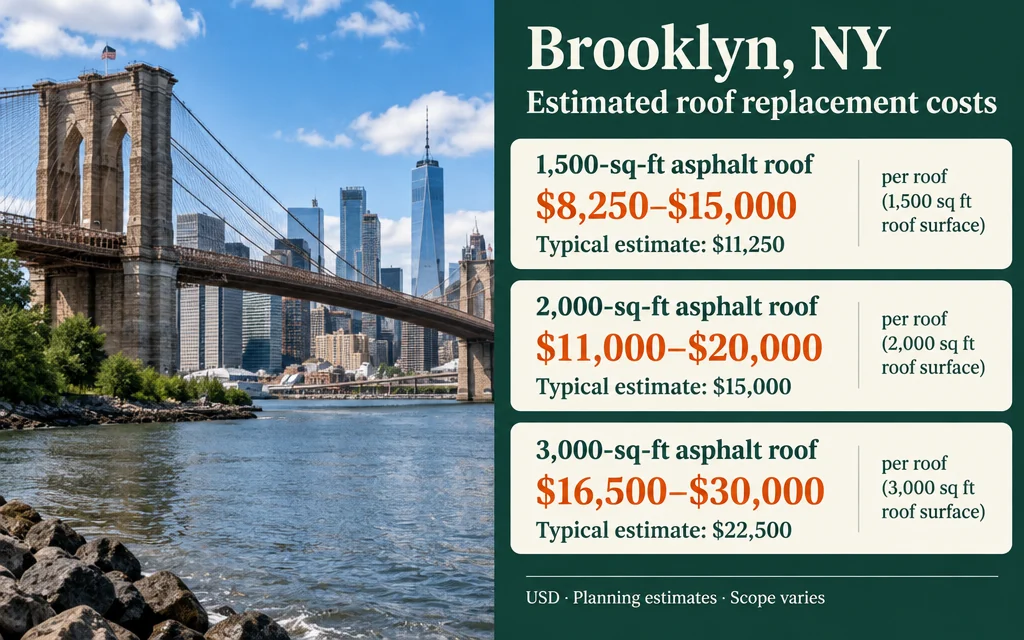
Calculated installed planning estimate for measured roof surface, with one-layer removal and disposal; extras excluded.
Calculated installed planning estimate for measured roof surface, with one-layer removal and disposal; extras excluded.
Calculated installed planning estimate for measured roof surface, with one-layer removal and disposal; extras excluded.
How much does a new roof cost in Brooklyn?
Budget expectations for a roof replacement in Brooklyn depend on whether your property has a pitched roof or a flat membrane deck. On pitched roofs, installing architectural asphalt shingles runs $5.50–$10.
That puts a complete tear-off and replacement at $8,250–$15,000 for a 1,500-square-foot roof surface and $11,000–$20,000 for a 2,000-square-foot roof surface. On brownstones and multi-family rowhouses with flat or low-slope decks, single-ply systems run $6–$12 for EPDM rubber and $7–$14 for reflective white TPO membrane.
When property owners research new roof cost, they are almost always planning a full roof replacement on an existing building. Replacement means removing the worn roof coverings down to bare structural decking, checking the substrate for rot or sagging, and installing fresh underlayment and flashing. By contrast, new construction involves nailing directly over newly framed decking with no old materials to tear off or haul away. Complete tear-off is the standard baseline in this guide: one layer of removal, disposal, standard flashing, and installation over sound decking.
Roofing Material Options and Pricing
Architectural asphalt shingles serve as the baseline pricing benchmark for pitched roofs across Brooklyn's detached and semi-attached homes. Their laminated two-piece construction provides solid wind resistance and clean visual depth.
Traditional three-tab shingles offer an economy alternative at $4.50–$7, but their lighter single-layer cutouts make them more prone to wind blow-off. Premium or designer architectural shingles feature heavier dimensional profiles that emulate slate or cedar shake, requiring higher material budgets.
Metal and tile systems fit specific architectural styles. Standing-seam metal roofs run $11–$18, using concealed fasteners that let panels expand and contract with temperature swings. Exposed-fastener metal panels run $8–$13.50, giving a lower initial cost but requiring periodic gasket inspection. Concrete tile costs $12–$21, while natural clay tile runs $16–$28. Because tile systems add significant dead load, older wood-framed structures require structural engineering verification to confirm the rafters can support the weight.
| Service / assumptions | Low | Typical estimate | High | Pricing unit | Estimated labor time |
|---|---|---|---|---|---|
| Architectural Asphalt ShinglesIncludes tear-off and disposal of one existing layer, synthetic underlayment, starter course, drip edge, and ridge caps over sound decking. | $5.50 | $7.50 | $10 | per sq ft of roof surface (installed) | 1–2 working days for 1,500–2,000 sq ft crew |
| Three-Tab Asphalt ShinglesBudget 25-year three-tab asphalt shingles including one-layer tear-off, disposal, felt underlayment, and edge metal over sound decking. Published rate reference for the stated roofing scope and unit, not verification of this guide's modeled range, a complete roof quote or provider availability.Published price reference ↗ | $4.50 | $5.75 | $7 | per sq ft of roof surface (installed) | 1–2 working days for 1,500–2,000 sq ft crew |
| Standing-Seam Metal RoofingConcealed fastener 24- or 26-gauge steel standing seam panels, high-temp underlayment, flashings, and one-layer tear-off. | $11 | $14.50 | $18 | per sq ft of roof surface (installed) | 3–5 working days for 1,500–2,000 sq ft crew |
| Exposed-Fastener Metal RoofingRibbed corrugated steel panels fastened with neoprene gasket screws, synthetic underlayment, and one-layer removal. | $8 | $10.50 | $13.50 | per sq ft of roof surface (installed) | 2–4 working days for 1,500–2,000 sq ft crew |
| Concrete Tile RoofingHeavyweight concrete tiles, self-adhered underlayment, battens, and one-layer removal; requires verified roof framing load capacity. | $12 | $16.50 | $21 | per sq ft of roof surface (installed) | 4–6 working days for 1,500–2,000 sq ft crew |
| Clay Tile RoofingTraditional barrel or flat terra cotta clay tiles, premium high-grade underlayment, copper flashing, and engineering verification. | $16 | $21 | $28 | per sq ft of roof surface (installed) | 5–8 working days for 1,500–2,000 sq ft crew |
| Product type | How to compare |
|---|---|
| Three-tab asphalt | Compare the specified product and installed scope with the three-tab rate row. |
| Architectural asphalt | The baseline for the calculated roof-size budgets in this guide. |
| Premium or designer asphalt | Request a product-specific installed proposal; this guide does not invent a separate premium rate. |
Product names and grades alone do not establish an impact, wind or fire rating. Compare the exact product documentation, installation requirements and written warranty.
Roof Size Scenarios and Project Totals
Roofing bids reflect actual roof surface area measured in roofing squares (100 square feet per square), not interior living space. Pitch, overhangs, dormers, and valleys make exterior roof surface substantially larger than interior square footage.
Applying the baseline installed rate of $5.50–$10—which covers one-layer tear-off, disposal, underlayment, and materials over sound decking—project totals scale predictably by roof surface area.
A compact 1,500-square-foot roof surface totals $8,250–$15,000 and takes an on-site crew 1–2 working days (4–6 person crew). A mid-sized 2,000-square-foot roof surface costs $11,000–$20,000, taking 2–3 working days (4–6 person crew). A larger 3,000-square-foot roof surface runs $16,500–$30,000, with an estimated duration of 3–4 working days (4–6 person crew). These timelines represent continuous on-site crew work under fair weather conditions, excluding structural carpentry or staging delays.
| Service / assumptions | Low | Typical estimate | High | Pricing unit | Estimated labor time |
|---|---|---|---|---|---|
| Architectural asphalt: 1,500-sq-ft roofCalculated planning scenario: 1,500 sq ft of measured roof surface × architectural-asphalt installed rate. Includes the same one-layer tear-off, disposal, labor, materials and sound-deck baseline; separately quoted extras excluded. | $8,250 | $11,250 | $15,000 | per roof (1,500 sq ft roof surface) | 1–2 working days (4–6 person crew) |
| Architectural asphalt: 2,000-sq-ft roofCalculated planning scenario: 2,000 sq ft of measured roof surface × architectural-asphalt installed rate. Includes the same one-layer tear-off, disposal, labor, materials and sound-deck baseline; separately quoted extras excluded. | $11,000 | $15,000 | $20,000 | per roof (2,000 sq ft roof surface) | 2–3 working days (4–6 person crew) |
| Architectural asphalt: 3,000-sq-ft roofCalculated planning scenario: 3,000 sq ft of measured roof surface × architectural-asphalt installed rate. Includes the same one-layer tear-off, disposal, labor, materials and sound-deck baseline; separately quoted extras excluded. | $16,500 | $22,500 | $30,000 | per roof (3,000 sq ft roof surface) | 3–4 working days (4–6 person crew) |
Flat and Low-Slope Roof Systems
Many Brooklyn homes—including brownstones, brick rowhouses, and multi-family walk-ups—feature flat or low-slope decks framed behind masonry parapet walls. Standard asphalt shingles cannot shed water on these surfaces because water drains slowly and can back up under the laps.
These roofs require fully sealed continuous membrane systems.
White TPO (thermoplastic polyolefin) membrane costs $7–$14, taking 2–3 working days for 1,000–1,500 sq ft flat roof. TPO uses hot-air-welded seams to form a continuous sheet, and its light-colored surface reflects summer heat. Fully adhered EPDM rubber membrane runs $6–$12, installed in 2–3 working days for 1,000–1,500 sq ft flat roof. EPDM provides strong elasticity during freezing weather, though its taped or adhesive seams require regular maintenance checks. Both membrane rates include standard cover board, perimeter termination metal, and one-layer tear-off over sound decking, but exclude tapered insulation packages or masonry parapet repairs.
| Service / assumptions | Low | Typical estimate | High | Pricing unit | Estimated labor time |
|---|---|---|---|---|---|
| TPO Membrane Flat RoofWhite 60-mil single-ply TPO membrane mechanically attached or adhered with heat-welded seams, cover board, and one-layer removal. | $7 | $10.50 | $14 | per sq ft of roof surface (installed) | 2–3 working days for 1,000–1,500 sq ft flat roof |
| EPDM Rubber Flat Roof0.060-inch vulcanized EPDM rubber membrane fully adhered with taped laps, termination bars, and one-layer removal over sound substrate. | $6 | $8.50 | $12 | per sq ft of roof surface (installed) | 2–3 working days for 1,000–1,500 sq ft flat roof |
Complete Tear-Off vs. Overlay
A complete tear-off strips existing coverings down to the wood deck. This gives the contractor a direct view of rafters and planking, lets them replace compromised wood, and ensures code-compliant underlayment installation.
An overlay (nailing new shingles directly over an existing layer) skips disposal expenses upfront, but it traps heat, adds dead weight, and leaves the structural deck hidden. In New York City, building codes limit roof layering based on existing roof type and substrate condition; check permissible layering with a licensed contractor or registered design professional before considering an overlay.
If your roof already carries multiple layers, stripping all existing material down to structural decking adds labor and disposal fees. Removing an additional roof layer costs $150–$350. This charge accounts for the additional demolition labor, heavy-duty hauling, and commercial transfer station fees in the metropolitan area.
Decking, Flashing, and Common Add-Ons
Decking condition cannot be fully verified until the old roof covering is removed. When soft spots, rot, or water damage are discovered, replacing standard 4-by-8-foot sheets of plywood or OSB costs $95–$200.
Agreeing on a transparent per-sheet decking rate in your initial written contract prevents unexpected billing disputes during demolition.
Perimeter trim, flashing, and ventilation upgrades carry separate unit pricing. Replacing rotted fascia boards runs $12–$28, and rebuilding soffit panels costs $10–$24. Installing a continuous shingle-over ridge vent costs $9–$22. Reflashing an existing brick or stone chimney costs $450–$950, while resetting flashing collars around an existing skylight runs $400–$900. If gutters must be detached to install perimeter drip edge and then remounted, expect $6–$15. Contractors integrate these tasks into the main job schedule, so standalone timelines are not typically quoted.
| Service / assumptions | Low | Typical estimate | High | Pricing unit | Estimated labor time |
|---|---|---|---|---|---|
| Additional Roof Layer Tear-OffStripping and disposal of a second or third existing roof layer prior to installing new roofing materials. | $150 | $225 | $350 | additional per roofing square (100 sq ft) | N/A |
| Plywood Decking ReplacementFurnishing and fastening replacement 1/2-inch or 5/8-inch CDX plywood or OSB over exposed framing where soft spots or rot occur. | $95 | $140 | $200 | additional per 4-by-8-ft sheet (32 sq ft) | N/A |
| Fascia Board ReplacementRemoval of decayed wooden fascia boards and installation of primed cedar or composite fascia lumber. | $12 | $18 | $28 | additional per linear ft | N/A |
| Soffit Repair & ReplacementRebuilding or replacing damaged solid or vented soffit panels along building eaves. | $10 | $16 | $24 | additional per sq ft | N/A |
| Continuous Ridge Vent UpgradeCutting peak slot and installing plastic shingle-over ridge exhaust vent with weather baffle. | $9 | $14 | $22 | additional per linear ft | N/A |
| Chimney ReflashingGrinding mortar joints, custom bending and setting new step and counterflashing, and sealing masonry seams. | $450 | $675 | $950 | additional per chimney | N/A |
| Skylight ReflashingInstalling factory or site-fabricated step flashing and head flashing around existing standard curb skylight. | $400 | $600 | $900 | additional per skylight | N/A |
| Gutter Detach and ResetCarefully unclipping or unfastening existing gutters to replace drip edge and fascia trim, then re-hanging with hidden hangers. | $6 | $10 | $15 | additional per linear ft | N/A |
Cost Drivers and Brooklyn Job Site Logistics
Job site logistics in Brooklyn create distinct cost factors compared to open suburban projects. Dense street layouts, tight shared property lines, and alternate-side parking make placing dumpsters or parking boom trucks challenging.
When delivery trucks cannot reach curbside positions adjacent to the building, shingle bundles or rolls of membrane must be brought through interior stairwells or hoisted mechanically, increasing staging labor hours.
Building height and lot placement also dictate site preparation. Check with your contractor and verify through local Department of Buildings (DOB) and Department of Transportation (DOT) guidelines whether sidewalk sheds, overhead netting, or street occupancy permits are required for your address. Additionally, rowhouse flat roofs terminate at brick parapets. If mortar joints are washed out or coping stones are loose, parapet repointing and counterflashing must be coordinated with membrane installation to prevent water from slipping behind the new roof membrane.
Repair vs. Replacement Considerations
Choosing between a targeted repair and a full roof replacement comes down to physical inspection findings rather than an arbitrary age benchmark. When moisture intrusion stems from a single isolated defect—such as a deteriorated plumbing vent boot, localized flashing failure at a chimney, or a few lifted shingles after a storm—a focused repair is sensible and budget-friendly.
If the surrounding shingles are pliable and secure, repairing the leak avoids the expense of a complete replacement.
Widespread degradation calls for full replacement. Clear indicators include extensive granule loss exposing shingle fiberglass matting, brittle shingles that snap when handled, cupped edges, or chronic leaks in multiple areas. On flat membrane roofs, persistent ponding water, open laps along parapet walls, or spongy decking beneath the membrane show that moisture has penetrated the assembly. Once deterioration is systemic, spot patching only delays necessary replacement and risks interior structural framing.
| Decision point | Roof repair | Roof replacement | Metal roofing |
|---|---|---|---|
| Work being priced | A defined defect, such as damaged shingles or flashing. | Removal and installation of an agreed roof system across the measured roof surface. | A specified installed metal system; standing seam, exposed fasteners and metal shingles are different scopes. |
| What to inspect | The leak source, surrounding material and whether a durable localized fix is feasible. | The extent of deterioration, decking condition, roof details and suitable replacement systems. | The substrate, panel profile, coating, fasteners, roof geometry and installation details. |
| How to compare prices | Match the repair quantity, access, materials and included diagnosis. | Match measured roof area, material, tear-off layers, disposal and installed inclusions. | Match measured roof area, system, components, removal and conditional additional work. |
| Before deciding | Ask what the repair addresses and what existing problems would remain. | Ask whether repair remains practical and which additional items would change the total. | Ask about compatible materials, documented product/assembly ratings and product versus workmanship warranties. |
Age or a repair-cost percentage alone does not determine the right choice. Ask a qualified roofing contractor to assess the condition and explain viable options. A metal system is a material-specific installation choice, not a separate guarantee of durability or savings.
Hiring a Contractor, Permits, and Contracts
When hiring a roofing contractor in Brooklyn, verify that the business holds an active Home Improvement Contractor license from the NYC Department of Consumer and Worker Protection (DCWP). Request valid certificates of general liability and workers' compensation insurance sent directly from the contractor's insurance carrier.
Permit requirements depend on building classification, landmark status, and whether structural deck repair is involved; verify permit obligations for your address with the NYC Department of Buildings (DOB) or a registered design professional.
Require itemized, written proposals detailing brand names, material thickness, underlayment type, flashing metal gauge, and debris cleanup terms. The contract should clearly distinguish the manufacturer's material warranty from the contractor's workmanship warranty, and set a fixed price per sheet for any plywood decking replacement. Tie payment terms to clear project milestones—such as material arrival on site and completed phases—rather than providing large advance deposits.
STATEWIDE COST CONTEXT
New York prices, income & labor costs
These New York figures provide background for this city guide. They describe different measures and reference years; employee wages are not prices charged by a contractor.
BEA SAIRPD
State price change indicator
133.52024 · index (2017 basis)
Annual figures & sources
| Year | Value | 90% margin of error | Source |
|---|---|---|---|
| 2020 | 115.3 | — | Official source |
| 2021 | 119.4 | — | Official source |
| 2022 | 124.9 | — | Official source |
| 2023 | 130.0 | — | Official source |
| 2024 | 133.5 | — | Official source |
Census ACS 1-year
Median household income
$89,2102025 · USD/year
Annual figures & sources
| Year | Value | 90% margin of error | Source |
|---|---|---|---|
| 2021 | $74,314 | ±$613 | Official source |
| 2022 | $79,557 | ±$722 | Official source |
| 2023 | $82,095 | ±$500 | Official source |
| 2024 | $85,820 | ±$653 | Official source |
| 2025 | $89,210 | ±$934 | Official source |
BLS OEWS
Roofers
$31.742025 · USD/hour
Annual figures & sources
| Year | Value | 90% margin of error | Source |
|---|---|---|---|
| 2025 | $31.74 | — | Official source |
State prices: BEA, 2020–2024. Household income: Census ACS, 2021–2025. Employee wages: BLS, May 2025 snapshot. The charts retain their own units and fitted scales.
Explore all New York living-cost data and trends →Local context and limitations
Brooklyn housing stock spans two broad categories: masonry rowhouses and brownstones with flat or low-slope roof decks behind parapet walls, and detached or semi-attached homes with pitched shingle roofs. Street staging, dumpster placement, sidewalk protection, and alterations fall under New York City administrative codes administered by the Department of Buildings (DOB) and Department of Transportation (DOT). Homeowners should confirm contractor licensing with the NYC Department of Consumer and Worker Protection (DCWP) and verify specific permit and landmark requirements for their property before work begins.
Frequently asked questions
Is getting a new roof the same as roof replacement?
On an existing property, getting a new roof refers to a full replacement: tearing off the old materials down to bare decking, inspecting the wood substrate, and installing fresh underlayment and roofing. In new construction, a new roof is installed directly over newly framed decking without tear-off or disposal labor.
How much does a 2,000 sq ft roof replacement cost in Brooklyn?
Replacing an architectural asphalt roof on a 2,000-square-foot pitched roof surface in Brooklyn is estimated at $11,000–$20,000. This covers one-layer tear-off, disposal, synthetic underlayment, and installation over sound decking, and takes an on-site crew 2–3 working days (4–6 person crew).
What is the typical roof replacement cost for a Brooklyn rowhouse?
Most Brooklyn rowhouses and brownstones have flat or low-slope decks. Installing a reflective white TPO membrane runs $7–$14 (2–3 working days for 1,000–1,500 sq ft flat roof), while fully adhered EPDM rubber costs $6–$12 (2–3 working days for 1,000–1,500 sq ft flat roof). Both rates include one layer of tear-off over sound decking.
How does a tear-off compare to an overlay when budgeting a new roof?
An overlay installs new shingles over existing ones to avoid initial disposal costs, but it adds structural weight, traps heat, and conceals the underlying deck. NYC building regulations restrict roof layering based on existing materials and substrate condition. A complete tear-off provides a clean substrate and full warranty coverage.
How much does it cost if hidden rotted plywood decking is found?
If rotted or delaminated decking is discovered during tear-off, replacing standard 4-by-8-foot sheets of plywood or OSB costs $95–$200, including materials, fasteners, and labor.
How long does a residential roof replacement take in Brooklyn?
A standard 2,000-square-foot pitched roof replacement typically takes 2–3 working days (4–6 person crew). Flat membrane installations on 1,000- to 1,500-square-foot rowhouses take 2–3 working days for 1,000–1,500 sq ft flat roof. Multi-story structures requiring manual material hoisting, street protection, or parapet masonry repointing may require additional time.
Sources and methodology
Sources below retain their recorded retrieval dates and geographic scope. We checked the quoted rates against readable public pricing pages. The tables remain planning estimates, not provider quotes or a measured citywide survey. Per-square-foot references do not establish the modeled whole-roof totals or all their installed inclusions. Regional references are not verified Brooklyn-specific quotes. Confirm removal, disposal, materials, labor and the complete scope in a written proposal.
Published pricing pages retrieved; quoted excerpts checked automatically. 2 distinct website domains. · Generated 2026-11-09
- Roofing Cost Brooklyn NY 2026 | Complete Price GuideCity-specific page context · Page retrieved 2026-11-09 · Price excerpt matched automatically
“smaller roofs cost proportionally less. 🏡 Shingle Roof Replacement 3-Tab Asphalt Shingles $5 to $7/sq ft Economy option. 20 to 25 year lifespan.”
Planning ranges may differ from these published examples; they are not provider quotes.
- Flat Roof Replacement Cost in NYC: 2026 Bronx GuideState / regional reference · Page retrieved 2026-11-09 · Price excerpt matched automatically
“TL;DR A full flat roof replacement on a typical NYC brownstone runs $8,000 to $25,000+; national figures run $4 to $14 per sq ft.”
Planning ranges may differ from these published examples; they are not provider quotes.
Plan your roof replacement project
Choose your service and answer its project questions. Add notes or photos if helpful, then generate your project brief. The planner labels its budgeting assumptions separately. Use your plan to compare the scope and assumptions with a provider. Contact sharing and provider matching are not available yet.
Open the project planner →Share this city’s cost data
<> Embed Brooklyn Cost Data on Your Site
The HTML table shows the prices at the time of copying. The iframe follows the published guide.