Brooklyn · NY · COST GUIDE
Metal Roofing Costs in Brooklyn, NY (2026)
For budgeting, standing-seam steel roofing is estimated at $11–$18 per sq ft of roof surface, and exposed-fastener steel at $8–$13 per sq ft. These installed planning ranges include one-layer removal/disposal over sound decking; compare the specified system and conditional extras.
Standing Seam Steel (Concealed Fastener)
Budget estimate$11–$18per sq ft of roof surface (installed)
Planning range · Compare the roof area, material and included work in your quote.
Exposed Fastener Steel (Ribbed/Corrugated)
Budget estimate$8–$13per sq ft of roof surface (installed)
Planning range · Compare the roof area, material and included work in your quote.
Published examples apply to their stated scope. Budget ranges are estimates.
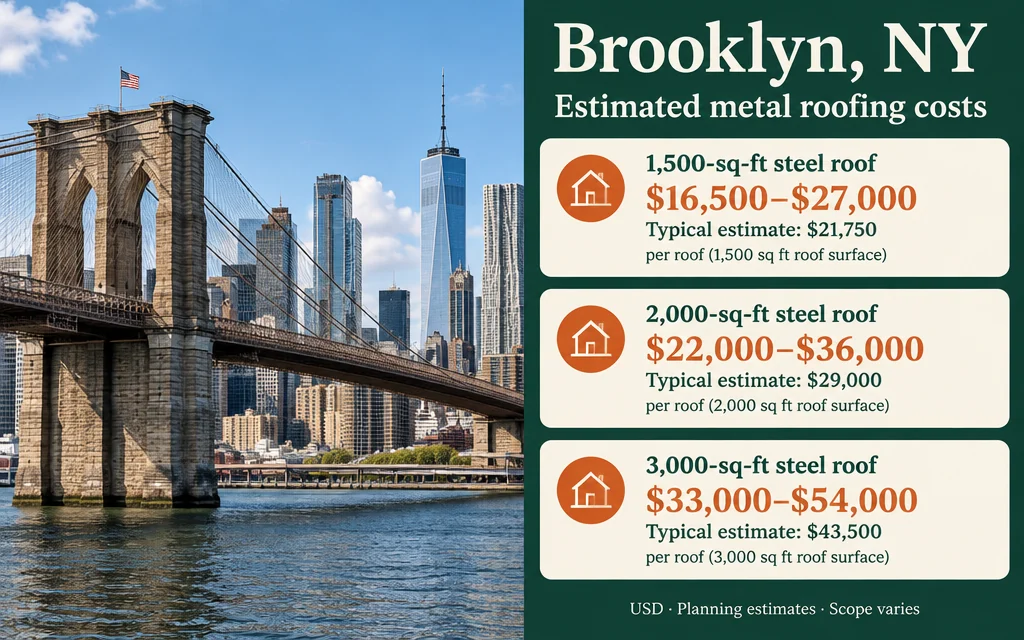
Calculated installed planning scenario for measured roof surface, including one-layer removal/disposal; conditional extras excluded.
Calculated installed planning scenario for measured roof surface, including one-layer removal/disposal; conditional extras excluded.
Calculated installed planning scenario for measured roof surface, including one-layer removal/disposal; conditional extras excluded.
Metal Roofing Overview in Brooklyn
For residential standing seam steel roofing in Brooklyn, budget $11–$18 per square foot of measured roof surface, with typical installations running around $14.50.
All baseline installed rates in this guide are measured per square foot of actual exterior roof surface area—not interior home floor space. That baseline covers 24- to 26-gauge panels, concealed expansion clips, high-temperature synthetic underlayment, baseline valley and perimeter flashings, and the complete tear-off and disposal of one existing roofing layer over sound wood decking. Roof surface area exceeds a home's foundation footprint due to slope, overhangs, dormers, and architectural hips. In roofing estimates, one 'square' equals exactly 100 square feet of surface.
Comparing Residential Metal Roof Systems
Metal roofing encompasses distinct profiles and alloys, each with different attachment methods, maintenance needs, and installed price levels.
Concealed-fastener standing seam steel is the standard profile for high-performance residential work, running $11–$18 per square foot installed. Panels are joined along raised vertical seams using hidden clips that allow the metal to slide during thermal expansion and contraction. Most residential systems use 24- or 26-gauge Galvalume steel with factory-applied PVDF finishes.
Exposed-fastener steel panels, such as corrugated or ribbed sheets, budget $8–$13 per square foot installed. These panels are screwed directly through the exterior face into the wood deck with rubber-gasketed fasteners. While less expensive upfront, exposed washers degrade under sunlight and temperature swings over 10 to 15 years, requiring periodic inspection and screw replacement.
Steel metal shingles budget $11.50–$19 per square foot installed, offering stamped interlocking panels designed to simulate shake, slate, or traditional tile. Standing seam aluminum budgets $13–$20 per square foot installed (typically 0.032- to 0.040-inch thickness), offering natural corrosion resistance well-suited to coastal air along Brooklyn's waterways. Standing seam architectural copper budgets $24–$40 per square foot installed, representing a premium sheet-metal installation requiring specialized hand-seaming.
| Service / assumptions | Low | Typical estimate | High | Pricing unit | Estimated labor time |
|---|---|---|---|---|---|
| Standing Seam Steel (Concealed Fastener)Calculated standing-seam steel planning rate: comparable panel/accessory materials + installation labor + one-layer removal/disposal. Ordinary underlayment and details over sound decking included; conditional extra work excluded. | $11 | $14.50 | $18 | per sq ft of roof surface (installed) | N/A |
| Exposed Fastener Steel (Ribbed/Corrugated)Screw-down through-fastened corrugated or 5V-crimp ribbed steel panels with rubber gasket washers, including one-layer tear-off. | $8 | $10.50 | $13 | per sq ft of roof surface (installed) | N/A |
| Steel Metal Shingles / TilesStamped stone-coated or painted interlocking steel shingles simulating shake, slate, or tile, including one-layer tear-off. | $11.50 | $15 | $19 | per sq ft of roof surface (installed) | N/A |
| Standing Seam Aluminum0.032 to 0.040 inch aluminum standing seam panels; rust-free performance ideal for coastal Brooklyn environments. Published rate reference for the stated roofing scope and unit, not verification of this guide's modeled range, a complete roof quote or provider availability. Regional reference; not a verified Brooklyn-specific quote.Published price reference ↗ | $13 | $16.50 | $20 | per sq ft of roof surface (installed) | N/A |
| Standing Seam Architectural Copper16 oz or 20 oz architectural copper panels, custom hand-formed seams, historical/landmark quality. | $24 | $32 | $40 | per sq ft of roof surface (installed) | N/A |
Cost Components of a Standing Seam Roof
Understanding how materials, installation labor, and tear-off divide helps you evaluate itemized bids against our typical planning benchmark of $14.50 per square foot:
Materials and trim account for $4–$6.50 per square foot (typically $5.25). This component covers 24- to 26-gauge Galvalume panels, concealed clips, synthetic underlayment, ice-and-water protection at eaves and valleys, and standard trim stock.
Installation labor accounts for $5.50–$8.50 per square foot (typically $7). Standing seam requires specialized equipment for roll-forming, pan folding, and seaming. Crews must detail transitions, ridges, and eave lock strips to ensure weather tightness while accommodating thermal expansion.
Removal and disposal of one existing roofing layer accounts for $1.50–$3 per square foot (typically $2.25). This covers stripping old shingles or membrane down to the deck, ground protection, container placement, hauling, and disposal fees.
| Service / assumptions | Low | Typical estimate | High | Pricing unit | Estimated labor time |
|---|---|---|---|---|---|
| Standing Seam Steel Materials & UnderlaymentMaterials-only component allowance for 24-26 ga Galvalume panels, hidden clips, synthetic underlayment, and standard trim stock. | $4 | $5.25 | $6.50 | per sq ft of roof surface (materials only) | N/A |
| Standing Seam Steel Installation LaborSkilled labor component allowance for panel formation, seam mechanical locking, and standard flashing integration (excludes tear-off). | $5.50 | $7 | $8.50 | per sq ft of roof surface (installation labor only) | N/A |
| One-Layer Roof Removal & DisposalTear-off, site protection, container fees, and disposal of one existing roofing layer down to sound decking. | $1.50 | $2.25 | $3 | per sq ft of roof surface (one-layer removal and disposal) | N/A |
Project Budgets by Roof Size
Because roofing costs scale directly with measured roof surface area rather than interior living space, geometry drives total project investment. Below are calculated scenarios based on our standing seam steel planning rate of $11–$18 per square foot:
For a 1,500-square-foot roof surface—typical of a compact detached residence, cottage, or rowhouse surface—the complete standing seam steel system runs $16,500–$27,000, with a typical benchmark of $21,750. On-site installation typically spans 2 to 4 business days of crew time.
For a 2,000-square-foot surface—common on mid-sized detached residences—costs run $22,000–$36,000, centering around $29,000. On-site work generally requires 3 to 5 business days of crew time.
For a 3,000-square-foot roof surface involving multiple hips, dormers, or multi-level planes, total installation runs $33,000–$54,000, averaging $43,500. Typical duration on-site runs 4 to 7 business days of crew time under favorable weather conditions.
| Service / assumptions | Low | Typical estimate | High | Pricing unit | Estimated labor time |
|---|---|---|---|---|---|
| Standing Seam Steel Roof (1,500 sq ft)Calculated scenario: 1,500 sq ft of measured roof surface × standing-seam steel installed planning rate. Includes its same materials, installation, one-layer removal/disposal and sound-deck assumptions. Not a provider whole-roof quote. | $16,500 | $21,750 | $27,000 | per roof (1,500 sq ft roof surface) | 2 to 4 business days |
| Standing Seam Steel Roof (2,000 sq ft)Calculated scenario: 2,000 sq ft of measured roof surface × standing-seam steel installed planning rate. Includes its same materials, installation, one-layer removal/disposal and sound-deck assumptions. Not a provider whole-roof quote. | $22,000 | $29,000 | $36,000 | per roof (2,000 sq ft roof surface) | 3 to 5 business days |
| Standing Seam Steel Roof (3,000 sq ft)Calculated scenario: 3,000 sq ft of measured roof surface × standing-seam steel installed planning rate. Includes its same materials, installation, one-layer removal/disposal and sound-deck assumptions. Not a provider whole-roof quote. | $33,000 | $43,500 | $54,000 | per roof (3,000 sq ft roof surface) | 4 to 7 business days |
Standing Seam Metal vs. Architectural Asphalt
Homeowners weighing standing seam steel against architectural asphalt shingles are comparing distinct service lives and upfront capital requirements. In Brooklyn, an architectural asphalt shingle roof budgets $6.50–$10.50 per square foot installed (averaging $8.50) under identical baseline assumptions of one-layer removal and sound decking.
Standing seam steel requires roughly 1.7 to 2.1 times the initial investment of architectural shingles. In return, steel panels eliminate shingle blow-off risks and can deliver 40 to 50 or more years of service with minimal upkeep, compared to 20 to 25 years for asphalt before replacement becomes necessary.
If you plan to own the property for decades, metal provides a durable covering with lower lifecycle replacement frequency. However, if you anticipate selling within five to seven years, recouping the metal expenditure through near-term resale value is difficult compared to installing a clean, standard asphalt roof.
| Service / assumptions | Low | Typical estimate | High | Pricing unit | Estimated labor time |
|---|---|---|---|---|---|
| Architectural Asphalt Shingles (Reference)Standard reference system: architectural shingles, synthetic felt, ice barrier, ordinary flashings, and one-layer tear-off. | $6.50 | $8.50 | $10.50 | per sq ft of roof surface (installed) | N/A |
| Comparison | Architectural asphalt | Standing-seam steel |
|---|---|---|
| Up-front planning estimate · 2,000 sq ft roof surface | $13,000–$21,000 | $22,000–$36,000 |
| What the baseline includes | Architectural asphalt, ordinary installed details, one-layer removal/disposal over sound decking. | Standing-seam steel, ordinary installed details, one-layer removal/disposal over sound decking. |
| Maintenance and repairs | Confirm product-specific inspections and repair terms. | Confirm seams, fasteners, coating, compatible repairs and inspection terms. |
| Insurance and ownership cost | Ask the insurer about the exact product and coverage. | Ask the insurer about accepted test documentation, any available credit and cosmetic-damage exclusions. |
These are calculated budgeting comparisons, not provider quotes or guaranteed lifetime savings. Compare your expected ownership period, specified products, actual maintenance proposals and written insurance terms.
| Decision point | Roof repair | Roof replacement | Metal roofing |
|---|---|---|---|
| Work being priced | A defined defect, such as damaged shingles or flashing. | Removal and installation of an agreed roof system across the measured roof surface. | A specified installed metal system; standing seam, exposed fasteners and metal shingles are different scopes. |
| What to inspect | The leak source, surrounding material and whether a durable localized fix is feasible. | The extent of deterioration, decking condition, roof details and suitable replacement systems. | The substrate, panel profile, coating, fasteners, roof geometry and installation details. |
| How to compare prices | Match the repair quantity, access, materials and included diagnosis. | Match measured roof area, material, tear-off layers, disposal and installed inclusions. | Match measured roof area, system, components, removal and conditional additional work. |
| Before deciding | Ask what the repair addresses and what existing problems would remain. | Ask whether repair remains practical and which additional items would change the total. | Ask about compatible materials, documented product/assembly ratings and product versus workmanship warranties. |
Age or a repair-cost percentage alone does not determine the right choice. Ask a qualified roofing contractor to assess the condition and explain viable options. A metal system is a material-specific installation choice, not a separate guarantee of durability or savings.
Additional Scope Items and Unexpected Repairs
Every roof replacement carries conditional scope items that cannot be confirmed until the old covering is stripped, or that require custom site detailing:
Multiple layers: When a building has an older second layer of shingles or flat membrane beneath the surface, stripping and discarding that extra material adds $60–$140 per roofing square (100 square feet).
Decking repairs: If water infiltration has damaged the wood substrate, replacing deteriorated plywood or OSB budgets $95–$180 per 4-by-8-foot sheet installed while the roof deck is open.
Flashing penetrations: While standard perimeter trims are included in base rates, custom lead or copper step-and-counter flashing around a masonry chimney runs $600–$1,800 per chimney. Integrating custom metal pans around an existing skylight curb adds $350–$850 per skylight.
Safety, drainage, and ventilation: On pitched metal profiles facing walkways, non-penetrating seam-clamped snow guards prevent sudden snow avalanches, costing $18–$42 per linear foot. Upgrading ridge or soffit ventilation adds $12–$25 per linear foot, while detaching and resetting gutters to fit new perimeter metal adds $6–$14 per linear foot.
| Service / assumptions | Low | Typical estimate | High | Pricing unit | Estimated labor time |
|---|---|---|---|---|---|
| Extra Roofing Layer RemovalAdditional labor and disposal costs when an existing second or third layer of shingles or flat membrane is stripped. | $60 | $95 | $140 | additional per roofing square (100 sq ft) | N/A |
| Plywood / OSB Decking ReplacementPer 4x8 ft CDX plywood or OSB sheet installed while deck is exposed; replaces damaged or rotted substrate. | $95 | $135 | $180 | additional per 4-by-8-ft sheet (32 sq ft) | N/A |
| Custom Masonry Chimney FlashingCustom fabricated metal step and reglet counter-flashing cut into masonry joints; excludes baseline edge trims. | $600 | $1,100 | $1,800 | additional per chimney | N/A |
| Skylight Flashing IntegrationCustom curb metal wrap and panel pan tie-ins for existing skylight; does not include full unit replacement. | $350 | $550 | $850 | additional per skylight | N/A |
| Ventilation Upgrade (Ridge / Soffit)Vented ridge cap profile and insect screening integrated into standing seam panels for continuous airflow. | $12 | $18 | $25 | additional per linear ft | N/A |
| Snow Retention SystemNon-penetrating seam-clamped snow rail or pad brackets to prevent sudden sliding snow avalanches. | $18 | $28 | $42 | additional per linear ft | N/A |
| Gutter Detach & ResetCareful detachment and re-hanging of existing gutters to install metal drip edge and underlayment properly. | $6 | $9.50 | $14 | additional per linear ft | N/A |
Performance Ratings, Coatings, and Warranties
Evaluating metal specifications requires distinguishing lab test results from real-world performance expectations.
Impact resistance is commonly evaluated under UL 2218, where a Class 4 rating indicates that steel panels withstand steel ball impacts without cracking. However, Class 4 testing does not mean a roof will never dent during heavy hail or falling branch strikes. Some insurers offer modest premium credits for Class 4 installations, but policies frequently carry cosmetic damage exclusions that refuse coverage for surface dimples that do not compromise waterproofing.
Wind uplift resistance depends on panel engagement and clip spacing verified under standards such as UL 580 or ASTM E1592. Properly clamped standing seam profiles fastened to solid decking offer strong resistance to coastal wind gusts, whereas exposed-fastener heads can back out over time under cyclical wind loads.
Coating selection directly affects paint longevity. PVDF (Kynar 500) resin finishes provide superior resistance to chalking and fading compared to standard silicone-modified polyester (SMP) paints. Always separate the manufacturer's finish warranty (often 30 to 40 years on paint integrity) from the installer's workmanship warranty (typically 2 to 10 years covering flashings and seams).
Brooklyn Specific Pricing Drivers
Site conditions and architectural styles across Brooklyn influence how contractors price metal installations:
Urban access and staging: Detached residences with driveways allow easier panel staging and dumpster drops. For attached townhomes or multi-story buildings, handling 20- to 30-foot standing seam panels, hoisting materials, and positioning disposal bins requires careful coordination. Ask your contractor whether street staging, dumpster placement, or pedestrian protection requires municipal permits on your block, and confirm who handles those filings.
Roof geometry: Simple gable roofs with straight runs price near the lower end of the bracket. Rooflines with multiple dormers, hips, valleys, or parapet wall transitions require extensive manual panel cutting and custom brake-formed flashing, which raises labor hours per square.
Historic district oversight: If your building falls within a designated historic district, confirm whether exterior alterations require approval from the Landmarks Preservation Commission. Certain districts mandate specific seam profiles, panel widths, or traditional materials such as architectural copper or lead-coated copper rather than modern pre-painted steel.
Hiring a Metal Roofing Contractor in Brooklyn
Installing standing seam metal is a specialized architectural sheet-metal craft rather than a standard shingle replacement. Improper clip spacing, overdriven fasteners, or locked seams can lead to panel buckling, loud thermal noise, or persistent perimeter leaks.
When evaluating contractors, verify that the business holds an active Home Improvement Contractor license with the NYC Department of Consumer and Worker Protection (DCWP) and carries comprehensive general liability and statutory workers' compensation insurance suited to roofing work at your building's height. Inquire whether panels will be factory pre-cut or roll-formed on-site, and ask to review previous standing seam installations.
Request an itemized written quote that specifies the exact steel gauge, coating system, underlayment type, flashing gauges, and unit rates for any decking replacement encountered after tear-off. Before work begins, ask the contractor directly who is responsible for pulling required building permits and verifying local code compliance for your specific address.
STATEWIDE COST CONTEXT
New York prices, income & labor costs
These New York figures provide background for this city guide. They describe different measures and reference years; employee wages are not prices charged by a contractor.
BEA SAIRPD
State price change indicator
133.52024 · index (2017 basis)
Annual figures & sources
| Year | Value | 90% margin of error | Source |
|---|---|---|---|
| 2020 | 115.3 | — | Official source |
| 2021 | 119.4 | — | Official source |
| 2022 | 124.9 | — | Official source |
| 2023 | 130.0 | — | Official source |
| 2024 | 133.5 | — | Official source |
Census ACS 1-year
Median household income
$89,2102025 · USD/year
Annual figures & sources
| Year | Value | 90% margin of error | Source |
|---|---|---|---|
| 2021 | $74,314 | ±$613 | Official source |
| 2022 | $79,557 | ±$722 | Official source |
| 2023 | $82,095 | ±$500 | Official source |
| 2024 | $85,820 | ±$653 | Official source |
| 2025 | $89,210 | ±$934 | Official source |
BLS OEWS
Roofers
$31.742025 · USD/hour
Annual figures & sources
| Year | Value | 90% margin of error | Source |
|---|---|---|---|
| 2025 | $31.74 | — | Official source |
State prices: BEA, 2020–2024. Household income: Census ACS, 2021–2025. Employee wages: BLS, May 2025 snapshot. The charts retain their own units and fitted scales.
Explore all New York living-cost data and trends →Local context and limitations
Brooklyn housing stock ranges from detached and semi-detached homes with pitched roofs to attached brownstones and rowhouses where standing seam metal is often specified for mansard facades, top-floor rear additions, or accent canopies rather than low-slope primary decks. When budgeting, address-specific logistical questions matter: confirm with prospective contractors whether your building falls within a designated historic district subject to Landmarks Preservation Commission review, whether work requires municipal building filings, and how narrow street access, dumpster placement, or material hoisting will be handled on your block.
Frequently asked questions
What is the practical difference between standing seam and exposed-fastener metal?
Standing seam uses raised vertical seams with concealed clips underneath, allowing the metal to expand and contract freely while keeping all screw penetrations sheltered from the elements. Exposed-fastener systems use screws driven directly through the panel surface with rubber sealing washers. Over time, those exposed washers can dry out, crack, or loosen under temperature swings, requiring periodic inspection and resealing.
How is roof surface area calculated compared to home floor area?
Roof surface area measures the true exterior plane of the roof deck, not the interior living space. Because roof pitch, overhangs, gables, and dormers add slope and surface area, measured roof surface is always greater than the building's ground footprint. Contractors calculate true square footage using pitch multipliers or aerial measurements rather than interior room dimensions.
Can a metal roof be installed over existing shingles in Brooklyn?
While some manufacturer specifications and local authorities evaluate overlays under narrow conditions, complete tear-off down to the wood deck is standard practice for standing seam metal. Overlays prevent inspecting the underlying sheathing for rot, can trap moisture, and create an irregular deck that causes visible panel distortion. Baseline estimates include one-layer removal.
Does installing a metal roof guarantee an insurance premium discount?
No. While some insurance carriers provide credits for impact-resistant systems tested under UL 2218 Class 4, discounts vary widely by insurer and policy type. Carriers often require specific documentation from the manufacturer or installer, and some policies include cosmetic damage endorsements that exclude payouts for surface denting that does not leak. Check directly with your insurance provider.
Is a metal roof noticeably noisy during heavy rain?
Installed over solid wood decking, synthetic underlayment, and standard residential attic insulation, a standing seam metal roof does not create excessive indoor noise. Interior sound levels during rainstorms are comparable to conventional asphalt shingle roofs.
What metal gauge is standard for residential standing seam?
Residential standing seam steel is typically installed in 24-gauge or 26-gauge. The lower number indicates thicker steel; 24-gauge provides greater panel rigidity and reduces the risk of oil canning (visible surface waviness) on longer roof runs. Thinner 29-gauge steel is primarily used in exposed-fastener agricultural or utility installations.
Sources and methodology
Sources below retain their recorded retrieval dates and geographic scope. We checked the quoted rates against readable public pricing pages. The tables remain planning estimates, not provider quotes or a measured citywide survey. Per-square-foot references do not establish the modeled whole-roof totals or all their installed inclusions. Regional references are not verified Brooklyn-specific quotes. Confirm removal, disposal, materials, labor and the complete scope in a written proposal.
Published pricing pages retrieved; quoted excerpts checked automatically. 3 distinct website domains. · Generated 2026-11-12
- What Is the Average Cost of a Roof in Houston? - Integris RoofingState / regional reference · Page retrieved 2026-11-11 · Price excerpt matched automatically
“In Houston, the average cost of a tile roof ranges from $7 to $15 per square foot, depending on the material and installation complexity.”
Planning ranges may differ from these published examples; they are not provider quotes.
- Roofing Cost Brooklyn NY 2026 | Complete Price GuideCity-specific page context · Page retrieved 2026-11-11 · Price excerpt matched automatically
“smaller roofs cost proportionally less. 🏡 Shingle Roof Replacement 3-Tab Asphalt Shingles $5 to $7/sq ft Economy option. 20 to 25 year lifespan.”
Planning ranges may differ from these published examples; they are not provider quotes.
- How Much Does a Standing Seam Metal Roof Cost in 2026?State / regional reference · Page retrieved 2026-11-11 · Price excerpt matched automatically
“The average cost to install an aluminum standing seam roof on a 2,500-square-foot roof is $25,000 to $42,500, or $10 to $17 per square foot.”
Planning ranges may differ from these published examples; they are not provider quotes.
Plan your metal roofing project
Choose your service and answer its project questions. Add notes or photos if helpful, then generate your project brief. The planner labels its budgeting assumptions separately. Use your plan to compare the scope and assumptions with a provider. Contact sharing and provider matching are not available yet.
Open the project planner →Share this city’s cost data
<> Embed Brooklyn Cost Data on Your Site
The HTML table shows the prices at the time of copying. The iframe follows the published guide.