Staten Island · NY · COST GUIDE
Metal Roofing Costs in Staten Island, NY (2026)
For budgeting, standing-seam steel roofing is estimated at $11–$20 per sq ft of roof surface, and exposed-fastener steel at $6.50–$12.50 per sq ft. These installed planning ranges include one-layer removal/disposal over sound decking; compare the specified system and conditional extras.
Standing Seam Steel Roof (Installed)
Budget estimate$11–$20per sq ft of roof surface (installed)
Planning range · Compare the roof area, material and included work in your quote.
Exposed Fastener Steel Roof (Installed)
Budget estimate$6.50–$12.50per sq ft of roof surface (installed)
Planning range · Compare the roof area, material and included work in your quote.
Published examples apply to their stated scope. Budget ranges are estimates.
Calculated installed planning scenario for measured roof surface, including one-layer removal/disposal; conditional extras excluded.
Calculated installed planning scenario for measured roof surface, including one-layer removal/disposal; conditional extras excluded.
Calculated installed planning scenario for measured roof surface, including one-layer removal/disposal; conditional extras excluded.
Metal Roofing in Staten Island
Metal roofing is an increasingly popular alternative for Staten Island homeowners looking to step away from repetitive asphalt shingle replacements. While dimensional shingles remain standard across the borough, a properly detailed metal roof provides strong protection against seasonal freeze-thaw cycles, driving rain, and coastal gusts.
Planning for a metal roof requires evaluating panel designs, installation methods, and the true geometry of your roof deck.
For a baseline standing seam Galvalume steel roof in Staten Island, budget $11–$20 per sq ft of roof surface (installed). This planning range includes stripping one layer of old asphalt shingles, hauling away the debris, laying synthetic underlayment, and securing panels with concealed expansion clips. For a representative 2,000 sq ft roof surface, total outlays typically budget $22,000–$40,000. Exposed fastener panels offer an upfront budget-friendly alternative at budget $6.50–$12.50 per sq ft of roof surface (installed), though their exposed screw heads and rubber washers demand periodic maintenance.
Because direct local published quotes for metal roofing are limited in Staten Island, published regional references serve as budgeting guideposts rather than guaranteed bids. Securing an itemized written proposal from a licensed contractor who inspects your roof deck, eaves, and site access is the only way to establish your address-specific cost.
Comparing Residential Metal Roof Systems
Different metal roofing systems provide distinct aesthetic profiles, attachment mechanics, and weathering capabilities. Choosing the right system depends on your home's roof pitch, architectural style, and proximity to saltwater.
Concealed-fastener standing seam steel budgets $11–$20 per sq ft of roof surface (installed). Panels interlock over concealed clips fastened directly to the roof deck, leaving no exposed screw holes through the metal face. Made from 24-gauge or 26-gauge Galvalume steel with factory PVDF coatings, standing seam works on low to steep slopes and accommodates natural thermal movement smoothly.
Exposed fastener steel panels budget $6.50–$12.50 per sq ft of roof surface (installed). These panels are fastened with color-matched screws driven through the face of the metal into the decking, sealed with rubber washers. While more economical upfront, seasonal temperature changes push and pull against the fasteners, and the washers eventually degrade under UV exposure, requiring periodic inspection and tightening.
Steel metal shingles budget $9.50–$17 per sq ft of roof surface (installed). These stamped or stone-coated steel panels mimic the dimensional look of traditional shingles or tile while providing metal's structural durability and concealed fastening.
Standing seam aluminum budgets $13–$23 per sq ft of roof surface (installed). For homes along Raritan Bay, the Arthur Kill, or coastal South Shore waters, aluminum offers superior resistance to salt spray because cut or scratched edges do not rust.
Standing seam copper represents a premium architectural option at budget $25–$48 per sq ft of roof surface (installed). Fabricated with traditional crimped seams, copper naturally develops a protective patina over time and is often selected for historic renovations, porches, or bay window accents.
| Service / assumptions | Low | Typical estimate | High | Pricing unit | Estimated labor time |
|---|---|---|---|---|---|
| Standing Seam Steel Roof (Installed)Calculated standing-seam steel planning rate: comparable panel/accessory materials + installation labor + one-layer removal/disposal. Ordinary underlayment and details over sound decking included; conditional extra work excluded. Published rate reference for the stated roofing scope and unit, not verification of this guide's modeled range, a complete roof quote or provider availability. Regional reference; not a verified Staten Island-specific quote.Published price reference ↗ | $11 | $15 | $20 | per sq ft of roof surface (installed) | N/A |
| Exposed Fastener Steel Roof (Installed)Includes ribbed 26-gauge or 29-gauge steel panels, external rubber-washer fasteners, underlayment, basic flashing, and one-layer removal. | $6.50 | $9 | $12.50 | per sq ft of roof surface (installed) | N/A |
| Steel Metal Shingles (Installed)Includes stamped stone-coated or painted steel shingle panels, concealed fasteners, underlayment, edge flashing, and one-layer removal. | $9.50 | $13 | $17 | per sq ft of roof surface (installed) | N/A |
| Standing Seam Aluminum Roof (Installed)Includes 0.032 to 0.040 inch marine-grade aluminum standing seam panels, stainless clips, PVDF finish, high-temp underlayment, and one-layer removal. | $13 | $17.50 | $23 | per sq ft of roof surface (installed) | N/A |
| Standing Seam Copper Roof (Installed)Includes 16 oz or 20 oz cold-rolled copper panels, custom hand-crimped seams, brass/copper clips, underlayment, and one-layer removal. | $25 | $35 | $48 | per sq ft of roof surface (installed) | N/A |
Component Breakdown for Standing Seam Steel
Evaluating a metal roofing estimate requires breaking down material costs, skilled sheet-metal labor, and preparatory tear-off. For a baseline standing seam Galvalume steel roof, these three components combine into the total installed planning figure.
Materials allowance: Budget $4–$7.50 per sq ft of roof surface (materials only). This covers 24-gauge or 26-gauge Galvalume steel panels, concealed expansion clips, corrosion-resistant screws, synthetic underlayment, self-adhering membrane along eaves and valleys, and standard trims like drip edges and ridge caps.
Installation labor: Skilled sheet-metal craftsmanship accounts for budget $5.50–$9.50 per sq ft of roof surface (installation labor only). Installing standing seam panels requires careful layout, field hemming of drip edges, clean transition notching, and watertight penetration details without relying on exposed caulking.
Tear-off and disposal: Stripping a single existing layer of asphalt shingles and hauling away debris averages budget $1.50–$3 per sq ft of roof surface (one-layer removal and disposal). This covers clearing old material down to the wooden deck, pulling stray nails, and proper disposal handling.
Combined, these three components yield the installed baseline of budget $11–$20 per sq ft of roof surface over sound decking.
| Service / assumptions | Low | Typical estimate | High | Pricing unit | Estimated labor time |
|---|---|---|---|---|---|
| Standing Seam Steel Materials AllowanceAllowance for 24-gauge Galvalume steel panels, clips, high-temp underlayment, and standard transition trims. | $4 | $5.50 | $7.50 | per sq ft of roof surface (materials only) | N/A |
| Standing Seam Steel Installation LaborSkilled sheet metal labor for layout, panel seaming, and standard trim integration, excluding tear-off. | $5.50 | $7.50 | $9.50 | per sq ft of roof surface (installation labor only) | N/A |
| One-Layer Tear-Off & Disposal AllowanceStripping one layer of existing asphalt shingles down to the deck and carting debris under local disposal rules. | $1.50 | $2 | $3 | per sq ft of roof surface (one-layer removal and disposal) | N/A |
Estimated Costs by Roof Surface Area
When budgeting your project, remember that roof surface area is always larger than a home's interior ground-floor footprint. Slope, roof overhangs, dormers, and architectural hips or valleys add significant square footage.
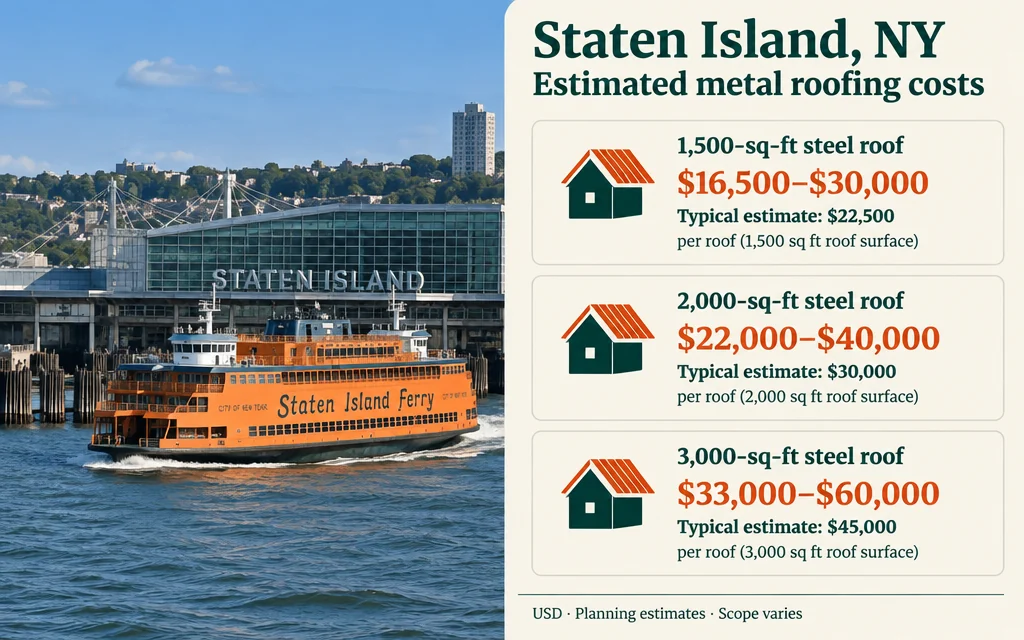
A simple roof footprint with 1,500 sq ft of roof surface budgets $16,500–$30,000 installed for standing seam steel. Under favorable weather and straightforward property access, on-site installation typically takes 3-5 business days.
A typical Staten Island home with 2,000 sq ft of roof surface budgets $22,000–$40,000 installed, averaging roughly $30,000. On-site crew work for this scope generally takes 4-6 business days.
A larger residence measuring 3,000 sq ft of roof surface budgets $33,000–$60,000 installed, with typical projects centering around $45,000. Installation for standard layouts usually requires 5-8 business days.
Roofs with steep slopes (over 7:12), complex dormer configurations, or tight access along narrow side lots will trend toward the upper boundary of these pricing and timing ranges.
| Service / assumptions | Low | Typical estimate | High | Pricing unit | Estimated labor time |
|---|---|---|---|---|---|
| Standing Seam Steel Roof (1,500 Sq Ft)Calculated scenario: 1,500 sq ft of measured roof surface × standing-seam steel installed planning rate. Includes its same materials, installation, one-layer removal/disposal and sound-deck assumptions. Not a provider whole-roof quote. | $16,500 | $22,500 | $30,000 | per roof (1,500 sq ft roof surface) | 3-5 business days |
| Standing Seam Steel Roof (2,000 Sq Ft)Calculated scenario: 2,000 sq ft of measured roof surface × standing-seam steel installed planning rate. Includes its same materials, installation, one-layer removal/disposal and sound-deck assumptions. Not a provider whole-roof quote. | $22,000 | $30,000 | $40,000 | per roof (2,000 sq ft roof surface) | 4-6 business days |
| Standing Seam Steel Roof (3,000 Sq Ft)Calculated scenario: 3,000 sq ft of measured roof surface × standing-seam steel installed planning rate. Includes its same materials, installation, one-layer removal/disposal and sound-deck assumptions. Not a provider whole-roof quote. | $33,000 | $45,000 | $60,000 | per roof (3,000 sq ft roof surface) | 5-8 business days |
Metal Versus Architectural Asphalt Shingles
Comparing metal to architectural asphalt shingles involves balancing higher upfront material and labor costs against extended service life and lower ongoing upkeep. In Staten Island, an architectural asphalt shingle roof installed with single-layer tear-off budgets $5.50–$9 per sq ft of roof surface (installed).
By comparison, standing seam steel budgets $11–$20 per sq ft of roof surface (installed). While metal represents approximately double the initial investment of asphalt, it features concealed fasteners engineered to accommodate thermal movement and withstand heavy coastal winds without curling, cracking, or losing protective granules.
For a home with 2,000 sq ft of roof surface, standing seam steel typically totals $30,000 installed, compared to a lower initial outlay for architectural shingles. Homeowners planning to stay in their residences for decades often find that skipping a future tear-off and re-roof cycle justifies the upfront expenditure, whereas those anticipating a relocation in the near term may prefer the lower upfront cost of asphalt shingles.
| Service / assumptions | Low | Typical estimate | High | Pricing unit | Estimated labor time |
|---|---|---|---|---|---|
| Architectural Asphalt Shingles ReferenceReference cost for dimensional asphalt shingles including tear-off, synthetic underlayment, and standard drip edge. | $5.50 | $7 | $9 | per sq ft of roof surface (installed) | N/A |
| Comparison | Architectural asphalt | Standing-seam steel |
|---|---|---|
| Up-front planning estimate · 2,000 sq ft roof surface | $11,000–$18,000 | $22,000–$40,000 |
| What the baseline includes | Architectural asphalt, ordinary installed details, one-layer removal/disposal over sound decking. | Standing-seam steel, ordinary installed details, one-layer removal/disposal over sound decking. |
| Maintenance and repairs | Confirm product-specific inspections and repair terms. | Confirm seams, fasteners, coating, compatible repairs and inspection terms. |
| Insurance and ownership cost | Ask the insurer about the exact product and coverage. | Ask the insurer about accepted test documentation, any available credit and cosmetic-damage exclusions. |
These are calculated budgeting comparisons, not provider quotes or guaranteed lifetime savings. Compare your expected ownership period, specified products, actual maintenance proposals and written insurance terms.
| Decision point | Roof repair | Roof replacement | Metal roofing |
|---|---|---|---|
| Work being priced | A defined defect, such as damaged shingles or flashing. | Removal and installation of an agreed roof system across the measured roof surface. | A specified installed metal system; standing seam, exposed fasteners and metal shingles are different scopes. |
| What to inspect | The leak source, surrounding material and whether a durable localized fix is feasible. | The extent of deterioration, decking condition, roof details and suitable replacement systems. | The substrate, panel profile, coating, fasteners, roof geometry and installation details. |
| How to compare prices | Match the repair quantity, access, materials and included diagnosis. | Match measured roof area, material, tear-off layers, disposal and installed inclusions. | Match measured roof area, system, components, removal and conditional additional work. |
| Before deciding | Ask what the repair addresses and what existing problems would remain. | Ask whether repair remains practical and which additional items would change the total. | Ask about compatible materials, documented product/assembly ratings and product versus workmanship warranties. |
Age or a repair-cost percentage alone does not determine the right choice. Ask a qualified roofing contractor to assess the condition and explain viable options. A metal system is a material-specific installation choice, not a separate guarantee of durability or savings.
Additional Work and Scope Modifiers
Standard estimates assume a sound, flat wood deck and standard trim packages. Site-specific repairs and necessary roof modifications introduce add-on costs that adjust your final contract.
Extra layer removal: If your roof has multiple existing shingle layers, budget $60–$120 additional per roofing square (100 sq ft). Stripping multiple layers adds substantial labor and disposal weight.
Decking replacement: If removing the old roof reveals soft, rotted, or water-damaged sheathing, replacing panels costs budget $85–$145 additional per 4-by-8-ft sheet (32 sq ft). Standing seam metal requires a solid, planar deck to lay flat and prevent panel oil-canning.
Chimney flashing: Custom fabrication of step flashing, counter-flashing, and a rear diversion saddle budgets $400–$950 additional per chimney.
Skylight flashing: Fabricating custom metal curb pans and aprons around existing or new skylights costs budget $350–$750 additional per skylight.
Ridge ventilation: Upgrading to continuous metal-compatible ridge venting runs budget $18–$38 additional per linear ft.
Snow retention: In areas directly over walkways, doorways, or driveways, clamp-on snow rails prevent heavy snow from sliding off in sheets; plan on budget $25–$55 additional per linear ft.
Gutter detach and reset: If existing gutters must be removed to detail drip edges and starter strips correctly, budget $6–$14 additional per linear ft.
| Service / assumptions | Low | Typical estimate | High | Pricing unit | Estimated labor time |
|---|---|---|---|---|---|
| Extra Shingle Layer Tear-OffApplies only when removing a second or third existing roof layer prior to metal installation. | $60 | $85 | $120 | additional per roofing square (100 sq ft) | N/A |
| Plywood/OSB Decking ReplacementReplaces rotted or compromised wood decking with new 1/2-inch or 5/8-inch CDX plywood while roof is exposed. | $85 | $115 | $145 | additional per 4-by-8-ft sheet (32 sq ft) | N/A |
| Custom Chimney Flashing & CricketFabrication and installation of step flashing, counter-flashing, and rear diversion cricket integrated with metal panels. | $400 | $650 | $950 | additional per chimney | N/A |
| Skylight Curb Flashing KitCustom curb transitions, back pans, and apron flashings to seal around an existing or new skylight. | $350 | $500 | $750 | additional per skylight | N/A |
| Metal Ridge Vent UpgradeContinuous perforated or louvered ridge venting detailed to prevent weather infiltration beneath ridge caps. | $18 | $26 | $38 | additional per linear ft | N/A |
| Standing Seam Snow Retention RailsNon-penetrating clamp-on bar or two-pipe snow fence installed above walkways and entry doors. | $25 | $38 | $55 | additional per linear ft | N/A |
| Gutter Detach & ResetCarefully removing existing gutters to allow drip-edge and starter installation, then reinstalling them afterward. | $6 | $9 | $14 | additional per linear ft | N/A |
Testing, Code Compliance, and Insurance
Metal roofing provides dependable long-term protection, but specific performance characteristics depend on the tested product assembly rather than generic marketing claims.
Impact resistance: Roofing products evaluated under UL 2218 or FM 4473 receive ratings from Class 1 to Class 4. A Class 4 rating confirms strong resistance to cracking or puncturing during standardized laboratory impact tests, but it does not guarantee protection against cosmetic surface denting. Some insurance policies offer premium credits for impact-rated installations, while others attach cosmetic damage waivers that exclude payouts for dents that do not cause water infiltration. Contact your insurer directly to verify how they treat metal roof classifications for your property.
Wind uplift standards: In coastal areas like Staten Island, uplift resistance is vital. Assemblies evaluated under UL 580 or UL 1897 verify panel and clip hold-down strength against heavy wind suction. Ask your installer to confirm how panel seam profiles, metal gauge, and clip spacing align with manufacturer wind engineering and structural requirements for your address.
Fire resistance: While bare steel and aluminum panels are non-combustible, achieving a formal Class A fire rating requires a complete, certified assembly, which typically relies on specialized gypsum barrier boards or fire-resistant underlayment directly over the roof deck.
Local Cost Drivers in Staten Island
Several site conditions and architectural details influence where an estimate falls within our planning ranges.
Roof slope and geometry: Low to moderate pitches are simpler to walk and stage. Once a roof slope exceeds 7:12, crew members require specialized staging, harnesses, and safety rigging, which slows daily production and increases labor costs. Complex layouts featuring multiple intersecting valleys, dormers, and rake details demand custom field fabrication on a sheet-metal brake, driving up labor hours compared to a simple gable.
Lot layout and material staging: Staten Island neighborhoods feature diverse lot sizes, ranging from broad South Shore parcels to tight North Shore properties with shared driveways and low overhead tree canopies or utility wires. Constrained site access affects panel delivery trucks, crane placement, and dumpster staging. If roll-off waste containers must sit on a public street, ask your contractor what municipal street-occupancy permits or placement fees apply to your block.
Coastal proximity: For homes along the shoreline or tidal waterways, marine salt air can degrade standard cut steel edges over time. In these microclimates, contractors frequently recommend marine-grade aluminum standing seam or specialized corrosion-resistant coatings, which carry higher material costs than standard Galvalume steel.
Permit filings and administrative coordination: Check with each bidder on whether building department filings, structural plan reviews, or special work permits apply to your specific address and scope. Ask contractors to state in writing whether they will manage all filings with the NYC Department of Buildings, whether expeditor fees are bundled into the proposal, and what sign-offs or documentation you will receive upon completion.
Evaluating Quotes and Hiring Contractors
Installing standing seam metal roofing demands specialized sheet-metal brakes, hemming tools, and proper detailing techniques that differ fundamentally from asphalt shingle roofing. A reliable contractor will provide clear documentation and explicit scopes.
Licensing and permit verification: Ask prospective roofers to confirm active home improvement contractor licensing with the New York City Department of Consumer and Worker Protection, along with current certificates for general liability and workers' compensation coverage. Verify directly in writing whether the contractor or homeowner is responsible for filing any necessary permits with the NYC Department of Buildings for your specific parcel.
Insist on detailed specifications: A comprehensive quote should state the metal substrate (such as Galvalume steel or aluminum), metal thickness (gauge or decimal inches), seam style (snap-lock versus mechanically seamed), coating type (such as PVDF/Kynar), and underlayment materials. The scope should explicitly cover flashing details at chimneys, valleys, and walls, along with stated unit rates for decking replacement if rotted wood is uncovered.
Distinguish warranties: Clarify the difference between the manufacturer's finish warranty (which covers paint chalking, peeling, and fading) and the contractor's workmanship warranty (which covers watertightness and installation defects). Review what routine maintenance tasks are required to keep all warranties in force.
STATEWIDE COST CONTEXT
New York prices, income & labor costs
These New York figures provide background for this city guide. They describe different measures and reference years; employee wages are not prices charged by a contractor.
BEA SAIRPD
State price change indicator
133.52024 · index (2017 basis)
Annual figures & sources
| Year | Value | 90% margin of error | Source |
|---|---|---|---|
| 2020 | 115.3 | — | Official source |
| 2021 | 119.4 | — | Official source |
| 2022 | 124.9 | — | Official source |
| 2023 | 130.0 | — | Official source |
| 2024 | 133.5 | — | Official source |
Census ACS 1-year
Median household income
$89,2102025 · USD/year
Annual figures & sources
| Year | Value | 90% margin of error | Source |
|---|---|---|---|
| 2021 | $74,314 | ±$613 | Official source |
| 2022 | $79,557 | ±$722 | Official source |
| 2023 | $82,095 | ±$500 | Official source |
| 2024 | $85,820 | ±$653 | Official source |
| 2025 | $89,210 | ±$934 | Official source |
BLS OEWS
Roofers
$31.742025 · USD/hour
Annual figures & sources
| Year | Value | 90% margin of error | Source |
|---|---|---|---|
| 2025 | $31.74 | — | Official source |
State prices: BEA, 2020–2024. Household income: Census ACS, 2021–2025. Employee wages: BLS, May 2025 snapshot. The charts retain their own units and fitted scales.
Explore all New York living-cost data and trends →Local context and limitations
Staten Island site conditions directly influence metal roofing scopes and material selections. Salt air along the South Shore, Raritan Bay, and the Arthur Kill can accelerate cut-edge corrosion on standard steel panels, prompting installers to evaluate marine-grade aluminum (budget $13–$23 per sq ft of roof surface (installed)) or Galvalume steel with robust factory finishes. Inland parcels with mature tree canopies require clear drainage valleys to prevent debris accumulation. Because direct municipal price studies are limited, these figures serve as planning estimates grounded in regional references. What specific filings or approvals does your project require? Ask prospective contractors to clarify the exact trade licensing, building department filings, and structural or wind-uplift standards that apply to your address through the New York City Department of Buildings and the Department of Consumer and Worker Protection before signing an agreement.
Frequently asked questions
What is the difference between standing seam and exposed fastener metal roofs?
Standing seam uses concealed clips that hold panels from underneath, allowing the metal to expand and contract freely while protecting fastener penetrations from weather. Exposed fastener roofs use screws driven straight through the face of the panels with rubber washers, which are less expensive initially but require periodic inspection as washers age.
Why is roof surface area larger than home square footage?
Home square footage measures flat interior living space. A roof includes overhangs, eaves, covered porches, and slope angles that expand the actual surface area. A 2,000 sq ft home often has between 2,200 and 2,800 sq ft of actual exterior roof area depending on pitch and architectural design.
Can a metal roof be installed over existing asphalt shingles in Staten Island?
Whether an overlay is permitted depends on applicable building codes, structural framing capacity, and manufacturer installation guidelines for your specific address. Most manufacturers and professional metal roofers recommend tearing off old shingles down to bare wood. Full tear-off allows thorough inspection of roof sheathing and ensures underlayment adheres securely to a flat deck.
Are metal roofs noisy during heavy rain or hail?
When installed over solid wood decking with quality synthetic underlayment and standard attic insulation, residential metal roofs are no noticeably louder than asphalt shingle roofs. The tinny sound commonly associated with metal roofing occurs on open-framed structures like agricultural barns, not finished homes.
Will a metal roof lower my homeowner insurance premium in New York?
Some insurance companies provide discounts for Class 4 impact-rated roofing materials or fire-resistant assemblies, but credits are not guaranteed. Some policies also attach cosmetic damage endorsements that exclude coverage for surface hail dents that do not cause water leaks. Check with your insurance agent to verify your policy terms.
Is aluminum or steel better for a metal roof on Staten Island?
For properties close to the ocean, bay, or saltwater channels, aluminum is generally preferred because it naturally resists salt-air corrosion and does not develop red rust on cut edges. For inland properties protected from marine spray, 24-gauge Galvalume steel provides excellent structural rigidity and dent resistance at a lower material cost.
Sources and methodology
Sources below retain their recorded retrieval dates and geographic scope. We checked the quoted rates against readable public pricing pages. The tables remain planning estimates, not provider quotes or a measured citywide survey. Per-square-foot references do not establish the modeled whole-roof totals or all their installed inclusions. Regional references are not verified Staten Island-specific quotes. Confirm removal, disposal, materials, labor and the complete scope in a written proposal.
Published pricing pages retrieved; quoted excerpts checked automatically. 2 distinct website domains. · Generated 2026-11-12
- Nebraska Roof Replacement Cost in 2026 by City and MaterialState / regional reference · Page retrieved 2026-11-12 · Price excerpt matched automatically
“Metal roof cost per square foot: Most metal roofing systems in Nebraska range from $9 to $18 per square foot installed .”
Planning ranges may differ from these published examples; they are not provider quotes.
- How Much Does a Metal Roof Cost for a House?State / regional reference · Page retrieved 2026-11-12 · Price excerpt matched automatically
“Standing seam steel systems run approximately $16 per square foot installed.”
Planning ranges may differ from these published examples; they are not provider quotes.
Plan your metal roofing project
Choose your service and answer its project questions. Add notes or photos if helpful, then generate your project brief. The planner labels its budgeting assumptions separately. Use your plan to compare the scope and assumptions with a provider. Contact sharing and provider matching are not available yet.
Open the project planner →Share this city’s cost data
<> Embed Staten Island Cost Data on Your Site
The HTML table shows the prices at the time of copying. The iframe follows the published guide.