Queens · NY · COST GUIDE
Metal Roofing Costs in Queens, NY (2026)
For budgeting, standing-seam steel roofing is estimated at $12–$22 per sq ft of roof surface, and exposed-fastener steel at $7–$13 per sq ft. These installed planning ranges include one-layer removal/disposal over sound decking; compare the specified system and conditional extras.
Standing Seam Steel (Installed)
Budget estimate$12–$22per sq ft of roof surface (installed)
Planning range · Compare the roof area, material and included work in your quote.
Exposed Fastener Steel (Installed)
Budget estimate$7–$13per sq ft of roof surface (installed)
Planning range · Compare the roof area, material and included work in your quote.
Published examples apply to their stated scope. Budget ranges are estimates.
Calculated installed planning scenario for measured roof surface, including one-layer removal/disposal; conditional extras excluded.
Calculated installed planning scenario for measured roof surface, including one-layer removal/disposal; conditional extras excluded.
Calculated installed planning scenario for measured roof surface, including one-layer removal/disposal; conditional extras excluded.
Metal Roofing in the Queens Residential Market
Metal roofing across Queens has expanded from accent work on bay windows and porch overhangs to complete replacements on detached and semi-detached homes. Homeowners evaluating metal prioritize long-term performance through freeze-thaw cycles, driving rain, and seasonal coastal wind.
Accurate budgeting requires pricing the complete installed assembly rather than bare panels.
A full replacement covers panels, clips, self-adhering underlayment, perimeter trim, ridge ventilation, flashing details, and skilled sheet-metal labor. For standing-seam steel, budget $12–$22 per sq ft of roof surface (installed), with a typical benchmark around $16.50. This baseline assumes single-layer asphalt shingle removal and disposal over sound sheathing. For an illustrative 2,000-square-foot roof surface, that equates to budget $24,000–$44,000 per roof (2,000 sq ft roof surface).
Because standing-seam panels run continuously from ridge to eave, delivery and handling require careful logistics. Moving 20-to-30-foot metal trays down narrow residential driveways or staging equipment on busy streets requires coordinated planning before materials arrive.
Residential Metal Roofing Systems Compared
Residential metal roof systems vary substantially in fastening method, alloy composition, and long-term maintenance needs. Matching the system to your architectural style and site exposure is essential.
Concealed-Fastener Standing Seam Steel: The standard baseline for residential projects. Panels interlock along vertical seams over concealed clips, allowing the metal to expand and contract smoothly across wide temperature swings. Because fasteners are shielded under the seams, leak risks remain low. Most homes use 24-gauge or 26-gauge Galvalume steel with a factory PVDF paint finish. For this system, budget $12–$22 per sq ft of roof surface (installed).
Exposed-Fastener Steel: Ribbed or corrugated panels screw directly through the metal face into the roof deck using gasketed screws. Because the panels move while the fasteners stay rigid, screw holes can enlarge over time, and exposed rubber washers eventually harden and require scheduled replacement. For exposed-fastener steel, budget $7–$13 per sq ft of roof surface (installed). This profile is common on detached garages and outbuildings rather than primary residences.
Steel Metal Shingles: Stamped steel shingles imitate wood shake, slate, or barrel tile while using concealed interlocking clips. Finished with painted or stone-coated surfaces, they suit homes where traditional curb appeal is preferred, budgeting $10.50–$18.50 per sq ft of roof surface (installed).
Standing-Seam Aluminum: Fabricated from .032-inch or .040-inch aluminum and secured with concealed clips. Unlike steel, aluminum naturally forms a protective oxide surface when cut or scratched rather than rusting. Near salt-air waterfront zones such as the Rockaways or Jamaica Bay, aluminum offers superior corrosion resistance, budgeting $14.50–$26 per sq ft of roof surface (installed).
Architectural Standing-Seam Copper: Hand-formed from 16-ounce or 20-ounce cold-rolled copper, this profile oxidizes into an enduring natural patina without requiring paint. It involves meticulous sheet-metal trade craft, running budget $26–$48 per sq ft of roof surface (installed).
| Service / assumptions | Low | Typical estimate | High | Pricing unit | Estimated labor time |
|---|---|---|---|---|---|
| Standing Seam Steel (Installed)Calculated standing-seam steel planning rate: comparable panel/accessory materials + installation labor + one-layer removal/disposal. Ordinary underlayment and details over sound decking included; conditional extra work excluded. | $12 | $16.50 | $22 | per sq ft of roof surface (installed) | 3 to 5 business days |
| Exposed Fastener Steel (Installed)26-gauge or 29-gauge ribbed/corrugated panels fastened with exterior gasketed screws; includes one-layer tear-off. | $7 | $9.50 | $13 | per sq ft of roof surface (installed) | 2 to 3 business days |
| Steel Metal Shingles (Installed)Stamped steel shingles mimicking slate or shake profile with concealed fastening and one-layer removal. | $10.50 | $14 | $18.50 | per sq ft of roof surface (installed) | 4 to 6 business days |
| Standing Seam Aluminum (Installed)Marine-grade .032" or .040" aluminum standing seam with concealed clips; ideal for Queens coastal salt spray zones. Published rate reference for the stated roofing scope and unit, not verification of this guide's modeled range, a complete roof quote or provider availability. Regional reference; not a verified Queens-specific quote.Published price reference ↗ | $14.50 | $19.50 | $26 | per sq ft of roof surface (installed) | 3 to 5 business days |
| Standing Seam Copper (Installed)16-oz or 20-oz cold-rolled architectural copper standing seam with hand-formed pans and soldered details. | $26 | $36 | $48 | per sq ft of roof surface (installed) | 6 to 10 business days |
Component Cost Allowances for Standing Seam Steel
Reviewing an itemized proposal helps identify whether all phases of the project are accounted for. In Queens, the calculated standing-seam steel baseline reflects three standard component allowances:
Materials Allowance: Budget $4.50–$7.50 per sq ft of roof surface (materials only). This covers 24-gauge Galvalume steel panels with a PVDF finish, concealed expansion clips, matched flashings (drip edge, valley pans, and ridge caps), fasteners, and high-temperature self-adhering underlayment engineered for metal assemblies.
Installation Labor Allowance: Budget $6–$11.50 per sq ft of roof surface (installation labor only). This covers professional layout, field hem folds, mechanical or snap-lock seaming, and custom detail work around dormers, sidewalls, and chimneys. Elapsed on-site crew time generally takes 3 to 4 business days for an average residential roofline.
Removal and Disposal Allowance: Budget $1.50–$3 per sq ft of roof surface (one-layer removal and disposal). This covers stripping a single layer of existing asphalt shingles down to the deck, magnetic sweeps for stray nails, hauling, and local transfer fees, typically requiring 1 to 2 business days.
| Service / assumptions | Low | Typical estimate | High | Pricing unit | Estimated labor time |
|---|---|---|---|---|---|
| Standing Seam Steel Materials Allowance24-ga Galvalume panels, factory PVDF finish, clips, high-temp synthetic underlayment, drip edge, ridge cap, and trims. | $4.50 | $6 | $7.50 | per sq ft of roof surface (materials only) | N/A |
| Standing Seam Steel Installation LaborSkilled architectural sheet metal installation labor for panel layout, seaming, flashings, and safety staging. | $6 | $8.50 | $11.50 | per sq ft of roof surface (installation labor only) | 3 to 4 business days |
| One-Layer Tear-Off & DisposalStripping one layer of existing asphalt shingles, magnetic sweep, dumpster carting, and Queens transfer station fees. | $1.50 | $2 | $3 | per sq ft of roof surface (one-layer removal and disposal) | 1 to 2 business days |
Hypothetical Queens Roof Budget Scenarios
Because of slope, overhangs, and architectural dormers, actual roof surface area is always larger than your home's interior living footprint. The following calculated scenarios represent complete standing-seam steel installations based on measured roof surface area, including one-layer tear-off and standard flashings.
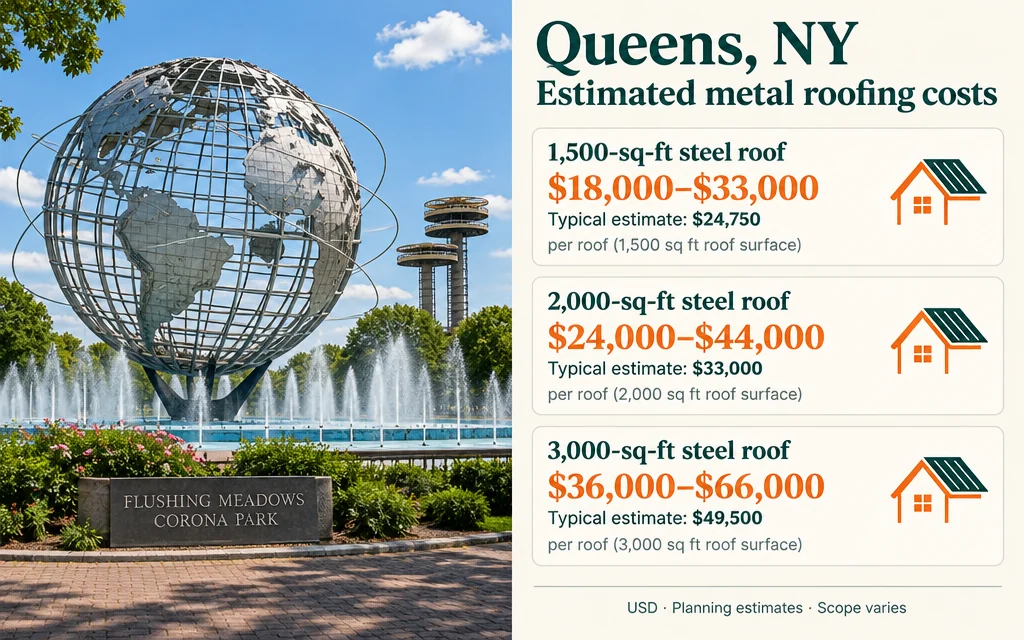
Compact Detached Home (1,500 sq ft roof surface): A simple gable or modest bungalow roofline budgets $18,000–$33,000 per roof (1,500 sq ft roof surface), with a typical midpoint around $24,750. Elapsed crew time typically spans 3 to 4 business days.
Standard Single-Family Home (2,000 sq ft roof surface): A two-story detached home or colonial layout budgets $24,000–$44,000 per roof (2,000 sq ft roof surface), averaging $33,000. Straightforward designs sit near the lower end, while multi-pitch planes move toward the top. On-site installation takes 4 to 5 business days.
Larger or Complex Residence (3,000 sq ft roof surface): A larger residence featuring multiple dormers, intersecting hips, or steep pitches budgets $36,000–$66,000 per roof (3,000 sq ft roof surface), with a typical benchmark of $49,500. Elapsed crew work generally requires 5 to 7 business days.
| Service / assumptions | Low | Typical estimate | High | Pricing unit | Estimated labor time |
|---|---|---|---|---|---|
| Complete 1,500 Sq Ft Standing Seam Steel RoofCalculated scenario: 1,500 sq ft of measured roof surface × standing-seam steel installed planning rate. Includes its same materials, installation, one-layer removal/disposal and sound-deck assumptions. Not a provider whole-roof quote. | $18,000 | $24,750 | $33,000 | per roof (1,500 sq ft roof surface) | 3 to 4 business days |
| Complete 2,000 Sq Ft Standing Seam Steel RoofCalculated scenario: 2,000 sq ft of measured roof surface × standing-seam steel installed planning rate. Includes its same materials, installation, one-layer removal/disposal and sound-deck assumptions. Not a provider whole-roof quote. | $24,000 | $33,000 | $44,000 | per roof (2,000 sq ft roof surface) | 4 to 5 business days |
| Complete 3,000 Sq Ft Standing Seam Steel RoofCalculated scenario: 3,000 sq ft of measured roof surface × standing-seam steel installed planning rate. Includes its same materials, installation, one-layer removal/disposal and sound-deck assumptions. Not a provider whole-roof quote. | $36,000 | $49,500 | $66,000 | per roof (3,000 sq ft roof surface) | 5 to 7 business days |
Metal vs. Architectural Asphalt: 30-Year Financial Context
Initial investment represents the most substantial contrast between standing-seam metal and standard asphalt shingles. For an architectural asphalt shingle roof, budget $5.50–$9.50 per sq ft of roof surface (installed), which is roughly half the upfront cost of standing-seam steel at $12–$22 per sq ft.
The trade-off lies in expected service life and ongoing maintenance. Asphalt roofs in coastal urban climates face freeze-thaw stress, seasonal wind, and strong summer heat, often requiring full replacement on a 20-to-25-year cycle alongside occasional shingle patching or sealant repairs. Over a 30-to-40-year window, an owner may pay for two asphalt shingle installations.
A properly detailed 24-gauge standing-seam steel roof can endure across that same timeline with only periodic visual inspections and gutter cleaning. However, the higher initial cost makes the most financial sense if you intend to keep the home long enough to bypass that second shingle replacement. Discuss market value with local real estate professionals rather than assuming an automatic resale return.
| Service / assumptions | Low | Typical estimate | High | Pricing unit | Estimated labor time |
|---|---|---|---|---|---|
| Architectural Asphalt Shingles ReferenceBaseline comparison: standard architectural shingles including underlayment, flashing, and one-layer tear-off over sound deck. | $5.50 | $7.25 | $9.50 | per sq ft of roof surface (installed) | 1 to 2 business days |
| Comparison | Architectural asphalt | Standing-seam steel |
|---|---|---|
| Up-front planning estimate · 2,000 sq ft roof surface | $11,000–$19,000 | $24,000–$44,000 |
| What the baseline includes | Architectural asphalt, ordinary installed details, one-layer removal/disposal over sound decking. | Standing-seam steel, ordinary installed details, one-layer removal/disposal over sound decking. |
| Maintenance and repairs | Confirm product-specific inspections and repair terms. | Confirm seams, fasteners, coating, compatible repairs and inspection terms. |
| Insurance and ownership cost | Ask the insurer about the exact product and coverage. | Ask the insurer about accepted test documentation, any available credit and cosmetic-damage exclusions. |
These are calculated budgeting comparisons, not provider quotes or guaranteed lifetime savings. Compare your expected ownership period, specified products, actual maintenance proposals and written insurance terms.
| Decision point | Roof repair | Roof replacement | Metal roofing |
|---|---|---|---|
| Work being priced | A defined defect, such as damaged shingles or flashing. | Removal and installation of an agreed roof system across the measured roof surface. | A specified installed metal system; standing seam, exposed fasteners and metal shingles are different scopes. |
| What to inspect | The leak source, surrounding material and whether a durable localized fix is feasible. | The extent of deterioration, decking condition, roof details and suitable replacement systems. | The substrate, panel profile, coating, fasteners, roof geometry and installation details. |
| How to compare prices | Match the repair quantity, access, materials and included diagnosis. | Match measured roof area, material, tear-off layers, disposal and installed inclusions. | Match measured roof area, system, components, removal and conditional additional work. |
| Before deciding | Ask what the repair addresses and what existing problems would remain. | Ask whether repair remains practical and which additional items would change the total. | Ask about compatible materials, documented product/assembly ratings and product versus workmanship warranties. |
Age or a repair-cost percentage alone does not determine the right choice. Ask a qualified roofing contractor to assess the condition and explain viable options. A metal system is a material-specific installation choice, not a separate guarantee of durability or savings.
Additional Scope and Conditional Work
Quotes can change once existing roofing is stripped and hidden deck conditions become visible. Agreeing on itemized unit prices in your initial agreement protects your budget against surprise change orders.
Extra Layer Removal: If tear-off uncovers a second or third shingle layer, budget an additional $45–$120 additional per roofing square (100 sq ft) for the extra stripping labor and dumping weight.
Decking Replacement: Metal panels must be secured to a sound, flat wood substrate. If rotted or damaged roof boards must be replaced, budget $65–$115 additional per 4-by-8-ft sheet (32 sq ft) installed for materials and labor.
Chimney and Skylight Flashings: Standard proposals include perimeter transitions. If an existing masonry chimney requires a new reglet counterflashing ground directly into mortar joints, budget $450–$1,200 additional per chimney. Custom metal curb flashing around existing skylights budgets $400–$1,100 additional per skylight.
Snow Retention Systems: Metal panels shed snow rapidly as daytime temperatures rise. Over walkways, steps, or driveways, installing seam-clamping snow guards or rail pipes budgets $25–$65 additional per linear ft.
Ventilation and Gutters: Upgrading to a continuous baffle-protected ridge vent designed for metal roofs budgets $12–$32 additional per linear ft. Detaching and resetting existing seamless gutters to accommodate a continuous drip-edge cleat budgets $6–$16 additional per linear ft.
| Service / assumptions | Low | Typical estimate | High | Pricing unit | Estimated labor time |
|---|---|---|---|---|---|
| Extra Layer Removal & DisposalIncremental labor and disposal surcharge for a second or third existing roof layer discovered during tear-off. | $45 | $75 | $120 | additional per roofing square (100 sq ft) | N/A |
| Plywood / OSB Decking ReplacementReplaces rotted or damaged roof sheathing with 1/2" or 5/8" CDX plywood sheet exposed after tear-off. | $65 | $85 | $115 | additional per 4-by-8-ft sheet (32 sq ft) | N/A |
| Chimney Counterflashing DetailCustom reglet-cut step and counterflashing in masonry chimneys; baseline quote includes only standard edge transitions. | $450 | $750 | $1,200 | additional per chimney | N/A |
| Skylight Metal Flashing KitCustom backpan and curb flashing fabrication for standing seam around existing skylights. | $400 | $650 | $1,100 | additional per skylight | N/A |
| Standing Seam Ridge Vent UpgradeContinuous baffle-protected ridge ventilation profile designed specifically for metal roof thermal movement. | $12 | $20 | $32 | additional per linear ft | N/A |
| Snow Retention Guard SystemNon-penetrating seam-clamping snow guards or continuous rail pipe to prevent snow shedding above walkways and doors. | $25 | $42 | $65 | additional per linear ft | N/A |
| Gutter Detach & ResetCareful unmounting of existing seamless gutters to install heavy drip edge metal, followed by resecuring and testing pitch. | $6 | $10 | $16 | additional per linear ft | N/A |
Understanding Material Ratings and Regional Suitability
Manufacturer performance testing establishes helpful technical baselines, but real-world reliability depends heavily on assembly detailing.
Impact Resistance (UL 2218): Many 24-gauge steel and heavy aluminum panels carry a Class 4 rating under UL 2218 impact tests. This indicates the metal resists cracking or water breach under steel-ball impact; it does not promise that panels will remain free of visible cosmetic indentations. Verify policy details with your insurance carrier, as some insurers attach cosmetic damage waivers to metal roofs.
Wind Uplift: Concealed-clip standing seam systems tested under UL 580 (Class 90) or ASTM E1592 deliver dependable uplift performance when clip spacing conforms to engineering specs. In contrast, exposed-fastener profiles carry greater risk of fastener pull-out along eaves and rakes during intense windstorms.
Fire Classification: The metal panels themselves are non-combustible, but obtaining an overall Class A fire rating requires a certified complete roof assembly, including fire-rated underlayment and approved wood decking.
Reflective Coatings: Factory PVDF finishes reflect substantial solar heat away from the roof plane, helping reduce attic heat build-up during peak summer sun compared to standard dark asphalt shingles.
Cost Drivers Specific to Queens Installations
Contractors pricing residential metal roofing in Queens evaluate several parcel-specific variables when preparing an estimate:
Roof Pitch and Complexity: Steep slopes, dormer tie-ins, and multi-valley hip roofs require extensive scaffolding, worker fall protection, and hand-fabricated sheet-metal flashings. These features require significantly more skilled trade hours than simple two-sided gable roofs.
Access and Material Staging: In dense residential neighborhoods with shared driveways or narrow side alleys, contractors cannot easily park tractor-trailers carrying full-length panels. Materials frequently need to be carried by hand or roll-formed at the curb, adding material-handling time.
Permit and Staging Questions: Confirm regulatory and staging procedures directly for your specific address. Ask prospective contractors: Will your team handle filing required building permits for this installation, or does that require a separate expediter? If roll-forming equipment or disposal containers must occupy street frontage, who secures the necessary street-use permits? Does the property carry historic or landmark designations that dictate specific metal finishes? Clarify in writing who pays municipal fees and coordinates required inspections.
Salt-Air Exposure: Neighborhoods bordering coastal waters face elevated airborne chlorides that can cause corrosion at cut steel edges over time. In these settings, contractors frequently advise marine-grade aluminum panels or edge-seal treatments, which involve higher upfront material costs.
Hiring a Metal Roofing Specialist in Queens
Standing-seam metal installation is a specialized architectural sheet-metal trade requiring dedicated equipment and detailing skills that differ sharply from shingle application. Focus on contractors with dedicated metal experience.
Verify Installation Track Record: Ask prospective roofers how many standing-seam roofs their current crew has installed. Check whether panels will be factory-ordered to exact lengths or roll-formed on-site, and confirm whether their installers hold manufacturer certifications, which are frequently required for extended paint and weathertightness warranties.
Inspect Thermal Movement Detailing: Metal panels expand and contract with temperature changes. Confirm how the roofer manages thermal movement, ensuring they use floating expansion clips and hemmed panel ends hooked over starter cleats rather than driving screws through panel faces.
Check Credentials and Coverage: Ask contractors for their active home improvement contractor license number and confirm current standing with local licensing authorities. Request direct certificates of general liability and workers' compensation insurance, verifying that roofing work at your structure's height is covered without exclusions.
Require Itemized Bids: Your written quote should specify exact metal gauge, alloy, finish type, underlayment brand, flashing details, tear-off parameters, and unit costs for any rotted wood decking found once shingles are removed.
STATEWIDE COST CONTEXT
New York prices, income & labor costs
These New York figures provide background for this city guide. They describe different measures and reference years; employee wages are not prices charged by a contractor.
BEA SAIRPD
State price change indicator
133.52024 · index (2017 basis)
Annual figures & sources
| Year | Value | 90% margin of error | Source |
|---|---|---|---|
| 2020 | 115.3 | — | Official source |
| 2021 | 119.4 | — | Official source |
| 2022 | 124.9 | — | Official source |
| 2023 | 130.0 | — | Official source |
| 2024 | 133.5 | — | Official source |
Census ACS 1-year
Median household income
$89,2102025 · USD/year
Annual figures & sources
| Year | Value | 90% margin of error | Source |
|---|---|---|---|
| 2021 | $74,314 | ±$613 | Official source |
| 2022 | $79,557 | ±$722 | Official source |
| 2023 | $82,095 | ±$500 | Official source |
| 2024 | $85,820 | ±$653 | Official source |
| 2025 | $89,210 | ±$934 | Official source |
BLS OEWS
Roofers
$31.742025 · USD/hour
Annual figures & sources
| Year | Value | 90% margin of error | Source |
|---|---|---|---|
| 2025 | $31.74 | — | Official source |
State prices: BEA, 2020–2024. Household income: Census ACS, 2021–2025. Employee wages: BLS, May 2025 snapshot. The charts retain their own units and fitted scales.
Explore all New York living-cost data and trends →Local context and limitations
Residential metal roof planning in Queens involves specific site and material trade-offs. In coastal waterfront settings near Jamaica Bay, Flushing Bay, or the Rockaways, airborne salt can accelerate corrosion at cut edges on standard coated steel, leading many property owners to evaluate marine-grade aluminum. On narrow parcels or semi-detached properties, tight side clearances often limit crane placement or long trailer access, requiring on-site roll-forming or manual panel staging. Because direct city-specific quote data is limited, published rates from regional New York markets provide helpful baseline benchmarks. Always verify parcel-specific filing requirements, street-staging allowances, and written scopes directly with prospective contractors before signing an agreement.
Frequently asked questions
What is the difference between standing seam and exposed fastener metal roofing?
Standing seam uses raised vertical seams with concealed clips secured beneath the panels, allowing the metal to expand and contract smoothly while protecting screws from weather exposure. Exposed fastener roofs use overlapping panels screwed directly through the exterior surface into the roof deck with rubber-washer screws, which require regular inspections and eventual washer replacement.
Can I install a metal roof over existing shingles in Queens?
While building codes may allow an overlay under specific structural conditions, contractors generally recommend a complete tear-off. Stripping old shingles allows crews to inspect the wooden deck for water damage, eliminates uneven surfaces that can show through metal panels, and ensures a flat surface for clips and high-temperature underlayment.
Why is aluminum often recommended near Queens coastal waters?
In coastal areas near Jamaica Bay and the Rockaways, salt-laden air can corrode the cut edges of Galvalume steel panels over time. Aluminum naturally forms a protective oxide layer that resists rust and corrosion, making it a reliable choice for waterfront locations.
Will a residential metal roof affect cell phone reception or Wi-Fi?
No. Everyday cellular signals and residential Wi-Fi primarily enter homes through windows, exterior walls, and door openings. A residential metal roof does not cause noticeable disruption to everyday mobile phone service or wireless home networks.
Are snow guards necessary on a metal roof in Queens?
Snow guards or continuous rail systems are strongly recommended above pedestrian sidewalks, entry steps, driveways, and shared property lines. Smooth metal panels shed accumulated snow quickly during daytime warming, and guard systems hold snow in place so it melts gradually into gutters.
Does installing a metal roof reduce homeowners insurance costs in Queens?
Some insurance carriers offer policy discounts for Class 4 impact resistance or Class A fire ratings, but terms and eligibility vary widely. Contact your insurance agent before installation to verify applicable credits and to confirm whether cosmetic exclusions apply to panel dents.
Sources and methodology
Sources below retain their recorded retrieval dates and geographic scope. We checked the quoted rates against readable public pricing pages. The tables remain planning estimates, not provider quotes or a measured citywide survey. Per-square-foot references do not establish the modeled whole-roof totals or all their installed inclusions. Regional references are not verified Queens-specific quotes. Confirm removal, disposal, materials, labor and the complete scope in a written proposal.
Published pricing pages retrieved; quoted excerpts checked automatically. 3 distinct website domains. · Generated 2026-11-11
- Roofing Cost Brooklyn NY 2026 | Complete Price GuideState / regional reference · Page retrieved 2026-11-11 · Price excerpt matched automatically
“smaller roofs cost proportionally less. 🏡 Shingle Roof Replacement 3-Tab Asphalt Shingles $5 to $7/sq ft Economy option. 20 to 25 year lifespan.”
Planning ranges may differ from these published examples; they are not provider quotes.
- Metal Roof Replacement Cost by Home Size in Suffolk County, NYState / regional reference · Page retrieved 2026-11-11 · Price excerpt matched automatically
“At $10 to $16 per square foot installed, a 1,200 sq ft metal roof replacement in Suffolk County typically runs between $12,000 and $19,200.”
Planning ranges may differ from these published examples; they are not provider quotes.
- How Much Does a Standing Seam Metal Roof Cost in 2026?State / regional reference · Page retrieved 2026-11-11 · Price excerpt matched automatically
“The average cost to install an aluminum standing seam roof on a 2,500-square-foot roof is $25,000 to $42,500, or $10 to $17 per square foot.”
Planning ranges may differ from these published examples; they are not provider quotes.
Plan your metal roofing project
Choose your service and answer its project questions. Add notes or photos if helpful, then generate your project brief. The planner labels its budgeting assumptions separately. Use your plan to compare the scope and assumptions with a provider. Contact sharing and provider matching are not available yet.
Open the project planner →Share this city’s cost data
<> Embed Queens Cost Data on Your Site
The HTML table shows the prices at the time of copying. The iframe follows the published guide.