Glendale · CA · COST GUIDE
Metal Roofing Costs in Glendale, CA (2026)
For budgeting, standing-seam steel roofing is estimated at $11–$20 per sq ft of roof surface, and exposed-fastener steel at $7–$11 per sq ft. These installed planning ranges include one-layer removal/disposal over sound decking; compare the specified system and conditional extras.
Standing Seam Steel Roof (Installed)
Budget estimate$11–$20per sq ft of roof surface (installed)
Planning range · Compare the roof area, material and included work in your quote.
Exposed-Fastener Corrugated/Ribbed Steel (Installed)
Budget estimate$7–$11per sq ft of roof surface (installed)
Planning range · Compare the roof area, material and included work in your quote.
Published examples apply to their stated scope. Budget ranges are estimates.
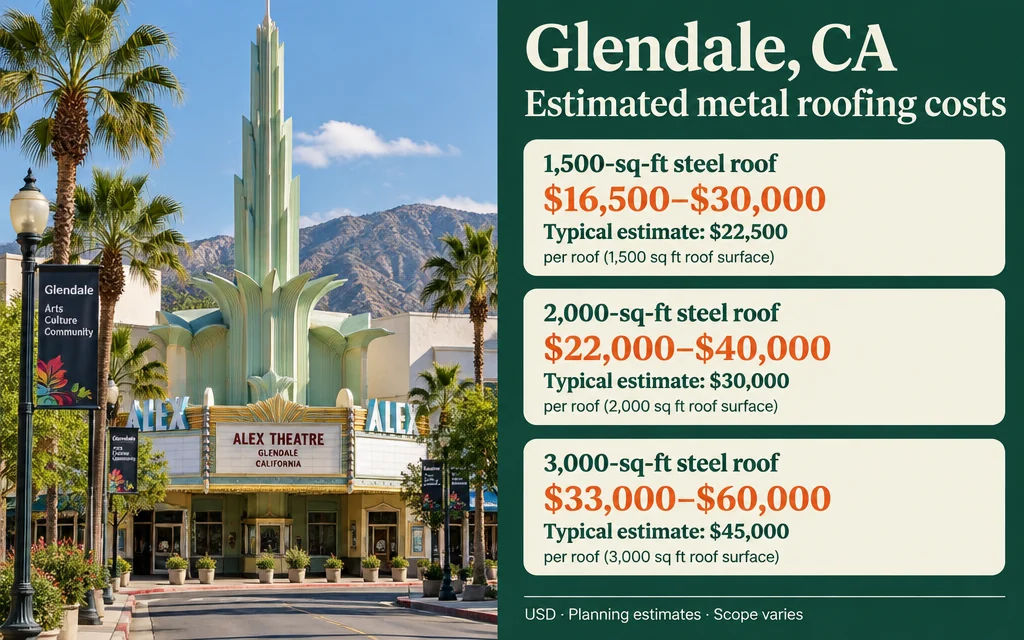
Calculated installed planning scenario for measured roof surface, including one-layer removal/disposal; conditional extras excluded.
Calculated installed planning scenario for measured roof surface, including one-layer removal/disposal; conditional extras excluded.
Calculated installed planning scenario for measured roof surface, including one-layer removal/disposal; conditional extras excluded.
Metal Roofing Investment in Glendale
Metal roofing is increasingly specified for Glendale homes, particularly among owners looking for extended durability against strong ultraviolet exposure, improved fire resilience, and clean architectural lines. While traditional asphalt shingles bake under sustained Southern California sun and experience thermal fatigue over time, properly detailed metal profiles offer an enduring exterior finish.
For planning purposes, standing seam steel systems in Glendale typically budget $11–$20 per square foot of roof surface for a complete assembly, including removal of one asphalt layer over sound decking. Exposed-fastener steel profiles budget $7–$11 per square foot of roof surface. Project totals depend directly on pitch, geometry, underlayment type, and panel gauge. Although initial outlays are substantially higher than conventional asphalt, metal eliminates the recurring tear-off cycle common in sun-drenched foothill climates.
Comparing Residential Metal Roofing Systems
Choosing the right metal profile involves balancing material durability, aesthetic preferences, routine maintenance, and upfront cost. Five core metal systems appear on residential structures across the Glendale area:
Standing Seam Steel (Concealed Fastener): The benchmark system for hillside moderns and major re-roofs. Panels feature raised vertical seams joined over concealed clips, keeping screw penetrations sheltered from sunlight and rain while permitting natural thermal movement. Typical residential panels use 24- or 26-gauge Galvalume steel finished with a factory PVDF (Kynar 500) coating, running budget $11–$20 per square foot of roof surface installed.
Exposed-Fastener Ribbed Steel: Profiles like corrugated or R-panel attach directly through the metal face with neoprene- or EPDM-gasketed screws. Installed at budget $7–$11 per square foot of roof surface, this represents the lowest initial cost for metal. However, rubber washers degrade under Glendale's direct solar exposure, necessitating screw inspections and periodic gasket replacement every 10 to 15 years. This profile is most often chosen for detached studios, patio covers, or outbuildings.
Steel Metal Shingles and Shakes: Stamped steel shingles—often coated with acrylic-bonded stone granules—mimic traditional wood shakes, slate, or clay tile. At budget $9–$15.50 per square foot of roof surface installed, they offer high wind and impact resistance while satisfying architectural review committees that restrict vertical standing seam profiles.
Standing Seam Aluminum: Fabricated from 0.032- to 0.040-inch aluminum alloy, this concealed-clip profile cannot develop red rust. Although Glendale sits inland from the immediate coastline, aluminum provides lightweight handling and high corrosion resistance. It typically budgets $12–$21 per square foot of roof surface installed.
Standing Seam Copper: Natural copper requires no applied paint and gradually forms a distinctive protective patina over decades. Copper systems budget $20–$36 per square foot of roof surface installed, requiring specialized sheet-metal craftsmanship and custom soldered or double-locked joints for historic estates and custom architectural details.
| Service / assumptions | Low | Typical estimate | High | Pricing unit | Estimated labor time |
|---|---|---|---|---|---|
| Standing Seam Steel Roof (Installed)Calculated standing-seam steel planning rate: comparable panel/accessory materials + installation labor + one-layer removal/disposal. Ordinary underlayment and details over sound decking included; conditional extra work excluded. | $11 | $15 | $20 | per sq ft of roof surface (installed) | N/A |
| Exposed-Fastener Corrugated/Ribbed Steel (Installed)Includes screw-through corrugated or ribbed steel panels, gaskets, one layer tear-off, and underlayment on sound deck. | $7 | $8.50 | $11 | per sq ft of roof surface (installed) | N/A |
| Steel Metal Shingles / Shakes (Installed)Stamped stone-coated or painted steel shingles mimicking slate or cedar shake, fully installed with tear-off. | $9 | $12 | $15.50 | per sq ft of roof surface (installed) | N/A |
| Standing Seam Aluminum Roof (Installed)Turnkey installed 0.032- to 0.040-inch aluminum standing seam system with concealed clips, ideal for complete rust protection. | $12 | $16 | $21 | per sq ft of roof surface (installed) | N/A |
| Standing Seam Copper Roof (Installed)Premium architectural 16-ounce natural copper with custom sheet-metal seam work, clips, underlayment, and one layer removal. | $20 | $27 | $36 | per sq ft of roof surface (installed) | N/A |
Standing Seam Steel Cost Breakdown
A transparent standing seam steel estimate brings together three separate cost components: materials, installation labor, and initial tear-off. Checking that each element is addressed prevents confusing a materials-only delivery with a turnkey installation.
Materials and System Accessories: Expect budget $4.50–$9 per square foot of roof surface for 24- or 26-gauge Galvalume panels, concealed expansion clips, fasteners, high-temperature underlayment, and preformed trim pieces (ridge caps, valley flashings, drip edges, and rake metal). Panels with tested cool-roof finishes sit toward the higher end of this bracket.
Installation Labor and Detailing: Skilled sheet-metal fabrication and on-site assembly runs budget $5–$8.75 per square foot of roof surface. Unlike nailing composition shingles, installing standing seam requires meticulous pan hemming along eaves, continuous valley locking, and tailored counter-flashing around walls and parapets.
Removal and Disposal: Stripping one layer of existing asphalt shingles, cleanup, hauling, and disposal fees adds budget $1.50–$2.25 per square foot of roof surface. Combining these three baselines gives the standard installed planning benchmark of $11–$20 per square foot of roof surface over sound wood decking.
| Service / assumptions | Low | Typical estimate | High | Pricing unit | Estimated labor time |
|---|---|---|---|---|---|
| Standing Seam Steel Materials AllowancePanels, concealed clips, fasteners, high-temp synthetic underlayment, and standard trim components. | $4.50 | $6.50 | $9 | per sq ft of roof surface (materials only) | N/A |
| Standing Seam Steel Labor AllowanceSkilled sheet-metal crew labor for forming, clipping, panel layout, and standard edge/flashing details. | $5 | $6.75 | $8.75 | per sq ft of roof surface (installation labor only) | N/A |
| One-Layer Removal & Disposal AllowanceStripping one layer of existing composition shingles, cleanup, hauling, and local disposal fees. | $1.50 | $1.75 | $2.25 | per sq ft of roof surface (one-layer removal and disposal) | N/A |
Installed Cost by Roof Surface Area
Roof surface area always exceeds the interior living square footage because of slope, overhangs, eaves, and garage coverage. In Glendale, a single-story 1,500-square-foot home typically measures roughly 1,800 to 2,000 square feet of actual sloped roof area.
For a compact 1,500-square-foot roof plane, typical of a modest bungalow or detached ADU, standing seam steel budgets $16,500–$30,000, with typical costs near $22,500. On-site installation generally takes 3-5 days.
For a mid-sized 2,000-square-foot roof area, expect an installed budget of $22,000–$40,000, with a typical project near $30,000. Crew schedules typically span 4-7 days, depending on roof complexity and access.
For a larger 3,000-square-foot roof on a multi-level or split-pitch home, standing seam steel budgets $33,000–$60,000, averaging $45,000. Installation on this scale usually spans 6-10 days due to safety staging, panel lengths, and extensive edge transitions.
| Service / assumptions | Low | Typical estimate | High | Pricing unit | Estimated labor time |
|---|---|---|---|---|---|
| Complete Standing Seam Steel Roof (1,500 sq ft)Calculated scenario: 1,500 sq ft of measured roof surface × standing-seam steel installed planning rate. Includes its same materials, installation, one-layer removal/disposal and sound-deck assumptions. Not a provider whole-roof quote. | $16,500 | $22,500 | $30,000 | per roof (1,500 sq ft roof surface) | 3-5 days |
| Complete Standing Seam Steel Roof (2,000 sq ft)Calculated scenario: 2,000 sq ft of measured roof surface × standing-seam steel installed planning rate. Includes its same materials, installation, one-layer removal/disposal and sound-deck assumptions. Not a provider whole-roof quote. | $22,000 | $30,000 | $40,000 | per roof (2,000 sq ft roof surface) | 4-7 days |
| Complete Standing Seam Steel Roof (3,000 sq ft)Calculated scenario: 3,000 sq ft of measured roof surface × standing-seam steel installed planning rate. Includes its same materials, installation, one-layer removal/disposal and sound-deck assumptions. Not a provider whole-roof quote. | $33,000 | $45,000 | $60,000 | per roof (3,000 sq ft roof surface) | 6-10 days |
Standing Seam Metal vs. Architectural Asphalt
When comparing standing seam steel to architectural asphalt shingles, initial cash outlay tells only part of the story. Regionally, architectural asphalt shingles budget $5.50–$9 per square foot of roof surface installed, making composition shingles the lower initial investment.
However, service life differs markedly under intense Southern California sun. Strong solar radiation dries out asphalt binders, causing shingles to lose granules and curl around edges over time, leading to earlier replacement cycles compared to metal.
By contrast, standing seam steel on a 2,000-square-foot roof area budgets $22,000–$40,000, with a typical baseline of $30,000. Concealed-fastener metal does not shed granules or buckle under heat, eliminating mid-span tear-offs. In addition, factory-applied reflective coatings help reduce heat transfer into attic spaces during summer heat waves.
| Service / assumptions | Low | Typical estimate | High | Pricing unit | Estimated labor time |
|---|---|---|---|---|---|
| Architectural Asphalt Shingles (Reference)Benchmark installed cost for dimensional asphalt shingles with one-layer tear-off and standard underlayment. Published rate reference for the stated roofing scope and unit, not verification of this guide's modeled range, a complete roof quote or provider availability. Regional reference; not a verified Glendale-specific quote.Published price reference ↗ | $5.50 | $7 | $9 | per sq ft of roof surface (installed) | N/A |
| Comparison | Architectural asphalt | Standing-seam steel |
|---|---|---|
| Up-front planning estimate · 2,000 sq ft roof surface | $11,000–$18,000 | $22,000–$40,000 |
| What the baseline includes | Architectural asphalt, ordinary installed details, one-layer removal/disposal over sound decking. | Standing-seam steel, ordinary installed details, one-layer removal/disposal over sound decking. |
| Maintenance and repairs | Confirm product-specific inspections and repair terms. | Confirm seams, fasteners, coating, compatible repairs and inspection terms. |
| Insurance and ownership cost | Ask the insurer about the exact product and coverage. | Ask the insurer about accepted test documentation, any available credit and cosmetic-damage exclusions. |
These are calculated budgeting comparisons, not provider quotes or guaranteed lifetime savings. Compare your expected ownership period, specified products, actual maintenance proposals and written insurance terms.
| Decision point | Roof repair | Roof replacement | Metal roofing |
|---|---|---|---|
| Work being priced | A defined defect, such as damaged shingles or flashing. | Removal and installation of an agreed roof system across the measured roof surface. | A specified installed metal system; standing seam, exposed fasteners and metal shingles are different scopes. |
| What to inspect | The leak source, surrounding material and whether a durable localized fix is feasible. | The extent of deterioration, decking condition, roof details and suitable replacement systems. | The substrate, panel profile, coating, fasteners, roof geometry and installation details. |
| How to compare prices | Match the repair quantity, access, materials and included diagnosis. | Match measured roof area, material, tear-off layers, disposal and installed inclusions. | Match measured roof area, system, components, removal and conditional additional work. |
| Before deciding | Ask what the repair addresses and what existing problems would remain. | Ask whether repair remains practical and which additional items would change the total. | Ask about compatible materials, documented product/assembly ratings and product versus workmanship warranties. |
Age or a repair-cost percentage alone does not determine the right choice. Ask a qualified roofing contractor to assess the condition and explain viable options. A metal system is a material-specific installation choice, not a separate guarantee of durability or savings.
Additional Scope and Conditional Work
Basic proposals assume sound, flat wood decking beneath the old roof. When jobsite inspections uncover deteriorated framing or non-standard details, contractors issue itemized adjustments:
Extra Layer Removal: Stripping a second shingle layer or underlying shake roof beyond the baseline single layer adds budget $40–$90 per roofing square (100 square feet) for increased crew labor and debris disposal.
Plywood Decking Replacement: Damaged, dry-rotted, or widely spaced skip sheathing must be replaced or covered with solid CDX plywood or OSB, running budget $75–$125 per 4-by-8-foot sheet installed.
Flashing Penetrations: Standard eave metal and basic pipe boots are part of the main scope. Custom hand-formed chimney counter-flashing runs budget $350–$850 per chimney, while flashing around integrated skylights adds budget $250–$650 per unit.
Ventilation Upgrades: Installing continuous ridge ventilation or ember-resistant off-ridge vents adds budget $14–$35 per linear foot. Detaching and resetting existing rain gutters to accommodate new perimeter drip edges adds budget $6–$14 per linear foot.
Snow Retention: While rarely required on the valley floor, custom high-pitch roofs or foothill properties over active pedestrian walkways may install non-penetrating seam-clamped snow guards at budget $15–$40 per linear foot.
| Service / assumptions | Low | Typical estimate | High | Pricing unit | Estimated labor time |
|---|---|---|---|---|---|
| Extra Existing Layer Tear-OffStripping a second layer of shingles or underlying wood shakes beyond the baseline single layer. | $40 | $60 | $90 | additional per roofing square (100 sq ft) | N/A |
| Plywood Decking ReplacementReplacing damaged or delaminated 4x8 ft CDX plywood or OSB roof sheathing once decking is exposed. | $75 | $95 | $125 | additional per 4-by-8-ft sheet (32 sq ft) | N/A |
| Chimney Flashing PackageCustom-bent sheet metal step flashing, cricket integration, and reglet counter-flashing cut into masonry. | $350 | $550 | $850 | additional per chimney | N/A |
| Skylight Flashing IntegrationCustom fabricated curb flashing and head pan detail to tie existing skylight watertight into standing seam panels. | $250 | $400 | $650 | additional per skylight | N/A |
| Ventilation Upgrade (Ridge / Off-Ridge)Vented ridge cap profiles with mesh filter baffling or ember-resistant WUI-compliant intake/exhaust vents. | $14 | $22 | $35 | additional per linear ft | N/A |
| Snow Retention Bar / Guard SystemNon-penetrating seam-clamped snow rail or snow guards installed above pedestrian walkways or entries. | $15 | $25 | $40 | additional per linear ft | N/A |
| Gutter Detach and ResetCarefully removing existing seamless gutters before drip edge installation and reinstalling after metal is secured. | $6 | $9 | $14 | additional per linear ft | N/A |
Ratings, Testing, and Title 24 Compliance
Navigating technical performance ratings helps ensure the roof assembly meets both environmental exposure demands and local building standards:
Fire Ratings: Metal is inherently non-combustible, but a roofing system achieves its fire rating as an entire assembly. When installed over solid sheathing with a rated, high-temperature underlayment, standing seam systems routinely qualify for a Class A assembly rating. Homeowners in designated hillside wildfire zones should confirm specific Wildland-Urban Interface requirements with local building officials.
Wind Uplift: Concealed clip systems are engineered and tested to recognized standards such as UL 580 or ASTM E1592, holding panels tight during high Santa Ana wind events that can lift asphalt shingle tabs.
Impact Ratings: Many residential steel panels achieve UL 2218 Class 4 impact ratings under laboratory drop testing. However, Class 4 certification does not make metal impervious to cosmetic dents from falling tree branches, nor does it guarantee an insurance premium reduction. Insurers that offer impact discounts frequently attach cosmetic exclusion endorsements, which disallow claims for surface dimpling that does not cause water leaks.
Energy Standards: Factory coil-coated panels with reflective pigments help satisfy Title 24 cool-roof requirements. Ask your installer to provide the Cool Roof Rating Council (CRRC) product documentation with the permit application.
Key Cost Drivers for Metal Roofs
A few primary roof and material characteristics determine where a project lands within the planning range:
Roof Pitch and Geometry: Low-to-moderate pitches (3:12 to 5:12) allow crews to work smoothly. Steep pitches (7:12 and above) require continuous fall-protection harnesses, specialized staging, and slower panel placement, increasing labor expenses. Complex plans with intersecting valleys, hip ridges, and dormers generate additional off-cuts and require custom hand-folded flashings compared to a simple gable roof.
Panel Gauge and Coating: Metal thickness runs inversely to gauge: 24-gauge steel is heavier and more dent-resistant than 26-gauge. For residential standing seam, 24-gauge steel with a polyvinylidene fluoride (PVDF/Kynar 500) finish offers superior color stability and resistance to chalking under strong UV exposure. Polyester-based finishes cost less upfront but fade more rapidly.
Underlayment Specifications: Because metal surfaces transfer ambient heat quickly, basic organic felt is unsuitable. High-temperature, self-adhering synthetic underlayment rated to withstand temperatures above 240 degrees Fahrenheit is necessary to prevent backing material from adhering to the underside of expanding panels.
Hiring a Metal Roofing Specialist in Glendale
Installing standing seam metal involves specialized sheet-metal equipment, panel hem tools, and layout procedures that differ from asphalt shingle roofing. When reviewing bids, address these specific scope items with prospective contractors:
Licensing and Insurance: Verify that the contractor holds an active California C-39 roofing license through the Contractors State License Board (CSLB). Request current certificates of insurance directly from the roofer's broker showing active workers' compensation and general liability coverage.
Permit Handling: Confirm whether the roofer or the homeowner will pull the building permit with the City of Glendale, and verify that the permit fee is explicitly accounted for in the written quote.
Factory Panels vs. Site Roll-Forming: Ask whether the contractor installs factory-ordered panels cut to length or operates a mobile roll-forming machine on site. On-site forming allows panels to run continuously from ridge to eave without horizontal lap seams, minimizing potential water entry points.
Thermal Movement Provisions: Inquire about how the quote handles thermal expansion. Panels over 30 feet in length should use floating or two-piece expansion clips rather than fixed cleats, allowing the metal to slide quietly through daily temperature swings.
Itemized Scope of Work: Ensure your written contract explicitly specifies the metal manufacturer, gauge, coating system, underlayment brand, flashing gauge, and workmanship warranty duration.
Local income & housing costs
Glendale city, California · U.S. Census Bureau, 2025 ACS 1-year estimates.
per month · ±$73
Cash-rent units; includes applicable tenant-paid utilities
Census source ↗Dollar amounts use the survey period’s published basis. Income is annual; gross rent is monthly. Home value reflects owner-occupied housing values. Margins of error shown are at the ACS 90% confidence level. These statistics provide city context; service budgets use their own pricing evidence.
STATEWIDE COST CONTEXT
California prices, income & labor costs
These California figures provide background for this city guide. They describe different measures and reference years; employee wages are not prices charged by a contractor.
BEA SAIRPD
State price change indicator
136.92024 · index (2017 basis)
Annual figures & sources
| Year | Value | 90% margin of error | Source |
|---|---|---|---|
| 2020 | 117.2 | — | Official source |
| 2021 | 122.0 | — | Official source |
| 2022 | 130.7 | — | Official source |
| 2023 | 135.2 | — | Official source |
| 2024 | 136.9 | — | Official source |
Census ACS 1-year
Median household income
$102,1592025 · USD/year
Annual figures & sources
| Year | Value | 90% margin of error | Source |
|---|---|---|---|
| 2021 | $84,907 | ±$542 | Official source |
| 2022 | $91,551 | ±$471 | Official source |
| 2023 | $95,521 | ±$611 | Official source |
| 2024 | $100,149 | ±$381 | Official source |
| 2025 | $102,159 | ±$390 | Official source |
BLS OEWS
Roofers
$30.582025 · USD/hour
Annual figures & sources
| Year | Value | 90% margin of error | Source |
|---|---|---|---|
| 2025 | $30.58 | — | Official source |
State prices: BEA, 2020–2024. Household income: Census ACS, 2021–2025. Employee wages: BLS, May 2025 snapshot. The charts retain their own units and fitted scales.
Explore all California living-cost data and trends →Local context and limitations
Direct public price records for metal roofing within Glendale city limits are limited; regional Los Angeles County quotes and published rates provide the baseline for these planning estimates. Local considerations center on intense summer solar exposure and proximity to hillside brush areas. For properties near the Verdugo Mountains, verify parcel-specific Wildland-Urban Interface (WUI) standards, assembly fire ratings, and ember-resistant venting directly with the City of Glendale Community Development Department. In addition, confirm specific Title 24 cool-roof reflectance minimums with your installer and local building officials before ordering materials.
Frequently asked questions
What is the primary difference between standing seam and exposed-fastener metal roofs?
Standing seam uses concealed clips and raised, interlocking ribs that leave all fasteners hidden beneath the metal, protecting screws from sun and rain while allowing panels to glide during thermal expansion. Exposed-fastener roofs use screws driven directly through the panel faces with rubber washers. In hot foothill climates, those exposed rubber washers dry out and require inspection and maintenance every 10 to 15 years.
How do contractors calculate roof surface area compared to home floor size?
Roof surface area is measured along the true slope of each roof plane and includes overhangs, eaves, covered porches, and attached garages. Because of roof pitch and overhangs, a 2,000-square-foot single-story home typically presents between 2,400 and 2,700 square feet of actual roof surface. Roofing proposals base their pricing on this sloped exterior area, traditionally quantified in squares (100 square feet).
Can a metal roof be installed over an existing asphalt shingle roof?
Whether building codes permit an overlay over existing shingles depends on local municipal requirements and deck conditions, but roofing manufacturers and specialists generally recommend a complete tear-off for standing seam steel. Removing old shingles allows inspection and repair of the wood decking and ensures proper adhesion of high-temperature underlayment required for warranty coverage.
Does a metal roof make rain or outside noise louder inside the home?
When installed over solid plywood or OSB roof decking with high-temperature underlayment and typical attic insulation, standing seam metal is no louder during rain than conventional asphalt or clay tile. The combination of solid sheathing and attic insulation dampens airborne vibration before sound reaches living areas.
Will installing a metal roof lower homeowner insurance premiums in Glendale?
Certain insurance carriers offer premium credits for assemblies carrying Class A fire ratings or UL 2218 Class 4 impact certifications, but discounts are not universal. Check with your insurance agent before signing a contract to find out whether credits apply and whether your policy would include a cosmetic damage waiver excluding payouts for surface dents.
Does metal roofing meet California Title 24 cool roof requirements?
Many factory-applied PVDF finishes use reflective cool-roof pigments designed to meet Title 24 solar reflectance and thermal emittance standards. Ask your contractor to verify that your chosen color and finish carry a valid Cool Roof Rating Council (CRRC) rating that meets the specific compliance path for your permit jurisdiction.
Sources and methodology
Sources below retain their recorded retrieval dates and geographic scope. We checked the quoted rates against readable public pricing pages. The tables remain planning estimates, not provider quotes or a measured citywide survey. Per-square-foot references do not establish the modeled whole-roof totals or all their installed inclusions. Regional references are not verified Glendale-specific quotes. Confirm removal, disposal, materials, labor and the complete scope in a written proposal.
Published pricing pages retrieved; quoted excerpts checked automatically. 2 distinct website domains. · Generated 2026-11-12
- Metal Roofers Los Angeles: Systems & Installation GuideState / regional reference · Page retrieved 2026-11-12 · Price excerpt matched automatically
“This makes installation faster and less expensive than standing seam systems, with costs ranging from $3 to $6 per square foot installed.”
Planning ranges may differ from these published examples; they are not provider quotes.
- Roofing Cost in Granada Hills CA — 2026 Pricing GuideState / regional reference · Page retrieved 2026-11-12 · Price excerpt matched automatically
“Asphalt Shingle Installation Architectural asphalt shingles are the most popular roofing material in Granada Hills, costing $5.50–$9.00 per square foot installed .”
Planning ranges may differ from these published examples; they are not provider quotes.
Plan your metal roofing project
Choose your service and answer its project questions. Add notes or photos if helpful, then generate your project brief. The planner labels its budgeting assumptions separately. Use your plan to compare the scope and assumptions with a provider. Contact sharing and provider matching are not available yet.
Open the project planner →Share this city’s cost data
<> Embed Glendale Cost Data on Your Site
The HTML table shows the prices at the time of copying. The iframe follows the published guide.