Los Angeles · CA · COST GUIDE
Metal Roofing Costs in Los Angeles, CA (2026)
For budgeting, standing-seam steel roofing is estimated at $11–$21 per sq ft of roof surface, and exposed-fastener steel at $6.50–$12 per sq ft. These installed planning ranges include one-layer removal/disposal over sound decking; compare the specified system and conditional extras.
Standing Seam Steel (Installed)
Budget estimate$11–$21per sq ft of roof surface (installed)
Planning range · Compare the roof area, material and included work in your quote.
Exposed-Fastener Steel (Installed)
Budget estimate$6.50–$12per sq ft of roof surface (installed)
Planning range · Compare the roof area, material and included work in your quote.
Published examples apply to their stated scope. Budget ranges are estimates.
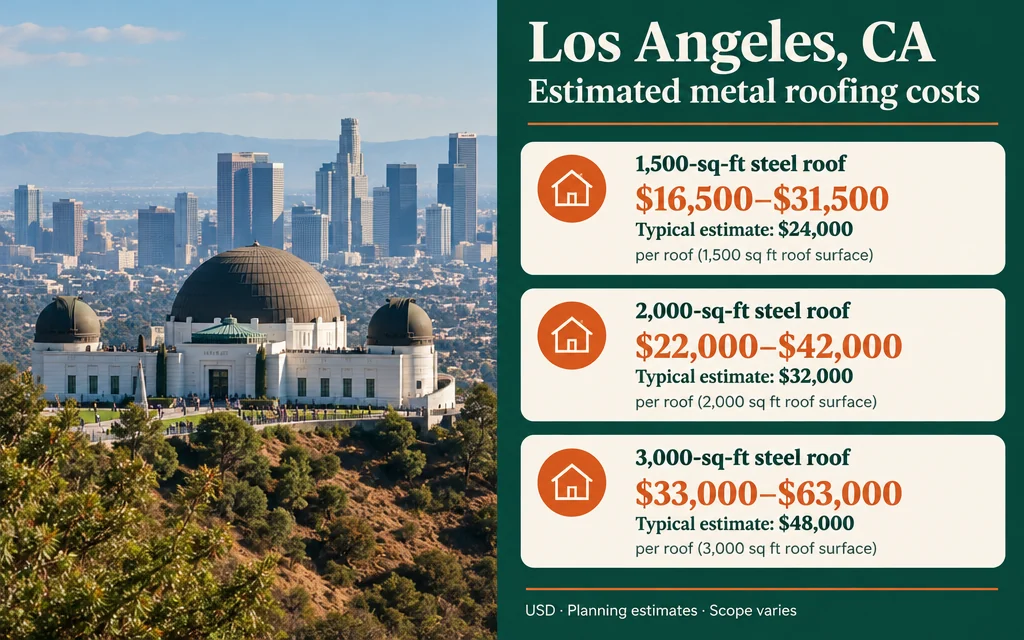
Calculated installed planning scenario for measured roof surface, including one-layer removal/disposal; conditional extras excluded.
Calculated installed planning scenario for measured roof surface, including one-layer removal/disposal; conditional extras excluded.
Calculated installed planning scenario for measured roof surface, including one-layer removal/disposal; conditional extras excluded.
Metal Roofing Pricing in Los Angeles
Installing a metal roof on a Los Angeles home requires budgeting for skilled metal fabrication, old-roof removal, and code-compliant flashing details. For single-family residences, standing-seam steel is the primary residential profile, where homeowners should budget $11–$21 per sq ft of roof surface (installed).
This planning baseline reflects a complete scope: stripping and disposing of one existing layer of asphalt shingles, checking the wooden roof deck, installing high-temperature self-adhering underlayment, and fastening concealed-clip panels with preformed perimeter flashings.
When reviewing bids, separate your home's interior living footprint from the actual roof area. A 2,000-square-foot single-story house frequently has between 2,200 and 2,600 square feet of roof surface once eaves, overhangs, and slope pitch are accounted for. In roofing terminology, 100 square feet of surface equals one roofing square. Confirming that all competing contractors base their quotes on the same measured roof surface ensures an accurate comparison.
Residential Metal Roofing Systems Compared
Residential metal roofing spans several distinct profiles, metals, and fastening configurations, each suited to different design goals and budgets:
Standing-Seam Steel (Concealed Fastener): Budget $11–$21 per sq ft of roof surface (installed). Panels interlock over hidden clips secured to the roof deck. Because the fasteners remain covered, the metal panels expand and contract freely during hot Southern California afternoons without fatiguing exposed rubber gaskets. Most single-family jobs specify 24-gauge or 26-gauge Galvalume steel finished with a factory-applied PVDF resin coating.
Exposed-Fastener Ribbed Steel: Budget $6.50–$12 per sq ft of roof surface (installed). These corrugated or ribbed sheets overlap at the ribs and are screwed directly through the face of the metal into the roof deck using gasketed screws. While the upfront investment is lower, the exposed rubber washers degrade under sustained sun exposure and require periodic inspection and eventual replacement. This profile generally requires a roof slope of 3:12 or steeper.
Steel Metal Shingles and Modular Profiles: Budget $8–$15 per sq ft of roof surface (installed). These stamped, interlocking steel shingles mimic the visual profile of architectural shingles, clay barrel tile, or cedar shakes. They provide a viable option for properties in homeowner associations with strict exterior style mandates.
Standing-Seam Aluminum: Budget $12–$22 per sq ft of roof surface (installed). Aluminum forms a natural oxide film that resists corrosion from sea breezes. For properties near coastal waters where salt mist is common, aluminum provides added protection against cut-edge rust.
Standing-Seam Copper: Budget $25–$45 per sq ft of roof surface (installed). Copper is an architectural metal that requires no factory paint finish and gradually patinas to a verdigris green over several decades. It demands specialized sheet-metal craftsmanship and carries substantially higher raw-material expenses.
| Service / assumptions | Low | Typical estimate | High | Pricing unit | Estimated labor time |
|---|---|---|---|---|---|
| Standing Seam Steel (Installed)Calculated standing-seam steel planning rate: comparable panel/accessory materials + installation labor + one-layer removal/disposal. Ordinary underlayment and details over sound decking included; conditional extra work excluded. | $11 | $16 | $21 | per sq ft of roof surface (installed) | N/A |
| Exposed-Fastener Steel (Installed)Corrugated or ribbed steel panels with exterior gasket screws, tear-off of 1 layer, and basic flashings. | $6.50 | $9 | $12 | per sq ft of roof surface (installed) | N/A |
| Steel Metal Shingles (Installed)Interlocking stamped steel shingles or stone-coated steel modular profiles, including tear-off. | $8 | $11.50 | $15 | per sq ft of roof surface (installed) | N/A |
| Standing Seam Aluminum (Installed)0.032-inch aluminum standing seam panels; optimal for coastal properties exposed to salt air. | $12 | $16.50 | $22 | per sq ft of roof surface (installed) | N/A |
| Standing Seam Copper (Installed)16-oz or 20-oz cold-rolled architectural copper with hand-seamed or mechanical double-lock joints. | $25 | $34 | $45 | per sq ft of roof surface (installed) | N/A |
Cost Components of a Standing Seam Roof
A full standing-seam steel estimate combines three primary trade allowances to reach the installed project baseline:
1. Materials and Accessories: Budget $4.25–$8.50 per sq ft of roof surface (materials only). This covers 24-gauge or 26-gauge PVDF-finished steel panels, concealed hold-down clips, mechanical fasteners, high-temperature underlayment, drip-edge trim, ridge caps, and valley flashings.
2. Installation Labor: Budget $5.50–$10 per sq ft of roof surface (installation labor only). Standing-seam work involves panel layout, hemming panel ends around perimeter drip edges, forming watertight valley transitions, and operating hand or mechanical seamers along every raised rib.
3. Tear-Off and Disposal: Budget $1.25–$2.50 per sq ft of roof surface (one-layer removal and disposal). This covers stripping a single existing layer of asphalt shingles down to bare plywood or board decking, pulling stray fasteners, hauling away debris, and paying regional disposal fees.
| Service / assumptions | Low | Typical estimate | High | Pricing unit | Estimated labor time |
|---|---|---|---|---|---|
| Standing Seam Steel Panels & MaterialsPanels, concealed clips, fasteners, high-temp self-adhering underlayment, drip edge, and ridge caps. | $4.25 | $6.25 | $8.50 | per sq ft of roof surface (materials only) | N/A |
| Standing Seam Installation LaborSpecialized metal roofing crew labor for panel layout, seaming, valleys, gables, and basic penetrations. | $5.50 | $8 | $10 | per sq ft of roof surface (installation labor only) | N/A |
| Tear-Off & Disposal (One Layer)Stripping one layer of existing asphalt shingles down to deck, hauling, and Los Angeles disposal fees. | $1.25 | $1.75 | $2.50 | per sq ft of roof surface (one-layer removal and disposal) | N/A |
Planning Budgets by Roof Size
Applying the installed baseline rate to typical roof areas gives clear planning ranges for full reroofing projects over sound decking:
For a smaller residence or detached structure with 1,500 square feet of roof surface, budget $16,500–$31,500 per roof (1,500 sq ft roof surface). On straightforward gable rooflines, expect on-site crew time of 2-4 working days.
For an average single-family home with 2,000 square feet of measured roof surface, budget $22,000–$42,000 per roof (2,000 sq ft roof surface). Elapsed on-site work typically spans 3-5 working days for shingle removal, underlayment dry-in, and panel installation.
For a larger home with 3,000 square feet of roof surface, budget $33,000–$63,000 per roof (3,000 sq ft roof surface). Complex roof layouts involving multiple hips, valleys, and dormers typically take 4-7 working days of elapsed crew work.
| Service / assumptions | Low | Typical estimate | High | Pricing unit | Estimated labor time |
|---|---|---|---|---|---|
| 1,500 Sq Ft Roof ReplacementCalculated scenario: 1,500 sq ft of measured roof surface × standing-seam steel installed planning rate. Includes its same materials, installation, one-layer removal/disposal and sound-deck assumptions. Not a provider whole-roof quote. | $16,500 | $24,000 | $31,500 | per roof (1,500 sq ft roof surface) | 2-4 working days |
| 2,000 Sq Ft Roof ReplacementCalculated scenario: 2,000 sq ft of measured roof surface × standing-seam steel installed planning rate. Includes its same materials, installation, one-layer removal/disposal and sound-deck assumptions. Not a provider whole-roof quote. | $22,000 | $32,000 | $42,000 | per roof (2,000 sq ft roof surface) | 3-5 working days |
| 3,000 Sq Ft Roof ReplacementCalculated scenario: 3,000 sq ft of measured roof surface × standing-seam steel installed planning rate. Includes its same materials, installation, one-layer removal/disposal and sound-deck assumptions. Not a provider whole-roof quote. | $33,000 | $48,000 | $63,000 | per roof (3,000 sq ft roof surface) | 4-7 working days |
Standing Seam Metal vs. Architectural Asphalt Shingles
Choosing between standing-seam steel and architectural asphalt shingles involves balancing upfront expenditure against long-term maintenance and durability.
In regional reference data, replacing a roof with architectural asphalt shingles typically requires a budget of $6–$12 per sq ft of roof surface (installed). Standing-seam steel budgets $11–$21 per sq ft of roof surface (installed). For a typical 2,000-square-foot roof surface, a complete standing-seam replacement budgets $22,000–$42,000 per roof (2,000 sq ft roof surface), reflecting the higher material specification and specialized panel-seaming labor.
Standard asphalt shingles degrade gradually under prolonged solar ultraviolet radiation and seasonal temperature swings, commonly requiring reroofing after 20 to 30 years. A properly installed standing-seam metal roof offers extended weather durability and requires minimal routine maintenance beyond clearing gutters and valleys. If you plan to own your home for decades, the initial investment helps you bypass subsequent reroofing cycles. For homeowners anticipating a move within a few years, asphalt shingles represent a smaller initial cash outlay.
| Service / assumptions | Low | Typical estimate | High | Pricing unit | Estimated labor time |
|---|---|---|---|---|---|
| Architectural Asphalt Shingles (Installed)Standard reference system: architectural shingles, synthetic underlayment, 1-layer tear-off, and disposal. Published rate reference for the stated roofing scope and unit, not verification of this guide's modeled range, a complete roof quote or provider availability. Regional reference; not a verified Los Angeles-specific quote.Published price reference ↗ | $6 | $8.50 | $12 | per sq ft of roof surface (installed) | N/A |
| Comparison | Architectural asphalt | Standing-seam steel |
|---|---|---|
| Up-front planning estimate · 2,000 sq ft roof surface | $12,000–$24,000 | $22,000–$42,000 |
| What the baseline includes | Architectural asphalt, ordinary installed details, one-layer removal/disposal over sound decking. | Standing-seam steel, ordinary installed details, one-layer removal/disposal over sound decking. |
| Maintenance and repairs | Confirm product-specific inspections and repair terms. | Confirm seams, fasteners, coating, compatible repairs and inspection terms. |
| Insurance and ownership cost | Ask the insurer about the exact product and coverage. | Ask the insurer about accepted test documentation, any available credit and cosmetic-damage exclusions. |
These are calculated budgeting comparisons, not provider quotes or guaranteed lifetime savings. Compare your expected ownership period, specified products, actual maintenance proposals and written insurance terms.
| Decision point | Roof repair | Roof replacement | Metal roofing |
|---|---|---|---|
| Work being priced | A defined defect, such as damaged shingles or flashing. | Removal and installation of an agreed roof system across the measured roof surface. | A specified installed metal system; standing seam, exposed fasteners and metal shingles are different scopes. |
| What to inspect | The leak source, surrounding material and whether a durable localized fix is feasible. | The extent of deterioration, decking condition, roof details and suitable replacement systems. | The substrate, panel profile, coating, fasteners, roof geometry and installation details. |
| How to compare prices | Match the repair quantity, access, materials and included diagnosis. | Match measured roof area, material, tear-off layers, disposal and installed inclusions. | Match measured roof area, system, components, removal and conditional additional work. |
| Before deciding | Ask what the repair addresses and what existing problems would remain. | Ask whether repair remains practical and which additional items would change the total. | Ask about compatible materials, documented product/assembly ratings and product versus workmanship warranties. |
Age or a repair-cost percentage alone does not determine the right choice. Ask a qualified roofing contractor to assess the condition and explain viable options. A metal system is a material-specific installation choice, not a separate guarantee of durability or savings.
Additional Work and Conditional Scopes
Standard baseline quotes assume sound wood decking and accessible, unobstructed roof planes. Real-world properties frequently require specific add-on items depending on roof condition and geometry:
Second-Layer Tear-Off: When an existing roof already has two shingle layers installed, stripping the additional layer adds disposal weight and labor, requiring a budget of $45–$95 additional per roofing square (100 sq ft).
Plywood Decking Repairs: Hidden moisture damage or rotten deck boards cannot be fully diagnosed until the existing shingles are stripped. Replacing damaged sub-decking budgets $85–$150 additional per 4-by-8-ft sheet (32 sq ft).
Chimney Flashing: Fabricating custom two-piece metal counter-flashing and a small rear diversion cricket around a masonry or framed chimney budgets $350–$950 additional per chimney.
Skylight Integration: Fitting curb-mounted skylights into raised standing seams requires custom step, head, and sill flashings, budgeting $250–$750 additional per skylight.
Continuous Ridge Ventilation: Adding a baffled, perforated metal ridge vent for continuous passive attic exhaust budgets $14–$35 additional per linear ft.
Snow Retention: Properties in higher-elevation foothill areas subject to occasional winter icing may use non-penetrating clamp-on snow guards, budgeting $20–$50 additional per linear ft.
Gutter Handling: When existing seamless gutters are in good condition, detaching and resetting them to clear the perimeter drip edge budgets $6–$16 additional per linear ft.
| Service / assumptions | Low | Typical estimate | High | Pricing unit | Estimated labor time |
|---|---|---|---|---|---|
| Second Layer Tear-Off & DisposalAdditional labor and disposal surcharges when stripping a second existing layer of composition shingles. | $45 | $65 | $95 | additional per roofing square (100 sq ft) | N/A |
| Plywood Decking ReplacementFurnish and install 1/2-inch CDX plywood or OSB over damaged rafter framing, with old panel exposed. | $85 | $115 | $150 | additional per 4-by-8-ft sheet (32 sq ft) | N/A |
| Custom Chimney Flashing KitTwo-piece metal counter-flashing and cricket fabrication for masonry or framed chimneys. | $350 | $600 | $950 | additional per chimney | N/A |
| Skylight Flashing IntegrationCustom-fabricated metal head, sill, and step flashing integrated around existing curb-mounted skylights. | $250 | $450 | $750 | additional per skylight | N/A |
| Continuous Vented Ridge FlashingPerforated baffled metal ridge vent upgrade for continuous attic exhaust along roof ridges. | $14 | $22 | $35 | additional per linear ft | N/A |
| Snow Retention Bar / Guard SystemNon-penetrating clamp-on standing seam snow guards or rail retention systems for foothill snow zones. | $20 | $32 | $50 | additional per linear ft | N/A |
| Detach & Reset Existing GuttersCarefully removing existing seamless gutters to install drip edge and reinstalling upon completion. | $6 | $10 | $16 | additional per linear ft | N/A |
Performance Standards: Fire, Wind, Impact, and Title 24
While metal panels possess durable physical characteristics, real-world building performance depends on the entire roof assembly rather than the metal skin alone:
Fire Ratings: Steel and aluminum panels are noncombustible, but an official Class A fire rating requires a tested assembly that includes the specified underlayment, roof deck, and panel profile. In designated wildfire hazard zones, ask contractors to verify that their proposed assembly meets local building department submittal requirements.
Impact and Hail: Many standing-seam profiles carry a UL 2218 Class 4 impact rating. This laboratory standard measures resistance to puncturing and tearing from hail and small debris, but it is not a guarantee against visible cosmetic denting. Confirm with your insurance carrier whether cosmetic metal damage is covered under your policy terms.
Wind Uplift: Concealed-clip standing-seam assemblies offer strong wind resistance when clip spacing, fastener patterns, and perimeter eaves are installed strictly according to manufacturer engineering specifications.
Title 24 Energy Compliance: Factory-painted metal panels with certified cool-roof coatings reflect solar heat away from the attic, helping limit radiant heat transfer during hot summer days. Verify that your selected panel color meets the solar reflectance and thermal emittance values specified in current California Energy Code (Title 24) standards for your climate zone.
Local Cost Drivers in Los Angeles
Several jobsite conditions and property characteristics influence final metal roofing costs across the Los Angeles area:
Roof Pitch and Geometry: Slopes of 7:12 or steeper require harness staging, specialized roof scaffolding, and slower panel maneuvering. Rooflines with numerous dormers, valleys, hips, and skylights require extensive hand brake work, pushing labor toward the higher end of the planning range.
Marine Proximity: Galvalume steel performs dependably across inland areas. However, within a mile or two of the Pacific coastline, airborne salt mist can accelerate edge corrosion on cut steel ends. In these oceanfront environments, standing-seam aluminum offers higher corrosion resistance, though at a slightly higher material investment.
Permits and Plan Review: Building permit fees and review protocols depend on whether the property falls under the Los Angeles Department of Building and Safety (LADBS) or an adjacent incorporated municipality. Check in advance whether your specific address requires structural deck load calculations or dedicated fire-hazard review.
Access and Panel Staging: Narrow hillside roads, compact residential lots, and overhead utility lines complicate the delivery of long metal panels. Sites with restricted staging space may require panels to be formed off-site and hand-carried to the roof, adding material handling time to the contractor's labor quote.
Hiring a Metal Roofing Contractor in Los Angeles
Standing-seam metal roofing requires distinct sheet-metal tools and forming techniques that general shingle installers may not routinely use. Vetting your contractor's qualifications helps safeguard your investment:
Verify Licensing and Insurance: Check that your contractor holds an active C-39 roofing contractor license with the California Contractors State License Board (CSLB). Request current certificates for commercial general liability insurance and workers' compensation coverage, and verify that the business name on the paperwork matches your contract.
Establish Milestone Payments: Insist on a written payment schedule tied directly to observable job progress. A standard arrangement includes an initial deposit, a progress payment upon material delivery to your site, a draw after tear-off and dry-in underlayment installation, and a final balance paid only after municipal building inspection sign-off.
Separate Finish and Workmanship Warranties: Differentiate between the factory paint warranty (which protects against chalking or color fading) and the contractor's installation warranty (which covers leak-free flashing details and panel seams). Confirm whether panels will be factory roll-formed or run on site, and verify that flashings are mechanically hemmed rather than relying exclusively on surface caulk.
Agree on Decking Rates in Advance: Ensure your written contract states a fixed replacement cost per 4-by-8-foot sheet for damaged plywood or OSB identified during tear-off. Establishing this unit cost in advance prevents billing disputes once your decking is uncovered.
Local income & housing costs
Los Angeles city, California · U.S. Census Bureau, 2025 ACS 1-year estimates.
per month · ±$21
Cash-rent units; includes applicable tenant-paid utilities
Census source ↗Dollar amounts use the survey period’s published basis. Income is annual; gross rent is monthly. Home value reflects owner-occupied housing values. Margins of error shown are at the ACS 90% confidence level. These statistics provide city context; service budgets use their own pricing evidence.
STATEWIDE COST CONTEXT
California prices, income & labor costs
These California figures provide background for this city guide. They describe different measures and reference years; employee wages are not prices charged by a contractor.
BEA SAIRPD
State price change indicator
136.92024 · index (2017 basis)
Annual figures & sources
| Year | Value | 90% margin of error | Source |
|---|---|---|---|
| 2020 | 117.2 | — | Official source |
| 2021 | 122.0 | — | Official source |
| 2022 | 130.7 | — | Official source |
| 2023 | 135.2 | — | Official source |
| 2024 | 136.9 | — | Official source |
Census ACS 1-year
Median household income
$102,1592025 · USD/year
Annual figures & sources
| Year | Value | 90% margin of error | Source |
|---|---|---|---|
| 2021 | $84,907 | ±$542 | Official source |
| 2022 | $91,551 | ±$471 | Official source |
| 2023 | $95,521 | ±$611 | Official source |
| 2024 | $100,149 | ±$381 | Official source |
| 2025 | $102,159 | ±$390 | Official source |
BLS OEWS
Roofers
$30.582025 · USD/hour
Annual figures & sources
| Year | Value | 90% margin of error | Source |
|---|---|---|---|
| 2025 | $30.58 | — | Official source |
State prices: BEA, 2020–2024. Household income: Census ACS, 2021–2025. Employee wages: BLS, May 2025 snapshot. The charts retain their own units and fitted scales.
Explore all California living-cost data and trends →Local context and limitations
Direct, published contractor quotes for residential metal roof replacements within the city of Los Angeles are limited. Consequently, the rates in this guide rely on regional California cost data combined with component-based engineering estimates. Jobsite conditions across Los Angeles influence final costs substantially: coastal neighborhoods face salt-laden marine air that can cause edge corrosion on cut steel panels, while foothill properties located in designated fire hazard zones require tested Class A noncombustible roof assemblies. Because permitting paths, Title 24 cool-roof requirements, and structural reviews under the Los Angeles Department of Building and Safety (LADBS) vary by address, treat these figures as initial planning benchmarks and obtain written estimates from licensed California C-39 roofing contractors.
Frequently asked questions
What is the difference between standing seam and exposed-fastener metal roofs?
Standing seam uses concealed clips hidden beneath raised, interlocking seams. This shields fasteners from sun exposure and allows the metal to expand and contract freely. Exposed-fastener roofs use screws driven directly through the face of the panels with rubber washers. Standing seam budgets $11–$21 compared to $6.50–$12 per sq ft of roof surface (installed) for exposed fasteners, but standing seam provides stronger leak prevention and avoids periodic washer maintenance.
How much does a standing seam metal roof cost in Los Angeles for an average home?
For an average residence with 2,000 square feet of measured roof surface, a complete standing-seam steel replacement typically budgets $22,000–$42,000 per roof (2,000 sq ft roof surface). This planning figure covers removing one layer of old shingles, installing high-temperature underlayment, and securing panels and flashings over sound roof decking.
Can a metal roof be installed directly over existing asphalt shingles?
Whether an overlay is permitted depends on local building regulations, structural load limits, and manufacturer warranty terms. However, roofing professionals generally recommend a complete tear-off down to bare wood. Removing old shingles allows crews to inspect the decking for hidden rot, creates an even surface that minimizes visible metal distortion, and ensures underlayment seals directly to the substrate.
Is steel or aluminum better for a metal roof in Los Angeles?
For most inland areas, Galvalume steel provides high structural strength, fire resistance, and cost efficiency. For homes located close to the coast where ocean breezes carry salt moisture, aluminum standing seam is generally preferred because aluminum naturally resists corrosion along raw cut edges and penetrations.
Does a metal roof comply with California Title 24 and wildfire regulations?
Factory-painted metal panels with certified cool-roof finishes meet California Title 24 solar reflectance standards. For wildfire areas, metal panels achieve a Class A fire rating when installed as part of an approved, tested roof assembly that includes fire-resistant underlayment and solid decking. Confirm exact assembly specifications with your local building authority.
What payment schedule should I expect for a residential metal roofing project?
Expect clear milestone payments detailed in your written agreement. A customary payment structure includes an initial calendar deposit, followed by progress payments when materials arrive on site and after tear-off and dry-in underlayment are completed. The final balance is paid only after passing local municipal building inspection and completing final punch-list items.
Sources and methodology
Sources below retain their recorded retrieval dates and geographic scope. We checked the quoted rates against readable public pricing pages. The tables remain planning estimates, not provider quotes or a measured citywide survey. Per-square-foot references do not establish the modeled whole-roof totals or all their installed inclusions. Regional references are not verified Los Angeles-specific quotes. Confirm removal, disposal, materials, labor and the complete scope in a written proposal.
Published pricing pages retrieved; quoted excerpts checked automatically. 2 distinct website domains. · Generated 2026-11-11
- Metal Roof Installation: Cost, Process and TimelineState / regional reference · Page retrieved 2026-11-11 · Price excerpt matched automatically
“Standing seam typically runs about $12–$22 per square foot installed in 2026, or roughly $24,000–$44,000 for a 2,000 sq ft roof.”
Planning ranges may differ from these published examples; they are not provider quotes.
- How Much Does a Metal Roof Cost Per Square Foot in 2026: A Complete Guide for California Homeowners - Cobex - Sacramento RooferState / regional reference · Page retrieved 2026-11-11 · Price excerpt matched automatically
“Cost Comparison Asphalt shingles often cost $3 to $6 per square foot for 3‑tab or $5 to $10 per square foot for architectural shingle installation.”
Planning ranges may differ from these published examples; they are not provider quotes.
Plan your metal roofing project
Choose your service and answer its project questions. Add notes or photos if helpful, then generate your project brief. The planner labels its budgeting assumptions separately. Use your plan to compare the scope and assumptions with a provider. Contact sharing and provider matching are not available yet.
Open the project planner →Share this city’s cost data
<> Embed Los Angeles Cost Data on Your Site
The HTML table shows the prices at the time of copying. The iframe follows the published guide.