Garland · TX · COST GUIDE
Metal Roofing Costs in Garland, TX (2026)
For budgeting, standing-seam steel roofing is estimated at $12–$18.50 per sq ft of roof surface, and exposed-fastener steel at $5–$9 per sq ft. These installed planning ranges include one-layer removal/disposal over sound decking; compare the specified system and conditional extras.
Standing Seam Steel (Concealed Fastener)
Budget estimate$12–$18.50per sq ft of roof surface (installed)
Planning range · Compare the roof area, material and included work in your quote.
Exposed Fastener Steel (R-Panel / Corrugated)
Budget estimate$5–$9per sq ft of roof surface (installed)
Planning range · Compare the roof area, material and included work in your quote.
Published examples apply to their stated scope. Budget ranges are estimates.
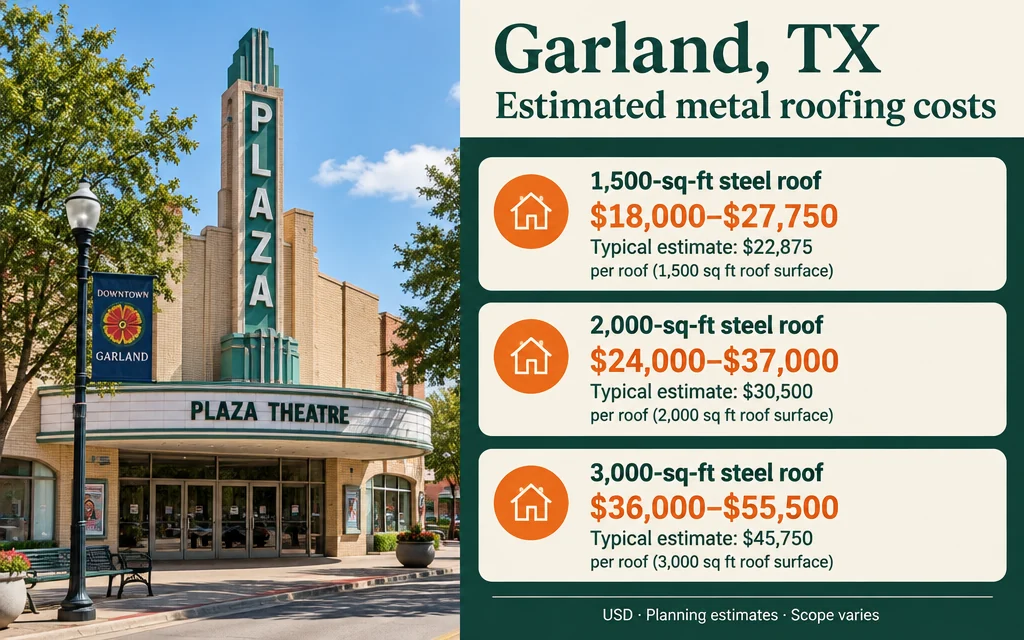
Calculated installed planning scenario for measured roof surface, including one-layer removal/disposal; conditional extras excluded.
Calculated installed planning scenario for measured roof surface, including one-layer removal/disposal; conditional extras excluded.
Calculated installed planning scenario for measured roof surface, including one-layer removal/disposal; conditional extras excluded.
Understanding Residential Metal Roofing in Garland
Metal roofing across Garland and northern Dallas County offers high solar reflectance during hot Texas summers along with dependable wind performance during severe storm seasons. When planning your budget, remember that your total roof surface area will always exceed your interior living space.
Roof pitch, overhang eaves, and architectural details like valleys, hips, and dormers add surface area beyond your home's ground footprint.
Baseline estimates in this guide assume a complete installation: tear-off and haul-away of one existing layer of asphalt shingles, inspection of sound decking, high-temperature synthetic underlayment, perimeter drip-edge and flashing details, and complete panel attachment. For standing seam steel, budget $12–$18.50 per sq ft of roof surface (installed). Unforeseen structural repairs, such as replacing damaged decking sheets or framing custom chimney crickets, are billed conditionally as separate line items.
Metal Roofing Systems Compared
Each metal roofing profile uses different manufacturing methods, attachment styles, and field labor requirements:
• Concealed-Fastener Standing Seam Steel: Budget $12–$18.50 per sq ft of roof surface (installed). The standard choice for residential re-roofing. Fasteners are concealed beneath raised interlocking seams using concealed expansion clips. This design allows panels to expand and contract smoothly across wide Garland temperature swings without putting shear stress on screws. Panels typically feature 24- or 26-gauge Galvalume steel with a durable PVDF finish.
• Exposed-Fastener Steel (R-Panel / Corrugated): Budget $5–$9 per sq ft of roof surface (installed). Commonly chosen for detached garages, porches, and simpler residential roofs. Screws are driven straight through the face of the metal with rubberized neoprene or EPDM washers. While upfront costs are lower, washers face heavy degradation under intense North Texas UV rays, requiring routine inspections and screw replacement over time.
• Steel Metal Shingles and Tiles: Budget $9–$14 per sq ft of roof surface (installed). Stamped or stone-coated steel modules recreate the look of slate, cedar shakes, or barrel tile while providing the strength of steel. These panels are often favored in subdivisions with specific architectural roofline rules.
• Standing Seam Aluminum: Budget $14–$21 per sq ft of roof surface (installed). A lightweight alternative to steel. Because Garland is inland, aluminum is rarely essential for salt-air resistance, but its natural rust resistance makes it appealing for homeowners seeking a low-weight metal.
• Standing Seam Copper: Budget $18–$34 per sq ft of roof surface (installed). A premium architectural metal designed for long service life without painting, developing a distinctive patina over decades. Copper requires artisan soldering and specialized installation, sitting at the top of the price range.
| Service / assumptions | Low | Typical estimate | High | Pricing unit | Estimated labor time |
|---|---|---|---|---|---|
| Standing Seam Steel (Concealed Fastener)Calculated standing-seam steel planning rate based on regional Texas references: comparable panel/accessory materials + installation labor + one-layer removal/disposal. Ordinary underlayment and details over sound decking included; conditional extra work excluded. Regional benchmark; not a verified Garland-specific contractor bid.Published price reference ↗ | $12 | $15.25 | $18.50 | per sq ft of roof surface (installed) | 3-5 business days |
| Exposed Fastener Steel (R-Panel / Corrugated)Regional Texas planning estimate for 26-29 gauge face-screwed panels with neoprene washers, synthetic underlayment, and 1-layer removal over sound decking. Regional benchmark; not a verified Garland-specific contractor bid. | $5 | $7 | $9 | per sq ft of roof surface (installed) | 2-3 business days |
| Steel Metal Shingles / TilesStone-coated or stamped steel modular shingles including tear-off, underlayment, and edge trim. | $9 | $11.50 | $14 | per sq ft of roof surface (installed) | 3-5 business days |
| Standing Seam Aluminum0.032 to 0.040 inch aluminum standing seam panels, fully installed with 1-layer tear-off. | $14 | $17.50 | $21 | per sq ft of roof surface (installed) | 3-5 business days |
| Standing Seam Copper16-20 oz architectural copper panels, soldered transitions, clips, and tear-off included. | $18 | $26 | $34 | per sq ft of roof surface (installed) | 1-2 weeks |
Component Allowances for Standing Seam Steel
The overall installed cost for a standing seam steel roof reflects three essential trade components:
1. Materials and Underlayment: Budget $4.50–$7 per sq ft of roof surface (materials only). Covers 24-gauge Galvalume coil or pre-formed panels, concealed clips, fasteners, ridge vents, eave and rake flashings, and high-temp self-adhering underlayment.
2. Installation Labor: Budget $6–$9.50 per sq ft of roof surface (installation labor only). Covers skilled sheet-metal tradespeople who roll-form panels, interlock seam joints, fold transitions, and secure watertight perimeter terminations.
3. Tear-Off and Disposal: Budget $1.50–$2 per sq ft of roof surface (one-layer removal and disposal). Covers removing the original shingle layer, hauling debris off-site, paying local transfer fees, and running a magnetic sweep around the yard.
These components make up the baseline installed estimate rather than extra surcharges. Conditional items, such as rotted plywood or framing repairs, are billed separately.
| Service / assumptions | Low | Typical estimate | High | Pricing unit | Estimated labor time |
|---|---|---|---|---|---|
| Standing Seam Steel Materials & Underlayment24-ga PVDF steel panels, concealed clips, fasteners, high-temp underlayment, and standard flashings. | $4.50 | $5.75 | $7 | per sq ft of roof surface (materials only) | N/A |
| Standing Seam Steel Installation LaborOn-site panel roll-forming/fitting, seam mechanical locking or snapping, and detailing over sound deck. | $6 | $7.75 | $9.50 | per sq ft of roof surface (installation labor only) | N/A |
| One-Layer Shingle Removal & DisposalTear-off of one asphalt shingle layer, roll-off dumpster rental, haul-away, and magnetic sweep. | $1.50 | $1.75 | $2 | per sq ft of roof surface (one-layer removal and disposal) | N/A |
Installed Standing Seam Budgets by Roof Area
Because roof slope and overhangs expand actual surface area, a typical one-story home has more roof surface than interior floor space. Below are planning figures for standing seam steel across standard roof surface sizes:
• 1,500 sq ft roof surface: Common on a compact single-story home or cottage. Budget $18,000–$27,750 per roof (1,500 sq ft roof surface), with on-site crew work taking 2-3 business days.
• 2,000 sq ft roof surface: Typical for an average single-story suburban property. Budget $24,000–$37,000 per roof (2,000 sq ft roof surface), with on-site work running 3-4 business days.
• 3,000 sq ft roof surface: Sized for larger homes or complex designs with multiple valleys and gables. Budget $36,000–$55,500 per roof (3,000 sq ft roof surface), with on-site installation typically requiring 4-6 business days.
| Service / assumptions | Low | Typical estimate | High | Pricing unit | Estimated labor time |
|---|---|---|---|---|---|
| Standing Seam Roof (1,500 sq ft surface)Calculated scenario: 1,500 sq ft of measured roof surface × standing-seam steel installed planning rate. Includes its same materials, installation, one-layer removal/disposal and sound-deck assumptions. Not a provider whole-roof quote. | $18,000 | $22,875 | $27,750 | per roof (1,500 sq ft roof surface) | 2-3 business days |
| Standing Seam Roof (2,000 sq ft surface)Calculated scenario: 2,000 sq ft of measured roof surface × standing-seam steel installed planning rate. Includes its same materials, installation, one-layer removal/disposal and sound-deck assumptions. Not a provider whole-roof quote. | $24,000 | $30,500 | $37,000 | per roof (2,000 sq ft roof surface) | 3-4 business days |
| Standing Seam Roof (3,000 sq ft surface)Calculated scenario: 3,000 sq ft of measured roof surface × standing-seam steel installed planning rate. Includes its same materials, installation, one-layer removal/disposal and sound-deck assumptions. Not a provider whole-roof quote. | $36,000 | $45,750 | $55,500 | per roof (3,000 sq ft roof surface) | 4-6 business days |
Comparing Standing Seam Metal to Architectural Shingles
In North Texas, a standard architectural shingle roof runs budget $3.50–$5.50 per sq ft of roof surface (installed). Standing seam steel demands roughly two to three times that initial commitment, running budget $12–$18.50 per sq ft of roof surface (installed), but it offers a fundamentally different long-term ownership profile.
Asphalt shingles in the Dallas area experience steady granule loss and drying from relentless UV radiation, and they are susceptible to wind uplift during severe spring squalls. Standing seam metal is non-combustible and sheds wind cleanly. However, your decision should weigh your available budget and how long you plan to remain in the property, as a metal roof requires substantially higher upfront capital.
| Service / assumptions | Low | Typical estimate | High | Pricing unit | Estimated labor time |
|---|---|---|---|---|---|
| Architectural Asphalt Shingles ReferenceInstalled architectural shingles baseline with 1-layer tear-off and synthetic underlayment. | $3.50 | $4.50 | $5.50 | per sq ft of roof surface (installed) | 1-2 business days |
| Comparison | Architectural asphalt | Standing-seam steel |
|---|---|---|
| Up-front planning estimate · 2,000 sq ft roof surface | $7,000–$11,000 | $24,000–$37,000 |
| What the baseline includes | Architectural asphalt, ordinary installed details, one-layer removal/disposal over sound decking. | Standing-seam steel, ordinary installed details, one-layer removal/disposal over sound decking. |
| Maintenance and repairs | Confirm product-specific inspections and repair terms. | Confirm seams, fasteners, coating, compatible repairs and inspection terms. |
| Insurance and ownership cost | Ask the insurer about the exact product and coverage. | Ask the insurer about accepted test documentation, any available credit and cosmetic-damage exclusions. |
These are calculated budgeting comparisons, not provider quotes or guaranteed lifetime savings. Compare your expected ownership period, specified products, actual maintenance proposals and written insurance terms.
| Decision point | Roof repair | Roof replacement | Metal roofing |
|---|---|---|---|
| Work being priced | A defined defect, such as damaged shingles or flashing. | Removal and installation of an agreed roof system across the measured roof surface. | A specified installed metal system; standing seam, exposed fasteners and metal shingles are different scopes. |
| What to inspect | The leak source, surrounding material and whether a durable localized fix is feasible. | The extent of deterioration, decking condition, roof details and suitable replacement systems. | The substrate, panel profile, coating, fasteners, roof geometry and installation details. |
| How to compare prices | Match the repair quantity, access, materials and included diagnosis. | Match measured roof area, material, tear-off layers, disposal and installed inclusions. | Match measured roof area, system, components, removal and conditional additional work. |
| Before deciding | Ask what the repair addresses and what existing problems would remain. | Ask whether repair remains practical and which additional items would change the total. | Ask about compatible materials, documented product/assembly ratings and product versus workmanship warranties. |
Age or a repair-cost percentage alone does not determine the right choice. Ask a qualified roofing contractor to assess the condition and explain viable options. A metal system is a material-specific installation choice, not a separate guarantee of durability or savings.
Additional Work and Conditional Line Items
Certain scope items depend on the condition of your home once the old roof is removed and are quoted as separate line items:
• Rotted Decking: Any soft or rotted plywood discovered after tear-off must be replaced before dry-in. Budget $70–$100 additional per 4-by-8-ft sheet (32 sq ft) installed.
• Secondary Layer Tear-Off: If your roof has an older re-roof layer underneath, stripping that extra layer adds labor and hauling weight. Budget $35–$60 additional per roofing square (100 sq ft).
• Chimney Details: Masonry chimneys need custom metal crickets and counterflashings. Budget $350–$700 additional per chimney.
• Skylight Flashings: Curb-mounted skylights need sealed custom transitions into the metal pans. Budget $250–$500 additional per skylight.
• Ridge Ventilation: Continuous baffled ridge vents promote steady attic airflow. Budget $12–$20 additional per linear ft.
• Gutter Detach and Reset: Removing gutters to install perimeter drip edge cleanly runs budget $5–$10 additional per linear ft.
| Service / assumptions | Low | Typical estimate | High | Pricing unit | Estimated labor time |
|---|---|---|---|---|---|
| Additional Layer Tear-OffLabor and disposal fee to strip a secondary underlying layer of shingles. | $35 | $47.50 | $60 | additional per roofing square (100 sq ft) | N/A |
| Rotted Decking ReplacementRemoval and replacement of rotted CDX plywood or OSB subdecking with roof exposed. | $70 | $85 | $100 | additional per 4-by-8-ft sheet (32 sq ft) | N/A |
| Custom Chimney Flashing KitCustom-fabricated metal cricket, backpan, counterflashing, and reglet sealant. | $350 | $525 | $700 | additional per chimney | N/A |
| Skylight Flashing & Curb DetailSpecialty flashing kit integrated into standing seam pans around existing curb. | $250 | $375 | $500 | additional per skylight | N/A |
| Continuous Ridge Ventilation UpgradePerforated baffled metal ridge vent profile designed for standing seam panels. | $12 | $16 | $20 | additional per linear ft | N/A |
| Snow Retention Bar / ClampsNon-penetrating seam clamps and continuous snow bar across walkways and entries. | $25 | $35 | $45 | additional per linear ft | N/A |
| Gutter Detach & ResetTemporary removal and reinstallation of existing seamless gutters to allow drip-edge work. | $5 | $7.50 | $10 | additional per linear ft | N/A |
Weather Performance, Hail Ratings, and Insurance
North Texas lies in a recognized hail corridor, making impact resistance a major consideration for homeowners. Many 24-gauge standing seam systems achieve a UL 2218 Class 4 rating, which certifies that the metal passed lab testing against a dropped two-inch steel sphere without splitting or cracking.
A Class 4 test rating does not mean a roof is dent-proof. Severe hail storms can still leave visible indentations on metal surfaces even when seams hold watertight. Some property insurance carriers offer policy discounts for certified Class 4 installations, but discounts are never guaranteed. Contact your insurance agent directly to ask if your policy qualifies. Be sure to ask whether qualifying requires signing a cosmetic damage waiver, which releases the insurer from paying for hail claims unless the metal is actually punctured or leaking.
Key Drivers of Metal Roofing Quotes
Three critical job variables influence where your Garland quote lands within the cost range:
1. Steel Thickness (Gauge): 24-gauge steel is thicker and offers superior resistance to denting and visible surface waviness ('oil-canning') compared to lighter 26- or 29-gauge sheets.
2. Fastening and Seam Profile: Snap-lock standing seam profiles click together cleanly by hand, reducing labor hours on walkable slopes. Mechanically seamed panels require an electric seaming machine to crimp the metal folds on-site, adding crew time but providing exceptional wind uplift resistance on lower pitches.
3. Roof Architecture: A straightforward two-sided gable roof requires minimal trim and low scrap waste. Complex rooflines with dormers, intersecting hips, and varied roof angles require custom on-site brake bending, driving up skilled sheet-metal labor.
Hiring a Metal Roofing Specialist in Garland
Installing standing seam metal requires specialized sheet-metal training that differs from asphalt shingle installation. Poor clip placement, over-tightened fasteners, or inadequate expansion room will cause panels to buckle and fail.
When reviewing bids from local contractors, clarify these questions in writing:
• Do you roll-form panel profiles on-site or order factory-measured lengths from a regional supplier?
• What exact steel gauge, base metal (such as Galvalume AZ50), and paint coating (such as Kynar 500) are specified?
• Does your company pull necessary permits with the City of Garland Building Inspection department and schedule the final municipal inspection?
• What workmanship warranty do you back directly, separate from the manufacturer's finish warranty?
Local income & housing costs
Garland city, Texas · U.S. Census Bureau, 2025 ACS 1-year estimates.
per month · ±$92
Cash-rent units; includes applicable tenant-paid utilities
Census source ↗Dollar amounts use the survey period’s published basis. Income is annual; gross rent is monthly. Home value reflects owner-occupied housing values. Margins of error shown are at the ACS 90% confidence level. These statistics provide city context; service budgets use their own pricing evidence.
STATEWIDE COST CONTEXT
Texas prices, income & labor costs
These Texas figures provide background for this city guide. They describe different measures and reference years; employee wages are not prices charged by a contractor.
BEA SAIRPD
State price change indicator
120.02024 · index (2017 basis)
Annual figures & sources
| Year | Value | 90% margin of error | Source |
|---|---|---|---|
| 2020 | 103.4 | — | Official source |
| 2021 | 107.2 | — | Official source |
| 2022 | 113.1 | — | Official source |
| 2023 | 117.1 | — | Official source |
| 2024 | 120.0 | — | Official source |
Census ACS 1-year
Median household income
$82,6252025 · USD/year
Annual figures & sources
| Year | Value | 90% margin of error | Source |
|---|---|---|---|
| 2021 | $66,963 | ±$513 | Official source |
| 2022 | $72,284 | ±$443 | Official source |
| 2023 | $75,780 | ±$472 | Official source |
| 2024 | $79,721 | ±$564 | Official source |
| 2025 | $82,625 | ±$670 | Official source |
BLS OEWS
Roofers
$22.132025 · USD/hour
Annual figures & sources
| Year | Value | 90% margin of error | Source |
|---|---|---|---|
| 2025 | $22.13 | — | Official source |
State prices: BEA, 2020–2024. Household income: Census ACS, 2021–2025. Employee wages: BLS, May 2025 snapshot. The charts retain their own units and fitted scales.
Explore all Texas living-cost data and trends →Local context and limitations
Garland homeowners contend with intense North Texas sun, high summer heat, and recurring severe spring squalls. For residential projects, 24-gauge standing seam with a factory-applied PVDF (Kynar 500) finish is commonly specified to limit fading and surface chalking over time. Published local pricing for Garland relies on regional Texas contractor benchmarks rather than direct municipal bid tabulations; treat all per-square-foot ranges as planning figures. Confirm directly with your contractor whether their bid includes pulling building permits through the City of Garland Building Inspection department and scheduling the final inspection. Any decking showing rot or water damage from past weather events must be replaced before underlayment is rolled out. If your property is governed by an HOA, check your association's architectural guidelines for allowable panel profiles, seam heights, and surface reflectivity before ordering materials.
Frequently asked questions
What is the primary difference between standing seam and exposed-fastener metal?
Standing seam conceals all clips and screws beneath raised vertical ribs, protecting fasteners from weather and allowing panels to expand and contract freely. Exposed-fastener roofs use face-driven screws with rubber washers that sit exposed to sun and heat, requiring regular inspection and eventual replacement.
Will my Garland HOA approve a metal roof?
Texas property code places limits on HOAs prohibiting metal roofs outright when they meet energy-efficiency and standard neighborhood criteria. However, associations retain authority over color choices, seam profiles, and finish reflectivity. Always submit your product spec sheet to your architectural review committee before purchasing panels.
How does roof surface area differ from home square footage?
Interior square footage measures floor space inside your exterior walls. Roof surface area accounts for roof pitch, overhangs, eaves, rakes, and covered garages or porches. A 2,000-square-foot home typically has 2,400 square feet or more of actual roof surface depending on the slope.
Does installing a standing seam roof guarantee an insurance discount?
No. While some insurance carriers offer premium credits for roofs with a verified UL 2218 Class 4 impact rating, discounts are neither uniform nor guaranteed. Verify specific policy terms with your insurer and check whether taking a discount requires signing a cosmetic damage exclusion endorsement.
Can a new metal roof be installed over my old asphalt shingles?
Ask the Garland Building Inspection department and your installer whether your specific roof structure permits a retrofit over existing shingles. In North Texas, stripping the old asphalt layer down to the decking is widely preferred because it lets the crew inspect for hidden decking rot or storm damage, verify structural fastening, and lay high-temperature underlayment directly across clean wood.
Sources and methodology
Sources below retain their recorded retrieval dates and geographic scope. We checked the quoted rates against readable public pricing pages. The tables remain planning estimates, not provider quotes or a measured citywide survey. Per-square-foot references do not establish the modeled whole-roof totals or all their installed inclusions. Regional references are not verified Garland-specific quotes. Confirm removal, disposal, materials, labor and the complete scope in a written proposal.
Published pricing pages retrieved; quoted excerpts checked automatically. 3 distinct website domains. · Generated 2026-11-12
- Metal Roofing Pricing Lubbock, TX | Rates 2026 | Lubbock Metal RoofingState / regional reference · Page retrieved 2026-11-12 · Price excerpt matched automatically
“Metal Roof Replacement From $9/sq ft Full tear-off and replacement of hail-battered shingle or end-of-life metal roofs: old roofing hauled away”
Planning ranges may differ from these published examples; they are not provider quotes.
- Metal Roofing Pricing Laredo, TX | Rates 2026 | Laredo Metal RoofingState / regional reference · Page retrieved 2026-11-12 · Price excerpt matched automatically
“Metal Roof Over Shingles (Retrofit) From $7/sq ft A new metal roof installed directly over your existing asphalt shingles: no tear-off, less waste, lower cost.”
Planning ranges may differ from these published examples; they are not provider quotes.
- Metal Roof Cost per Square Foot in Texas: Line by LineState / regional reference · Page retrieved 2026-11-11 · Price excerpt matched automatically
“For standing seam steel on a home, about $10 to $16 per square foot installed.”
Planning ranges may differ from these published examples; they are not provider quotes.
Plan your metal roofing project
Choose your service and answer its project questions. Add notes or photos if helpful, then generate your project brief. The planner labels its budgeting assumptions separately. Use your plan to compare the scope and assumptions with a provider. Contact sharing and provider matching are not available yet.
Open the project planner →Share this city’s cost data
<> Embed Garland Cost Data on Your Site
The HTML table shows the prices at the time of copying. The iframe follows the published guide.