Plano · TX · COST GUIDE
Metal Roofing Costs in Plano, TX (2026)
For budgeting, standing-seam steel roofing is estimated at $12–$22 per sq ft of roof surface, and exposed-fastener steel at $5.50–$10 per sq ft. These installed planning ranges include one-layer removal/disposal over sound decking; compare the specified system and conditional extras.
Standing Seam Steel (Concealed Fastener)
Budget estimate$12–$22per sq ft of roof surface (installed)
Planning range · Compare the roof area, material and included work in your quote.
Exposed-Fastener Steel (Ribbed / R-Panel)
Budget estimate$5.50–$10per sq ft of roof surface (installed)
Planning range · Compare the roof area, material and included work in your quote.
Published examples apply to their stated scope. Budget ranges are estimates.
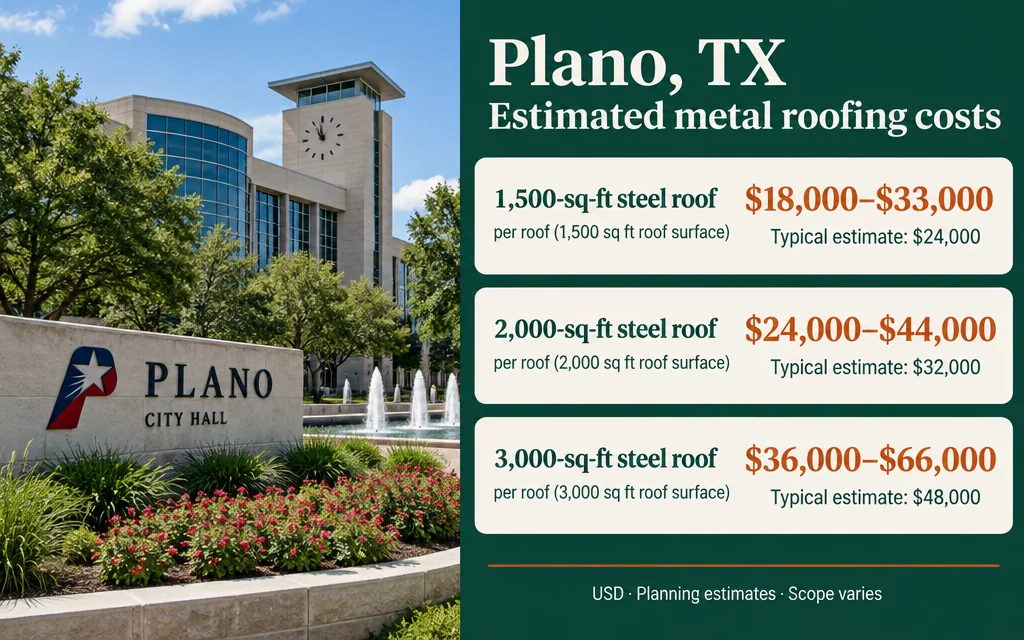
Calculated installed planning scenario for measured roof surface, including one-layer removal/disposal; conditional extras excluded.
Calculated installed planning scenario for measured roof surface, including one-layer removal/disposal; conditional extras excluded.
Calculated installed planning scenario for measured roof surface, including one-layer removal/disposal; conditional extras excluded.
Metal Roofing Pricing in Plano, TX
Budgeting for a residential metal roof in Plano requires looking at installed system costs rather than raw panel pricing. A complete installation quote covers stripping existing asphalt shingles, inspecting and preparing the wooden substrate, rolling out high-temperature underlayment, fabricating custom flashings, and anchoring panels to allow natural expansion and contraction.
For residential standing seam steel, budget $12–$22 per sq ft of actual roof surface for an installed system. Homes with steep slopes, dormers, or complex hips and valleys sit toward the upper end of that spread. Utilitarian exposed-fastener steel panels budget $5.50–$10 per sq ft installed. Because Plano-area pricing sources represent planning benchmarks rather than guaranteed local bids, compare your itemized quotes against the specific panel profile and site conditions.
Residential Metal Roofing Systems Compared
Different metal systems carry distinct service profiles, aesthetic choices, and maintenance demands:
- Concealed-Fastener Standing Seam Steel: The standard for residential architectural metal. Panels interlock vertically with hidden clips and screws, keeping penetrations shielded from weather. Coils are typically coated with Galvalume and finished with a durable PVDF coating. This setup allows panels to slide across concealed clips as metal expands during 100-degree North Texas summer days.
- Exposed-Fastener Steel (Ribbed / R-Panel): Panels overlap and fasten directly through the metal face into the decking using gasketed screws. While it budgets lower at $5.50–$10 per sq ft, intense sun eventually degrades rubber washers, requiring scheduled leak checks and fastener replacements.
- Steel Metal Shingles and Stone-Coated Profiles: Stamped steel panels mimic slate, shake, or barrel tile while providing Class 4 impact resistance. They budget $8.50–$15 per sq ft installed and help satisfy neighborhoods with traditional design guidelines.
- Standing Seam Aluminum: Budgets $14–$24 per sq ft installed. Aluminum offers strong corrosion resistance, though it expands faster than steel under thermal swings and is softer against hail impact.
- Standing Seam Copper: Budgets $22–$38 per sq ft installed. Copper oxidizes into an earth-toned protective patina over time. It requires specialized hand-soldering and mechanical seaming, representing a premium long-term architectural investment.
| Service / assumptions | Low | Typical estimate | High | Pricing unit | Estimated labor time |
|---|---|---|---|---|---|
| Standing Seam Steel (Concealed Fastener)Calculated standing-seam steel planning rate: comparable panel/accessory materials + installation labor + one-layer removal/disposal. Ordinary underlayment and details over sound decking included; conditional extra work excluded. | $12 | $16 | $22 | per sq ft of roof surface (installed) | 3 to 5 business days |
| Exposed-Fastener Steel (Ribbed / R-Panel)Includes 26-gauge painted steel, exterior screw-through fasteners with neoprene washers, and standard flashings. | $5.50 | $7.50 | $10 | per sq ft of roof surface (installed) | 2 to 3 business days |
| Steel Metal Shingles / Stone-CoatedStamped steel shingles or stone-coated shake/tile profiles; includes one-layer tear-off and underlayment. | $8.50 | $11.50 | $15 | per sq ft of roof surface (installed) | 3 to 5 business days |
| Standing Seam Aluminum0.032 to 0.040 architectural aluminum panels with concealed clips and one-layer tear-off. | $14 | $18.50 | $24 | per sq ft of roof surface (installed) | 3 to 5 business days |
| Standing Seam Copper16-oz or 20-oz cold-rolled copper panels, hand-fabricated flashings, and soldered critical joints. | $22 | $29 | $38 | per sq ft of roof surface (installed) | 5 to 8 business days |
Cost Components of Standing Seam Steel
Every complete standing seam estimate is built from three distinct scope layers: materials, installation labor, and tear-off.
- Materials Allowance: Budget $4.50–$8.50 per sq ft of roof surface. This covers the steel panels or coil stock, concealed mounting clips, structural fasteners, starter trims, ridge vent closures, and high-temperature synthetic underlayment.
- Installation Labor: Budget $6.25–$11 per sq ft of roof surface. Labor covers panel forming, measuring, hand-bending eave and gable transitions, flashing valleys and wall junctions, and executing watertight seams.
- Tear-Off and Disposal: Stripping one layer of old shingles, hauling away waste, paying transfer station disposal fees, and running ground magnets budgets $1.25–$2.50 per sq ft of roof surface.
Combined, these three component ranges form the overall standing seam baseline of $12–$22 per sq ft installed.
| Service / assumptions | Low | Typical estimate | High | Pricing unit | Estimated labor time |
|---|---|---|---|---|---|
| Standing Seam Steel Materials AllowanceCovers panels, clips, fasteners, high-temperature synthetic underlayment, and standard trims. | $4.50 | $6 | $8.50 | per sq ft of roof surface (materials only) | N/A |
| Standing Seam Steel Installation LaborSkilled architectural metal roofing labor for field forming, seaming, and standard perimeter trim execution. | $6.25 | $8.25 | $11 | per sq ft of roof surface (installation labor only) | N/A |
| One-Layer Shingle Removal & DisposalTear-off of one asphalt shingle layer, debris haul-off, disposal fees, and magnetic ground sweep. | $1.25 | $1.75 | $2.50 | per sq ft of roof surface (one-layer removal and disposal) | 1 business day |
Installed Cost by Roof Surface Area
Your roof's surface area is always larger than your home's interior living footprint. Roof pitch, overhangs, attached garages, and covered porches add measurable area.
For instance, a 2,000-square-foot single-story house often has 2,400 to 2,600 square feet of actual sloped roof area.
Planning totals scale directly from measured roof surface area using the standing seam baseline rate:
- 1,500 sq ft roof surface: Budget $18,000–$33,000 installed, with on-site work typically running 2 to 4 business days.
- 2,000 sq ft roof surface: Budget $24,000–$44,000 installed, typically requiring 3 to 5 business days on site.
- 3,000 sq ft roof surface: Budget $36,000–$66,000 installed, averaging 4 to 7 business days on site.
These scenarios include basic tear-off, underlayment, and standard trims over sound decking, but exclude structural repairs or custom accessory upgrades.
| Service / assumptions | Low | Typical estimate | High | Pricing unit | Estimated labor time |
|---|---|---|---|---|---|
| Standing Seam Steel Roof (1,500 sq ft)Calculated scenario: 1,500 sq ft of measured roof surface × standing-seam steel installed planning rate. Includes its same materials, installation, one-layer removal/disposal and sound-deck assumptions. Not a provider whole-roof quote. | $18,000 | $24,000 | $33,000 | per roof (1,500 sq ft roof surface) | 2 to 4 business days |
| Standing Seam Steel Roof (2,000 sq ft)Calculated scenario: 2,000 sq ft of measured roof surface × standing-seam steel installed planning rate. Includes its same materials, installation, one-layer removal/disposal and sound-deck assumptions. Not a provider whole-roof quote. | $24,000 | $32,000 | $44,000 | per roof (2,000 sq ft roof surface) | 3 to 5 business days |
| Standing Seam Steel Roof (3,000 sq ft)Calculated scenario: 3,000 sq ft of measured roof surface × standing-seam steel installed planning rate. Includes its same materials, installation, one-layer removal/disposal and sound-deck assumptions. Not a provider whole-roof quote. | $36,000 | $48,000 | $66,000 | per roof (3,000 sq ft roof surface) | 4 to 7 business days |
Metal Versus Architectural Asphalt Shingles
Upfront cost is the most apparent distinction when comparing metal to standard roofing. A complete architectural asphalt shingle replacement in the Plano area budgets $3.75–$6.25 per sq ft installed.
By comparison, standing seam steel budgets roughly three to four times higher initially at $12–$22 per sq ft.
The trade-off centers on service life and durability. North Texas heat and regular storm cycles take a heavy toll on asphalt shingles, which typically need replacement every 15 to 22 years. Quality standing seam systems commonly last several decades with minimal panel degradation.
If you plan to stay in your home long enough to outlast multiple asphalt shingle cycles, the investment can make practical sense. However, if you anticipate moving within a few years, a standing seam replacement rarely returns its full upfront premium in market resale value alone.
| Service / assumptions | Low | Typical estimate | High | Pricing unit | Estimated labor time |
|---|---|---|---|---|---|
| Architectural Asphalt Shingles ReferenceComplete architectural asphalt replacement with one-layer tear-off, underlayment, and ridge cap. | $3.75 | $4.75 | $6.25 | per sq ft of roof surface (installed) | 1 to 2 business days |
| Comparison | Architectural asphalt | Standing-seam steel |
|---|---|---|
| Up-front planning estimate · 2,000 sq ft roof surface | $7,500–$12,500 | $24,000–$44,000 |
| What the baseline includes | Architectural asphalt, ordinary installed details, one-layer removal/disposal over sound decking. | Standing-seam steel, ordinary installed details, one-layer removal/disposal over sound decking. |
| Maintenance and repairs | Confirm product-specific inspections and repair terms. | Confirm seams, fasteners, coating, compatible repairs and inspection terms. |
| Insurance and ownership cost | Ask the insurer about the exact product and coverage. | Ask the insurer about accepted test documentation, any available credit and cosmetic-damage exclusions. |
These are calculated budgeting comparisons, not provider quotes or guaranteed lifetime savings. Compare your expected ownership period, specified products, actual maintenance proposals and written insurance terms.
| Decision point | Roof repair | Roof replacement | Metal roofing |
|---|---|---|---|
| Work being priced | A defined defect, such as damaged shingles or flashing. | Removal and installation of an agreed roof system across the measured roof surface. | A specified installed metal system; standing seam, exposed fasteners and metal shingles are different scopes. |
| What to inspect | The leak source, surrounding material and whether a durable localized fix is feasible. | The extent of deterioration, decking condition, roof details and suitable replacement systems. | The substrate, panel profile, coating, fasteners, roof geometry and installation details. |
| How to compare prices | Match the repair quantity, access, materials and included diagnosis. | Match measured roof area, material, tear-off layers, disposal and installed inclusions. | Match measured roof area, system, components, removal and conditional additional work. |
| Before deciding | Ask what the repair addresses and what existing problems would remain. | Ask whether repair remains practical and which additional items would change the total. | Ask about compatible materials, documented product/assembly ratings and product versus workmanship warranties. |
Age or a repair-cost percentage alone does not determine the right choice. Ask a qualified roofing contractor to assess the condition and explain viable options. A metal system is a material-specific installation choice, not a separate guarantee of durability or savings.
Conditional Roofing Work and Upgrades
Standard roof quotes assume sound underlying wood and basic architectural details. Real-world tear-offs frequently uncover conditional needs:
- Decking Repairs: Once old shingles come off, rotted plywood or OSB must be replaced. In Plano, replacing damaged decking budgets $70–$105 per 4-by-8-ft sheet, including materials and labor.
- Multiple Shingle Layers: If your home has a second existing roof layer that must be stripped, budget an additional $45–$95 per roofing square (100 sq ft) for the added labor and disposal fees.
- Flashing Details: Specialized penetrations require custom-formed metal backer pans and step counterflashing. Budget $350–$850 per chimney and $250–$650 per skylight.
- Ventilation & Accessories: Upgrading the crest with a continuous standing seam ridge vent budgets $12–$28 per linear ft. Detaching and resetting sound gutters to install drip edge cleanly budgets $4–$10 per linear ft. Where snow or ice sliding over entries is a concern, clamp-on snow guards budget $22–$52 per linear ft.
| Service / assumptions | Low | Typical estimate | High | Pricing unit | Estimated labor time |
|---|---|---|---|---|---|
| Additional Shingle Layer Tear-OffAdditional charge when a second pre-existing shingle layer must be stripped and disposed of. | $45 | $65 | $95 | additional per roofing square (100 sq ft) | N/A |
| Plywood / OSB Decking ReplacementReplaces rotted or damaged roof decking sheets with roof already exposed, including materials and labor.Published price reference ↗ | $70 | $85 | $105 | additional per 4-by-8-ft sheet (32 sq ft) | N/A |
| Chimney Metal Flashing & Cricket DetailCustom-fabricated metal cricket, step-flashing, and counterflashing integrated into standing seam panels. | $350 | $550 | $850 | additional per chimney | N/A |
| Skylight Flashing IntegrationSpecialized curb flashing and head pan integration for existing skylights on standing seam metal. | $250 | $400 | $650 | additional per skylight | N/A |
| Standing Seam Ridge Vent UpgradePerforated vented Z-closures, baffle material, and ridge cap integration along the main roof crest. | $12 | $18 | $28 | additional per linear ft | N/A |
| Snow Retention Bar / Guard SystemClamp-on snow guards or continuous rail system engineered for standing seam ribs without piercing panels. | $22 | $34 | $52 | additional per linear ft | N/A |
| Detach & Reset Existing GuttersCarefully detaching and re-hanging sound seamless gutters to properly install drip edge and eave trim. | $4 | $6.50 | $10 | additional per linear ft | N/A |
Hail, Wind, and Energy Performance in North Texas
North Texas storms bring severe winds and hail, making system ratings an essential part of evaluating quotes.
- Hail and Impact Ratings: High-grade standing seam steel often carries a UL 2218 Class 4 rating, which is determined by dropping a 2-inch steel ball from 20 feet without cracking the metal or underlayment. However, a Class 4 rating does not prevent cosmetic hail dimpling. Some insurance policies contain cosmetic damage endorsements that exclude payouts unless hail punctures the steel or breaks water integrity. Review your policy language carefully.
- Wind Uplift: Concealed clip systems engineered to manufacturer specifications deliver strong wind resistance, often exceeding 110 to 120 mph when anchored into sound decking.
- Solar Reflectance: Metal panels finished with reflective PVDF coatings reflect solar heat rather than absorbing it like dark asphalt. This can lower attic heat transfer during peak summer afternoons, helping reduce cooling stress on air conditioning systems.
Key Factors That Influence Your Quote
Quotes for similar home sizes can vary based on several technical factors:
- Steel Gauge: Standard residential standing seam uses 24-gauge or 26-gauge steel. Thicker 24-gauge coil provides superior rigidity and minimizes visible surface waviness (oil-canning) under direct sun. Thinner 26-gauge stock has a lower material cost but dents more readily.
- Finish Chemistry: PVDF coatings (such as Kynar 500) offer high UV resistance, maintaining color consistency and resisting chalking across decades. Silicone-Modified Polyester (SMP) finishes carry lower material costs but fade sooner under continuous Texas sun.
- Roof Complexity and Pitch: Low-to-moderate pitches with straightforward gables represent the baseline. Steep slopes, multi-level tie-ins, and multiple valleys slow crew production, require safety tie-offs, and increase fabrication labor.
- Seaming Style: Snap-lock profiles click together over concealed clips and go up faster. Mechanically double-locked seams require running a dedicated seamer tool across every panel rib, which increases labor time but provides maximum weather tightness on very low-pitch slopes.
Vetting Metal Roofing Contractors in Plano
Sheet metal roofing requires specialized tools and metalworking knowledge. When collecting proposals in Plano, ask targeted questions to verify scope and workmanship:
- In-House Crews vs. Subcontractors: Ask whether the crew specializes in standing seam sheet metal or primarily installs asphalt shingles.
- Gauge and Coil Specs: Confirm whether the contract specifies 24-gauge or 26-gauge steel, the specific manufacturer, and whether the finish is PVDF.
- Underlayment Specification: Ensure the contract includes high-temperature self-adhering synthetic underlayment, which is necessary to withstand heat buildup beneath metal panels.
- Permitting: Ask how the contractor handles City of Plano building permits, inspections, and local code compliance for your specific address.
- Workmanship Warranties: Distinguish between the manufacturer's coating warranty and the installer's written workmanship guarantee covering flashings, seams, and leak prevention.
Local income & housing costs
Plano city, Texas · U.S. Census Bureau, 2025 ACS 1-year estimates.
per month · ±$66
Cash-rent units; includes applicable tenant-paid utilities
Census source ↗Dollar amounts use the survey period’s published basis. Income is annual; gross rent is monthly. Home value reflects owner-occupied housing values. Margins of error shown are at the ACS 90% confidence level. These statistics provide city context; service budgets use their own pricing evidence.
STATEWIDE COST CONTEXT
Texas prices, income & labor costs
These Texas figures provide background for this city guide. They describe different measures and reference years; employee wages are not prices charged by a contractor.
BEA SAIRPD
State price change indicator
120.02024 · index (2017 basis)
Annual figures & sources
| Year | Value | 90% margin of error | Source |
|---|---|---|---|
| 2020 | 103.4 | — | Official source |
| 2021 | 107.2 | — | Official source |
| 2022 | 113.1 | — | Official source |
| 2023 | 117.1 | — | Official source |
| 2024 | 120.0 | — | Official source |
Census ACS 1-year
Median household income
$82,6252025 · USD/year
Annual figures & sources
| Year | Value | 90% margin of error | Source |
|---|---|---|---|
| 2021 | $66,963 | ±$513 | Official source |
| 2022 | $72,284 | ±$443 | Official source |
| 2023 | $75,780 | ±$472 | Official source |
| 2024 | $79,721 | ±$564 | Official source |
| 2025 | $82,625 | ±$670 | Official source |
BLS OEWS
Roofers
$22.132025 · USD/hour
Annual figures & sources
| Year | Value | 90% margin of error | Source |
|---|---|---|---|
| 2025 | $22.13 | — | Official source |
State prices: BEA, 2020–2024. Household income: Census ACS, 2021–2025. Employee wages: BLS, May 2025 snapshot. The charts retain their own units and fitted scales.
Explore all Texas living-cost data and trends →Local context and limitations
Plano sits in a hail-prone corridor of Collin County, which influences panel choice and underlayment specifications. For standing seam steel, residential contractors commonly specify 24-gauge panels over lighter 26-gauge stock to provide better rigidity and lessen cosmetic dimpling during convective storms. In addition, many master-planned subdivisions in Plano enforce architectural covenants regarding exterior reflectivity. Homeowners often need to submit finish samples for architectural review, with subdivisions routinely requiring low-gloss PVDF coatings or stone-coated steel profiles over bare metallic mill finishes.
Frequently asked questions
What is the primary difference between standing seam and exposed fastener panels?
Standing seam uses concealed clips and interlocking vertical ribs that hide all screws beneath the surface, allowing the steel to expand and contract freely in summer heat without stressing penetrations. Exposed-fastener panels are screwed through the outside surface with thousands of rubber-washer screws. Over time, UV exposure degrades those rubber washers, requiring periodic inspections and maintenance to prevent leaks.
Does a metal roof reduce homeowners insurance premiums in Texas?
Some Texas insurers offer discounts on the wind and hail portion of a homeowner's premium for installing a UL 2218 Class 4 impact-resistant roof. However, savings are not automatic or guaranteed. Always contact your insurance agent with the specific manufacturer product specification sheet, and check whether your policy includes a cosmetic damage exclusion for hail dimples.
Can a metal roof be installed directly over existing shingles in Plano?
While an overlay may seem like a way to save on tear-off costs, contractors generally recommend removing old shingles down to the deck. Stripping the roof allows an inspection of the decking for hidden rot, provides a smooth substrate that prevents oil-canning, and ensures high-temperature underlayment can be applied directly to the decking. Always verify local building permit and code requirements for your specific address.
Will my Plano neighborhood HOA approve a metal roof?
Texas law limits an HOA's ability to ban energy-efficient or impact-resistant materials outright, but associations have broad authority to regulate aesthetic details. In Plano, HOAs commonly restrict raw metallic sheens or exposed-fastener agricultural panels, usually requiring matte, low-reflectivity PVDF coatings or stone-coated steel profiles that blend with neighborhood architecture.
What are the practical advantages of 24-gauge steel over 26-gauge steel?
24-gauge steel is noticeably thicker than 26-gauge. This added thickness improves dent resistance during hail storms, provides greater structural strength against wind uplift, and substantially reduces visual oil-canning (surface waviness) when the panels expand under hot North Texas sunshine.
How is the true square footage of a roof calculated?
Roof square footage is always larger than a home's interior floor plan. Estimators calculate true surface area by measuring exterior building dimensions, adding overhangs and covered porches, and applying a pitch multiplier based on the slope. A 2,000-square-foot single-story home with a standard slope typically measures between 2,400 and 2,600 square feet of actual roof surface.
Sources and methodology
Sources below retain their recorded retrieval dates and geographic scope. We checked the quoted rates against readable public pricing pages. The tables remain planning estimates, not provider quotes or a measured citywide survey. Per-square-foot references do not establish the modeled whole-roof totals or all their installed inclusions. Regional references are not verified Plano-specific quotes. Confirm removal, disposal, materials, labor and the complete scope in a written proposal.
Published pricing pages retrieved; quoted excerpts checked automatically. 2 distinct website domains. · Generated 2026-11-12
- Metal Roofing Dallas: Cost, Standing Seam vs Exposed FastenerCity-specific page context · Page retrieved 2026-11-12 · Price excerpt matched automatically
“replaces any rotted decking at $70 to $100 per sheet”
Planning ranges may differ from these published examples; they are not provider quotes.
- Metal Roofing in Plano, TX | Plano Affordable RoofingCity-specific page context · Page retrieved 2026-11-12 · Price excerpt matched automatically
“Metal roofing costs in Plano typically range from $8.00 to $20.00 per square foot installed, depending on the metal type, gauge, finish, and roof complexity.”
Planning ranges may differ from these published examples; they are not provider quotes.
 Provider badge
Plan your metal roofing project
Choose your service and answer its project questions. Add notes or photos if helpful, then generate your project brief. The planner labels its budgeting assumptions separately. Use your plan to compare the scope and assumptions with a provider. Contact sharing and provider matching are not available yet.
Open the project planner →Share this city’s cost data
<> Embed Plano Cost Data on Your Site
The HTML table shows the prices at the time of copying. The iframe follows the published guide.